5
INSTITUTIONALIZING SUSTAINABILITY
As many participants pointed out, transitioning to sustainability will require changes in the institutions that manage and support our urban environments. This does not necessarily mean creating new institutions, but it does entail increased, more regular interaction among institutions. This, in turn, can help “institutionalize” sustainability, reducing the transaction costs of cooperating across sectors and making sustainability part of a given organization’s work stream instead of a special or ad hoc project. This chapter summarizes the discussions on this issue, which included coordination at a federal level, multistakeholder partnerships, and sustainability-oriented research programs.
BUILDING FROM THE FEDERAL GOVERNMENT’S EXAMPLE
Catherine Ross, director and Harry West Chair, Center for Quality Growth and Regional Development, Georgia Tech, pointed out that a great example of systems thinking is that several federal agencies are now attempting to coordinate their sustainability efforts, including the Department of Housing and Urban Development (HUD), the Environmental Protection Agency (EPA), and the Department of Transportation (DOT). This partnership signifies progress for the federal government because it requires agencies with overlapping missions to coordinate on complicated issues. Renee Glover, president and CEO, Atlanta Housing Authority, described this as connecting the dots and suggested that we have known for years that different agency missions (local, state, and federal) are interrelated, so it is encouraging to finally see connections being made. Catherine Ross also mentioned that the White House’s Office of Urban Affairs could help direct federal policy supporting metropolitan areas, staging policies for the long term so that
regional actors could determine the particular pathway and correct course as needed.
John Frece, director, Office of Sustainable Communities, EPA, described how the agency has recently partnered with the DOT and HUD to jointly address issues they now recognize as being connected. The interagency “Partnership for Sustainable Communities” has organized itself around a core set of livability principles:
-
“Provide more transportation choices. Develop safe, reliable, and economical transportation choices to decrease household transportation costs, reduce our nation’s dependence on foreign oil, improve air quality, reduce greenhouse gas emissions, and promote public health.
-
Promote equitable, affordable housing. Expand location- and energy-efficient housing choices for people of all ages, incomes, races, and ethnicities to increase mobility and lower the combined cost of housing and transportation.
-
Enhance economic competitiveness. Improve economic competitiveness through reliable and timely access to employment centers, educational opportunities, services and other basic needs by workers, as well as expanded business access to markets.
-
Support existing communities. Target federal funding toward existing communities—through strategies like transit oriented, mixed-use development, and land recycling—to increase community revitalization and the efficiency of public works investments and safeguard rural landscapes.
-
Coordinate and leverage federal policies and investment. Align federal policies and funding to remove barriers to collaboration, leverage funding, and increase the accountability and effectiveness of all levels of government to plan for future growth, including making smart energy choices such as locally generated renewable energy
-
Value communities and neighborhoods. Enhance the unique characteristics of all communities by investing in healthy, safe, and walkable neighborhoods—rural, urban, or suburban” (EPA, 2011a).
Mr. Frece added that EPA’s Office of Sustainable Communities is focusing on three major goals. The first is to change the conversation to embrace sustainability as a central principle, not an optional add-on. The
second is to change the rules to promote or incentivize more sustainable options. For example, existing policies incentivize new development over redevelopment; in fact, HUD has even had a prohibition on building on brownfields. The third goal is to help the willing by working with businesses, local governments, and communities that ask for input and advice on sustainability.
EPA already boasts 14 years of smart growth programs,4 and currently they are promoting Greening America’s Capitals,5 a pilot program with demonstration projects in five state capitals. Mr. Frece noted that EPA and other agencies have taken notice of the projected changes in demographics in U.S. cities. The share of the population that is 65 and older will double in the next 20 years. That shift necessitates different access to transportation and health care—the status quo will not suffice. Additionally, there is already a growing desire for walkable communities. Mr. Frece remarked that the demand far outstrips current supply, driving prices up and making walkable communities less accessible to lower-income groups.
Mr. Frece described some early successes from the interagency partnership work: DOT wants to change its New Starts program—discretionary funding to support locally planned, implemented, and operated transit projects—and is seeking congressional approval. HUD wants to change the way it spends $44 billion, that is, its entire budget, by making all of its investments oriented toward sustainability.6 These are challenging changes to enact, but Mr. Frece noted that the discussions have had more traction since the agencies began
collaborating. He also pointed out that the agencies have learned that they need to do a better job of communicating internally, across different offices. As an example, he cited his office’s coordination with the Water Office and said it is critical because that office controls $3 billion for water and wastewater infrastructure across the country and fixing this infrastructure is a top priority.
Mr. Frece noted that the EPA, DOT, and HUD are now jointly drafting Requests for Proposals, making public appearances together, coordinating budget advising, and pooling funds for projects.7 They are working extensively with regional representatives and seeking partnerships with other federal agencies, including the Federal Emergency Management Agency, the Department of Health and Human Services, the Department of Defense, the Department of Agriculture, and the Department of General Services.
These efforts have taught several valuable lessons. For partnerships to become a habit, agencies must collaborate from the very beginning of their new initiatives. It entails not only regular meetings between leaders but full staff-to-staff interaction.
Mr. Frece concluded with the call to institutionalize these partnerships so that they survive changes of administrations and the vicissitudes of the political climate. One way to do so would be to co-locate government buildings, making it much easier for different offices to coordinate weekly meetings and regular interactions. Also, he added that we need to quantify the successes of such collaboration—the more we can show the value of this work, the easier it will be to continue. A participant suggested that the partnership identify some early “wins” from the process, so that communities can identify what works and begin to embed this type of interagency approach.
TAKING STEPS IN THE ATLANTA REGION
Tom Weyandt, former director for Comprehensive Planning at the Atlanta Regional Commission (ARC), explained that the ARC has been supporting transit-oriented and sustainability-oriented developments
since at least 1999, primarily through the Livable Centers Initiative.8 This initiative was the response to an air quality crisis—the metropolitan region was in nonconformity status with regard to federal standards and was in danger of losing federal transportation funding. Mr. Weyandt described two recent redevelopment projects in Atlanta that were affiliated with the Livable Centers Initiative (see Box 3). According to Mr. Weyandt, projects coming before the ARC are now primarily pedestrian-friendly, suggesting that the market is changing and that this could be a positive indicator.
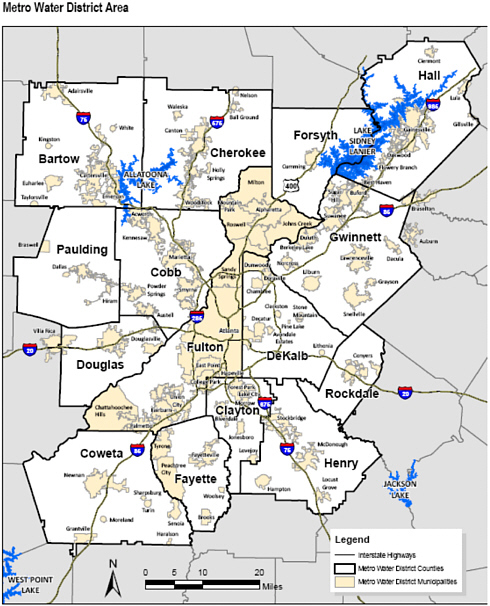
Carol Couch, Senior Public Service Associate, College of Environment and Design, University of Georgia, highlighted the institutional complexity inherent in comprehensive planning in metropolitan Atlanta. For example, the North Georgia Water Planning District comprises 15 counties, 91 cities, and 7 water authorities (see Figure 5–1). The number of jurisdictions involved in Georgia’s watersheds complicates comprehensive water planning. Institutionalizing sustainability (e.g., via partnerships among these communities) would be no small task.
John Wegner, Senior Lecturer and Chief Environmental Officer, Department of Environmental Studies, Emory University, discussed sustainability efforts on the Emory University campus, noting that the university has institutionalized important changes. For example, the Board approved applying LEED standards to all buildings, and a land-use plan for campus was developed that sets aside 50 percent of the campus for green space. Also, about one quarter of employees live within 3 miles of campus, easing much of the transportation challenges that many organizations face. The academic curriculum has also changed in response to these efforts. Emory University now offers a joint bachelor of science/master of public health program in environmental science and public health, and undergraduates can also opt for a sustainability minor as well.
|
BOX 5-1 A Tale of Two Brownfields: Atlantic Station and Edgewood Avenue Edgewood Retail, in close proximity to two MARTA stations, is the former site of Atlanta Gas Light office and maintenance facility. ARC’s initial review of the redevelopment proposal was that it was “not in the best interest” of the community. The developer added 44 percent more residential units, planned residential and office space above commercial and retail stores, and proposed a shuttle circulator to MARTA stations, thereby improving pedestrian connection. With these changes in place, ARC changed its ruling to “in the best interest” of the community. The project was carried out and completed, creating a major new retail center in an urban location. The project is pedestrian-friendly and contains multiple connections to the neighboring community. Its high occupancy rates are notable as well. However, the project has few public gathering areas and little park area. It is also still fairly difficult to traverse as a pedestrian and contains more parking spaces than necessary. Affordable housing is limited, and commercial occupancy is composed mostly of national retail chains. Atlantic Station, another recently redeveloped brownfield site, is located near the midtown Atlanta MARTA and is the site of an old steel mill. As with the Edgewood site, ARC’s initial review also deemed this project “not in the best interest” of the community because it lacked funding for a bridge necessary to connect it to the adjacent neighborhood. But the governor created a “green light” committee to resolve issues with the 17th Street bridge, and the city gave approval for its construction. Atlantic Station was designated a tax allocation district to raise revenue for development. Atlantic Station has succeeded in turning a low-value parcel of property into a vibrant, tax-revenue-generating property. It reused a significant amount of the mill’s concrete from old foundation and became an excellent example of environmental remediation. Its high-intensity mixed-use development complements Midtown and hosts numerous attractions such as Cirque de Soleil, Bodies, and Dialogue in the Dark. Atlantic Station has a shuttle connection to MARTA boasting high ridership—high enough that there is discussion of converting the route to light rail. However, office and retail occupancy is not as high as desired, and the connections to neighboring districts are limited. Pedestrian access from Midtown is difficult, though internally it is quite walkable. Source: Weyandt (2010). |
Catherine Ross discussed some integrated analyses that Georgia Tech’s Center for Quality Growth and Regional Development recently led. She cited the Atlanta BeltLine health impact assessment, where the primary goal of the project was to measure the health impacts of the project on affected populations, especially disadvantaged and vulnerable groups, through both quantitative and qualitative analyses and metrics (Ross, 2010). She noted that this could be a useful template for further Health Impact Assessments work in the region. Troup County also requested a spatial strategy for sustainability (Ross, 2010), suggesting that even outlying counties were trying to think more strategically about sustainability.
Many participants pointed out that private developers play a substantial role in metropolitan Atlanta’s development. They are major investors, and major landholders, and thus potential drivers for sustainable development. However, potential developers may not naturally lead the way in innovative practices since they build according to local specifications, and sustainable practices are perceived as an added cost that cuts into projected profits. Local specifications are shaped in part by federal and state policies, and current policies frequently do not distinguish between greenfield development (new suburban or exurban developments) and redevelopment (brownfields and other infill developments). One participant suggested that one way to change business as usual would be to waive impact fees for sites that were previously developed. This would encourage in-fill within cities rather than furthering sprawl. Another participant suggested that HUD funding to AcoRA (the agency responsible for managing Atlanta as a HUD-designated Renewal Community) might be reconfigured to focus on sustainability concerns. The current program provides tax incentives in an effort to promote employment opportunities, economic development, and affordable housing in distressed neighborhoods, and these all seem to be complementary goals to a sustainability agenda.