B
The Leading Edge in Aerospace Propulsion
The Committee on Materials Needs and R&D Strategy for Future Military Aerospace Propulsion Systems analyzed the three most recent decades of top 10 affiliations (companies, universities, and government-affiliated institutions) for work done in the area of propulsion as indicated by searches of the keywords “Propulsion,” “Hypersonic,” “Scramjet,” and “Supersonic” in publications listed in the Scopus database and in patents files in selected countries’ patent offices. From this analysis, it is clear that the amount of public information in these fields of aerospace, propulsion-related work is increasing and that the dramatic lead once enjoyed by the United States no longer exists. Instead there is a more uniform distribution of efforts worldwide. What cannot be determined from this analysis is how much information is kept as trade secrets or what portion is driven by the need to “publish or perish” at universities. However, this analysis was performed on the body of commonly available knowledge. As such, in most cases it reflects the overall effort even though there might be a large unpublished body of knowledge as well. Clearly, it is also worth noting that the field of published information is no longer dominated by company-affiliated work; instead, universities and government-affiliated institutions are in the top 10 spots.
B.1
COMPARISON OF WORLDWIDE PUBLISHED AEROSPACE PROPULSION KNOWLEDGE
B.1.1
International Hypersonics and Scramjet Papers
With the help of the National Air and Space Intelligence Center (NASIC), a compilation was made of some of the international hypersonics and scramjet papers published by the American Institute of Aeronautics and Astronautics (AIAA) from 1995 to 2009.1 The list in Table B.1 shows in alphabetical order some of the countries active in the aerospace propulsion area and the number of their publications related to both hypersonics and scramjet work that were analyzed by the committee. As can be seen, the most prolific countries (the United States not included) were China, France, and Russia. However, there might be certain topic areas or countries that have a tradition of publishing with AIAA, whereas others might not.
The following lists of the titles of hypersonics- and scramjet-related papers published from 1995 through 2009 are arranged alphabetically by country. In addition to the titles of papers from AIAA—indicated by “[AIAA]” at the end of the title—the lists show titles from the Institute of Electrical and Electronics Engineers (indicated by “[IEEE]”)2 and from the Institute for Scientific Information’s Web of Knowledge listed publications (indicated by “[ISI]”).3
Australia
-
“Comparison of Computation and Measurements in a Supersonic Cavity Combustor” [AIAA]
China
-
“Aerothermodynamics of the Waveriders Applying Artificially Blunted Leading Edge Concept” [AIAA]
-
“Airframe/Scramjet Integrated Design of Hypersonic Cruise Vehicle” [AIAA]
-
“Application of Taguchi Design Methods and Uniform Design Methods to Scramjet Propulsion System Optimization for Hypersonic Cruise Vehicle” [AIAA]
-
“Modeling for Coupled Dynamics of Integrated Hypersonic Airbreathing Vehicle and Engine” [AIAA]
|
1 |
American Institute of Aeronautics and Astronautics, Publications & Papers, http://www.aiaa.org/content.cfm?pageid=2. Accessed November 3, 2010. |
|
2 |
IEEE Xplore Digital Library, http://ieeexplore.ieee.org/Xplore/guesthome.jsp. Accessed November 3, 2010. |
|
3 |
ISI Web of Knowledge, http://isiwebofknowledge.com/. Accessed November 3, 2010. |
TABLE B.1 Analyzed Papers (non-U.S.) Published by AIAA, 1995-2009
|
Country |
Number |
|
Australia |
1 |
|
China |
12 |
|
France |
10 |
|
Germany |
5 |
|
India |
5 |
|
Italy |
4 |
|
Japan |
8 |
|
Russia |
10 |
|
Sweden |
2 |
-
“Oscillatory Flows of Rectangular Hypersonic Inlet Unstart Caused by Downstream Mass-Flow Choking” [AIAA]
-
“Overall Performance Design of Ramjet for Combined Engine” [AIAA]
-
“Parallel Numerical Investigation of Fuel Atomization and Combustion in a Scramjet” [AIAA]
-
“Parameter Research of an MHD Controlled Inlet” [AIAA]
-
“Research on Optimal Regulating Rule for Scramjet Control” [AIAA]
-
“Research on Three-Dimensional Scramjet Inlet” [AIAA]
-
“Study on Solid Rocket Based Wave-Rider Concept with Skipping Trajectory” [AIAA]
-
“Thrust and Drag of a Scramjet Model with Different Combustor Geometries” [AIAA]
-
“Catastrophe, Hysteresis and Bifurcation of Mode Transition in Scramjet Engines and Its Model” [ISI]
-
“CFD Assessment of Classifications for Hypersonic Inlet Start/Unstart Phenomena” [ISI]
-
“Development of Supersonic Scramjet Inlet” [ISI]
-
“Hypersonic Combined Cycle Engine Concept with Tandem Layout” [ISI]
-
“Integrated Aero-Propulsive CFD Analysis for 2D Air-Breathing Hypersonic Vehicle” [ISI]
-
“Numerical Study on Self-Sustained Oscillation Characteristics of Cavity Flameholders in a Supersonic Flow” [ISI]
-
“Preliminary Study on Hypersonic Airbreathing Engine Performance” [ISI]
-
“Pyrolysis of Hydrocarbon Fuel ZH-100 Under Different Pressures” [ISI]
-
“Trajectory Planning for Hypersonic Vehicle Using Improved Sparse A* Algorithm” [IEEE]
Following, in addition to the papers listed above from AIAA, ISI, and IEEE, are titles of Chinese hypersonic- and scramjet-related papers:4
-
“Application of Resistance Heater in Supersonic Combustion Facility”
-
“Cold Flow Research in Scramjet Combustor”
-
“Combustion Mode Transition in a Scramjet Engine”
-
“Conceptual Study on Integrated Design of Magnetohydrodynamic Bypass Scramjet for a Waverider-Based Hypersonic Vehicle”
-
“The Coupling Model and Control Between Scramjet and Airframe for Hypersonic Vehicle”
-
“Design and Analysis of Thermal Structure of Inlet of Scramjet”
-
“Development of Supersonic Scramjet Inlet”
-
“Effects of Scramjet Combustor Configuration on Combustor Performance”
-
“Experiment on Control of Liquid Hydrocarbon Fueled Scramjet Combustor”
-
“Influences of Geometric Parameters upon Nozzle Performances in Scramjets”
-
“Investigation on Flow Pattern of Sidewall Compression Scramjet Inlet with Single Central Strut”
-
“Multi-Objective Optimization Design of Airframe for Hypersonic Cruise Vehicle”
-
“Numerical Investigation of Hydrogen Combustion-Heater for Scramjet Ground Test”
-
“Numerical Simulation of Flaming Gas Generator with Catalytic Reforming Process”
-
“Numerical Simulation of the Flow Field for Resistance Pressure in Scramjet Isolator”
-
“Numerical Simulation on the Turbulent Flow Field of Supersonic Combustion”
-
“One-Dimensional Evaluation of the Scramjet Flow Path Performance”
-
“One New Type Closed Cooling Cycle of Scramjet”
-
“Performance Analysis of MHD-Arc-Scramjet Combined Cycle Engine”
-
“Performance Comparison Between 2-D Scramjet Inlet and 3-D Sidewall Compression Scramjet Inlet”
-
“Study on Flow Characteristics of Scramjet Isolator”
-
“3-D Numerical Investigation on Supersonic Combustion of Hydrogen in Two Different Types of Scramjet Combustors”
|
4 |
East View Information Services, Online Databases, http://online.eastview.com/login_china/index.jsp. Accessed November 4, 2010. |
France
-
“Air-Breathing Launch Vehicle Activities in France—The Last and the Next 20 Years” [AIAA]
-
“Composite Technologies Development Status for Scramjet” [AIAA]
-
“A Contribution to the Development of Actual Continuous Detonation Wave Engine” [AIAA]
-
“First Steps for the Development and Testing of a Pulse Detonation Engine for UAV Application” [AIAA]
-
“Improved Prediction of Heat Transfer in a Rocket Combustor for GOX/Kerosene” [AIAA]
-
“Modal Linear Stability of the Near-Wall Flow on a Hypersonic Forebody” [AIAA]
-
“Numerical Simulations and Experimental Results of Endothermic Fuel Reforming for Scramjet Cooling Application” [AIAA]
-
“Scramjet Combustor Design in French PREPHA Program—Final Status in 1998” [AIAA]
-
“Scramjet Combustor Design in France” [AIAA]
-
“Systematic Numerical Study of the Supersonic Combustion in an Experimental Combustion Chamber” [AIAA]
-
“Characterization of Coking Activity During Supercritical Hydrocarbon Pyrolysis” [ISI]
-
“SFPG2007—Pyrolysis of Supercritical Endothermic Fuel: Evaluation for Active Cooling Instrumentation” [ISI]
Germany
-
“Experimental Verification of Heat-Flux Mitigation by Electromagnetic Fields in Partially-Ionized-Argon Flows” [AIAA]
-
“Influence of Heat Capacity Ratio on Pressure and Nozzle Flow of a Scramjet” [AIAA]
-
“Investigation of the Performance of a Scramjet Inlet at Mach 6 with Boundary Layer Bleed” [AIAA]
-
“Measurement of Flow Properties and Thrust on Scramjet Nozzle Using Pressure-Sensitive Paint” [AIAA]
-
“Multidisciplinary Analysis and Evaluation of Supersonic Combustion Ramjets” [AIAA]
-
“Constraining Heat Input by Trajectory Optimization for Minimum-Fuel Hypersonic Cruise” [ISI]
-
“Measurement of Rotational Temperatures Near Surfaces in Hypersonic Flow” [IEEE]
India
-
“Experimental Investigations on the Effect of a Thermal Bump in the Hypersonic Flow Around a Flat Plate” [AIAA]
-
“Investigation of Missile-Shaped Body with Forward-Facing Cavity at Mach 8” [AIAA]
-
“Shock Tunnel Studies on Drag Reduction of a Blunt Body Using Argon Plasmajet” [AIAA]
-
“Studies on Unsteady Shock Interactions near a Generic Scramjet Inlet” [AIAA]
-
“Trajectory Optimization and Guidance of an Air Breathing Hypersonic Vehicle” [AIAA]
-
“Numerical Flow Visualization of a Single Expansion Ramp Nozzle with Hypersonic External Flow” [ISI]
Italy
-
“Is the MHD Scramjet Really an Advantage?” [AIAA]
-
“Optimization of Hybrid Sounding Rockets for Hypersonic Testing” [AIAA]
-
“Sizing of TBCC Hypersonic Airbreathing Vehicles” [AIAA]
-
“Supersonic Combustion Models Application in Advanced Propulsion Concepts” [AIAA]
-
“Exergy Analysis of Hypersonic Propulsion Systems: Performance Comparison of Two Different Scramjet Configurations at Cruise Conditions” [ISI]
-
“Hypersonic MHD Interaction on a Conical Test Body with a Hall Electrical Connection” [IEEE]
-
“Magnetohydrodynamic Interaction in the Shock Layer of a Wedge in a Hypersonic Flow” [IEEE]
-
“Numerical Modeling of MHD Interaction in the Boundary Layer of Hypersonic Flows” [IEEE]
Japan
-
“Computational Analysis of HVEPS Scramjet MHD Power Generation” [AIAA]
-
“Experimental Analysis of TSTO Aerodynamic Interactions Based on Oil Flow Patterns at Hypersonic Speed” [AIAA]
-
“Mach 8 Ground Tests of the Hypermixer Scramjet for HyShot-IV Flight Experiment” [AIAA]
-
“Measurement of Hypersonic Boundary Layer Transition on Cone Models in the Free-Piston Shock Tunnel HIEST” [AIAA]
-
“Numerical Simulations in Scramjet Combustion with Boundary-Layer Bleeding” [AIAA]
-
“Performances of a Rocket Chamber for the Combined-Cycle Engine at Various Conditions” [AIAA]
-
“Payload to Low Earth Orbit’ [AIAA]
-
“Problems of Numerical Diffusion Found in Scramjets” [AIAA]
-
“An Analytical Study of Scramjet Combustion at Mach 6 Flight Conditions” [ISI]
-
“Development Study of the Mach 6 Turbojet Engine” [ISI]
-
“Frost Formation Problem in the Development of a Hypersonic Turbojet Engine” [ISI]
-
“Temperature Measurement of Noble and Combustion Gas Plasmas with Optical Measurement System for MHD Generators” [IEEE]
-
“Variable Nozzles for Aerodynamic Testing of Scramjet Engines” [IEEE]
Russia
-
“Atmospheric Cruise Flight Challenges for Hypersonic Vehicles Under the Ajax Concept” [AIAA]
-
“Hypersonic Technologies of Atmospheric Cruise Flight Under AJAX Concept” [AIAA]
-
“Magnetohydrodynamic Control on Hypersonic Aircraft Under ‘Ajax’ Concept” [AIAA]
-
“MHD Control by External and Internal Flows in Scramjet Under AJAX Concept” [AIAA]
-
“Parametric and Numerical Investigations of Scramjet with MHD Bypass” [AIAA]
-
“The Prospects of Hypersonic Engines In-Flight Testing Technology Development” [AIAA]
-
“The Program for the Complex Investigation of the Hypersonic Flight Laboratory (HFL) ‘IGLA’ in the PGU of TSNIIMASH” [AIAA]
-
“Scheme and Inlet Performance of Supersonic Business M = 1.6 Cruise Aircraft” [AIAA]
-
“Scramjet with MHD Controlled Inlet” [AIAA]
-
“Scramjet with MHD Bypass Under ‘AJAX’ Concept” [AIAA]
-
“Experimental Study of Fuel/Air Mixing Using the Cavity in the Supersonic Flow” [AIAA]
-
“Atmospheric Cruise Flight Challenges for Hypersonic Vehicles Under the Ajax Concept” [ISI]
-
“Investigation of Self-Sustaining Waves in Metastable Systems: Deflagration-to-Detonation Transition” [ISI]
-
“Shock-Wave Flow Regimes at Entry into the Diffuser of a Hypersonic Ramjet Engine: Influence of Physical Properties of the Gas Medium” [ISI]
-
“Background and Prediction of Correct Full-Scale Reproduction in Wind Tunnels as Concerns Gas Dynamic Parameters of Hypervelocity Atmospheric Flights and Scramjet Combustion Chamber Conditions” [IEEE]
-
“Mathematical Modeling of Supersonic Turbulent Separated Flows in the Vicinity of Forward- and Backward-Facing Steps” [IEEE]
-
“Overview of EML Research in Russia” [IEEE]
-
“Velocity Field Measurements in a Swirled Gas Flow by Thermal Imaging Technique” [IEEE]
Sweden
-
“Concept Study for a Mach 6 Transport Aircraft” [AIAA]
-
“System Analysis of High Speed, Long Range Weapon Systems” [AIAA]
Individual Countries’ Research Efforts
Some countries have too few publications in this field to allow pinpointing where the research efforts lie; for some it is possible to give a broader overview. The work listed above for China is mostly related to a hypersonic cruise vehicle, combustors, inlets, and simulation of processes. For France a number of publications are related to detonation engines and scramjet combustors, whereas Germany and Italy seem to work on flow analysis. Japan has a set of publications indicating work on many aspects of high Mach flight. Finally, many of Russia’s publications are related to the Ajax concept.
B.1.2
Foreign Patents in the Hypersonics Area
NASIC has compiled a list of foreign patents in the hypersonics area. The list below, by the country in which the patents are filed, shows the titles of some of these patents.5 As can be seen, China is patenting inlet designs, whereas France is patenting ramjet engine designs. However, most of the foreign patents are filed in Russia, and they deal with most fields needed for understanding hypersonics and the scramjet.
China
-
Ablation-Free Self-Adaptive Heat-Resistant and Damping System for High Supersonic Aerocraft
-
Fixed Geometrical Supersonic-Speed and High Supersonic-Speed Adjusting Air Inlet
-
Hypersonic Intake Duct Starting/Non-Starting Mode Integrated Classification and Determination Method
-
Hypersonic Liquid Jet Generator
-
Internal Waverider-Derived Hypersonic Inlet with Ordered Inlet and Outlet Shape and Design Method
-
Reverse Pulse Explosion Heat-Resistant and Damping Method for High Supersonic Aerocraft
France
-
Aircraft Ram Jet Engine for Supersonic and/or Hypersonic Flight
-
Fuel Injection Device for Ramjets for Aircraft
-
Ramjet Engine for Aircraft with Supersonic and/or Hypersonic Flying Speed
-
Ramjet Engine for Supersonic or Hypersonic Aircraft
-
Thermal Protection Structure, Especially for Components Subjected to Very High Temperatures, e.g., Hypersonic Aircraft Engines
-
Variable Geometry Ramjet for Aircraft
Germany
-
Low-Temperature High-Velocity Flame Spraying System
-
Combined Supersonic/Hypersonic Combustion Ramjet Has Air Injector System for Reflection of Supersonic Intake Air
|
5 |
Some of the information is available at European Patent Office, http://ep.espacenet.com/. |
Japan
-
Engine for Exhaust Nozzle for Hypersonic
-
Engine for Hypersonic Transport Aircraft
-
Stationary Detonation Combustor, and Stationary Detonation Wave Generating Method
Russia
-
Construction of Hypersonic Projectile with Self-Pressuring Compressive Detonation Jet Engine Having High Working Pressure and Using High Explosive Charge for Propulsion
-
Device for Stabilization of Supersonic Combustion
-
Engine Plant of Hypersonic Craft
-
Experimental Hypersonic Ramjet Engine
-
Hybrid Air-Jet Magnetogasdynamic Engine
-
Hypersonic Aircraft
-
Hypersonic Aircraft Flight Control Method
-
Hypersonic Chemical Reactor
-
Hypersonic Cryogenic Air-Jet Engine
-
Hypersonic Guided Missile
-
Hypersonic Pulse Detonating Engine and Method of Its Functioning
-
Hypersonic Ramjet Engine
-
Member Separable from Hypersonic Flying Vehicle Possessing Aerodynamic Efficiency
-
Method for Generating Electrical Energy Onboard Hypersonic Flying Vehicle and MHD Generator Used for the Purpose
-
Method for Increasing the Hypersonic Speeds of Flow of Light Gases
-
Method of Control of Aerodynamic Streamlining of Flying Vehicle and Plasma Generator
-
Method of Control of Supersonic Air Flow over Aircraft
-
Method of Determining Tractive Force of Hypersonic Direct Flow Aerojet Engine from Results of Flying Experiments in Hypersonic Flying Laboratories
-
Method of Hypersonic Flow Preparation for Aerodynamic Research and Device for Its Implementation
-
Method of Measuring Flight Thrust of Hypersonic Ramjet Engine of Unmanned Hypersonic Flying Laboratory
-
Method of Organization of Detonation Combustion Chamber of Supersonic Ramjet Engine
-
Method of the Heat-Mass-Power Exchange and a Device for Its Realization
-
Methods of Determination of Attack Angles and Slide at Flight Trials of Supersonic Flying Machine
-
Methods of Setting-Up Combustion in Hypersonic Ramjet Engine and Hypersonic Ramjet Engine for Realization of These Methods
-
Propulsion System for Hypersonic Aircraft and Spacecraft
B.2
FURTHER COMPARISON OF WORLDWIDE PUBLISHED AEROSPACE PROPULSION KNOWLEDGE
Building on the NASIC-collected data, a follow-up was done by the committee using the Scopus database in order to look at a broader area than that represented by the previously discussed publications alone, and also to put the foreign publications in context with published work done in the United States at the same time.
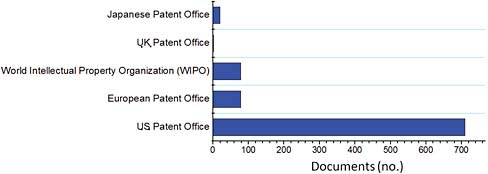
Below is information related to certain keywords used for the search—“Propulsion,” “Hypersonic,” “Scramjet,” and “Supersonic”—and how those are reflected in terms of the number of publications as a function of publication year as well as affiliation, with a special emphasis on the top 10 publication affiliations and each affiliation’s country of origin for the three past decades: 1980-1989, 1990-1999, and 2000-2009. The information is also looked at with respect to the total publication production as a function of the top 10 publication venues (journals, conference proceedings, and so on) over the entire period. Data also include total patents from some of the key patent offices (the U.S. Patent Office, the European Patent Office, the World Intellectual Property Organization of the United Nations, and the patent offices of the United Kingdom and Japan). It is hoped that this analysis captures one view of where the leading edge of future aerospace propulsion knowledge is and where it is heading. Although this method of looking at published information is not optimal for determining the full level of aerospace propulsion activities, it is one of the few approaches that provide one form of hard numbers to compare. Even though it is possible to argue about the quality of the work from different institutions, these data do indicate where activity is going on, and usually that is an indication of where a rapid increase in knowledge and ability is taking place.
B.2.1
Publications and Patents Related to Keyword “Propulsion”
As can be seen in Figure B.1, there was a clear increase in the publication rate of propulsion-related documents in the early 2000s, from around 100 per year to almost 1,000 per year. As seen below, this type of increase is replicated in several of the subfields described in this appendix (hypersonics, scramjet, and supersonics), albeit with some differences. Some “temporary” increases in publication numbers can also be observed during the mid-1980s and early 1990s, preceding the “explosion” of recent years.
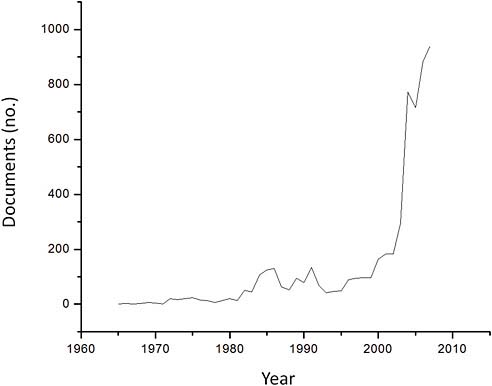
FIGURE B.1 Number of documents published, by year, 1965-2009, related to the keyword “Propulsion” in the Scopus database. The search is refined by the word “Aerospace.”
The total publication output since 1965 (Figure B.2) is led by two Chinese universities, closely followed by the California Institute of Technology’s Jet Propulsion Laboratory (JPL), which after a drop in overall numbers is followed by NASA. Figure B.2 is likewise educational for showing which are the less prolific institutions. However, with respect to the top affiliations, it is perhaps more instructive to look at the breakdown in publication affiliations as a function of the past three decades, as seen below.
The period from 1980 to 1989 was clearly dominated by authors with affiliations in the United States. The top 10 list (Figure B.3) is led by NASA and has only one foreign affiliation, in eighth place (Japan Aerospace Exploration Agency [JAXA]). The period from 1990 to 1999 (Figure B.4) continued to be dominated by authors with U.S. affiliations. The top 10 list was still led by NASA but had two foreign affiliations, in seventh (Japan, JAXA) and ninth places (Germany, Deutsches Zentrum fur Luft- und Raumfahrt).
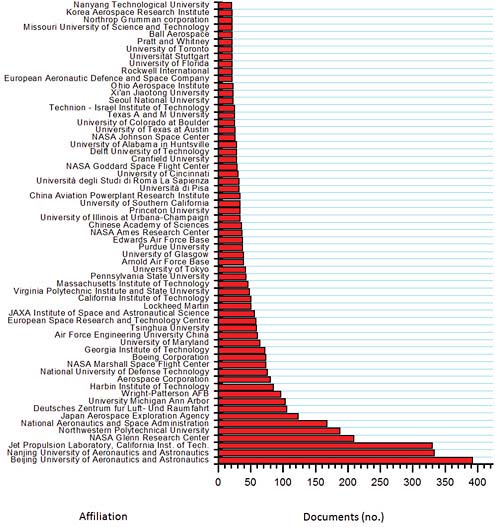
FIGURE B.2 Most common publication affiliations for documents related to the keyword “Propulsion” in the Scopus database for the years 1965-2009. The search is refined by the word “Aerospace.” Affiliations are listed exactly as they appear in the Scopus database search results.
The most recent period, from 2000 to 2009, is very different (Figure B.5). It is dominated by authors from two Chinese universities, in Beijing and Nanjing. The top 10 list shows the United States in third place; the affiliation is no longer NASA but JPL. Japan and Germany are still on the list, with China also in fifth and tenth place. Looking at overall publications, one can see in Figure B.6 that there is tremendous publication activity in the Hangkong Dongli Xuebao Journal of Aerospace
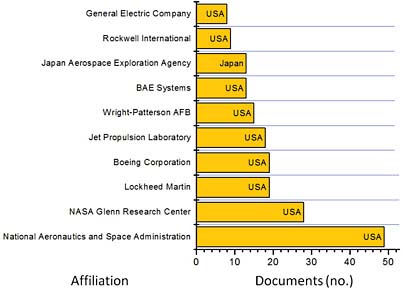
FIGURE B.3 Ten most common publication affiliations for documents related to the keyword “Propulsion” in the Scopus database for the decade 1980-1989. The search is refined by the word “Aerospace.” Affiliations are listed exactly as they appear in the Scopus database search results.
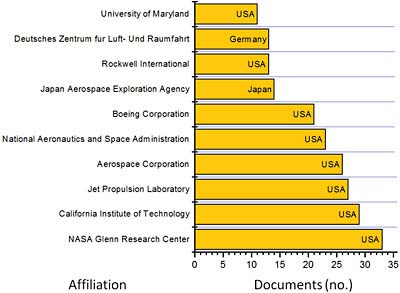
FIGURE B.4 Ten most common publication affiliations for documents related to the keyword “Propulsion” in the Scopus database for the decade 1990-1999. The search is refined by the word “Aerospace.” Affiliations are listed exactly as they appear in the Scopus database search results.
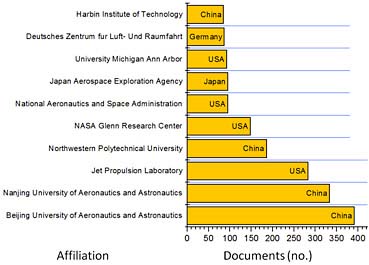
FIGURE B.5 Ten most common publication affiliations for documents related to the keyword “Propulsion” in the Scopus database for the decade 2000-2009. The search is refined by the word “Aerospace.” Affiliations are listed exactly as they appear in the Scopus database search results.
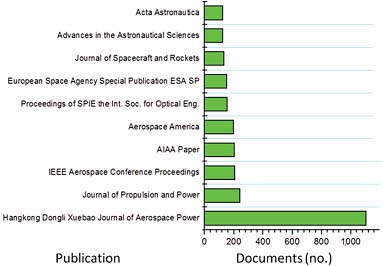
FIGURE B.6 Most common publications for documents related to the keyword “Propulsion” in the Scopus database for the years 1965-2009. The search is refined by the word “Aerospace.” Publications are listed exactly as they appear in the Scopus database search results.
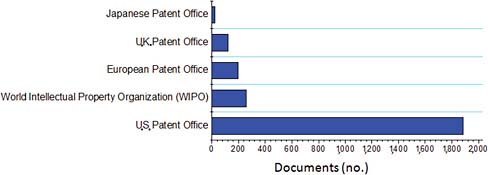
FIGURE B.7 Number of patents filed related to the keyword “Propulsion,” as a function of patent office, for the years 1965-2009, according to data from the Scopus database. The search is refined by the word “Aerospace.”
Power. Most of the other top 10 publication venues are from the United States, although the European Space Agency Special Publication (ESASP) is included.
As shown in Figure B.7, most propulsion-related patents are still filed in the United States. It is unclear if other countries keep their work as trade secrets or file in the United States in order to “secure” their influence in the U.S. arena.
B.2.2
Publications and Patents Related to Keyword “Hypersonic”
The field of hypersonics also saw a dramatic increase in the number of publication in the early 2000s, as indicated in Figure B.8.
Following, from the data for Figure B.8, is a list of the top 10 most prolific authors overall (according to Scopus), and in parentheses the number of their published documents, for the years 1970-2005, as indicated by a search for the keyword “Hypersonic”; the search is refined by the word “Aerospace.”
|
• Jagadeesh, G. (31) |
India (Indian Institute of Science) |
|
• Reddy, K.P.J. (29) |
India (Indian Institute of Science) |
|
• Boyd, I.D. (26) |
USA (University of Michigan) |
|
• Candler, G.V. (25) |
USA (Pennsylvania State University) |
|
• Lewis, M.J. (23) |
USA (University of Maryland) |
|
• Shang, J.S. (21) |
USA (Wright State University) |
|
• Schneider, S.P. (20) |
USA (Purdue University) |
|
• Gulhan, A. (20) |
Germany (German Aerospace Center) |
|
• Holden, M.S. (18) |
USA (Calspan-University of Buffalo, SUNY) |
|
• Zhong, X. (17) |
USA (University of California at Los Angeles) |
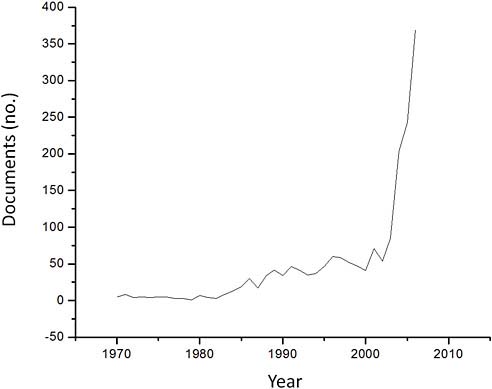
FIGURE B.8 Number of published documents, by year, 1970-2005, related to the keyword “Hypersonic” in the Scopus database. The search is refined by the word “Aerospace.”
It is interesting to note that, according to the Scopus data for Figure B.8, various different authors contributed to the record of very active publishing seen for Japan and Germany, whereas a few highly prolific authors represented India and the United States, as indicated by the list above.
Clearly, published work in the hypersonics area for the 1968-2009 time period is dominated by NASA, followed by Japan, Germany, China, and India in some of the top spots (Figure B.9). The 2000-2009 period (Figure B.10) is also dominated by publications from NASA, followed by Nanjing University in China. This most recent decade also shows the presence of Japan, Germany, and India.
In the 1990-1999 decade (Figure B.11), there were more entries from both Japan and Germany (two each), and representation from France as well. In the 1980-1989 period (Figure B.12), however, NASA and the United States were enormously dominant in the hypersonics field. Thus a clear trend can be seen over
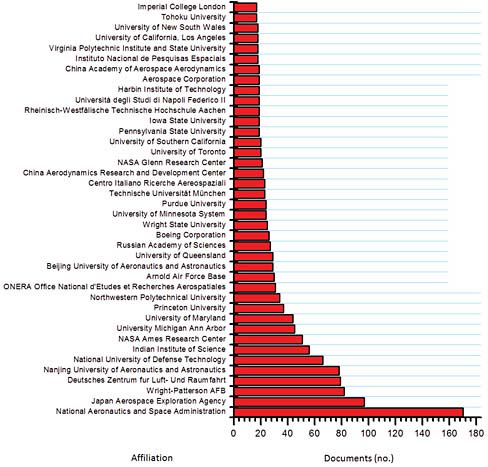
FIGURE B.9 Most common publication affiliations for documents related to the keyword “Hypersonic” in the Scopus database for the years 1968-2009 (that is, all years available in the database). The search is refined by the word “Aerospace.” Affiliations are listed exactly as they appear in the Scopus database search results.
time: even though the output from NASA has increased, its lead over other prolific affiliations has declined dramatically.
As shown by the publication venues for hypersonics for 1968-2009 (Figure B.13) as cataloged in the Scopus database, the American Institute of Aeronautics and Astronautics is dominant through all its journals and papers, and AIAA’s Journal of Spacecraft and Rockets is singled out as clearly in the lead. A non-U.S. publication—ESASP (Europe)—is only in position 10.
Again, as was the case with propulsion-related patents, the dominant patent office for hypersonic-related patents is the U.S. patent office (Figure B.14).
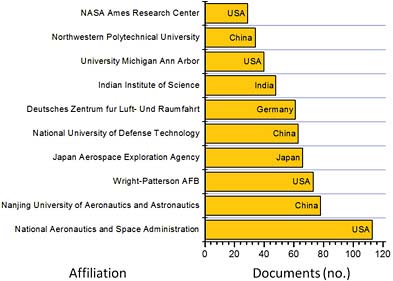
FIGURE B.10 Ten most common publication affiliations for documents related to the keyword “Hypersonic” in the Scopus database for the decade 2000-2009. The search is refined by the word “Aerospace.” Affiliations are listed exactly as they appear in the Scopus database search results.
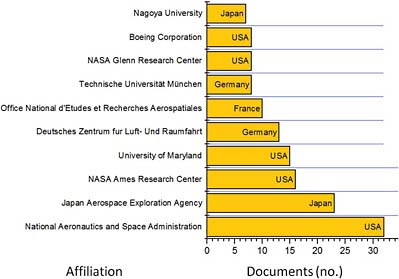
FIGURE B.11 Ten most common publication affiliations for documents related to the keyword “Hypersonic” in the Scopus database for the decade 1990-1999. The search is refined by the word “Aerospace.” Affiliations are listed exactly as they appear in the Scopus database search results.
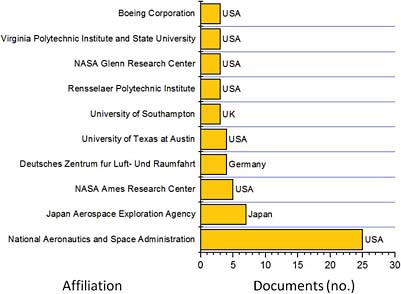
FIGURE B.12 Ten most common publication affiliations for documents related to the keyword “Hypersonic” in the Scopus database for the decade 1980-1989. The search is refined by the word “Aerospace.” Affiliations are listed exactly as they appear in the Scopus database search results.
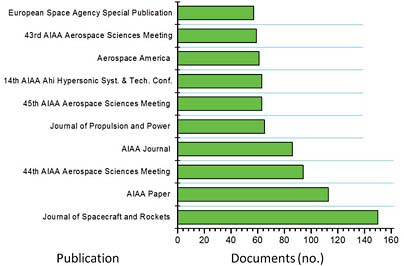
FIGURE B.13 Most common publications for documents related to the keyword “Hypersonic” in the Scopus database for the years 1968-2009. The search is refined by the word “Aerospace.” Publications are listed exactly as they appear in the Scopus database search results.
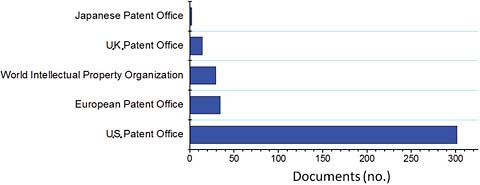
FIGURE B.14 Number of patents filed related to the keyword “Hypersonic,” as a function of patent office, for the years 1968-2009, according to data from the Scopus database. The search is refined by the word “Aerospace.”
B.2.3
Publications and Patents Related to Keyword “Scramjet”
“Scramjet,” like “hypersonic” and “propulsion,” has been the topic of an increasing number of documents published since the early 2000s (Figure B.15).
Looking at the affiliation for published documents over the 1970-2005 time period (Figure B.16), it is seen that NASA leads the field, closely followed by Japan, and followed in fourth position by China and Australia.
Looking at the top data by decades gives another picture for the most recent decade, 2000-2009 (Figure B.17). Here Japan is in the lead, with affiliations in China holding half of the top 10 positions. Previously (1990-1999) there had been a more distinct lead, by the United States and Japan, and no affiliations related to China (Figure B.18).
For the earliest period analyzed (1980-1989), the lead was clearly related to NASA publications, with Australia as the only other country on the top 10 list (Figure B.19). In conclusion, for the scramjet field it is clear that the domination of U.S. contributions to the body of published knowledge is rapidly diminishing, even though its contributions have increased in absolute numbers.
The publication venues for the 1970-2009 period are dominated by the Journal of Propulsion and Power. The other top 10 spots include several AIAA venues but also two Chinese journals (Figure B.20).
Following is a list of the top 10 most prolific authors overall, and in parentheses the number of their published documents for the years 1970-2009 (according to Scopus), as indicated by a search for the keyword “Scramjet.” It is clear from this list that some of the Japanese authors have been very prolific in publishing results in comparison with results for U.S. authors.
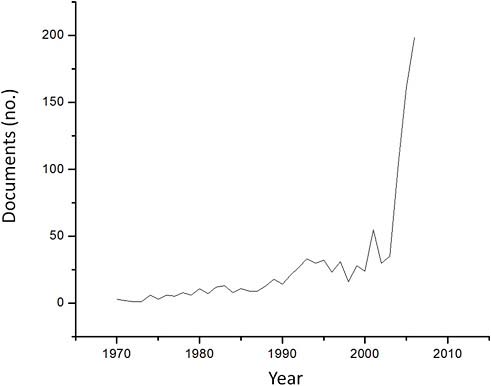
FIGURE B.15 Number of published documents each year, 1970-2005, related to the keyword “Scramjet” in the Scopus database.
|
• Kanda, T. (33) |
Japan (Kakuda Space Center) |
|
• Wang, Z.G. (25) |
China (National University of Defense Technology) |
|
• Mitani, T. (23) |
Japan (Japan Aerospace Exploration Agency) |
|
• Tani, K. (22) |
Japan (Kakuda Space Center) |
|
• Tomioka, S. (22) |
Japan (Kakuda Space Center) |
|
• Zhang, K.Y. (21) |
China (Nanjing University) |
|
• Schetz, J.A. (21) |
USA (Virginia Polytechnic Institute) |
|
• Paull, A. (21) |
Australia (University of Queensland) |
|
• Masuya, G. (20) |
Japan (Tohoku University) |
|
• Murakami, A. (18) |
Japan (Kakuda Space Center) |
Figure B.21 lists the number of patents related to the keyword “Scramjet” filed at five patent offices for the years 1970-2009.
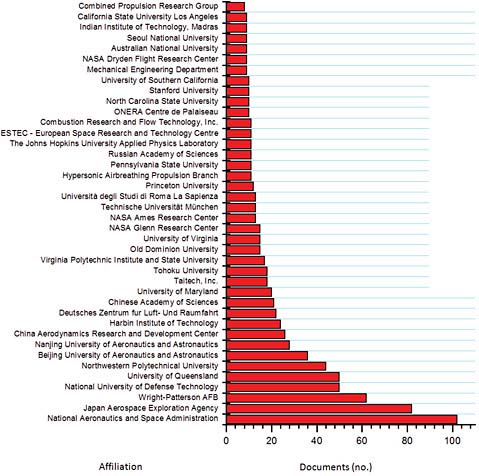
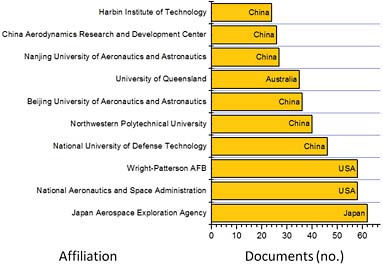
FIGURE B.17 Ten most common publication affiliations for documents related to the keyword “Scramjet” in the Scopus database for the decade 2000-2009. Affiliations are listed exactly as they appear from the Scopus database search results.
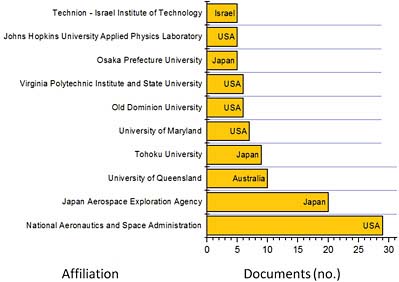
FIGURE B.18 Ten most common publication affiliations for documents related to the keyword “ Scramjet” in the Scopus database for the decade 1990-1999. Affiliations are listed exactly as they appear in the Scopus database search results.
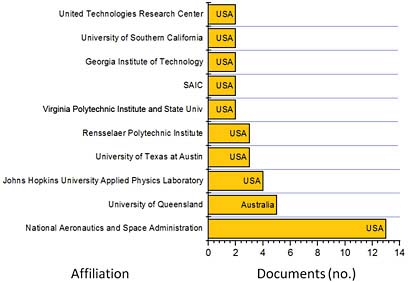
FIGURE B.19 Ten most common publication affiliations for documents related to the keyword “Scramjet” in the Scopus database for the decade 1980-1989. Affiliations are listed exactly as they appear in the Scopus database search results.
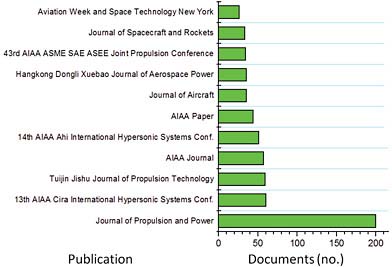
FIGURE B.20 Most common publications for documents related to the keyword “Scramjet” in the Scopus database for the years 1970-2009. The search is refined by the word “Aerospace.” Publications are listed exactly as they appear from the Scopus database search results.
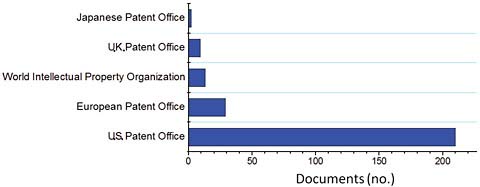
FIGURE B.21 Number of patents filed related to the keyword “Scramjet,” as a function of patent office, for the years 1970-2009, according to data from the Scopus database.
B.2.4
Publications and Patents Related to Keyword “Supersonic”
The field of supersonics has had the same upswing in publications as that experienced in all the other areas described here, albeit with some notable smaller peaks all the way back to 1985 (Figure B.22).
Following is a list of the top 10 most prolific authors overall, and in parentheses the number of their published documents, for the years 1970-2005 (according to Scopus), as indicated by a search for the keyword “Supersonic”; the search is refined by the word “Aerospace.”
|
• Schetz, J.A. (29) |
USA (Virginia Polytechnic Institute) |
|
• Wang, Z.G. (28) |
China (National University of Defense Technology) |
|
• Nakahashi, K. (24) |
Japan (Tohoku University) |
|
• Setoguchi, T. (23) |
Japan (Saga University) |
|
• Tomioka, S. (22) |
Japan (Japan Aerospace Exploration Agency) |
|
• Rathakrishnan, E. (22) |
India (Indian Institute of Technology, Kanpur) |
|
• Dutton, J.C. (21) |
USA (University of Illinois at Urbana-Champaign) |
|
• Bobashev, S.V. (21) |
Russia (Russian Academy of Sciences) |
|
• Miles, R.B. (20) |
USA (Princeton University) |
|
• Zhou, J. (19) |
China (National University of Defense Technology) |
The most prolific affiliations of published material in the supersonics area are clearly the Japanese Aerospace Exploration Agency and, in second place, NASA. These are followed by China, Germany, and Russia in the nearest top positions (Figure B.23). This ordering is also reflected in the subset of publications during the past 10 years (Figure B.24).
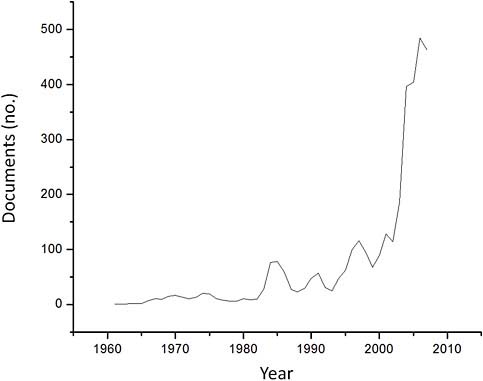
FIGURE B.22 Number of published documents, by year, 1970-2005, related to the keyword “Supersonic” in the Scopus database. The search is refined by the word “Aerospace.”
Looking back to the decade 1990-1999, China and Russia were not publishing and/or doing as much work as in 2000-2009. Also, the Israel Institute of Technology, which was very active in this field in 1990-1999 (Figure B.25), is no longer among the countries with the most prolific affiliations.
Even farther back (1980-1989), except for the United States, only Canada and Japan were on the list, in the two last spots (Figure B.26). It is also noteworthy that there were more companies on the list during the decade 1980-1989 (today there are none among the top 10; see Figure B.24).
The publication sources in the top 10 list are clearly dominated by AIAA-related and U.S. venues (Figure B.27).
And finally, a look at the number of patents filed related to the keyword “Supersonic” for the years 1961-2009 (Figure B.28), with the search refined by the word “Aerospace,” shows a trend similar to that seen with patent filings related to the other keywords.
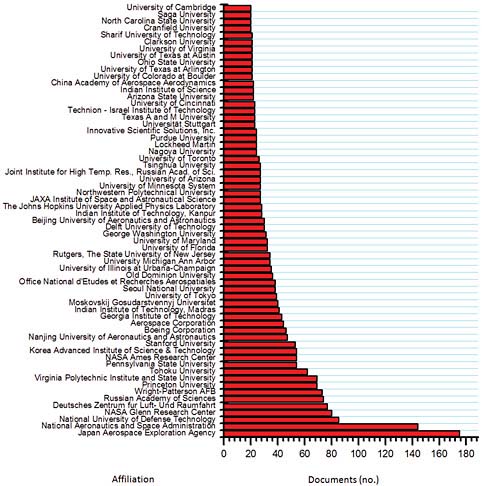
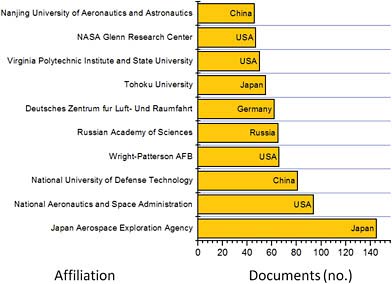
FIGURE B.24 Ten most common publication affiliations for documents related to the keyword “Super sonic” in the Scopus database for the decade 2000-2009. The search is refined by the word “Aerospace.” Affiliations are listed exactly as they appear in the Scopus database search results.
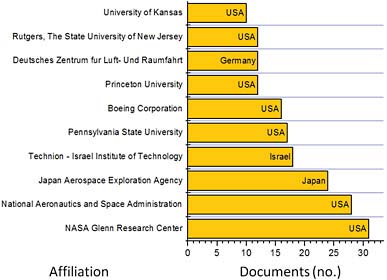
FIGURE B.25 Ten most common publication affiliations for documents related to the keyword “Super sonic” in the Scopus database for the decade 1990-1999. The search is refined by the word “Aerospace.” Affiliations are listed exactly as they appear in the Scopus database search results.
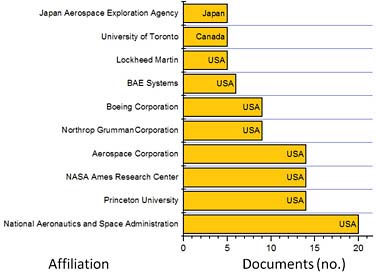
FIGURE B.26 Ten most common publication affiliations for documents related to the keyword “Supersonic” in the Scopus database for the decade 1980-1989. The search is refined by the word “Aerospace.” Affiliations are listed exactly as they appear in the Scopus database search results.
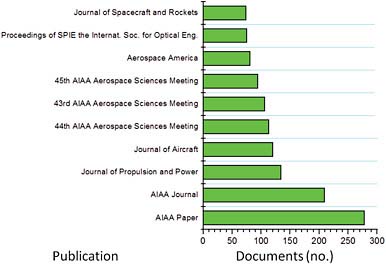
FIGURE B.27 Most common publications for documents related to the keyword “Supersonic” in the Scopus database for the years 1961-2009. The search is refined by the word “Aerospace.” Publications are listed exactly as they appear in the Scopus database search results.