
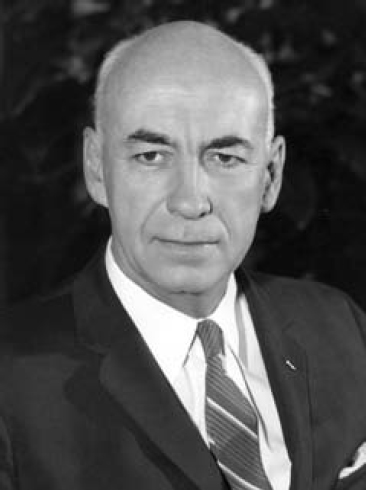
1913–2000
Elected in 1968
“For aircraft design and testing in subsonic, transonic, and supersonic speed ranges; development and use of satellites.”
BY CHRISTOPHER C. KRAFT, JR.
ROBERT R. GILRUTH, a father of human space flight, never sought public attention, and his leadership and technical contributions were often overlooked. Of the many heroes in the early days of the U.S. space program, Gilruth was among the most respected. He led the United States in the Mercury, Gemini, and Apollo efforts and directed the greatest engineering achievement in history: the safe voyages of humans to the Moon.
I worked for Bob as director of flight operations and succeeded him as director of the Johnson Space Center. He was one of the greatest men I have ever known. He launched his career at the Langley Memorial Aeronautical Laboratory in Hampton, Virginia, concentrating on the handling qualities of airplanes. In 1945 he organized and directed free-flight experiments with rocket-powered models at Wallops Island, investigating flight dynamics at transonic and supersonic speeds. By 1952 Gilruth was assistant director of the Langley laboratory, responsible for research into hypersonic aerodynamics, high-temperature structures, and dynamic
Adapted from the biographical memoir of Robert A. Gilruth, by Christopher C. Kraft, Jr., pp. 93-112, in Biographical Memoirs of the National Academy of Sciences, vol. 84 (Washington, DC: National Academies Press, 2003).
loads. In 1958 he became director of the Space Task Group and then managed the design, development, and flight operations of Project Mercury, which put Americans into space. In 1961, after President Kennedy committed the nation to land a human on the Moon, Gilruth became director of the National Aeronautics and Space Administration’s Manned Spacecraft Center in Houston, Texas. He actively directed and oversaw the design and construction of spacecraft, the selection and training of astronauts, and the planning and operation of space flights. In 1973 Bob Gilruth retired from NASA. In later life he suffered from Alzheimer’s disease. He died on August 17, 2000, at the age of 86.
Robert Rowe Gilruth was born October 18, 1913, in Nashwauk, Minnesota. He graduated from high school in Duluth, Minnesota, after attending public schools in several communities in that region. He studied aeronautical engineering at the University of Minnesota, where he received his bachelor’s degree and then a master’s degree in 1936. Bob Gilruth’s first engineering experiences came from watching his grandfather carve little boats to sail on the Minnesota lakes. Gilruth’s parents were both teachers. His mother had an inclination toward math, while his father was “a born teacher, but not an engineer,” who loved to read the classics to Gilruth and his older sister. Gilruth did not want to follow in his parents’ footsteps as an educator. “I was going to build something,” he remembered later. “I wasn’t sure what.” Aeronautical engineering grabbed his imagination, although he would continue to invent and build boats for the rest of his life.
When Gilruth was about 11, his father lost his job, and the family moved to Duluth to find work. There the young Gilruth designed rubber-band-powered airplanes, inventing a feathering propeller to reduce drag during glide. Modestly, Gilruth later asserted that he “wasn’t a very good student, and said his parents did not see much future in aviation, but the young Gilruth scoured magazines for articles about airplanes. He read American Boy and Popular Mechanics, as many boys did. When Bob learned about the National Advisory Committee
for Aeronautics (NACA) from the pages of The Saturday Evening Post, he sent away for NACA reports on airfoils. He used the information to improve his rubber-band gliders and successfully competed in local model-airplane contests.
To save his family money, Gilruth attended junior college before entering the University of Minnesota to study aeronautical engineering. He studied structure and loading and basically “how to design an airplane,” although he felt the department at that time was better at “teaching you…the routine things you did in an airplane company.”
When Gilruth completed his undergraduate degree in 1935, the United States was so deep in the Great Depression that none of the 17 graduates received job offers in aviation. Some of Bob’s classmates joined the Naval Air Corps, but Gilruth never seriously considered becoming a pilot. “I didn’t think that I had time to learn to fly,” he said. “And I didn’t really think that it would do that much for me to be a pilot. I wanted to go to NACA. That’s what I wanted to do.”
The University of Minnesota gave Gilruth a graduate research fellowship. Earning $50 a month, he worked toward his master’s degree on several projects. For example, he reluctantly helped on a department chief’s project to build a hot-air military “barrage balloon” that depended on a ground-based generator transmitting electricity up a tether to heat the balloon’s air. The project failed, and an embarrassing demonstration for the press provided Gilruth with some useful early experience.
About this time the famed French balloonist Jean Piccard joined Minnesota’s faculty. Piccard, a pioneer in upper-atmosphere research, asked Gilruth to develop a valve to keep constant air pressure inside an airplane’s cockpit. According to Gilruth, Piccard was very interested in helping airplanes fly high: “He said they’d be out of the thunderstorm belt, the air would be thinner, and you’d be able to go faster.” And he was right. This experience primed Gilruth for his future studies of high flight.
Piccard’s mentoring helped Gilruth in other ways, too. For example, Gilruth said Piccard “used blasting caps on
everything. It was great for me because it wasn’t too long before I was using igniters on all kinds of spacecraft,” beginning with rockets at NACA’s Wallops Island site. Gilruth learned much from Piccard, especially his “ways of looking at problems…of simplifying things.” Piccard’s ideas about high-altitude balloon gondolas would help Gilruth later when the Mercury capsule was being designed.
During his fellowship at Minnesota, Bob Gilruth met and married Jean Barnhill, a fellow engineering student and an aviatrix who flew in cross-country races. The new Mrs. Gilruth likewise worked with Piccard, and she helped construct an unmanned balloon that sent back telemetry on cosmic radiation. Piccard himself was married to an American, Jeannette Piccard, an engineer and a balloonist who Gilruth considered to be “at least half the brains of the family.” Later, during Mercury, Gilruth would hire Mrs. Piccard to serve as a consultant.
Also at this time, for a wage of 40 cents an hour, Gilruth helped design the Laird Watt, a racing plane flown by the famed pilot Roscoe Turner. According to Gilruth, “I was trying to design an airplane that was going to win the Thompson Trophy Race…. I made good use of that experience when I went to work for NACA…. It was equivalent to a couple of years’ experience, even though it was done while I was at school.”
In his graduate project at the University of Minnesota, Gilruth investigated the possibilities of placing an airplane’s propellers at the ends of its wings to take advantage of the tip vortices that are naturally produced there. However, the added effects were not large enough to follow up on his findings. In December 1936, just before he received his graduate degree, Gilruth was offered a job as a junior engineer at NACA.
Gilruth regarded NACA to be a better place to learn than graduate school and found Langley to be “an absolutely fantastic place to work.” When he left Minnesota, the temperature was 20 degrees below zero with 2 feet of snow on the ground. He arrived by train in Hampton, Virginia, where it was about 45 degrees and overcast. The grass was green, and
the magnolia leaves were on the trees. “I got out in that air, and…my goodness!” He looked around and said, “Gee, this is really neat.” Jean subsequently joined Bob in Hampton, where they set up housekeeping in a small apartment. This is where they would design and build their first boat, and later design their home and await the birth of their daughter, Barbara.
When Gilruth joined NACA in early 1937, he felt the United States had not made much progress in aviation since World War I. Charles Lindbergh’s 1927 solo flight across the Atlantic had been “a great shot in the arm for this country,” much as Alan Shepard’s Mercury flight would be in 1961. However, Gilruth said, “The Army flew the airmail for a while and they lost a lot of airplanes…. We had not made our mark in aviation.” But Langley had an engine research lab, advanced wind tunnels, and a towing basin for work on seaplanes. “Best of all, they had a staff of skilled people, dedicated in how you made the airplane better.”
Oddly, Gilruth was given no assignment at first. He was just assigned to a desk. As a new, young engineer he was “kind of worried, yet I hadn’t done anything wrong.” So Gilruth started reading. He studied all of NACA’s technical reports. One day another engineer, Hartley Soulé, noticed Gilruth and said, “Here, you’re not doing anything. How about working these up for me?” He handed Gilruth films that he had taken during a recent research flight. Six months later Gilruth had replaced Soulé as the engineer who flew with the test pilots. The purpose of the project was to determine quantitative criteria for the flying and handling qualities of airplanes. When Soulé was soon promoted, Gilruth became the flying quality expert at Langley.
As a result of the project, Gilruth wrote a report titled Requirements for Satisfactory Flying Qualities of Airplanes, which abstained from pilot jargon and put numbers to the qualities that made an airplane’s characteristics good or bad. For the first time Gilruth used his concept of “stick force per g,” which compares the pilot’s actions to the airplane’s reactions. This report helped make Gilruth’s reputation. Later when World War II was raging, the British were so enamored with Gilruth’s
findings that they sent a team of people to consult with him in 1943.
During the war, Bob Gilruth and many other aeronautical engineers were inducted into the military, put on enlisted reserve, and then sent back to their design work. When I joined Langley in 1945, Gilruth was trying to break the sound barrier. He had invented a technique he called “wing flow.” This placed small models above the wings of flying airplanes and used the accelerated flow there to study Mach conditions. “This was like making a wind tunnel along the top of a wing of an airplane,” Gilruth explained. He was able to show that a thinner wing like that of a P-51 flew better around Mach speed than a thicker wing like that of a P-47. The results were so important that they were promptly classified top secret, but they helped shape the wing of the Bell X-1, which would break the sound barrier in 1947.
At about this time Gilruth and others at Langley were also dropping streamlined bodies from high altitudes. They used telemetry to measure airfoil drag as the bodies went through the sound barrier. In 1945 Gilruth was placed in charge of developing a guided missile research station on Wallops Island. His team used Doppler radar to measure missile speeds and calculate the drag of airfoils and the behavior of ailerons as they passed through the speed of sound. Gilruth’s organization became known as PARD, the Pilotless Aircraft Research Division. Others joining him at Langley after the war were people like Max Faget and Caldwell Johnson; both would be major contributors in the race to the Moon.
Promoted to assistant director of Langley in 1952, Gilruth worked on several of the ballistic missiles that were being developed then. He was deeply troubled by the advent of the atomic age of warfare. He said, “I felt that things had really gotten out of hand.” He was also aware of the discussion of orbiting an artificial satellite, but he wasn’t much intrigued by that possibility. On the other hand, he said, “When you think about putting a man up there, that’s a different thing. That’s a lot more exciting. There are a lot of things you can do with men up in orbit.”
Like most Americans, Robert Gilruth realized the world changed when, in 1957, the Soviet Union orbited first a Sputnik satellite and then a second satellite, which carried a dog named Laika. According to Gilruth, “When I saw the dog go up, I said, ‘My God, we better get going because it’s going to be a legitimate program to put man in space.’ I didn’t need somebody to hit me on the head and tell me that.”
After the dog flew in space, Gilruth and his colleagues considered manned space flight. “We started scheming about what you could do.” To Gilruth, “the problems of putting a man in space [and] the physical problems of the vehicle were pretty well solved before we ever really started the Mercury program…. We could do it without exceeding the gravity forces” that a man could endure. “We had experiments with couches where a man could safely stand 20 g’s…and that’s a lot more than you need for reentry.”
At Wallops Island, Gilruth’s teams had already studied the heat generated by high-velocity reentry. The U.S. Air Force was considering using winged reentry vehicles, but they would be too heavy. On August 1, 1958, Gilruth went before Congress to present a manned space program based on the blunt body shape, which Mercury would later use. Still, there were skeptics. Even Gilruth’s supportive boss Hugh Dryden called the blunt body approach the same as “shooting a lady out of a cannon.” Using a blunt capsule seemed a stunt to many at the time, but the new idea of using a preceding shock wave was the best way for a spacecraft to reenter the atmosphere.
Gilruth was made the leader of the Space Task Group: “I was pried out of Langley…. I was expected to put man in space and bring him back in good shape—and do it before the Soviets, which we didn’t do.” I got to work with Bob as his assistant.
Congress created NASA on October 1, 1958, and incorporated all of NACA and its 8,000 employees. Before long, NASA absorbed the space science group of the Naval Research Laboratory, the Jet Propulsion Laboratory, and the Army Ballistic Missile Agency in Huntsville, Alabama, where Werner von Braun’s engineers were already designing large rockets.
At this point Gilruth’s career took a turn not uncommon to first-rate engineers. He went from being leader of design and testing teams to being manager of a huge program. As his first task he hired the best engineers and managers he could find, even bringing in many from Canada. NACA’s Langley largely had been an in-house operation, but NASA would work differently. In some ways, said Gilruth, “All we were was a contracting agency,” letting contracts to companies large and small.
Project Mercury commenced. Astronauts were selected and trained, capsules were designed and constructed, rockets were tested, and the Cape Canaveral launch site was readied. But the Soviet Union beat the United States into space with the one-orbit flight of Yuri Gagarin on April 12, 1961. This event stirred the world and frightened the United States. To many the Soviets obviously led the Americans in important areas of technology. They were certainly ahead in propaganda. In Gilruth’s words, “Poor President Kennedy was fit to be tied.”
When Alan Shepard flew his suborbital flight on May 5, 1961, Kennedy and the American public were delighted. But now Project Mercury wasn’t enough. By itself it was just “a dead-end program,” which had already ceded space primacy to the Soviets. Mercury needed to be part of a bigger competition that the United States could expect to win. As Gilruth tells it, “And that’s where Kennedy came along and said, ‘Look, I want to be first. How do we do something?’”
Gilruth advised the President, “Well, you’ve got to pick a job that’s difficult—that’s new—that they’ll have to start from scratch. They just can’t take their old rocket and put another gimmick on it and do something we can’t do. It’s got to be something that requires a great big rocket—like going to the Moon. Going to the Moon will take new rocket technology, and if you want to do that, I think our country could probably win because we’d both have to start from scratch.”
In Gilruth’s later recollection, “Kennedy bought that. He was a young man. He didn’t have all the wisdom he would have had. If he’d been older, he probably never would have done it.” Interestingly, this decision was made in the same
time frame as the failed U.S.-supported military operation at the Bay of Pigs in Cuba in April 1961.
And so on May 25, 1961, President Kennedy challenged the U.S. Congress: “[T]his nation should commit itself to achieving the goal, before this decade is out, of landing a man on the moon and returning him safely to the earth…[for]…one purpose which this nation will never overlook: the survival of the man who first makes this daring flight. But in a very real sense, it will not be one man going to the moon—if we make this judgment affirmatively, it will be an entire nation. For all of us must work to put him there.”
Even though Gilruth was “up to his neck” in Kennedy’s decision, he was still stunned when he heard the speech. He was flying on a DC-3 with NASA Administrator James Webb. They heard it on the radio. Gilruth knew well what Kennedy was going to say, “but I still was aghast that he was saying it, and that we were going to try to do it.” The enormity of the challenge was overwhelming. Still, Gilruth was glad Kennedy had set a lunar landing date of “before this decade is out.” Otherwise, with budgets and politics the Moon landing might never happen.
So the Apollo program was born: the most audacious engineering challenge in history. Bob Gilruth was to lead it from the new Manned Spacecraft Center to be located a few miles south of Houston, Texas. Not only did he have to manage Apollo, but he also had to build a great space center in a place that was then no more than a salt-grass cow pasture. Of Houston, Gilruth thought what many have thought: The climate is bad, the air conditioning is good, and the people are wonderful. It was also near water, where Gilruth could build his boats.
In an amazingly brief period the Manned Spacecraft Center was constructed, the Gemini flights were flown, and the Apollo spacecraft were built, all as Gilruth coordinated these activities and other efforts with the other NASA installation directors, von Braun at Marshall in Huntsville, Alabama, and Kurt Debus at Cape Canaveral, Florida. But even with the pressures of deadline and the competition with the Soviets,
Gilruth demanded that things be done right. He insisted on inclusion of the Gemini flights that would develop technology and techniques for orbital rendezvous, docking, and space walks.
Then, on January 27, 1967, a fire during a ground simulation in an Apollo spacecraft test killed the Apollo 1 prime crew: Gus Grissom, Ed White, and Roger Chaffee. Bob Gilruth was in Washington, D.C., meeting with contractors. “I got a call from [the prime contractor] North American, saying ‘We just lost our crew on the Cape.’ I said, ‘We lost them? Nobody’s flying.’ They said, ‘But this was on the ground.’” Gilruth couldn’t believe it. None of us could. We learned it was due to a lot of bad luck and some bad work. As would happen with NASA’s later space tragedies, Apollo 1 triggered rethinking and reworking.
It also brought about a recommitment to courage. In 1968 NASA decided to fly the Apollo 8 around-the-Moon mission much ahead of schedule. At that point, “James Webb retired because he felt that he could not face another potential tragedy after the Apollo fire of January 1967,” Gilruth said. “I hated to see him leave, but I understood how deeply he felt and all he had endured since the fire.”
The Apollo program was now beginning to move rather rapidly. With Apollo 8, for the first time in history humans had left their home planet. Everyone now realized a Moon landing was imminent. On July 20, 1969, much of the world watched as the Apollo 11 crew set footprints on the Moon. Later flights introduced lunar rovers to the Moon’s surface, and the final mission, Apollo 17, included a geologist, Harrison Schmidt.
But by now Apollo had lost much of its political support and the public’s interest in space flight had waned. In fact, NASA had to pay the television networks to broadcast Apollo 17. Interestingly, this mission was the only Apollo launch that Gilruth watched in person. He preferred to be with us at Mission Control in Houston.
Ironically, Bob’s interest in Apollo was waning, too. I don’t mean his interest in the challenge, but his interest in risking lives to repeat what had already been done. As he put it,
“We’d already flown to the Moon many times. I put up my back and said, ‘We must stop. There are so many chances for us losing a crew. We just know that we’re going to do that if we keep going.’” Bob Gilruth regarded the astronauts almost as his own family. The decision to halt Apollo was made with his tacit approval.
Gilruth thought the U.S. space program should look in other directions. At one time before Apollo, he was more interested in building a space station than in going to the Moon. He was also interested in opening up cooperation with the Soviets, and he made trips to Russia to prepare for what was to become the Apollo-Soyuz mission of July 1975.
Gilruth’s wife, Jean, died in 1972 after the last Moon landing and during the period of his trips to Russia. He had left the Manned Spacecraft Center to work in Washington, D.C., as NASA’s head of personnel development. He subsequently retired from NASA in 1973 and worked as a consultant for a short time thereafter; but soon he moved back to Houston with his new wife, Jo. Later that year they launched a 52-foot multihull sailboat, The Outrigger, designed and built by Gilruth in his spare time during the previous 10 years. Gilruth died in Virginia in 2000 after a long illness. In addition to his wife, Jo Gilruth, he is survived by his daughter, Barbara Jean Wyatt.
Bob Gilruth received many honors and awards throughout his career. In addition to the National Academy of Engineering, he was an elected member of the National Academy of Sciences and the International Academy of Astronautics. He was elected an honorary fellow of the American Institute of Aeronautics and Astronautics and the Royal Aeronautical Society and was a fellow of the American Astronautical Society. The Sylvanus Albert Reed Award in 1950 from the Institute of Aerospace Sciences was the first of many prestigious awards and medals he received, including the Louis Hill Space Transportation Award (1962), the Goddard Memorial Trophy of the National Rocket Society (1962), the Spirit of St. Louis Medal from the American Society of Mechanical Engineers (1965), the Daniel and Florence Guggenheim International Astronautics Award of the International Academy of Astronautics (1966), the Space
Flight Award by the American Astronautical Society (1968), the ASME Medal from the American Society of Mechanical Engineers (1970), the James Watt International Medal from the Institution of Mechanical Engineers (1971), the National Aviation Club Award for Achievement (1971), and the Robert Collier Trophy of the National Aeronautic Association and the National Aviation Club (1972). Gilruth was one of the first 10 persons installed in the National Space Hall of Fame (1969) and one of 35 space pioneers inducted into the International Space Hall of Fame (1975). He received the NASA Distinguished Service Medals in 1962 and 1969 and the President’s Award for Distinguished Federal Civilian Service in 1962. Honorary doctors were awarded to Gilruth from the University of Minnesota (1962), Indiana Institute of Technology (1962), George Washington University (1962), Michigan Technological University (1963), and New Mexico State University (1970).
Robert Gilruth’s achievements and life history are simple enough to trace; however, his effects on people were deep and continuing. He was such an interesting personality, a beautiful man, a true leader, and a mentor. When I succeeded Bob as director of the Johnson Space Center, I was fully ready. No one could have prepared me better.
Note: The quotes from Bob Gilruth’s colleagues are from the Johnson Space Center’s Oral History Project. They, along with Gilruth’s own interviews conducted for the National Air and Space Museum, were the major resources in compiling this tribute.


