
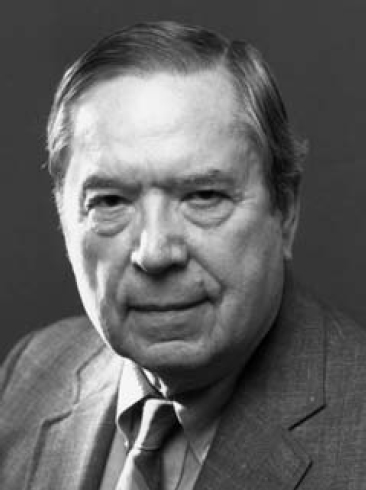
1910–2008
Elected in 1965
As an “eminent authority on earthquake engineering.”
BY PAUL C. JENNINGS
GEORGE W. HOUSNER, Braun Professor of Engineering Emeritus at the California Institute of Technology, died on November 10, 2008, a few weeks before his 98th birthday.
George was born in Michigan on December 9, 1910. He had an older brother who died very young and a sister who had polio as a child and died as a young adult. He earned his B.S. degree from the University of Michigan in 1933. Moving to California, he received his master’s degree from the California Institute of Technology in 1934. After working several years as a practicing engineer, he returned to Caltech and earned his Ph.D. in 1941, doing a thesis with R. R. Martel on the response of an oscillator to arbitrary earthquake ground motion. All his degrees were in civil engineering.
He served in the Army Air Force during World War II, where he did operations analysis in Africa and Italy. During this time he showed that bombers confronted by barrage balloons could safely fly through the balloons’ tethering cables because the cables would break from plastic yielding before they could damage the airplane severely. He also showed the counterintuitive result that it was more effective for a bomber trying to strike a bridge to approach the bridge perpendicular to its centerline rather than to take a path along the bridge, even though when approaching perpendicular one can only hope to take out at most one span.
George returned to Caltech as an assistant professor in 1945, where he remained the rest of his career. Although the retirement rules in place then required that he become professor emeritus in 1981, he remained technically active in the field of earthquake engineering for two more decades.
Professor Housner had an extraordinary range of accomplishments in research. Perhaps most notable was development of the response spectrum as a fundamental tool in earthquake-resistant analysis and design. He was the first to use statistical methods and techniques of random processes to characterize strong-motion accelerograms and to assess the probabilities of experiencing damaging shaking at a specific site in a given number of years. He was a leader in the development of instrumentation to measure strong ground shaking and building response and in the programs to deploy these instruments and analyze the resultant data. He also saw the need for research on the dynamic characteristics of structures, and with colleagues at Caltech led the effort to develop “shaking machines” with sufficient force and frequency control to excite large buildings, dams, and other structures to amplitudes large enough to determine accurately their natural frequencies and mode shapes. To help understand how large liquid storage tanks respond to earthquake motion, he produced now-classic papers on the dynamics of rocking and sloshing of these structures.
In other classic papers he elucidated the mechanics of the dynamic behavior of inverted pendulum structures and the bending vibrations of pipelines carrying flowing fluid. He also did some of the first studies of the nonlinear yielding response of structures to strong earthquake motion and the role of soil flexibility—the soil-structure interaction phenomenon—in the earthquake response of buildings. In the area of soils engineering, he authored a seminal study of the mechanism of sand blows, the minigeysers that often accompany major earthquakes when areas of saturated soils are shaken strongly.
George was a “real engineer” as well as a researcher, and his advice was sought on many important engineering
projects in the United States and around the world. Among his consulting activities was work on the earthquake engineering challenges of the Bay Area Rapid Transit tunnel across San Francisco Bay, the California Water Project, the Tagus River suspension bridge in Portugal, the first skyscrapers in Los Angeles, industrial refineries, and offshore drilling platforms in various parts of the world. For many years he headed the consultant Board of California’s Division of Dam Safety and the Seismic Advisory Board of the California Department of Transportation.
In addition to his broad range of fundamental technical accomplishments, he was an intellectual leader in a broader sense. He helped found the Earthquake Engineering Research Institute and served as its president for 12 of the first 13 years of its existence. During this time he guided the early development of the institute and laid the groundwork for the transition of the institute into the strong and active technical society that it is today. He also played a key role in the founding of the International Association for Earthquake Engineering and served as its president for four years. This organization holds world conferences on earthquake engineering every four years and promotes cooperation among the many national societies active in this very international field. George continued to influence both of these organizations long after he was out of office, participating in many of their activities and serving the role of elder statesman.
One of the first technical delegations to the People’s Republic of China after President Nixon’s visit opened up relations was a National Academy of Sciences–sponsored delegation in earthquake engineering in 1978. This team, led by George Housner, reported back on the status of earthquake engineering research and practice in China and on some of the effects of the disastrous Tangshan earthquake of 1978, which killed an estimated 650,000 people. This visit also led to the subsequent publication, in both Chinese and English, of a detailed, multivolume report on this most destructive earthquake, which George meticulously edited.
George was elected to the National Academy of Engineering
(NAE) in 1965, in the first election after that of the founding members, and to the National Academy of Sciences (NAS) in 1972. He participated widely in the work of both NAS and NAE committees dealing with earthquake engineering, seismology, and natural disasters. He chaired the Engineering Section of the NAS from 1978 to 1981 and committees of the NAE and the National Research Council (NRC). He chaired the Engineering Panel of the National Academy of Sciences Committee on the Great Alaska Earthquake of 1964, editing and overseeing publication of arguably the most extensive report ever produced on earthquake effects on engineered structures and facilities. He also chaired the NRC Committee on Earthquake Engineering Research, producing a report in 1969 that greatly influenced earthquake engineering research in the following decades. Later, in 1982, he chaired the NRC Earthquake Engineering Research Committee reprise of this effort, producing the report Earthquake Engineering—1982, which was also very influential in determining the path of subsequent earthquake engineering research.
He was also chair of the NAE’s Committee on Natural Disasters, which dealt with tornados, hurricanes, and floods, in addition to earthquakes. After the Loma Prieta earthquake in 1989, which caused severe damage to freeways and bridges in the San Francisco Bay area, George was appointed by California Governor Deukmejian to chair the Governor’s Board of Inquiry on the earthquake and to prepare responses to key questions that arose from the earthquake’s damage and to make recommendations for future practice. The resulting report, Competing Against Time (Earthquake Spectra, 1990), is a landmark in the field.
George’s strategic leadership and excellent research contributions were widely recognized. The NAE honored him with its Founders Award in 1991, and in 1988 President Reagan awarded him the National Medal of Science. He earned the Von Karman, Newmark, and Norman medals from the American Society of Civil Engineers, in addition to being made an honorary member. The society also published a collection of his technical papers in its Civil Engineering Classics series.
The volume, entitled Selected Earthquake Engineering Papers of George W. Housner, contains 54 of his many papers in the field.
He was elected to honorary membership in several national and international engineering societies and received honorary doctorates from the University of Michigan and the University of Southern California. As noted above, he was one of the founding members of the Earthquake Engineering Research Institute, and that technical society established the George W. Housner medal in 1989. Appropriately, he was the first recipient. Another organization he helped establish, the Consortium of Universities for Research in Earthquake Engineering, honored him with a symposium in his name on the occasion of his 85th birthday.
For his unique role in the field of earthquake engineering, George was often called the “Father of Earthquake Engineering.”
George never married. He lived modestly and he invested well. He left the bulk of his substantial estate as an endowment to the California Institute of Technology, where the funds are used to provide scholarships for graduate students, research support for earthquake engineering projects, and support for undergraduate research and other scholarly activities. Another part of his estate—his large collection of historic scientific books—was left to the Caltech Archives.


