
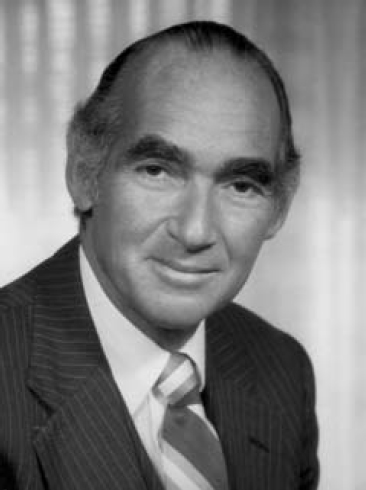
1922–2009
Elected in 1974
“For contributions to methods of fuels conversion and energy utilization.”
BY ROBERT S. LINDEN AND MARGARET M. MURPHY SUBMITTED BY THE NAE HOME SECRETARY
HENRY ROBERT LINDEN, world-renowned authority in energy research and policy, passed away on September 13, 2009, at the age of 87.
Born on February 21, 1922, and raised in Vienna, Austria, Henry was the only child of parents Fred and Edith (Lermer) Linden. Both of Henry’s grandfathers were medical doctors, and Fred had been required to earn a law degree before being allowed to pursue his chosen career as an artist, which led to a series of commissioned portraits of the Habsburg monarchy. Edith worked as a society editor for a Viennese newspaper. Henry was expected to pursue his studies diligently, but enjoyed spending his free time outdoors in the Boy Scouts and on his own. He learned to ski the Alps when a day’s ski outing consisted of eight hours of strenuous climbing and one hour of exhilaration on the way down. In a manner that came to characterize his professional career, he took satisfaction in the long climb up—all the better to appreciate the reward of the short trip down.
In 1939 the family immigrated to New York City, where Henry’s parents remained for the rest of their lives. Henry applied for admission to several American colleges but could gain entrance only to West Georgia College, where he majored in textile engineering. After proving himself academically, Henry transferred to Georgia Institute of Technology, where he changed his major to chemical engineering and graduated at the top of his class in 1944. That same year he married Dorothy Jenks and returned to New York to work for Socony Vacuum (later Mobil Oil) on high-performance aviation fuels while completing a master’s degree in chemical engineering at Polytechnic Institute of Brooklyn (now Polytechnic Institute of New York University).
In 1947 Henry moved to the Midwest to begin what would be a 30-year affiliation with the Institute of Gas Technology (IGT), joining as supervisor of oil gasification processes. Simultaneously, Henry continued his graduate program in chemical engineering at the neighboring Illinois Institute of Technology (IIT), conducting his doctoral research under the direction of Ralph Peck in high-temperature, vapor-phase cracking of hydrocarbons. The 1950s were highly productive years for Henry; he completed his Ph.D. degree (1952) and greeted the arrival of son, Robert Seth, and daughter, Debra Jeanne, all the while assuming greater and broader managerial responsibility at IGT. By 1961, Henry was appointed as institute director, a post he held for 17 years, executing major programs in energy supply and conversion and pioneering the concept of a hydrogen economy along the way. An accomplished technologist with a global view on energy, Henry had an illustrious career at IGT, which reached its pinnacle in 1974 with his appointment as president and trustee.
Amid growing concerns about the adequacy of U.S. natural gas supplies, Henry provided the pivotal impetus in the launching of the Gas Research Institute (GRI), the U.S. natural gas industry’s cooperative research and development arm, and served as its first president and as a member of the board of directors from 1977 until his retirement in 1987. It is widely accepted that Henry’s foresight and visionary leadership of
GRI are largely responsible for the widespread availability of natural gas supplies today, particularly with respect to the key contribution of technologically and economically feasible “unconventional” resources, which today comprise 65% of U.S. natural gas production.
Throughout the course of his professional life, Henry maintained a close relationship with IIT, his beloved alma mater. After retiring from GRI, he turned his energy and attention to establishing a comprehensive research and education program in sustainable global energy development at IIT. Although the preponderance of Henry’s career was spent in the administration of large-scale research and development programs, he maintained a lifelong commitment to critical thinking, conducting his own research in sustainable global energy systems, industrial ecology, the energy/environment/economics paradigm, and global climate change. Beginning in the mid-1980s, long before global warming had surfaced as a topic of raging debate, Henry assumed what he called a “contrarian” perspective, encouraging researchers and policymakers alike to maintain a fact-based, long-term perspective of the issues.
In the course of pursuing these diverse interests, Henry served as an esteemed member of the faculty of the IIT Department of Chemical Engineering for more than 50 years. Most recently, he was appointed the Max McGraw Distinguished Professor of Chemical Engineering, director of the IIT Energy + Power Center, and member of the advisory boards for the IIT Department of Chemical and Biological Engineering and the Wanger Institute for Sustainable Energy Research (WISER). The culmination of Henry’s lifelong effort to secure international prominence for IIT in energy research and education, WISER was established in 2008 under the directorship of Hamid Arastoopour, Henry’s protégé, colleague, and recently named IIT Henry R. Linden Professor of Energy. Relentlessly dedicated to his research, Henry continued to come to work until a few short months before his death, when his failing health prevented him from doing so.
A prolific researcher, Henry was author or coauthor of more
than 240 publications and 27 patents related to energy supply, energy use, and petrochemical production. He wrote and lectured extensively on U.S. and world energy issues throughout his lifetime and was revered for his uncanny ability to bridge the communication gap between key stakeholders in productive energy policy development. For this reason he was tapped to serve on several federal advisory bodies dealing with energy policy, technology, and regulation, beginning with the Kennedy administration, and held a presidential appointment during the Ford administration.
Among Henry’s most noteworthy and proudest professional achievements was his election in 1974 to the National Academy of Engineering (NAE) in recognition of his “contributions to methods of fuels conversion and energy utilization.” He was also fellow of the American Association for the Advancement of Science, the American Institute of Chemical Engineers (AIChE), and the Institute of Energy. Henry was a member of the Hydrogen Technical Advisory Panel of the U.S. Department of Energy (1992–2003), the NAE Advisory Committee on Technology and Society (1987–1992) and the Steering Committee on Industrial Ecology and Design for the Environment (1992–1994), the Advisory Council of the Electric Power Research Institute (1987–1993), and the Energy Engineering Board of the National Research Council (1986–1993). He served as a director of five major corporations—Sonat, Inc., and its subsidiary Southern Natural Gas Company, Reynolds Metals Company, UGI Corporation, and the AES Corporation—and as an advisory board member of five venture capital funds.
Henry received numerous awards for his technical and analytical work in the fossil fuels area, including the Homer H. Lowry Award for Excellence in Fossil Energy Research from the U.S. Department of Energy in 1991, the 1993 United States Energy Award from the United States Energy Association, the 1996 Lifetime Achievement Award of The Energy Daily, and the American Chemical Society Division of Fuel Chemistry Award in 1967. In 2000, AIChE recognized Henry with the Ernest W. Thiele Award, and in 2008 the AIChE’s Centennial Committee
selected him as one of the “100 Chemical Engineers of the Modern Era” for his guidance of the profession into the new century in the area of global climate change, industrial ecology, energy resource assessment, and clean coal technologies. An icon at IIT and a lifelong university benefactor, the IIT Alumni Association awarded him its Professional Achievement Award in 1975, the Alumni Medal in 1995, and the Lifetime Achievement Award (posthumously in 2010). Henry was inducted into the IIT Hall of Fame in 1982. Today, a chemical engineering graduate fellowship bears his name, as does the Henry R. Linden Endowed Professorship.
Although his professional commitments occupied the lion’s share of his time, Henry never lost his inherent love of nature and the desire to be alone among its elements. In the late 1980s, Henry and Natalie, his beloved wife of 42 years, bought a farm in western Wisconsin and drove nearly seven hours to get there on weekends, as time permitted. It was there that Henry enjoyed a respite from his daunting professional commitments. Respite did not mean escape from the values and goals that sustained him through his 87 years, however. Setting aside his more intellectual pursuits, he enjoyed picking up a spade on summer weekends to work the soil and plant a tree, secure in his knowledge of the long-term benefits that can grow from a little extra effort today. But in the cold Wisconsin winter, strapping on his cross country skis for yet another foray up the hills that surrounded the farmhouse, Henry truly came full circle, his boyhood passion for hard work still driving him to mark new trails—in a long life defined by self-set challenges well met.


