
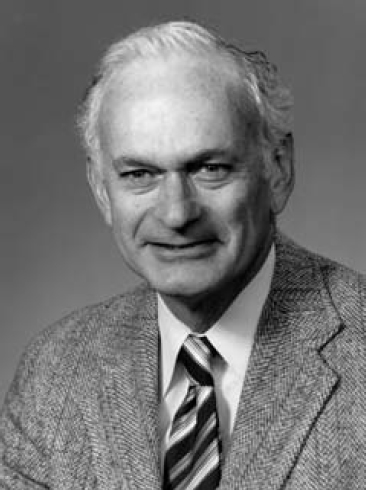
1923–2010
Elected in 1985
“For the understanding and development of fine particle magnets and plated wire memories, and for important contributions to the study of the metallurgy and magnetic properties of amorphous alloys applicable to a wide range of magnetic devices, particularly power transformers.”
BY HARVEY W. SCHADLER
FRED E. LUBORSKY, an internationally known authority on permanent magnets and amorphous metals, died February 3, 2010. Fred was born on May 14, 1923. Fred was 86 and he died peacefully.
Fred was a highly educated and technically competent scientist who was open with his scientific information, his insights, and his enthusiasm. He was granted a four-year merit scholarship from the city of Philadelphia, and he completed a bachelor’s degree in chemistry at the University of Pennsylvania in 1947. After serving two years in the U.S. Navy, he completed his doctorate in physical chemistry at the Illinois Institute of Technology in 1951.
Fred joined the General Electric Corporate Research and Development Laboratory (CRD) in 1951. Following one year at CRD, he spent seven years working for GE in Lynn, Massachusetts. In 1958 Fred returned to GE’s CRD, where he specialized in the physics of magnets and the metallurgy of magnetic materials and devices. His career began, grew, and
ended with studies in these areas. Fred’s contributions to the scientific community included more than 160 technical papers and 21 patents. These documents demonstrate Fred’s efforts (and those of many others in the magnet materials sphere) to thoroughly establish the knowledge base for magnetic materials. In addition to these scientific contributions, he was the key technology leader in developing GE’s Lodex permanent magnets, thin-film electroplated magnetic disks, plated wire memory, amorphous alloys for transformers, and amorphous films for magneto-optic recording.
Fred’s career was special not only because of these achievements but because of his enthusiasm and his openness to new information and insights. His contributions to his colleagues were immense and greatly appreciated. Some of this appreciation is reflected in his many awards, including:
- The Centennial Medal for outstanding service and achievements awarded by the Institute of Electrical and Electronics Engineers (IEEE)
- IEEE: Magnetic Society, president, 1971–1977, and editor in chief, 1972–1975
- Member of the National Academy of Engineering
- Coolidge Fellow, General Electric Corporate Research and Development
- Fellow of the IEEE, American Institute of Chemists, American Physical Society, and New York Academy of Sciences
Fred was an avid tennis player and woodworking craftsman. He and his wife Florence were married for 63 years. They raised three children: Professor Judith L. Luborsky, biologist at Rush Medical Center, Chicago; Professor Mark R. Luborsky, anthropologist (husband of Professor Andrea Sankar) at Wayne State University, Michigan; and Rhoda S. Luborsky, owner of Schenectady VanCurler Music, Schenectady, New York. He has one granddaughter, Rebecca C. Luborsky, of Philadelphia.


