
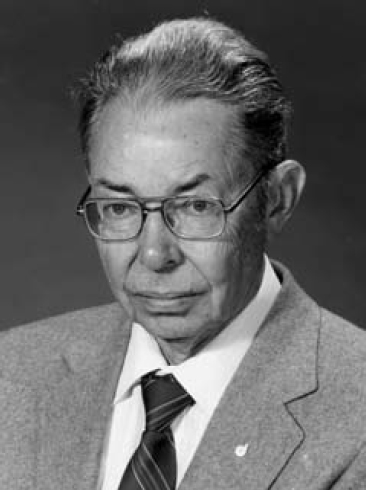
1918–2009
Elected in 1991
“For theoretical and practical contributions that have advanced understanding of aircraft stability, control, guidance, flying qualities, and simulation technology.”
BY WILMER H. REED III
SUBMITTED BY THE NAE HOME SECRETARY
WILLIAM HEWITT PHILLIPS, a member of the National Aeronautics and Space Administration (NASA) engineering team responsible for the success of the Apollo program died at home on June 27, 2009, at the age of 91.
He was born in Port Sunlight, England, on May 31, 1918 and came to the United States with his parents when he was 2. He earned a B.S. in 1939 and an M.S. in 1940 in aeronautical engineering, both from the Massachusetts Institute of Technology (MIT).
William Hewitt Phillips was truly one of a kind. A stranger meeting this humble, unassuming man would hardly suspect that before him stood an internationally known, highly respected technical giant in his field. His entire professional career was spent with the National Advisory Committee for Aeronautics and NASA at Langley Research Center. His technical contributions in the field of aeronautics and space span from flight research on World War II aircraft in the early 1940s to the present-day Space Shuttle. His research and innovations related to such topics as aircraft stability, control and handling qualities, gust alleviation and aeroelastic effects,
space rendezvous and navigation, and lunar landing studies, in which he conceived and developed the 200-foot-tall Lunar Landing Facility used to train astronauts and which forms part of Hampton’s skyline.
Among Hewitt’s special talents was the ability to explain incredibly complex subjects in simple understandable English. That talent is well borne out in NASA’s publication of two of his books: Journey in Aeronautical Research and Journey Into Space Research—continuation of a career at NASA Langley Research Center. These well-illustrated books make for good reading for anyone interested in aerospace. Fortunately, Hewitt’s research papers and files have been preserved and cataloged at Virginia Tech’s Virginia Heritage Special Archival Collection, which can be accessed over the Internet.
I became friends with Hewitt through our mutual interest in a lifelong hobby of building and flying model airplanes. We were both longtime members of the “Brainbusters Free-Flight Model Club.” Hewitt and I also participated in volunteer projects sponsored by the local chapter of the AIAA (American Institute of Aeronautics and Astronautics). One such project was to design and build a prototype of a wind tunnel exhibit planned for use at the Virginia Air and Space Museum. Hewitt was ideally suited for this mission, recalling that in the late 1930s, while at MIT, he and a fellow student built a wind tunnel for testing model airplanes. This prototype wind tunnel was later used by the AIAA and others in classrooms and on special occasions such as career days.
Another project in which Hewitt and I participated involved AIAA’s bid to break the Guinness record for the world’s largest paper airplane. Teachers from four Hampton high schools selected 18 outstanding senior students to participate. Hewitt, along with Dr. Richard Witcomb, Jim Penland, and I served as advisors. At the beginning of the one-year program, named the “White Pelican” project, the students listened to lectures by Hewitt, Dr. Whitcomb, and the other advisor on such topics as airplane design, aerodynamics, stability and control, structures, and materials. At the end of a year of intensive labor by all involved, the White Pelican was born. She weighed in at
9½ pounds and had a wing span of 30 feet and 6 inches. The recordbreaking flight took place in the NASA hangar, where she gracefully glided 114 feet, earning her place in the 1993 edition of the Guiness Book of Records.
After retiring from government service in February 1979, he remained a distinguished research associate, researching solar-powered aircraft, propellers, airfoil design, and wind tunnel studies of the use of canard surfaces for the Space Shuttle. He served as a consultant on studies of flight dynamics and control. He was awarded the America Institute for Aeronautics and Astronautics’ Lawrence Sperry Award for aeronautics in 1944, the NASA Distinguished Service Medal in 1979, and the President’s Award for Distinguished Federal Civilian Service in 1979; he was elected into the National Academy of Engineering in 1991 and he was elected a fellow of the American Institute of Aeronautics and Astronautics.
Hewitt enjoyed a variety of outside activities. In addition to his addiction to model airplanes, he was an accomplished artist, played the piano, enjoyed opera, and looked forward to summer vacations at his time-share on the Outer Banks of North Carolina. I remember being with him there a few years back. While he was unpacking the car at the start of his vacation, curious onlookers watched as he pulled out his 6-foot radio-controlled glider, unusual kites configured with rotors and rotating cylinders, painting art supplies, and stacks of sheet music for piano practice at the recreation center. And then it was really fascinating to see this 80+ -year-old trudging up the Jockey Ridge sand dunes with said glider and kites in hand.
Another love of Hewitt’s was attending, each year, the December 17 celebration of the anniversary of man’s first flight by the Wright brothers. We often went together and would also attend, on the night before, a dinner sponsored by the “Man Will Never Fly (MWNF) Memorial Society.” Its motto: “Birds Fly, Men Drink”; its objective, to prove that the first flight was a big hoax and that the Wright brothers came there just to party. Well, Hewitt didn’t drink, but he always enjoyed the event, especially when he wore his MWNF party hat.
Phillips married Viola Ohler in 1947. They were married for 49 years and had three children—Frederick H. (of Middleton, Massachusetts), Robert O. (of Belmont, Massachusetts), and Alice B. Phillips (of Beaverton, Oregon)—and six grandchildren. He was preceded in death by his sister, Hilda Stuntz, of Lexington, Massachusetts, and is survived by Hilda’s husband David and longtime caregiver Janice Singleton.
William Hewitt Phillips has left this earth a better place, and his legendary contributions will long endure.


