
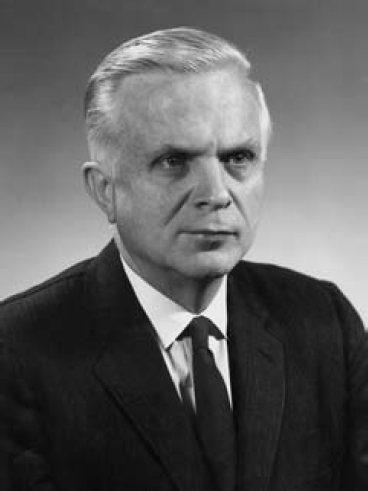
1921–2009
Elected in 1976
“For pioneering research and application in the aerodynamic design of high performance aircraft.”
BY RICHARD H. PETERSEN
SUBMITTED BY THE NAE HOME SECRETARY
RICHARD T. WHITCOMB, aviation pioneer, died in Newport News, Virginia, on October 13, 2009, at the age of 88. The National Aeronautics and Space Administration (NASA) Langley Research Center engineer has been called the most significant aerodynamic contributor of the second half of the 20th century. His work changed the way we fly today with three design innovations that allowed airplanes to fly farther and faster using less fuel. He was elected to the National Academy of Engineering in 1976 for his “pioneering research and application in the aerodynamic design of high performance aircraft.”
Born on February 21, 1921, in Evanston, Illinois, Richard Travis Whitcomb was the son and grandson of engineers. He grew up in Worcester, Massachusetts, in an era when aviation pioneers such as Charles Lindbergh were household names. He built and flew rubberband-powered model airplanes. His interest in aerodynamics continued into college at Worcester Polytechnic Institute, where he joined the aeronautics club and spent a lot of time in the school’s wind tunnel.
Whitcomb came to what is now NASA’s Langley Research Center in Hampton, Virginia, in 1943, during World War II, after graduating with a bachelor of science degree in mechanical engineering with highest honors. It was a busy time for aeronautical engineers working to improve America’s military
air superiority, and Whitcomb dived right in. In less than a decade he tackled and solved one of the biggest challenges of the day—how to achieve practical, efficient transonic flight.
In interviews over the years, Whitcomb told how he was sitting one day with his feet up on his desk when he had a “Eureka!” moment and came up with what is known as the Area Rule. He theorized that the shape of the fuselage could be changed to reduce the aircraft shock wave drag that occurs near the speed of sound. The basic idea was to ensure a smooth cross-sectional area distribution between the front and back of the plane. Because projections from the fuselage increase a plane’s cross section, narrowing the fuselage where the wings and tail assembly attach reduces drag. “We built airplane models with Coke-bottle shaped fuselages and lo and behold the drag of the wing just disappeared,” said Whitcomb. “The wind tunnel showed it worked perfectly.” (The wind-tunnel model Whitcomb used to develop the Area Rule is displayed in the Smithsonian’s Air and Space Museum.)
The Area Rule was first tested in flight on the Convair YF-102, a delta-winged jet fighter that flew well at supersonic speeds but had difficulty passing through transonic speeds. The plane was lengthened and given the now-famous “Coke-bottle” fuselage. In the words of a test pilot, the redesigned Convair YF-106 “slipped right past the speed of sound and kept on going.”
For his development of the Area Rule the Langley engineer, aged 34, was awarded the National Aeronautics Association’s Collier Trophy for the greatest achievement in aviation in 1954. Previous recipients included aviation pioneers such as Glenn H. Curtis, Glenn L. Martin, Elmer A. Sperry, and Donald W. Douglas.
Looking at almost any large airplane today—especially those that fly at transonic and supersonic speeds—one can see the genius of Dick Whitcomb. He developed three important aeronautical innovations while working at NASA Langley, one in each decade of his career. The Area Rule was Whitcomb’s major accomplishment of the 1950s, but his “supercritical wing” revolutionized the design of jet liners after the 1960s.
The key was the development of an airfoil that was flatter on the top and rounder on the bottom with a downward curve on the trailing edge. That shape delayed the onset of drag, increasing the fuel efficiency of aircraft flying close to the speed of sound.
In the 1970s it was an article on birds that led Whitcomb to develop his third significant innovation—winglets—refining an idea that had been around for decades. Other engineers had suspected that end plates added to the wing tip could reduce drag. But the Langley engineer proved a simple vertical plate wasn’t enough. “It is a little wing. That’s why I called them winglets,” said Whitcomb. “It’s designed with all the care that a wing is designed.” Winglets reduce wingtip vortex drag and increase lift, thus improving aerodynamic efficiency. Many airliners and private jets use winglets for better fuel performance.
Those who worked with Whitcomb remember him as brilliant, driven, and single-minded with aerodynamics dominating his thoughts at work and at home (he never married). He often would work a double shift, taking a short nap on a cot next to the wind tunnel where he tested, and then going right back to work. He was known for his intuitive sense of airflow and aerodynamics. “I didn’t run a lot of mathematical calculations,” he said, “I’d just sit there and think about what the air was doing, based on flow studies in the wind tunnel.” His co-workers said he had an uncanny sense of aerodynamics, unbelievable concentration, and a phenomenal memory.
The famed aerodynamicist retired from NASA Langley in 1980, but his contributions remain some of the research center’s greatest accomplishments. He continued to work as a consultant for NASA and for aerospace companies. He did not work for money and had little use for it. He often used expired checks as bookmarks.
Whitcomb earned many honors in his life. Besides the Collier Trophy, he received the U.S. Air Force Exceptional Service Medal in 1955, the first National Advisory Committee for Aeronautics Distinguished Service Medal in 1956, the NASA Exceptional Scientific Achievement Medal in 1959, the
National Medal of Science (personally conferred by President Richard Nixon) in 1973, and the National Aeronautics Association’s Wright Brothers Memorial Trophy in 1974. He also was inducted into the National Inventors Hall of Fame in 2003 and the Paul E. Garber First Flight Shrine at the Wright Brothers National Memorial. Whitcomb’s alma mater, Worcester Polytechnic Institute, also awarded him an honorary doctorate in 1956 and its Presidential Medal in 2003.
“There’s been a continual drive in me since I was a teenager to find a better way to do everything,” Whitcomb told the Washington Post in 1969. “A lot of very intelligent people are willing to adapt, but only to a certain extent. If a human mind can figure out a better way to do something, let’s do it. I can’t just sit around. I have to think.”


