
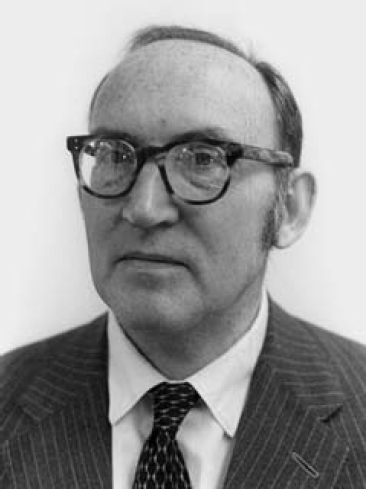
1913–2010
Elected Foreign Associate in 1977
“For pioneering development of practical electronic computers and leadership in computer science.”
BY MARTIN CAMPBELL-KELLY
SUBMITTED BY THE NAE HOME SECRETARY
SIR MAURICE VINCENT WILKES FRS, a pioneer of British computing and professor emeritus at Cambridge University, died on November 29, 2010, at the age of 97.
Wilkes was born on June 26, 1913, in Dudley, a town in the English midlands. His father was an administrator for the estate of the Earl of Dudley, his mother a housewife. He was educated at King Edward VI Grammar School in the town of Stourbridge. In his early teens he read Wireless World and built crystal sets—experience for which he was very grateful when it came to building electronic computers two decades later. He entered St. John’s College, Cambridge University, in 1931, where he read mathematics.
In 1935 he became a research student at the Cavendish Laboratory, Cambridge University, working on the propagation of long radio waves. A turning point in his life occurred when he attended a lecture by Douglas Hartree, a computing expert and professor of mathematical physics at Manchester University. In 1937, when the university established the Mathematical Laboratory for practical computing, Wilkes leapt at the opportunity to become its manager.
On the outbreak of war, Wilkes was enlisted in the scientific war effort. He worked on radar and operations research, building up a network of contacts that would prove invaluable in the postwar period.
At the end of the war, Wilkes returned to Cambridge University, with the mission to rebuild the Mathematical Laboratory. Electronic computing was in the air. At the Moore School of Electrical Engineering, University of Pennsylvania, the ENIAC, the world’s first electronic computer for defense calculations, designed by J. Presper Eckert and John Mauchly, had just been completed. Eckert and Mauchly, together with John von Neumann, subsequently produced a proposal for the EDVAC, the blueprint of the modern stored-program digital computer. In the summer of 1946, Wilkes was one of a handful of Britishers invited to attend a course on electronic computers at the Moore School. Sailing home on the Queen Mary he began the design of a machine he called the Electronic Delay Storage Automatic Calculator, EDSAC for short, an acronym consciously chosen as a tribute to the EDVAC.
Work started on building the EDSAC in early 1947. The following spring Wilkes married Nina Twyman, a classicist he had met in Cambridge; they had three children.
Almost everything in the EDSAC had to be done from first principles—memory technology, electronic arithmetic and logic, and control circuits. The machine sprang to life on May 6, 1949, the world’s first practical electronic computer. (Manchester University had got there first in June 1948 with an experimental machine, but the EDSAC was the first capable of running realistic programs.) By the beginning of 1950 the Mathematical Laboratory was offering a regular computing service. Wilkes decided that the laboratory would specialize in writing programs rather than building computers. He was perhaps the first person to recognize that what we now call software (a term not used until about 1960) would prove to be a worthwhile academic pursuit. Heavy use of the laboratory’s facilities was made by Cambridge University’s researchers, including some of its luminaries—such as John Kendrew, Fred Hoyle, and Martin Ryle. Kendrew’s calculations for determination of the molecular structure of myoglobin, for which he received a Nobel Prize in 1962, were largely done on the EDSAC.
EDSAC was soon loaded to capacity, and plans were laid for a successor, EDSAC 2. Wilkes came up with a new design principle—which he called microprogramming—that greatly simplified the logical design of the new computer. Microprogramming was Wilkes’s most important scientific contribution to computing, and had he done nothing else he would be famous for that. In the early 1960s IBM based its world-beating System/360 computers around the idea, and it remains a cornerstone of computer architecture.
Wilkes played an influential role in promoting computing in Britain, being elected to the Royal Society in 1956, becoming inaugural president of the British Computer Society in 1957, and serving as the British representative for the International Federation of Information Processing Societies.
He was appointed professor of computer technology at Cambridge in 1965, a title deliberately chosen to distance himself from the theoretically minded professors of computing science who were by then being appointed in large numbers. At heart he was an engineer. He received the Association for Computing Machinery’s (ACM) Turing Award in 1967 and the Harry Goode Memorial Award of the American Federation of Information Societies in 1968. Later honors included the Institute of Electrical and Electronics Engineers (IEEE)/ACM Eckert-Mauchly Award, the McDowell Award of the IEEE Computer Society, the Pender Award of the University of Pennsylvania, and the Faraday Medal of the Institution of Electrical Engineers.
Wilkes remained director of the Computer Laboratory (the name was changed from the Mathematical Laboratory in 1970) until he reached the statutory retirement age of 67 in 1980. His tenure had seen computers evolve from scientific instruments to information processing machines that were the basis of a worldwide industry.
Wilkes was deeply interested in the history of his subject. His early writings in the 1950s are almost unique for the historical context in which he placed contemporary developments. He became an authority on Charles Babbage, the Victorian
computer pioneer, making a study of his manuscripts in the Science Museum Library, London—the first modern scholar to do so.
Wilkes loved America and Americans. Following his retirement from Cambridge University, he took up a position as a senior consulting engineer with the Digital Equipment Corporation in Maynard, Massachusetts. There he enjoyed the American way of life and hospitality and developed an abiding friendship with I. Bernard Cohen, professor of the history of science at Harvard University.
Quite incapable of retiring, in 1986 he returned to Cambridge, where he became a board member of Olivetti-AT&T Research Laboratories. He continued to make technical contributions and publish historical articles about Charles Babbage and his milieu. In 1992 he was the first recipient of the Kyoto Prize, the most prestigious and financially rewarding award that computer science can offer. He was elected a fellow of the ACM in 1994 and received the IEEE von Neumann Medal in 1997. He was knighted in 2000.
Sir Maurice is survived by his son, Anthony, and two daughters, Margaret and Helen; Lady Nina predeceased him in 2008.
This page intentionally left blank.


