
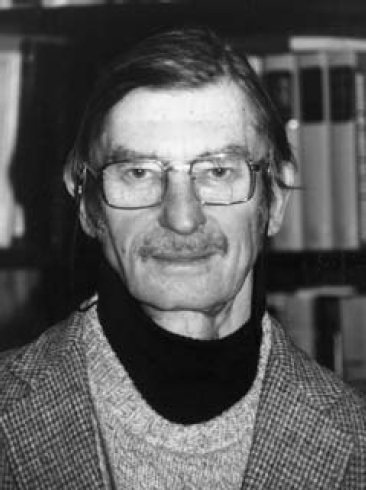
1924–2005
Elected in 1977
“For contribution to the theory and application of microwave propagation in complex media and for leadership in engineering education.”
BY THEODOR TAMIR
SUBMITTED BY THE NAE HOME SECRETARY
LEOPOLD B. FELSEN, an internationally renowned authority on wave electrodynamics with applications to electrical engineering, optics, acoustics, and geophysics, died on September 24, 2005, at the age of 81.
Leo, as his close colleagues and friends generally knew him, was born in Munich, Germany, on May 7, 1924, to Jewish parents. Upon witnessing anti-Semitic persecutions that were initiated by the Nazis before World War II, his parents sent him in 1939 to England, after which he managed to reach New York in 1940. As a new American, he served in the Army for three years. He thereafter married his wife Sima in 1944 and they had two children, Michael and Judy.
Prompted by an early but keen mathematical insight and interest in science and engineering, Leo studied at the Polytechnic Institute of Brooklyn (now Polytechnic Institute of New York University), where he received the degrees of B.E.E., M.E.E., and D.E.E. in 1948, 1949, and 1952, respectively. He then joined the faculty of that institute, where he became
professor of electrophysics in 1961, dean of engineering in 1974, university professor in 1978, and university professor emeritus in 1994. In 1975 his wife Sima died, and a few years later Leo learned that he suffered from a rare form of muscular dystrophy that slowly wasted away his muscular system. To live closer to his family, he substantially reduced his activities at the Polytechnic in 1994 and joined Boston University as a professor in the Aerospace and Mechanical Engineering Department.
Leo was granted top-rank membership as life fellow in the Institute of Electrical and Electronics Engineers (IEEE), fellow of the Optical Society of America (OSA), and fellow of the Acoustical Society of America (ASA). He received many additional honors in his lifetime, which included a Guggenheim Fellowship in 1973, IEEE/APS Distinguished Lecturer in 1974, the Van der Pol Gold Medal from the International Radio Science Union (URSI) in 1975, the Humboldt Foundation Senior Scientist Award from the Federal Republic of Germany in 1980, the IEEE Centennial Medal in 1984, the IEEE Heinrich Hertz Gold Medal in 1991, the Antennas and Propagation Society Distinguished Achievement Award in 1998, and the IEEE Electromagnetics Award in 2003. In addition, he was granted many awards for distinguished papers authored or coauthored by him; also, he was honored with special recognition awards by academic institutes and professional societies for his excellence in teaching and research.
Throughout his career, Leo held named visiting professorships and fellowships and was invited to visit and lecture at distinguished universities and research institutes in the Soviet Union, Japan, China, Brazil, Korea, Israel, Germany, Turkey, Italy, and other European countries. In that context, he received honorary doctoral degrees from the Technical University of Denmark (1979); the University of Sannio, Italy (2003); the Technical University of Munich, Germany (2004); the Polytechnic University, New York (2005); and the Dogus University of Istanbul, Turkey (2005).
Leo’s most significant early achievement was the book Radiation and Scattering of Waves (Prentice-Hall, 1973) on which
he devoted a major portion of his time for five years with Nathan Marcuvitz as coauthor. This book was reprinted in 1996 by IEEE as a classical and invaluable resource for rigorously solving a multitude of analytical problems involving fields and waves in electromagnetics, optics, acoustics, geophysics, and other areas of applied physics. A main feature of the book is the twofold view in time and frequency domains, which is treated with the systematic rigor that characterizes all his work. An important and very useful aspect is the emphasis on alternative Green’s representations; these are subsequently treated in terms of spectral and asymptotic solutions that lend insight into physical interpretations of the relevant phenomena.
Leo’s professional papers span a period that started in 1952, and their impact has been continued posthumously by his many collaborators. He published over 350 articles on a wide variety of topics, a short list of which includes the classification and properties of basic (surface, leaky, lateral, creeping, etc.) waves that appear in actual propagation and scattering problems; the development of augmented ray-tracing techniques that connect typical sources to scattering objects; the construction of hybrid representations involving finite numbers of rays and modes that effectively describe field representations that otherwise require an infinite number of terms; the derivation of solutions to canonic problems involving realistic beams having bounded cross-sections; the extension of modal and ray techniques to the study of transient wave propagation in complex environments; and many other related topics as well as their application to typical configurations in electromagnetics, optics, acoustics, and geophysics.
Leo’s dedication to the study of wave phenomena motivated him to participate in every major national or international conference that addressed the latest progress on theoretical aspects in the above areas. His attendance was often by invitation and, during presentations by others as well as in subsequent technical discussions, his views usually provided the conclusive arguments on debates concerning the validity of a given approach to specific problems and their solutions.
While Leo’s most cherished activity was his academic research, he was also sought after and highly recognized for his teaching activities. In this context, he offered primarily graduate courses on basic aspects of propagation, scattering, and guiding of waves. In these courses, his approach was to deftly combine mathematical rigor with models of actual applications while at the same time emphasizing the strengths and weaknesses of various methods. He made a point of stressing the elegance and utility of canonic problems; he clearly presented the latest state-of-the-art techniques and indicated the principal as-yet-unsolved problems. Most importantly, his course assignments were actually mini-projects whose basic aspect and treatment often served as a prelude to M.S. and Ph.D. dissertations. Needless to say, those courses turned out to be an inspirational source to many of his students, as well as to colleagues with interest in wave phenomena.
Perhaps most impressive was Leo’s heroic achievement in living a full and productive life after being stricken by his unforgiving and progressive muscular illness. He did not just stoically accept a debilitating situation, but he adroitly accommodated his daily activities and scientific pursuits so as to continue taking full advantage of his brilliant intellectual capacity. It is simply amazing that he was able to continue until his death a distinguished professional career, both working on his own and in collaboration with many others. By adding to this a piquant humor and charming his friends with insightful verses that he composed for many odd occasions, Leo was an inspiration to all his professional peers as well as to his younger colleagues.
A few of Leo’s additional sides: In his earlier years, he was an avid hiker, and remained a lover of nature, and especially the mountains, throughout his life. He was a true humanist; he appreciated and respected the many cultures found around the globe and knew that he was fortunate to have had the opportunity to experience so many of them firsthand, through his wide professional travels and his diverse relationships with students and colleagues. He very much enjoyed following the
exploits of his three growing grandsons, just as he relished offering the obligatory sage advice from “grumpy gramps.” And there were few family events at which he didn’t offer a topical poem or limeric—sometimes gently gibing, but just as often wittily self-mocking—to liven up the festivities.
Indeed, even though English was not his native tongue, he became a real admirer and master of the language. His prose was elegant, but his poetry—whether on scientific themes or philosophical musings or family matters—was his pastime and his real pride and joy. For years he authored the “Poet’s Corner” in the IEEE Antennas and Propagation Magazine, penning rhymes about waves and computers and conferences and the comradeship of colleagues. For a symposium luncheon honoring his birthday in 1990, he wrote about himself:
You’ve been a gadfly through critique
With questions often sharp, direct.
While this may not engender love
With those who’ve worked up close with you,
Heated debates have spurred the quest
To find the route that formulates
A controversial issue best.
And as you inch along that path,
Your sparring can become intense.
Yet close encounters of this kind
Have transformed colleagues into friends.
In his later years, as his body became increasingly feeble, his mind remained sharp, engaged, and intrigued by life’s mysteries. He appreciated each day, but also was well aware of his mortality, and was moved to comment on it from time to time. The following poem, written a few years before his death at 81, provides a small window into how he contemplated his passing from the stage:


