
Opportunities to Enhance Research in Antarctica and the Southern Ocean
As the foregoing chapters have noted, Antarctica and the Southern Ocean provide extraordinary opportunities to study questions that go deep within and across many disciplines. This chapter examines opportunities to enhance future scientific research in Antarctica and the Southern Ocean through collaboration; energy, technology, and infrastructure; and education. This chapter also describes a proposed initiative for an observing network with data integration and enhanced scientific modeling.
In the first half of the 20th century, many of the nations that were interested in Antarctica were primarily concerned with claiming territory. Since then, as Antarctica has become a haven for science, research in Antarctica and the Southern Ocean has grown into a large and successful international scientific enterprise. Throughout this evolution, collaboration has played a valuable role. This includes collaboration in several senses: across national borders, across disciplinary boundaries, between public- and private-sector entities, and between scientists and the logistical support providers who facilitate the conduct of science in these harsh environments. Each of these is explored in this section, but the general observation on the necessity of collaboration is as simple as stating that by working together new things can be done, and be done more affordably. Moreover, increasingly collaboration across any one of these areas encourages collaboration in others.
International Collaboration
One of the easiest places to see the growth in collaboration is among nations. The Antarctic Treaty process, led in part by the United States in 1959, has to date enrolled 48 countries, more than 20 of which operate more than 40 permanent, manned science bases on the continent (Box 4.1, Table 4.1, Figure 4.1). Many of these countries were
BOX 4.1 THE ANTARCTIC TREATY SYSTEM
The Antarctic Treaty System originated in 1961 during the height of the Cold War, and although the Cold War effectively ended more than two decades ago, the Antarctic Treaty System remains in force. The countries that are signatories to the Antarctic Treaty System are listed in the table below. One might argue, given the importance of Antarctica and the Southern Ocean for the conditions of the larger world, that the treaty system is now more important than ever. The Antarctic Treaty System provides the foundation for treating the continent of Antarctica as a scientific research zone, while excluding hostile military activity and territorial conquest. Subsequent additions to the Antarctic Treaty System of the Convention for the Conservation of Antarctic Marine Living Resource, which manages fishing in the Southern Ocean, and the Environmental Protocol provide explicit regulations to maintain the comparatively pristine conditions of the continent.
TABLE Signatories of the Antarctic Treaty System, Country and Date Joined (as of 2011)
| Argentina | 23-6-61* | Japan | 23-6-61* |
| Australia | 23-6-61* | Korea DPRK | 21-1-87 |
| Austria | 25-8-87 | Korea ROK | 28-11-76 |
| Belgium | 23-6-61* | Monaco | 30-5-08 |
| Belarus | 27-12-06 | Netherlands | 30-3-67 |
| Brazil | 16-5-75 | New Zealand | 23-6-61* |
| Bulgaria | 11-9-78 | Norway | 23-6-61* |
| Canada | 04-5-88 | Papua New Guinea | 16-9-75 |
| Chile | 23-6-61* | Peru | 10-4-81 |
| China | 08-6-83 | Poland | 23-6-61 |
| Colombia | 31-1-89 | Portugal | 29-1-10 |
| Cuba | 6-8-84 | Romania | 15-9-71 |
| Czech Republic | 01-9-93 | Russian Federation | 23-6-61* |
| Denmark | 20-5-65 | Slovak Republic | 01-1-93 |
| Ecuador | 15-9-87 | South Africa | 23-6-61* |
| Estonia | 17-5-01 | Spain | 31-3-82 |
| Finland | 15-5-84 | Sweden | 24-4-84 |
| France | 23-6-61* | Switzerland | 15-11-90 |
| Germany | 05-2-79 | Turkey | 24-1-96 |
| Greece | 08-1-87 | Ukraine | 28-10-92 |
| Guatemala | 31-7-91 | United Kingdom | 23-6-61* |
| Hungary | 27-1-84 | United States | 23-6-61* |
| India | 19-8-83 | Uruguay | 11-1-80 |
| Italy | 18-3-81 | Venezuela | 24-3-99 |
*Original signatory.
SOURCE: Information from Antarctic Treaty Secretariat.
TABLE 4.1 Permanent Manned Stations in Antarctica: Country and Base Names (as of 2011)
| Country | Station | ||
| Argentina | Belgrano II, Esperanza, Jubany, Marambio, Orcadas, San Martín | ||
| Australia | Casey, Davis, Mawson | ||
| Brazil | Comandante Ferraz | ||
| Chile | Arturo Prat, Bernardo O’Higgins, Eduardo Frei, Estación marítima Antártica, Julio Escudero, Rodolfo Marsh | ||
| China | Great Wall, Zhongshan | ||
| France | Dumont d’Urville, Concordia (with Italy) | ||
| Germany | Neumayer | ||
| India | Maitri, Bharathi (to open in 2012) | ||
| Italy | Concordia (with France) | ||
| Japan | Syowa | ||
| Korea | King Sejong | ||
| New Zealand | Scott Base | ||
| Norway | Troll | ||
| Poland | Arctowski | ||
| Russia | Bellingshausen, Mirny, Novolazarevskaya, Progress 2, Vostok | ||
| South Africa | SANAE IV | ||
| Ukraine | Vernadsky | ||
| United Kingdom | Halley, Rothera | ||
| United States | Amundsen-Scott, McMurdo, Palmer | ||
| Uruguay | Artigas | ||
SOURCE: Adapted from COMNAP.
motivated by reasons of national pride to establish new stations to advance their national interests. But a broader perspective and increased emphasis on collaboration is now evident as nations consider the cost of running stations, the need for geographic flexibility, and the environmental regulations involved in operating stations since the Protocol on Environmental Protection (signed in Madrid in 1991) went into effect in 1998 (Orheim, 2011). In many ways, Antarctic science provides a glimpse of how national and international scientific collaboration can proceed successfully in the future.
Increased international collaboration has been driven by recognition that many Antarctic science questions are too large to be solved by any single nation. The committee has attempted to identify areas of science that will drive research in the coming decades in Chapters 2 and 3, drawn from a number of reports (see Box 1.2). Many nations that are active in Antarctic research have published future research priorities
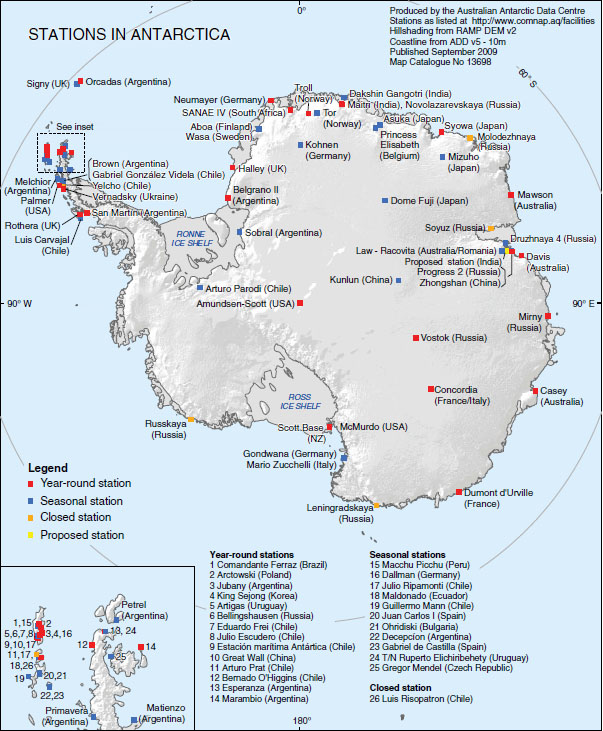
FIGURE 4.1 Map of Antarctic research stations from various countries.
SOURCE: Australian Antarctic Data Centre.
for the long term because such research requires heavy investments in logistics and infrastructure and necessitates long-term planning. A survey of plans of the European Polar Board (EPB), British Antarctic Survey, Alfred Wegener Institute (Germany), Australian Antarctic Division, and the Antarctic research organizations of New Zealand, Korea, and Norway is summarized in Table 4.2. The United States and the EPB, representing a consortium of European nations, are both involved in all elements of Antarctic research. Although the United States currently possesses the human capital, financial resources, and logistic strength to be able to take part in all segments of Antarctic
TABLE 4.2 Areas of Science Considered Priorities for Study in Antarctica and the Southern Ocean for the United States and a Sampling of Other Nations
| United States* | EU Polar Board | Australia | British Ant Survey | China | Germany | India | Korea | New Zealand | Norway | |
| Climate change and impacts | X | X | X | X | X | X | X | X | X | |
| Paleoclimate | X | X | X | X | X | X | X | X | X | |
| Ice sheet and sea level change | X | X | X | X | X | X | X | X | X | X |
| Crustal structure and subglacial geology | X | X | X | X | X | X | ||||
| Deep sea ecosystems | X | X | X | X | X | X | X | X | ||
| Earth system modeling | X | X | X | X | X | X | X | |||
| Astrophysics | X | X | X | X | X | X | ||||
| Space physics | X | X | X | X | X | X | X | |||
| Basic and applied life sciences | X | X | X | X | X | X | X | X | X | X |
| Atmospheric dynamics | X | X | X | X | X | X | X | X | ||
| Terrestrial ecology | X | X | X | X | X | X | X | X | X | |
*Priorities for the United States identified by the committee (Priorities for other nations and the EU Polar Board based on available documentation).
SOURCES: AWI, 2009; Australian Antarctic Division, 2011; British Antarctic Survey Science Programme, 2009; European Polar Board, 2010; Gupta, 2010; Lee, 2010; Ministry of Earth Sciences India, 2011; National Science Foundation, 2009; National Science Foundation Office of Polar Programs, 2011; New Zealand Antarctic and Southern Ocean Science Program, 2010; Polar Research Institute of China, 2006; Research Council of Norway, 2010.
research, the overlapping scientific priorities of the United States with those of other nations present numerous opportunities for collaboration.
Many new nations entered into Antarctic research in the 1980s, driven in part by interest in Antarctic mineral resources, national pride, and the chance to join an exclusive club of nations leading the world in scientific research. Internationally, the Scientific Committee on Antarctic Research (SCAR) has been supplemented by regional organizations such as the EPB and the Asian Forum for Polar Sciences. Antarctic science publications have been growing more quickly than publications in other areas of science, tripling between 1981 and 2009 (Figure 4.2) (Aksnes and Hessen, 2009). Although U.S. scientists contributed the largest portion of articles, this 2009 bibliographic analysis of 65,000 “polar” articles published in the peer-reviewed literature showed that the U.S. share declined from 34 percent in 1981-1983 to 24 percent in 2005-2007, and the share of the second-most-active country, the United Kingdom, declined from 17 to 11
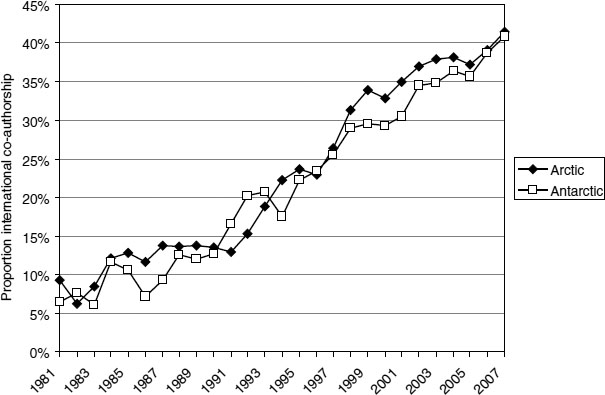
FIGURE 4.2 International co-authorship of Arctic and Antarctic publications, 1981-2007.
SOURCE: Aksnes and Hessen, 2009.
percent. Australia and Germany held their own, while countries like Italy, Spain, China, and Argentina increased their shares. In short, there is a greater diversity of nations participating in Antarctic science. There is also noteworthy growth in partnerships: collaboration within European Union (EU) countries has increased from 27 to 35 percent, between scientists in the EU and other nations from 12 to 24 percent, and among non-U.S. and non-EU nations from 3 to 6 percent. The International Polar Year (IPY) from 2007 to 2008 led to increased international collaboration, as did the U.S. National Science Foundation (NSF) requirement that IPY awards involve international partnerships (Krupnik et al., 2011; National Science Board, 2010; National Science Foundation, 2010).
International collaboration in Antarctica has produced spectacular results. One example is the joint drilling and analysis of the Vostok ice core by scientists from France, Russia, and the United States that led to publication in 1999 of a 400,000-year record of proxy temperatures and carbon dioxide (CO2) and methane (CH4) concentrations. This was one of the most important climate research results of the past decade. Other examples of successful international collaborations include the following:
• EPICA1 (European Program for Ice Coring in Antarctica) on Dome C and Kohnen station, which collects information on climate variations over the past 1 million years;
• ANDRILL2 (Antarctic Geologic Drilling) project involving Germany, Italy, New Zealand, the United Kingdom, and the United States, which studies the evolution of the Antarctic ice sheets during the past 40 million years;
• Concordia astronomical observatory involving France, Italy, and others, which aims to open new spectral windows at infrared and submillimeter wavelengths;
• Gamburtsev solid Earth investigations involving the United Kingdom, the United States, Germany, Japan, Australia, and China, which studies this very large subglacial mountain range;
• CAML3 (Census of Antarctic Marine Life) led by Australia, involving 17 ships and scientists from 20 nations, which investigates the distribution and abundance of Antarctica’s marine life;
• AMPS4 (Antarctic Mesoscale Prediction System) provides tailored numerical weather predictions that support aircraft operations, field programs, and fundamental Antarctic atmospheric research. It is a U.S. program but with active participation of 17 countries; and
________________
1See http://www.esf.org/index.php?id=855.
3See http://www.caml.aq/.
• IODP5 (Integrated Ocean Drilling Program) supported by 24 countries, which advances scientific understanding by monitoring, drilling, sampling, and analyzing subseafloor environments.
The organization of Antarctic research within countries can facilitate collaboration. In many nations, the presence of a central institute with responsibility for both logistics and science makes for rapid decision making once the case for cooperation has been accepted. Most nations engaged in Antarctic research need to collaborate to tackle large scientific questions. The U.S. Antarctic Program (USAP) has been large enough to undertake major projects alone, but, for reasons elaborated below, the USAP will probably collaborate more in the future to enable U.S. scientists to stay at the forefront of Antarctic and Southern Ocean science. Specifically, collaboration can benefit U.S. scientists when
• Research needs to be done in geographic areas where logistic support from other nations is practical and feasible;
• Other nations have instruments or other technical or logistic resources exceeding those available to U.S. scientists (e.g., see icebreaking capability below);
• Scientists in other nations are ahead of U.S. scientists and collaboration can raise the quality of U.S. Antarctic science; and
• The United States has a personpower shortage in given subject areas, and scientists from other countries can make up for that shortage.
U.S. collaborations with other strong Antarctic science communities can help achieve critical mass and density of observations to answer particular questions. Increasing international collaboration can be achieved without moving funds across national borders. Sometimes, nations can contribute in-kind portions of the total needs for a project, such as one nation supplying the aircraft and another supplying the fuel. The most important factors in increasing international collaborations are sufficient will to increase such collaborations and flexibility in meeting the needs of the science.
Interdisciplinary Collaboration
As explained in Chapters 2 and 3, science in Antarctica and the Southern Ocean is increasingly tied to research questions that cut across traditional disciplinary boundaries. A good example of this is the growing perspective of Earth system science that incorporates a wide set of the physical sciences, and the concept of ecological change
_________________
that incorporates many of the life sciences. Of course, the changes in the physical systems affect the ecology, so these two broad realms of work are increasingly pulled together as well. As the policy implications of environmental change become apparent—the changing nature of fisheries in the Southern Ocean, for example—it becomes increasingly important to understand all aspects of the phenomena in question because mitigation strategies often have serious economic and social consequences and trade-offs. It is rapidly becoming unacceptable to ask policy makers to make difficult choices without good information on the consequences of their decisions.
Discovery, as well, is increasingly interdisciplinary, where even seemingly disparate fields come together around some projects. For example, the IceCube neutrino detector required the drilling of many deep holes in ice, and, as discussed elsewhere, drilling remains a major area of engineering investigation. Similarly, IceCube is highly dependent on cyberinfrastructure, as are most other areas of scientific inquiry, and research and development in cyberinfrastructure are important areas of cross-disciplinary inquiry.
Given the extensive logistical support typically required to do research in Antarctica and the Southern Ocean, the successful execution of interdisciplinary scientific work in this region often requires successful international collaboration. Addressing many of the future science questions in Antarctica and the Southern Ocean will benefit from integrated research projects and programs that are both international and interdisciplinary.
Collaboration Between the Public Sector and Private Sector
The private sector plays an important role in scientific research, and that role has been evolving and increasing in recent decades. The private sector makes major investments in scientific research: pharmaceutical companies, agricultural chemical and seed suppliers, automobile manufacturers, and many other kinds of companies invest heavily in research to create or improve products and services. As of now, the private sector does not perform much scientific research of its own in Antarctica and the Southern Ocean, but that may change in the future. Similarly, the private sector is a primary supplier of materials and equipment for scientific research of all kinds, including chemical reagents, laboratory animals, and special instruments used in research. As one example, more than 50 companies are listed as suppliers to the biotelemetry
community.6 Some of these companies got their start by developing telemetry devices for tracking animals in Antarctica and the Southern Ocean.
Historically, scientific work in Antarctica and the Southern Ocean was largely a public-sector affair. During the early days of U.S. research in the Antarctic region, the U.S. Navy provided most of the logistics support for U.S. scientific research. This has evolved over time to the point where logistical support is provided by contract with private companies. This is one example of the interaction of the private sector with research in Antarctica and the Southern Ocean.
There are undoubtedly challenges associated with opening the activities in Antarctica and the Southern Ocean to more private-sector involvement. The committee does not make a specific recommendation about the role of the private sector here; we simply note that this role is already changing and that it is doubtful that the situation will be reversed. The possibility of more collaboration across the public and private sectors can be viewed as an opportunity, and serious exploration of opportunities for and consequences of more public-private collaboration in the region is warranted.
Collaboration Between Science and Logistics Personnel
The Blue Ribbon Panel, which NSF has convened to look in detail at logistical issues, has an opportunity to evaluate the current approach of using a single large private contractor to support U.S. science in the Antarctic region, and to address the concerns this committee heard on the increasing difficulty and logistics-related stresses in conducting research in this region. The Blue Ribbon Panel can affect the future of science in significant ways by reconfiguring U.S. logistics to be more flexible, nimble, and synchronized with the needs of science. The rapidly evolving nature of the scientific questions facing society today demands this. Scientists working in Antarctica and the Southern Ocean want more direct input into the planning and conduct of logistics.
Although many of the positive efficiency aspects of shifts in logistical support in the past two decades have been obtained by moving from military to commercial operations, the Blue Ribbon Panel has an opportunity to consider how to improve logistical support so it enhances and expands science research and discovery capacities. The three U.S. bases are situated so as to foster access to much of the continent. The U.S. program possesses unique assets such as ski-equipped LC-130s and the heavy airdrop capability of the C-17. The Blue Ribbon Panel also has the opportunity to look into the places where the United States has fallen behind (e.g., in icebreaking capability)
______________
6See http://www.biotelem.org/index.php?option=com_content&view=article&id=2&Itemid=2.
and where international collaboration could increase efficiencies in logistical support. There is great future potential in emerging and innovative ways of conducting research, such as autonomous vehicles (underwater and airborne), miniaturization of sensors, development of novel sensors, engineering innovations for deep drilling systems, and innovative sampling strategies (e.g., instrumenting marine mammals). Improvements in communications, especially data transmission and continent-wide connectivity, will be crucial to support successful science in the future from the operational needs of field parties to the movement of large quantities of data northward to U.S. laboratories. Considerations for how to enhance the efficiency, flexibility, and user friendliness of Antarctic logistical support should include discussions of appropriate relaxation of rigid fieldwork rules and fostering morale in field and base scientists. Overall, the Blue Ribbon Panel has an opportunity to examine these issues in looking to the future of logistical support for science in Antarctica and the Southern Ocean.
4.2 ENERGY, TECHNOLOGY, AND INFRASTRUCTURE
There are significant opportunities related to energy, technology, and infrastructure that can facilitate the scientific research effort in Antarctica and the Southern Ocean and bring cost efficiencies to allow a greater proportion of funds to be used to support scientific research projects directly. This section highlights a few examples of major emerging technologies; Appendix C provides a longer list of new technologies that can potentially enhance scientific research in the coming two decades.
Energy
The Antarctic region is cold, where high winds (>160 km/h) and low temperatures (<−50°C) are common. During the winter the continent is frequently icebound, and severe storms and darkness prevent most air operations and make lighting and heating for personnel a primary challenge. The Antarctic Treaty System and its Environmental Protocols require that much of what is brought to Antarctica be shipped home, so supply chain and waste management requires significant effort. Science operations in the Antarctic and Southern Ocean are energy intensive, a fact long understood by explorers and scientists. As a result, managers in Antarctica and the Southern Ocean are always looking for innovations related to energy production and use. For example, during the 1960s a small nuclear plant was built at McMurdo Station in an attempt to provide more reliable electric power generation. (Note that the Antarctic Treaty does not prohibit peaceful uses of nuclear science or nuclear power.) Unfortunately, the 1.75 megawatt PM-3A reactor developed mechanical problems, including leaks, and
the plant had to be decommissioned and dismantled (U.S. Naval Nuclear Power Unit, 1973). Although this particular innovation did not last, Antarctica has been and can continue to be an important testing ground for future energy innovations.
Currently, most of the energy for Antarctic science is provided by combustion of fossil fuels, primarily jet fuel and gasoline treated to withstand the low temperatures. These fuels are consumed for transportation, electric power generation, space heating, desalination and melting ice for potable water, washing, and other needs at both the field camps and the permanent stations. The fuel pipeline for much of the continent starts at McMurdo, where the station receives most of its annual 5.3 million gallons of fuel delivered by ship. Fuel is then transferred from McMurdo to airstrips and helioports via a flexible hose. Aircraft annually move over 600,000 gallons of jet fuel and gasoline to Amundsen-Scott South Pole Station to power diesel generators, provide heating, and fuel vehicles. Palmer Station has no permanent fixed-wing landing facilities and receives all its fuel via ship. In addition to cost, combustion of fossil fuels pollutes the air, and storage and transport can leak fuel into the water, ice, or ground.
Looking to the future, innovation in energy continues to be an active concern in Antarctica and the Southern Ocean. For example, a new overland traverse route using tractors and sleds promises to reduce the cost of fuel transport from McMurdo to South Pole Station. In another example, in 2008 Antarctica New Zealand and the U.S. Antarctic Program worked together to install three 330-kW wind turbines on the ridgeline of Crater Hill between McMurdo Station and Scott Base (Figure 4.3). The wind power generation system was integrated with the McMurdo and Scott power distribution network and has proven highly reliable despite the extreme weather conditions at McMurdo. Approximately 15 percent of McMurdo’s and nearly 90 percent of Scott Base’s electricity needs are now provided by this system. Analysis by the National Renewable Energy Laboratory suggests that expansion of wind electric power generation at McMurdo and extension of this capability to Amundsen-Scott South Pole Station could save as much as half a million gallons of fuel per year and produce net savings of $20 million over 20 years (Baring-Gould et al., 2005). It seems likely that adoption and adaptation of smaller, energy-efficient technologies will add significantly to energy savings in the region over time.
New science technologies discussed below will require energy. Remotely operated or autonomous sensor networks will play a critical role in data collection across a wide variety of scientific fields in Antarctic and Southern Ocean research. Energy is required for materials and personnel transport, facilities operations, and data collection, processing, storage, and transmission. A strategy that relies exclusively on fossil fuels and combustion will probably not be efficient and cost effective over the long run. In-
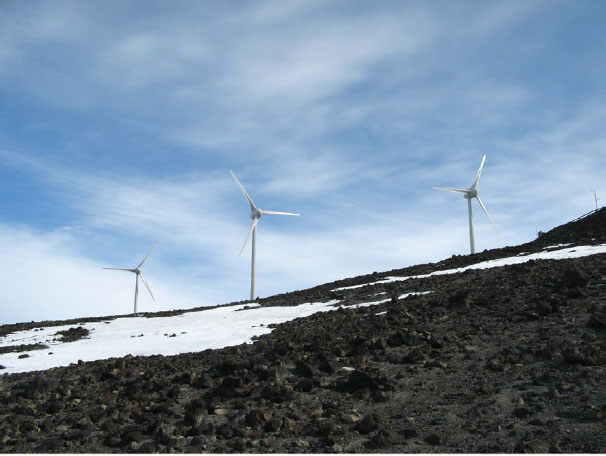
FIGURE 4.3 Three wind turbines located between McMurdo Station and Scott Base that provide energy to both stations.
SOURCE: Mike Casey, NSF.
novations such as wind and solar power will likely play a role in many of the current energy-intensive activities, and battery technology, fuel cells, and other mechanisms for energy generation and storage should be explored in the challenging conditions of the Antarctic region. Overall the Antarctic and Southern Ocean region has the opportunity to continue to be an important testbed for new energy concepts for other extreme climates, such as the Arctic. This also offers a potential opportunity for public-private partnerships in research and development.
Technology
Previous chapters in this report have shown the need for observations to be made in more places and at more times in Antarctica and the Southern Ocean. The conditions
in the Antarctic region are often challenging for observers and instruments alike. The advancement of technology, both in the instruments that make measurements and in the platforms that support those instruments, can help to overcome those challenges.
In addition to overcoming challenges, the emergence of new technologies can open up new capabilities. One example is the emergence of miniaturized computers, which has allowed small instruments to be attached to diving animals. These instrumented animals have measured the conductivity, temperature, and depth of the ocean in some areas where ice cover had previously impeded such measurements by ship or mooring (mentioned in Section 3.2). This is one example out of many where the exploitation of new technology has led to a scientific advancement in oceanography and animal ecology and physiology. It is important to remember that new technologies often appear “by surprise,” meaning that cost-effective deployment comes after a considerable lag time from when the ideas behind the technology were first articulated and the proof-of-concept work was finished. A good example is the Internet. Work on what became the Internet began in the late 1960s, but relatively few people knew about it until the mid-1990s when the network was officially named the Internet (Abbate, 1999). The cultures of technical development are complicated, and one cannot simply expect new and useful technologies to appear as needed. A theme throughout this discussion of technology is that new capabilities—for energy, remote sensing, cyberinfrastructure, icebreaking, or any other activity important in the Antarctic and Southern Ocean—must be nurtured over significant periods of time, sometimes decades, before they prove their worth in the field.
Looking to the future, there are numerous emerging technologies that have the potential to expand, and even revolutionize, science’s observational capacity. Three such examples are autonomous underwater vehicles (AUVs), long-duration balloons and air ships, and mobile drilling capacity for rapid drilling; see Figure 4.4. AUVs allow investigators to access difficult environments such as within cavities underneath ice shelves. Long-duration balloons and air ships allow instruments to access the upper portion of the atmosphere for extended periods of time, even potentially years at a time. Mobile drilling capacity, such as the FASTDRILL project, will allow for rapid drilling of multiple holes that significantly improves information output. Examples of platforms like these that provide access for measurements in more locations, with greater frequency, and at more times of the year will help provide needed data to address the types of science questions listed in Chapters 2 and 3. New technologies have the potential to affect all aspects of science, and a fuller, but by no means complete, list of emerging technologies is included in Appendix C. A continued effort to incorporate and adopt new technologies can ensure increased efficiency in U.S. research efforts.
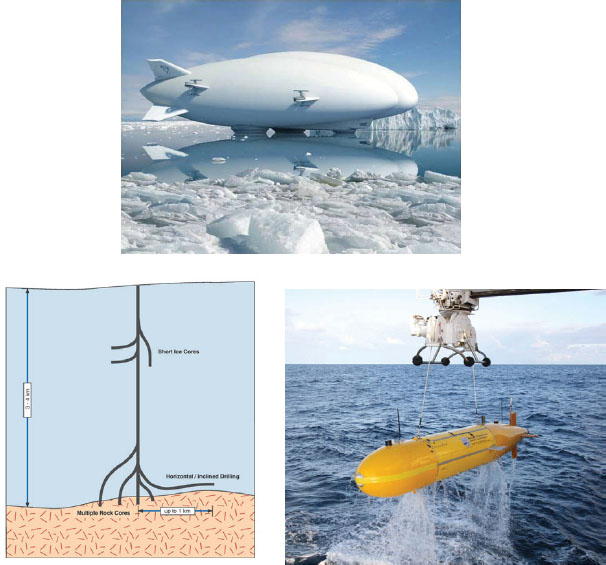
FIGURE 4.4 Medium-altitude blimp systems (top) can be self-sustaining, powered by solar and fuel cells. FASTDRILL (left) allows for the rapid drilling of multiple holes. The AUTOSUB (right) is propeller driven and programmable for navigation. SOURCES (from left to right): © Lockheed Martin 2008. Reprinted by permission; Clow and Koci, 2002; and National Oceanography Centre, Southampton.
Two special topics within this area are the use of research ships and icebreakers, both of which need to be considered for access to fully and partially ice-covered seas.
Research Vessels
Research ships have long been used for sampling of ocean temperature, salinity, plankton, and seawater chemistry, as well as the installation and servicing of moorings to monitor ocean properties and the launching of autonomous sampling systems. The expansion of physical and biological oceanography research in the Southern Ocean will require research ships that are capable of operating in fully and partially ice-covered seas.
Currently, much of the oceanography work in the Southern Ocean is performed from two privately owned research ships (the Laurence M. Gould and the Nathaniel B. Palmer, both leased by NSF from Edison Chousest Offshore, Inc.); these are able to navigate in the ice conditions around the Antarctic Peninsula but are not the polar class research icebreakers PC3 or PC5 (Appendix D, Table D.1) needed for scientific support around the Antarctic coast and ice-covered Southern Ocean. The U.S. Coast Guard cutter Healy can operate in ice-covered seas and has power and displacement greater than other icebreakers used for scientific research in the Arctic and Antarctica (e.g., Oden [Sweden], Polarstern [Germany]). There is a need to examine the fleet of research vessels in the United States, particularly with respect to ships that operate in fully and partially ice-covered seas; this is discussed in more detail in a previous NRC report, Critical Infrastructure for Ocean Research and Societal Needs in 2030 (National Research Council, 2011c), and an analysis of U.S. Coast Guard capabilities (O’Rourke, 2011).
Heavy Icebreakers
Heavy icebreakers are a special class of surface ships that are essential to the conduct of science in Antarctica and the Southern Ocean, providing access for ocean and coastal research in heavy ice covered seas, and allowing fuel and supplies to reach research stations. They are complex, sturdy vessels that are inherently expensive. Icebreakers are discussed in more depth in Appendix D, with a brief summary provided here. Anticipated scientific research needs in Antarctica and the Southern Ocean will require the services of heavy icebreakers, not only to break ice and clear out harbors, but also to support research missions for less-capable polar research vessel ice-
breakers and act as helicopter platforms. In addition, scientific operations at McMurdo now totally rely on the annual resupply in late Austral summer of fuel and materials; this is done by transport ship and tanker and requires heavy ice-breaking capacity.
There is a critical shortage of U.S. heavy icebreaking capacity in Antarctica and the Southern Ocean at this time. The two U.S. Coast Guard heavy icebreakers, Polar Sea and Polar Star, are more than 30 years old and have exceeded their service lives. The Polar Sea is to be decommissioned in 2011. The Polar Star is undergoing engine repairs and refitting needed to extend this ship’s service for a limited period; repairs are expected to be complete in 2013. As concluded by the 2007 NRC report Polar Icebreakers in a Changing World, the “operations and maintenance of the polar icebreaker fleet have been underfunded for many years” (National Research Council, 2007b).
The purchase of any new polar class icebreakers by the United States will be expensive. Alternatives for building heavy icebreaker capability include partnerships with other countries and leasing icebreakers flagged by other countries, such as the successful collaboration between the United States and Sweden using the icebreaker Oden. The arrangement with Sweden is not permanent, however, and the Oden will not be available for the McMurdo break–in during the 2011-2012 austral summer; thus, another polar class icebreaker must be engaged for this essential resupply mission. A contract has been signed by the NSF and the Murmansk Shipping Company to provide the Russian diesel electric heavy icebreaker Vladimir Ignatyuk to perform the McMurdo break-in for the 2011-2012 season, with options for two more years of support.
Other reports have discussed the need for the United States to have its own icebreaking capacity, including three previous NRC reports, a congressional analysis, and a Homeland Security audit (National Research Council, 2007b, 2011c, 2011e; O’Rourke, 2011; Richards, 2011). These documents conclude that there are strong national security and operational reasons for the nation to develop its own icebreaking capability. As stated in the Critical Infrastructure for Ocean Research and Societal Needs in 2030 (National Research Council, 2011c) report, “the nation should recover U.S. capability to access fully and partially ice-covered seas.” Based on the scientific research needs outlined in this report, the committee strongly supports the conclusion that the United States should develop sufficient icebreaking capacity, either on a national or international basis. Any arrangement should ensure that the U.S. needs in Antarctica and the Southern Ocean, for both research vessel support, and in particular the annual break-in supplying McMurdo, can be met by secure, reliable, and heavy icebreaking capacity.
Infrastructure
Science activity in the Antarctic region is dependent on facilities and on transport, and as noted above in the energy section, successful science depends on adequate provision of energy. Ships bring heavy cargo and fuel to support operations at Palmer Station and McMurdo Station. Aircraft bring personnel and equipment from Christchurch, New Zealand, down the 170° East meridian to McMurdo Station. From McMurdo, aircraft take personnel and equipment to the Amundsen-Scott South Pole Station or other locations, and supply materials and much of the fuel to those sites as well. The McMurdo-South Pole overland heavy traverse was established during the 2008-2009 season, and has continued each season. Many waste materials are required to be taken away from the inland sites, and eventually away from the continent.
Physical Infrastructure
Science activity in the Antarctic region is dependent on facilities and on transport, and as noted above in the energy section, successful science depends on adequate provision of energy. Ships bring heavy cargo and fuel to support operations at Palmer Station and McMurdo Station. Aircraft bring personnel and equipment from Christchurch, New Zealand, down the 170 meridian to McMurdo Station. From McMurdo, aircraft take personnel and equipment to the Amundsen-Scott South Pole Station or other locations, and supply materials and much of the fuel to those sites as well. The McMurdo-South Pole overland traverse is starting but is not yet established as a routine and reliable supply strategy. Many waste materials are required to be taken away from the inland sites, and eventually away from the continent.
Both transportation and facilities have improved dramatically over the past decades; an improvement that is easy to see given the existence of well-preserved huts left by the explorers of a century ago. It is reasonable to expect significant additional improvements in infrastructure in the coming years, and these improvements represent opportunities for improved efficiency and effectiveness. One of the most promising examples is the installation of wind turbines for electric power generation at McMurdo Station and New Zealand’s Scott Base, discussed earlier. Similarly, ongoing improvements in materials technology have resulted in better building materials, clothing and outerwear, and scientific equipment.
One concern worth considering is the degree to which inherently harsh environments such as Antarctica and the Southern Ocean should be made to resemble settled areas elsewhere. A campsite does not necessarily require all the features of a modern
city, and temporary field facilities for scientific work may be reasonably safe without meeting electrical and other code requirements for permanent buildings. Anecdotal evidence suggests that imbalances along these lines are common, with expectations for safety outweighing practicality. The health and safety of personnel are important, but overzealous development and enforcement of safety protocols can interfere with scientific work and add to the costs of supporting such work. A reasonable balance could be sought. The committee encourages the Blue Ribbon Panel to examine these issues as part of its review of the logistical support of science in Antarctica and the Southern Ocean.
The impacts of global human activity, such as increasing releases of greenhouse gases into the atmosphere and the resulting global climate change, far outweigh the impact researchers will have on Antarctica and the Southern Ocean. Yet stewardship of this fragile environment will require continual vigilance. The “footprints” of stations such as McMurdo or the South Pole Station should be kept as minimal as possible and researchers should strive to ensure that exploration does not lead to irreversible changes in the environment, such as possible contamination of subglacial lakes from drilling into these fragile environments.
Cyberinfrastructure
Scientific research in Antarctica and the Southern Ocean is already moving toward the deployment of extensive sensor networks that generate vast amounts of information. Remote sensing is now an important element of astronomy, physics, climate, oceanography, and biology. The kinds of novel sensors discussed earlier in this section and later in this chapter can usher in an era of “big data” for Antarctica and the Southern Ocean. Significant information processing capability would need to be located directly on the Antarctic continent to provide preliminary analysis of these data and to clean and compress the data for efficient transmission to and analysis by researchers and U.S. government agencies located in the United States and elsewhere.
Cyberinfrastructure support for research in Antarctica and the Southern Ocean is currently limited. Some facilities (e.g., the Amundsen-Scott South Pole Station) are often beyond the range of major communication satellites in geostationary orbit above the equator because of the curvature of the Earth. Intermittent satellite communication from such sites is provided from only those “failing” geostationary satellites that have gone far enough out of position to allow access. Low-Earth-orbiting communication satellites such as the Iridium System provide some data connectivity, but that connectivity is limited and expensive and will not provide the level of connectivity needed
for future sensor networks. Future scientific research in Antarctica and the Southern Ocean would greatly benefit from “24/7” Internet connectivity. High-bandwidth capability to and on the Antarctic continent would require improved terrestrial and satellite communications infrastructure (Lazzara and Stearns, 2004). Cyberinfrastructure support would also aid in deployment of new instruments with computer-controlled mechanics for positioning and sampling, as well as scientific instrumentation with on-board information processing and data management capability. Such advances would expand scientific activity without an equivalent expansion of costs.
Given the importance of sensing networks, it is vital that the cyberinfrastructure needs for such networks be understood in advance of design and deployment. Cyberinfrastructure is not merely a complementary asset for such systems; it is in many cases the core of such systems and should not be left until it is too late to realize the essential needs it covers or the benefits it brings. As evidence of the emerging importance of cyberinfrastructure to all areas of science and engineering, several years ago NSF created an Office of Cyberinfrastructure under the Director. All polar research programs, and particularly those in Antarctica and the Southern Ocean, would benefit from incorporation of cyberinfrastructure planning in their overall planning.
General Education
The report Rising Above the Gathering Storm (National Research Council, 2007c) raises the concern that the United States is not producing sufficient numbers of scientists and engineers to ensure a competitive future for the nation. Numerous measures of science education achievement in schools indicate that U.S. students are falling behind students from other nations, and that this could imperil the nation’s future prosperity and security. Antarctic and Southern Ocean science can play a positive role in addressing this national need for science, technology, engineering, and mathematics (STEM) professionals and the general education of a scientifically literate citizenry. People of all ages are interested in the polar regions, and interest in polar science could have a similar mobilizing effect on students in the early 21st century that space exploration had in the latter half of the 20th century. An interesting example of this “polar appeal” is the remarkable reception the 2005 National Geographic film March of the Penguins received.7
______________
7See http://www.nationalgeographic.com/marchofthepenguins/; the film won an Academy award and grossed more than $120 million worldwide (http://www.imdb.com/title/tt0428803/business).
NSF supported a broad spectrum of educational efforts during the IPY. These programs targeted informal and formal science education at the K-12 level and aimed at improving the skills of classroom teachers, and they reached audiences across the United States and around the globe. An NSF-supported NOVA television special focused on recovering key climate records in the Ross Sea, and a number of radio programs on polar science were broadcast in the United States, the United Kingdom, New Zealand, Germany, and Australia. Polar-Palooza, a successful multimedia presentation with scientists as stars, toured U.S. science centers, museums, libraries, and schools. The IPY Research and Educational Opportunities in Antarctica for Minorities program took 15 undergraduate students, 5 graduate students, and 5 high school teachers on an ecological study of the Antarctic Peninsula. K-12 teachers made field trips with the Teachers and Researchers Exploring and Collaborating program, and developed online materials through WGBH Television’s Teachers’ Domain.8 NSF has long operated the highly successful Antarctic Artists and Writers program that has done much to help popularize polar science and communicate it to the general public.9 The program enables artists and writers to travel to the continent with the goal of increasing public awareness and understanding of the research that takes place there.
These kinds of efforts are a crucial part of the overall communication of polar science to society at large. They should be continued, and communicators of science to the general public should be seen as an essential part of the overall scientific enterprise. Major science initiatives, such as those in Antarctica and the Southern Ocean, can greatly benefit from education and public outreach components.
Any efforts undertaken by NSF or other agencies working in the Antarctic region would need to be informed by and supportive of national education standards to be effective for K-12 science education. The Next Generation Science Standards project is establishing new science education standards under the leadership of the National Academies and in collaboration with state departments of education. These standards will be adopted in many states and instruction will be aligned with those standards. Similarly, new standards for mathematics education and English-language arts have been released and widely adopted by states. Polar science can contribute directly in the areas of science and mathematics education, and more broadly to interdisciplinary themes. A good first step would be to convene one or more workshops to determine how polar science can contribute to the success of national education standards.
________________________
8See http://www.teachersdomain.org.
9See http://www.nsf.gov/funding/pgm_summ.jsp?pims_id=12783&org=OPP.
The Workforce Pipeline
Improved education is a vital “pipeline” issue. A new generation of polar scientists will be required to implement the vision laid out in this report and to work in science broadly. Some fraction of K-12 students will enter STEM careers, and some fraction of those will become the U.S. polar science leaders of tomorrow. It is important to develop enough strong scientists to take up the work in the Antarctic region, especially as international collaborations grow and advanced scientific techniques (particularly computation and simulations) enable new kinds of science, while broadening participation in science at all levels. The inherent lure of polar science might be sufficient to keep the pipeline going generally. The committee developed an online questionnaire for polar scientists as part of its work (see Appendix B for a fuller description of the questionnaire and responses). Questionnaire respondents reported by a 3:1 margin that they were able to find the needed students and postdocs. In addition, a majority of respondents felt that there existed a “next generation of scientists” who will be able to continue to advance their scientific field for the next 20 years (see Appendix B, Figure B.4). While concerns were raised about the variable quality of the workforce of the next generation, the first-order future of the Antarctic scientific community—simply having enough experts to do the science—appears to be secure.
The problem of broadening participation is more difficult to address. As fewer college students choose STEM fields, there is an increased need to attract STEM majors, including students from groups who have been historically underrepresented in science. In 2007, African-American and Hispanic students accounted for less than 4 percent (26 out of 653) of physics Ph.D.s awarded to U.S. citizens (Mulvey and Nicholson, 2010). Yet, such minority groups are growing as a fraction of the U.S. population.10 Their participation in science is important because the new generations of scientists will be drawn from a student body comprised increasingly of these minority groups. To expand diversity in Antarctic research, the Antarctic research community needs to have a greater presence at venues with large numbers of minority students. The annual meeting of the Society for Advancement of Chicanos and Native Americans in Science (SACNAS) represents one such venue. SACNAS hosted Polar-Palooza11 in 2008 and provided many students with their first opportunity to learn about the excitement of polar research.
The committee’s questionnaire also provided insights into some of the reasons behind the difficulty of broadening participation. The questionnaire asked, “How did you get into Antarctic and/or Southern Ocean science?” and “Are similar pathways available
________________
10See http://2010.census.gov/2010census/data/.
11See http://passporttoknowledge.com/polar-palooza/pp01.php.
to others today?” Approximately half the respondents indicated that they began as students or postdoctoral researchers in a relevant field. These scientists obtained their start in Antarctic research by collaborating with established Antarctic researchers. Many of these respondents appeared concerned that Antarctic research is a “closed shop” and not particularly welcoming of outsiders. A “closed shop” would have serious implications for broadening participation in polar science: if the leaders in the pipeline are not themselves a diverse community, then special efforts will be required to broaden participation from new entrants. Established social networks are not the only path for entry into polar science, however. A significant number of respondents said they wrote independent proposals and were funded, and these respondents believed that any scientist who wants to participate in polar research can do so. Encouraging independent proposals from underrepresented participants is another possible avenue for broadening participation, and serious thought should be given to helping such participants to be competitive.
Although the current pipeline seems strong, important opportunities should be considered. Investment in proven models is a good place to begin. For example, the International Graduate Training Course in Antarctic Biology12 has been a well-regarded summer school in Antarctic research for biology students at McMurdo Station for the past 16 years; students in the course have the opportunity to do laboratory and field-based research in Antarctica focused on biological adaptations in an extreme environment. Such efforts should be evaluated and, if warranted, expanded to include other fields for multidisciplinary research, while also incorporating lessons learned as well as the latest pedagogical approaches to promote student learning (e.g., Lopez and Gross, 2008). Graduate students, in particular, benefit from research-based instructional strategies that draw from research findings. Such students will form the next generation of university faculty, and they are likely to teach the way that they were taught. Making doctoral education more responsive to societal and educational needs is an important objective for all areas of science (Woodrow Wilson National Fellowship Foundation, 2005), and the polar science community should take advantage of the opportunity to develop innovative professional educational efforts that build on the interdisciplinary and unique aspects of Antarctic research.
Vision for the Future
A characteristic of education for polar science is the ad hoc and somewhat haphazard pattern shown of the efforts that have been mentioned in this section. All levels of
________________
12See http://www.nsf.gov/events/event_summ.jsp?cntn_id=104292&org=ANT.
education—K-12, undergraduate, graduate, and public education and outreach—require coordination if they are to have a lasting impact. A strategic plan for education in polar science would reduce the uncertainty and variation of programs from year to year. The NSF Geoscience Directorate (GEO) has developed an interdisciplinary portfolio strategy that incorporates the different pipelines by which people enter graduate study in the geosciences. Geoscientists often do not originate in the geosciences, but come from physics or chemistry, so pathways into and through the pipeline are likely to vary. GEO has established its own education program as a line item and appointed a dedicated Program Officer. This and similar strategies are worth examining. The NSF Office of Polar Programs (OPP) has extraordinary opportunities to influence education at all levels, and it is arguably among the best positioned of NSF’s efforts to engage broad public participation in STEM-related learning. Such a program would be able to collaborate on an institutional level with programs within NSF’s Education and Human Resources Directorate, leveraging the impact of Antarctic (and polar) science on many education programs. Any OPP educational plan would benefit from including a well-integrated component designed to recruit a diverse group of students into Antarctic research and to address opportunities in areas such as computational science education that will be increasingly important to science as a whole.
4.4 OBSERVING NETWORK WITH DATA INTEGRATION AND SCIENTIFIC MODELING
The preceding chapters highlight important scientific questions expected to drive research in Antarctica and the Southern Ocean over the next two decades. Because many other nations are tackling the same questions, there is a great deal of sense in working together. Answering these questions will require interdisciplinary approaches at the system scale that would be best addressed with a coordinated, long-term, international effort. Given the scope of its research program and support infrastructure in the Antarctic region, the United States has the opportunity to play a leading role in this effort. The committee has identified two new initiatives that are critical to this effort to achieve rapid and meaningful advances in science in Antarctica and the Southern Ocean in the coming 10-20 years: expansion of an observing network with data integration and improvements in scientific modeling capabilities.
Observing Network with Data Integration
From predicting sea level rise to understanding ecosystem response to environmental change, the preceding chapters of this report highlight the most important scientific questions that will be driving Antarctic research over the next two decades. A
common theme throughout these chapters is the role that integrated and sustained observations will play in answering these questions. These problems are highly multidisciplinary, exist on a system scale, and cross multiple domains. The United States has the ability to help lead the effort that is required to address these questions. To be effective, this effort needs to go far beyond what can be achieved with expedition- and project-based data gathering. Therefore, the committee identifies an overarching need for NSF to help lead a coordinated international Antarctic observing system network encompassing the atmosphere, land, ocean, ice, and ecosystems, as well as their interfaces. This initiative should provide the framework for intensive data collection, management, dissemination, and synthesis across projects and across disciplines; lay the foundation for many future Antarctic and Southern Ocean observations; use models to evaluate and plan the optimal locations for observations; and maximize the scientific output from deploying resource-intensive observing platforms in such an extreme environment.
Examples of Observing Networks
The concept of an observing system is not new, particularly in the atmospheric and oceanographic sciences. There are strong precedents and valuable models for the multidisciplinary system the committee envisions. Ocean observing networks with shared common protocols, data formats and sensors, with joint operations from multiple countries have matured over the past several decades. Established systems that contribute to the Global Ocean Observing System,13 which is focused on the physical properties of the ocean, include satellite observations, surface drifters and profiling floats (“Argo”), networks of moored instruments, networks of simple observations from merchant and military ships, and networks of specialized observations from research ships. Each of these individual systems includes international coordination, infrastructure, and commitment for long-term operations, usually with an integrated data system.
Many open-ocean observing systems were invigorated or implemented during the large international research programs of the 1980s and 1990s, including the Joint Global Ocean Flux Study (see example in Figure 4.4 of carbon records at the ship-based oceanographic station established near Hawaii in 1987) (Fasham, 2003); the Tropical Ocean-Global Atmosphere program, which introduced moored observations of temperature, salinity, currents, winds, and air-sea fluxes in the equatorial Pacific Ocean (now expanded to the Atlantic and Indian oceans) to enhance the prediction of tropical
________________
climate variability (McPhaden et al., 2010); and the World Ocean Circulation Experiment, which initiated the global drifter, profiling float, and ship-based observations that have continued and expanded, mainly with observations of physical properties.
Within the United States, the Integrated Ocean Observing System (IOOS14) is a major interagency portal and umbrella for physical and ecosystem observations. The IOOS provides an excellent model for an integrated observing system in the Southern Ocean, especially if such a framework is international, because it is inconceivable that the region could be adequately observed without major international partnerships. As part of the U.S. IOOS, a large new NSF program, the Ocean Observatories Initiative15 (OOI), will provide 25-30 years of sustained ocean measurements to study climate variability, ocean circulation, ecosystem dynamics, air-sea exchange, seafloor processes, and plate-scale geodynamics. The OOI infrastructure includes cabled seafloor observatory nodes, moored sensors, AUVs, and gliders, as well as the supporting cyberinfrastructure for data and communications (National Science Foundation, 2005). The large OOI is representative of the magnitude of just part of the effort that will be required for comprehensive observation of the Southern Ocean.
Looking to the future, the committee proposes a sustained, multinational, multidisciplinary effort to monitor ocean conditions in the Southern Ocean, including hydrography, levels of carbon dioxide (CO2), and nutrients (Rintoul et al., 2011). Such an observing system would offer the opportunity for large-scale data collection covering huge areas of ocean (for an example of such a system, see Figure 4.5), producing large quantities of data that can be analyzed over time by researchers around the world. Community-based efforts for a Southern Ocean Observing System (SOOS; Rintoul et al., 2011) are well under way (Figure 4.6). Its present design addresses many of the major scientific questions identified in this report, including the role of the Southern Ocean in the planet’s heat and freshwater balance, the nature and stability of the Southern Ocean circulation, the interaction of the Southern Ocean with the glacial ice sheets of Antarctica and its effect on their contribution to sea level rise, the stability of the Southern Ocean sea-ice cover, the impact of Southern Ocean carbon uptake regionally and globally, and the future of Southern Ocean ecosystems. Such efforts, or parts thereof, can form the nucleus of a comprehensive cross-disciplinary, system-scale, long-term Southern Ocean observing initiative.
In ecology, the U.S. NSF Long Term Ecological Research (LTER) Network is a coupled, multidisciplinary system of 26 observing sites, each focusing on a specific ecosystem (e.g., grasslands, coastal marine, forests), including the McMurdo Dry Valleys and
________________
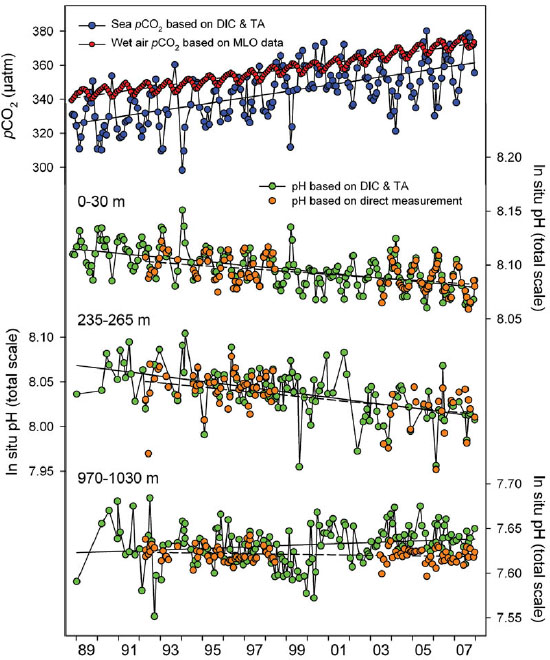
FIGURE 4.5 Time series of mean carbonic acid system measurements within selected depth layers at Station ALOHA, 1988-2007. (First image) Partial pressure of CO2 in seawater calculated from DIC and TA (blue symbols) and in water-saturated air at in situ seawater temperature (red symbols). Linear regressions of the sea and air PCO2 values are represented by solid and dashed lines, respectively (second, third, and fourth images). In situ pH, based on direct measurements (orange symbols) or as calculated from DIC and TA (green symbols), in the surface layer and within layers centered at 250 and 1,000 m. Linear regressions of the calculated and measured pH values are represented by solid and dashed lines, respectively.
SOURCE: Dore et al., 2009, © 2009 National Academy of Sciences.
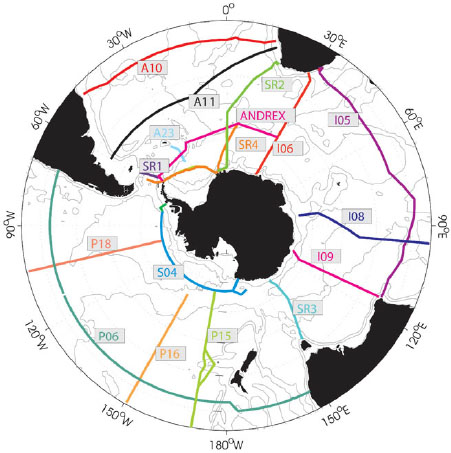
FIGURE 4.6 Repeat hydrographic section to be occupied by SOOS. Symbols indicate the WOCE/CLIVAR designations for each line.
SOURCE: Rintoul et al., 2011.
Palmer LTER Sites in Antarctica (Hobbie et al., 2003). The LTER Network was established in 1980 with six sites that now have more than 30 years of sustained data collection. Sites share common measurements and participate in a unified data system. Some sites build on previously initiated time series such as the California Current Ecosystem LTER, drawing on the legacy and ongoing observations of the California Cooperative Fisheries Investigation started in 1950 (Ducklow et al., 2009). The LTER sites investigate a wide range of ecological phenomena, but common themes like climate change, biogeochemical cycling, and invasive species characterize many sites as diverse as a tropical rainforest and an Antarctic pelagic marine ecosystem. The LTER Network provides a model for just a part of the proposed Antarctic observing system (the ecological component, anchored by the Palmer and McMurdo sites).
There are a number of measurements that can only be made from space. Remote sensing allows the measurement of variables over greater geographic areas. The Integrated Global Observing Strategy initiated a Cryosphere Theme16 as part of the IPY in 2007-2008. The summary report from 200717 contained a number of recommendations for future developments in remote sensing that could enhance the envisioned Antarctic observing system.
A closer model to the committee’s vision for Antarctica and the Southern Ocean is the currently evolving Arctic Observing Network18 (AON) that includes many of the needed elements. AON is an NSF-supported system of atmospheric, land-, and ocean-based environmental monitoring capabilities with four main objectives:
• record the full suite of environmental changes;
• understand the causes and consequences of the changes under way;
• predict the course, magnitude, and consequences of future changes; and
• develop adaptive responses to future change.
The need for an Arctic Observing System was conceived by the Arctic research community in response to system-scale changes in all domains of the Arctic system. It was included as a recommendation in the final report on the 1998 workshop Opportunities in Arctic Research that stated, “If we are to understand the implications and effects of the changes in the Arctic, we must first of all track them into the future by establishing long-term, systematic observation programs.” It was developed and promoted during the design of Arctic Environmental Change programs such as the Study of Environmental Arctic Change (SEARCH) or the International Study of Arctic Change (Murray et al., 2010; Schofield et al., 2001) and the development of recommendations for Arctic research support and logistics (Schlosser et al., 2003). Major impetus for its implementation came from the IPY and the NRC report A Vision for the International Polar Year 2007-2008 (National Research Council, 2004), which recommended that IPY “should be used as an opportunity to design and implement multidisciplinary polar observing networks that will provide a long-term perspective.” Later, in a follow-up report from the Polar Research Board, Toward an Integrated Arctic Observing Network (National Research Council, 2006), a committee recommended that development of an Arctic Observing Network aided by Observing System Simulation Experiments should get under way immediately to take advantage of IPY. Currently in the United States, AON has 35 funded projects pursuing research on the Arctic atmosphere, ocean and sea ice, hydrology and cryosphere, terrestrial ecosystems, and human dimensions. A
________________
16See http://igos-cryosphere.org/index.html.
17See http://igos-cryosphere.org/docs/cryos_theme_report.pdf.
complementary international effort called Sustaining Arctic Observing Networks19 is presently being implemented with the goal to coordinate and facilitate implementation of Arctic observing activities at the international level.
Vision and Goals for an Observing System
An Antarctic observing system—including in situ and remote measurements—would have many of the same goals as AON: to establish a new infrastructure for sustained observations capable of detecting and recording the full suite of environmental changes occurring over decades within the Antarctic system of atmosphere, oceans, land, and ice; to further the understanding of the causes and mechanisms of change and develop the capability to predict the course of future changes; and to better manage the continent for future generations. The envisioned observation system would also share a number of the same goals as the proposed Pan-Antarctic Observation System (PAntOS) that hopes to “deliver a coherent set of pan-Antarctic, long-term, and multidisciplinary observations focused on the entire chain of effects from geospace to Earth’s surface.”20 PAntOS was proposed to be a SCAR Action Group in conjunction with the SCAR Open Science Conference in Hobart during 2006. The primary goal of the PAntOS Group was “to address the scope and implementation strategies for the follow-on development of the multidisciplinary Pan-Antarctic Observations Network encompassing the Antarctic Continent and the surrounding Southern Ocean.”21 Planning continued into 2007 but did not result in the formation of an Action Group and no activities have taken place since.
Inherent to this concept of an observational network is the need for sharing of data and information. Overall improvements by all institutes in the collection, management, archiving, and exchange of data and information will allow data that has been collected once to be used for multiple purposes by a variety of stakeholders reaching well beyond the scientific community. An observational network will require the efforts of more than one nation, and, as encouraged by the Antarctic Treaty, SCAR, and recently published science plans, it is important that data and information be shared at an international level. Initiatives like the Polar Information Commons22 are beginning to address this issue. The United States has played a leading role in supporting international data sharing and should continue in this role. Internationally shared data sets can become assets that are greater than the sum of their national parts.
________________
19See http://www.arcticobserving.org/.
20See http://www.scar.org/researchgroups/physicalscience/PAntOS_Plan_Rev1.pdf.
21Ibid.
The increasing scope of Antarctic and Southern Ocean research envisioned for the coming years and decades will likely require diversification of its support. Presently, NSF is the primary agency supporting research in these regions, although current contributions from other agencies are adding significant capacity. The research activities proposed by this committee for the coming decades include components that will require a higher level of participation by other agencies, including mission-oriented or operational agencies. Without the latter, implementation and maintenance of a cross-domain, long-term, system-scale observing system for Antarctica and the Southern Ocean will be at best extremely difficult and would have a major impact on the ability to sustain a balanced portfolio of new research programs. The same holds for other components, such as enhanced development and application of new technologies. A multiagency approach should include participation by NSF, the National Oceanic and Atmospheric Administration (NOAA), NASA, the Department of Defense (Office of Naval Research), the U.S. Geological Survey, the Environmental Protection Agency, and the National Institutes of Health, as well as any other agency whose mission fits the vision for future research in Antarctica and the Southern Ocean outlined in this report. Effective coordination among agencies will be a key requirement for success of a future Antarctic research support structure.
Observing System Overview and Components
An observation system has three major components:
1. a set of observations of selected properties being made repeatedly at selected locations or in specified areas over a sustained period;
2. cyberinfrastructure for collection, communication, and curation of data; and
3. a network of scientists, technicians, and students to further develop the technology underpinning the system (e.g., novel and robust sensors), synthesize and analyze the data produced by the system, and predict future trajectories of the system grounded in observations.
The Antarctic observing system would be most beneficial if it encompassed the major elements of the Earth system: the atmosphere, oceans, land surface, ice, and both terrestrial and marine ecosystems that inhabit or are supported by these major geophysical systems. Sensor deployment should be guided by model-based observing system design and optimization whenever possible and take advantage of multisensor platforms wherever feasible (including use of existing platforms and observatories where possible). Data delivery should be timely—in real time or as close to real time as possible. As data transfer is currently achieved by manually downloading data periodi-
cally (often annually) or via low-bandwidth telecommunication systems (Iridium and Argos), a systemwide approach to improving data transfer could benefit both scientific observing needs and operational needs that rely on data transfer (e.g., operational weather data). Once assembled, data from observing systems should be widely available through data centers and/or web pages for scientific use including modeling, as well as for use by the broad stakeholder community. The design of an Antarctic observing system would benefit from a deliberate planning process, similar to that for AON. As an initial step, the major requirements for the observing system are outlined briefly in Appendix E.
Scientific Modeling
Any observing system will be incomplete without the simultaneous development of new models that can assimilate the observational data and provide sophisticated tools for data analysis and synthesis. For example, sea level projections due to ice changes come mainly from ice sheet models that lack the appropriate initial and boundary conditions with inadequate understanding of the underlying ice physics. Capturing system-scale spatial patterns in multiple domains including the ocean, atmosphere, sea ice, glacial ice, and biology requires modeling on multiple timescales. It is also important that empirical, theoretical/dynamical, and simplified modeling approaches be incorporated along with the execution of process studies to provide the scientific understanding from which to build better models.
Data assimilation allows the merger of diverse observation types that are irregularly dispersed in space and time (such as from the ground and space) into a coherent three-dimensional and time-dependent framework. The technique was first developed by the atmospheric science community for use in numerical weather prediction and is currently being extended to many other disciplines. A short-term prediction from a numerical model provides an initial estimate of the behavior of the system, and that estimate is further modified by additional observations.
Data assimilation has evolved through global retrospective analyses and reanalyses. For example, the latest reanalysis from the NOAA National Centers for Environmental Prediction features coupled assimilation of data on atmosphere, ocean, sea ice, and land surface (Saha et al., 2010). The next generation of reanalyses aims to develop an Integrated Earth System Analysis capability.23 Possible components contemplated for inclusion are greenhouse gases, aerosols, ocean biogeochemistry, and ecosystems.
________________
Global reanalyses are essential tools for investigating Arctic and Antarctic climate system behavior, but high-quality results are difficult to obtain for the Southern Ocean and Antarctica because of insufficient ground-based observations, challenges of assimilating the available satellite data, limited realism of the physical descriptions employed in the models, and the perception that this unpopulated part of the world is less important than other areas such as the tropics or the northern midlatitudes. Better reanalyses of the Southern Ocean and Antarctica would greatly benefit international efforts at modeling, leading to development of an Earth system reanalysis framework that enables both regional and global understanding.
Future conditions can be anticipated through models, and comprehensive Earth system models are the primary tools capable of projecting the behavior of the climate system as the atmospheric concentration of greenhouse gases increases. The outputs of these models are featured prominently in the Intergovernmental Panel on Climate Change reports (IPCC, 2007). Today the coupled behavior of the atmosphere, oceans, sea ice, and land is simulated. Among other components that are being or still need to be included are the dynamic behavior of ice sheets, the global carbon and nitrogen cycles, ocean and land biogeochemistry and ecology, the role of interactive aerosols, and the changing vegetation patterns. These global models have limited realism over the Southern Ocean and Antarctica, and significant effort is needed to develop accurate predictive capabilities.
The limited realism of the atmospheric simulations by Earth system models is illustrated by the rapid surface temperature increase over Antarctica that they simulate in contrast to the much more muted observed change (Monaghan et al., 2008). More accurate stratospheric simulations, including interactive stratospheric chemistry, are required to model the changing Antarctic ozone hole and the Southern Annular Mode. Improving Antarctic models also entails better representations of the Antarctic troposphere, including the ubiquitous stable boundary layer that, along with the surface topography, causes the katabatic winds. This necessitates high vertical resolution close to the ice sheet surface that is not available in any Earth system model. Higher horizontal resolution is required to resolve and place the strong coastal katabatic winds in the right locations for polynya formation. Antarctic clouds should not be modeled in the same manner as midlatitude clouds, but rather as tenuous ice clouds that nucleate on biological material and play an important role in determining the surface temperature and snow accumulation on the ice sheet. Similarly, future space weather models that use data assimilation will need diagnostic information about the ionosphere, as well as the underlying neutral atmosphere that can drive ionospheric dynamics.
Ice sheet models are starting to be included in Earth system models. Yet many aspects of ice sheet behavior are not well understood, such as ice streams, outlet glaciers, ice shelves and associated calving, and the flow of liquid water at the base. As a result ice sheet models currently show limited skill, but vigorous efforts at improvement are under way.24 Progress in modeling Antarctic outlet glacier behavior will have the added benefit of being directly applicable to Greenland, where outlet glaciers are showing rapid change.
Earth system models do not capture the behavior of the Southern Ocean with much fidelity (Weijer et al., Forthcoming). Simulated sea ice behavior often shows large differences with respect to observations (e.g., Landrum et al., Forthcoming). Ice shelves are not included, so the formation of Antarctic Bottom Water is not well simulated. This is the densest water at the bottom of the global ocean and is part of the global oceanic overturning circulation that links the Southern and Northern hemispheres. This, along with Subantarctic Mode Water and Antarctic Intermediate Water, needs to be better understood to anticipate global climate change. Present models do not represent the transport across the Antarctic Circumpolar Current well, owing to their inability to resolve small-scale ocean processes. It is also important to understand the melting of ice shelves by warm ocean water (such as occurring in the rapidly retreating Pine Island Glacier) and their contribution to sea level rise, as well as the role of ice shelf retreat on the inland ice sheet.
For ecosystem models, a new generation of models is needed—one that can predict the effects of changes in species composition and ecosystem structure on ecosystem services (Reid, 2005), such as primary and secondary productivity, CO2 uptake, and climate regulation, which are derived from properly functioning ecosystems. Current models lack species diversity, trophodynamic complexity, and realistic linkages between the lower trophic levels with their fast turnover times and upper-level predators that live for decades and range over thousands of kilometers, crossing ecosystem boundaries and coupling remote subsystems of the Antarctic system.
The many new physical processes that need to be understood at a process level and incorporated into models along with the fine spatial and temporal scales required indicate that regional climate system models will be required to make major progress in accurately predicting the broad-scale climate changes to be expected in Antarctica, not only for the long-term trends but also for the interannual and decadal variability. Successfully achieving such progress will require a major effort over the next 20 years. Regional Earth system models will need to be “nested” within the global Earth system
________________
models with simulation results flowing back and forth. Some work is already under way on this.25 Improved Earth system models for Antarctica and the Southern Ocean are urgently needed to strengthen the simulation and prediction of global climate patterns.
Vision for the Future
The committee envisions an observing network with data integration along the lines of that in AON or the proposed PAntOS, along with a sustained modeling effort that plans and evaluates observation locations, synthesizes large data sets, and improves predictive capability looking into the future. Expansion of these activities holds great opportunity for improved productivity in science and will require resources and a careful planning process. These efforts are important for national and international collaboration, because the observation network and modeling effort described here are inherently interdisciplinary and will cross agency and institutional boundaries. This is very much in line with the goals of NSF as society enters the “New Era of Observation” as described by the NSF Director.26 The committee endorses the development of an observing network and an improved intercoupled system modeling effort as the best hope in answering the pressing scientific questions facing the globe.
________________
25See http://www.cesm.ucar.edu/working_groups/Polar/.
26See http://www.nsf.gov/news/speeches/suresh/11/ss110214_nsfbudget.jsp.
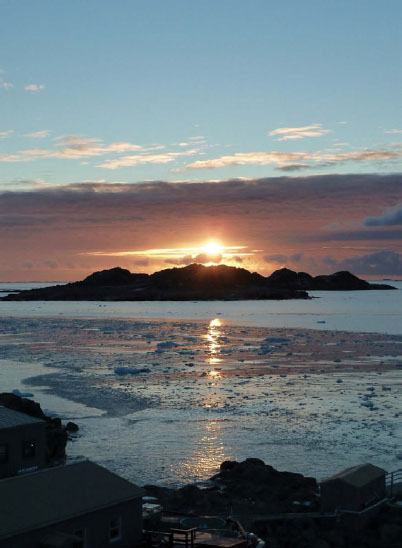
A spring sunset near Palmer Station.
SOURCE: Mindy Piuk/NSF.


