Assessment of Air Force
Air Logistics Centers
INTRODUCTION
This chapter addresses element 4 of the terms of reference (TOR): “Determine if the Air Logistics Centers have the necessary resources (funding, manpower, skill sets, and technologies) and are equipped and organized to sustain legacy systems and equipment and the Air Force of tomorrow.” The U.S. Air Force (USAF) currently has three Air Logistics Centers (ALCs), operating under the Air Force Materiel Command (AFMC), which provide acquisition, modification, and maintenance support for the Air Force aircraft fleets, end items, commodity parts, and some missile systems.
The ALCs are complex, multi-faceted organizations. They provide support to the Air Force and other components of the Department of Defense (DoD) on numerous product lines. As shown in Figure 4-1, the Warner-Robins Air Logistics Center (WR-ALC), founded in 1943 and located on Robins Air Force Base, Georgia, serves as the primary modernization, sustainment, and depot maintenance center for a variety of aircraft, including the U-2, C-5, C-17, all models of the C-130, E-8, and F-15, and other important aircraft.1,2 WR-ALC also has the Air Force’s primary
______________
1 Major General Robert H. McMahon, Commander, Warner-Robins Air Logistics Center (WR-ALC). “Commander’s Briefing.” Presentation to the committee, January 6, 2011.
2 United States Air Force (USAF). 2001. “A Brief History of WR-ALC and Robins AFB.” September 1. Available at http://www.robins.af.mil/shared/media/document/AFD-070226-039.pdf. Accessed March 22, 2011.
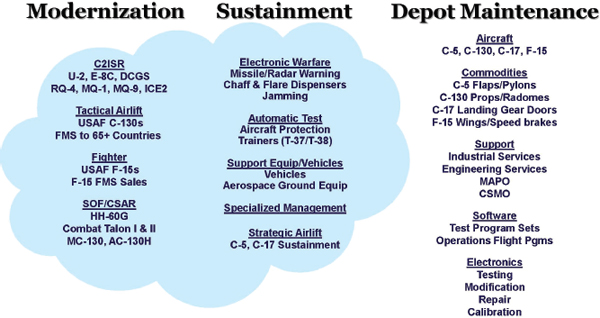
FIGURE 4-1
Warner-Robins Air Logistics Center (WR-ALC) operation areas of responsibility. SOURCE: Major General Robert H. McMahon, Commander, WR-ALC. “Commander’s Briefing.” Presentation to the committee, January 6, 2011.
responsibility for avionics systems management, support equipment management, and electronic warfare systems and the significant maintenance of these systems.
The Oklahoma City Air Logistics Center (OC-ALC), founded in 1941 and located on Tinker Air Force Base, Oklahoma, manages an inventory of more than 2,000 aircraft including the B-1, B-2, B-52, C/KC-135, E-3, VC-25, VC-137, Cruise missile inventories, and 25 other Contractor Logistics Support aircraft.3,4,5 Additionally, OC-ALC is responsible for all Air Force propulsion systems and management and a sizable portion of the propulsion systems maintenance. Figure 4-2 depicts the core expertise areas of OC-ALC’s 76th Maintenance Wing.
As shown in Figures 4-3 and 4-4, the third and last ALC, Ogden Air Logistics Center (OO-ALC), founded in 1940 and located on Hill Air Force Base, Utah, provides weapon system management and sustainment for numerous platforms, including the A-10, F/QF-4, F-16, T-38, A-37, F-4, F-5, F-16, T-37, F-22A, QF-16,
______________
3 Major General P. David Gillette, Jr., Commander, Oklahoma City Air Logistics Center (OC-ALC). “OC-ALC Strategic Goals.” Presentation to the committee, January 11, 2011.
4 USAF. Undated. Oklahoma City Air Logistics Center Factsheet. Available at http://www.tinker.af.mil/library/factsheets/factsheet.asp?fsID=8552. Accessed March 22, 2011.
5 Tinker Education and Development website, Force Development Division, OC-ALC.
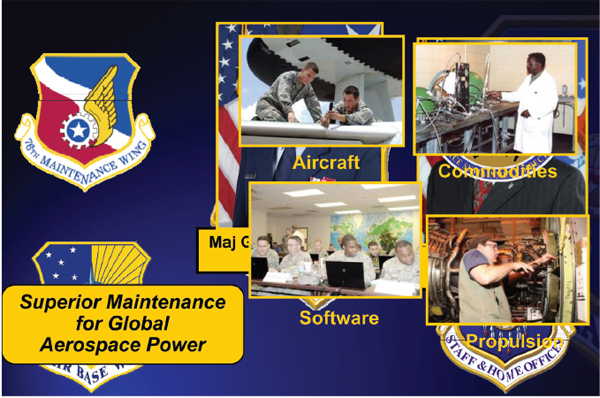
FIGURE 4-2
Oklahoma City Air Logistics Center (OC-ALC), 76th Maintenance Wing (76 MXW). SOURCE: Caysie Mercer, OC-ALC. “Tinker Today.” Presentation to the committee, January 11, 2011.
and BQM-167A.6,7 Like WR-ALC and OC-ALC, OO-ALC has key areas of specialization, such as the management and repair of Air Force landing gear systems and sustainment management for conventional munitions and the Minuteman Intercontinental Ballistic Missile system.
To establish the degree of complexity, it is important to note that responsibility for program management and sustainment for some of these platforms are shared with the Aeronautical Systems Center (ASC) and the Electronic Systems Center (ESC). For example, the F-22 program office is at ASC, and many sustainment actions are accomplished at OO-ALC. The E-3 and the E-8 have program offices at ESC.
The following sections address the resourcing (i.e., funding, workforce, skill sets, and technologies), equipping, and organizing of the three ALCs to sustain legacy weapon systems and equipment. The term “manpower” is used in the TOR,
______________
6 Major General Andrew E. Busch, Commander, Ogden Air Logistics Center (OO-ALC). “OO-ALC Overview—Core Competencies & Priorities.” Presentation to the committee, January 31, 2011.
7 USAF. 2010. Ogden Air Logistics Center Factsheet. Available at http://www.afhra.af.mil/factsheets/factsheet.asp?id=16630. March 31. Accessed March 22, 2011.
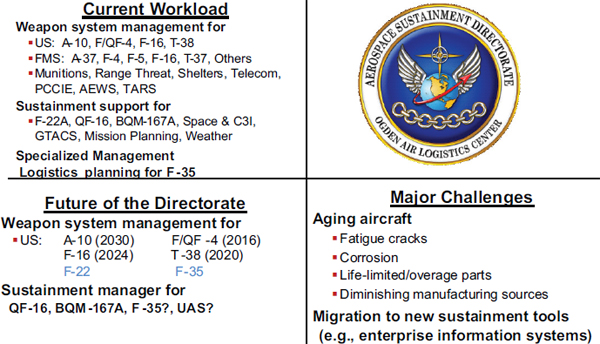
FIGURE 4-3
Weapon system management at Ogden Air Logistics Center (OO-ALC). SOURCE: Major General Andrew E. Busch, Commander, OO-ALC. “OO-ALC Mission Briefing.” Presentation to the committee, January 31, 2011.
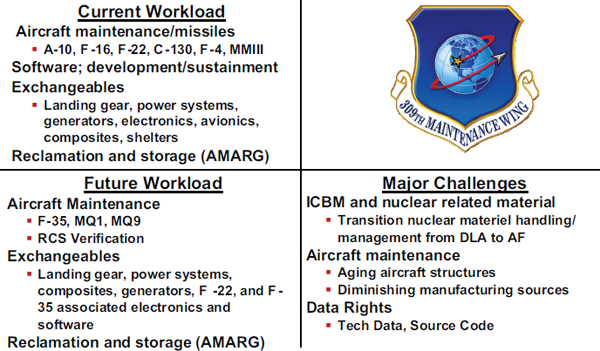
FIGURE 4-4
Depot maintenance at OO-ALC. SOURCE: Major General Andrew E. Busch, Commander, OO-ALC. “OO-ALC Overview—Core Competencies and Priorities.” Presentation to the committee, January 31, 2011.
but this term often equates solely to people. Thus, the term “workforce,” which includes not only numbers but also skill sets, education, and training, is used in this chapter.
METHODOLOGY FOR THE ASSESSMENT
The committee assessed the ALCs’ activities and resourcing using a variety of inputs, including: (1) briefings at Headquarters Air Force; (2) briefings at Headquarters AFMC; and (3) visits to the three ALCs with presentations and tours by the respective ALC management chains. During the visits to the ALCs, the committee divided into smaller subgroups composed of subject matter experts that aligned with the activities at the specific ALCs. The committee formed an opinion of the ALCs’ activities and conditions from detailed presentations and from candid discussions with the workforce. To assess the ALCs’ resourcing, the committee required an understanding of how the ALC leadership teams view the current situation and how the Headquarters AFMC and Headquarters Air Force view both the past investment utilization and the current flow of funding to support ALC operations. Consequently, a holistic perspective was taken of the past, present, and future outlooks for assessing resourcing investments.
The format of each ALC visit was guided by an agenda established by the ALC commander in response to a general request for information. Each ALC visit consisted of a combination of briefings, facility tours, and in-depth discussions with the participants. Each ALC was represented by its commander, with the attendance of both senior military and civilian leadership. The briefings were both detailed and comprehensive, the tours were open and thorough, and the discussions were frank and responsive to the questions posed. In addition, the reviews of the activities of Headquarters AFMC and the ALCs focused on the adequacy of the ALCs’ resources in terms of organizational structure, responsibilities, funding, workforce, skill sets, and technologies and their current and planned equipment to sustain legacy and future systems.
In addition to the three ALCs, two Air Force major command customers of the ALCs, specifically the Air Combat Command and the Air Mobility Command, provided important input to the committee. Finally, the original architects of the United States Navy’s Naval Aviation Enterprise, including a past commander of Naval Aviation Forces and the current Director of Logistics for the Naval Air Forces,
provided a valuable perspective on an alternative business model.8,9,10 These latter Navy sources provided valuable insights and benchmarks on how the Navy operates its sustainment enterprise. Additionally, four committee members travelled to the Navy Fleet Readiness Center Southwest (FRCSW) to observe selected elements of the Navy’s depot maintenance programs and the interfaces with program offices and supply support.11 Although this chapter stands alone, topics such as policy, investments in general and in facility and equipment technology are covered in depth in Chapters 2, 3, and 5, respectively.
HISTORY AND PRESENT STATE OF AIR FORCE AIR LOGISTIC CENTERS
Historically, the ALCs have operated under several different organizational constructs. From the mid 1970s until approximately 1990, the ALCs had three primary functions, which, in today’s terms, were material management, maintenance, and distribution. It is important to note that material management involved managing commodities and parts as well as weapon systems (i.e., system program offices for aircraft). There were also major support functions such as contracting and manufacturing, and communications and computer systems. Although the internal alignment of all of these functions varied during the 1970s to the early 1990s, the ALCs were consistently functionally aligned.
During the early 1990s the functions were re-aligned according to product orientation, which aligned weapon system sustainment not only with weapon system management but also with unique material management and major system maintenance, under a single leader. For example, at WR-ALC, a C-5 management directorate became responsible for C-5 aircraft systems, commodities, and maintenance. Also important is that the ALC commander, traditionally a major general, became responsible and accountable for the operation of the entire ALC organization. The commander generally had authority, responsibility, and accountability for the range of resources available within normal constraints to execute the programs
______________
8 Vice Admiral Walter Massenburg (United States Navy [USN], retired). “Enterprise Behavior: Fundamental Changes in the Government Business Model.” Presentation to the committee, January 18, 2011.
9 Vice Admiral James Zortman (USN, retired). “Aircraft Sustainment Strategy: Can Industry and Government Move the Needle?” Presentation to the committee, January 19, 2011.
10 Captain Mike Kelly, Commander Naval Air Forces, Force Material. “COMNAVAIR. Presentation to the National Academies Committee on U.S. Air Force Sustainment.” Presentation to the committee, January 17, 2011.
11 A conscious decision was made to not visit United States Army sustainment activities. Unlike the Army, the Navy has significant commonality with Air Force systems and resourcing. Time constraints also did not permit such a visit.
assigned to the ALC. However, this no longer appears to be the case.12 Since 1992, when Air Force Logistics Command and Air Force Systems Command were integrated into a single major command, the ALCs have been part of the AFMC. This consolidation placed ALCs, the Air Force Research Laboratory, and the Product Centers within the same major command. The AFMC develops, tests, fields, and sustains weapon systems. Today’s ALCs provide some but not all weapon system and product support sustainment, some modernization, and some maintenance for the majority of the aircraft fleet. Some aircraft sustainment support is provided by the Product Centers, namely, the Aeronautical Systems Center and the Electronic Systems Center. The material management (supply chain) and distribution functions have largely been removed from the ALC commanders’ responsibilities. At the time of the 1992 integration there were five major ALCs, and a series of changes began to chip away responsibility and authority from the ALC commanders. As a result of Defense Management Review Decision (DMRD) 902, the Air Force began to transfer to the Defense Logistics Agency (DLA) a sizeable portion of the ALC distribution functions, which essentially involved wholesale Class IX parts storage and the movement of parts around the ALC bases. The 1995 Base Realignment and Closure (BRAC) Act determined that the future Air Force depot maintenance work load could be more efficiently sized and managed in three ALCs. Consequently, the Sacramento ALC and the San Antonio ALC were selected for closure, with a large part of their maintenance and sustainment work realigned to the remaining three ALCs. Also in 1995, DMRD 926 began to transfer some non-recoverable parts (expendables) management to the DLA. Table 4-1 depicts the attributes and activities of the three ALCs.
With the 2005 BRAC, responsibility for greater portions of the ALC supply chain were re-aligned to the DLA. In addition, responsibility for managing nearly all remaining non-reparable items (expendables) was transferred from the Air Force to the DLA center in Richmond, Virginia. Although on initial examination the implications of any transfer of expendables seem rather routine, the fact is that these types of parts range in price from a few cents to tens of thousands of dollars per assembly (see Table 4-2). Importantly, these expendables are directly related to an ALC commander’s maintenance production activities, and, whether pennies or thousands of dollars, when not available they can impact the commander’s success.
The 2005 BRAC further eroded the ALC commanders’ responsibilities with respect to two key aspects of supply chain management. First, the purchasing function for reparable parts at each of the ALCs was realigned to the DLA in place at the ALC base. In other words, although the Air Force would still manage reparable items, determine the quantities to be purchased, and initiate contracts for repair of these parts, the DLA would source and procure the new parts. The rationale for
______________
12 AFMC Historian Office. Personal communications to the committee, May 3, 2011.
TABLE 4-1 Air Force Air Logistics Centers and Their Attributes
| ALC | Location | Total Base Employment | ALC Employment | MX Wing Employment |
| Warner-Robins | Robins AFB, Georgia | 21,254 | Total: 14,295; Civilians: 12,873; Military: 1,422 | Total: 8,786; Civilians: 8,173; Military: 133 |
| Ogden | Hill AFB, Utah 22,547 | Civilian and Military: 13,483 | 7,796 | |
| Oklahoma City | Tinker AFB, Okla. | 29,218 | Total: 13,296; Civilians: 12,173; Military: 1,123 | Total: 9,263; Civilians: 9,152; Military: 111 |
SOURCE: Air Force Materiel Command.
this transfer was based on the belief that consolidation would provide economies of scale and place major parts purchases under the management of the DLA—a single DOD supplies purchaser. The unintended consequence was to create numerous process seams and put the same part under two separate management systems, controls, and authorities. Under a March 2011 memorandum, the Secretary of Defense proposed a pilot program to move additional spare parts support to the DLA.13
______________
13 DoD. “Track Four Efficiency Initiatives Decisions.” A Memorandum for USAF Key Personnel. March 11, 2011. Washington, D.C.: Office of the Under Secretary of Defense. Available at http://www.airforce-magazine.com/SiteCollectionDocuments/Reports/2011/March%202011/Day24/Secdef_Ef-ficiencies_031411.pdf. Accessed May 3, 2011.
| Maintenance Wing 2010 Revenue | Maintenance Floor Space | Weapon System and End-Item Program Management | Economic Impact | |
| FY10 total revenue (including Material Support Division)—$1.738 billion | Maintenance Shops: 4,500 ft2 Administration: 2,100 ft2; Storage: 3,900 ft2 | E-8C, C-130, F-15, HH-60G, UH-1, U-2, DCGS, C-5, C-17, RQ-4, MQ-1, MQ-9, Software, Electronics, Electronic Warfare (missile/radar warning, chaff/flare dispensers, jamming), Support Equipment, Vehicles, Automated Test Systems, Commodities (C-5 flaps/pylons, C130 props/radomes, C-17 landing gear doors, F-15 wings/speed brakes), F-15 and C-130 FMS | $4.134 billion | |
| $1.7 billion | 17,400 ft2 | B-2 Structure, F-16, A-10, F-22, C-130, T-38, Commodities, Software | $3 billion | |
| FY10 total; revenue (including Material Support Division)—$2.69 billion | 9,200 ft2 | E-3, KC-135, B-1, B-52, KC-46A, B-2, Contract Logistics Support Commercial Derivative A/C (KC-10, E-4, VC-25, T-6, C-12, C-21, C-9, C-20, Peace Lotus, C-26, C-38, T-1A, Iraqi A/C, C-32/C-40, E-9, KDC-10, T-41, T-43, T-51, TG-10, TG-15, UV-18, C-37), Engines (F100, F101, F108, F118, F110, T56, TF39, TF34, TF33, F117, F119), Commodities, Software, ATCALS, HF Global, Foreign Military Sales | $3.511 billion | |
The 2005 BRAC’s second change, equally significant in terms of impact, was the in-place transfer of Air Force personnel who directly provided parts movement and stocking to the ALC (almost 1,000 employees) to the DLA. These employees then reported to the DLA Distribution Command; they were no longer part of the organization responsible for producing the maintenance results, and their objectives and performance reviews were not driven by the ALC. Although almost 1,000 personnel were transferred, the Air Force has placed some personnel into positions to fill the voids in staffing and experience.
Following the 2005 BRAC, the Air Force established the Air Force Global Logistics Support Center (AFGLSC) to manage all reparable parts. This action occurred for a variety of reasons, including the desire to standardize processes for reparable
TABLE 4-2 Examples of Costs Relating to Spare Parts
| Nomenclature | Quantity Used/Year | Last Purchase Price/ Repair Cost ($) | Extended Cost/Year ($) | |
| Adj pin spacer tube (C-130) | 22,913 | 7.71 | 176,659 | |
| Turbine rotor blade | Condemn: 806 | 6,375 | 5,138,250 | |
| (F108 Engine) | Repair: 5,511 | 287 | 1,581,657 | |
| 6 719 907 | ||||
SOURCE: AFGLSC.
parts management across the three ALCs and to provide a standard approach to supply chain management for the external world to follow. The AFGLSC assumed responsibility for the Air Force reparable parts supply chain in March 200814 and is tasked with assuring the availability of reparable parts to both base-level maintenance activities and depot maintenance production activities. The current AFGLSC commander is a major general with personnel located at five or more locations within the Air Force.
The AFGLSC’s creation completed the combination of changes that limited the ALC commanders’ sustainment responsibilities to some weapon system or product program management as well as maintenance. The ALC commanders were rendered less effective because they lost responsibility, authority, and accountability for size\able portions of the supply chain, and had no real direct influence over outside suppliers but were still accountable for depot maintenance production and a portion of parts support to field-level activities.
Clearly, the ALCs have undergone a great deal of organizational change within the past 20 years. With this brief history in mind, it would be a mistake to view the ALCs in a monolithic fashion. The committee focused on the current state of the ALCs and their resourcing for present-day operations and future support of the assigned weapon systems. ALC leadership and authority, although not specific items in the TOR, are critical factors. For example, an ALC commander must deal with multiple lines of external authority, many of whom have far less experience and certainly far less of an Air Force enterprise view. An ALC commander should be considered a “supported commander,” but many organizations fail to grasp the relationship of “supporting and supported” commander, and therefore operate independently and are driven by their own policies.15 As a result, the ALC receives fragmented sustainment support, which impacts the support it provides to its own
______________
14 AFGLSC provisional command was established in April 2007.
15 Kathy Cutler, Deputy Commander, Defense Logistics Agency Aviation. “Air Force Studies Board Committee on U.S. Air Force Sustainment.” Presentation to the committee, February 17, 2011.
customers. The various entities, such as the supply chain and “out of the chain” command offices, optimize for their own organization and/or products rather than support a major sustainment entity such as an ALC. The various seams, the ALCs’ limited ability to influence the supply chain, and the fragmented system alignment all impact outcomes—to the extent that it is surprising that the process works at all.
Finding 4-1. The ALC commanders’ authority has been significantly weakened over the past several years to the extent that they do not have sufficient authority to effectively and efficiently execute the programs for which they are responsible.
Recommendation 4-1. The Air Force should establish streamlined command lines of accountability and authority to allow the ALC commanders clear execution authorities to direct process improvements on assigned programs, maintenance activities, and supply support.
HOLISTIC APPROACH TO THE RESPONSIBILITIES AND PERFORMANCE OF AIR FORCE AIR LOGISTICS CENTERS
It is essential to have a clear understanding of all the resources that impact the ALCs’ operations to better evaluate the ALCs’ capabilities. Today’s ALCs have two principal focus areas: (1) weapon system or product management and (2) maintenance of assigned systems, end items, and parts. Numerous subsets of activities support accomplishments within these focus areas. For example, within weapon system and product management, there are product engineering, condition of equipment reviews, corrective action planning, modification management, maintenance planning and evaluations, configuration management, technical documentation updates, and safety processes. Likewise within maintenance, all actions are derived from engineering-based requirements with subsets that can and should lead to effective workflow. Among these are process engineering, workforce and workload planning and scheduling, replacement parts needs and bill of material upkeep, modern equipment technology insertion efforts, and facility management. All of these processes must come together for an ALC to fulfill its mission to provide support to the commanders who rely on the ALC products and services to fulfill their missions. To understand how these processes can come together, it is useful to review who and what roles are necessary to achieve the desired results.
To effectively carry out safe and efficient maintenance operations, a technical support process should be developed that begins with system design and ultimately extends to system retirement. From initial concepts, analyses are conducted to assess the system’s purpose, mission, operating environments, and support exposure at all levels of the system or system operations. To be effective, these processes and
analysis activities must form a continuum throughout the system’s life cycle. To this end, the ALCs play a key, but not the only, role. The ALC role is part of a complex process involving the system users (operating commands), program management offices, contractors who manufacture and provide all types of support, and Air Force laboratories that assist with technology infusion as well as with modernizing equipment for system maintenance. Effective and efficient sustainment programs are directly tied to the coordination of these multiple players. Achieving effective and efficient sustainment programs is a direct responsibility of many, but should be an enterprise integration effort of the ALC commander.
Sustainment activities should be focused to maintain a system in the status for which it was designed. Thus, the activities should interface with all aspects of operations and processes to ensure that the design goals and or mission objectives are accomplished. The activities should involve a series of tasks that can maintain operations in an orderly fashion throughout the system’s life cycle. The purpose is to monitor the system’s condition to assure that it does not inhibit the design goals or mission effectiveness. An example of such an effort would be strong data capture and archiving. How data processes enhance this support is covered in detail in Chapters 2 and 6.
Program management can substantially improve the overall operation of a product but must take a holistic approach to do so. Maintenance alone cannot make something better than the design objectives without integrated support from the program management engineering. In the absence of desired improvements to the design, maintenance can only assure that the system does not deteriorate below the design objective. Maintenance must be supported by all the factors of program management and provided with what it needs, when it needs it, by the entire supply chain. Consequently, the committee viewed sustainment activities and the resourcing of these activities at the ALCs in a holistic manner. During meetings with sustainment officials, the discussion of support for the ALCs centered on policy, planning, people, products, processes, and parts. In addition, the organizational structure, technology infusion, and plant equipment were assessed. It is important to realize that all of these factors are inter-related and inter-dependent on an ongoing continuum that affects the ability of the ALC to meet the sustainment goals that are established above the ALC commander.16
In measuring the resourcing of the ALCs—funding, workforce, skill sets, technologies—the committee studied a large number of charts and various planning documents, including the ALCs’ strategic plans. These plans significantly differ from ALC to ALC. Aircraft availability (AA) was often mentioned as the principal measure of merit for the Air Force’s as well as the ALCs’ sustainment goals. However, after analyzing AA, the committee found many external factors that affect
______________
16 See Chapter 2 for a discussion of the Air Force’s sustainment goals.
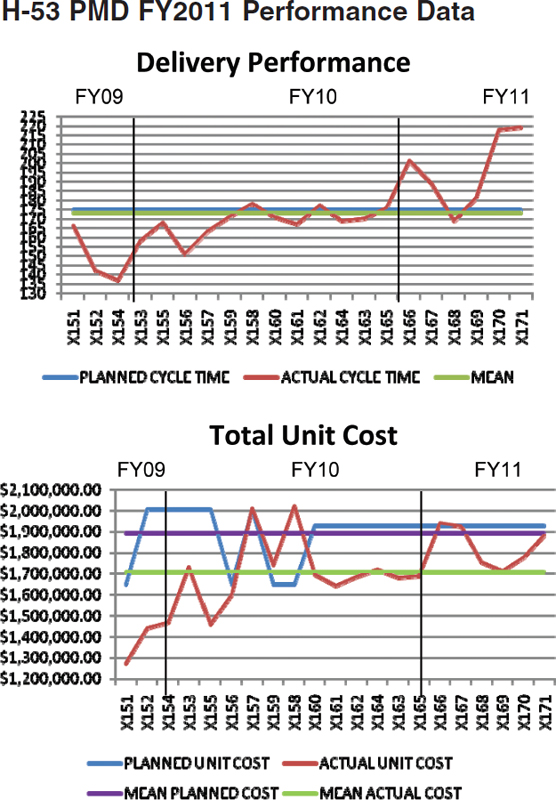
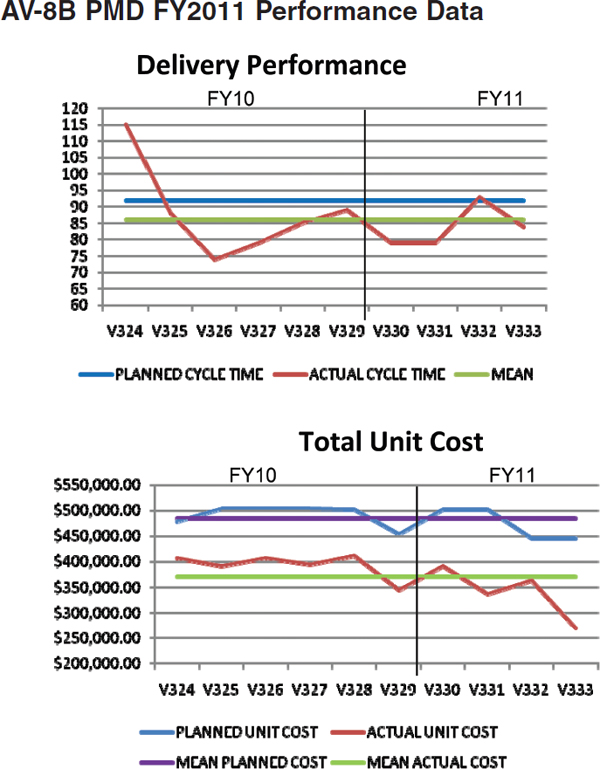
AA and that are well beyond the ALC commander’s ability to control. As discussed in this chapter and in Chapter 2, the committee was unable to identify succinct sustainment goals that the Air Force can use to measure the ALCs’ success. Later in this chapter the report discusses metrics on aircraft production that were used at the United States Navy’s FRCSW and that captured a best practice on aircraft production quite well.
Finding 4-2. The metrics that would determine the success of an ALC, such as cost, schedule, and performance, are not widely used and consistently applied across the three ALCs.
As the following section shows, the broad subject of resourcing impacts the ability of the ALCs to accomplish their missions now and in the future.
ASSESSMENT OF THE RESOURCING OF AIR LOGISTICS CENTERS
Policy-Driven Supply Support
Policy for sustainment is largely covered in Chapter 2. As the committee assessed the resourcing of the ALCs, it found a great deal of policy that can, in various ways and through various interpretations and regulations, encumber the efficiency of the processes. Policy is always essential; however, the Air Force’s existing policy does not clearly identify the official responsible for ALC sustainment activities and whether that official has the proper resources to execute the mission. The committee repeatedly asked the questions: “Who decides what gets executed at ALCs?” and “Who determines what resources the commander has to execute the mission?” The answers were usually nebulous and lacked specificity but were mostly along the lines of “It depends.” There is clearly a major disconnect between the policy’s intent and its execution. To build on the earlier discussion of supply chain fragmentation, the following discussions offer a few specific examples of organizations external to the ALCs’ executing decisions that affect the ALCs’ efforts.
At WR-ALC, the C-17 aircraft are modified and repaired by government employees. Spare parts are supplied by contractors, and even though this process performs remarkably well, it has been proposed that spare parts be supplied by organic Air Force and DLA sources.17 In discussing this concept with C-17 main-
______________
17 During briefings at WR-ALC, the source of supply was a subject of great concern. During subsequent discussions, it became evident that a final decision on the C-17 supply support has not been made. However, it is noteworthy that the widespread conviction of government maintenance personnel is that the contractor-operated supply chains provide far better support than government-operated supply chains.
tenance managers and technicians, the committee learned that a contractor, when responsible for a part, can typically supply the part within 24 hours, while organic sources routinely take 17 days. Although it is expected that a contractor will take more time as the C-17 production activity draws down, it still will not take as much time as the government currently takes. Additionally, the committee repeatedly heard comments about poor supply support to repair lines across all three ALCs. The C-17 proposal to move to organic support and similar stories on other product lines are key examples of how the ALCs are not being resourced to meet production demands. When parts support across all ALCs is considered, the poor performance is systemic, and sustainment activities are not resourced for effective and efficient operations.
Resourcing the ALC Workforce
The most critical resource for the ALCs is a workforce that is remarkably talented and goes to extremes to make a complicated organizational environment work. The committee interfaced with employees in conference room settings and by “walking the floor” to talk with them at random. Employees at all levels exhibited great attitudes and were frequently well-versed about, and clearly committed to, improvement activities. Safety practices and a keen awareness for environmentally “green” operations were observed at each ALC. Overall, the general industrial operations as well as the product support sustainment workforces are producing reasonably well. There is a willingness to change to improve processes, but pockets of insular thinking remain, which is not unusual in organizations the size of the ALCs. The leadership is clearly committed to improvement; however, they do not have command-standardized processes, metrics, and goals.
To the extent possible, the committee analyzed workforce levels to support the ALC sustainment missions. The ALCs have reasonable distributions of staff with skill sets to meet current needs. However, the ALC workforce appears to be constrained in product support sustainment activities in much the same way that other similar Air Force-wide organizations are suffering workforce shortages. The workforce may be further constrained because a definable workforce standard does not seem to exist for the program offices engaged in sustainment or for the AFGLSC. The committee could not determine what levels of staffing are sufficient or required, because the amount of predicted work varies, and there is no definite operating plan to support staffing levels.
For industrial activities, the workforce seems to be more balanced to the workload. Yet, the ability to rapidly adjust staffing levels, as would happen in the commercial sector as workload changes, is constrained in the ALCs. Despite a known greater than 10 percent growth in maintenance workload, an ALC was restricted by higher levels from hiring maintenance personnel to meet the growing workload. In
fact, the ability to hire as workload grows was constrained for some time, and this direct employment “cap” has contributed to higher-than-desired work-in-process and year-end carryover. An analysis of the Air Force industrial workload personnel policies indicates that greater freedom to adjust staffing levels without higher Headquarters interference is needed. 18 This is not to say that the process should be free from executive reviews. However, ALC commanders should be able to rapidly adjust staffing levels to effectively and efficiently meet fluctuating workload demands. The net result of the delay was a significant growth in work-in-process, unfavorable year-end carryover, and the attendant budget impacts. However, the more significant result was that aircraft became backlogged in the depot maintenance process, and there were fewer aircraft available to the operational commands. What appears to be a budget-driven decision on workforce management may have netted short-term benefits, but its long-term impacts on the Air Force and ALC work management were very disruptive. The occurrence of such actions was surprising, but not as surprising as the long-term outcome. In the commercial sector, flexibility exists to flow workforce with workload. The commander and the civilian executive director at the FRCSW both commented that, although their industrial workforce levels are reviewed, they have freedom to adjust industrial personnel levels as determined by the workload.19
50/50 Affects the ALC Workforce
Another policy issue with broad ramifications as well as a direct impact on the workforce, which was discussed in depth in Chapter 2, is the requirement to have at least 50 percent of the depot maintenance performed in government facilities. This is commonly referred to as the 50/50 rule of 10 U.S.C. § 2466. The genesis and purpose of the rule are understood; however, its constraints impact product support, depot maintenance planning, and warfighter asset availability. At the ALCs, the impacts are felt on the production lines, where work-in-process increases as the Air Force directs earlier than planned maintenance to assure that the 50/50 rule is not violated during a fiscal year. Although it is recognized that some attempts have been made to change what is or is not in the 50/50 equation, these attempts have not been successful to date.
The effects of surged workload on the workforce are obvious. But the problem is not the 50/50 rule—it is the Air Force’s fragmented approach to managing 50/50
______________
18 General Military Law, U.S. Code, Title 10, Section 2472, February 10, 1996.
19 Captain Fred Melnick, USN Commanding Officer, and Mr. William Reschke, Plant General Manager, USN, Fleet Readiness Center Southwest (FRCSW), San Diego, California, personal communications with the committee, March 29, 2011.
on a long-term basis.20 The Air Force should undertake aggressive, positive, long-range planning on a large scale to assure that in the near future the 50/50 balance is sufficient and the ratio is not threatening. To not do so ignores the fact that Title 10 has put the components on notice to achieve, and not necessarly cause, significant perturbations in the workforce.
Critical Support Staff for the ALC Workforce
Support manpower issues affect the ALC workforce. These issues directly pertain to the support forces that allow the depot maintenance production effort to proceed efficiently and effectively and have been referred to as “color of money” issues. However, the issue actually centers around proper sizing of the support workforce—a challenge that extends into the working level and impacts support to the production lines. As an example, when the workload for a product line increases, the workforce will eventually increase to meet the workload, but the engineering support that provides technical direction and instructions for the craftsmen comes from a different pool of authorizations and resources. Thus, the production workforce and engineering support do not uniformly grow to meet the increased demand. As systems age, the situation becomes increasingly difficult to manage because the workload and the demand for engineering support usually increase commensurately.
A second area, like engineering support, is DLA support to the production lines. Although the workload for selected repair lines has increased, the size of the DLA workforce that supports parts to these repair operations has not been linked to the repair volume. DLA Aviation reported that the DLA employee count is linked to government-wide personnel policies.21 The hiring restriction may be temporary, but the fact will remain that the DLA manages personnel independent of the repair effort, which was confirmed in discussions at the ALCs and with DLA Aviation. Thus, while the workload on repair lines changes, portions of the workforce that support parts for repairs lines are completely disconnected from the function they support. These are just two of a select few of the many policy impediments that affect the ALCs in their sustainment efforts.
Finding 4-3. There remain significant issues related to providing a skilled product engineering and DLA supply support workforce to ALC maintenance activities to assure that the support is properly sized to match the workload.
______________
20 Recommendation 2-2 in Chapter 2 provides a related recommendation.
21 Kathy Cutler, Deputy Commander, Defense Logistics Agency Aviation. “DLA Aviation.” Presentation to the committee, February 17, 2011.
Workforce Training
The ALCs have established notable industrial-type training for new employees. ALCs have close relationships with local area community colleges and technical schools for training of new industrial employees as well as “upgrade” training where appropriate. These training programs have allowed the ALCs to fairly rapidly meet significant increased demand for shop floor personnel due to retirements and work scope increases.
While technical skill training is ongoing, the significant growth in shop floor personnel has generated a requirement for training incoming workers on the detailed repair and overhaul procedures unique to specific work stations. Many of these techniques were not reduced to writing or a knowledge capture basis and consequently require a “revised” learning curve. Improvements in knowledge capture from vested employees are being addressed with the retiring workers, whose experience is being documented for all critical processes. The introduction of low observable technology presents additional workforce training requirements that must be addressed in the future.
The ALCs recognize that strong leadership and supervisory skills “don’t just happen”—they develop over time and can only come from efforts by leadership. Figure 4-5 depicts the “tip of the iceberg” of what training programs can provide. It is most noteworthy that 1,300 applicants sought this type of professional and personal development in its first year alone.
Labor Relations and Growing the Workforce
A key part of the ALCs’ ability to perform effectively is their relationship with the unions. There appeared to be a distinct and noticeable difference in the relationship between ALC management and unions at the various ALCs. The ALC leadership teams were strongly committed to partnering with the unions but met with varying degrees of success. There is room for significant improvement in gaining flexible work rules to permit the workforce to be more versatile. Such a change would improve utilization of available resources, allow adaptation of improved processes, and gain efficiencies and productivity. The Air Force should recognize that relief from overly restrictive policies, which in a modern industrial aviation setting impede effective and efficient production.
Finding 4-4. The ALC workforce is professional and continues to work within the Air Force system to provide strong weapon system sustainment. The leadership teams are engaged with the workforce and constantly demand process improvements and efficiencies; however, the current work rules lack the flexibility to achieve these efficiencies.
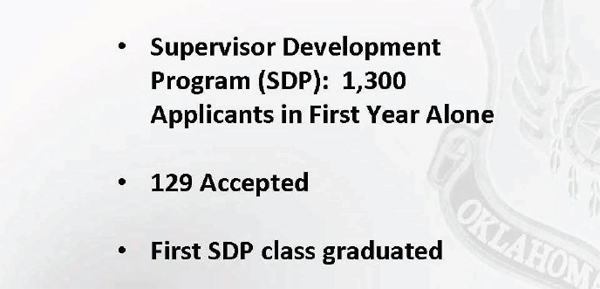
FIGURE 4-5
Supervisor development program at OC-ALC. SOURCE: Major General P. David Gillett, Jr., Commander, OC-ALC. “OC-ALC Strategic Goals.” Presentation to the committee, January 11, 2011.
Recommendation 4-2. The Air Force should follow in a more timely manner the statutes that require the depot maintenance industrial workforce to be managed according to workload. The Air Force should also ensure that supporting organizations are staffed to support the industrial workloads and that flexible work rules are established to permit more workforce versatility.
ORGANIZING THE AIR LOGISTIC CENTERS FOR SUSTAINMENT
Organizational structure and process flow is an important part of the resourcing equation. The ALCs support the “supported commander.” Yet, success is often attributed to the individuals involved in “making it happen” rather than to an optimal, high-efficiency construct, clearly defined lines of authority, effective enterprise resource planning systems, and data-driven analysis and actions. For example, programs differ as to the roles and responsibilities of the program manager, sustainment manager, system support manager, systems development manager, product support manager, and a Program Executive Officer.22 The committee was often told of the frustration in executing programs and controlling resources. Fig-
______________
22 The committee heard all of these terms used, often interchangeably.
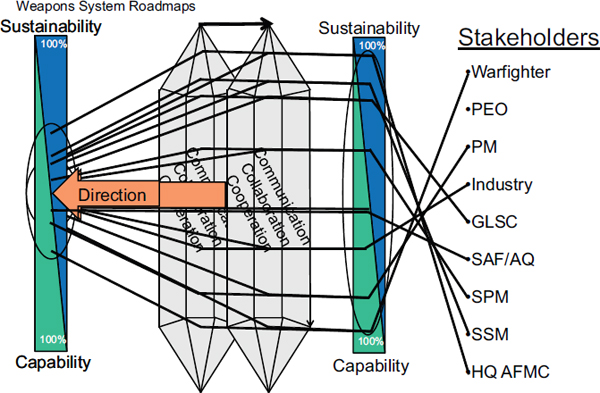
FIGURE 4-6
Focus the enterprise. SOURCE: Brigadier General Arnold W. Bunch, Jr., Director and Program Executive Officer for the Fighters and Bombers Directorate, Aeronautical Systems Center, Wright-Patterson Air Force Base. “ASC/WW (Fighter/Bomber PEO).” Presentation to the committee, December 8, 2011.
ure 4-6 illustrates the lines of authority and communication among the various Air Force sustainment stakeholders.
When this information is reviewed and considered in the context of the major operations at the ALCs, it becomes apparent that the organizational structure is so dispersed that no one is responsible. One can only imagine how this diagram would look if expanded to represent all of the systems that are supported by the ALCs. The lines of authority for multiple programs become so convoluted that personalities prevail rather than defined processes achieving optimal results. Without clearly defined responsibilities and prudent metrics to determine results, system breakdowns are commonplace. Unfortunately, this allows for excuses and often leads to celebrating superficial success rather than measurable real achievements.
As discussed earlier in this chapter, the spare parts organizational structures for the Air Force at large and for the depot maintenance lines, in particular, are broken, largely because no one officer is responsible for the supply chain. The committee repeatedly heard that expensive hanger space, tooling, equipment, and, most
importantly, skilled technical personnel are either forced to conduct workarounds, cannibalize parts, or place items in a downtime status for the lack of parts. These events are not exceptional; they occur with sufficient frequency that shop floor employees expect them, take them for granted, and freely shared their frustrations about them with committee members.23 Although the DLA is often cited as the largest offender for parts shortages, the Air Force also has problems providing parts. The Air Force stated that the 20 percent unavailability is partially due to the unavailability of DLA parts needed to support the repair of Air Force managed parts. Figure 4-7 depicts the spare parts situation.
In some cases, the parts shortages reflect poor performance of the supply chain, and in others the Bills of Material and the quantity of items to be repaired were not properly defined to the supplying agencies. From a broad perspective, the overall parts situation is just another reflection of who is in charge (or not in charge) of the sustainment process at the ALCs. Under the organizational structure, the ALC commander runs the facility as a coordinating and communicating officer rather than an executive with authority to direct all of the key elements of the sustainment process. As the Air Force moves into new production modes such as High Velocity Maintenance and Repair Network Integration that demand higher flows through the repair cycle, the current parts situation will not be capable of sustaining these new processes. Dramatic improvements are needed.
As another classic example of organizational dysfunction, nearly 2 years after the DLA assumed responsibility at one ALC for managing the stocking and the parts movements to the shop floors, debate continued over who was responsible for providing kitted parts to the mechanic level. At another ALC, the DLA was “kitting away,” but it wasn’t clear who was building the kits. In either case, clear lines of authority do not exist to resolve disputes and expedite decisions on supply chain issues.
The DLA and the Air Force have established metrics on the performance of the DLA enterprise to the Air Force.24 Likewise, the senior DLA official at OO-ALC provided metrics on parts support to that site. A Performance-Based Agreement (PBA) has been executed between the Air Force Deputy Chief of Staff for Instal-
______________
23 In fact, in the Air Force, complex parts are routinely not available within 2 days 20 percent of the time. The less complex parts provided by the DLA are not available 10 percent of the time. The committee was consistently and independently told that the maintenance leadership teams must turn to four to six supply chain managers/organizations to find a responsible person who might be able to resolve the spare parts problem.
24 Kathy Cutler, Deputy Commander, Defense Logistics Agency Aviation. “DLA Aviation.” Presentation to the committee on February 17, 2011.
lations, Mission Support and Logistics and the Director of the DLA.25,26 Close examination of the document reveals that nine key metrics have been agreed upon for use today. These metrics represent the first concrete evidence that performance of the supply chain is being measured. The concept of supply chain metrics should be continued; however, the nine metrics in the PBA do not adequately reflect the conditions of the supply chain.
Foremost, the key metrics measure degrees of improvement that are modest at best. The majority of the metrics have no upper or lower threshold limits, and the others identify only degrees of improvement instead of a standard to be achieved. Although continuous improvement is important, when resources are finite and demands great, metrics without standards to be achieved are confusing to the responsible parties, especially. That is, how do they know when they have achieved the desired performance level? It is like a basketball team high-fiving because they narrowed the points margin, but they are still down 20 with a minute left in the game! One metric of the nine, Mission Incapable Awaiting Parts (MICAP), generally measures “the pain” of not having parts and applies to both field and depot operations. However, the target goal for FY2011 is expressed in a table for each weapon system/ subsystem and does not begin to portray the degree of parts non-availability for selected product lines at the depots, in part because depot maintenance activities can express MICAP conditions based on work content, timing, and product lines. This PBA is a good first attempt to measure the DLA performance, but additional effort should be devoted to developing metrics with upper and lower thresholds, thresholds and standards as appropriate, and a key single metric that reflects the impact on operational effectiveness and most importantly on efficiency of field and depot maintenance operations of the DLA-managed supply chain.
A presentation at a recent symposium outlined the complexities of the marketplace for any entity that deals with external suppliers.27Figure 4-8 outlines a strategic framework that challenges supply chain managers. As the criticality and complexity of the items to be supplied increases, the options for the procurer become more limited, and the options for the supplier become more customer-focused than commodity-focused.
Ultimately, the supplier- buyer relationship must mature into a partnership arrangement. As Figure 4-9 shows, with the more complex parts used in the aviation world today, product specialty suppliers such as original equipment manufacturers
______________
25 Ibid.
26 USAF. 2010. Logistics, Installations & Mission Support United States Air Force (AF/A4/7) and Defense Logistics Agency (DLA) - PERFORMANCE BASED AGREEMENT (PBA), Version 3.0. Sept 20. Available at https://acc.dau.mil/CommunityBrowser.aspx?id=32525. Accessed March 1, 2011.
27 Steve Geary, Center for Executive Education, University of Tennessee. “Acquiring What the Warfighter Needs.” Presentation to the Aviation Week MRO Conference, April 12-14, 2011, Miami, Florida.
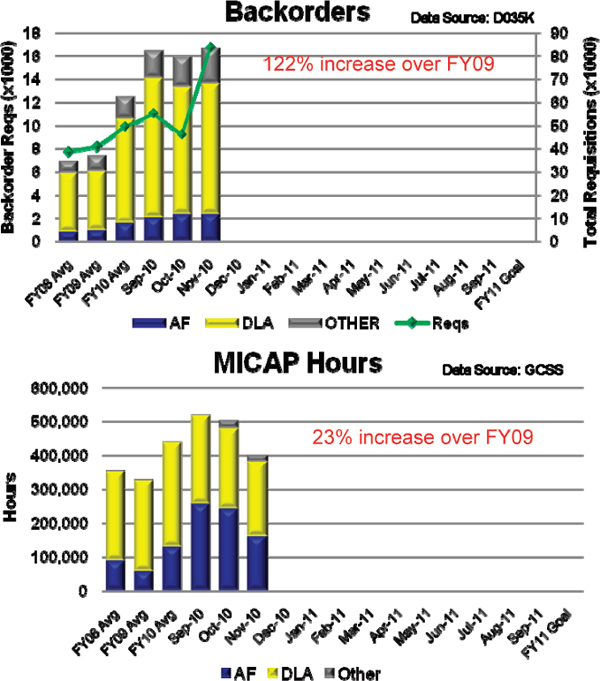
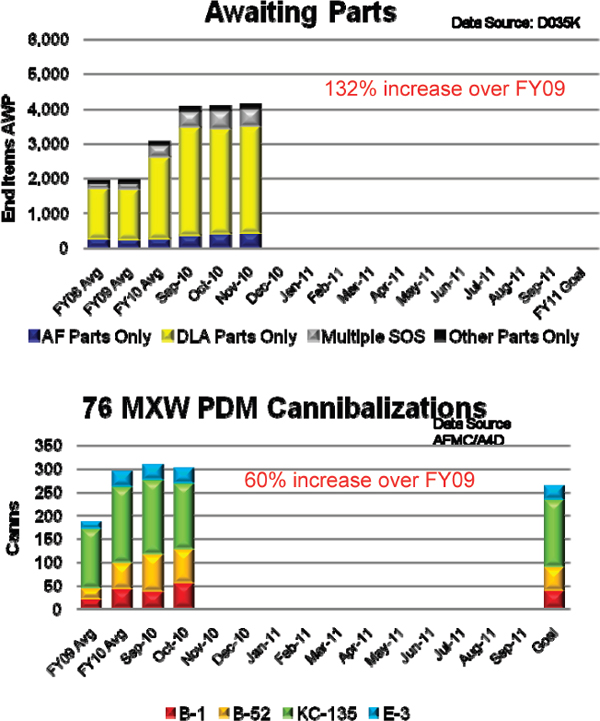
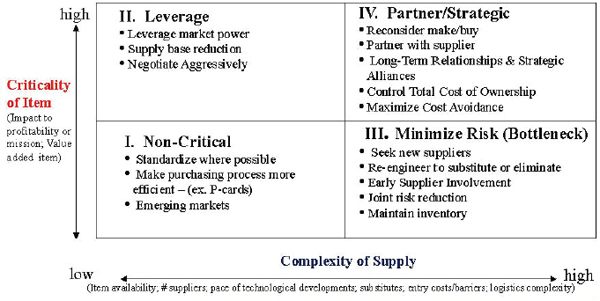
FIGURE 4-8
A strategic framework. SOURCE. Peter Kraljic. 1983. “Purchasing Must Become Supply Management.” Harvard Business Review 83509 (September-October). Available at http://www.sourcingchina.org/PictureLoad/2009829103938430.pdf. Accessed May 5, 2011.
(OEMs) and high-confidence aftermarket suppliers have a higher likelihood of providing the parts where and when needed than do mass commodity suppliers.
The present market approach by the current supply chain managers seems to drive all classes of supply to the characteristics listed in the lower left quadrant of Figure 4-10.
In reality, market dynamics demonstrate that for many commodities this is entirely appropriate. However, for the upper tier of readiness and engineering critical parts with few qualified suppliers, the market approach with alignment to key qualified suppliers is more appropriate. A subject matter expert would also point out that the supply characteristics in the upper right quadrant (few participants, high barriers to entry, high switching costs) cannot be left to market forces but must be cultivated with long- term partnerships. Figure 4-11 highlights partnerships strategies to be considered.
These partnerships must be strategic and tactical, and both sides have an obligation to control the effectiveness and efficiency outcome. Establishing long-term spare parts relationships with suppliers who are capable of providing parts and particularly those that fit in the upper right quadrant of Figure 4-9 would provide highly effective (minimum lead time, on-time delivery) and optimally efficient results (appropriate costs).28
______________
28 Peter Kraljic. 1983. Purchasing Must Become Supply Management. Harvard Business Review 83509 (September-October). Available at http://www.sourcingchina.org/PictureLoad/2009829103938430.pdf. Accessed May 5, 2011.
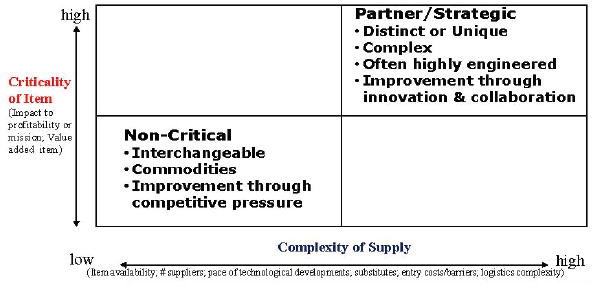
FIGURE 4-9
Production characteristics. SOURCE: Steve Geary, Center for Executive Education, University of Tennessee. “Acquiring What the Warfighter Needs.” Presentation to the Aviation Week MRO Conference, April 12-14, 2011, Miami, Florida.
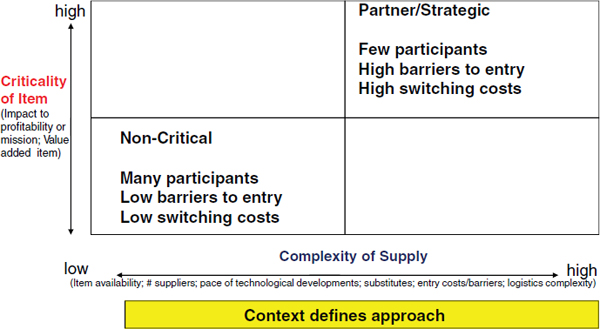
FIGURE 4-10
Production characteristics. SOURCE: Steve Geary, Center for Executive Education, University of Tennessee. “Acquiring What the Warfighter Needs.” Presentation to the Aviation Week MRO Conference, April 12-14, 2011, Miami, Florida.
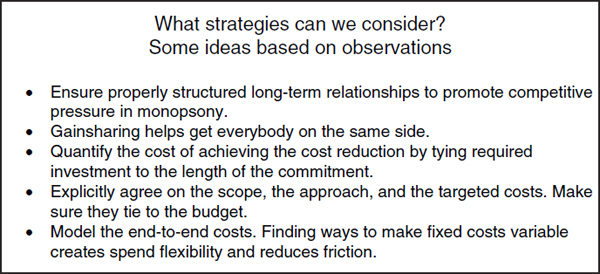
FIGURE 4-11
Production characteristics. SOURCE: Steve Geary, Center for Executive Education, University of Tennessee. “Acquiring What the Warfighter Needs.” Presentation to the Aviation Week MRO Conference, April 12-14, 2011, Miami, Florida.
Finally, the DLA and the AFGLSC each have a colonel designate as the key coordinator of spare parts support at the respective ALC. The AFGLSC colonel is a commander and seems to have extensive decision-making authority for the personnel and parts execution of his group. The DLA colonel serves as a point of contact with whom ALC personnel can work. Yet, the DLA colonel must defer to lower levels at DLA Richmond for decisions such as local manufacture or rapid sourcing to meet demands, which are significant to the production effort but inconsequential in terms of difficulty or economic value in the bigger picture of enterprise resource consumption. In a briefing to the full committee, the DLA representative explained that because the Air Force is responsible for significant portions of the approval flow, DLA Richmond must be involved.
During discussions at the ALCs and at the FRCSW, key leaders made very appropriate comments with respect to the organizational structure, workforce,29,30
______________
29 Major General Andrew E. Busch, Commander, OO-ALC. Personal communications with committee, January 31, 2011.
30 In general, Major General Busch stated that the issues affecting performance are not so much about organizational structure as they are about defining and following processes. In other words, organizational change will not necessarily solve the many issues, but crafting and following defined process may.
and spare support.31,32 At the Aviation Week MRO conference, the Assistant Deputy Undersecretary of Defense for Maintenance succinctly summarized the bottom line for any maintenance effort: “If you don’t have parts, you can’t do maintenance.”33
Finding 4-5. The current supply chain for spare parts, as managed by the Air Force and the DLA, is deficient and often fails to provide parts for technicians in time to affect repairs in an efficient manner.
Recommendation 4-3. The Air Force should take action, both internally (with Air Force sources of supply and Air Force-controlled contractors) and externally across the DoD (DLA), to dramatically improve the supply chain’s timeliness and accuracy in providing necessary parts to meet the maintenance technician’s needs.
RESOURCING FOR TECHNOLOGY INSERTION AT AIR LOGISTICS CENTERS
Although technology insertion is covered in depth in Chapters 5 and 6, the committee notes here that it observed a limited amount of technology insertion into weapon system and commodity parts and into supporting maintenance equipment at the ALCs. Insertion was largely a function of what was available and provided to program management as funded by operational commands. The committee did not detect any reluctance or inability by ALC program office personnel to accomplish technology insertion, including the associated master planning and the execution, when opportunities arose. Improving the levels of the manufacturing technology (ManTech) program and Component Improvement Program (CIP) appears to be a problem within the broader AFMC organizational structure rather than at the ALC level. At the ALCs, a viable organizational structure and good support exist to institutionalize the process of developing and transitioning repair and durability. Repair technologies—that is, the capability to repair systems and parts—at the ALCs appear to lag behind the introduction of new systems, in part because design data packages are lacking early in the fielding of new systems and because the ALCs initially rely on contractor logistics support, which is a significant chal-
______________
31 Captain Fred Melnick, Commander, United States Navy, Fleet Readiness Center Southwest. Personal communication, March 29, 2011.
32 Captain Melnick commented on the DLA’s metrics in the sense of the Air Force’s PBA with DLA. In general he stated, “The metrics may mean a lot to DLA, but they do not have the same meaning to ‘us.’” That is, the metrics do not measure the true supply support to the field-level activities that are receiving supply support from the DLA.
33 John Johns, Assistant Secretary of Defense for Maintenance. Presentation at the Aviation Week MRO Conference, April 12, 2011, Miami, Florida.
lenge to meeting the 50/50 rule. Recent policy decisions to at least source and price data packages are noteworthy endeavors.34 The resource impacts of procuring data packages are understood, and it is encouraging that a more methodical approach to tie data packages to the analyses conducted in support of DoD Instruction 5000.02 Milestone A and Milestone B activities has been observed. This effort appears to be progressive for the longer term, but in the immediate and near term the ALCs are impacted by lack of strong data packages. The overall data situation is made worse by efforts to manage software that is entirely dependent on total data packages being available. In the end, data are key to the ALC business of sustaining systems.
ENTERPRISE MANAGEMENT AT THE AIR LOGISTICS CENTERS
For the ALCs to be effective, data must become the key element in their efforts.35Chapter 2 addresses how data suppots engineering. Maintenance of complex equipment is as much about information as it is about the ability to execute the actual work. The lack of effective measures, an effective planning and forecasting system, true condition monitoring of the equipment, and enterprise capture of work accomplished are major impediments to the ALCs’ success. During the assessment of the ALCs, much was heard about the Expeditionary Combat Support System (ECSS) and the promise it holds for the future sustainment processes management. Although enterprise management extends far beyond the ALCs, it certainly is a substantial part of the ALC environment and is a key part of the ALC resourcing. ECSS is a component—albeit an important component—of the Air Force Expeditionary Logistics for the 21st Century (eLog21) initiative. Numerous processes under eLog21 are designed to improve the governance of sustainment and the effectiveness and efficiency of the processes.36
ECSS standardizes sustainment processes at every level and uses an Enterprise Resource Planning (ERP) tool to enforce the approved rule set. Although this is noteworthy, the committee also detected the “pain” of legacy systems that have been forced to operate “as is” for years while ECSS has been fielded. Several committee members have fielded ERPs and agree with the decisions to “freeze” the legacy systems. This approach creates a very high risk for the near term because there are no other systems to take their place. Thus freezing of legacy system improvements requires considerable faith in those responsible for current mission execution that a very large and complex system will in fact be implemented in a timely fashion.
______________
34 DoD. “Better Buying Power: Guidance for Obtaining Greater Efficiency and Productivity in Defense Spending.” A Memorandum for Acquisition Professionals. September 14, 2010. Washington, D.C.: Office of the Under Secretary of Defense. Available at http://www.acq.osd.mil/docs/USD_ATL_Guidance_Memo_September_14_2010_FINAL.PDF. Accessed May 5, 2011.
35 Further discussion of data and enterprise management occurs in Chapters 2 and 5.
36 eLog21 is discussed extensively in Chapter 2.
Based on experience, the skepticism in various execution offices is well founded. The legacy systems with all of their shortcomings are the only systems available. As a result, today there is no integrated or enterprise system that ties all of the sustainment requirements together, easily and accurately ties maintenance consumption to forecasts for future production needs, allows for the engineering officer to manage the mechanic information flow, tracks man-hours consumption or task completion, assists with planning and scheduling, or allows supply systems to meet the consumer demands. The lack of an integrated planning tool is a serious resource constraint for the ALCs.
During tours at one repair facility, the committee witnessed a locally developed “online” report that used legacy systems to draw information and allowed the maintenance personnel to see worldwide demands for the products, to track month-to-date production against a month-to-date requirement, and track current critical product needs. The committee asked maintenance leadership, “What other production activities has this system been exported to?” The response was noteworthy in that it simply hadn’t been exported, for reasons related to the promise of a future with ECSS, a need to tailor the report somewhat to meet other area’s needs, a reluctance by some to adopt the system in light of the coming of ECSS, and limited funding to alter the system to work in other areas. All of the reasons demonstrate the strong need for a standard way of doing business. The report that the committee observed, while very good, is one of a kind and stands alone in this particular repair group. In one form or another, the committee repeatedly heard similar stories about the condition of management systems to support parts requirements generation or production support. Suffice it to say, the sustainment process is hindered by the currently fielded or lack of process management and reporting tools.
A program such as eLog21 and its ECSS component are very valuable and are a necessary way forward. Further, these systems are by their nature expensive, have an element of risk, and take time. In pursuing an ERP system, whether it is ECSS or others, the Air Force must understand that implementation of major systems requires extensive buy-in from top to bottom, stable management, and process and work habit changes that are very disruptive. In such a major system implementation, frequent organizational changes are anathema and will greatly hinder the success. Major system changes cannot be implemented by outside consultants or contractors alone but must have major engagement of the actual management and workforce that will use them. Effective ERP systems are the cornerstone of an effective sustainment effort. Over the course of the study, the committee reached the conclusion that one of the single greatest impediments to a successful sustainment enterprise is the lack of standardized processes and a functioning enterprise-level data system that forces standardized actions and delivers timely, actionable data to all levels of work/management.
Finding 4-6. The lack of a functioning ERP tool or a strong management information suite and the reliance on outdated legacy information systems are great causes of added complexity and inefficiency in the operation of the entire sustainment enterprise that includes system “cradle to grave” program management, and maintenance, supply, and transportation activities.
Recommendation 4-4. The Air Force should continue its eLog 21 approach to sustainment improvement and should aggressively continue to pursue incremental fielding of the ECSS as an enterprise resource planning solution. Strong advocacy for this program should reside in the sustainment commander.37
MAINTENANCE PLANNING AND PRIORITIES
During tours of the ALCs, the committee searched for evidence of strong planning and execution of maintenance programs. Improvement programs for existing system are being planned, such as High Velocity Maintenance (HVM) and Maintenance Steering Group Three. These efforts are designed to enhance depot throughput and to tailor both depot and field inspections to realistic operational conditions. Likewise the committee saw evidence of lean practices and critical chain project management tools that will improve the overall maintenance processes. The full-scale deployment of these improvement programs is not envisioned, and programs such as HVM have different meanings for WR-ALC, OC-ALC, and OO-ALC. Often these programs are local efforts with little or no central focus on efficiency improvements. Although it was referenced by Headquarters staff, the committee did not see a concerted effort on the part of the AFMC to implement and measure productivity measures systemwide. Until recently, HVM was in prototype stage. The new WR-ALC commander instructed the HVM team to proceed and plan on full implementation.38
The maintenance staffing on aircraft during heavy maintenance is certainly lower than that experienced in the commercial aviation industry. The committee notes the new programs and use of enhanced productivity efforts; however, appropriate man loading would complement all of these efforts, more quickly improve flow through the depot, reduce the work-in-process at the installation at any one time, and still produce the same output per year. The committee was told that increased man loading cannot be done because the ALCs have not invested in a
______________
37 Based on detailed information provided to the committee by the Air Force, the committee concluded that there is a critical need for an ERP system to help address Air Force sustainment issues. The ECSS is being developed with ERP capabilities and will be implemented to meet the Air Force need. The committee did not attempt to evaluate the process that selected the specific ERP system or the contractor(s) involved in the development and implementation.
38 Doug Keene, High Velocity Maintenance, WR-ALC. Personal communication to committee, January 6, 2011.
work package that allows for it. For systems of this age and in these general conditions, a deck of work could be optimized for both cost and turn time. The ALCs over the years have acquired a large and growing workload. This workload reflects the increasing trend of electronics, avionics, computers, and ultimately software in weapon systems. Attendant with an integrated approach, software maintenance became a part of the ALCs and specifically the maintenance organization in the ALCs.39
SOFTWARE SUSTAINMENT FOR LEGACY AND FUTURE SYSTEMS
Although not specified in the TOR, the sustainment of software embedded in legacy and future systems was cited as a critical concern by high-level Air Force officials at the outset of the study. The primary focus of the following discussion pertains to the process for software development, through transition and on to sustainment.
Despite the much publicized issues with software development in major weapon systems, relating to cost and schedule overruns, software that is delivered to operational use is generally mature. Software sustainment can be characterized as either (1) the modification or correction of existing code or (2) development of new functions or performance improvements that provide increased capability to enhance weapon system relevance. Problem reports and deficiencies corrections are incorporated into releases that support such capability unless they are urgent enough to ground the aircraft for immediate fixes. Additionally, Diminished Manufacturing Sources (DMS) and support equipment changes may necessitate modifications. Typically, software development and sustainment have nearly identical processes.40
Software releases are usually organized in “blocks” where all software changes to the system are developed, integrated, tested, and delivered as a single block release. The Air Force typically maintains a 2-year block release cycle for its aircraft, although this is flexible, and some systems such as ground command and control can have cycles as short as 3 months. Although software is very important for legacy systems, current trends in electronics and software capabilities ensure that future systems will be much more dependent on software to deliver warfighting capabilities. Growth in software size and complexity in modern weapon systems is and will remain a significant concern for Air Force leadership. The following topics are discussed in this section: (1) current trends in software development and maintenance; (2) current Air Force capabilities; and (3) future challenges based on new aircraft entering the inventory.
______________
39 Chapter 2 includes a related discussion under the section entitled Engineering-based Decisions.
40 Karl Rogers, Director, 309th Software Maintenance Group, OO-ALC. “309th Software Maintenance Group.” Presentation to the committee, February 1, 2011.
Current Trends in Air Force Software Development and Maintenance
Significant growth in software content across Air Force systems is driven by multiple factors. First, continued increases in the Air Force’s dependence on software-intensive systems, and the associated growth in size, complexity, and cost of these systems, have been further compounded by multi-contractor teams using different processes and different tool sets in dispersed engineering, development, and operational locations. Second, software technology is advancing at a breathtaking pace. New technologies and products create both opportunities and challenges that need to be managed during the development and sustainment phases of the life cycle. Third, business and operational needs change, often faster than full system capability can be implemented, which, in turn, challenges the Air Force requirements management processes, existing program management directives, and traditional systems engineering practice. Fourth, software connects other systems in net-centric or system-of-system constructs, increasing the management complexity of software development and modification. Finally, software digitization of previously analog-based, hardware-delivered measurement and control functions, such as sensing, flight controls, and engine controls, continues to increase.
Software presents numerous advantages and challenges to sustainment. First, adopting good software engineering practices often leads to reasonable return on investment; however, investment’s benefits may not be realized on initial pathfinder programs. Second, software tends to be invisible in the acquisition process. Typically, the Air Force does not purchase software source code; rather, it buys systems and subsystems that are defined by hardware-centric, prime-item specifications. The total cost of these systems is often significantly underestimated, because the delivered code is but one part, and corresponding support and testing of software can increase costs by significant factors. Third, doing software “right” requires persistence, discipline, and relentless attention to detail. Last, few key decision makers or mid-level managers outside the immediate software community have in-depth software understanding; therefore, software management and engineering competency tend to be weak.
The increased dependence on software is not restricted to DoD systems; it is also evident in commercial products, such as personal digital assistants, smart phones, games, and automobiles. For example, advanced automobiles use upwards of 30 million lines of code, and there exist projections of a 100 million lines-of-code car.41,42 Indeed, software is the major scheduler and cost driver for the development and maintenance of most systems. Figure 4-12 illustrates many of the above trends,
______________
41 Available at http://www.techweb.com/wire/software/showArticle.jhtml?articleID=51000353. Accessed May 1, 2011.
42 Available at http://www.eweek.com/c/a/Enterprise-Apps/GM-to-Software-Vendors-Cut-theComplexity/. Accessed May 1, 2011.
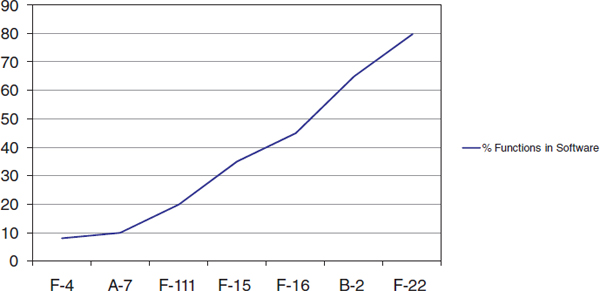
FIGURE 4-12
Increasing percentage of aircraft system capabilities that are now delivered by software. SOURCE: Jack Ferguson. 2001. Crouching Dragon, Hidden Software: Software in DOD Weapon Systems. IEEE Software 18(4):105-107.
showing that an ever-increasing percentage of aircraft system capabilities is now delivered by software. It is estimated that this percentage is quickly approaching 100.43
Although code counting and classification methods differ,44 source lines of code (SLOC) are growing rapidly in modern aircraft, as evidenced in Table 4-3. In addition, the growth in safety-critical SLOC is notable. Complexity of certification for flight-critical software increases rapidly (in a nonlinear manner) as flight-critical code size increases.
As shown in Figure 4-13, the net result is that these factors drive an expected significant increase in dollars consumed to support software.
Air Force Policies for Software Sustainment
Currently, no reasonable, concrete definition of software maintenance exists. There is no set Air Force policy for when software development, upgrade, or modification or when software maintenance begins or ends. During the committee’s discussions with software experts and with staff, the common opinion was that
______________
43 Karl Rogers, Director, 309th Software Maintenance Group, Ogden Air Logistics Center. “309th Software Maintenance Group.” Presentation to the committee, February 1, 2011.
44 Delvyn Deschamps.Air Force Materiel Command. Personal communication to the committee on May 11, 2011.
software is integral, and maintenance, upgrades, modifications, and improvements happen simultaneously. With that as a common approach across the ALCs and with the growth of data previously described, the committee believes that sustainment of weapons system software has the potential to be the largest single growth item in
TABLE 4-3 Software Lines of Code (SLOC) in Selected Legacy and Future Air Force Systems
| F-16a | F-22b | F-35c | ||
| Total SLOCd | Unknowne | 5,447,388 | 19,000,000f | |
| Aircraft SLOCg | 1,710,114h | 2,730,000i,j | 9,000,000k | |
| Safety-critical SLOCl | 259 | 152,000m | 500,000n | |
aDelvyn D. Deschamps, Air Force Materiel Command. Personal communication to the committee, May 11, 2011.
bDelvyn D. Deschamps, Air Force Materiel Command. Personal communication to the committee, May 11, 2011.
cNo data provided by the program office.
dTotal SLOC—All code associated with the aircraft, including onboard/operational (OFP, fire control, stores management, communications, radar, heads-up display, embedded GPS/ins, digital video recorder, mission planning, etc.), simulators, maintenance and diagnostic software, logistics tracking, etc.
eMetric not tracked by the program. Delvyn D. Deschamps, Air Force Materiel Command. Personal communication to the committee, May 11, 2011.
fLockheed Struggles to Keep F-35 Flight-Testing on Track: Report.” January 10, 2010. Available at http://www.flightglobal.com/articles/2010/01/21/337424/lockheed-struggles-to-keep-f-35-flight-testing-ontrack.html. Accessed May 13, 2011.
gAircraft SLOC—Code for onboard/operational purposes (OFP, fire control, stores management, communications, radar, heads-up display, embedded GPS/ins, digital video recorder, mission planning, etc.).
hFor current fielded OFP (SCU7/7.1).
iApproximate on-aircraft software size (post increment 3.1 with sustainment update 3 merge). SLOC projected to increase to approximately 3.13 million SLOC post increment 3.2. Headquarters U.S. Air Force F-22 Inc 3.2, Modernization Joint Assessment Team Brief, Kathy Watern, SAF/FMC, November 29, 2010.
jThis number excludes firmware. Margaret Fisher, Air Force Materiel Command. Personal communication to the committee, April 27, 2011.
kThe article also suggests 11.6 million lines of code as the eventual total. “F-35B Flies with Block 1.0 Software.” November 15, 2010. Available at http://www.flightglobal.com/articles/2010/11/15/349732/f-35b-flies-with-block-1.0-software.html. Accessed May 13, 2011.
lSafety-critical: A term applied to a condition, event, operation, process, or item whose proper recognition, control, performance or tolerance is essential to safe system operation or use, e.g., safety-critical function, safety-critical path, safety-critical component. Safety-critical computer software Components: Those computer software components and units whose errors can result in a potential hazard, or loss of predictability or control of a system. Available at http://www.system-safety.org/Documents/Software_System_Safety_Handbook.pdf.
mMargaret Fisher, Air Force Materiel Command. Personal communication to the committee, April 27, 2011.
nEstimated.
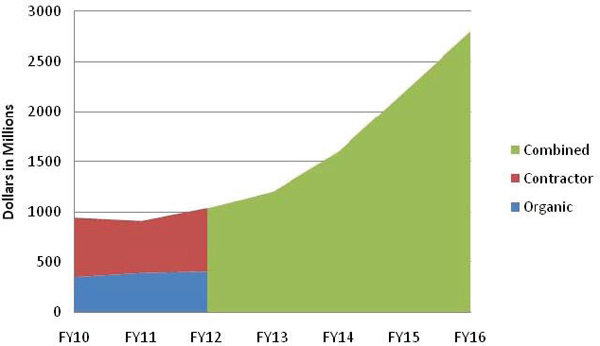
FIGURE 4-13
Software sustainment. SOURCE: Debra K. Tune, Principal Deputy Assistant Secretary of the Air Force for Installations, Environment and Logistics, Office of the Assistant Secretary of the Air Force for Installations, Environment and Logistics. “Developing the Right Product Support Concepts for the Future.” Presentation to the committee, October 20, 2010.
the ALC depot maintenance portfolio. As noted in a briefing at OO-ALC, “Even if the number of platforms decreases, software workload will continue to increase.”45
Software Workforce
Approximately 2,700 people, or 12 percent of the depot maintenance workforce, provide software support to weapons systems at the ALCs. Of these, approximately 90 percent are professionals, and approximately 70 percent (1,800+) have engineering or computer science backgrounds.46,47 The majority of staff are government civilian personnel, augmented significantly by contractors. The current organizational components are stable, but there is concern over the stability
______________
45 Karl Rogers, Director, 309th Software Maintenance Group, OO-ALC. “309th Software Maintenance Group.” Presentation to the committee, February 1, 2011.
46 Tom Labrie, 76th Software Maintenance Group (76 SMXG), OO-ALC. “76 SMXG Overview.” Presentation to the committee, January 12, 2011.
47 Karl Rogers, Director, 309th Software Maintenance Group, OO-ALC. “309th Software Maintenance Group.” Presentation to the committee, February 1, 2011.
of funding. Funding requirements are generally driven by modernization activities. As individual weapon system programs evolve, the need for software staffing varies.
In addition, as software needs grow, the technical and management workforce must be able to expand with the work. The software workforce can be maintained and grown, but it will be easier at some locations than others. Additionally, the transition from the National Security Personnel System (NSPS) to the standard civil service system will make the task harder.48 Nevertheless, there is a strong feeling that the needs will be met.
There is strong historical compliance with industry software standards across the ALCs. The WR-ALC and OO-ALC49 software maintenance organizations are assessed at Carnegie Mellon University Software Engineering Institute CMMI v1.150 level 5 (the highest), and both are AS9001/ISO9001 certified.51 The OC-ALC is assessed at CMMI level 4. All ALCs are currently due to be re-assessed to maintain the currency of their ratings.52 Each of the ALCs and their software maintenance organizations are critical Air Force assets. They have attained substantial process controls and quality measures at the highest levels of the industry. Their staffs have the technical skill sets required to maintain current inventory aircraft.
Software Facilities
The Air Force has made significant investments in software maintenance facilities at the ALCs. The facilities were comparatively new and largely designed for software maintenance support activities. Although the facilities were generally impressive, the committee noted situations where the equipment and computers used for software maintenance were worn out or suffering from the inability to get repair parts, or the technology had far surpassed the on-hand support equipment. This is particularly important with respect to system or software integration
______________
48 Under NSPS, the system allowed personnel to be hired at the market rate. In other words, the private-sector pay scale for engineers, for example, could be matched. Under the Federal Employee Retirement System or General Schedule system, a 12, 13, 14 gets what a 12, 13, 14 gets and the added or taking away of the locality pay.
49 Karl Rogers, Director, 309th Software Maintenance Group, OO-ALC. “309th Software Maintenance Group.” Presentation to the committee, February 1, 2011.
50 Capability Maturity Model Integration (CMMI): A process improvement approach that helps organizations improve their performance. CMMI can be used to guide process improvement across a project, division, or an entire organization.
51 OO-ALC was assessed CMMI v1.1 level 5 in CMMI V1.3 in 2006. SOURCE: Karl Rogers, Director, 309th Software Maintenance Group, OO-ALC. “309th Software Maintenance Group.” Presentation to the committee, February 1, 2011.
52 OO-ALC is scheduled to be re-assessed for CMMI v1.3 level 5 in October 2011. SOURCE: Karl Rogers, Director, 309th Software Maintenance Group, OO-ALC. “309th Software Maintenance Group.” Presentation to the committee, February 1, 2011.
laboratories (SILs). These SILs are major facilities, requiring $100 million or more to stand up and fundamental to system testing.
Finding 4-7. With some exceptions, the ALCs are well resourced to maintain today’s existing software. They have achieved quality processes that allow for a strong case for investment to maintain future systems software.
Recommendation 4-5. The Air Force should focus the same, arguably more, attention and investment as that given to equipment in the actual weapon system on tools used for software maintenance. Maintaining currency between test laboratories and actual weapon systems is fundamental for dealing with timing, details of hardware interface behavior, and concurrency.
Organization and Management
A very interesting aspect of the software maintenance organization and processes at the ALCs is the lack of significant organizational and higher Headquarters management oversight. Actually, the committee found this refreshing, even though there are delicate issues requiring higher-level Air Force involvement, albeit not at an excessive level that might stifle local execution. The software leadership of the three ALCs have formed a laudable working arrangement to address workload, process improvement, and policy, fiscal, personnel, and other corporate software issues,53 but this body has little to no formal authority. Certainly the intent of the AFMC Software Maintenance Group is to provide one virtual software maintenance function, instead of three geographically separated, competing organizations, and a unified message/face to the customer and Headquarters.
Finding 4-8. Weapon system software sustainment is well supported at the three ALCs, but the Air Force has no central governance body to sustain software, and the various Headquarters staffs are technically ill equipped to deal with software issues.
Future Challenges Based on New Aircraft Entering the Inventory
The primary issues with the future software enterprise are driven by two long-standing heuristics: “Software is never finished” and “Software never makes the system cost less.” These truisms do not implicate problems with software as a technology, but instead reflect the fact that software can significantly enhance capa-
______________
53 Tom Labrie, 76th Software Maintenance Group (76 SMXG), OO-ALC. 2011. “76 SMXG Overview.” Presentation to the committee, January 12, 2011.
bility and is significantly more flexible to change than physical hardware. Combine that with the growth in dependency discussed earlier in this chapter, and it is easy to conclude that software will be a major and growing cost driver for sustainment of future systems, which must be recognized in planning.
Within the Air Force, better policy and guidance for software development, upgrades and modifications, and maintenance must be developed, promulgated to the field, and enforced. The Air Force would benefit from reviewing its corporate oversight of embedded systems software development and sustainment with an eye toward greater risk identification and mitigation, and from enabling corporate (versus command specific) decision making. In addition, given its dependence on software to achieve mission capabilities, the Air Force would benefit from additional senior leader education in this area.
The Air Force has developed a very strong weapon system software capability, which can be used to improve future weapon system sustainment. Stable workforce planning will continue to be important because the scope of software update manning varies with the amount of modernization in each platform as well as with the scheduling of blocks between platforms.
As cited earlier, the software sustainment processes at the ALCs were considered to be on par with the best of industry. Although process maturity is extremely important, technical expertise in real-time systems, concurrency, new programming languages and operating systems, system of systems, networks, communications, and large-scale integration will be equally important to maintain future aircraft systems. Notwithstanding the process improvement efforts and outstanding performance on various aircraft systems, such as the F-16, the committee is concerned with how the ALCs will build and retain the technical expertise needed in the indicated areas, particularly given the lack of planning for organic maintenance that seems prevalent in the newest weapon systems. Stated another way, there is an overwhelming learning curve to assuming an organic maintenance load when you have not been involved from the beginning of development. Some in the Air Force may prefer long-term contractor maintenance, but at some undetermined point the contractor workforce will become no longer available or extremely expensive. At that point, there will be no fall-back position because the expertise will not be available internally.
Recommendation 4-6. The Air Force should focus on strengthening and retaining the advanced skill sets needed for the sustainment of new aircraft systems.
The facilities and laboratories related to software sustainment are adequate to meet current demands. For future system acquisitions, however, as part of initial program planning, strong consideration must be given to a single government en-
tity or contractor SIL per program. This would localize costs and facilitate transfer of software maintenance responsibilities. In addition, it would generally ensure that the SIL equipment and development tools, which are generally commercial products, are current, as opposed to what sometimes occurs in maintenance organizations; namely, the support equipment is baselined at older versions that are no longer supported by the vendor.
Within Headquarters Air Force, Headquarters AFMC, AFMC Directorate of Logistics and AFMC Directorate of Engineering, there does not appear to be a senior software counterpart that deals effectively with software. In addition, software support for weapon systems is underrepresented (i.e., there is no apparent advocate) in the sustainment community, and software maintenance decisions are defaulted to the program offices and therefore largely to the OEMs. Although this may be acceptable, the Air Force has declared software a core maintenance area under the provisions of 10 U.S.C. § 2464. Because the Air Force believes software to be a core maintenance capability, it must be managed and supported accordingly.
Recommendation 4-7. The Air Force should review its corporate oversight, management, and support of embedded systems software development and sustainment with foci on (1) greater risk identification and mitigation and (2) enabling Air Force corporate, as opposed to command-specific, decision making. In addition, given Air Force dependence on software to achieve mission capabilities, the Air Force should strongly consider additional education on software sustainment for senior leaders.
Access to software development data is vital to proper software sustainment. This includes development of domain expertise with the software and tool sets used in the software development of each platform. Data rights are vital and an issue on virtually all new software workloads; these issues must be considered during acquisition planning to ensure future access for the ALCs.54 The shift from development to sustainment is currently defined at Milestone C, but it is more a shift from development to sustained block updates—an approach that is not optimum for the new generation of aircraft. A closer partnership between government and contractor throughout the entire development life cycle must be a fundamental part of acquisition planning. Software sustainment planning must begin prior to Milestone A and must have ongoing involvement by the designated sustainment organization throughout the development process. As such, management attention should focus on acquisition/sustainment planning early in the genesis of weapon
______________
54 Karl Rogers, Director, 309th Software Maintenance Group, OO-ALC. “309th Software Maintenance Group.” Presentation to the committee, February 1, 2011.
systems to balance contractor efforts with the required development of organic capabilities.
Recommendation 4-8. The Air Force should pursue a blended partnership between ALCs and contractors throughout the entire software development and sustainment life cycle, commencing before Milestone A.
SUSTAINMENT FUNDING
The Air Force planning and budgeting processes have the capability to successfully address the forecasting and distribution of funds at a high level. The Centralized Asset Management services provided for the Air Force by Headquarters AFMC is a noteworthy improvement. Yet, the budget constraints imposed on the entire Air Force are also felt at the ALCs and impact their abilities to be high-performing, effective, and efficient organizations.
Several limitations on spare parts currently exist because of organizational alignment, material practices, and enterprise funding constraints that have pronounced impacts at the ALC maintenance levels. These involve cost targets, reallocation of priorities for spare parts, and stockage effectiveness targets that fail to realize that parts delays often cause inefficiencies that impact workforce and facility use in a far greater way than the savings created by constraining supplies investment, to say nothing of the direct impacts on material readiness in warfighter operations.
As discussed in Chapter 3, the Air Force has invested in plant and equipment extensively over the past 8 years. Nevertheless, select parts of the plant and equipment do not meet current needs.
Finding 4-9. Despite significant investments, if the ALCs are expected to meet new workloads imported from outside the Air Force repair facilities or to support new technology, additional investment will be required.
As noted early in this chapter, there is a mismatch between funded workload in the maintenance departments and funded support personnel such as engineers to provide technical guidance for the work. This situation can only be understood in the sense that funding accounts do not allow technical engineering support to grow or that policy limits hiring engineering personnel and placing them in the production environment with inherent authority to make decisions. There are disconnects between the engineering resources needed to support production and the resources provided. As discussed in more detail in Chapter 2, the FRCSW
has a highly qualified engineering cadre immediately available to support depot production lines.55
Although not a funding issue in the traditional sense, the ALCs need an enterprise management solution. The Air Force is slowly fielding an ERP, but a system is needed as soon as practical, and the Air Force must provide it to the entire sustainment community. The impact of not having a system appears to be far greater at the ALCs/AFGLSC because of their total responsibility for fleet support across commands and in some cases across services and foreign military sales.
EFFICIENCY AND EFFECTIVENESS OF AIR FORCE AIR LOGISTICS CENTERS
During the course of the committee’s visits, several “white boards,” flat screen displays, or paper charts were used to reflect the productivity efforts of the people. Although visual aids are commendable, there was no consistent measure of effectiveness or efficiency across the ALCs or even within an ALC. At the highest levels, there is a lack of measures and objectives for productivity and effectiveness. The committee was not successful in its search for the “key” metric that would tell the chief executive officer of the ALC, AFMC, or the Air Force how the sustainment process or the industrial operation was performing. A Headquarters AFMC briefing to the committee noted, “Current State Maintenance: AFMC has capacity, personnel and facilities and equipment to sustain legacy systems.”56 The committee disagrees and could not find supporting evidence that legacy systems can be effectively and efficiently supported with current policies and resources. Thus, the committee seriously questions the validity of this statement over the longer term. The ALCs have strategic plans, and in those the committee observed limited metrics for AA and aircraft on-time delivery from production lines. Although the committee saw displays on aircraft status in the work area and delivery times as a center overview, it could not find evidence that these metrics were being pushed to production teams as a whole. In addition, there were no strong plans for recovery when AA or delivery fell below target levels. The committee observed metrics for quality that exceeded the standard. However, for one or all of these, there was little demonstrated awareness at key supervisor or worker levels. Finally, the committee did not see a metric that related the cost of the production to the planned cost or the planned outcome.
The committee discussed the AA metric at length. The metric has high utility for operational commanders: Do they have the aircraft they need to execute the war
______________
55 USN. “Fleet Readiness Center Southwest – Roundtable Discussion.” Presentation to the committee, March 29, 2011.
56 Major General Kathleen D. Close, AFMC/A4. “Weapon Systems Sustainment.” Presentation to the committee, December 8, 2010.
plans? Therefore, the metric may apply to the overall sustainment community: Is the community at large providing the number of aircraft needed by the war plan? Otherwise, it is not a key performance metric for any manager of the sustainment community. Many argued that the depot maintenance piece, the field maintenance piece, and the supply piece all build the AA metric. There was enough evidence to suggest that the many pieces of the metric result in no one fully taking accountability and responsibility for the performance. The committee universally came to believe that AA is fragmented, and its accountability is such that it is not a measureable performance criterion for any single sustainment manager.
Maintenance depots production metrics were discussed during the visit to the FRCSW where the committee observed excellent quality, cost, and schedule measures. The method of measuring and portraying quality results is much like that in the ALCs. That is, customers are surveyed and the results graphically displayed. Figure 4-14 depicts cost and schedule metrics for two Navy vertical lift platforms.
These metrics immediately resonated with the committee because they portrayed at a glance how the aircraft production lines were doing on cost and schedule. The use of the “0” or planned line as the baseline allows most people to immediately see where the successes have been and what shortfalls have occurred. The charts show performance by each platform as well as by mean performance for the year. Furthermore, these charts are a key part of a bi-weekly Friday standup session with the FRCSW commander that highlights the production results since the last meeting. These standup meetings are held in the quarterdeck of FRCSW and are well attended by many levels of key managers. The charts are constantly on display in a public area.
Finding 4-10. Within the sustainment environment, there is a lack of focus on clear, well-, and widely understood key performance metrics, specifically for cost, schedule, and performance (e.g., cost, delivery schedules, quality), that drive specific actions to improve performance across the sustainment enterprise.
Recommendation 4-9. The Air Force should develop key metrics for sustainment that flow to ALC commanders and that highlight the success or shortcomings of ALC activities, drive appropriate behavior for the workforce, and allow Air Force leadership to assess the health of the enterprise and the adequacy of resourcing for the sustainment process regardless of organizational affiliation.
CONCLUDING THOUGHTS
This chapter evaluated whether the ALCs are adequately resourced in light of the severity of past and current Air Force budgets. As directed by the TOR, the
evaluation reaches beyond the mere allocation of monies to support sustainment operations at the ALCs. In fact, the flow of funds for depot maintenance and for the Air Force’s flying hour programs has been adequate, although this may not be the case in the near term. Nevertheless, the organizational structure of the ALCs is not resourced adequately in that executive leadership does not have full command or control of the ALC enterprise.
To a serious extent, the supply chain causes great inefficiencies in the depot maintenance and parts repair efforts. Mismatches remain between support to production activities and the growth of requirements at the production level. Importantly, a modern resource management tool, although promised as “coming” is not available, despite being desperately needed. Finally, the only defined measure of effectiveness and efficiency relates to aircraft availability, but far more organizations than ALCs impact aircraft availability. In summary, the ALCs are making it work, but the true full spectrum of resources needed for effective and efficient organizations are not yet available.