
Specific biomarkers can be measured to indicate performance capability. For instance, individuals exhibiting extensive neural connectivities between major brain areas (as determined by increased fractional anisotropy on diffusion tensor imaging, a magnetic resonance imaging technique) tend as a group to sustain attention for longer periods of time than those with fewer such connectivities. Subsequently, those individuals exhibiting extensive connectivities will perform at a sustained level for longer time periods than those will with fewer connectivities.1 As another example, the marked reduction in the slow wave from visual cortex recordings following eye closure is indicative of fatigue and loss of vigilance.2

1 Matthew D. Rocklage, Victoria Williams, Jennifer Pacheco, and David M. Schnyer, 2009, “White Matter Differences Predict Cognitive Vulnerability to Sleep Deprivation,” Sleep 32(8):1100-1103; Matthew D. Rocklage, W. Todd Maddox, Logan T. Trujillo, and David M. Schnyer, 2010, “Individual Differences to Sleep Deprivation Vulnerability and the Neural Connection with Task Strategy, Metacognition, Visual Spatial Attention, and White Matter Differences,” pp. 75-92 in Steven Kornguth, Rebecca Steinberg, and Michael D. Matthews (eds.), Neurocognitive and Physiological Factors During High-Temp Operations, Ashgate Publishing, Burlington, Vt.
2 Christian Cajochen, Daniel P. Brunner, Kurt Kräuchi, Peter Graw, and Anna Wirz-Justice, 1995, “Power Density in Theta/Alpha Frequencies of the Waking EEG Progressively Increases During Sustained Wakefulness,” Sleep 18:890-894; Christian Cajochen, Rosalba Di Biase, and Makoto Imai, 2008, “Interhemospheric EEG Asymmetries During Unilateral Bright-Light Exposure and Subsequent Sleep in Humans,” American Journal of Physiology-Regulatory, Integrative and Comparative Physiology 294:R1053-1060; Julian Lim and David F. Dinges, 2008, “Sleep Deprivation and Vigilant Attention,” pp. 149-173 in Annals of the New York Academy of Sciences 1129:305-322; Ernst Niedermeyer, 1999, “The /Normal EEG of the Waking Adult,” in Ernst Niedermeyer and Fernando Lopes Da Silva (eds.), Electroencephalography: Basic Principles, Clinical Applications and Related Fields (4th ed.), Williams and Wilkens, Philadelphia, Pa.
Certain biomarkers can be measured quantitatively in an operational setting as shown in Chapter 3, Table 3.1. By monitoring multiple indicators, it may be possible to provide a signature of probable performance degradation. The measurement of these biomarkers in the deployed leader could then provide a mechanism for anticipating potential positive and negative responses to threat and thereby allow mitigation of undesired states. One possibility then would be for extensive data sets of individual performance versus stress curves to be developed for the leaders.
One challenge would be to develop better estimates of an individual’s state (e.g., Is an individual in a rational, decision making mode versus an anger-response mode, or in a state to detect the presence of a threat rapidly versus lacking focus?). Objective assessments of individual states performed in a quantitative and reproducible manner would require individual-based correlates of biomarker measurements with performance capability. The varied experiences of individual Marines suggest that biomarker outputs required for the assessment of logistics leaders may differ from those needed by infantry leaders who may also have a different set of critical markers from those for Marines involved in negotiations with a local council leader.
Stress is coupled to performance in general as a U-shaped function: at very low stress levels and at very high stress levels, performance degrades (see Figure F.1). For example, performance can degrade either because of boredom (very low stress) or because of overload (high stress). The maximum level of stress conducive to high performance varies by individual.3 In studying individual differences, it would be ideal to develop for each unit leader a plot of stress susceptibility versus performance under high-tempo operations. The stresses assessed could include sleep deprivation, fatigue, anxiety, isolation, and fear. Such a set of curves could predict changes in the ability to make decisions and maintain vigilance, situational awareness, and communication skills.
DECISION SPACE
Decision making in conducting enhanced company operations in hybrid engagement, complex environments is carried out in a context of complexity, the time duration of the mission, and geographical distribution. The complexity of decision making is confounded by the conflicting goals of kinetic combat conducted simultaneously with nonkinetic interactions involving noncombatants with a strategic mission to “win the hearts and minds of the population.” The time element can range from tactical issues that last for minutes to long-term strategic issues that may last for weeks and months. The geographic distribution can range from the local issues in a neighborhood of a small village to the large-scale inter-
3 Peter A. Hancock and James L. Szalma. 2008. Performance Under Stress (Human Factors in Defense), Ashgate Publishing, Surrey, U.K.
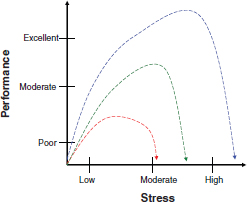
FIGURE F.1 Performance versus stress. SOURCE: Adapted from data by Peter A. Hancock and Joel S. Warm, 1989, “A Dynamic Model of Stress and Sustained Attention,” Human Factors 31(5):519-537.
action actions in a state or a region. These three variables (complexity, time, and space) that characterize decision making can be plotted together. This plot in Figure F.2 can be thought of as the “decision space.”
The decision space also includes many coupled dependencies, such as the impact of noncombatant and combatant casualties on psychological stress, time urgency as a function of rapidly changing conditions, the logistics of supplying needed support over a great distance, and the quantity and validity of the data that contribute to situational awareness. And, of course, all of these interactions are
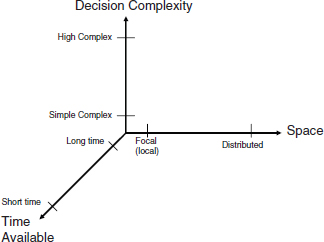
FIGURE F.2 The decision space, involving complexity, time, and space. The farther one is from the origin, the more stressful and difficult the decision making task becomes, with a higher likelihood of negative outcomes; the closer to the origin, the more manageable the decision making is.
compounded by the various uncertainties associated with each of the decisional factors (i.e., the real state of the world, the uncertainty associated with a weapon’s effect and the associated collateral damage, etc.). As a result of these multiple interacting variables, the outcome of any action will have high variability with often-unexpected and sometimes undesirable outcomes.
A PROBABILISTIC APPROACH
Because precise predictions of the outcomes of various decisions are not possible, a probabilistic risk management approach to decision making could be applied. This probabilistic or engineering approach should include the expected performance of individual decision makers at various points in the decision space. In particular, the biomarkers of the individual making the decision could be a particularly vital source of data that could be monitored and used to reduce the risk involved in military operational decisions.
“Risk” is defined here as the product of the consequence of an outcome and the probability of that outcome occurring. The desired outcome from improving the decision making capability of small unit leaders is to minimize the risk involved in their decisions. Risk can be reduced by changing either the consequence of an action or its probability of occurrence, or both. Improvements could be achieved in decision making performance by using biomarkers to monitor the physiological characteristics of individuals and providing mitigation to reduce the probability or consequence of a particular suboptimal decision process. Figure F.3 illustrates how lowering the consequences and lowering the probability lowers the risk.
Because of the inherent complexity of hybrid warfare, particularly in situations involving combatants and noncombatants, the consequences of an action may be significant and the probability of an undesirable outcome may be high. An example would be a patrol that has a high probability of noncombatant casualties as a result of the co-location of noncombatants.
In all cases, the risk management approach requires the ability to make decisions involving an analysis of a situation and an evaluation of the risk involved. The performance of the decision maker will depend on such factors as perceived rewards, cost, and social influences. Individual differences include intelligence, adaptability, specific situational awareness, and training. It is well known that the effectiveness of the decision maker is particularly impacted by chronic and acute stressors as a function of time.4
Individual characteristics of adaptability can result in different levels of continuing performance over a broad level of stress and over an extended period, but for each individual there is a cumulative effect of chronic stress punctuated
4 Peter A. Hancock and James L. Szalma. 2008. Performance Under Stress (Human Factors in Defense), Ashgate Publishing, Surrey, U.K.
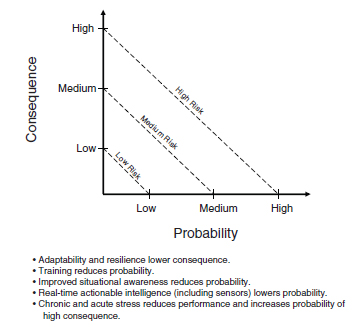
FIGURE F.3 Risk management. (The scales of the axes are logarithmic.)
by acute incidents that can lead to a certain point at which the performance can rapidly decline (based on the Yerkes-Dodson law illustrated earlier in Figure F.1). In addition to the widely used methods of behavioral modeling, the data from biomarkers on the physiological status of the decision maker could also be used to anticipate or avoid this decrease in performance.
The critical technical issue that needs to be resolved is whether physiological monitoring using biomarkers can be used to determine the performance stress curves for individuals and whether those data can be used in a predictive manner to improve decision making under realistic stress conditions.


