
This chapter reprints the summaries of Space Studies Board (SSB) reports that were released in 2010 (note that the official publication date may be 2011). Reports are often written in conjunction with other National Research Council Boards, including the Aeronautics and Space Engineering Board (ASEB), the Board on Physics and Astronomy (BPA), or the Laboratory Assessments Board (LAB), as noted.
One report was released in 2009 but published in 2010—An Enabling Foundation for NASA’s Earth and Space Mission—its Summary was reprinted in Space Studies Board Annual Report—2009.
5.1 Assessment of Impediments to Interagency Collaboration on Space and Earth Science Missions
A Report of the SSB Ad Hoc Committee on Assessment of Impediments to Interagency Cooperation on Space and Earth Science Missions
Executive Summary
Through an examination of case studies, agency briefings, and existing reports, and drawing on personal knowledge and direct experience, the Committee on Assessment of Impediments to Interagency Cooperation on Space and Earth Science Missions found that candidate projects for multiagency collaboration1 in the development and implementation of Earth-observing or space science missions are often intrinsically complex and, therefore costly, and that a multiagency approach to developing these missions typically results in additional complexity and cost. Advocates of collaboration have sometimes underestimated the difficulties and associated costs and risks of dividing responsibility and accountability between two or more partners; they also discount the possibility that collaboration will increase the risk in meeting performance objectives.
This committee’s principal recommendation is that agencies should conduct Earth and space science projects independently unless:
• It is judged that cooperation will result in significant added scientific value to the project over what could be achieved by a single agency alone; or
• Unique capabilities reside within one agency that are necessary for the mission success of a project managed by another agency; or
• The project is intended to transfer from research to operations necessitating a change in responsibility from one agency to another during the project; or
• There are other compelling reasons to pursue collaboration, for example, a desire to build capacity at one of the cooperating agencies.
Even when the total project cost may increase, parties may still find collaboration attractive if their share of a mission is more affordable than funding it alone. In these cases, alternatives to interdependent reliance on another government agency should be considered. For example, agencies may find that buying services from another agency or pursuing interagency coordination of spaceflight data collection is preferable to fully interdependent cooperation.
LESSONS FROM INTERNATIONAL COLLABORATION
Important lessons for national interagency collaboration efforts may also be learned from experiences with international collaboration (i.e., more than one country working together). In particular, the committee found that the U.S. experience in international collaborative projects is instructive with regard to the degree of upfront planning involved to define clear roles, responsibilities, and interfaces consistent with each entity’s strategic plans.
Experience has shown that collaborative projects almost invariably lead to increased costs. When additional participants join a project, the basic costs remain, but the costs of duplicating management systems and of managing interactions must be added. It is also important to recognize that even though the overall cost of the program may increase, the cost to each partner is often decreased, thus making a program more affordable to each partner. With
_______________
NOTE: “Executive Summary” reprinted from Assessment of Impediments to Interagency Collaboration on Space and Earth Science Missions, The National Academies Press, Washington, D.C., 2010, pp. 1-4, released in prepublication form on November 23, 2010.
1In this report, “collaboration” is used as an overarching term that refers to more than one agency working together, and four types of collaboration are defined by the committee, based on the degrees of interdependency between collaborating entities. Although the committee’s name refers to “cooperation,” which is taken from the congressional call for this study, the committee treated “cooperation” as one of the four types of collaboration in which two or more agencies collaborate in such as way that makes each agency dependent on the other for the project’s success.
international cooperation, the cost of a program to the U.S. government can be decreased, since a foreign government is absorbing some of the basic costs. With interagency cooperation, the cost to the government inevitably rises, because the basic cost plus the additional costs must all be absorbed by the participating U.S. agencies.
A prerequisite for a successful international collaboration is that all parties believe the collaboration is of mutual benefit. Proposals for interagency collaboration within the United States should receive similar serious attention as part of each agency’s strategic decision-making process prior to proceeding with technical commitments and procurements. As with international agreements, interagency agreements should not be entered into lightly and should be undertaken only with full assessment of the inherent complexities and risks.
IMPEDIMENTS TO INTERAGENCY COLLABORATION
Impediments to interagency collaboration can result from sources both internal and external to the agencies themselves. Internal sources can include conflicts that result from differing agency goals, ambitions, cultures, and stakeholders, and agency-unique technical standards and processes. External sources can include the differing budget cycles for agencies—especially for the National Oceanic and Atmospheric Administration (NOAA), which must first submit its budget to the Department of Commerce—each of which has different congressional authorization and appropriation subcommittees, budget instability, and changes in policy direction from the administration and Congress. These impediments manifest themselves as impacts to mission success and as changes in cost, schedule, performance, and associated risks.
The most serious impediments to collaboration are external to the agencies. They are typically symptoms of conflicting policies that are often not made explicit at the beginning of proposed cooperative efforts. Such impediments manifest themselves as different budget priorities by agencies, the Office of Management and Budget (OMB), and the Congress toward the same collaborative activity. While there may be acknowledgement of the value of collaboration at a national level, at the implementation level decision makers can be unwilling to prioritize collaboration above other agency mission assignments and constraints.
As detailed in Chapter 3 of this report, many of the impediments to interagency collaboration, both internal and external, manifest themselves as impediments to good systems engineering. Good systems engineering and project management techniques2 are important in any space mission, but especially when multiple organizations are involved. The inevitable creation of seams (i.e., divisions of responsibility and/or accountability between participants for planning, funding, decision making, and project execution) as a result of interagency collaboration is a source of technical and programmatic risks. Such risks could include failure to meet agreed technical performance requirements, compromised system reliability, unacceptable schedule delays, or cost overruns, and mitigating such shortfalls requires proactive management and attention.
The committee identified a number of impediments that should be considered and addressed prior to the start of collaboration, and it outlines below a number of best practices to mitigate risk at various stages of mission development. From its consideration of numerous case studies (Appendix C), the committee found that interagency collaboration based on working-level collaborations among the agencies’ technical staff is preferred to top-down direction to pursue collaboration (e.g., via policy edict), because top-down direction may be burdened from the beginning with a lack of working-level buy-in. Successful collaboration was also found to be more likely when each agency considers the partnership one of its highest priorities; such an understanding should be codified in signed agreements that also document the terms of the collaboration’s management and operations.
GOVERNANCE AND INTERAGENCY COLLABORATION
To facilitate interagency collaborations, there is a need for coordinated oversight by the executive and legislative branches. Because the current roles of OMB and the Office of Science and Technology Policy (OSTP) are not suited to this kind of day-to-day operational oversight, some other governance mechanism may be needed to facilitate
_______________
2By systems engineering the committee means the process by which the performance requirements, interfaces, and interactions of multiple elements of a complex system such as a spacecraft are analyzed, designed, integrated, and operated so as to meet the overall requirements of the total system within the physical constraints on and resources available to the system. By project management the committee means the overall management of the budget, schedule, performance requirements, and assignments of team member roles and responsibilities for the development of a complex system such as a scientific spacecraft.
accountable decision making across multiple agencies while providing senior administration and congressional support for those decisions.
The committee recommends that if OSTP, OMB, or the Congress wishes to encourage a particular interagency research collaboration, then specific incentives and support for the interagency project should be provided. Such incentives and support could include facilitating cross-cutting budget submissions; protecting funding for interagency projects; providing freedom to move needed funds across appropriation accounts after approval of a cross-cutting budget; multiyear authorizations; lump-sum appropriations for validated independent cost estimates; minimization of external reviews that are not part of the project’s approved implementation plans; and unified reporting to Congress and OMB, as opposed to separate agency submissions.
The committee also investigated the particular problems associated with NASA-NOAA collaboration in support of climate research. Ensuring the continuity of measurements of particular climate variables, sustaining measurements of the climate system, and developing and maintaining climate data records are long-standing problems rooted in the mismatch of agency charters and budgets. As noted in the 2007 National Research Council decadal survey, Earth Science and Applications from Space,3 the nation’s civil space institutions, including NASA and NOAA, have responsibilities that are in many cases mismatched with their authorities and resources: institutional mandates are inconsistent with agency charters, budgets are not well matched to emerging needs, and shared responsibilities are supported inconsistently by mechanisms for cooperation. This committee concurs with the decadal survey committee, which concluded that solutions to these issues will require action at a level of the federal government above that of the agencies.
FACILITATING SUCCESSFUL COLLABORATIONS
Successful interagency collaborations (i.e., those that have achieved their mission objectives and satisfied sponsor goals) share many common characteristics that are, in turn, the result of realistic assessment of agency self-interests and capabilities before and during the collaboration, and involve a disciplined attention to systems engineering and project management best practices.4The committee recommends that the following key elements be incorporated in every interagency Earth and space science collaboration agreement:
• A small and achievable priority list. Projects address a sharply focused set of priorities and have clear goals. Agreement is based on specific projects rather than general programs.
• A clear process to make decisions and settle disputes. Project decision making is driven by an intense focus on mission success. This is facilitated by formal agreement at the outset on explicitly defined agency roles and responsibilities and should involve agreed processes for making management decisions, single points of accountability (i.e., not committees), and defined escalation paths to resolve disputes. Long-term planning, including the identification of exit strategies, is undertaken at the outset of the project and includes consideration of events that might trigger a reduction-in-scope or cancellation review and associated fallback options if there are unexpected technical difficulties or large cost overruns that make the collaboration untenable.
• Clear lines of authority and responsibility for the project. Technical and organizational interfaces are simple and aligned with the roles, responsibilities, and relative priorities of each collaborating entity. Project roles and responsibilities are consistent with agency strengths and capabilities. Expert and stable project management has both the time and the resources available to manage the collaboration. Specific points of contact for each agency are identified. Agency and project leadership provides firm resistance to changes in scope. When possible, one of the collaborating agencies should be designated as the lead agency with ultimate responsibility and accountability for executing the mission within the agreed set of roles and responsibilities, command structure, and dispute resolution process defined in a Memorandum of Understanding. In some cases the lead agency might change as a function of time, as for missions in which the lead agency differs between the implementation and operations phases.
• Well-understood participation incentives for each agency and its primary stakeholders. All parties share a common commitment to mission success and are confident in and rely on the relevant capabilities of each collaborating agency. Each agency understands how it benefits from the cooperation and recognizes that collabora-
_______________
3National Research Council, Earth Science and Applications from Space: National Imperatives for the Next Decade and Beyond, The National Academies Press, Washington, D.C., 2007, available at http://www.nap.edu/catalog.php?record_id=11820.
4The committee’s views on best-practice approaches to systems engineering and project management are outlined below in the section entitled “Mitigating the Risks of Interagency Collaboration.”
tive agreements may need to be revisited at regular intervals in response to budgetary and political changes. There is buy-in from political leadership (e.g., senior administration, Congress, and agency-level administrators), which can help projects past the inevitable rough spots. There is a general spirit of intellectual and technical commitment from the agency workforce and contractors to help projects mitigate the disruptive effects of technical and programmatic problems that are likely to occur. Early and frequent stakeholder involvement throughout the mission keeps all stakeholders informed, manages expectations, and provides appropriate external input.
• Single acquisition, funding, cost control, and review processes. There is a single agency with acquisition authority, and each participating entity accepts financial responsibility for its own contributions to joint projects. Reliance on multiple appropriation committees for funding is avoided or reduced to the smallest possible extent. Cost control is ideally the responsibility of a single stakeholder or institution, because without a single point of cost accountability, shared costs tend to grow until the project is in crisis. Single, independent technical and management reviews occur at major milestones, including independent cost reviews at several stages in the project life cycle.
• Adequate funding and stakeholder support to complete the task. Funding adequacy is based on technically credible cost estimates with explicitly stated confidence levels.
In summary, engaging in collaboration carries significant cost and schedule risks that need to be actively mitigated. Agencies are especially likely to seek collaborators for complex missions so that expected costs can be shared. However, as the committee observed from historical experience and interviews, inefficiencies arise when collaborating agencies’ goals, authorities, and responsibilities are not aligned. Thus, collaborations require higher levels of coordination, additional management layers, and greater attention to mechanisms for conflict resolution.
5.2 Capabilities for the Future: An Assessment of NASA Laboratories for Basic Research
A Report of the LAB, SSB, and ASEB Ad Hoc Committee on the Assessment of NASA Laboratory Capabilities
Summary
The National Research Council (NRC) selected and tasked the Committee on the Assessment of NASA Laboratory Capabilities to assess the status of the laboratory capabilities of the National Aeronautics and Space Administration (NASA) and to determine whether they are equipped and maintained to support NASA’s fundamental research activities. Over the past 5 years or more, there has been a steady and significant decrease in NASA’s laboratory capabilities, including equipment, maintenance, and facility upgrades. This adversely affects the support of NASA’s scientists, who rely on these capabilities, as well as NASA’s ability to make the basic scientific and technical contributions that others depend on for programs of national importance. The fundamental research community at NASA has been severely impacted by the budget reductions that are responsible for this decrease in laboratory capabilities, and as a result NASA’s ability to support even NASA’s future goals is in serious jeopardy. This conclusion is based on the committee’s extensive reviews conducted at fundamental research laboratories at six NASA centers (Ames Research Center, Glenn Research Center, Goddard Space Flight Center, the Jet Propulsion Laboratory, Langley Research Center, and Marshall Space Flight Center), discussions with a few hundred scientists and engineers, both during the reviews and in private sessions, and in-depth meetings with senior technology managers at each of the NASA centers.
Several changes since the mid-1990s have had a significant adverse impact on NASA’s funding for laboratory equipment and support services:
• Control of the research and technology “seed corn” investment was moved from an associate administrator focused on strategic technology investment and independent of important flight development programs’ short-term needs, to an associate administrator responsible for executing such flight programs. The predictable result was a substantial reduction over time in the level of fundamental—lower technology readiness level, TRL—research budgets, which laboratories depend on to maintain and enhance their capabilities, including the procurement of equipment and support services. The result was a greater emphasis on higher TRL investments, which would reduce project risk.
• A reduction in funding of 48 percent for the aeronautics programs over the period fiscal year (FY) 2005-FY 2009 has significantly challenged NASA’s ability to achieve its mission to advance U.S. technological leadership in aeronautics in partnership with industry, academia, and other government agencies that conduct aeronautics-related research and to keep U.S. aeronautics in the lead internationally.
• Institutional responsibility for maintaining the health of the research centers was changed from the associate administrator responsible for also managing the technology investment to the single associate administrator to whom all the center directors now report.
• NASA changed from a budgeting and accounting system in which all civil service manpower was covered in a single congressional appropriation to one in which all costs, including manpower, had to be budgeted and accounted for against a particular program or overhead account.
NASA personnel at the centers reported that reductions in budgets supporting fundamental research have had several consequences:
_______________
NOTE: “Summary” reprinted from Capabilities for the Future: An Assessment of NASA Laboratories for Basic Research, The National Academies Press, Washington, D.C., 2010, pp. 1-4.
• Equipment and support have become inadequate.
• Centers are unable to provide adequate and stable funding and manpower for the fundamental science and technology advancements needed to support long-term objectives.
• Research has been deferred.
• Researchers are expending inordinate amounts of time writing proposals seeking funding to maintain their laboratory capabilities.
• Efforts are diverted as researchers seek funding from outside NASA for work that may not be completely consistent with NASA’s goals.
The institutional capabilities of the NASA centers, including their laboratories, have always been critical to the successful execution of NASA’s flight projects. These capabilities have taken years to develop and depend very strongly on highly competent and experienced personnel and the infrastructure that supports their research. Such capabilities can be destroyed in a short time if not supported with adequate resources and the ability to hire new people to learn from those who built and nurtured the laboratories. Capabilities, once destroyed, cannot be reconstituted rapidly at will. Laboratory capabilities essential to the formulation and execution of NASA’s future missions must be properly resourced.
In the Strategic Plan for the Years 2007-2016, NASA states that it cannot accomplish its mission and vision without a healthy and stable research program. The fundamental research community at NASA is not provided with healthy or stable funding for laboratory capabilities, and therefore NASA’s vision and missions for the future are in jeopardy. The innovation and technologies required to advance aeronautics, explore the outer planets, search for intelligent life, and understand the beginnings of the universe have been severely restricted by a short-term perspective and funding. The changes in the management of fundamental research represent a structural impediment to resolving this problem. Despite all these challenges, the NASA researchers encountered by the committee remain dedicated to their work and focused on NASA’s future.
Approximately 20 percent of all NASA facilities are dedicated to research and development: on average, they are not state of the art: they are merely adequate to meet current needs. Nor are they attractive to prospective hires when compared with other national and international laboratory facilities. Over 80 percent of NASA facilities are more than 40 years old and need significant maintenance and upgrades to preserve the safety and continuity of operations for critical missions. A notable exception to this assessment is the new science building commissioned at GSFC. NASA categorizes the overall condition of its facilities, including the research centers, as “fairly good,” but deferred maintenance (DM) over the past 5 years has grown substantially. Every year, NASA is spending about 1.5 percent of the current replacement value (CRV) of its active facilities on maintenance, repairs, and upgrades,1 but the accepted industry guideline is between 2 percent and 4 percent of CRV.2 Deferred maintenance grew from $1.77 billion to $2.46 billion from 2004 to 2009, presenting a staggering repair and maintenance bill for the future. The facilities that house fundamental research activities at NASA are typically old and require more maintenance than current funding will permit. As a result, they are crowded and often lack the modern layouts and utilities that improve operational efficiency.
The equipment and facilities of NASA’s fundamental research laboratories are inferior to those witnessed by committee members at comparable laboratories at the U.S. Department of Energy (DOE), at top-tier U.S. universities, and at many corporate research institutions and are comparable to laboratories at the Department of Defense (DOD). If its basic research facilities were equipped to make them state of the art, NASA would be in a better position to maintain U.S. leadership in the space, Earth, and aeronautical sciences and to attract the scientists and engineers needed for the future.
The committee believes that NASA could reverse the decline in laboratory capabilities cited above by restoring the balance between funding for long-term fundamental research and technology development and short-term, mission-focused applications. The situation could be significantly improved if fundamental long-term research and advanced technology development at NASA were managed and nurtured separately from short-term mission programs. Moreover, in the light of recent significant changes in direction, NASA might wish to consider re-evaluating its strategic plan and developing a tactical implementation plan that will create, manage, and financially support the
_______________
1NASA FY 2008 Budget. Available at http://www.nasa.gov/news/budget/FY2008.html.
2Statement made by William L. Gregory, member of the NRC Committee to Assess Techniques for Developing Maintenance and Repair Budgets for Federal Facilities, to the U.S. House of Representatives Subcommittee on Economic Development, Public Buildings, Hazardous Material and Pipeline Transportation, April 29, 1999.
needed research capabilities and associated laboratories, equipment, and facilities. NASA is increasingly relying on a contractor-provided technician workforce to support those needs. If this practice continues, and if a strategy to ensure the continuity and retention of technical knowledge as the agency increasingly relies on a contractor-provided technician workforce is not currently in place, then such a strategy should be considered. Researchers in the smaller laboratories are forced to buy necessary laboratory equipment from their modest research grants, and it is not unusual for researchers in the larger laboratories to operate them at reduced throughput or not at all because the sophisticated and expensive research equipment for maintaining state-of-the-art capabilities is not being procured in sufficient quantities. Mechanisms need to be found that will provide the equipment and support services required to conduct the high-quality fundamental research befitting the nation’s top aeronautics and space institution.
The specific findings and recommendations of this report are as follows:
Finding 1. On average, the committee classifies the facilities and equipment observed in the NASA laboratories as marginally adequate, with some clearly being totally inadequate and others being very adequate. The trend in quality appears to have been downward in recent years. NASA is not providing sufficient laboratory equipment and support services to address immediate or long-term research needs and is increasingly relying on the contract technician workforce to support the laboratories and facilities. Researchers in the smaller laboratories are forced to buy needed laboratory equipment from their modest research grants, while it is not unusual for researchers in the larger laboratories/facilities to operate facilities at reduced capabilities or not at all due to lack of needed repair resources. The sophisticated and expensive research equipment needed to achieve and maintain state-of-the-art capabilities is not being procured.
Recommendation 1A. Sufficient equipment and support services needed to conduct high-quality fundamental research should be provided to NASA’s research community.
Recommendation 1B. If a strategy is not currently in place to ensure the continuity and retention of technical knowledge as the agency increasingly relies on a contractor-provided technician workforce, then such a strategy should be considered.
Finding 2. The facilities that house fundamental research activities at NASA are typically old and require more maintenance than funding permits. As a result, research laboratories are crowded and often lack the modern layouts and utilities that improve operational efficiency. The lack of timely maintenance can lead to safety issues, particularly with large, high-powered equipment. A notable exception is the new science building commissioned at Goddard Space Flight Center in 2009.
Recommendation 2A. NASA should find a solution to its deferred maintenance issues before catastrophic failures occur that will seriously impact missions and research operations.
Recommendation 2B. To optimize limited maintenance resources, NASA should implement predictive-equipment-failure processes, often known as health monitoring, currently used by many organizations.
Finding 3. Over the past 5 years or more, the funding of fundamental research at NASA, including the funding of facilities and equipment, has declined dramatically, such that unless corrective action is taken soon, the fundamental research community at NASA will be unable to support the agency’s long-term goals. For example, if funding continues to decline, NASA may not be able to claim aeronautics technology leadership from an international and in some areas even a national perspective.
Recommendation 3A. To restore the health of the fundamental research laboratories, including their equipment, facilities, and support services, NASA should restore a better funding and leadership balance between long-term fundamental research/technology development and short-term mission-focused applications.
Recommendation 3B. NASA must increase resources to its aeronautics laboratories and facilities to attract and retain the best and brightest researchers and to remain at least on a par with international aeronautical research organizations in Europe and Asia.
Finding 4. Based on the experience and expertise of its members, the committee believes that the equipment and facilities at NASA’s basic research laboratories are inferior to those at comparable DOE laboratories, top-tier U.S. universities, and corporate research laboratories and are about the same as those at basic research laboratories of DOD.
Recommendation 4. NASA should improve the quality and equipping of its basic research facilities, to make them at least as good as those at top-tier universities, corporate laboratories, and other better-equipped government laboratories in order to maintain U.S. leadership in the space, Earth, and aeronautic sciences and to attract the scientists and engineers needed for the future.
5.3 Controlling Cost Growth of NASA Earth and Space Science Missions
A Report of the SSB Ad Hoc Committee on Cost Growth in NASA Earth and Space Science Missions
Summary
STUDY BACKGROUND
Cost growth in Earth and space science missions conducted by the Science Mission Directorate (SMD) of the National Aeronautics and Space Administration (NASA) is a longstanding problem with a wide variety of interrelated causes. To address this concern, the NASA Authorization Act of 2008 (P.L. 110-422) directed the NASA administrator to sponsor an “independent external assessment to identify the primary causes of cost growth in the large-, medium-, and small-sized Earth and space science spacecraft mission classes, and make recommendations as to what changes, if any, should be made to contain costs and ensure frequent mission opportunities in NASA’s science spacecraft mission programs.” NASA subsequently requested that the National Research Council (NRC) conduct a study to:
• Review the body of existing studies related to NASA space and Earth science missions and identify their key causes of cost growth and strategies for mitigating cost growth;
• Assess whether those key causes remain applicable in the current environment and identify any new major causes; and
• Evaluate effectiveness of current and planned NASA cost growth mitigation strategies and, as appropriate, recommend new strategies to ensure frequent mission opportunities.
As part of this effort, NASA also asked the NRC to “note what differences, if any, exist with regard to Earth science compared with space science missions.”
COST GROWTH—MAGNITUDE AND CAUSES
NASA identified 10 cost studies and related analyses that this study uses as its primary references (listed in the References chapter and in Table 1.1). The committee generally concurs with the consensus viewpoints expressed in these studies as a whole, but in some areas, the studies reached different conclusions. For example, the prior studies calculated values for average cost growth ranging from 23 percent to 77 percent. Different studies reach different conclusions because they examine different sets of missions and calculate cost growth based on different criteria. By definition, cost growth is a relative measure reflecting comparison of an initial estimate of mission costs against costs actually incurred at a later time. But studies use initial estimates made at different points in mission life cycles (see Figure S.1), as well as cost estimates that cover different phases of mission life cycles. For example, some studies consider only development costs (up to but not including launch), but other studies consider all costs through the end of each mission.
In general, the earlier the initial estimate, the more the cost will grow. In addition, including a larger share of the later phases of a mission (such as launch, operations, and analysis of data collected by a mission) increases the total cost assigned to each mission and the absolute value of the cost growth (in dollars). These differences make it very difficult to derive a single, reliable value for the average cost growth of NASA Earth and space science missions on the basis of previous studies.
The primary references also indicate that most cost growth occurs after critical design review. This implies that the required level of cost reserves remains substantial, even late in the development process. In addition, a relatively small number of missions cause most of the total cost growth. For one large set of 40 missions, 92 percent of the total cost growth (in dollars) was caused by only 14 missions (one-third of the total number). Conversely, the 26 missions with the least cost growth (two-thirds of the total number) accounted for only 8 percent of the total cost growth (see Figure S.2).
_______________
NOTE: “Summary” reprinted from Controlling Cost Growth of NASA Earth and Space Science Missions, The National Academies Press, Washington, D.C., 2010, pp. 1-7.
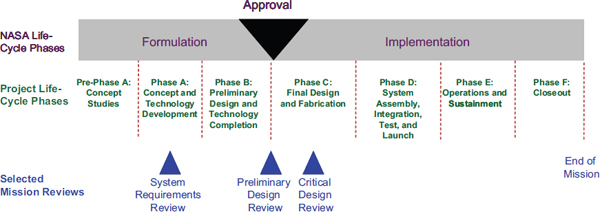
FIGURE S.1 NASA mission life cycle. SOURCE: Based on NASA Procedural Requirements 7120.5D (NASA, 2007).
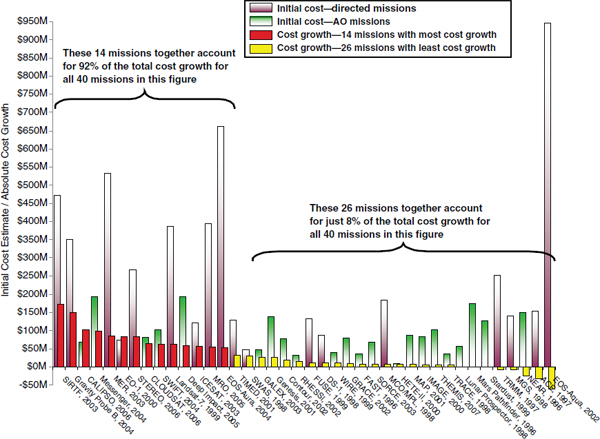
FIGURE S.2 Ranking of 40 NASA science missions in terms of absolute cost growth in excess of reserves in millions of dollars, excluding launch, mission operations, and data analysis, with initial cost and launch date for each mission also shown. NOTE: Acronyms are defined in Appendix D. SOURCE: Based on data from Tom Coonce, NASA Headquarters, e-mail to committee member Joseph W. Hamaker, December 21, 2009.
The primary references identify a wide range of factors that contribute to cost and schedule growth of NASA Earth and space science missions. The most commonly identified factors are the following:
• Overly optimistic and unrealistic initial cost estimates,
• Project instability and funding issues,
• Problems with development of instruments and other spacecraft technology, and
• Launch service issues.
Additional factors identified in the primary references include schedule growth that leads to cost growth. Schedule growth and cost growth are well correlated because any problem that causes schedule growth contributes to and magnifies total mission cost growth. Furthermore, cost growth in one mission may induce organizational replanning that delays other missions in earlier stages of implementation, further amplifying overall cost growth. Effective implementation of a comprehensive, integrated cost containment strategy, as recommended herein, is the best way to address this problem.
COMPREHENSIVE, INTEGRATED STRATEGY FOR COST AND SCHEDULE CONTROL
NASA sets the strategic direction of its Earth and space science programs using decadal surveys, the SMD science plan, and supporting road maps. A comprehensive, integrated approach to cost and schedule growth is also essential.
The primary references identify dozens of specific causes, make dozens of specific recommendations, and include dozens of additional findings concerning cost growth. The primary references, as a whole, are generally consistent and comprehensive, and so the individual causes of cost growth and the necessary corrective actions are not a mystery. However, rather than simply picking and choosing from among the many suggested causes, findings, and recommendations, development of a comprehensive, integrated strategy offers the best chance that future actions will work in concert to minimize or eliminate cost and schedule growth. An effective strategy would substantially reduce cost growth (beyond reserves) on individual missions and programs so that whatever growth does occur is offset by other missions and programs completed for less than the budgeted amount. This approach would allow NASA to execute the Earth and space science mission portfolio for the appropriated budget. Achieving this goal will require NASA to address both internal and external factors.
Internally, a comprehensive, integrated cost containment strategy would improve the definition of baseline costs and enhance the utility of NASA’s independent cost-estimating capabilities. Early development of technologies and more effective program reviews would improve the ability to identify and effectively manage risks and uncertainties. Externally, NASA has the opportunity to collaborate with other federal agencies, the Office of Management and Budget, and Congress to sustain and improve critical capabilities and expertise in the industrial base and the nation’s science and engineering workforce; to address cost and schedule risk associated with launch vehicles; and to improve funding stability.
Successful implementation of a comprehensive, integrated strategy to control cost and schedule growth of NASA Earth and space science missions would benefit both NASA and the nation, while enabling NASA to more efficiently and effectively carry out these critical missions.
Finding. Comprehensive, Integrated Cost Containment Strategy. Recent changes by NASA in the development and management of Earth and space science missions are promising. These changes include budgeting programs to the 70 percent confidence level1 and specifying that decadal surveys include independent cost estimates. However, it is too early to assess the effectiveness of these actions, and NASA has not taken the important step of developing a comprehensive, integrated strategy.
Recommendation. Comprehensive, Integrated Cost Containment Strategy. NASA should develop a comprehensive, integrated strategy to contain cost and schedule growth and enable more frequent science opportuni-
_______________
1If programs are budgeted at the 70 percent confidence level, there is a 70 percent probability that all of the missions included in the program can be completed without exceeding mission and program reserves.
ties. This strategy should include recent changes that NASA has already implemented as well as other actions recommended in this report.
KEY PROBLEMS
In addition to developing a comprehensive, integrated cost containment strategy, and as detailed below, NASA should address specific issues related to cost realism and the development process for Earth and space science missions.
Cost Realism
Cost Estimates
NASA project staff generally estimate mission costs using detailed engineering analyses of labor and material requirements, vendor quotes, subcontractor bids, and the like. Non-advocate independent cost estimates in NASA are generally parametric cost estimates using statistical cost-estimating relationships based on historical relationships among cost and technical and programmatic variables (mass, power, complexity, and so on). In both cases, mission cost estimates are created by summing costs at lower levels of a project’s work breakdown structure to obtain total project costs. Parametric cost models rely on observations rather than opinion, are an excellent tool for answering “what-if” questions quickly, and provide statistically sound information about the confidence level of cost estimates. In contrast, the process used within NASA to generate cost estimates on the basis of detailed engineering assessments does not provide a statistical confidence level and, in retrospect, has generally been less accurate than parametric cost models in estimating the cost of NASA Earth and space science missions.2
A project manager or principal investigator who is personally determined to control costs can be of great assistance in avoiding cost growth. People and organizations tend to optimize their behavior based on the environment in which they operate. Unfortunately, instead of motivating and rewarding vigilance in accurately predicting and controlling costs, the current system incentivizes overly optimistic expectations regarding cost and schedule. For example, competitive pressures encourage (overly) optimistic assessments of the cost and schedule impacts of addressing uncertainties and overcoming potential problems. As a result, initial cost estimates generally are quite optimistic, underestimating final costs by a sizable amount, and that optimism sometimes persists well into the development process.
Recommendation. Independent Cost Estimates. NASA should strengthen the role of its independent cost-estimating function by
• Expanding and improving NASA’s ability to conduct parametric cost estimates, and
• Obtaining independent parametric cost estimates at critical design review (in addition to system requirements review and preliminary design review), comparing them to other estimates available from the project and reconciling significant differences.
Cost Growth Methodology
The measurement of cost growth has been inconsistent across programs, NASA centers, and Congress. The Government Accountability Office and Congress generally consider the baseline to be the first time a mission appears as a budget line item in an appropriations bill, which is often before preliminary design review. The contents of NASA estimates also differ—some estimates include Phase A and B, some start with Phase C, some (but not all) include launch costs and/or mission operations, and some include NASA oversight and internal project management costs. These differences make it difficult to develop a clear understanding of trends in cost and schedule growth.
_______________
2A detailed list of the strengths and weaknesses of various cost-estimating methods appears in 2008 NASA Cost Estimating Handbook. Washington, D.C.: NASA.
Recommendation. Measurement of Cost Growth. NASA, Congress, and the Office of Management and Budget should consistently use the same method to quantify and report cost. In particular, they should use as the baseline a life-cycle cost estimate (that goes through the completion of prime mission operations) produced at preliminary design review.
Development Process
Management of Announcement of Opportunity Missions and Directed Missions
NASA implements two separate and distinct classes of Earth and space science missions—announcement of opportunity (AO) missions and directed missions. NASA headquarters competitively selects AO missions from proposals submitted in response to periodic AOs by teams led by a principal investigator (PI), who is commonly affiliated with a university but may work in industry or for NASA. NASA headquarters determines the scientific goals and requirements for directed missions, which are sometimes referred to as facility class missions or flagship missions. Headquarters then directs a particular NASA center, usually Goddard Space Flight Center or the Jet Propulsion Laboratory, to implement the mission.
The differing nature and goals of directed and AO missions call for different management approaches. AO missions are on average much smaller than directed missions are, and the impact of cost growth in AO missions, which are managed within a mission budget line (e.g., Discovery), is limited to other missions within the line. Flagship missions, however, are typically much larger than AO missions are, and so cost growth in these missions has a much greater potential to diminish NASA’s Earth and space science enterprise as a whole.
Recommendation. Management of Large, Directed Missions. NASA headquarters’ project oversight function should pay particular attention to the cost and schedule of its larger missions (total cost on the order of $500 million or more), especially directed missions (which form a single line item).
Recommendation. Management of Announcement of Opportunity (AO) Missions. NASA should continue to emphasize science in the AO mission selection process, while revising the AO mission selection process to allocate a larger percentage of project funds for risk reduction and improved cost estimation prior to final selection.
Recommendation. Incentives. NASA should ensure that proposal selection and project management processes include incentives for program managers, project managers, and principal investigators to establish realistic cost estimates and minimize or avoid cost growth at every phase of the mission life cycle, for both directed missions and announcement of opportunity missions.
Technology and Instrument Development
NASA Procedural Requirements (NPR) 7120.5, NASA Space Flight Program and Project Management Requirements, requires that “during formulation, the project establishes performance metrics, explores the full range of implementation options, defines an affordable project concept to meet requirements specified in the Program Plan, develops needed technologies, and develops and documents the project plan” (NASA, 2007, Section 2.3.4). However, despite these requirements, the primary references identify an ongoing need to improve technical and programmatic definition at the beginning of a project. The limited time and resources typically available in phases A and B to mature new technology and solidify system design parameters contribute to cost growth through higher risk and unrealistic cost estimates.
Instrument technology is particularly important because Earth and space science missions generally require special-purpose, one-of-a-kind components. Delays and cost increases for instrument development are pervasive and impact a large number of missions. This problem is exacerbated by shrinkage of the U.S. industrial base that supports space system development.
Recommendation. Technology Development. NASA should increase the emphasis in phases A and B on technology development, risk reduction, and realism of cost estimates.
Recommendation. Instrument Development. NASA should initiate instrument development well in advance of starting other project elements and establish a robust instrument technology development effort relevant to all classes of Earth and space science missions to strengthen and sustain the nation’s instrument development capability.
Recommendation. Decadal Surveys. NASA should ensure that guidance regarding the development of instruments and other technologies is included in decadal surveys and other strategic planning efforts. In particular, future decadal surveys should prioritize science mission areas that could be addressed by future announcements of opportunity and the instruments needed to carry out those missions.
Major Reviews
NASA has increased the size and number of external project reviews to the point that some reviews are counterproductive and disruptive, especially for small missions. Large numbers of reviews diffuse responsibility and accountability, creating an environment where NASA senior managers can become dependent on review teams with many outside members who sometimes do not understand NASA, the field center in question, and/or the mission being reviewed. In addition, major reviews are sometimes conducted as scheduled even though a project may not have progressed as rapidly as expected and, as a result, cannot achieve the intended review criteria, programmatically and/or technologically.3
Recommendation. External Project Reviews. NASA should reassess its approach to external project reviews to ensure that (1) the value added by each review outweighs the cost (in time and resources) that it places on projects; (2) the number and the size of reviews are appropriate given the size of the project; and (3) major reviews, such as preliminary design review and critical design review, occur only when specified success criteria are likely to be met.
Launch Vehicles
Problems with the procurement of launch vehicles and launch services are a significant source of cost growth. Specific factors include increases in the cost of expendable launch vehicles, vendor issues such as strikes, weather-related issues at the launch site, problems with launch-site-facility capabilities, and delays in the availability of a given launch vehicle. In addition, if a mission is required to change launch vehicles, the costs can be substantial.
Recommendation. Launch Vehicles. Prior to preliminary design review, NASA should minimize mission-unique launch site processing requirements. NASA should also select the launch vehicle with appropriate margins as early as possible and minimize changes in launch vehicles.
DIFFERENCES BETWEEN EARTH AND SPACE SCIENCE MISSIONS
Different classes of missions face different challenges. Earth science missions typically have more complex, more costly, and more massive instruments than do space science missions, because Earth science missions also have more stringent requirements in terms of pointing accuracy, resolution, stability, and so on, although astrophysics missions also have stringent pointing requirements, and planetary spacecraft and instrument technology must be able to survive long cruise phases and radiation environments that are sometimes quite extreme. Space science missions that leave Earth orbit have greater incentives to minimize spacecraft mass and power, and the average cost and average spacecraft mass of these missions are lower than those for Earth science missions. However, the size of the cost growth of Earth and space science missions has been comparable. Both Earth and space science missions have shown good correlation between (1) instrument schedule growth and instrument cost growth, (2) instrument cost/schedule growth and mission cost/schedule growth, and (3) the absolute costs of instruments and instrument complexity.
_______________
3General preliminary design review and critical design review readiness criteria exist within NPR 7120.5D (NASA, 2007). More detailed criteria are provided in center directives such as Criteria for Flight Project Critical Milestone Reviews (NASA/GSFC, 2009).
5.4 Defending Planet Earth: Near-Earth Object Surveys and Hazard Mitigation Strategies
A Report of the SSB and ASEB Ad Hoc Committee to Review Near-Earth Object Surveys
and Hazard Mitigation Strategies
Summary
The United States spends about $4 million annually searching for near-Earth objects (NEOs), according to NASA.1 The goal is to detect those that may collide with Earth. The funding helps to operate several observatories that scan the sky searching for NEOs, but, as explained below, it is insufficient to detect the majority of NEOs that may present a tangible threat to humanity. A smaller amount of funding (significantly less than $1 million per year) supports the study of ways to protect Earth from such a potential collision (“mitigation”).
Congress established two mandates for the search for NEOs by NASA. The first, in 1998 and now referred to as the Spaceguard Survey, called for the agency to discover 90 percent of NEOs with a diameter of 1 kilometer or greater within 10 years. An object of this limiting size is considered by many experts to be the minimum that could produce global devastation if it struck Earth. NASA is close to achieving this goal and should reach it within a few years. However, as the recent (2009) discovery of an approximately 2- to 3-kilometer-diameter NEO demonstrates, there are still large objects to be detected.
The second mandate, established in 2005, known as the George E. Brown, Jr. Near-Earth Object Survey Act,2 called for NASA to detect 90 percent of NEOs 140 meters in diameter or greater by 2020. As the National Research Council’s (NRC’s) Committee to Review Near-Earth Object Surveys and Hazard Mitigation Strategies noted in its August 2009 interim report (NRC, 2009):
Finding: Congress has mandated that NASA discover 90 percent of all near-Earth objects 140 meters in diameter or greater by 2020. The administration has not requested and Congress has not appropriated new funds to meet this objective. Only limited facilities are currently involved in this survey/discovery effort, funded by NASA’s existing budget.
Finding: The current near-Earth object surveys cannot meet the goals of the 2005 George E. Brown, Jr. Near-Earth Object Survey Act directing NASA to discover 90 percent of all near-Earth objects 140 meters in diameter or greater by 2020.
THE SURVEY AND DETECTION OF NEAR-EARTH OBJECTS
The charge from Congress to the NRC committee was stated as two tasks (see the Preface for the full statement of task). The first asks for the “optimal approach” to completing the George E. Brown, Jr. Near-Earth Object Survey. The second asks for the same approach to developing a capability to avert an NEO-Earth collision and for options that include “a significant international component.”
The committee concluded that there is no way to define “optimal” in this context in a universally acceptable manner: there are too many variables involved that can be both chosen and weighted in too many plausible ways. Recognizing this fact, the committee first took a broad look at all aspects of the hazards to Earth posed by NEOs and then decided on responses to the charge. The body of this report contains extensive discussions of these many
_______________
NOTE: “Summary” reprinted from Defending Planet Earth: Near-Earth Object Surveys and Hazard Mitigation Strategies, The National Academies Press, Washington, D.C., 2010, pp. 1-6.
1“NEO” denotes “near-Earth object,” which has a precise technical meaning but can be usefully thought of as an asteroid or comet whose orbit approaches Earth’s orbit to within about one-third the average distance of Earth from the Sun. These objects are considered to be the only ones potentially capable of striking Earth, at least for the next century, except for comets that can enter the inner solar system from the outer system through the “slingshot” gravitational action of Jupiter.
2National Aeronautics and Space Administration Authorization Act of 2005 (Public Law 109-155), January 4, 2005, Section 321, George E. Brown, Jr. Near-Earth Object Survey Act.
issues. This summary concentrates on responses to the charge and at the end provides a few comments on some of the other main conclusions drawn from the report.
Regarding the first task of its charge, the committee concluded that it is infeasible to complete the NEO census mandated in 2005 on the required time scale (2020), in part because for the past 5 years the administration has requested no funds, and the Congress has appropriated none, for this purpose. The committee concludes that there are two primary options for completing the survey:
Finding: The selected approach to completing the George E. Brown, Jr. Near-Earth Object Survey will depend on nonscientific factors:
• If the completion of the survey as close as possible to the original 2020 deadline is considered more important, a space mission conducted in concert with observations using a suitable ground-based telescope and selected by peer-reviewed competition is the better approach. This combination could complete the survey well before 2030, perhaps as early as 2022 if funding were appropriated quickly.
• If cost conservation is deemed more important, the use of a large ground-based telescope is the better approach. Under this option, the survey could not be completed by the original 2020 deadline, but it could be completed before 2030. To achieve the intended cost-effectiveness, the funding to construct the telescope must come largely as funding from non-NEO programs.
Multiple factors will drive the decision on how to approach completion of this survey. These factors include, but are not limited to, the perceived urgency for completing the survey as close as possible to the original 2020 deadline, the availability of funds to complete the survey, and the acceptability of the risk associated with the construction and operation of various ground- and space-based options.
Of the ground-based options, the Large Synoptic Survey Telescope (LSST) and the Panoramic Survey Telescope and Rapid Response System, mentioned in the statement of task, and the additional options submitted to the committee in response to its public request for suggestions during the beginning of this study, the most capable appears to be the LSST. The LSST is to be constructed in Chile and has several science missions as well as the capability of observing NEOs. Although the primary mirror for the LSST has been cast and is being polished, the telescope has not been fully funded and is pending prioritization in the astronomy and astrophysics decadal survey of the NRC that is currently underway.
Unless unexpected technical problems interfere, a space-based option should provide the fastest means to complete the survey. However, unlike ground-based telescopes, space options carry a modest launch risk and a more limited lifetime: ground-based telescopes have far longer useful lifetimes and could be employed for continued NEO surveys and for new science projects. (Ground-based telescopes generally have an annual operating cost that is approximately 10 percent of their design and construction costs.)
The committee notes that objects smaller than 140 meters in diameter are also capable of causing significant damage to Earth. The best-known case from recent history is the 1908 impact of an object at Tunguska in the Siberian wilderness that devastated more than 2,000 square kilometers of forest. It has been estimated that the size of this object was on the order of approximately 70 meters in diameter, but recent research indicates that it could have been substantially smaller (30 to 50 meters in diameter), with much of the damage that it caused being due to shock waves from the explosion of the object in Earth’s atmosphere. (See, e.g., Chyba et al., 1993; Boslough and Crawford, 1997, 2008.) The committee strongly stresses that this new conclusion is preliminary and must be independently validated. Since smaller objects are more numerous than larger ones, however, this new result, if correct, implies an increase in the frequency of such events to approximately once in three centuries.
All told, the committee was struck by the many uncertainties that suffuse the subject of NEOs, including one other related example: Do airbursts from impactors in this size range over an ocean cause tsunamis that can severely damage a coastline? This uncertainty and others have led the committee to the following recommendation:
Recommendation: Because recent studies of meteor airbursts have suggested that near-Earth objects as small as 30 to 50 meters in diameter could be highly destructive, surveys should attempt to detect as many 30- to 50-meter-diameter objects as possible. This search for smaller-diameter objects should not be allowed to interfere with the survey for objects 140 meters in diameter or greater.
In all cases, the data-reduction and data-analysis resources necessary to achieve the congressional mandate would be covered by the survey projects themselves and by a continuation of the current funding of the Smithsonian Astrophysical Observatory’s Minor Planet Center, as discussed in the report.
CHARACTERIZATION AND THE ARECIBO AND GOLDSTONE OBSERVATORIES
Obtaining the orbits and the physical properties of NEOs is known as characterization and is primarily needed to inform planning for any active defense of Earth. Such defense would be carried out through a suitable attack on any object predicted with near certainty to otherwise collide with Earth and cause significant damage. The apparently huge variation in the physical properties of NEOs seems to render infeasible the development of a comprehensive inventory through in situ investigations by suitably instrumented spacecraft: the costs would be truly astronomical. A spacecraft reconnaissance mission might make good sense to conduct on an object that, without human intervention, would hit Earth with near certainty. Such a mission would be feasible provided there was sufficient warning time for the results to suitably inform the development of an attack mission to cause the object to miss colliding with Earth.
In addition to spacecraft reconnaissance missions as needed, the committee concluded that vigorous, ground-based characterization at modest cost is important for the NEO task. Modest funding could support optical observations of already-known and newly discovered asteroids and comets to obtain some types of information on this broad range of objects, such as their reflectivity as a function of color, to help infer their surface properties and mineralogy, and their rotation properties. In addition, the complementary radar systems at the Arecibo Observatory in Puerto Rico and the Goldstone Solar System Radar in California are powerful facilities for characterization within their reach in the solar system, a maximum of about one-tenth of the Earth-Sun distance. Arecibo—which has a maximum sensitivity about 20-fold higher than Goldstone’s but does not have nearly as good sky coverage as Goldstone—can, for example, model the three-dimensional shapes of (generally very odd-shaped) asteroids and estimate their surface characteristics, as well as determine whether an asteroid has a (smaller) satellite or satellites around it, all important to know for planning active defense. Also, from a few relatively closely spaced (in time) observations, radar can accurately determine the orbits of NEOs, which has the advantage of being able to calm public fears quickly (or possibly, in some cases, to show that they are warranted).
Finding: The Arecibo and Goldstone radar systems play a unique role in the characterization of NEOs, providing unmatched accuracy in orbit determination and offering insight into size, shape, surface structure, and other properties for objects within their latitude coverage and detection range.
Recommendation: Immediate action is required to ensure the continued operation of the Arecibo Observatory at a level sufficient to maintain and staff the radar facility. Additionally, NASA and the National Science Foundation should support a vigorous program of radar observations of NEOs at Arecibo, and NASA should support such a program at Goldstone for orbit determination and the characterization of physical properties.
For both Arecibo and Goldstone, continued funding is far from assured, not only for the radar systems but for the entire facilities. The incremental annual funding required to maintain and operate the radar systems, even at their present relatively low levels of operation, is about $2 million at each facility (see Chapter 4). The annual funding for Arecibo is approximately $12 million. Goldstone is one of the three deep-space communications facilities of the Deep Space Network, and its overall funding includes additional equipment for space communications.
MITIGATION
“Mitigation” refers to all means of defending Earth and its inhabitants from the effects of an impending impact by an NEO. Four main types of defense are discussed in this report. The choice of which one(s) to use depends primarily on the warning time available and on the mass and speed of the impactor. The types of mitigation are these:
1. Civil defense. This option may be the only one feasible for warning times shorter than perhaps a year or two, and depending on the state of readiness for applying an active defense, civil defense may be the only choice for even longer times.
2. “Slow-push” or “slow-pull” methods. For these options the orbit of the target object would be changed so that it avoided collision with Earth. The most effective way to change the orbit, given a constraint on the energy that would be available, is to change the velocity of the object, either in or opposite to the direction in which it is moving (direct deflection—that is, moving the object sideways—is much less efficient). These options take considerable time, on the order of decades, to be effective, and even then they would be useful only for objects whose diameters are no larger than 100 meters or so.
3. Kinetic impactors. In these mitigation scenarios, the target’s orbit would be changed by the sending of one or more spacecraft with very massive payload(s) to impact directly on the target at high speed in its direction, or opposite to its direction, of motion. The effectiveness of this option depends not only on the mass of the target but also on any net enhancement resulting from material being thrown out of the target, in the direction opposite to that of the payload, upon impact.
4. Nuclear explosions. For nontechnical reasons, this would likely be a last resort, but it is also the most powerful technique and could take several different forms, as discussed in the report. The nuclear option would be usable for objects up to a few kilometers in diameter.
For larger NEOs (more than a few kilometers in diameter), which would be on the scale that would inflict serious global damage and, perhaps, mass extinctions, there is at present no feasible defense. Luckily such events are exceedingly rare, the last known being about 65 million years ago.
Of the foregoing options, only kinetic impact has been demonstrated (by way of the very successful Deep Impact spacecraft that collided with comet Tempel-1 in July 2006). The other options have not advanced past the conceptual stage. Even Deep Impact, a 10-kilometer-per-second impact on a 6-kilometer-diameter body, was on a scale far lower than would be required for Earth defense for an NEO on the order of 100 meters in diameter, and it impacted on a relatively large—and therefore easier to hit—object.
Although the committee was charged in its statement of task with determining the “optimal approach to developing a deflection capability,” it concluded that work in this area is relatively new and immature. The committee therefore concluded that the “optimal approach” starts with a research program.
FURTHER RESEARCH
Struck by the significant unknowns in many aspects of NEO hazards that could yield to Earth-based research, the committee recommends the following:
Recommendation: The United States should initiate a peer-reviewed, targeted research program in the area of impact hazard and mitigation of NEOs. Because this is a policy-driven, applied program, it should not be in competition with basic scientific research programs or funded from them. This research program should encompass three principal task areas: surveys, characterization, and mitigation. The scope should include analysis, simulation, and laboratory experiments. This research program does not include mitigation space experiments or tests that are treated elsewhere in this report.
NATIONAL AND INTERNATIONAL COOPERATION
Responding effectively to hazards posed by NEOs requires the joint efforts of diverse institutions and individuals, with organization playing a key role. Because NEOs are a global threat, efforts to deal with them could involve international cooperation from the outset. (However, this is one area in which one nation, acting alone, could address such a global threat.) The report discusses possible means to organize, both nationally and internationally, responses to the hazards posed by NEOs. Arrangements at present are largely ad hoc and informal here and abroad, and they involve both government and private entities.
The committee discussed ways to organize the national community to deal with the hazards of NEOs and also recommends an approach to international cooperation:
Recommendation: The United States should take the lead in organizing and empowering a suitable international entity to participate in developing a detailed plan for dealing with the NEO hazard.
One major concern with such an organization, especially in the area of preparing for disasters, is the maintenance of attention and morale, given the expected exceptionally long intervals between harmful events. Countering the tendency to complacency would be a continuing challenge. This problem would be mitigated if, for example, the civil defense aspects were combined in the National Response Framework with those for other natural hazards.
RECENT NEAR-EARTH-OBJECT-RELATED EVENTS
The U.S. Department of Defense, which operates sensors in Earth orbit capable of detecting the high-altitude explosion of small NEOs, has in the past shared this information with the NEO science community. The committee concluded that this data sharing is important for understanding issues such as the population size of small NEOs and the hazard that they pose. This sharing is also important for validating airburst simulations, characterizing the physical properties of small NEOs (such as their strength), and assisting in the recovery of meteorites.
Recommendation: Data from NEO airburst events observed by the U.S. Department of Defense satellites should be made available to the scientific community to allow it to improve understanding of the NEO hazards to Earth.
In 2008, Congress passed the Consolidated Appropriations Act3 calling for the Office of Science and Technology Policy to determine by October 2010 which agency should be responsible for conducting the NEO survey and detection and mitigation program. Several agencies are possible candidates for such a role.
During its deliberations the committee learned of several efforts outside the United States to develop spacecraft to search for categories of NEOs. In particular, Canada’s Near-Earth-Object Surveillance Satellite, or NEOSSat, and Germany’s AsteroidFinder are interesting and capable small-scale missions that will detect a small percentage of specific types of NEOs, those primarily inside Earth’s orbit. These spacecraft will not accomplish the goals of the George E. Brown, Jr. Near-Earth Object Survey Act of 2005. However, they highlight the fact that other countries are beginning to consider the NEO issue seriously. Such efforts also represent an opportunity for future international cooperation and coordination in the search for potentially hazardous NEOs. In addition, the committee was impressed with the European Space Agency’s early development of the Don Quijote spacecraft mission, which would consist of an observing spacecraft and a kinetic impactor. This mission, though not funded, would have value for testing a mitigation technique and could still be an opportunity for international cooperation in this area.
Finally, the committee points out a current estimate of the long-term average annual human fatality rate from impactors: slightly under 100 (Harris, 2009). At first blush, one is inclined to dismiss this rate as trivial in the general scheme of things. However, one must also consider the extreme damage that could be inflicted by a single impact; this presents the classic problem of the conflict between “extremely important” and “extremely rare.” The committee considers work on this problem as insurance, with the premiums devoted wholly toward preventing the tragedy. The question then is: What is a reasonable expenditure on annual premiums? The committee offers a few possibilities for what could perhaps be accomplished at three different levels of funding (see Chapter 8); it is, however, the political leadership of the country that determines the amount to be spent on scanning the skies for potential hazards and preparing our defenses.
REFERENCES
Boslough, M., and D. Crawford. 2008. Low-altitude airbursts and the impact threat. International Journal of Impact Engineering 35:1441-1448.
Boslough, M.B.E., and D.A. Crawford. 1997. Shoemaker-Levy 9 and plume-forming collisions on Earth. Near-Earth Objects, the United Nations International Conference: Proceedings of the International Conference held April 24-26, 1995, in New York, N.Y. (J.L. Remo, ed.). Annals of the New York Academy of Sciences 822:236-282.
Chyba, C.F., P.J. Thomas, and K.J. Zahnle. 1993. The 1908 Tunguska explosion—Atmospheric disruption of a stony asteroid. Nature 361:40-44.
Harris, A.W., Space Science Institute. 2009. The NEO population, impact risk, progress of current surveys, and prospects for future surveys, presentation to the Survey/Detection Panel of the NRC Committee to Review Near-Earth Object Surveys and Hazard Mitigation Strategies, January 28-30, 2009.
NRC (National Research Council). 2009. Near-Earth Object Surveys and Hazard Mitigation Strategies: Interim Report, The National Academies Press, Washington, D.C., available at http://www.nap.edu/catalog.php?record_id=12738, pp. 1-2.
_______________
3Consolidated Appropriations Act, 2008 (Public Law 110-161), Division B—Commerce, Justice, Science, and Related Agencies Appropriations Act, 2008. December 26, 2007.
5.5 Life and Physical Sciences Research for a New Era of Space Exploration: An Interim Report
A Report of the SSB and ASEB Ad Hoc Committee for the Decadal Survey on
Biological and Physical Sciences in Space
Executive Summary
In early 2009 the National Research Council’s Committee for the Decadal Survey on Biological and Physical Sciences in Space began work on a study to establish priorities and recommendations for life and physical sciences research in microgravity and partial gravity for the decade 2010-2020. This effort represents the first decadal survey conducted for these fields. The committee is being assisted in this work by seven appointed panels, each focused on a broad area of life and physical sciences research. The study is considering research in two general categories: (1) research enabled by unique aspects of the space environment as a tool to advance fundamental and applied scientific knowledge and (2) research that enables the advances in basic and applied knowledge needed to expand exploration capabilities. The project’s statement of task calls for delivery of two reports—an interim report and a final survey report.
PURPOSE OF THIS INTERIM REPORT
During the period of the decadal survey’s development, NASA received guidance in the fiscal year 2011 presidential budget request that directed it to extend the lifetime of the International Space Station (ISS) to 2020. This step considerably altered both the research capacity and the role of the ISS in any future program of life and physical sciences microgravity research. In addition, the budget initiated other potential changes that might affect both the organization and the scale of these programs at NASA. The purpose of this interim report is to provide timely input to the ongoing reorganization of programs related to life and physical sciences microgravity research, as well as to near-term planning or replanning of ISS research. Although the development of specific recommendations is deferred until the final report, this interim report does attempt to identify programmatic needs and issues to guide near-term decisions that the committee has concluded are critical to strengthening the organization and management of life and physical sciences research at NASA. This report also identifies a number of broad topics that represent near-term opportunities for ISS research. Topics discussed briefly in this interim report reflect the committee’s preliminary examination of a subset of the issues and topics that will be covered in greater depth in the final decadal survey report.
PROGRAMMATIC ISSUES FOR STRENGTHENING THE RESEARCH ENTERPRISE
As the result of major reorganizations and shifting priorities within the past decade at NASA, there is currently no clear institutional home within the agency for the various scientific endeavors that are focused on understanding how biological and physical systems behave in low-gravity environments. As NASA moves to rebuild or restructure programs focused on these activities, it will have to consider what elements to include in that program.
In its preliminary analysis, the committee has identified a number of critical needs for a successful renewed research endeavor in life and physical sciences. These include:
• Elevating the priority of research in the agenda for space exploration;
• Selecting research likely to provide value to an optimal range of future mission designs;
• Developing a comprehensive database that is accessible to the scientific community;
• Implementing a translational science component to ensure bidirectional interactions between basic science and the development of new mission options; and
_______________
NOTE: “Executive Summary” reprinted from Life and Physical Sciences Research for a New Era of Space Exploration: An Interim Report, The National Academies Press, Washington, D.C., 2010, pp. 1-2.
• Encouraging, and then accommodating, team science approaches to what are inherently complex multidisciplinary challenges.
In addition, as noted repeatedly by the scientific community that has provided input to this study, reasonable stability and predictability of research funding are critical to ensuring productive and sustained progress toward research goals in any program.
In the context of an institutional home for an integrated research agenda, the committee noted that program leadership and execution are likely to be productive only if aggregated under a single management structure and housed in a NASA directorate or other key organization that understands the value of science and has the vision to see its potential application in future exploration missions. Ultimately, any successful research program would need to be directed by a leader of significant gravitas who is in a position of authority within the agency and has the communication skills to ensure that the entire agency understands and concurs with the key objective to support and conduct high-fidelity, highquality, high-value research.
INTERNATIONAL SPACE STATION RESEARCH OPPORTUNITIES
The International Space Station provides a unique platform for research, and past studies have noted the critical importance of its research capabilities to support the goal of long-term human exploration in space.1 Although it is difficult to predict the timing for the transition of important research questions from ground- to space-based investigations, the committee identifies in this interim report a number of broad topics that represent near-term opportunities for ISS research. These topics, which are not prioritized, fall under the following general areas:
• Plant and microbial research to increase fundamental knowledge of the gravitational response and potentially to advance goals for the development of bioregenerative life support;
• Behavioral research to mitigate the detrimental effects of the spaceflight environment on astronauts’ functioning and health;
• Human and animal biology research to increase basic understanding of the effects of spaceflight on biological systems and to develop critically needed countermeasures to mitigate the negative biological effects of spaceflight on astronauts’ health, safety, and performance;
• Physical sciences research to explore fundamental laws of the universe and basic physical phenomena in the absence of the confounding effects of gravity; and
• Translational and applied research in physical sciences that can provide a foundation of knowledge for the development of systems and technologies enabling human and robotic exploration.
This report contains discussion of various topics within each of these areas. The committee notes, however, that although the ISS is a key component of research infrastructure that will need to be utilized by a biological and physical research sciences program, it is only one component of a healthy program. Other platforms will play an important role and, in particular, research on the ISS will need to be supported by a parallel ground-based program to be scientifically credible.
_______________
1See, for example, National Research Council, Review of NASA Plans for the International Space Station, The National Academies Press, Washington, D.C., 2006.
5.6 New Worlds, New Horizons in Astronomy and Astrophysics
A Report of the BPA and SSB Ad Hoc Committee for a Decadal Survey of Astronomy and Astrophysics
Executive Summary
Our view of the universe has changed dramatically. Hundreds of planets of startling diversity have been discovered orbiting distant suns. Black holes, once viewed as an exotic theoretical possibility, are now known to be present at the center of most galaxies, including our own. Precision measurements of the primordial radiation left by the big bang have enabled astronomers to determine the age, size, and shape of the universe. Other astronomical observations have also revealed that most of the matter in the universe is dark and invisible and that the expansion of the universe is accelerating in an unexpected and unexplained way. Recent discoveries, powerful new ways to observe the universe, and bold new ideas to understand it have created scientific opportunities without precedent.
This report of the Committee for a Decadal Survey of Astronomy and Astrophysics proposes a broad-based, integrated plan for space- and ground-based astronomy and astrophysics for the decade 2012-2021. It also lays the foundations for advances in the decade 2022-2031. It is the sixth in a sequence of National Research Council (NRC) decadal studies in this field and builds on the recommendations of its predecessors. However, unlike previous surveys, it reexamines unrealized priorities of preceding surveys and reconsiders them along with new proposed research activities to achieve a revitalized and timely scientific program. Another new feature of the current survey is a detailed analysis of the technical readiness and the cost risk of activities considered for prioritization. The committee has formulated a coherent program that fits within plausible funding profiles considering several different budget scenarios based on briefings by the sponsoring agencies—the National Aeronautics and Space Administration, the National Science Foundation, and the Department of Energy. As a result, recommended priorities reflect an executable balance of scientific promise against cost, risk, and readiness. The international context also played an important role in the committee’s deliberations, and many of the large projects involve international collaboration as well as private donors and foundations.
The priority science objectives chosen by the survey committee for the decade 2012-2021 are searching for the first stars, galaxies, and black holes; seeking nearby habitable planets; and advancing understanding of the fundamental physics of the universe. These three objectives represent a much larger program of unprecedented opportunities now becoming within our capability to explore. The discoveries made will surely lead to new and sometimes surprising insights that will continue to expand our understanding and sense of possibility, revealing new worlds and presenting new horizons, the study of which will bring us closer to understanding the cosmos and our place within it.
This report recommends a program that will set the astronomy and astrophysics community firmly on the path to answering some of the most profound questions about the cosmos. In the plan, new optical and infrared survey telescopes on the ground and in space will employ a variety of novel techniques to investigate the nature of dark energy. These same telescopes will determine the architectures of thousands of planetary systems, observe the explosive demise of stars, and open a new window on the time-variable universe. Spectroscopic and high-spatial-resolution imaging capabilities on new large ground-based telescopes will enable researchers to discern the physical nature of objects discovered at both shorter and longer wavelengths by other facilities in the committee’s recommended program. Innovative moderate-cost programs in space and on the ground will be enhanced so as to enable the community to respond rapidly and flexibly to new scientific discoveries. Construction will begin on a space-based observatory that employs the new window of gravitational radiation to observe the merging of distant black holes and other dense objects and to precisely test theories of gravity in new regimes that we can never hope to study on Earth. The foundations will be laid for studies of the hot universe with a future X-ray telescope that will search for the first massive black holes, and that will follow the cycling of gas within and beyond galaxies. Scientists will conduct new ground-based experiments to study the highest-energy photons emitted by cosmic sources. At the opposite end of the electromagnetic spectrum, radio techniques will become powerful enough to view the epoch when the very first objects began to light up the universe, marking the transition from a protracted dark age to one of
_______________
NOTE: “Executive Summary” reprinted from New Worlds, New Horizons in Astronomy and Astrophysics, The National Academies Press, Washington, D.C., 2010, pp. 1-8, released in prepublication form on August 13, 2010.
self-luminous stars. The microwave background radiation will be scrutinized for the telltale evidence that inflation actually occurred. Perhaps most exciting of all, researchers will identify which nearby stars are orbited by planets on which life could also have developed.
Realizing these and an array of other scientific opportunities is contingent on maintaining and strengthening the foundations of the research enterprise that are essential in the cycle of discovery—including technology development, theory, computation and data management, and laboratory experiments, as well as, and in particular, human resources. At the same time, the greatest strides in understanding often come from bold new projects that open the universe to new discoveries, and such projects thus drive much of the strategy of the committee’s proposed program. This program requires a balance of small, medium, and large initiatives on the ground and in space. The large and medium elements within each size category are as follows:
• In Space: (Large-scale, in priority order) Wide-Field Infrared Survey Telescope (WFIRST)—an observatory designed to settle essential questions in both exoplanet and dark energy research, and which will advance topics ranging from galaxy evolution to the study of objects within our own galaxy. The Explorer Program—augmenting a program that delivers a high level of scientific return on relatively moderate investment and that provides the capability to respond rapidly to new scientific and technical breakthroughs. Laser Interferometer Space Antenna (LISA)—a low-frequency gravitational wave observatory that will open an entirely new window on the cosmos by measuring ripples in space-time caused by many new sources, including nearby white dwarf stars, and will probe the nature of black holes. International X-ray Observatory (IXO)—a powerful X-ray telescope that will transform our understanding of hot gas associated with stars and galaxies in all evolutionary stages. (Medium-scale, in rank order) New Worlds Technology Development Program—a competed program to lay the technical and scientific foundation for a future mission to study nearby Earth-like planets. Inflation Probe Technology Development Program—a competed program designed to prepare for a potential next-decade cosmic microwave-background mission to study the epoch of inflation.
• On the Ground: (Large-scale, in priority order) Large Synoptic Survey Telescope (LSST)—a wide-field optical survey telescope that will transform observation of the variable universe and will address broad questions that range from indicating the nature of dark energy to determining whether there are objects that may collide with Earth. Mid-Scale Innovations Program augmentation—a competed program that will provide the capability to respond rapidly to scientific discovery and technical advances with new telescopes and instruments. Giant Segmented Mirror Telescope (GSMT)—a large optical and near-infrared telescope that will revolutionize astronomy and provide a spectroscopic complement to the James Webb Space Telescope (JWST), the Atacama Large Millimeter/submillimeter Array (ALMA), and LSST. Atmospheric Čerenkov Telescope Array (ACTA)—participation in an international telescope to study very high energy gamma rays. (Medium-scale) CCAT (formerly the Cornell-Caltech Atacama Telescope)—a 25-meter wide-field submillimeter telescope that will complement ALMA by undertaking large-scale surveys of dust-enshrouded objects.
These major new elements must be combined with ongoing support of the core research program to ensure a balanced program that optimizes overall scientific return. To achieve that return the committee balances the program with a portfolio of unranked smaller projects and augmentations to the core research program, funded by all three agencies. These elements include support of individual investigators, instrumentation, laboratory astrophysics, public access to privately operated telescopes, suborbital space missions, technology development, theoretical investigations, and collaboration on international projects.
This report also identifies unique ways that astronomers can contribute to solving the nation’s challenges. In addition, the public will continue to be inspired with images of the cosmos and descriptions of its contents, and students of all ages will be engaged by vivid illustrations of the power of science and technology. These investments will sustain and improve the broad scientific literacy vital to a technologically advanced nation as well as providing spin-off technological applications to society.
The committee notes with appreciation the striking level of effort and involvement in this survey contributed by the astronomy and astrophysics community. The vision detailed in this report is a shared vision.
RECOMMENDED PROGRAM
Maintaining a balanced program is an overriding priority for attaining the overall science objectives that are at the core of the program recommended by the survey committee. More detailed guidance is provided in the report, but optimal implementation is the responsibility of agency managers. The small-scale projects recommended in Table ES.1 are unranked and are listed in alphabetical order. The highest-priority ground-based elements in the medium (Table ES.2) and large (Table ES.3) categories are listed in priority order, and the highest-priority space-based elements in the medium (Table ES.4) and large (Table ES.5) categories are also listed in priority order. All cost appraisals are in FY2010 dollars.
TABLE ES.1 Space and Ground: Recommended Activities—Small Scale (Alphabetical Order)
| Recommendation | Agency | Science | Budget,a 2012-2021 | Cross-Reference in Chapter 7 |
| (Augmentation to) Advanced Technologies and Instrumentation | NSF | Broad; key opportunities in advanced instrumentation, especially adaptive optics and radio instrumentation | $5M/year additional | Page 236 |
| (Augmentation to) Astronomy and | NSF | Broad realization of science from observational, empirical, and theoretical investigations, including | $8M/year additional | Page 236 |
| Astrophysics Research Grants Program | laboratory astrophysics | |||
| (Augmentation to) Astrophysics Theory Program | NASA | Broad | $35M additional | Page 219 |
| (Definition of) a future ultraviolet-optical space capability | NASA | Technology development benefiting a future ultraviolet telescope to study hot gas between galaxies, the interstellar medium, and exoplanets | $40M | Page 219 |
| (Augmentation to) the Gemini international partnership | NSF | Increased U.S. share of Gemini; science opportunities include exoplanets, dark energy, and early-galaxy studies | $2M/year additional | Page 236 |
| (Augmentation to) Intermediate Technology Development | NASA | Broad; targeted at advancing the readiness of technologies at technology readiness levels 3 to 5 | $2M/year additional, increasing to $15M/year additional by 2021 | Page 220 |
| (Augmentation to) Laboratory Astrophysics | NASA | Basic nuclear, ionic, atomic, and molecular physics to support interpretation of data from JWST and future missions | $2M/year additional | Page 220 |
| (U.S. contribution to JAXA-led) SPICA mission | NASA | Understanding the birth of galaxies, stars, and planets; cycling of matter through the interstellar medium | $150M | Page 218 |
| (Augmentation to) the Suborbital Program | NASA | Broad, but including especially cosmic microwave background and particle astrophysics | $15M/year additional | Page 221 |
| (Augmentation to) the Telescope System Instrument Program | NSF | Optical-infrared investments to leverage privately operated telescopes and provide competitive access to U.S. community | $2.5M/year additional | Page 236 |
| Theory and Computation | NASA | Broad; targeted at high-priority science through key projects | $5M/year NASA | Page 222 |
| Networks | NSF | $2.5M/year NSF | ||
| DOE | $2M/year DOE | |||
a Recommended budgets are in FY2010 dollars and are committee-generated and based on available community input.
TABLE ES.2 Ground: Recommended Activities—Medium Scale
| Recommendationb | Science | Technical Riskc | Appraisal of Costs Through Constructiona (U.S. Federal Share, 2012-2021) | Appraisal of Annual Operations Costsd (U.S. Federal Share) | Cross-Reference in Chapter 7 |
| CCAT | Submillimeter surveys | Medium | $140M | $11M | Page 234 |
| —Science early 2020s | enabling broad | ($37M) | ($7.5M) | ||
| —University-led, | extragalactic, galactic, and | ||||
| 33% federal share | outer-solar-system science | ||||
a The survey’s construction-cost appraisal for CCAT is based on the survey’s cost, risk, and technical readiness evaluation (i.e., the cost appraisal and technical evaluation, or CATE, analysis) and project input, in FY2010 dollars.
b The survey’s appraisal of the schedule to first science is based on CATE analysis and project input.
c The risk scale used was low, medium low, medium, medium high, and high.
d The survey’s appraisal of operations costs, in FY2010 dollars, is based on project input.
TABLE ES.3 Ground: Recommended Activities—Large Scale (Priority Order)
| Recommendationb | Science | Technical Riskc | Appraisal of Costs Through Constructiona (U.S. Federal Share, 2012-2021) | Appraisal of Annual Operations Costsd (U.S. Federal Share) | Cross-Reference in Chapter 7 |
| 1. LSST —Science late 2010s —NSF/DOE | Dark energy, dark matter, time-variable phenomena, supernovae, Kuiper belt and near-Earth objects | Medium low | $465M ($421M) | $42M ($28M) | Page 223 |
| 2. Mid-Scale Innovations Program —Science mid-to-late 2010s | Broad science; peer-reviewed program for projects that fall between the NSF MRI and MREFC limits | N/A | $93M to $200M | Page 225 | |
| 3. GSMT —Science mid-2020s —Immediate partner choice for ~25% federal share | Studies of the earliest galaxies and galactic evolution; detection and characterization of planetary systems | Medium to medium high | $1.1B to $1.4B ($257M to $350M) | $36M to $55M ($9M to $14M) | Page 228 |
| 4. ACTA —Science early 2020s —NSF/DOE; U.S. join European Čerenkov Telescope Array | Indirect detection of dark matter; particle acceleration and active galactic nucleus science | Medium low | $400M ($100M) | Unknown | Page 232 |
a The survey’s construction-cost appraisals for the Large Synoptic Survey Telescope (LSST), Giant Segmented Mirror Telescope (GSMT), and Atmospheric Čerenkov Telescope Array (ACTA) are based on the survey’s cost, risk, and technical readiness evaluation (i.e., the cost appraisal and technical evaluation, or CATE, analysis) and project input, in FY2010 dollars; cost appraisals for the Mid-Scale Innovations Program augmentation are committee-generated and based on available community input. For GSMT the cost appraisals are $1.1 billion for the Giant Magellan Telescope (GMT) and $1.4 billion for the Thirty Meter Telescope (TMT). Construction costs for GSMT could continue into the next decade, at levels of up to $95 million for the federal share. The share for the U.S. government is shown in parentheses when it is different from the total.
b The survey’s appraisals of the schedule to first science are based on CATE analysis and project input.
c The risk scale used was low, medium low, medium, medium high, and high.
d The contractor had no independent basis for evaluating the operations cost estimates provided for any ground-based project. The survey’s appraisals for operations costs, in FY2010 dollars, were constructed by the survey committee on the basis of project input and the experience and expertise of its members. For GSMT the range in operations costs is based on estimates from GMT ($36 million) and TMT ($55 million). The share for the U.S. government is shown in parentheses when it is different from the total.
TABLE ES.4 Space: Recommended Activities—Medium-Scale (Priority Order)
| Recommendation | Science | Appraisal of Costsa | Cross-Reference in Chapter 7 | |
| 1. New Worlds Technology Development Program | Preparation for a planet-imaging mission beyond 2020, including precursor science activities | $100M to $200M | Page 215 | |
| 2. Inflation Probe Technology Development Program | Cosmic microwave background (CMB)/inflation technology development and preparation for a possible mission beyond 2020 | $60M to $200M | Page 217 | |
a The survey’s cost appraisals are in FY2010 dollars and are committee-generated and based on available community input.
TABLE ES.5 Space: Recommended Activities—Large-Scale (Priority Order)
| Recommendation | Launch Dateb | Science | Technical Riskc | Appraisal of Costsa | Cross-Reference in Chapter 7 | |
| Total (U.S. Share) | U.S. Share, 2012-2021 | |||||
| 1. WFIRST —NASA/DOE collaboration | 2020 | Dark energy, exoplanets, and infrared survey-science | Medium low | $1.6B | $1.6B | Page 205 |
| 2. Augmentation to Explorer Program | Ongoing | Enable rapid response to science opportunities; augments current plan by 2 Medium-scale Explorer (MIDEX) missions, 2 Small Explorer (SMEX) missions, and 4 Missions of Opportunity (MoOs) | Low | $463M | $463M | Page 208 |
| 3. LISA —Requires ESA partnershipd | 2025 | Open low-frequency gravitational-wave window for detection of black-hole mergers and compact binaries and precision tests of general relativity | Mediume | $2.4B ($1.5B) | $852M | Page 209 |
| 4. IXO —Partnership with ESA and JAXAd | 2020s | Black-hole accretion and neutron-star physics, matter/energy life cycles, and stellar astrophysics | Medium high | $5.0B ($3.1B) | $200M | Page 213 |
a The survey’s cost appraisals for Wide-Field Infrared Survey Telescope (WFIRST), Laser Interferometer Space Antenna (LISA), and International X-ray Observatory (IXO) are based on the survey’s cost, risk, and technical readiness evaluation (i.e., the cost appraisal and technical evaluation, or CATE, analysis) and project input, in FY2010 dollars for phase A costs onward; cost appraisals for the Explorer augmentation and the medium elements of the space program are committee-generated, based on available community input. The share for the U.S. government is shown in parentheses when it is different from the total. The U.S. share is based on the United States assuming a 50 percent share of costs and includes an allowance for extra costs incurred as a result of partnering.
b The survey’s appraisal of the schedule to launch is the earliest possible based on CATE analysis and project input.
c The risk scale used was low, medium low, medium, medium high, and high.
d Note that the LISA and IXO recommendations are linked—both are dependent on mission decisions by the European Space Agency (ESA) and the Japan Aerospace Exploration Agency (JAXA).
e Technical risk assessment of “medium” is contingent on a successful LISA Pathfinder mission.
5.7 Panel Reports—New Worlds, New Horizons in Astronomy and Astrophysics
A Report of the BPA and SSB Ad Hoc Science Frontiers Panels; Program Prioritization Panels; and Committee for a Decadal Survey of Astronomy and Astrophysics
Report of the Panel on Cosmology and Fundamental Physics
SUMMARY
Astronomical observations have become a vital tool for studying fundamental physics, and advances in fundamental physics are now essential for addressing the key problems in astronomy and cosmology.
The past 15 years have been a period of tremendous progress in cosmology and particle physics:
• There is now a simple cosmological model that fits a host of astronomical data. Fifteen years ago, cosmologists considered a wide range of possible models; their best estimates of the Hubble constant differed by nearly a factor of two, and estimates of the mass density of the universe differed by as much as a factor of five. Today, the Lambda Cold Dark Matter model is remarkably successful in explaining current observations, and the key cosmological parameters in this model have been measured by multiple techniques to better than 10 percent.
• Measurements of the cosmic microwave background (CMB), supplemented by observations of large-scale structure (LSS), suggest that the very early universe underwent a period of accelerated expansion that is likely to be attributable to a period of cosmological “inflation.” The inflationary model predicts that the universe is nearly flat and that the initial fluctuations were Gaussian, nearly scale-invariant, and adiabatic. Remarkably, all of these predictions have now been verified.
• The astronomical evidence for the existence of dark matter has been improving for more than 60 years. Within the past decade, measurements of acoustic peaks in the CMB have confirmed the predictions of big bang nucleosynthesis (BBN) that the dark matter must be nonbaryonic. Gravitational lensing measurements have directly mapped its large-scale distribution, and the combination of lensing and X-ray measurements has severely challenged many of the modified-gravity alternatives to dark matter.
• Supernova data, along with other cosmological observations, imply that the expansion of the universe is accelerating. This surprising result suggests either a breakdown of general relativity on the scale of the observable universe or the existence of a novel form of “dark energy” that fills space, exerts repulsive gravity, and dominates the energy density of the cosmos.
• The discovery that neutrinos oscillate between their electron, muon, and tau flavors as they travel, and hence that they have mass, provides evidence for new physics beyond the standard model of particle physics. The effects of oscillations were seen in the first experiment to measure solar neutrinos, and the interpretation was confirmed by measurements of atmospheric neutrinos produced by cosmic rays and by new solar neutrino experiments with flavor sensitivity.
• In the past few years, a cutoff has been seen in the energy spectrum of ultra-high-energy cosmic rays (UHECRs) consistent with that predicted to arise from interactions with the CMB. UHECRs have become a powerful tool for probing the active galactic nuclei (AGN), galaxy clusters, or radio sources responsible for accelerating such particles.
Looking forward to the coming decade, scientists anticipate further advances that build on these results.
The Astro2010 Science Frontiers Panel on Cosmology and Fundamental Physics was tasked to identify and articulate the scientific themes that will define the frontier in cosmology and fundamental physics (CFP) research in the 2010-2020 decade. The scope of this report encompasses cosmology and fundamental physics, including the early universe; the cosmic microwave background; linear probes of large-scale structure using galaxies, interga-
_______________
NOTE: Summaries from each panel report are reprinted, without figures or tables, from the prepublication version of Panel Reports—New Worlds, New Horizons in Astronomy and Astrophysics, The National Academies Press, Washington, D.C., which was released on August 30, 2010.
lactic gas, and gravitational lensing; the determination of cosmological parameters; dark matter; dark energy; tests of gravity; astronomical measurements of physical constants; and fundamental physics derived from astronomical messengers such as neutrinos, gamma rays, and ultra-high-energy cosmic rays.
In response to its charge, the panel identified four central questions that are ripe for answering and one general area in which there is unusual discovery potential:
• How did the universe begin?
• Why is the universe accelerating?
• What is dark matter?
• What are the properties of neutrinos?
• Discovery Area: Gravitational wave astronomy.
How Did the Universe Begin?
Did the universe undergo inflation, a rapid period of accelerating expansion within its first moments? If so, what drove this early acceleration, when exactly did it occur, and how did it end? When introduced in the early 1980s, the inflationary paradigm made a number of generic observational predictions: we live in a flat universe seeded by nearly scale-invariant, adiabatic, Gaussian scalar fluctuations. Over the past decade, cosmological observations have confirmed these predictions. Over the coming decade, it may be possible to detect the gravitational waves produced by inflation, and thereby infer the inflationary energy scale, through measurements of the polarization of the microwave background. It may also be possible to test the physics of inflation and distinguish among models by precisely measuring departures from the predictions of the simplest models.
Why Is the Universe Accelerating?
Is this acceleration the signature of the breakdown of general relativity on the largest scales, or is it due to dark energy? The current evidence for the acceleration of the universe rests primarily on measurements of the relationship between distance and redshift based on observations of supernovae, the CMB, and LSS. Improved distance measurements can test whether the distance-redshift relationship follows the form expected for vacuum energy or whether the dark energy evolves with redshift. Measurements of the growth rate of LSS provide an independent probe of the effects of dark energy. The combination of these measurements tests the validity of general relativity on large scales. The evidence for cosmic acceleration provides further motivation for improving tests of general relativity on laboratory, interplanetary, and cosmic scales, and for searching for variations in fundamental parameters.
What Is Dark Matter?
Astronomical observations imply that the dark matter is nonbaryonic. Particle theory suggests several viable dark matter candidates, including weakly interacting massive particles (WIMPs)1 and axions. Over the coming decade, the combination of accelerator experiments at the Large Hadron Collider (LHC), direct and indirect dark matter searches, and astrophysical probes are poised to test these and other leading candidates and may identify the particles that constitute dark matter. Successful detections would mark the dawn of dark matter astronomy: the use of measurements of dark matter particles or their annihilation products to probe the dynamics of the galaxy and the physics of structure formation.
What are the Properties of Neutrinos?
What are the masses of the neutrinos? What are their mixing angles and couplings to ordinary matter? Is the universe lepton number symmetric? Solar neutrino astronomy determined the Sun’s central temperature to 1 percent and provided the first evidence for neutrino oscillations. Neutrino events from Supernova 1987A confirmed scien-
_______________
1WIMPs are hypothetical particles serving as one possible solution to the dark matter problem. These particles interact through the weak nuclear force and gravity, and possibly through other interactions no stronger than the weak force. Because they do not interact with electromagnetism, they cannot be seen directly, and because they do not interact with the strong nuclear force, they do not react strongly with atomic nuclei.
tists’ basic ideas about stellar core collapse and placed important new constraints on neutrino properties. Owing to rapid advances in neutrino-detection technologies, over the coming decade astronomers will be able to use neutrinos as precise probes of solar and supernova interiors and of ultra-high-energy cosmic accelerators. Cosmological measurements of structure growth offer the most sensitive probe of the neutrino mass scale, with the potential to reach the 0.05 eV lower limit already set by oscillation experiments. The next generation of neutrino detectors could detect the cosmic background of neutrinos produced over the history of star formation and collapse. Ultra-high-energy neutrino detectors will record the neutrino by-products of the interactions of UHECRs with CMB photons, the same interactions that degrade the energy of the charged particles and cause the high-energy cutoff. These experiments offer a unique probe of physics at and beyond the TeV scale. Improved measurements of light-element abundances might relieve the current tension between the predictions of BBN and observations, or they might amplify this tension and point the way to a revised model of neutrino physics or the early universe.
Discovery Area: Gravitational Wave Astronomy
With upcoming and prospective experiments about to open a new window on the universe, gravitational wave astronomy is an area of unusual discovery potential that may yield truly revolutionary results. Gravitational waves, on the verge of being detected, can be used both to study astrophysical objects of central importance to current astronomy and to perform precision tests of general relativity. The strongest known sources of gravitational waves involve extreme conditions— black holes and neutron stars (and especially the tight binary systems containing them), core-collapse supernovae, evolving cosmic strings, and early-universe fluctuations—and studies of these phenomena can advance the understanding of matter at high energy and density. General relativity predicts that gravitational waves propagate at the speed of light and produce a force pattern that is transverse and quadrupolar. Observations of black hole mergers with high signal-to-noise ratios will make possible extremely precise tests of many predictions of general relativity in the strong-field regime, such as whether black holes really exist and whether the warped space-time that surrounds them obeys the theorems developed by Hawking, Penrose, and others. And since merging black hole binaries act as “standard sirens,” there is a well-understood relationship between their waveform and their intrinsic luminosity. If their optical counterparts can be detected, they will enable a novel approach to absolute distance measurements of high-redshift objects.
A worldwide network of terrestrial laser interferometric gravitational wave observatories is currently in operation, covering the 10-1000 Hz frequency range. This network may soon detect neutron star–black hole mergers and stellar mass black hole–black hole mergers. Operating in the much lower nanohertz (10-9 Hz) frequency range are pulsar timing arrays. The low-frequency range, between 10-5 and 10-1 Hz, is believed to be rich in gravitational wave sources of strong interest for astronomy, cosmology, and fundamental physics. This portion of the gravitational wave spectrum can only be accessed from space. Space-based detections can achieve much higher precision measurements of black hole mergers and thus much stronger tests of general relativity.
Theoretical and Computational Activities
Theory and observation are so closely intertwined in investigations of cosmology and fundamental physics that it is often difficult to define the border between them. Many of the ideas that are central to the next decade’s empirical investigations originated decades ago as theoretical speculations. Many of the tools now being used for these investigations grew out of theoretical studies that started long before the methods were technically feasible. Theory plays an important role in designing experiments, optimizing methods of signal extraction, and understanding and mitigating systematic errors. Theoretical advances often amplify the scientific return of a data set or experiment well beyond its initial design. More-speculative, exploratory theory may produce the breakthrough that leads to a natural explanation of observed phenomena or a prediction of extraordinary new phenomena. In all these areas, high-performance computing plays a critical and growing role. Robust development of a wide range of theoretical and computational activities is essential in order to reap the return from the large investments in observational facilities envisioned over the next decade.
Key Activities Identified by the Panel
The panel identified the following key activities as essential to realizing the scientific opportunities within the decade 2010-2020 (the list is unranked):
Inflation and Acceleration
• Measure the amplitude of the initial scalar fluctuations across all observationally accessible scales through measurements of CMB E-mode polarization, the LSS of galaxies, weak lensing of galaxies and the CMB, and fluctuations in the intergalactic medium.
• Search for ultra-long-wavelength gravitational waves through measurements of CMB B-mode polarization, achieving sensitivities to the tensor-scalar ratio at the level set by astronomical foregrounds. Detection of these gravitational waves would determine the energy scale of inflation.
• Search for isocurvature modes, non-Gaussian initial conditions, and other deviations from the fluctuations predicted by the simplest inflationary models.
• Measure the curvature of the universe to precision of 10–4, the limit set by horizon-scale fluctuations.
• Determine the history of cosmic acceleration by measuring the distance-redshift relation and Hubble parameter to sub-percent accuracy over a wide range of redshifts.
• Determine the history of structure growth by measuring the amplitude of matter clustering to sub-percent accuracy over a wide range of redshifts.
• Improve measurements that test the constancy of various physical constants and the validity of general relativity.
Dark Matter
• Probe both spin-independent and spin-dependent dark matter scattering cross sections with searches that explore much of the parameter space of WIMP candidates, through both underground experiments and searches for dark matter annihilating to neutrinos. Although a review of laboratory dark matter detection methods is outside the scope of this panel’s charge, progress in this area (as well as progress at the LHC) is critical for determining the properties of dark matter. As noted in the NRC report entitled Revealing the Hidden Nature of Space and Time,2 the proposed International Linear Collider may turn out to be an essential tool for studying dark matter.
• Carry out indirect searches for dark matter that probe the annihilation cross sections of weakly interacting thermal relics. Identifying “smoking gun” signals is essential for detecting dark matter annihilation products above the astronomical backgrounds.
Improve astrophysical constraints on the local dark matter density and structure on subgalactic scales to test the par• adigm of cold, collisionless, and stable dark matter and to look for evidence for alternative dark matter candidates. These astronomical observations, particularly of dwarf galaxies, help optimize dark matter search strategies and will be critical for determining the implications of dark matter signals for the particle properties of dark matter.
Neutrinos
• Develop the sensitivity to detect and study the ultra-high-energy (UHE) neutrinos that can be expected if the cosmic-ray energy cutoff is due to protons annihilating into neutrinos and other particles. The detection of UHE neutrino fluxes above those expected from the GZK mechanism would be the signature of new acceleration processes.
• Measure the neutrino mass to a level of 0.05 eV, the lower limit implied by current neutrino mixing measurements, through its effects on the growth of structure.
• Enable precision measurement of the multiflavor neutrino “light curves” from a galactic supernova.
• Improve measurements of light-element abundances in combination with big bang nucleosynthesis theory to test neutrino properties and dark matter models.
_______________
2National Research Council, Revealing the Hidden Nature of Space and Time: Charting the Course for Elementary Particle Physics, The National Academies Press, Washington, D.C., 2006.
Gravitational Waves
• Detect gravitational waves from mergers of neutron stars and stellar mass black holes.
• Detect gravitational waves from inspiral and mergers of supermassive black holes at cosmological distances.
• Achieve high signal-to-noise ratio measurements of black hole mergers to test general relativity in the strong-field, highly dynamical regime.
• Identify electromagnetic counterparts to gravitational wave sources.
• Open a radically new window on the universe, with the potential to reveal new phenomena in stellar-scale astrophysics, early-universe physics, or other unanticipated areas.
Theory
• Advance theoretical work that provides the foundation for empirical approaches, through the development of methods, design of experiments, calculation of systematic effects, and statistical analysis.
• Advance theoretical work that provides interpretation of empirical results in terms of underlying physical models.
• Push the frontiers of exploratory theory, which can lead to breakthrough ideas needed to address the deep mysteries of cosmology and fundamental physics.
Report of the Panel on the Galactic Neighborhood
SUMMARY
The galactic neighborhood occupies a key role in our quest to understand the universe. Extending from the Milky Way and the Local Group out to redshifts z ≈ 0.1, the galactic neighborhood contains galaxies of all morphological types, metallicities, masses, histories, environments and star-formation rates. However, unlike galaxies seen at greater distances, those within the galactic neighborhood can be probed with parsec-scale resolution down to faint luminosities. The resulting sensitivity permits the dissection of galaxies into their individual components, reaching the scale of individual stars and gas clouds. Moreover, these constituents can be studied in their proper context and with full knowledge of their galactic environment, allowing one to connect the stars and gas to the larger structure within which each formed. Thus, only in the galactic neighborhood can galaxies be studied as the complex, interconnected systems that they truly are, governed by microphysical processes. Probing this complexity involves studying processes that connect galaxies to extended gaseous systems: the interstellar medium (ISM), circumgalactic medium (CGM), and intergalactic medium (IGM).
The detailed observations possible in the galactic neighborhood also make it the critical laboratory for constraining the physics that governs the assembly and evolution of galaxies and their components across cosmic time. Indeed, almost every field of astrophysics—from the evolution of stars to the structure of dark matter halos, from the formation of supermassive black holes to the flows of gas in and out of galaxies—benefits from the detailed physical constraints that are possible to achieve only in the galactic neighborhood. Not surprisingly, these constraints have been woven into the modern theoretical framework for galaxy formation and evolution.
To appreciate the impact of the galactic neighborhood, first consider studies of the universe on the largest scales. The interpretation of observations of the most distant galaxies is built on a foundation of knowledge established in the galactic neighborhood, including knowledge about the evolution of stellar populations, the existence of dark matter, the scaling relations of supermassive black holes, the effects of feedback from supernovae, the importance of accretion, the relationship between star formation and gas density, and the stellar initial mass function, among many others. Likewise, the evidence for dark energy from high-redshift supernovae was predicated on years of characterization of the properties of supernovae in nearby galaxies, along with more mundane constraints on the properties of dust extinction and exhaustive calibrations of the local distance scale.
The impact of the galactic neighborhood has been equally significant on smaller scales. The galaxies of the Local Group offer millions of observationally accessible stars, assembled into systems with a common distance and foreground extinction. The resulting samples of stars, their ancestors, and their descendants (e.g., planetary
nebulae, supernova remnants, variable stars, transients, supernovae, molecular clouds, H II regions, X-ray binaries, etc.) can be analyzed with fewer uncertainties than in the Milky Way, where unknown distances and reddenings present challenging obstacles to assembling large samples. Moreover, such samples span a wide range of environment and metallicity, adding these new dimensions to the understanding of the physics of stellar evolution and the interstellar medium. The galactic neighborhood is also the only region where one can study the smallest scales of galaxy formation, revealing the presence of galaxies whose masses are scarcely more than a globular cluster. This fact is particularly important for assessing processes of feedback from star formation to the ISM, CGM, and IGM.
In assessing the scientific potential of the galactic neighborhood over the coming decade, the Panel on the Galactic Neighborhood faced a difficult task, given that the galactic neighborhood is the arena within which the interaction of nearly all astrophysical systems can be witnessed. Thus, narrowing down the scientific potential to only four key questions involved both the exclusion of research areas and unavoidable overlap with the scientific realms covered by other Science Frontiers Panels participating in the National Research Council’s (NRC’s) Astronomy and Astrophysics (Astro2010) Survey. This panel chose to focus its questions on areas in which the constraints from the galactic neighborhood are most powerful and unique. As a result, the four science questions developed by the panel exploit the use of the galactic neighborhood as a venue for studying interconnected astrophysical systems, for constraining complex physical processes, and for probing small scales. The key science questions are as follows:
• What are the flows of matter and energy in the circumgalactic medium? This question concerns the understanding of the circumgalactic medium that is needed to understand the mass, energy, and chemical feedback cycle that appears to shape the growth of galaxies and the metal enrichment of the universe. In this report the panel identifies a program of detailed observations of the accretion and outflow processes in nearby galaxies that can inform the understanding of these processes at all epochs and mass scales.
• What controls the mass-energy-chemical cycles within galaxies? This question explores the rich system of gas and stellar physics that shapes, and is shaped by, the interstellar medium. The panel outlines multiwavelength and theoretical studies of gas, dust, and magnetic fields within galaxies. Such studies can unravel the complexities of the gaseous ecosystem, with a level of detail critical to isolating the relevant physics but that cannot be obtained outside the galactic neighborhood.
• What is the fossil record of galaxy assembly from first stars to present? This question focuses on probes of the fossil record of star formation, galaxy assembly, and the first stars. The panel identifies the value of surveys for resolved stars at high spatial resolution, with spectroscopic follow-up of stellar populations and metal-poor halo stars providing high-impact science unique to the galactic neighborhood. Furthermore, this fossil record promises to reveal the properties of galaxies at epochs where they cannot be seen directly.
• What are the connections between dark and luminous matter? This question addresses the use of the galactic neighborhood as a laboratory of fundamental physics. The local universe offers the opportunity to isolate the nearest and smallest dark matter halos and to study astrophysically “dark” systems at high spatial resolution. The panel discusses the many observational and theoretical advances that could be expected as a result of these unique capabilities.
The prospects for advances in the coming decade are especially exciting in these four areas, particularly if supported by a comprehensive program of theory and numerical calculation, together with laboratory astrophysical measurements or calculations. The sections that follow this Summary describe the unresolved scientific issues in more detail, highlighting specific observational and theoretical programs that offer significant opportunities for advancing scientific understanding. Also highlighted is the discovery potential of time-domain astronomy and astrometry for capitalizing on powerful new techniques and facilities that provide precise connections among stars, galaxies, and newly discovered transient events.
Highlights of Top Activities Identified by the Panel
To make significant progress in addressing the four science questions, the panel suggests a broad program of ground-based and space-based science, together with theoretical studies. In the highest overview, galactic neighborhood science uses the local universe as a laboratory for fundamental physics and astrophysics, galactic and dark matter structures, gas flows in and out of galaxies, and the fossil record of galaxy assembly. The astronomical goal is toward an understanding of how gas gets into galaxies, arranges itself to form stars, and returns to the galactic surroundings, reprocessed in the form of radiative, mechanical, and chemical “feedback.”
The science goals discussed in this panel’s report depend on the ability to trace the interconnected, multiphase nature of galaxies and their surroundings. This complexity naturally leads to a very broad range of desired observational and theoretical capabilities. Tables 2.1 through 2.4 at the end of this panel report summarize in some detail many of the possible capabilities that are mentioned in the sections following the Summary.
The panel recommends powerful new ultraviolet (UV) and X-ray missions for spectroscopic studies of these gaseous structures, chemical abundances, and flows. Studying processes within the galaxies requires capability at longer wavelengths (infrared [IR], submillimeter, millimeter, radio) to probe the processes that transform accreted gas into stars. Measuring the fossil record requires the identification of large numbers of stars through photometric and kinematic surveys and the subsequent study of their chemical content. Studies of the star-formation histories through color-magnitude diagrams require both high spatial resolution on large optical/infrared (OIR) telescopes in space and high-resolution stellar spectroscopy on very large telescopes on Earth. Pursuing the connections between dark and luminous matter requires kinematic and abundance studies of dwarf galaxies and their stars, as well as of black holes that reside in many galactic nuclei, particularly in the Milky Way center. Progress in the areas of discovery potential identified by the panel can be made with new OIR and radio facilities that follow the transient universe and with powerful astrometric facilities.
Report of the Panel on Galaxies Across Cosmic Time
I get wisdom day and night
Turning darkness into light.
—St. Paul Irish Codex, translated by Robin Flower
SUMMARY
The study of galaxies across cosmic time encompasses the main constituents of the universe across 90 percent of its history, from the formation and evolution of structures such as galaxies, clusters of galaxies, and the “cosmic web” of intergalactic matter, to the stars, gas, dust, supermassive black holes, and dark matter of which they are composed. Matter accretes into galaxies, stars form and evolve, black holes grow, supernovae and active galactic nuclei expel matter and energy into the intergalactic medium (IGM), galaxies collide and merge—and what seemed a static world of island universes only a few decades ago turns out to be a lively dance of ever-changing elements. Across all epochs, these processes are coupled in a complicated evolutionary progression, from the relatively smooth, cold universe at high redshift (z > 40 or so) to the highly structured cosmos of galaxies and intergalactic matter today.
The Astro2010 Science Frontiers Panel on Galaxies Across Cosmic Time began its deliberations by reading the extensive set of white papers submitted by the astronomical community to the National Research Council (NRC) at the request of the Committee for a Decadal Survey of Astronomy and Astrophysics. The panel reviewed the substantial advances in the understanding of galaxy and structure evolution that have occurred over the past decade or two. It then identified the four key questions and one discovery area that it believes will form the focus for research in the coming decade:
• How do cosmic structures form and evolve?
• How do baryons cycle in and out of galaxies, and what do they do while they are there?
• How do black holes grow, radiate, and influence their surroundings?
• What were the first objects to light up the universe and when did they do it?
• Unusual discovery potential: the epoch of reionization.
To maximize progress in addressing these issues, the panel considered the wide array of observational and theoretical programs made possible by current or future facilities. Observational programs were discussed in sufficient detail to allow an understanding of the requirements (numbers of objects, sensitivity, area, spatial resolution, energy resolution, etc.) so that this panel could provide the most useful input to the study’s Program Prioritization Panels (PPPs; see the Preface for further information on this process); however, any assessment of the suitability of existing or proposed facilities to the key science issues outlined here is left to the PPPs and the survey committee.
This report describes the scientific context for the area “galaxies across cosmic time,” and identifies the key science questions in this area for the next decade and a set of science programs—observational and theoretical—that will answer the most important questions in the field. Some of these programs would require new observational facilities, whereas others could be done with existing facilities, possibly with a reprogramming of resources. In order to provide more useful input to the Astronomy and Astrophysics 2010 (Astro2010) Survey, the top science programs selected by the panel for purposes of this report are identified in three categories: most important, very important, and important. The panel considered many other programs that were eventually excluded from its list but that remain valuable ways to make progress, and it anticipates that significant progress will also come from unexpected directions.
This Summary addresses each of the four key questions in turn, listing only the programs ranked “most important,” plus those “very important” activities that represent unique capabilities. The full set of the panel’s top-ranked science programs is summarized in Table 2.1 at the end of this Summary and is presented with rankings and further details in the body of the report.
How Do Cosmic Structures Form and Evolve?
The answer starts with an understanding of the structure of dark matter halos on all of those scales. The now-standard lambda cold dark matter—LCDM— cosmology provides a detailed foundation on which a theory of galaxy formation and evolution can be built and which in turn can be tested by data. LCDM does seem to be validated on the largest scales of the cosmic web and superclusters, but some of its predictions seem to deviate seriously from observations on smaller scales, from clusters of galaxies, down to galaxies themselves. Specifically, theory predicts that, even after small clumps of dark matter have merged to form ever-larger structures, many of the small clumps should survive intact, embedded within the merged halos. Yet observations appear to indicate that the dark matter in halos is much less “lumpy” than predicted by the straightforward calculations. Direct constraints on the dark matter distribution can be derived from observations of gravitational lenses, both weak and strong. The panel therefore concluded:
• It is most important to obtain Hubble Space Telescope (HST)-like imaging to determine the morphologies, sizes, density profiles, and substructure of dark matter, on scales from galaxies to clusters, by means of weak and strong gravitational lensing, in lens samples at least an order-of-magnitude larger than currently available. HST can make an important start on this problem, but to develop large statistical samples will require a much larger field of view or more observing time than HST affords.
The best current calculations of cluster formation suggest that gas in the densest regions should cool more than is observed, and that more stars should form in cluster cores, especially in the richest clusters. Perhaps the physical processes that affect baryons in clusters need to be better understood, or perhaps extra energy is injected from supernovae, an active nucleus, or some other source. One critical missing piece of information concerns the dynamics of the hot intracluster gas: how turbulent is the gas, how does it flow through the cluster, what is its ionization and velocity structure, and how do these properties depend on cluster richness and cosmic epoch (redshift)? The panel concluded:
• High-energy resolution, high-throughput X-ray spectroscopic studies of groups and clusters to z ~ 2 are most important for understanding the dynamics, ionization and temperature structure, and metallicity of the hot intracluster gas, as well as for studying the growth of structure and the evolution of the correlations among cluster properties.
Much is still not known about how galaxies were assembled. The well-defined correlations observed among the shapes, sizes, velocity structures, and compositions of galaxies, observed mainly in the local universe, are poorly understood. A Sloan Digital Sky Survey (SDSS)-size spectroscopic survey at z ~ 1-3 would provide essential information about the evolution of galaxy correlations and should provide essential clues to the process of galaxy formation and evolution. The panel concluded:
• It is very important to obtain moderate-resolution multi-slit spectroscopy of SDSS-size galaxy samples at z ~ 1-3, in the optical for z < 1.5, and in the near-infrared (IR) for z > 1.5 (with resolution [R] ~ 5000 to allow
effective removal of night skylines in the near-IR). For a representative subset of hundreds of galaxies, high-angular-resolution integral field unit (IFU) spectroscopy in the optical or near-IR would help calibrate the slit spectra. To select targets for spectroscopy requires optical/IR pre-imaging over a large area.
How Do Baryons Cycle in and out of Galaxies and What Do They Do While They Are There?
Along with galaxies, clusters, and dark matter, this diffuse baryonic gas is a key part of the cosmic web; indeed, it represents most of the baryonic mass in the universe. The metal enrichment of the gas indicates that a great deal of it was processed through stars in the past, yet little is understood about how galaxies acquire gas across cosmic time, convert it to stars, and eject it back into the IGM. To understand this process will require the kind of detailed study of galaxies in the young universe that was done for the local universe with large surveys such as the SDSS and the Two-degree Field Galaxy Redshift Survey.
To create a full evolutionary picture for galaxies, study of the following is needed: the star-formation rate, Active Galactic Nucleus (AGN) activity, star-formation history, stellar mass, and stellar and gas-phase metallicity in galaxies at z ~ 1-3, when the cosmic star formation and black hole growth rates peaked. Quantifying the correlations of these properties with one another and with the larger-scale environment, astronomers can trace the evolution of galaxies and the baryons within them from the galaxies’ origins to the present day. These detailed galaxy properties are accessible through rest-frame optical spectra that have sufficient resolution to measure dynamical and stellar population parameters, sufficient continuum sensitivity to measure absorption lines, and sufficient emission-line sensitivity to measure low levels of star formation (see Figure 3.13 later in this report). The galaxy samples must be large enough to disentangle the covariances among galaxy properties such as luminosity, mass, age, morphology, and metallicity, over volumes large enough to sample representative galaxy environments. A wide-area survey would trace luminous galaxies, while a smaller-volume survey could probe deeper in order to study the fainter progenitors of typical galaxies today.
To develop a complete view of galaxies in the peak epoch of galaxy formation, comparable to the understanding of galaxies in the local universe, the panel concluded:
• It is most important to carry out an SDSS-size near-infrared spectroscopic survey of galaxies at 1 < z < 3 using multi-object spectrographs. This will require near-infrared pre-imaging in the J, H, and K bands (at 1, 1.6, and 2 microns) to select targets for spectroscopy. Properly designed, the same large near-IR spectroscopic survey could serve the first key question as well.
To probe baryons when they are in and around and between galaxies, one can use absorption spectra of background sources along lines of sight passing near galaxies. Such techniques probe both the gas distribution and its velocity field and will yield insights into gas accretion, outflows, chemical enrichment, and the overall cycle of matter between galaxies and the IGM. Theoretical simulations will be critical for connecting such one-dimensional probes to the three-dimensional gas distribution. At z < 1.5, the principal absorption lines of gas outflowing from galaxies and quasars are in the ultraviolet (UV). UV absorption-line spectroscopy also provides an alternative to X-rays in searching for the “missing baryons” thought to comprise a warm-hot intergalactic medium (WHIM). It may also be possible to image the WHIM directly using IFUs in the UV. The panel therefore concluded:
• It is most important to use extremely large optical/infrared telescopes (ELOITs) to map metal- and hydrogen-line absorption from circumgalactic and dense filamentary intergalactic gas, at moderate resolution toward background galaxies and at higher resolution toward background quasars.
• A 4-meter-class UV-optimized space telescope, equipped with a high-resolution spectrograph and an IFU for spectral mapping, is very important for characterizing outflows from galaxies and AGN at z < 1.5 and for mapping the WHIM.
A complete inventory of cold gas in and around galaxies is also crucial for understanding baryon cycling. Molecular gas traced by carbon monoxide (CO), neutral carbon atoms (C I), and higher-density probes provides the raw material for star formation. Neutral atomic gas in the circumgalactic medium likely feeds the growth of galaxy mass. Direct observations of cold gas will make it possible to test theoretical models for complex gas physics and predictions for the evolution of gas content. For the construction of a seamless picture of how gas is processed
into stars during the epoch 1 < z < 3, when roughly half of the stellar mass in the universe was formed, a complete inventory of cold gas in and around galaxies is needed. The panel therefore concluded:
• It is most important to detect CO emission from a representative sample of typical star-forming galaxies from z ~ 1-3, to develop technology for faster spectroscopic follow-up in the (sub)millimeter, and to develop large-collecting-area facilities to study neutral hydrogen (H I) in emission at z ~ 1-3.
Accurately characterizing star formation that is obscured by dust is critical for obtaining a complete view of baryon processing during the epoch of galaxy formation. Complementing z ~ 1-3 rest-frame optical spectroscopy with radio and submillimeter imaging, as well as far-IR spectroscopy of the dustiest systems, would provide a complete synthesis. The panel concluded:
• It is very important to do sensitive radio and (sub)millimeter continuum mapping over large areas, preferably coincident with a near-IR (rest-frame optical) spectroscopic survey such as the one described above, and to carry out far-IR spectroscopy of luminous dusty galaxies.
How Do Black Holes Grow, Radiate, and Influence Their Surroundings?
Supermassive black holes (SMBHs), a prediction of Einstein’s general theory of relativity, are ubiquitous within our galaxy and throughout the universe. Observations over the past decade suggest that they play an important role in the evolution of galaxies and clusters. It is still uncertain how and when these black holes form, grow, produce relativistic jets, and feed energy back into the environment. The strong correlation between black hole mass and galaxy mass hints at tightly coupled coevolution and possibly a strong regulatory effect of one on the other. In galaxy clusters, there is equally intriguing evidence that energy liberated by accreting black holes—carried by jets or winds—regulates the thermal evolution of the intracluster gas.
Gas swirling into SMBHs in luminous AGN apparently forms a nearly Keplerian, thin accretion disk, much as predicted more than 30 years ago. X-rays reflected from the disk are imprinted with spectral signatures that encode the dynamical state of the gas and the relativistic curvature of space-time around the black hole. Coupled with sophisticated computer simulations, these signatures can be used to probe the physics of black holes and accretion disks directly and to determine the spin distribution function of the local SMBH population. The structure of AGN accretion disks and jets can also be explored through X-ray polarization measurements.
To understand the details of accretion onto supermassive black holes, jet formation, and energy dissipation, the panel concluded:
• It is most important to have sensitive X-ray spectroscopy of actively accreting black holes (AGN) to probe accretion disk and jet physics close to the black hole as well as to determine the spin distribution function of the local SMBH population. The effective area should be sufficient to detect the iron Ka emission line on dynamical timescales in a modest sample of the brightest AGN, yielding both spin and mass. In order to disentangle the effects of absorption in AGN spectra, high resolution (R > 2000) is required. The same capabilities will yield time-averaged line profiles of more than a hundred AGN with sufficient signal-to-noise ratios to derive the black hole spin distribution.
Most of the evidence for black hole feedback into the intracluster medium (ICM) is either morphological or based on low-spectral-resolution temperature measurements. But since such feedback is thought to occur primarily by way of the kinetic energy of jets and winds, kinematic measurements would provide a more direct test. High-throughput, high-resolution X-ray spectroscopy will reveal bulk motions and turbulence in the ICM, allowing the AGN/ICM coupling to be explored. In order to seek evidence of black hole feedback, the panel concluded:
• It is most important to measure turbulence and/or bulk flows using X-ray imaging spectroscopy of the ICM of nearby galaxy clusters and groups, with sufficient image quality, field of view, energy resolution, and signal to noise to provide ionization and velocity maps on the scale of the interaction between the AGN outflow (e.g., radio source) and the gas.
A census of black holes across cosmic time is fundamentally important for understanding when and how black holes formed and grew and for assessing whether the energy liberated is adequate to the feedback task. Various multiwavelength survey techniques have been effective at sampling large fractions of the SMBH population, although no one technique yields a full census. Hard X-rays are most directly connected to the energy-generation mechanism in AGN and penetrate all but the highest line-of-sight column densities; IR observations effectively capture radiation reprocessed by dust; optical narrow-line surveys find faint AGN, even when heavily obscured; and radio surveys are completely insensitive to obscuration and can readily detect jets. The panel concluded:
• It is very important to do complementary multiwavelength surveys to track the growth of black holes across cosmic time. A hard X-ray all-sky survey for AGN is an essential complement to the deep pencil-beam surveys of active galaxies expected from the upcoming NuSTAR Explorer. Long-wavelength IR surveys capture the total energy output, and rest-frame optical spectroscopic surveys allow black hole mass determinations.
The next decade offers the prospect of detecting gravitational radiation from merging SMBHs in the 105–107 MSun range out to z ~ 10. While the restricted mass range and the possibility of small-number statistics will prevent a detailed reconstruction of the SMBH merger tree, such observations can discriminate between small- and large-seed scenarios for early SMBH growth and determine the masses and spins of some objects. The panel concluded:
• The search for gravitational radiation from merging supermassive black holes, at lower frequencies than are probed with the Laser Interferometer Gravity Observatory, is very important for an understanding of the buildup of supermassive black holes.
What Were the First Objects to Light Up the Universe and When Did They Do It? —and Discovery Area: The Epoch of Reionization
Concerning the first objects to light up the universe, when and where did these objects form? When did the first galaxies emerge and what were they like? How was the universe reionized? This very early phase of galaxy evolution occurred during the epoch of reionization, which the panel designates as its discovery area because of its great discovery potential. This epoch lies at the frontier of astronomy and astrophysics for the next decade.
The first objects to light up the universe could be stars, black holes, galaxies, and/or something less obvious, such as dark matter annihilation. What these objects are and when and where they formed are almost completely unknown. They and subsequent generations provided enough light to reionize the universe by a redshift of z ~ 6, but the topology of the ionization is unconstrained at present. The expectations of astronomers are guided almost entirely by theory.
The first stars should have been essentially metal-free and extremely massive (M > 100 MSun), with a radiation field that is very efficient at ionizing hydrogen and helium. For redshifts z < 11, key emission features will appear in the J band. While individual stars will be much too faint (AB ~ 38-40) to be detected directly with the James Webb Space Telescope (JWST) or an ELOIT, aggregates of stars may be visible in JWST deep fields, especially with the aid of gravitational lensing. Hypernovae and/or gamma-ray bursts (GRBs), which may be the first individual stellar objects to be observed, can be found through time-domain surveys. GRBs can be used as a probe of the high-redshift intergalactic medium provided that several dozen with z > 8 are detected; this would take several years for a facility with an order-of-magnitude-higher detection rate (which depends on the product of field of view and sensitivity) than is possible with the Swift satellite.
To find and characterize the first-generation aggregates of stars, the panel concluded:
• It is most important to use JWST to make deep surveys, followed up with near-IR spectroscopy on an ELOIT.
• It is very important to develop a next-generation GRB observatory to search for the first explosions, with an order-of-magnitude-greater GRB detection rate than is possible with Swift, augmented by a rapid follow-up capability for infrared spectroscopy of faint objects.
• It is very important to do time-domain surveys to identify the first stars from their supernova or hypernova explosions.
One of the most tantalizing probes of the epoch of reionization is the redshifted 21-cm HI line. Ionization pockets in the cold intergalactic gas are expected to cause fluctuations in the 21-cm brightness temperature. Existing experiments (e.g., the Low Frequency Array for radio astronomy [LOFAR], the Murchison Widefield Array [MWA]) may be able to detect these fluctuations to z ~ 10. Ultimately, with future large-area low-frequency radio arrays, it should be possible to map the entire history of reionization by means of an all-sky map of redshifted 21-cm emission.
Absorption-line spectroscopy along sightlines toward the first stars, GRBs, or supernovae will allow the detection of the presence of metals and the ionization level throughout the epoch of reionization. Such observations require the collecting area and spectroscopic capability of an ELOIT.
The panel concluded that to explore the discovery area of the epoch of reionization:
• It is most important to develop new capabilities to observe redshifted 21-cm HI emission, building on the legacy of current projects and increasing sensitivity and spatial resolution to characterize the topology of the gas at reionization.
• It is very important to do near-infrared absorption-line spectroscopy with JWST, ELOITs, and 10-meter-class telescopes to probe the conditions of the IGM during the epoch of reionization.
Although this discussion has so far focused on the first objects, it is very important to find and identify objects residing in the later stages of the epoch of reionization, including radio-loud AGN, quasars, galaxies, supernovae, and GRBs. The panel concluded:
• It is very important to do multiwavelength surveys to detect galaxies, quasars, and GRBs residing in the late stages of reionization at 6 < z < 8, including near-infrared surveys for galaxies and quasars, hard X-ray or gamma-ray monitoring for GRBs, and time-variability surveys for supernovae or hypernovae.
Theory and Laboratory Astrophysics in the Next Decade
Underlying all of astronomy and astrophysics is critical work in theory and other intellectual infrastructure, such as laboratory astrophysics. Theory is at the heart of astronomical inference, connecting observations to underlying physics within the context of a cohesive physical model. The past decade has seen great advances in theoretical aspects of galaxy formation and black hole astrophysics, particularly in the computational arena, which is driven by technological advances (much as with observations). To understand the universe better, to reap the full value of new observational capabilities as they become available, and to guide the next observations, the panel concludes that investments are needed in the following theoretical areas:
• Cosmological context. Hydrodynamical simulations within a hierarchical structure-formation context, expanding the dynamic range to study detailed galaxy and cluster assembly within a representative volume.
• Galactic flows and feedback. Central to galaxy assembly; requires understanding of the associated two-phase interfaces and instabilities as gas moves through the inhomogeneous intergalactic medium and of how energy, momentum, and relativistic particles feed back into ambient gas.
• Magnetohydrodynamics (MHD) and plasma physics. Studies of how magnetic fields channel and transport energy over a large dynamic range, including developing a better understanding of magnetic reconnection, particle acceleration, and cosmic-ray transport.
• Radiation processes. Coupling radiative transfer models to dynamical galaxy-formation simulations, and incorporating radiation hydrodynamics and nonthermal processes into models of jets and accretion disks.
Summary of the Panel’s Conclusions
The panel’s conclusions and top-rated science programs are summarized in Table 2.1.
Report of the Panel on Planetary Systems and Star Formation
SUMMARY
Only one generation in the history of the human species is privileged to live during the time those great discoveries are first made; that generation is ours.
—Carl Sagan
There is an opportunity in the coming decade to make fundamental advances in understanding the origins of stars and planets, and to ascertain the frequency of potentially habitable worlds. These compelling scientific opportunities have far-reaching implications in areas ranging from cosmic evolution and galaxy formation to the origins of life. The paths by which star-forming clouds produce stars and planet-forming disks have become much clearer over the past decade, and a startling diversity of planets orbiting nearby stars has been discovered. We now stand on the verge of determining whether habitable worlds are common in the galaxy. Moreover, there exists the immediate possibility of identifying any such worlds circling nearby very cool stars and of characterizing their physical properties and atmospheres as the search for signs of habitation is carried out. Now is the time to take advantage of this progress to answer some of the key questions of our cosmic origins that have inspired scientists and fascinated the public.
The Astro2010 Science Frontiers Panel on Planetary Systems and Star Formation was charged to consider science opportunities in the domain of planetary systems and star formation—including the perspectives of astrochemistry and exobiology—spanning studies of molecular clouds, protoplanetary and debris disks, and extrasolar planets, and the implications for such investigations that can be gained from ground-based studies of solar system bodies other than the Sun.3 The panel identifies four central questions that are ripe for answering and one area of unusual discovery potential, and it offers recommendations for implementing the technological advances that can speed us on our way. The questions and the area of unusual discovery potential are these:
• How do stars form?
• How do circumstellar disks evolve and form planetary systems?
• How diverse are planetary systems?
• Do habitable worlds exist around other stars, and can we identify the telltale signs of life on an exoplanet?
• Discovery area: Identification and characterization of a nearby habitable exoplanet
How Do Stars Form?
The process of star formation spans enormous ranges of spatial scales and mass densities. The first stage involves the formation of dense structures that constitute only a small fraction of the volume and mass of a typical molecular cloud. Knowing how these dense regions form and evolve is vital to understanding the initiation of star formation, and it has implications for galactic and cosmic evolution. Yet the mechanisms controlling these processes are not well understood. To make further progress in characterizing the internal dynamical states of molecular clouds over a wide range of spatial scales and environments, the panel recommends the following:
• Extensive dust and molecular-line emission surveys of massive giant molecular clouds spanning spatial scales from 100 to 0.1 pc at distances greater than 5 kpc, and
• Complementary studies of the young stellar populations spawned in these regions, conducted by means of infrared surveys with spatial resolution at least 0.1 arcsec to reduce source confusion in clusters, with probing sufficiently faint to detect young brown dwarfs.
In the next stage of star formation, the dense structures in molecular clouds fragment into self-gravitating “cores” that are the direct progenitors of stars. There is mounting evidence from nearby star-forming regions that
_______________
3The Astronomy and Astrophysics 2010 Survey of which this panel report is a part does not address solar system exploration, which is the subject of a parallel decadal survey.
the distribution of core masses may be directly related to the resulting distribution of stellar masses, although some subsequent fragmentation likely produces binaries and very low mass objects. This may occur especially during the final stage of star formation through disk accretion. To explore this evolution and to improve core-mass spectra and characterize the core properties that may lead to subsequent fragmentation into stars, the panel recommends the following:
• Deep surveys of cores down to sizes of 0.1 pc at millimeter and submillimeter wavelengths in diverse star-forming environments out to distances of several kiloparsec (kpc), using both interferometers and large single-dish telescopes, far-infrared imaging and spectroscopy from spaceborne telescopes, and polarimetry to determine the role of magnetic fields.
An essential test of the understanding of star formation requires a definitive answer to the question of whether the initial mass function (IMF)—that is, the relative frequency with which stars of a given mass form—is independent of environment. This is a topic of great importance to an understanding of the development of galaxies and the production of heavy elements over cosmic time (see the discussion in Chapter 2, “Report of the Panel on Galaxies Across Cosmic Time”) in this volume. Initial investigations of massive young clusters using the Hubble Space Telescope (HST) and other large instruments have suggested that the IMF may be “top-heavy” (with larger fractions of massive stars) in very dense regions, such as might prevail in starburst galaxies. To explore IMFs in more extreme environments, such as dense galactic regions and the nearest low-metallicity systems (the Magellanic Clouds), the panel recommends the following:
• Near-infrared surveys with less than 0.1 arcsec resolution to limit source confusion in the galaxy and 0.01 arcsec resolution for the Magellanic Clouds.
Major theoretical efforts will be necessary to develop a fundamental understanding of these new observations, including improved treatment of thermal physics for an understanding of fragmentation and the origin of the IMF, along with better models for the chemical evolution of collapsing protostellar cores. More realistic calculations of the effects of massive stars on their environments (most dramatically in supernova explosions) are also needed to contribute to an understanding of how this feedback limits star-formation efficiencies. To facilitate these advances in the theoretical understanding of star formation and to enable the interpretation of complex data sets, the panel recommends the following:
• The development of improved algorithms, greater computational resources, and investments in laboratory astrophysics for the study of the evolution of dynamics, chemistry, and radiation simultaneously in time-dependent models of star-forming regions.
How Do Circumstellar Disks Evolve and Form Planetary Systems?
Circumstellar disks are the outcome of the collapse of rotating protostellar cores. Both central stars and planets are assembled from disks. Major advances were made over the past decade in characterizing evolutionary timescales of protoplanetary disks, but their masses and structure are much less certain. In the coming decade, improved angular resolution will routinely yield resolved images of disks, providing keys to their mass, physical and chemical structure, and mass and angular momentum transport mechanisms, crucial to the understanding of both star and planet formation.
The superb new high-resolution, high-contrast imaging capabilities of the Atacama Large Millimeter Array (ALMA), the James Webb Space Telescope (JWST), and large optical/infrared ground-based telescopes with adaptive optics (AO) will revolutionize the present understanding of disks. Resolved submillimeter-wavelength measurements of dust emission will help constrain dust opacities and improve the understanding of disk masses and mass distributions. The direct detection of spiral density waves from gravitational instabilities would enable independent estimates of disk masses and establish their role in mass and angular momentum transport. Spiral waves and gaps can also be produced by forming planets; the latter may be directly detected within these gaps owing to their high luminosities during formation. Detections of forming planets would enable monumental advances in the understanding of planet formation. To achieve these goals, the panel recommends the following:
• Studies of protoplanetary disks in nearby star-forming regions at resolutions below 100 milliarcsec, with every effort to achieve 10 milliarcsec resolution, at millimeter, submillimeter, infrared, and optical wavelengths, in order to map disk structure on spatial scales of approximately 1-10 AU;
• Searches for infant planets in disk gaps using JWST, extreme-AO near-infrared imaging on 8- to 10-m-class telescopes, and eventually extreme-AO imaging with 30-m-class telescopes.
Improved imaging will also revolutionize the understanding of later-stage debris disks, illuminating planetary system architectures through the detection of structure in the debris formed by the collisions of numerous solid bodies undergoing dynamical evolution. To exploit these possibilities, the panel recommends the following:
• Imaging debris disks in optical and near-infrared scattered light on 8-m-class telescopes and in thermal dust emission at submillimeter wavelengths with ALMA and other interferometric arrays in order to search for resonant structures, gaps, and other features caused by the gravitational perturbations of planets, allowing the inference of unseen bodies and constraining their masses.
Similar dynamical instabilities also occurred early in the evolution of our own solar system, as indicated by resonant structures in the Kuiper Belt. To improve vastly the understanding of the evolution of our solar system as well as to provide an essential link to the understanding of extrasolar debris disk systems, the panel recommends the following:
• Systematic, whole-sky, synoptic study to R magnitude ≥24 of Kuiper Belt objects (KBOs).
The physics and chemistry of disks, particularly those in the protoplanetary phase, are extremely complex. To make progress in understanding these topics, the panel recommends the following:
• Expanded theoretical efforts and simulations, with a detailed treatment of observational tracers to test theories, for developing an understanding of mass transport within disks and the processes of coagulation and accretion that lead to planet formation; and
• Major new efforts in chemical modeling and laboratory astrophysics to contribute to the understanding of the chemistry underlying molecule formation in the wide-ranging conditions in disks. In particular, laboratory studies of molecular spectra in the poorly studied far-infrared and submillimeter-wavelength regions of the spectrum are urgently needed to allow understanding and interpretation of the vast new array of spectral lines that are being detected by the Herschel mission and will be found by ALMA.
How Diverse Are Planetary Systems?
The past decade has seen a dramatic increase in the knowledge of the population and properties of planets orbiting nearby stars. Many more than 300 such exoplanets are now known, along with direct estimates of the densities and atmospheric temperatures for several dozen of these worlds. What has been learned from these exoplanets—mostly gas and ice giants—makes it clear that planetary systems are far from uniform. Yet these results apply just to the 14 percent of stars with close-in giant planets detectable with current techniques. The actual frequency of planetary systems in the galaxy and the full extent of their diversity, especially for small, rocky worlds similar to Earth, await discovery in the coming decade.
The recently commissioned Kepler mission is expected to yield the first estimate for the population of terrestrial exoplanets. However, the scientific return will be fully realized only if mass estimates can be obtained for a significant number of such planets. Therefore, the panel recommends the following:
• Both a substantial expansion of the telescope time available to pursue radial-velocity work, and the development of advanced radial-velocity techniques with a target precision sufficient to detect an Earth-mass planet orbiting a Sun-like star at a distance of 1 AU.
This investment in radial-velocity precision will also augment the understanding of more massive worlds located at distances of 1–10 AU from their stars, which is the region of giant planets in our own solar system. Another
promising approach is the detection of microlensing, which does not require that data be gathered over a full orbital cycle and can thus relatively rapidly provide detailed statistics on the masses and orbital separations of planets in the outer as well as inner reaches of planetary systems.
Thus the findings from Kepler combined with the results of a space-based microlensing survey will provide the essential statistics to test astronomers’ grand picture of how planetary systems form and whether the solar system is a commonplace occurrence or a cosmic rarity. Although the fundamental basis for understanding exoplanet diversity rests on measuring orbits and masses, and radii when possible, the chemistries, structures, and dynamics of exoplanet atmospheres can be explored with spectra. Therefore, the panel recommends the following:
• Extension of the eclipsing techniques currently employed with HST and the Spitzer Space Telescope to JWST, and
• Extreme-contrast-ratio imaging with both the extant ground-based observatories and the next generation of giant segmented-mirror telescopes (GSMTs) in order to image planets with dynamical mass estimates and to calibrate models predicting emission from planets as a function of mass and age.
Do Habitable Worlds Exist Around Other Stars, and Can We Identify the Telltale Signs of Life on an Exoplanet?
One of the deepest and most abiding questions of humanity is whether there exist inhabited worlds other than Earth. Discovering whether or not such a planet exists within the reach of Earth’s astronomical observatories will have ramifications that surpass simple astronomical inquiry to impact the foundations of many scholarly disciplines and irrevocably to alter our essential picture of Earth and humanity’s place in the universe.
The goal of detecting life on other worlds poses daunting technological challenges. A Sun-like star would be 100 times larger, 300,000 times more massive, and 10 million to 10 billion times brighter than a terrestrial planet with an atmosphere worthy of studying. Although several techniques have been proposed to achieve detection of biomarkers, it is currently premature to decide the technique and scope of such a mission. Rather, the panel endorses the finding of the National Science Foundation-National Aeronautics and Space Administration-U.S. Department of Energy (NSF-NASA-DOE) Astronomy and Astrophysics Advisory Committee (AAAC) Exoplanet Task Force4 that two key questions that will ultimately drive the technical design must first be addressed:
1. What is the rate of occurrence of Earth-like planets in the habitable zones of Sun-like stars, and hence at what distance will the target sample lie?
2. What is the typical brightness of the analogs of the zodiacal light disks surrounding solar analogs; in particular, do a significant fraction of stars have dust disks that are so bright as to preclude the study of faint Earth-like planets?
Kepler will address the first question, but the means to answer the second, perhaps through ground-based interferometry or space-based coronagraphy, has yet to be fully developed. Provided that Earth analogs are sufficiently common, the panel recommends the following as the preferred means to identify targets with appropriate masses:
• A space-based astrometric survey of the closest 100 Sun-like stars with a precision sufficient to detect terrestrial planets in the habitable zones.
The characterization effort lies beyond the coming decade, but it could be achieved in the decade following, provided that the frequency of Earth analogs is not too low. The panel recommends the following:
• A strong program to develop the requisite technologies needed for characterization should be maintained over the coming decade.
_______________
4The full report, Worlds Beyond: A Strategy for the Detection and Characterization of Exoplanets, Report of the ExoPlanet Task Force Astronomy and Astrophysics Advisory Committee, Washington, D.C., May 22, 2008, is available at http://www.nsf.gov/mps/ast/aaac/exoplanet_task_force/reports/exoptf_final_report.pdf.
Discovery Area: Identification and Characterization of a Nearby Habitable Exoplanet
An exciting possibility in the coming decade is the detection of possibly habitable, large, rocky planets (super-Earths) orbiting the abundant and nearby stars that are much less massive than the Sun (less than 0.3 solar masses). The panel deems this to be the single greatest area for unusual discovery potential in the coming decade, as it can be carried out with current methods provided that the necessary resources are made available.
The low luminosities of these cool, low-mass stars in the solar neighborhood ensure that the conditions for liquid water on the surface of an orbiting planet occur at a small separation of planet and star. The small stellar size, low stellar mass, and small orbital separation for habitable conditions all conspire to facilitate the discovery of super-Earths by a combination of the two detection methods that have proven the most successful to date: stellar radial velocities and timing of obscuration due to planetary transits of host stars. These techniques, currently refined for the study of Sun-like stars, need to be adapted for cooler, low-mass stars. Therefore, the panel recommends the following:
• Increasing the amount of observing time available for radial velocity studies,
• Investing in precision radial-velocity techniques at longer wavelengths, and
• Developing novel methods to calibrate the new, longer-wavelength spectrographs.
A far-reaching outcome of this investment is that the atmospheres of transiting super-Earths would be amenable to spectroscopic study with JWST and a future GSMT, permitting a search for biomarkers in the coming decade. Thus, the panel recommends the following:
• The closest 10,000 M-dwarfs should be surveyed for transiting super-Earths in their stellar habitable zones in time to ensure that the discoveries are in hand for JWST.
The discovery of even a handful of such worlds would present an enormous scientific return, fundamentally alter our perspective on life in the universe, and offer a hint of what might be expected for the properties of terrestrial worlds around Sun-like stars.
Summary of Requirements
The conclusions of this panel report are summarized in Table 4.1.
Report of the Panel on Stars and Stellar Evolution
SUMMARY
The science frontier for stars and stellar evolution is as close as the Sun and as distant as exploding stars at redshift 8.3. It includes understanding processes of exquisite complexity that connect the rotation of stars with their magnetic fields and areas of nearly total ignorance about phenomena that have been imagined, but not yet been observed, such as accretion-induced collapse. Because astronomers understand stars well, they have the confidence to use them as cosmic probes to trace the history of cosmic expansion; but because this understanding is not complete, there is much to learn about the subtle interplay of convection, rotation, and magnetism or the not-so-subtle violent events that destroy stars or transform them into neutron stars or black holes. Although the topics of stars and their changes over time comprise great chunks of introductory astronomy textbooks and although the tools for these investigations are tested and sharp, many of the simplest assertions about the formation of white dwarfs, mass loss from giant stars, and the evolution of binary stars are based on conjecture and a slender foundation of facts.
The future is promising. X-ray and radio observations allow astronomers to probe stars where strong gravity is at work. These settings stretch the understanding of fundamental physics beyond the range of laboratory investigations into unknown areas of particle interactions at higher densities than those produced in any nucleus or terrestrial accelerator. By testing three-dimensional predictions against the evidence, more-powerful computers and
programming advances put astronomers on the brink of understanding the violent events that make stars explode and collapse. Advances in laboratory astrophysics lead to a better understanding of the underlying nuclear, atomic, and magnetohydrodynamic (MHD) processes. New technology for optical and infrared (IR) spectropolarimetry and for interferometry open up the possibility of seeing magnetic fields and resolving the disks of stars. When well-sampled imaging is coupled to powerful systems for processing vast quantities of data sampled over time, subtle features of stellar interiors can be inferred. Similarly, rare and rapid transients that have eluded surveys to date will surely be found, and may be connected with gravitational waves.
These advances are certain to open up a new and unexplored world of investigation on timescales from seconds to decades. In this report, the Astro2010 Science Frontiers Panel on Stars and Stellar Evolution sketches the most fertile opportunities for the coming decade in the field of stars and stellar evolution. The panel is confident that it will prove a fruitful decade for this field of astronomy, with the resolution of today’s questions producing many new problems and possibilities.
As requested by the Astro2010 committee, the panel formulated its report around four science questions and one outstanding discovery opportunity. The panel is under no illusion that this short list is complete: the field is so rich that there will surely be advances in areas not emphasized here. The panel does, however, have every reason to believe that these questions capture some of the most promising areas for advances in the coming decade. The four questions and discovery opportunity are as follows:
1. How do rotation and magnetic fields affect stars?
2. What are the progenitors of Type Ia supernovae and how do they explode?
3. How do the lives of massive stars end?
4. What controls the mass, radius, and spin of compact stellar remnants?
5. Unusual discovery potential: time-domain astronomy—in which the technology on the horizon is well matched to the many timescales of stellar phenomena.
The subsections below summarize the main points.
How Do Rotation and Magnetic Fields Affect Stars?
There’s an old chestnut about a dozing theorist at the weekly colloquium who opens his eyes at the end of every talk and rouses himself to ask, to great approbation for his subliminal understanding, “Yes, all very interesting, but what about rotation and magnetic fields?”
Astronomers are now in a position to address this question in a serious way. In the Sun, the effects are visible; in many other stars they are likely to be much more important. It is not sufficient to think of rotation and magnetism as perturbations on a one-dimensional star. These are fundamental physical phenomena that demand a three-dimensional representation in stars.
Astronomers are poised to learn how stars rotate at the surface and within and how that rotation affects mass loss and stellar evolution. They seek a better understanding of how magnetic fields are generated in stars across the mass spectrum and of how these fields power the chromospheres and coronas that produce observed magnetic activity. Finally, the origin of highly magnetized main sequence stars, in which surface fields approach 104 gauss, remains mysterious, and the investigation of these stars promises to shed light on the star-formation process that produced them as well as on the origin of even more highly magnetized compact objects.
The prospects for progress on this question in the next decade stem from the emergence of greatly improved tools for measuring magnetic fields from polarization, for resolving the atmospheres of some stars with interferometry, for probing the interiors of stars through their vibration spectra, and for extending observations into X-rays and gamma rays. When combined with more thorough understanding of the static and dynamic properties of magnetic atmospheres, astronomers will learn how stellar atmospheres really work and how rotation and magnetism affect the evolution of stars.
What Are the Progenitors of Type Ia Supernovae and How Do They Explode?
Many lines of evidence converge on the idea that Type Ia supernovae are the thermonuclear explosions of white dwarfs in binary systems. Because of their high luminosity, and with effective empirical methods for determining
their distances from light curve shapes, Type Ia supernovae have acquired a central role not just in stellar astrophysics but in the tracing of the history of cosmic expansion and the revealing of the astonishing fact of cosmic acceleration. Because this result points to a profound vacuum in the understanding of gravitation, a problem right at the heart of modern physics, completing the astronomical story of Type Ia supernovae is a pressing priority for the coming decade.
First of all, the provenance of the exploding white dwarfs seen in other galaxies is not known for certain. The prevailing picture is that the Type Ia explosions arise in binary systems in which the white dwarf accretes matter until it approaches the Chandrasekhar limit, simmers, and then erupts in a thermonuclear flame. But it is not known how this picture is affected by chemical composition or age, two essential ingredients in making a precise comparison of distant events with those nearby. Events that are precipitated by the merger of two white dwarfs are not excluded. The Type Ia supernovae in star-forming galaxies and in ellipticals are at present treated in the same way, but this is the result of small samples, not of evidence that they should be analyzed together. More broadly, these gaps in knowledge illuminate the need for a better understanding of the evolution of interacting binary stars, which are responsible for a variety of crucial, yet poorly understood, phenomena.
It can be expected that both theory and improved samples will place this work on a firmer foundation. The complex, turbulent, unstable nuclear flame that rips through the star and incinerates its core is at the present time impossible to compute fully in three dimensions. But the prospects for achieving that goal in the coming decade are intriguing. Samples today amount to a few hundred objects at low redshift and similar numbers beyond redshift 0.5. Much larger and significantly more uniformly discovered samples are coming soon through targeted aspects of time-domain surveys. They will create a much tighter connection between chemistry, binary stellar populations, and supernova properties. Inferences on dark energy properties are at present limited by inadequate understanding of the intrinsic properties of Type Ia supernovae as distorted by interstellar dust. Observing in the rest-frame infrared will expand the basis for comparing observations with computations and provide more accurate measurements of dark energy.
How Do the Lives of Massive Stars End?
Ninety-five percent of stars will end their lives as white dwarfs. For the rest, stellar death is spectacular and dramatic: these massive stars can explode as supernovae, emit gamma-ray bursts (GRBs), and collapse to form neutron stars or black holes. The elements that they synthesize and eject become the stuff of other stars, planets, and life. The energy and matter that they produce are crucial for the evolution of galaxies and clusters of galaxies.
Despite a basic understanding that gravity is the energy source for these events, a clear connection between the mass and metallicity of the star that collapses, the nature of the collapse and explosion, and the properties of the compact remnant remain mysterious. The rotation of the progenitor and its mass loss, areas of uncertainty highlighted in the panel’s first question, seem to be essential aspects of the link between core collapse supernovae and GRBs. Exploring these frontiers will require continued thoughtful analysis and full-blown first-principles calculations.
The full range of outcomes for stellar deaths may not be well represented in current observational samples. Deeper, faster, wider surveys will surely detect rare or faint outcomes of stellar evolution that have not yet been seen. These could include pair-instability supernovae and other types of explosions that have only been imagined.
The role of massive stars in the evolution of the universe is coming into view. The fossil evidence of massive stars is embedded in the atmospheric abundance patterns of our galaxy’s most metal-poor stars. The most distant object measured so far is a gamma-ray burst, presumably from a massive star, at redshift 8.3. In the coming decade, the direct observation of the first generation of stars, which are predicted to be exceptionally massive, will be within reach with the James Webb Space Telescope (JWST).
Massive stars could be the source of gravitational wave signals, a neutrino flash, or nuclear gamma-ray lines. All of these novel messages from stars are within reach for very nearby cases, and could be exceptionally important in shaping the future understanding of the deaths of massive stars.
What Controls the Mass, Radius, and Spin of Compact Stellar Remnants?
Unanswered questions about the magnetic fields and rotation of stars carry through to similar questions about the exotic remnants that they leave behind as neutron stars and black holes. These are exceptional places in the universe where understanding of physics is extended beyond the reach of any laboratory.
For example, the equation of state for nuclear matter sets the relation between mass and radius for neutron stars. Theoretical understanding of the forces at work is uncertain where the density exceeds that of the densest nuclei.
Prospects for measuring masses for radio pulsars and neutron star radii from X-ray techniques promise a glimpse into the strange world of quantum chromodynamics and the possibility of hyperons, deconfined quark matter, or Bose condensates.
The spins of neutrons stars and black holes are rich areas for future work. It is known that millisecond pulsars are spinning much faster than when the neutron stars were formed, and it is understood how accretion in a binary system can make them accelerate, but the mechanism that limits how fast these neutron stars can whirl is not known. The answer is expected to come from new pulsar surveys that are less biased against detecting the fastest pulsars. Similarly, there are now plausible measurements which imply that black holes are spinning rapidly. It seems very likely that these black holes are telling us about the conditions in which they formed, during the collapse of a massive star—one of the key points in the panel’s third question. In the coming decade, X-ray spectroscopy should be a powerful technique for expanding the slender sample of spinning black holes, all identified in binaries.
Most stars surely become white dwarfs, but present understanding of the white dwarf mass for a main sequence star of a given initial mass is seriously incomplete. How stars lose mass is not understood well enough to predict which stars will become white dwarfs. Important details of the white dwarf population remain unsolved and could lead to types of supernovae that have not yet been recognized. Large surveys will be powerful tools for finding these objects, making it possible to fill in these embarrassing gaps in understanding.
Discovery Area: Time-Domain Astronomy
For poets, stars are symbols of permanence. But astronomers know that this is not the whole story. Stars reveal important clues about their true nature by their rotation, pulsation, eclipses and distortions, mass loss, eruptions, and death. Across a wide range of timescales from seconds to years, stars are changing, and scientific knowledge has been obtained through narrow windows of time set by practical matters of telescope time, detector size, and the ability to sift the data. The panel foresees a rich flood of data from specialized survey instruments capable of exploring this new frontier in astronomy, across the electromagnetic spectrum. These instruments will provide new time-domain data, with the potential for major impact on stellar astronomy, ranging from the precise understanding of stars through seismological data and the periodicities that rotation produces, to the detection of rare transient events that have not yet been revealed in extant surveys. An example provides a glimpse of the excitement: wide, deep, and frequent surveys will be the way to find the electromagnetic counterparts of gravitational wave events. The broad problems of binary star evolution, about which so much is assumed and so little is known, can be sampled by such an undertaking, perhaps advancing the knowledge of the progenitors of thermonuclear supernovae from being a plausible story to becoming an established fact. The range of stellar phenomena that will be addressed with large, accessible, time-domain databases goes far beyond the four questions of the panel.
Summary of Panel’s Conclusions
The conclusions of this report are summarized in Table 5.1.
Report of the Panel on Electromagnetic Observations from Space
SUMMARY
NASA’s support of astrophysics research is an essential element in the world-class accomplishments of U.S. astronomers in their exploration of the cosmos. In addition, as aptly expressed in the first finding of the congressionally requested study from the National Research Council (NRC) entitled An Enabling Foundation for NASA’s Earth and Space Science Missions: “The mission-enabling activities in SMD [NASA’s Science Mission Directorate]—including support for scientific research and research infrastructure, advanced technology development, and scientific and technical workforce development—are fundamentally important to NASA and to the nation.”5
_______________
5National Research Council, An Enabling Foundation for NASA’s Earth and Space Science Missions, The National Academies Press, Washington, D.C., 2010, p. 2.
The Astro2010 Program Prioritization Panel on Electromagnetic Observations from Space reviewed current astrophysics activities supported primarily by NASA’s Science Mission Directorate (SMD)—specifically, those activities requiring electromagnetic observations from space as distinct from observations of particles or gravitational waves. The charge of the panel was to study possible future activities and to recommend to the Astro2010 Survey Committee a scientifically compelling, balanced, affordable, and relatively low risk program for the 2011-2020 decade.
Guided by the science opportunities identified in the reports of the decadal survey’s five Science Frontiers Panels (SFPs; Chapters 1 through 5 in this volume) and within the framework of current and in-process facilities and programs available to the astrophysics community, the panel formulated the program described below for electromagnetic space missions for the 2011-2020 decade. In the process of formulating this program, the panel reviewed nearly 100 written submissions from the astronomy and astrophysics community describing a broad range of potential facilities, required tools, and needed technology development, as well as thought-provoking manifestos on process and principles.
The program recommended by the panel reflects its judgment that, in the 2011-2020 decade—with many scientifically compelling space missions to choose from but with a tightly constrained budget—the highest priority is for programs that will have a major impact on many of the most important scientific questions, engaging a broad segment of the research community.
The panel’s recommended program is divided into large activities and moderate/small activities. The panel expresses emphatic support for a balanced program that includes both. The three large initiatives—the Wide-Field Infrared Survey Telescope (WFIRST) Observatory mission, the International X-ray Observatory (IXO) mission, and an exoplanet mission—are presented in prioritized order.
The four moderate/small activites are not prioritized. The panel’s recommended program calls for strong support of all four activities, although one, the Space Infrared Telescope for Cosmology and Astrophysics and the Background-Limited Infrared-Submillimeter Spectrograph (SPICA/BLISS)—has de facto priority because of its time-critical nature. The moderate/small initiatives are the SPICA/BLISS initiative, augmentation of NASA’s Explorer Program for astrophysics, technology development for a Hubble Space Telescope (HST) successor, and augmentation of NASA research and analysis (R&A) programs in technology development and suborbital science. The relative levels of support for these activities would depend on factors that cannot be forecast in detail, such as (1) the future funding level of NASA’s Astrophysics Division base budget and (2) science opportunities and cost-benefit trade-offs. In the final section of this report, (“Funding a Balanced Program”) the panel recommends funding levels across the program that address these issues for three different budget projections for the Astrophysics Division.
Large Initiatives
Wide-Field Infrared Survey Telescope
The WFIRST Observatory is a 1.5-m telescope for near-infrared (IR) imaging and low-resolution spectroscopy. The panel adopted the spacecraft hardware of the Joint Dark Energy Mission (JDEM)/Omega mission as proposed to NASA and the Department of Energy (DOE), and substantially broadened the program for this facility. In addition to two dedicated core programs—cosmic acceleration and microlensing planet finding—WFIRST would make large-area surveys of distant galaxies and the Milky Way galaxy, study stellar populations in nearby galaxies, and offer a guest observer program advancing a broad range of astrophysical research topics.
International X-ray Observatory
The IXO mission, a proposed collaboration of NASA, the European Space Agency (ESA), and the Japan Aerospace Exploration Agency (JAXA), will revolutionize X-ray astronomy with its large aperture and energy-resolving imager. IXO will explore the role of feedback in galaxy evolution by connecting energetic processes within galaxies with the physical state and chemical composition of hot gas around and between galaxies and within galaxy clusters and groups. Time-resolved, high-resolution spectroscopy with IXO will probe the physics of neutron stars and black holes. IXO will measure the evolution of large-scale structure with a dynamic range and detail never before possible.
Exoplanet Mission
One of the fastest-growing fields in astrophysics is the study of planets beyond our solar system. NASA’s current Kepler and this report’s recommended WFIRST mission will advance the knowedge of the demographics of other planetary systems, but further steps will have to be taken to investigate the properties of individual planets around nearby stars. A micro-arcsecond astrometry mission such as the Space Interferometry Mission (SIM) Lite could detect nearby systems of planets and measure their masses. SIM Lite could even detectEarth-like planets which are particularly difficult to find and would be near enough to allow detailed study in more ambitious future spectroscopic missions. Alternatively, rapid advances in starlight-suppression techniques could enable a moderate-size facility that could image and characterize giant planets (and perhaps some smaller ones) and investigate the debris and dust disks that are stages in the planet-forming process. Discovering even smaller planets and studying their atmospheres with transit photometry and spectroscopy constitute another powerful, rapidly improving technique. The panel urges increased technology development for these techniques and recommends that one of these missions, or a yet-to-be-developed approach, be competitively selected around mid-decade and, if the budget permits, started before the end of the decade.
Moderate/Small Initiatives
Background-Limited Infrared-Submillimeter Spectrograph—U.S. Collaboration on the JAXA-ESA SPICA Mission
The tremendous success of the Spitzer Space Telescope has spurred the development of a yet-more-powerful far-IR mission, the Japanese-led Space Infrared Telescope for Cosmology and Astrophysics. The U.S. community should join this project by making the crucial contribution of a high-sensitivity spectrograph covering far-IR to submillimeter wavelengths, capitalizing on U.S. expertise and experience in detectors and instruments of this kind. Joining SPICA is time-critical and needs to be a priority. Such participation would provide cost-effective access to this advanced facility for the U.S. research community. Because JAXA and ESA are currently moving ahead with SPICA, the panel recommends that NASA commit to participation and begin to fund this activity now.
Augmenting the Explorer Program for Astrophysics
NASA’s Explorer program is arguably the best value in the space astrophysics program. After years of reduced funding, increased support for astrophysics Explorers is essential to a balanced program of research and development (R&D). The panel recommends a substantial augmentation of funding dedicated to astrophysics Explorers with the goal of returning to a flight rate of one Explorer per year by the end of the decade.
Technology Development for a Hubble Successor
The imperative of understanding the history of the “missing baryons,” as well as the evolution of stars and galaxies, requires ultraviolet (UV) spectroscopic observations more sensitive, and at shorter wavelengths, than are possible with the new Cosmic Origins Spectrograph on the HST. Key advances could be made with a telescope no larger than Hubble, also equipped with high-efficiency UV and optical cameras with greater areal coverage than Hubble’s—key to a very broad range of studies. Achieving these same capabilities with a 4-m or larger aperture, in combination with an exoplanet mission capable of finding and characterizing Earth-like worlds, is a compelling vision that requires further technology development. The panel recommends a dedicated program of major investments in several essential technologies to prepare for what could be the top priority in astrophysics for the 2021-2030 decade.
Augmenting Research and Analysis Programs in Technology Development and Suborbital Science
The NASA R&A program supports diverse activities that are crucial to the astrophysics program. This includes research grants—in both observation and theory and for laboratory astrophysics, technology development, and the Suborbital program. The panel, recognizing that these are core activities that underlie the NASA astrophysics
program, recommends as urgent the augmentation of R&A funding that targets technology development and the Suborbital program. The panel calls for (1) a new initiative of focused technology development for projects that are likely to move ahead in the 2021-2030 decade, (2) a more aggressive program of technology development for missions in their conceptual phase, and (3) greater support for the most promising, possibly transformational, ideas that are not necessarily tied to a particular mission. The panel also recommends an augmentation of the Suborbital program, which also plays a critical role in developing and testing new technologies while providing a nearly space-like environment for low-cost science and—crucially—the training of new instrumentalists.
Report of the Panel on Optical and Infrared Astronomy from the Ground
SUMMARY
The celebration of the 400th anniversary of Galileo’s first use of an astronomical telescope provides a fitting context for planning new goals and directions for ground-based optical and infrared (OIR) astronomy in the 21st century. The revolutionary improvement over the unaided eye that Galileo’s telescope provided in angular resolution and sensitivity began a transformation and expansion of our knowledge of the universe that continues to this day. The OIR ground-based projects and activities recommended for the decade 2011-2020 are the next step that will open up unprecedented capabilities and opportunities ranging from discovery in our solar system and the realms of exoplanets and black holes to understanding of the earliest objects in the universe and the foundations of the cosmos itself.
The vital science carried out by optical and infrared telescopes on Earth is at the core of the challenging astrophysics program laid out by the Astro2010 Science Frontiers Panels (SFPs). With the federal support recommended in this report for the construction of a Giant Segmented Mirror Telescope (GSMT), the Large Synoptic Survey Telescope (LSST), the development of ever-more-capable and technically advanced instrumentation, and renewed strategic stewardship of the nation’s suite of telescopes, the U.S. will maintain a leading role in the pursuit of science that probes to the farthest corners of the known universe. With the generation of extremely large and rich data sets, the system of telescopes and facilities envisioned will continue the transformation of astrophysical research. They will build on the success of programs identified by previous decadal surveys and lay the foundations for astronomical research far beyond 2020 by supporting the next generation of telescopes for which the astronomical community has been planning and preparing over the past two decades.
This panel recommends new programs to optimize science opportunities across astronomy and astrophysics in ways that will support work at all scales: from the inspired individual to teams of hundreds of astronomers and billion-dollar projects. These recommendations combine to reinvigorate the U.S. system of OIR telescopes and facilities, heralding a new, expanded era of federal and nonfederal partnership for astronomical exploration.6
Astro2010 occurs at a time of great challenge and great opportunity for OIR astronomy in the United States, which has led the world for the past century. In addition to the technical and intellectual challenges of OIR research, Europe, through its European Southern Observatory, is achieving parity with the United States for telescopes with apertures greater than or equal to 6 m and is poised to take a leading position with its plans for a 42-m Extremely Large Telescope project. The opportunity is for U.S. OIR astronomy to marshal and coordinate its great resources and creativity and build on its successes and accomplishments to answer the fundamental questions posed by Astro2010.
Large Projects
The frontiers of astronomy and astrophysics have been advanced over the course of the 20th century, starting with the Mount Wilson 60-inch (1.5-m) telescope in 1908, by each decade’s suite of ever-more-capable OIR telescopes and instruments. Continuing into the 21st century, the science opportunities in the coming decade promise to be equally great as the OIR community stands ready to build the next generation of facilities.
_______________
6The previous decadal survey—Astronomy and Astrophysics in the New Millennium (AANM, The National Academies Press, Washington, D.C., 2001)— advocated a System perspective toward the sum of all U.S. OIR facilities in order to encourage collaborations between federally funded and independent observatories so that federal funds would be leveraged by private investment. The System today is an emerging network of public and private ground-based observatories with telescopes in the 2- to 10-m-aperture range.
A GSMT, with a collecting area exceeding 100 times that of the Hubble Space Telescope and with a 10-times better-angular resolution, will open up discovery space in remarkable new directions, probe dense environments within the Milky Way and in nearby galaxies, and, coupled with advanced adaptive optics (AO), will map planetary systems around nearby stars. A GSMT’s capabilities for astrometry will offer an unparalleled ability to probe the kinematics of galaxies, stars, and planets at the very highest angular resolution, offering sensitivities that are, in some cases, almost 10 magnitudes better than that achievable in space in the next decade. With a suite of spectroscopic and imaging instrumentation covering the optical and near-infrared (NIR) bands, GSMT will be crucial for detailed follow-up investigations of discoveries from existing and planned facilities, including the James Webb Space Telescope (JWST) and the Atacama Large Millimeter Array (ALMA).
The promise of the next decade lies also in the capability of building a telescope to conduct systematic, repeated surveys of the entire available sky to depths unobtainable before now. Combining repeated survey images will provide composite wide-field images extending more than 10-fold fainter. Readily available synoptic data will revolutionize investigations of transient phenomena, directly addressing the key discovery area of time-domain astronomy, as well as being invaluable in surveys of regular and irregular variable sources, both galactic and extragalactic. At the same time, the combined images will provide a multiwaveband, homogeneous, wide-field imaging data set of unparalleled sensitivity that can be used to address a wide range of high-impact scientific issues. As the 48-in. Schmidt Telescope was to the 200-in. Palomar Observatory, LSST will play a fundamental role in detecting the most fascinating astronomical targets for follow-up observations with GSMT.
Having considered proposals from the research community for new large facilities, the panel’s conclusions with respect to large projects are as follows:
• The science cases for a 25- to 30-m Giant Segmented Mirror Telescope and for the proposed Large Synoptic Survey Telescope are even stronger today than they were a decade ago.
• Based on the relative overall scientific merits of GSMT and LSST, the panel ranks GSMT higher scientifically than LSST, given the sensitivity and resolution of GSMT.
• Both GSMT and LSST are technologically ready to enter their construction phases in the first half of the 2011-2020 decade.
• The LSST project is in an advanced state and ready for immediate entry into the National Science Foundation’s (NSF’s) Major Research Equipment and Facilities Construction (MREFC) line for the support of construction. In addition, the role of the Department of Energy (DOE) in the fabrication of the LSST camera system is well defined and ready for adoption.
• LSST has complementary strengths in areal coverage and temporal sensitivity, with its own distinct discovery potential. Indeed, GSMT is unlikely to achieve its full scientific potential without the synoptic surveys of LSST. Consequently, LSST plays a crucial role in the panel’s overall strategy.
• GSMT is a versatile observatory that will push back today’s limits in imaging and spectroscopy to open up new possibilities for the most important scientific problems identified in the Astro2010 survey. This exceptionally broad and powerful ability over the whole range of astrophysical frontiers is the compelling argument for building GSMT.
• Given the development schedules for GSMT and in order to ensure the best science return for the U.S. public investment, it is both vital and urgent that NSF identify one U.S. project for continued support to prepare for its entry into the MREFC process.
Based on these conclusions, the panel recommends the following ordered priorities for the implementation of the major initiatives that form part of the research program on optical and infrared astronomy from the ground for the decade:
1. Given the panel’s top ranking of the Giant Segmented Mirror Telescope based on its scientific merit, the panel recommends that the National Science Foundation establish a process to select which one of the two U.S.-led GSMT concepts it will continue to support in its preparation for entry as soon as practicable into the MREFC line. This selection process should be completed within 1 year from the release of this report.
2. The panel recommends that NSF and DOE commit as soon as possible but no later than 1 year from the release of this report, to supporting the construction of the Large Synoptic Survey Telescope. Because it will be several years before either GSMT project could reach the stage in the MREFC process that LSST occupies today,
the panel recommends that LSST should precede GSMT into the MREFC approval process. The LSST construction should start no later than 2014 in order to maintain the project’s momentum, capture existing expertise, and provide critical synergy with GSMT.
3. The panel recommends that NSF, following the completion of the necessary reviews, should commit to supporting the construction of its selected GSMT through the MREFC line at an equivalent of a 25 percent share of the total construction cost, thereby securing a significant public partnership role in one of the GSMT projects.
4. The panel recommends that in the longer term NSF should pursue the ultimate goal of a 50 percent public interest in GSMT capability, as articulated in the 2001 decadal survey (Astronomy and Astrophysics in the New Millennium). Reaching this goal will require (most likely in the decade 2021-2030) supporting one or both of the U.S.-led GSMT projects at a cost equivalent to an additional 25 percent GSMT interest for the federal government. The panel does not prescribe whether NSF’s long-term investment should be made through shared operations costs or through instrument development. Neither does the panel prescribe whether the additional investment should be made in the selected MREFC-supported GSMT in which a 25 percent partnership role is proposed already for the federal government. But the panel does recommend that, in the long run, additional support should be provided with the goal of attaining telescope access for the U.S. community corresponding to total public access to 50 percent of the equivalent of a GSMT.
Medium Projects and Activities
In assembling its prioritized program, the panel became convinced of the strategic importance of the entire national OIR enterprise, including all facilities—public and private. The panel crafted its program to maximize the scientific return for the entire U.S. astronomical community and to maintain a leading role for OIR astronomy on the global stage.
• The panel recommends as its highest-priority medium activity a new medium-scale instrumentation program in NSF’s Astronomy division (AST) that supports projects with costs between those of standard grant funding and those for the MREFC. To foster a balanced set of resources for the astronomical community, this program should be open to proposals to build (1) instruments for existing telescopes and (2) new telescopes across all ground-based astronomical activities, including solar astronomy and radio astronomy. The program should be designed and executed within the context of and to maximize the achievement of science priorities of the ground-based OIR system. Proposals to the medium-scale instrumentation program should be peer-reviewed. OIR examples of activities that could be proposed for the program include massively multiplexed optical/NIR spectrographs, adaptive optics systems for existing telescopes, and solar initiatives following on from the Advanced Technology Solar Telescope. The panel recommends funding this program at a level of approximately $20 million annually.
• As its second-highest-priority medium activity, the panel recommends enhancing the support of the OIR system of telescopes by (1) increasing the funds for the Telescope System Instrumentation Program (TSIP) and (2) adding support for the small-aperture telescopes into a combined effort that will advance the capabilities and science priorities of the U.S. ground-based OIR system. The OIR system includes telescopes with apertures of all sizes, whereas the TSIP was established to address the needs of large telescopes. The panel recommends an increase in the TSIP budget to approximately $8 million (FY2009) annually. Additional funding for small-aperture telescopes in support of the recommendations of the National Optical Astronomical Observatory (NOAO) Renewing Small Telescopes for Astronomical Research (ReSTAR) committee (approximately $3 million per year) should augment the combined effort to a total of approximately $11 million (FY2009) to encompass all apertures. The combined effort will serve as a mechanism for coordinating the development of the OIR system. To be effective, the funding level and funding opportunities for this effort must be consistent from year to year. Although it is possible that the total combined resources could be administered as a single program, the implementation of such a program raises difficult issues, such as formulas for the value of resources or the need to rebuild infrastructure. The panel considers the administration of two separate programs under the umbrella of System Development to be a simpler alternative. The expanded TSIP and the midscale instrumentation program both provide opportunities to direct these instrumentation funds strategically toward optimizing and balancing the U.S. telescope system.
• The U.S. system of OIR telescopes currently functions as a collection of federal and nonfederal telescope resources that would benefit from collaborative planning and management—for example, to avoid unnecessary instrument duplication between telescopes. The panel recommends that NSF ensures that a mechanism exists,
operating in close concert with the nonfederal observatories, for the management of the U.S. telescope system. The panel recommends that a high priority be given to renewing the System of ground-based OIR facilities, requiring a new strategic plan and a broadly accepted process for its implementation.
Small Programs
The panel concluded that initiating a tactical set of small targeted programs (each between $1 million and $3 million per year) would greatly benefit ground-based OIR science in the coming decade and would provide critical support for some of the medium and large programs. The panel recommends the programs in the following, unprioritized list:
• An adaptive optics technology development program (AODP) at the $2 million to $3 million per year level.
• An interferometry operations and development program at a level of approximately $3 million per year.
• An integrated ground-based astronomy data archiving program starting at a level of approximately $2 million per year and ramping down to approximately $1 million per year.
• A “strategic theory” program at the level of approximately $3 million per year.
Recommendations for Adjustments to Continuing Activities
The panel makes the following recommendations for continuing activities:
• NSF should continue to support the National Solar Observatory (NSO) over the 2011-2020 decade to ensure that the Advanced Technology Solar Telescope (ATST) becomes fully operational. ATST operations will require a ramp-up in NSO support to supplement savings that accrue from the planned closing of current solar facilities.
• Funding for NOAO facilities should continue at approximately the FY2010 level.
• The governance of the international Gemini Observatory should be restructured, in collaboration with all partners, to improve the responsiveness and accountability of the observatory to the goals and concerns of all its national user communities. As part of the restructuring negotiations, the United States should attempt to secure an additional fraction of the Gemini Observatory, including a proportional increase in the U.S. leadership role. The funding allocated for any augmentation in the U.S. share should be at most 10 percent of FY2010 U.S. Gemini spending. The United States should also seek improvements to the efficiency of Gemini operations. Efficiencies from streamlining Gemini operations, possibly achieved through a reforming of the national observatory to include NOAO and Gemini under a single operations team, should be applied to compensate for the loss of the United Kingdom from the Gemini partnership, thereby increasing the U.S. share. The United States should support the development of medium-scale, general-purpose Gemini instrumentation and upgrades at a steady level of about 10 percent of the U.S. share of operations costs. U.S. support for new large Gemini instruments (greater than approximately $20 million) should be competed against proposals for other instruments in the recommended midscale instrumentation program—a program aimed at meeting the needs of the overall U.S. OIR system discussed elsewhere in this panel report.
• The AST grants program (Astronomy and Astrophysics Research Grants [AAG]) should be increased above the rate of inflation by approximately $40 million over the decade to enable the community to utilize the scientific capabilities of the new projects and enhanced OIR system.
• NSF/AST should work closely with the Office of Polar Programs to explore the potential for exploiting the unique characteristics of the promising Antarctic sites.
The above program and the funding recommendations, presented in additional detail in the following sections of the panel’s report, represent a balanced program for U.S. OIR astronomy that is consistent with historical federal funding of astronomy and, more importantly, is poised to enable astronomers to answer the compelling science questions of the decade, as well as to open new windows of discovery. The proposed program involves an increased emphasis on partnerships, including NSF, DOE, NASA, U.S. federal institutions, state and private organizations, and international or foreign institutions. These partnerships not only are required by the scale of the new projects, which are beyond the capacity of any one institution or even one nation to undertake, but also are motivated by the key capabilities that each of the partners brings to ensuring a dynamic scientific program throughout the decade.
The revolution in human understanding that began with Galileo’s telescope 400 years ago has not slowed down or lost its momentum—in fact it is accelerating—and the panel believes that it has identified the most promising areas for future investment by the United States in optical and infrared astronomy from the ground.
Report of the Panel on Particle Astrophysics and Gravitation
SUMMARY
The fertile scientific ground at the intersection of astrophysics, gravitation, and particle physics addresses some of the most fundamental questions in the physical sciences. For example, the unexplained acceleration of the expanding universe leads scientists to question their understanding of cosmology. There may be an as-yet-uncharacterized component to the mass-energy that drives the dynamics of the universe—a cosmological constant or a new type of field—called “dark energy.” Or, gravity may be described not by Einstein’s general theory of relativity but rather by a different theory altogether. Solving these puzzles will require new astrophysical observations.
Another unsolved mystery is the origin of the initial conditions at the beginning of the universe, the first density fluctuations that grew into the structures seen today. There is evidence that these initial conditions were set down during the period of inflation in the very early universe. That leaves open the question: What caused inflation? Again, gravity may provide the clue. Measurements of the stochastic background of gravitational waves that formed at the same time as the initial density perturbations provide an important tool that might probe the inflationary period. Connecting physics and astronomy, the initial density perturbations set the stage for structure formation: How and when did the first structures form in the universe? Observations of gravitational waves from black hole mergers at high redshift will provide unique information about this era, complementing other probes.
Another puzzle is that of the laws of nature in the environments that harbor the most extreme gravitational fields. Supermassive black holes inhabit the centers of galaxies, and they somehow, following the laws of gravity, generate tremendous outflows of energetic particles and radiation, twisting magnetic fields into concentrated pockets of magnetism. Scientists cannot help but strive to understand these extreme environments and to take advantage of them as laboratories to put gravitation theories to their most demanding tests.
Gravitation is a unifying theme in nearly all of today’s most pressing astrophysics issues. Much of the precursor work of the past decade was motivated by the scientific imperative of understanding gravitation, and an intense period of technology development to build the necessary tools is reaching fruition and must now be exploited. Scientists now have ground-based laser interferometric detectors that are on a path to reaching the level of sensitivity at which the detection of gravitational waves is virtually assured. They have a plan and a design for a network of spacecraft that will measure long-wavelength gravitational waves where astrophysical sources are predicted to be the most abundant. They have developed high-precision techniques of pulsar observation that are a promising probe of the gravitational waves associated with inflation and with supermassive black holes. Recognizing these developments, the Panel on Particle Astrophysics and Gravitation presents a program of gravitational wave astrophysics that will bring the investments in technology to fruition. The panel recommends that the Laser Interferometer Space Antenna (LISA) be given a new start immediately; that ground-based laser gravitational wave detectors continue their ongoing program of operation, upgrade, and further operation; and that the detection of gravitational waves through the timing of millisecond pulsars move forward. Complementing the use of gravitational waves as a beacon for astrophysics and fundamental physics, the panel recommends that the theoretical foundations of gravity themselves be put to stringent test, when such tests can be carried out in a cost-effective manner . These tests of gravitation will be provided by LISA’s observations of strong field astrophysical systems, by electromagnetic surveys to characterize dark energy (considered by other Astro2010 panels), by the precise monitoring of the dynamics of the Earth-Moon system, and by controlled tests of gravity theories done in the nearly noise-free environment of space. The time has arrived to explore the still-unknown regions of the universe with the new tool of gravitation.
Understanding the nature of three-quarters of the universe is an important goal, but the other one-quarter, which is known to be some form of matter, must not be overlooked. Scientists have identified one-sixth of this matter: it is in the form of stars, galaxies, and gas that have been extensively studied for centuries. However, the nature of the other five-sixths is still a mystery. Evidence exists that the unknown part is not made up of familiar materials but rather must be a diffuse substance that interacts only weakly with ordinary matter. The leading candidates for this
so-called dark matter are new families of particles predicted by some theories of fundamental particle physics. There are three complementary approaches to attacking the dark matter problem: direct detection in the laboratory, indirect detection by way of astronomical observations, and searches for candidate particles in human-made high-energy particle accelerators. The panel’s recommendations concern only indirect detection by astrophysics, although all three approaches will be important in ultimately resolving this mystery.
The indirect detection of dark matter involves searching not for the dark matter particles themselves, but rather for products of the annihilation or decay of dark matter particles. These may be gamma rays, cosmic rays, or neutrinos. The sources will be places in the cosmos where scientists believe that dark matter concentrates, such as in the gravitational potential wells of galaxies. Therefore, the panel recommends a program of gamma-ray and particle searches for dark matter.
The field of high-energy and very high energy particle astrophysics has blossomed in the past decade with an explosion of results from spaceborne and ground-based gamma-ray telescopes and cosmic-ray detectors, and it is hoped that similar exciting results will come soon from neutrino telescopes. These instruments provide unique views of astronomical sources, exploring the extreme environments that give rise to particle acceleration near, for example, supermassive black holes and compact binary systems. The panel recommends continued involvement in high-energy particle astrophysics, with particular investment in new gamma-ray telescopes that will provide a much deeper and clearer view of the high-energy universe, as well as a better understanding of the astrophysical environment necessary to disentangle the dark matter signatures from natural backgrounds. The panel’s highest priority recommendation for ground-based instrumentation is significant U.S. involvement in a large international telescope array that will exploit the expertise gained in the past decade in atmospheric Cherenkov detection of gamma rays. Such a telescope array is expected to be an order-of-magnitude more sensitive than existing telescopes, and it would for the first time have the sensitivity to detect, in other galaxies, dark matter features predicted by plausible models.
The panel also recommends a broad program for particle detectors to be flown above the atmosphere, making use of the cost-effective platforms provided by balloons and small satellites. In progress already are major developments in large ground-based detectors of neutrinos. These programs are an important component of dark matter and astrophysical particle characterization and should be continued, along with the research and development that will improve the sensitivity of neutrino detectors in the decades to come.
The above recommendations are possible only because there is now available a suite of new instruments that have recently achieved technical readiness. In the program areas that the panel considered a significant component of the technology development has been done outside the United States. To maintain the nation’s ability to participate in research in astrophysics in the future, the panel recommends that the technology development programs of all three funding agencies relevant to particle astrophysics and gravitation be augmented. To enable missions to test gravitation theories and to carry out timely and cost-effective experiments in particle astrophysics, gravitation, and other areas of astrophysics, the panel recommends an augmentation in NASA’s Explorer program. It is expected that such missions will compete in a forum of peer review. To enable particle detection experiments, the panel recommends an augmentation in NASA’s balloon program to support ultra-long-duration ballooning.
Finally, on an even more fundamental level, the panel recognizes that the ultimate goal of all of these activities is the advancement of knowledge, for which the culminating activities are the interpretation and dissemination of the results, and which in turn lead to new frameworks for subsequent exploration. Therefore, the panel supports a strong base program in all areas of astronomy and astrophysics. This base program must include theory as one of its components.
The program in particle astrophysics and gravitation that this panel recommends includes missions, projects, and activities that will result in new tools for attacking many of the outstanding problems of astronomy and astrophysics, both in this decade and in the future. The recommended program will launch the new discipline of gravitational wave astrophysics. It will develop new detectors for cosmic rays, gamma rays, and neutrinos that, working in tandem with gravitational wave and longer wavelength electromagnetic detectors, will enable multi-messenger astrophysics. It will confront gravitation theories with new data, in the context of understanding the strong fields around black holes and the nature of dark energy on cosmological scales. It will seek to identify the elusive dark matter. It will elucidate the remarkable dynamics of black holes and their fields and outflows. All in the astronomy and astrophysics community look forward to the discoveries of the next decade.
Report of the Panel on Radio, Millimeter, and Submillimeter Astronomy from the Ground
SUMMARY
Astronomy at radio, millimeter, and submillimeter (RMS) wavelengths is poised for a decade of discoveries. The Atacama Large Millimeter Array (ALMA) will be commissioned in 2013, enabling detailed studies of galaxies, star formation, and planet-forming disks, with spectral coverage from 0.3 to 3 mm, at a resolution approaching 4 milli-arcseconds at the shortest wavelengths. Soon, the Expanded Very Large Array (EVLA) will have an order-of-magnitude more continuum sensitivity than the original Very Large Array (VLA) has, and continuous spectral coverage from 0.6 to 30 cm. The Herschel Space Observatory, with coverage from 60 mm to 670 mm, is delivering catalogs of tens of thousands of new “submillimeter-bright” galaxies. The Green Bank Telescope (GBT) operates over a broad range of centimeter and millimeter frequencies and has the potential for vastly improved mapping speeds with heterodyne and large-format bolometric array cameras. With upgrades, the Very Long Baseline Array (VLBA) will improve astrometric distances critical to studies of star formation, galactic structure, and cosmology. It is possible that gravitational waves will be detected by timing arrays of pulsars, with the Arecibo Observatory playing a crucial role. The University Radio Observatories (UROs) will produce steady streams of excellent science, provide training grounds for graduate students, and remain at the cutting edge of science and technological development. The sizes of detector arrays at millimeter and submillimeter (smm) wavelengths and the computational capabilities of digital correlators are both experiencing exponential growth.
The foundation for further advances in this field must be laid in this decade. The crucial scientific questions and themes identified today can be answered if the necessary steps are taken to lead to the instruments of tomorrow. RMS projects of modest cost will provide insights into the origins of the first sources of light that reionized the universe and led to the first galaxies. With truly large-format detector arrays on single-dish telescopes, large-scale surveys for galaxies forming stars intensely will inform the origin of the cosmic order observed today. An RMS project will provide insights into fundamental processes on the Sun and use the Sun as a laboratory for understanding the role of magnetic fields in astrophysical plasmas. Upgrades of modest cost to existing RMS facilities may allow the first discovery of gravitational waves and imaging of the event horizon around a black hole. The steps taken during this decade can lead to the next great advance in future decades, a telescope capable of studying the atomic gas flows that feed galaxies back in cosmic time and capable of studying the inner parts of circumstellar disks, where Earth-like planets may be forming. With continued robust support of studies of the cosmic microwave background (CMB), RMS science extends from the Sun to recombination and the physics of inflation.
The Panel on Radio, Millimeter, and Submillimeter Astronomy from the Ground has identified key capabilities that are needed to answer the scientific questions posed by the five Astro2010 Science Frontiers Panels (SFPs). By comparing those key capabilities to existing capabilities, the panel identified three new projects for mid-scale funding that will provide critical capabilities. The panel further identified enhancements to existing or imminently available facilities that fulfill other requirements, and this report presents a balanced program with support for small facilities, technology development, laboratory astrophysics, theory, and algorithm development. Priorities and phasing are discussed in the panel report’s final section, “Recommendations.” Those recommendations are summarized here.
Recommended New Facilities for Mid-Scale Funding
The Hydrogen Epoch of Reionization Array (HERA) will provide unique insight into one of the last remaining unknown eras in the history of the universe. The panel recommends continued funding of the two pathfinders (collectively HERA-I) and a review mid-decade to decide whether to build HERA-II. The panel identified specific milestones to be met by HERA-I activities. If those are met, HERA-II is the panel’s top priority in this category of recommended new facilities for mid-scale funding. HERA-I requires about $5 million per year, as is currently spent, and HERA-II is estimated to cost $85 million.
The Frequency-Agile Solar Radiotelescope (FASR) will scan the full solar disk conditions in the chromosphere and corona once a second, all day, every day. It is a vital complement to the Advanced Technology Solar Telescope (ATST) and provides essential ground truth for studies of magnetic fields on other stars. The estimated construction
cost for the FASR is $100 million, and operations will cost $4 million per year; the panel assumes an even split between the Astronomy Division (AST) in the Mathematical and Physical Sciences Directorate of the National Science Foundation (NSF) and the NSF Division of Atmospheric and Geophysical Science (AGS) for both the construction and operations costs.
The CCAT (formerly Cornell-Caltech Atacama Telescope) will provide the capability for rapid surveys of the submillimeter sky, essential for the optimal exploitation of ALMA. The CCAT is a 25-m-diameter telescope located on a very high, dry site equipped with megapixel detector arrays; the CCAT will address many of the questions posed by the Science Frontiers Panels. The CCAT is estimated to cost $110 million, with $33 million coming from NSF. NSF’s share of operating expenses would be about $7.5 million per year, or a net increase of $5 million per year, assuming that the current funding for the Caltech Submillimeter Observatory (CSO) is recycled.
The FASR and the CCAT have equal and very high priority in this category, but different phasing.
Development of Current and Imminent Activities
Studies of the CMB have delivered much of the most valuable information about the universe at large. The panel strongly recommends a continued robust program at the current funding levels of ground-based CMB studies with multiple approaches that are driven by individual investigators.
An expansion of the Allen Telescope Array to 256 antennas (ATA-256) would significantly improve astronomers’ ability to find and study transient sources and to detect gravitational waves by timing an array of pulsars. The ATA can test ideas needed for the development of next-generation telescopes such as the Square Kilometer Array (SKA). The estimated cost of construction for the expansion is about $44 million. The panel recommends that NSF explore collaboration with other agencies and private foundations for the enhancement of ATA-42.
The National Radio Astronomy Observatory (NRAO) telescopes (and soon, ALMA) provide a broad range of scientific capabilities needed to answer many of the SFP questions, but all will need instrument development, especially the completion of frequency coverage, multibeam capability, and electronics improvements to enable much higher data rates. The panel recommends a sustained and substantial program to enhance the NRAO telescope and ALMA capabilities, amounting to $90 million for NRAO and $30 million for the U.S. share for ALMA over the decade.
The Arecibo telescope is essential for science with pulsars, which test general relativity, constrain the neutron star equation of state, and may lead to the detection of gravitational waves. The telescope can also make the deepest maps of galactic and extragalactic neutral hydrogen currently possible. A future multi-pixel upgrade would dramatically speed up surveys at centimeter wavelengths. The panel recommends support of Arecibo, enhanced by $2 million per year over projected levels.
The UROs provide cost-effective capabilities, testbeds for technology, and training grounds for young scientists. The panel recommends a modest enhancement ($2 million per year) in the budget for the current program, and it recommends that the FASR ($2 million per year, starting in 2015) and the CCAT (net $5 million per year, starting in about 2017) be operated under the URO program.
Small Projects
To achieve a balanced program, the panel recommends that a range of small and moderate projects be supported through a combination of funding from the Advanced Technologies and Instrumentation (ATI) program at NSF-AST and from NSF’s Major Research Instrumentation (MRI) program. Examples of such projects include an enhancement of the VLBI’s millimeter-wave capabilities to allow the imaging of the event horizon around a black hole and multifeed receivers for the Combined Array for Research in Millimeter-wave Astronomy (CARMA). A program of technology development in a number of areas and a focused program of laboratory astrophysics are both vital needs. Support of theoretical work is crucial to realizing the investment in RMS facilities, as is a program of algorithm development. Both of these efforts will allow observations to confront theory, an essential aspect of moving science forward. The panel recommends enhancements to ATI of $1 million per year and a program of laboratory astrophysics at $2 million per year.
Looking to the Future
The SKA has a remarkable discovery potential, including studies of the epoch of reionization (SKA-low), determination of the gas content of galaxies at z of 1 to 2 (SKA-mid), and studies of the terrestrial planet zones of planet-forming disks (SKA-high). However, substantial technology development is needed to define an affordable instrument. Many of the areas that the panel recommends for technology development will be crucial for this effort. The HERA project provides a development pathway for SKA-low, and the North American Array (NAA) project (part of NRAO development) develops technology for the SKA-high. The panel recommends the continued development and exploration of options for realizing SKA-mid.
A Report of the BPA and SSB Ad Hoc Panel on Implementing Recommendations from New Worlds, New Horizons Decadal Survey
Executive Summary
The 2010 Astronomy and Astrophysics Decadal Survey report, New Worlds, New Horizons in Astronomy and Astrophysics (NWNH), outlines a scientifically exciting and programmatically integrated plan for both ground- and space-based astronomy and astrophysics in the 2012-2021 decade.1 However, late in the survey process, the budgetary outlook shifted downward considerably from the guidance that NASA had provided to the decadal survey. And since August 2010—when NWNH was released—the projections of funds available for new NASA Astrophysics initiatives has decreased even further because of the recently reported delay in the launch of the James Webb Space Telescope (JWST) to no earlier than the fourth quarter of 2015 and the associated additional costs of at least $1.4 billion. 2 These developments jeopardize the implementation of the carefully designed program of activities proposed in NWNH. In response to these circumstances, NASA has proposed that the United States consider a commitment to the European Space Agency (ESA) Euclid mission at a level of approximately 20 percent.3 This participation would be undertaken in addition to initiating the planning for the survey’s highest-ranked, space-based, large-scale mission, the Wide-Field Infrared Survey Telescope (WFIRST).
The Office of Science and Technology Policy (OSTP) requested that the National Research Council (NRC) convene a panel to consider whether NASA’s Euclid proposal is consistent with achieving the priorities, goals, and recommendations, and with pursuing the science strategy, articulated in NWNH. The panel also investigated what impact such participation might have on the prospects for the timely realization of the WFIRST mission and other activities recommended by NWNH in view of the projected budgetary situation.4
The Panel on Implementing Recommendations from the New Worlds, New Horizons Decadal Survey convened its workshop on November 7, 2010, and heard presentations from NASA, ESA, OSTP, the Department of Energy, the National Science Foundation, and members of the domestic and foreign astronomy and astrophysics communities. Workshop presentations identified several tradeoffs among options: funding goals less likely versus more likely to be achieved in a time of restricted budgets; narrower versus broader scientific goals; and U.S.-only versus U.S.-ESA collaboration. The panel captured these tradeoffs in considering four primary options.5
Option A: Launch of WFIRST in the Decade 2012-2021
The panel reaffirms the centrality to the overall integrated plan articulated in NWNH of embarking in this decade on the scientifically compelling WFIRST mission. If WFIRST development and launch are significantly delayed beyond what was assumed by NWNH, one of the key considerations that led to this relative ranking is no longer valid. However, until there is greater clarity on how and when WFIRST can be implemented, it is difficult to determine whether the relative priorities of NWNH should be reconsidered. These issues may well require consideration by the decadal survey implementation advisory committee (DSIAC) recommended in NWNH.6
_______________
NOTE: The “Executive Summary” is reprinted from the prepublication version of Report of the Panel on Implementing Recommendations from the New Worlds, New Horizons Decadal Survey, The National Academies Press, Washington, D.C., pp. 1-2, released on December 10, 2010.
1National Research Council, New Worlds, New Horizons in Astronomy and Astrophysics, The National Academies Press, Washington, D.C., 2010.
2J. Casani, et al., “James Webb Space Telescope Independent Comprehensive Review Panel: Final Report,” October 29, 2010 (publicly released on November 10, 2010).
3At the November 7, 2010, workshop NASA said that the current participation level on Euclid is planned at 20 percent of the estimated mission development cost (see Appendix B for more information).
4The panel’s statement of task is given in this report’s Preface. Information on the workshop is provided in Appendixes A and B.
5The four options are not ranked in any particular order.
6In NWNH, the recommended DSIAC was charged to “monitor progress toward reaching the goals recommended in [NWNH], and to provide strategic advice to the agencies over the decade of implementation” (p. 1-5).
Option B: A Joint WFIRST/Euclid Mission
If the budget constraints that have emerged since delivery of the NWNH report are not adequately addressed and a timely WFIRST as originally conceived is not possible (see Option A), one option to accomplish WFIRST’s goals would be a single, international mission, combining WFIRST and ESA’s Euclid. Either a U.S.-led mission or an ESA-led mission could be consistent with the NWNH report, contingent on whether or not the United States plays “a leading role” and “so long as the committee’s recommended science program is preserved and overall cost savings result” (p. 1-6). Therefore, it would be advantageous for NASA, in collaboration with ESA, to study whether such a joint mission is feasible. Waiting to decide on a significant financial commitment to such a partnership, whatever its form, would allow time for such studies and for the DSIAC to be established and provide guidance on this issue.
Option C: Commitment by NASA of 20 percent Investment in Euclid prior to the M-class decision
A 20 percent investment in Euclid as currently envisioned and as presented by NASA is not consistent with the program, strategy, and intent of the decadal survey. NWNH stated the following if the survey’s budget assumption cannot be realized: “In the event that insufficient funds are available to carry out the recommended program, the first priority is to develop, launch, and operate WFIRST, and to implement the Explorer program and core research program recommended augmentations” (p. 7-40). A 20 percent plan would deplete resources for the timely execution of the broader range of NWNH space-based recommendations and would significantly delay implementing the Explorer augmentation, as well as augmentations to the core activities that were elements in the survey’s recommended first tier of activities in a less optimistic budget scenario. A 20 percent contribution would also be a non-negligible fraction of the resources needed for other NWNH priorities.
Option D: No U.S. Financing of an Infrared Survey Mission This Decade
If neither options A nor B are viable due to budget constraints (or if option A is not viable and option B is not possible due to programmatic difficulties), and option C is rejected, the panel concluded that to be consistent with the overall plan in NWNH, any existing budget wedge could go to other NWNH priorities: the next-ranked large recommendation (augmentation of the Explorer program), technology development for future missions, and the high-priority medium and small recommended activities, possibly with the omission of WFIRST. Although an extremely unfortunate outcome with severely negative consequences for the exciting science program advanced by NWNH, this option seems consistent with NWNH, which did not prioritize between its large, medium, and small recommended activities. However, such a major change of plan should first be reviewed by the recommended DSIAC.
Providing strategic advice under current conditions is extremely challenging. The question of whether today’s changing conditions fundamentally alter the long-term approach of the decadal survey might understandably be asked. However, the panel emphasizes that the 2010 decadal survey provided integrated advice that was explicitly designed to be robust for the entire decade. The survey anticipated that fiscal and scientific conditions would change. NASA’s rapidly changing budgetary landscape highlights the urgency of establishing a mechanism such as the DSIAC to ensure that appropriate community advice is available to the government. The NWNH recommendations remain scientifically compelling, and this panel believes that the decadal survey process remains the most effective way to provide community consensus to the federal government to assist in its priority setting for U.S. astronomy and astrophysics.
A Report of the SSB Ad Hoc Committee on NASA’s Suborbital Research Capabilities
Executive Summary
In the NASA Authorization Act of 2008 (Section 505), the Space Studies Board (SSB) was asked by NASA to conduct a review of the suborbital mission capabilities of NASA. The act expresses the sense of Congress that suborbital flight activities, including the use of sounding rockets, aircraft, and high-altitude balloons, and suborbital reusable launch vehicles, offer valuable opportunities to advance science, train the next generation of scientists and engineers, and provide opportunities for participants in the programs to acquire skills in systems engineering and systems integration that are critical to maintaining the nation’s leadership in space programs. Further, the act finds it in the national interest to expand the size of NASA’s suborbital research program and to consider it for increased funding.
STATEMENT OF TASK
The Space Studies Board established the ad hoc Committee on NASA’s Suborbital Research Capabilities to assess the current state and potential of NASA’s suborbital research programs and conduct a review of NASA’s capabilities in this area. The scope of the requested review included:
• Existing programs that make use of suborbital flights;
• The status, capability, and availability of suborbital platforms and the infrastructure and workforce necessary to support them;
• Existing or planned launch facilities for suborbital missions; and
• Opportunities for scientific research, training, and educational collaboration in the conduct of suborbital missions by NASA, especially as they relate to the findings and recommendations of the National Research Council’s decadal surveys and recent report Building a Better NASA Workforce: Meeting the Workforce Needs for the National Vision for Space Exploration (NRC, 2007).
The committee was asked to consider airborne platforms broadly and to include the Stratospheric Observatory for Infrared Astronomy, although it is not part of the suborbital program per se.
RECOMMENDATIONS
Through review of reports and technical documents and the distillation of presentations to the committee by NASA staff, research scientists, educators, and outreach specialists, the committee found that suborbital program elements—airborne, balloon, and sounding rockets—play vital and necessary strategic roles in NASA’s research, innovation, education, employee development, and spaceflight mission success, thus providing the foundation for achievement of agency goals. The suborbital program elements enable important discovery science, rapid response to unexpected, episodic phenomena, and a range of specialized capabilities that enable a wide variety of cutting edge research in areas such as Earth observations, climate, astrophysics, and solar-terrestrial observations, as well as calibration and validation of satellite mission instruments and data. In Earth sciences, in particular, the suborbital program (especially through use of its airborne and balloon capabilities) has enabled studies of chemical and physical processes occurring in the atmosphere, oceans, and land (and at their interfaces) having important socioeconomic and political implications. Knowledge of greenhouse gas forcing and the associated feedbacks within the climate
_______________
NOTE: “Executive Summary” reprinted from Revitalizing NASA’s Suborbital Program: Advancing Science, Driving Innovation, and Developing a Workforce, The National Academies Press, Washington, D.C., 2010, pp. 1-3.
systems has been significantly advanced by an ability to conduct specific and accurate studies with high spatial and temporal resolution (often referred to as process-scale investigations). Arctic sea ice loss, changes in Earth’s albedo, trace gas emissions from various ocean and land ecosystems, the interplay between changes in atmospheric composition (including stratospheric ozone loss) and atmospheric radiative forcing (i.e., climate change), and changes in severe storms and in atmospheric dynamics are but a few areas of investigation significantly impacted by suborbital capabilities. The suborbital program elements provide essential technical innovation and risk mitigations that benefit spaceflight missions through development and demonstration of technology and instruments that later fly on NASA spacecraft. The suborbital elements provide effective, hands-on, engineering and management experience that transfers readily to NASA spaceflight projects. These frequent opportunities, which provide for cradle-to-grave hands-on mission experiences and training for students, researchers, principal investigators, project managers, and engineers, are vital to future space endeavors.
The committee decided not to include documentation of the evolution of the funding of the suborbital program because changes over time in NASA’s complex accounting procedures make it extremely difficult to obtain meaningful trends. Nonetheless, as currently implemented by NASA, suborbital elements and facilities are insufficiently funded and hence not fully or effectively used. There is inadequate support for payload construction and for the development of key technologies, such as detectors, lightweight optics, and so on. The suborbital elements are dependent on reimbursable funding; inadequate research and analysis funding has led to such a decrease in the number of flights that the program is jeopardized.
The following provides the committee’s integrated recommendations that cut across all suborbital elements. Chapter 8 provides a detailed listing of the overarching findings and recommendations, with additional details provided in Chapters 2 through 7.
Recommendation 1: NASA should undertake the restoration of the suborbital program as a foundation for meeting its mission responsibilities, workforce requirements, instrumentation development needs, and anticipated capability requirements. To do so, NASA should reorder its priorities to increase funding for suborbital programs.
Recommendation 2: NASA should assign a program lead to the staff of the associate administrator for the Science Mission Directorate to coordinate the suborbital program. This lead would be responsible for the development of short- and long-term strategic plans for maintaining, renewing, and extending suborbital facilities and capabilities. Further, the lead would monitor progress toward strategic objectives and advocate for enhanced suborbital activities, workforce development, and integration of suborbital activities within NASA.
Recommendation 3: To increase the number of space scientists, engineers, and system engineers with hands-on training, NASA should use the suborbital program elements as an integral part of on-the-job training and career development for engineers, experimental scientists, systems engineers, and project managers.
Recommendation 4: NASA should make essential investments in stabilizing and advancing the capabilities in each of the suborbital program elements, including the development of ultralong-duration super-pressure balloons with the capability to carry 2 to 3 tons of payload to 130,000 feet, the execution of a thorough conceptual study of a short-duration orbital capability for sounding rockets, and modernization of the core suborbital airborne fleet. (The committee notes that it was not asked to prioritize the different elements of the suborbital program, but such a prioritization should be an integral part of implementing this recommendation.)
Recommendation 5: NASA should continue to monitor commercial suborbital space developments. Given that the commercial developers stated to the committee that they do not need NASA funding to meet their business objectives, this entrepreneurial approach offers the potential for a range of opportunities for low-cost quick access to space that may benefit NASA as well as other federal agencies.


