2
Board and Standing Committees:
Activities and Membership
During 2010, the Space Studies Board (SSB) had five standing committees representing various disciplines: the Committee on Astronomy and Astrophysics (CAA; jointly with the Board on Physics and Astronomy, BPA), the Committee on Earth Studies (CES), the Committee on the Origins and Evolution of Life (COEL; jointly with the Board on Life Sciences), the Committee on Planetary and Lunar Exploration (COMPLEX), and the Committee on Solar and Space Physics (CSSP). The Board and its standing committees provide strategic direction and oversee activities of ad hoc study committees (see Chapter 3), interact with sponsors, and serve as a communications conduit between the government and the scientific community. They do not provide formal advice and recommendations, and therefore are not subject to the Federal Advisory Committee Act, Section 15.
HIGHLIGHTS OF SPACE STUDIES BOARD ACTIVITIES
The Space Studies Board held its 160th meeting at the National Academies’ Keck Center in Washington, D.C., on March 8-10. The meeting was devoted to a discussion of the fiscal year 2011 budget and the outlook for the various agencies. The first day of the meeting was a joint session with the Aeronautics and Space Engineering Board (ASEB), at which the boards heard from Chris Scolese, NASA Office of the Administrator; Ed Weiler, NASA Science Mission Directorate; Doug Cooke, NASA Exploration Systems Mission Directorate; David Radzanowski, NASA Space Operations Mission Directorate; Paul Shawcross and Brian Dewhurst, Office of Management and Budget; Richard Leshner and Johannes Loschnigg, Office of Science and Technology Policy; and congressional representatives, including Dick Obermann, Ed Feddeman, and Jeff Bingham. On day two the ASEB and SSB met separately, and the SSB heard from Tim Killeen, NSF/Directorate for Geosciences, and Mary Kicza, National Oceanic and Atmospheric Administration/National Environmental Satellite, Data, and Information Service (NOAA/NESDIS).
The SSB did not meet during the second or third quarter, however, the SSB executive committee (XCOM) did meet on August 23-25 at the J. Erik Jonsson Woods Hole Center in Woods Hole, Massachusetts, for its annual strategic planning session. The XCOM met with Marc Allen of NASA and congressional representatives Dick Obermann and Jeff Bingham. The discussion between XCOM and the government representatives included the impacts of recent reports, future areas of study for the Board, and the role of the Board and standing committees. XCOM members also discussed lessons learned and impacts from the decadal surveys, the midterm assessments of the decadal survey process, and the cost and technical risk assessments that have been done for the recent decadal surveys. The XCOM also discussed potential workshop activities and met with Jean Pierre Swings (European Space
Sciences Committee Chair) and Jean-Claude Worms (European Science Foundation) via teleconference for a discussion on a possible European Space Sciences Committee-SSB joint forum series.
The SSB met November 8, 2010, for their 161st meeting at the National Academies’ Arnold and Mabel Beckman Center in Irvine, California, for a short executive session. The Board then attended and participated in the workshop “Sharing the Adventure with the Public: The Value and Excitement of ‘Grand Questions’ of Space Science and Exploration,” which is described in more detail in Chapter 4 of this report.
SPACE STUDIES BOARD MEMBERSHIP
July 1, 2009–June 30, 2010
Charles F. Kennel, University of California, San Diego (chair)
A. Thomas Young,1 Lockheed Martin Corporation (retired) (vice chair)
Daniel N. Baker, University of Colorado at Boulder
Steven J. Battel, Battel Engineering
Charles L. Bennett, Johns Hopkins University
Yvonne C. Brill, Aerospace Consultant
Elizabeth R. Cantwell, Oak Ridge National Laboratory
Andrew B. Christensen, Dixie State College
Alan Dressler, Observatories of the Carnegie Institution
Jack D. Fellows, University Corporation for Atmospheric Research
Fiona A. Harrison, California Institute of Technology
Joan Johnson-Freese, Naval War College
Klaus Keil, University of Hawaii
Molly K. Macauley, Resources for the Future, Inc.
Berrien Moore III, Climate Central
Robert T. Pappalardo, Jet Propulsion Laboratory, California Institute of Technology
James A. Pawelczyk, Pennsylvania State University
Soroosh Sorooshian, University of California, Irvine
Joan Vernikos, Thirdage LLC
Joseph F. Veverka, Cornell University
Warren M. Washington, National Center for Atmospheric Research
Charles E. Woodward, University of Minnesota
Ellen G. Zweibel, University of Wisconsin
July 1, 2010–June 30, 2011
Charles F. Kennel, University of California, San Diego (chair)
John M. Klineberg,2 Space Systems/Loral (retired) (vice chair)
Steven J. Battel, Battel Engineering
Yvonne C. Brill, Aerospace Consultant
Elizabeth R. Cantwell, Oak Ridge National Laboratory
Andrew B. Christensen, Dixie State College and Aerospace Corporation
Alan Dressler, Observatories of the Carnegie Institution
Jack D. Fellows, University Corporation for Atmospheric Research
Heidi B. Hammel, Space Science Institute
Fiona A. Harrison, California Institute of Technology
Anthony C. Janetos, University of Maryland
Joan Johnson-Freese, Naval War College
Molly K. Macauley, Resources for the Future
John F. Mustard, Brown University
Robert T. Pappalardo, Jet Propulsion Laboratory, California Institute of Technology
James Pawelczyk, Pennsylvania State University
Soroosh Sorooshian, University of California, Irvine
David N. Spergel, Princeton University
Joan Vernikos, Thirdage LLC
Warren M. Washington, National Center for Atmospheric Research
Charles E. Woodward, University of Minnesota
Thomas H. Zurbuchen, University of Michigan
Ex Officio and Liaison Members
Raymond S. Colladay, Lockheed Martin Astronautics (retired) (ex-officio, chair, NRC Aeronautics and Space Engineering Board)
Jean-Pierre Swings, Université de Liège (liaison, chair of the European Space Science Committee)
Jay S. Pearlman, IEEE (ex-officio, member of the NRC Ocean Studies Board)
Robert P. Lin, University of California, Berkeley (U.S. Representative to COSPAR; from July 1)
Edward C. Stone, California Institute of Technology (U.S. Representative to COSPAR; through June 30)
_______________
1 Term ended in December 2010.
2 Term began in February 2011.
Membership of the SSB Executive Committee
July 1, 2009–June 30, 2010
Charles F. Kennel, University of California, San Diego (chair)
A. Thomas Young,3 Lockheed Martin Corporation (retired) (vice chair)
Daniel N. Baker, University of Colorado, Boulder
Charles L. Bennett, Johns Hopkins University
Molly K. Macauley, Resources for the Future, Inc.
Berrien Moore III, University of New Hampshire
Robert T. Pappalardo, Jet Propulsion Laboratory, California Institute of Technology
James A. Pawelczyk, Pennsylvania State University
Joseph F. Veverka, Cornell University
July 1, 2010–June 30, 2011
Charles F. Kennel, University of California, San Diego (chair)
John M. Klineberg,4 Space Systems/Loral (retired) (vice chair)
Elizabeth R. Cantwell, Oak Ridge National Laboratory
Fiona A. Harrison, California Institute of Technology
Molly K. Macauley, Resources for the Future, Inc.
Robert T. Pappalardo, Jet Propulsion Laboratory, California Institute of Technology
Joan Vernikos, Thirdage LLC
Thomas H. Zurbuchen, University of Michigan
Staff in 2010
Michael H. Moloney, Director (joined SSB in April)
Richard E. Rowberg, Interim Board Director (through March)
Joseph K. Alexander, Senior Program Officer
Arthur A. Charo, Senior Program Officer
Sandra J. Graham, Senior Program Officer
Ian W. Pryke, Senior Program Officer
Robert L. Riemer,5 Senior Program Officer, BPA
David H. Smith, Senior Program Officer
John Wendt,5 Senior Program Officer, ASEB
Dwayne A. Day, Program Officer
Paul Jackson,5 Program Officer, ASEB
David Lang,5 Program Officer, BPA
Abigail A. Sheffer, Associate Program Officer
Lewis Groswald, Research Associate
Celeste A. Naylor, Information Management Associate
Tanja E. Pilzak, Manager, Program Operations
Christina O. Shipman, Financial Officer
Sandra Wilson, Financial Assistant
Catherine A. Gruber, Editor
Carmela J. Chamberlain, Administrative Coordinator
Andrea Rebholz,5 Program Associate, ASEB
Dionna Williams, Program Associate
Terri Baker, Senior Program Assistant
Rodney N. Howard, Senior Program Assistant
Linda M. Walker, Senior Program Assistant
Consultant
Regina North
_______________
3 Term ended in December 2010.
4 Term began in February 2011.
5 Staff from other NRC Boards who are shared with the SSB.
Space Policy Interns and Fellows
Jason Callahan, 2010 Fall Lloyd V. Berkner Space Policy Intern
Dara Fisher, 2010 Summer Lloyd V. Berkner Space Policy Intern
Andreas Frick, 2010 Summer Lloyd V. Berkner Space Policy Intern
Gabriele Betancourt Martinez, 2010 Fall Lloyd V. Berkner Space Policy Intern
Bruno Sánchez-Andrade Nuño, 2010 Fall Christine Mirzayan Science and Technology Policy Graduate Fellow
Heather Smith, Winter 2011 Christine Mirzayan Science and Technology Policy Graduate Fellow
U.S. NATIONAL COMMITTEE FOR COSPAR
The Committee on Space Research (COSPAR) of the International Council of Science held its annual business meetings at COSPAR’s Paris headquarters on March 22-25. Edward Stone, the U.S. representative to COSPAR and COSPAR vice president, and U.S. National Committee staff participated. Dr. Stone’s term as U.S. representative ended on June 30, and he was succeeded by Robert P. Lin, a professor of physics of the University of California, Berkeley (UCB) and the former director of the UCB Space Sciences Laboratory, on July 1.
The COSPAR Council elected new officers during its meeting in Bremen, Germany, on July 17. Dr. Lin was elected as one of the vice presidents of the COSPAR Council. The council also selected Moscow, Russia, as the provisional host of the 2014 COSPAR Scientific Assembly. The 38th COSPAR Scientific Assembly was held in Bremen, Germany, on July 18-25, 2010. Scientific awards and medals for 2010 were presented on July 19.
COSPAR will hold its next scientific assembly in Mysore, India, on July 14-22, 2012. The annual business meetings will be held at COSPAR’s Paris headquarters on March 21-24, 2011.
U.S. Representative to COSPAR
Robert P. Lin, University of California, Berkeley (from July 1)
Edward C. Stone, California Institute of Technology (through June 30)
Staff
David H. Smith, Senior Program Officer, SSB (executive secretary for COSPAR)
Carmela J. Chamberlain, Administrative Coordinator, SSB
COMMITTEE ON ASTRONOMY AND ASTROPHYSICS
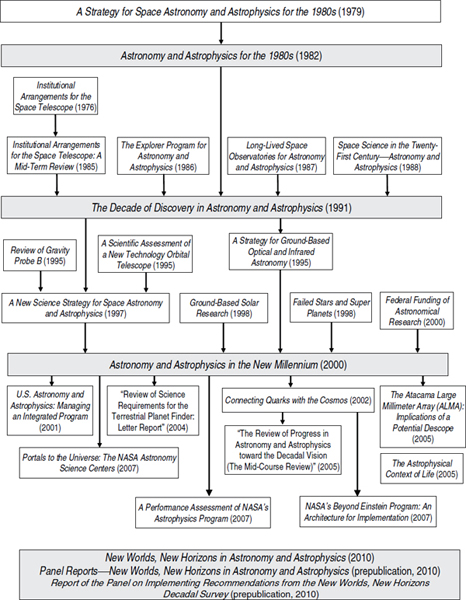
The Committee on Astronomy and Astrophysics, which operates under the joint auspices of the SSB and the BPA, continued to be on hiatus through completion of the astronomy and astrophysics decadal survey in August 2010. The NRC is exploring the reestablishment of the CAA with a modified charge following the release of the decadal survey. A historical summary of reports from CAA and related committees is presented in Figure 2.1.
Staff
David Lang, Program Officer, BPA
The Committee on Earth Studies held its only meeting of 2010 on July 7-8 in Washington, D.C. Agenda items for this meeting included briefings by NASA, NOAA, and the U.S. Geological Survey (USGS) officials on the implementation of the decadal survey in Earth science and applications from space and the implications of a major restructuring of the National Polar-orbiting Operational Environmental Satellite System program for climate-related
measurements, including continuity of climate data records. As is customary, the committee also met with agency officials to discuss issues of mutual interest, including potential NRC studies or workshops.
A subject of particular interest to the CES is the yet-to-be requested study on the “governance” of Earth observations, which was mandated by the 2005 NASA Authorization Act. To discuss prospects for the study, a teleconference was convened in August for members of the CES; NRC staff, including the directors of the SSB and the Board on Atmospheric Sciences and Climate; and representatives from Office of Science and Technology Policy, the U.S. Global Change Research Program, and NASA.
Also during the third quarter, SSB staff and members of the committee met with representatives from the USGS Geography Division to discuss a potential study on the value of developing an operational land remote sensing capability. A preliminary statement of task for this study was developed, and revisions were underway as the quarter ended. Planning continued during the fourth quarter as SSB staff met with senior officials at the USGS Geography Division, members of CES reviewed a preliminary statement of task for this study, and a study proposal to the NRC was prepared.
Members of the committee were also involved in developing a statement of task for a congressionally mandated study that will assess Earth science programs at NASA at the mid-point of the decadal survey cycle (the first NRC decadal survey in Earth science, Earth Science and Applications from Space, published in January 2007).
Also during 2010, members of the CES and SSB staff attended the June 28-30, Irvine, California, meeting of the NRC Committee on Assessing Requirements for Sustained Ocean Color Research and Operations, a shared activity of the Ocean Studies Board and the SSB.
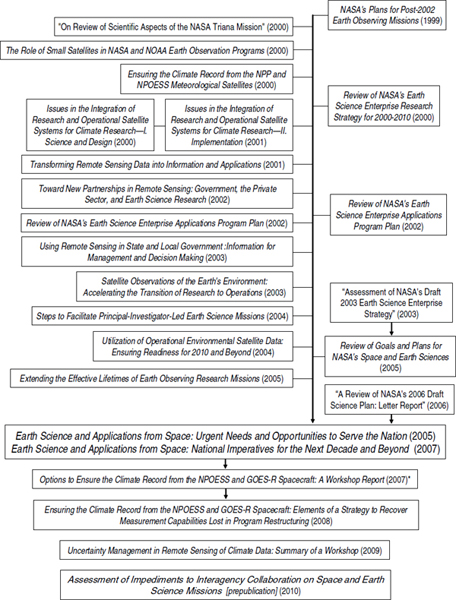
A historical summary of reports from CES and related committees is presented in Figure 2.2.
Membership
Berrien Moore III, Climate Central (chair)
Ruth S. DeFries, Columbia University (vice chair)
Mark R. Abbott, Oregon State University
Richard A. Anthes, University Corporation for Atmospheric Research
Philip E. Ardanuy, Raytheon Information Solutions
Steven J. Battel, Battel Engineering
Antonio J. Busalacchi, Jr., University of Maryland, College Park
Heidi M. Dierssen, University of Connecticut, Avery Point
Hung-Lung Allen Huang, University of Wisconsin, Madison
Anne W. Nolin, Oregon State University
Jay S. Pearlman, Institute for Electrical and Electronics Engineers, Inc.
Thomas H. Vonder Haar, Colorado State University
Staff
Arthur A. Charo, Senior Program Officer, SSB
Dionna Williams, Program Associate, SSB
COMMITTEE ON THE ORIGINS AND EVOLUTION OF LIFE
The Committee on the Origins and Evolution of Life, which operates under the joint auspices of the SSB and the Board on Life Sciences, held its first meeting of 2010 at the University of Southern California on February 17-19. The committee’s current activities remained focused on the initiation of a study for NASA concerning the planetary protection requirements for spacecraft missions to the icy bodies of the outer solar system. A formal request to initiate such a study was received from NASA on May 20. The ad hoc Committee for Planetary Standards for Icy Body Protection in the Outer Planets was appointed and will begin meeting in 2011 to address their statement of task (see Chapter 3).
COEL held its second meeting of 2010 at the National Academies’ Keck Center in Washington, D.C., on June 3-4. The main focus of the meeting was a series of presentations and discussions on virtual institutes—their role, operation, and criteria for success.
COEL’s last meeting of 2010 was at the National Academies’ Jonsson Center in Woods Hole, Massachusetts, on October 13-15. Discussions at this meeting included astrobiology, life on the titanian ocean, and life in extreme environments.
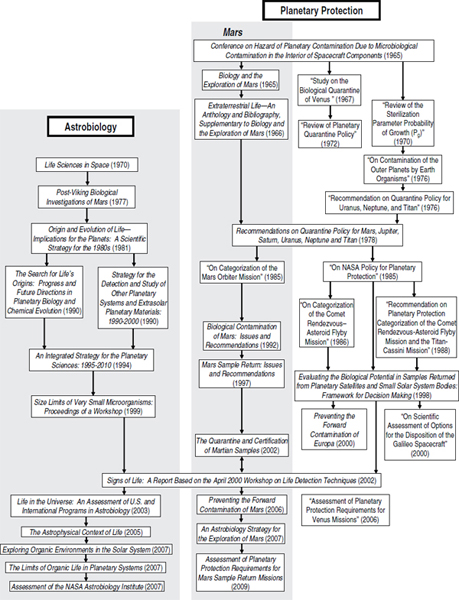
A historical summary of reports from COEL and related committees is presented in Figure 2.3.
Membership
July 1, 2009–June 30, 2010
J. Gregory Ferry, Pennsylvania State University (co-chair)
Robert T. Pappalardo, Jet Propulsion Laboratory, California Institute of Technology (co-chair)
Stanley M. Awramik, University of California, Santa Barbara
Katrina J. Edwards, University of Southern California
Paul G. Falkowski,6 Rutgers, The State University of New Jersey
Margo G. Haygood, University of Colorado, Boulder
Dante Lauretta, University of Arizona
Antonio Lazcano, Universidad Nacional Autonoma de Mexico
Ralph D. Lorenz, Johns Hopkins University, Applied Physics Laboratory
Jeff Moersch, University of Tennessee, Knoxville
John C. Priscu, Montana State University
Sara Seager, Massachusetts Institute of Technology
Barbara Sherwood Lollar, University of Toronto
Everett Shock, Arizona State University
Cristina Takacs-Vesbach, University of New Mexico
July 2010–June 30, 2011
J. Gregory Ferry, Pennsylvania State University (co-chair)
Robert T. Pappalardo, Jet Propulsion Laboratory, California Institute of Technology (co-chair)
Stanley M. Awramik, University of California, Santa Barbara
Katrina J. Edwards, University of Southern California
Margo G. Haygood, University of Colorado, Boulder
Dante Lauretta, University of Arizona
Antonio Lazcano, Universidad Nacional Autonoma de Mexico
Ralph D. Lorenz, Johns Hopkins University, Applied Physics Laboratory
Jeff Moersch, University of Tennessee, Knoxville
John C. Priscu, Montana State University
Gary Ruvkin,7 Masachusetts General Hospital
Barbara Sherwood Lollar, University of Toronto
Everett Shock, Arizona State University
Cristina Takacs-Vesbach, University of New Mexico
European Space Science Committee Liaison
Frances Westall, CNRS Centre de Biophysique Moleculaire, Orleans, France
Staff
David H. Smith, Senior Program Officer, SSB
Rodney N. Howard, Senior Program Assistant, SSB
COMMITTEE ON PLANETARY AND LUNAR EXPLORATION
The Committee on Planetary and Lunar Exploration is on hiatus until the completion of the planetary sciences decadal survey.
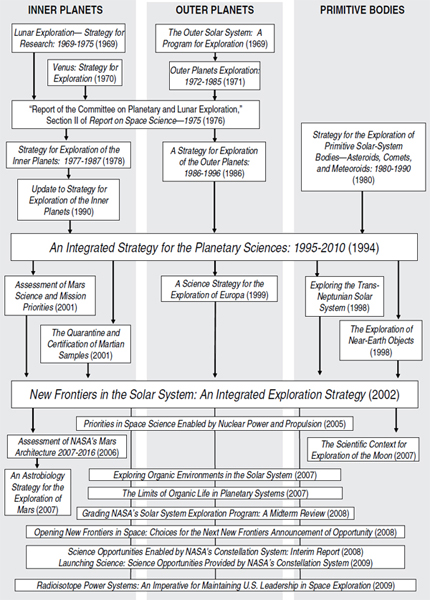
A historical summary of reports from COMPLEX and related committees is presented in Figure 2.4.
Staff
Sandra J. Graham, Senior Program Officer, SSB
_______________
6 Term ended in December 2010.
7 Term ended in October 2010.
COMMITTEE ON SOLAR AND SPACE PHYSICS
The Committee on Solar and Space Physics met on March 3-5 in Boulder, Colorado, at the University of Colorado’s Laboratory for Atmospheric and Space Physics to continue its planning for the initiation of the Decadal Strategy for Solar and Space Physics (Heliophysics), a comprehensive science and mission strategy for heliophysics research for a 10-year period beginning in approximately 2013 (see Chapter 3 for details about the survey). For the remainder of 2010, CSSP was on hiatus until the completion of the decadal survey.
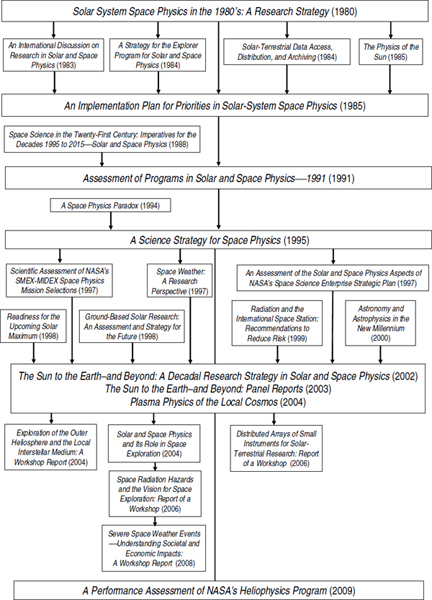
A historical summary of reports from CSSP and related committees is presented in Figure 2.5.
Staff
Arthur A. Charo, Senior Program Officer, SSB
Linda M. Walker, Senior Program Assistant, SSB
SPACE RESEARCH DISCIPLINES WITHOUT STANDING COMMITTEE REPRESENTATION
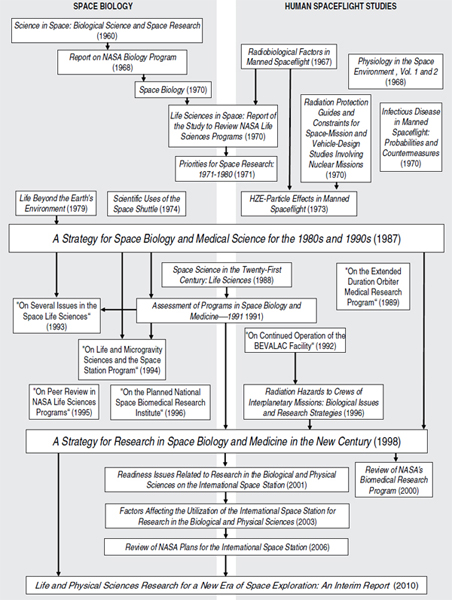
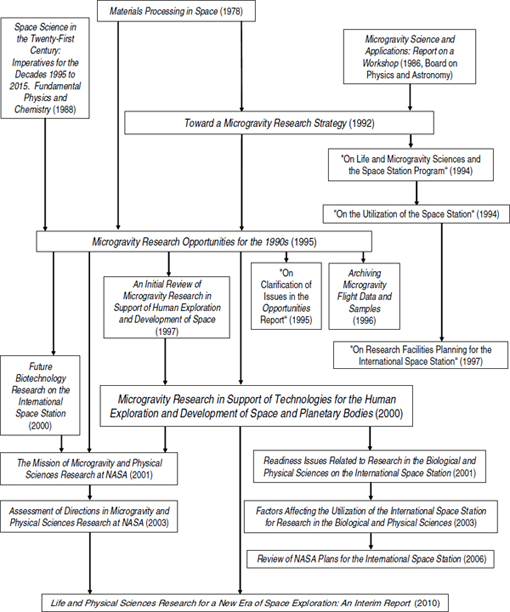
Although there are no longer standing committees representing microgravity research or space biology and medicine, a decadal survey on biological and physical sciences in space was conducted (see Chapter 3). A historical summary of NRC-SSB advice in space biology and medicine is presented in Figure 2.6, and a historical summary of NRC-SSB advice microgravity research is presented in Figure 2.7.