
Appendix A
Experiences with Health Impact Assessment
To develop a framework and guidance for the practice of health impact assessment (HIA) in the United States, the committee felt that it was critical to review the HIA experience of the international community given its use of HIA over the last several decades. The international experience in implementing HIA has involved different institutional arrangements, mechanisms for knowledge transfer, tools, and capacity. On examination of the international experience, the committee identified three main mechanisms for introducing HIA. The first is to incorporate HIA into existing assessment processes—for example, environmental impact assessment (EIA) under the National Environmental Policy Act (NEPA)—and thus make human health an explicit consideration in the mechanisms for approval of policies, plans, programs, and projects. The second is to require HIA explicitly by law or regulation or in response to defined triggers. The third is to use HIA voluntarily but to provide various degrees of government support and resources. In this appendix, the committee examines how the international community has used those mechanisms and what lessons the global experience offers for one who is considering a framework and guidance for HIA in the United States.
This appendix is not a comprehensive review, but it seeks to summarize HIA experience in Canada, Europe, Australia, and Thailand. It also looks at the use of HIA by indigenous people and multilateral organizations. The committee reviews HIA experience in the United States and discusses the relationship between HIA and the process of EIA. The appendix concludes with comments on the use of HIA in the private sector and some important lessons learned from the experience to date that are relevant to the future use of HIA in the United States. The committee notes that this appendix uses the terms health and health impact assessment. To examine the international experience, the committee recognized that it was important to consider the wider policy context and to view HIA as one among many methods by which health is incorporated into decision-making.
CANADA
In the early 1970s, a central government think tank, the Long Range Health Planning Branch, identified the effects of lifestyle and environment on public health and began to consider policy solutions to improve public health (Laframboise 1973; McKay 2000). That activity culminated in a report that identified objectives for the health-care system and for the prevention of health problems and promotion of good health (Lalonde 1974). A combination of research and advocacy was introduced to support and validate the notion that public policies affect determinants of health (Milio 1981; WHO 1986, 1988).
Healthy Public Policy
Health and environment are under provincial jurisdiction in Canada. Two provinces, British Columbia and Québec, have formalized HIA as a component of policy-making, and they offer different experiences (Banken 2001, 2004; Kwiatkowski 2004; Gagnon et al. 2008). In British Columbia, attention to the health of the population was advanced by a group of government officials who had an interest in health promotion. From 1989 to 1995, structures and policies for HIA were starting to be included in British Columbia’s health-care policy, and it was proposed that HIA of all government projects, programs, and laws be conducted. Guidelines were produced, and a series of workshops were held to raise awareness of and develop capacity for HIA1 (Banken 2004). By 1999, the values underpinning the reform of health care had changed, and resources for HIA were redeployed. The guidelines that required the use of HIA in government decisions were not changed, but they were no longer seen as mandatory. Banken (2004) concluded that the rise of HIA in that short time had been accelerated by key persons in the British Columbia Ministry of Health, that it did not benefit from wide ownership, and that it had become closely identified with a particular policy orientation. Banken contended that if other institutions had been more involved in examining the value of and establishing structures for HIA, support for HIA would not have withered as quickly after the policy direction changed and after key persons left the ministry.
Québec had a different experience in using HIA as part of healthy public policy. Banken (2001) traced the linking of environment and health to robust public-health input during hearings on the use of pesticides (BAPE 1983). That input led to a memorandum of understanding (MOU) between Québec’s Ministries of Health and Environment. A framework was developed to support the memorandum and led to the systematic practice of integrating health and the environment into projects and policies (Banken 2001, 2004). In the 1990s, pol-
_________________
1The committee is not aware of any examples of HIA from this period. Therefore, although it is documented that HIA was a part of the policy discussion, it is not possible to evaluate how HIA was conducted in British Columbia.
icy documents recognized the need for intersectoral initiatives to improve health (Government of Québec 1998, 1999) and explicitly recommended the systematic assessment of the impacts of public policies on health. The assessments were to be conducted by the Study Commission for Health and Social Services (Commission d’Étude sur les Services de Santé et les Services Sociaux), which analyzes health services.
HIA was included in Québec’s 2001 Public Health Act, which requires government ministries and agencies to ensure that legislative provisions do not adversely affect the health of the population. It also requires that the minister of public health be consulted on all policies that could have an important health effect (Section 54, Government of Québec 2001). Figure A-1 shows the number of requests for consultations from other ministries. In 2011, the national public health director and the assistant deputy minister in the Ministry of Health and Social Services (Ministère de la Santé et des Services Sociaux) of Québec stated that there were 434 requests for advice from 2003 to 2011 (Poirier 2011a). Although the demands of the legislative calendar influence the number of requests from year to year, the figure indicates a clear upward trend. The trend is ascribed to the Ministry of Health and Social Service’s efforts to develop an understanding of Section 54 across the government, improvements in how the ministry processes requests for consultation and provides its advice, and the application of a public-health perspective to a wider array of policies.
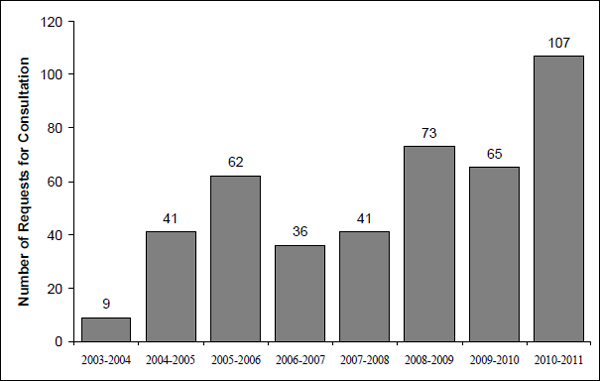
FIGURE A-1 Number of requests for consultation received by the Québec Ministry of Health and Social Services, 2003-2008. Source: L. Jobin, Ministry of Health and Social Services, Québec, personal communication, 2011.
The Québec public-health law is noteworthy because it focuses on the processes by which the government will request assistance on health issues and on how that assistance will be provided by the Ministry of Health (for more information, see NCCHPP 2008). Clearly defining the process has helped to ensure that government departments request health input when writing policy. The Ministry of Health and Social Services has also worked to heighten awareness and to gain the support of other government ministries and agencies (NCCHPP 2008). Although changes are occurring slowly, channels of communication beyond government departments covered by the law are being opened, and this has led to the integration of the health sector (and health consideration) into the political-administrative process. Furthermore, the government’s knowledge development and transfer strategy to support the implementation of the law has strengthened research capacity on healthy public policy in academic sectors and in the Institut National de Santé Publique du Québec (L. St-Pierre, National Collaborating Centre for Public Policy and Health, Québec, personal communication, 2010).
Some issues, however, still need to be resolved. Many government ministries do not comply with the law, and most requests to the Ministry of Health come from the Executive Committee, which is well versed in the importance of health effects. In addition, the process does not specify a particular method of conducting a health assessment (L. St-Pierre, National Collaborating Centre for Public Policy and Health, Québec, personal communication, 2010). Further efforts clearly are required to foster responsibility for health in some parts of government, such as economics and finance. The next steps envisaged include feedback mechanisms to monitor and evaluate how support is offered and taken and how recommendations are implemented. Continued support for changes in practice is needed through high-quality and strategic evaluations that facilitate actions early in the decision-making process, knowledge transfer, and strategic monitoring (Héroux de Sève et al. 2008; Poirier 2011b).
Examining Human Health in Environmental Impact Assessment
In 1995, the Federal-Provincial-Territorial Committee on Environmental and Occupational Health convened a task force in response to reviews that demonstrated that health aspects were inconsistently or only partially addressed in EIA. The task force was asked to develop a definition of HIA that would be acceptable to all jurisdictions, a public-health framework appropriate to HIA, guidance and training material for HIA, and strategies for increasing awareness about HIA, EIA, and the relationship between human health and the environment (Kwiatkowski 2004). The task force concluded that HIA should be promoted within the existing legislated federal or provincial EIA processes; that HIA was not the responsibility of any one government department or agency in that many factors—including environmental, social, economic, and occupational
ones—affect public health; and that HIA should use a multidisciplinary approach informed by the many determinants of health rather than a narrow definition of health (Kwiatkowski 2004). A review by Davies and Sadler (1997) was influential in establishing a case for examining human health in environmental assessment in Canada. A major output of the initiatives was the Canadian Handbook on Health Impact Assessment, a comprehensive resource that was first published in 1998 and has since been updated (Health Canada 2004a,b,c,d).
About 6,000 projects a year undergo EIA under the Canadian Environmental Assessment Act, so it is no small feat to ensure that potential health effects are considered for each project (Kwiatkowski and Ooi 2003). EIAs are characterized as screening, comprehensive study, or public-panel review. As implied by its name, screening is less intensive than the other types and accounts for over 95% of EIAs conducted (Kwiatkowski and Ooi 2003).
What is the current experience of incorporating HIA into EIA? Social effects are considered in EIA in Canada; this makes it somewhat easier to include a wide array of health determinants in assessments (M. Orenstein and M. Lee, Habitat Health Impact Consulting, personal communication, 2011). Noble and Bronson (2005, 2006) reviewed three mining case studies and conducted a survey of environmental-assessment practitioners, health practitioners, administrators, and special-interest groups in northern Canada. They found that health has typically been considered only in the early stages of the environmental-assessment process and that only physical health effects associated with project-related environmental damage have generally been considered. As a rule, health and social determinants have not been considered or have been considered only in the context of factors—such as employment opportunities and worker health and safety—that the project sponsor directly controls. The authors acknowledged, however, that the scope of attention to health in EIA has more recently been expanded to reflect a wider array of health determinants that includes a group’s culture and its traditional land use. They concluded that there is a need to adopt measures to mitigate adverse effects and optimize beneficial effects that the community is sensitive to, to ensure that the measures are effective, and to monitor and evaluate the effects after project approval (Noble and Bronson 2005, 2006). The committee notes that the somewhat bleak assessment by the authors is based on a small sample and may be unduly harsh.
Although systematic collaboration between public health and the environment sector can be improved, research indicates that health is being considered to some extent in EIA. Overall, Canada has some of the most extensive and successful experiences of including HIA in EIA and of analyzing and improving HIA practice. This work is not always labeled as HIA, but health is increasingly a component of an integrated approach to environmental assessment (Orenstein et al. 2010; M. Orenstein and M. Lee, Habitat Health Impact Consulting, personal communication, 2011).
THE EUROPEAN UNION
HIA has been practiced in the European Union (EU) since the 1980s. During the 1990s, there were developments in HIA methodology and practice in Germany, the Netherlands, Sweden, and the United Kingdom. In the late 1990s, the WHO European Centre for Health Policy played a key strategic role in European HIA policy development, and its 1999 Gothenburg consensus conference produced the first universally accepted definition of HIA.
Although requirements and practice have differed, there are examples of health assessment in the environmental-assessment framework,2 in stand-alone HIAs, and in all types of policies—from local policies to policies covering the EU. Explicit policies for HIA exist, but its practice is often advanced through the actions of committed individuals. Research grants from the EU play an important role in enabling research and in developing techniques and capacity for HIA. The grants have funded multicenter studies that involve universities, the public sector, and occasionally private-sector bodies across the EU (see, for example, Abrahams et al. 2004; Hilding-Rydevik et al. 2005; WHO 2005a,b,c,d; Wismar et al. 2007; Gulis et al. 2008; HEIMTSA consortium 2010; and INTARESE consortium 2010).
In the EU, HIA is recognized as a process that sits within the broader sphere of public-health policy and sustainable development. It is one of the ways in which partnerships are developed between municipalities and health authorities and is increasingly used as a mechanism by which land-use or spatial planning can work in partnership with public health. Although skills and capacity for HIA are not widespread, there are isolated examples of universities’ incorporating HIA as part of a curriculum to train planners and public-health professionals. In a study of HIA across Europe, Wismar et al. (2007) showed that HIA has been used in various countries, at various levels, and in various sectors. They noted that participation and equity considerations have played substantial roles in the practice of HIA and concluded that despite the reported variations, HIA can be used prospectively, cover all stages of the policy process, and use different types of approaches.
The following sections provide background on the EU and on the integrated assessment framework used for EU policy. Approaches for integrating health into environmental assessment across Europe are discussed next,3 and then other approaches that have been put into place across Europe to enable HIA to be conducted are reviewed.
_________________
2Regarding environmental assessment in the EU, human-health measures are included in directives and legislation that regulate the effects of development on the environment.
3This summary does not examine legislation for equality and human rights in the EU, which also leads to policy assessment and can incorporate health issues.
Incorporation of Health into Policies, Plans, Programs, and Projects in the European Union
In 2010, the EU had 27 member states and four applicants for membership (see Box A-1). Policies and laws that apply throughout the EU are produced mainly by the joint work of three institutions: the European Commission, the European Parliament, and the Council of the European Union. The European Commission, which proposes new laws and then works with member states to implement them, is divided into departments and services (EC 2011a). Public health falls under the Directorate-General for Health and Consumers, and environmental stewardship falls under the Directorate-General for the Environment. Public health is a relatively new policy topic at the EU level, and member states continue to hold the main responsibility for national health policy.4 Actions at the EU level complement actions at the national level, for example, by addressing major health threats and issues that have a cross-border or international impact, such as pandemics and bioterrorism; by addressing health threats related to the free movement of goods, services, and people; by promoting healthier lifestyles; and by supporting the work of national authorities. It is recognized that public health is not solely an issue for health policy. For example, in 1997, the Amsterdam Treaty of the EU required that all European Community policies protect health. Thus, the “health in all policies” approach is required for internal and external policies, and support is given for the use of impact assessment and other tools that evaluate health (CEC 2007).
The European Commission assesses initiatives for their potential economic, social, and environmental consequences before it proposes them (EC 2011b). Health is considered in that process as one of several topics in an integrated impact assessment framework. The guidelines for the framework were updated in 2009 to review public health and safety and to enhance the consideration of social impacts, including access to and effects on social protection, health, and educational systems (EC 2009a). Specific attention has been given to distributional effects and effects on poverty and social inclusion in the EU and developing countries (EC 2009b). Reviews show a small increase in the number of mentions of the word health in the European Commission’s impact assessment reports; thus, although progress is slow, consideration of health in the framework is increasing (Ståhl 2010). However, the framework for impact
_________________
4Before 1992, health was addressed in the context of health and safety in the workplace and as an issue of consumer safety. The 1992 Maastricht Treaty (EC 1992) was the first treaty to feature an article on public health and to explain the added value of Europe-wide approaches to common challenges in health while confirming that health care remains the mandate of national authorities. Later reform treaties (EC 1997, 2007) enhanced the role of the EU in supporting member states in cooperating and sharing good practice, such as in health-technology assessment, and in tackling cross-border health threats and disease prevention.
BOX A-1 European Union Members and When They Joined
1952 – Belgium, France, Germany, Italy, Luxembourg, and Netherlands
1973 – Denmark, Ireland, and United Kingdom
1981 – Greece
1986 – Portugal and Spain
1995 – Austria, Finland, and Sweden
2004 – Cyprus, Czech Republic, Estonia, Hungary, Latvia, Lithuania, Malta, Poland, Slovakia, and Slovenia
2007 – Bulgaria and Romania
Candidate Countries: Croatia, Turkey, the Former Yugoslav Republic of Macedonia, and Iceland.
Source: EU 2011a,b.
assessment has been criticized for failing to improve the consideration of public health, for example, in focusing on specific health services rather than the wider health of the general public (Ståhl 2010), in placing a low priority on health so that it is not seen as a factor that can differentiate between policy options (Ståhl 2010), in focusing on the effects on the economy or the business environment, and in being open to undue influence from corporate interests (Smith et al. 2010a,b).
Environmental-Assessment Directives
As noted, one of the roles of the Directorate-General for the Environment is to ensure that member states comply with the requirements of the environmental directives. Environmental assessment is a key mechanism for evaluating individual projects identified by the EIA directive (Council of the European Union 1985) or public plans or programs identified by the strategic environmental assessment (SEA) directive (EP/Council 2001). “The common principle of both directives is to ensure that plans, programs, and projects that are likely to have significant effects on the environment are made subject to an environmental assessment prior to their approval or authorization” (EC 2011c). Consultation with the public is a key feature of environmental-assessment procedures.
Member states are free to supplement the assessment processes, and they must incorporate them into their national consent regimes (that is, the framework by which projects are given permission). For that reason, there is some variation in processes between member states. The Directorate-General for the Environment ensures that each member state implements the EIA and SEA directives, and the European Court of Justice is the final arbiter if assessments are disputed. As both directives are procedural, the courts tend to be concerned
with how the assessments have been conducted rather than with their accuracy. Issues of quality are typically left to the organizations overseeing the consenting process, although that can be problematic; for example, health authorities are not always asked to comment on the health components of environmental assessments.
Environmental Impact Assessment
The EIA directive applies to public and private projects (Council of the European Union 1985).5 Annex I of the directive stipulates projects for which it is mandatory to conduct an EIA, such as railways, roads, waste-disposal installation, and waste-water treatment plants. Member states have discretion over whether to conduct an EIA on projects listed in Annex II, such as some types of agricultural or extractive-industry projects, urban-development projects, and flood-relief projects.
Although the rationale for the EIA directive states that “the effects of a project on the environment must be assessed in order to take account of concerns to protect human health” (Council of the European Union 1985), human health is not explicitly included in the list of direct and indirect effects of a project that must be identified, described, and assessed.6 Although environmental assessment considers health protection (for example, calculations of safe exposures are included in the derivation of environmental limits for air emissions and water quality), EIAs do not look in detail at the populations likely to be exposed, and compliance with the environmental limits does not mean that there will be no health effects (even small increases in air emissions can have effects on health).
National governments have interpreted the EIA directive differently, and their interpretations determine the extent to which health is explicitly considered in EIA (Bond 2004). For example, the English ministry responsible for planning has resisted including health explicitly in EIA; in contrast, Germany has sought to address health in EIA and passed a resolution in 1992 on HIA in the context of EIA (Fehr et al. 2004). The boundaries are set by bureaucrats in government ministries whose interests often lie in avoiding placement of extra duties on their minister or on businesses. Frequently, the approach taken is to meet legal compliance with minimum expense, and this can result in poor coverage of health. A review of 39 environmental impact statements in the United Kingdom found that 72% did not list human health in the table of contents, 49% provided no analysis of possible human-health effects, and 67% did not include sufficient data to es-
_________________
5The EIA directive has been amended three times (EP/Council 2001, 2003, 2009) to bring it into line with United Nations Economic Commission for Europe Conventions (UNECE 1991, 1998) and to update the list of projects that come under the EIA directive to include those related to transport, capture, and storage of carbon dioxide.
6The effects include those on human beings, fauna and flora, soil, water, air, climate and landscape, interaction between them, material assets, and cultural heritage.
timate the number of people potentially affected by the project or activity being considered (British Medical Association 1998 cited in Bond 2004).
A study of the application of the EIA directive concluded that when possible human health effects of a project should be assessed in an EIA rather than by a separate HIA (Hilding-Rydevik et al. 2005). The authors acknowledged that best practice for including health in EIA remains undefined and depends on a number of factors, such as how health is defined (that is, whether it is based on environmental impacts or on a wider array of human health determinants) (Hilding-Rydevik et al. 2005).
In a 2009 survey of the application of the EIA directive, all new member states reported that human health aspects are assessed as part of the EIA reports (COWI 2009). Common elements include the identification of human health effects during the scoping stage of EIA, consultations with health authorities or experts in the field on human health, and assessment of human health effects as a part of the environmental documentation submitted by a developer. Few new member states, however, have produced specific guidance documents for those activities (COWI 2009). Most new member states that were surveyed define health in environmental terms and involve public-health authorities mainly on environmental-health matters. For example, in Hungary, human health issues are examined in the EIA procedures for transport projects (focusing on noise), transmission lines (focusing on nonionizing radiation), hazardous-waste management facilities (focusing on complex effects on environmental health), and strip mines and cement factories (focusing on air pollution). Malta is the only member state that mentions well-being and states that, when relevant, health and well-being are studied with reference to socioeconomic impacts (COWI 2009).
Strategic Environmental Assessment
The SEA directive (EP/Council 2001) refers to public plans and programs but not to policies. The idea is to identify issues at a strategic level so that they do not arise at a project level; in practice, however, the link between strategic assessment and project assessment has proved problematic. Although SEAs are used to evaluate plans in various sectors, they are conducted primarily for land-use planning (EP/Council 2001).7 If the environmental effects of plans or programs are deemed likely to cross national boundaries, the member state in whose territory the plan or program is being prepared must consult the other member states (EC 2011d). The SEA directive, unlike the EIA directive, explicitly requires the consideration of “the likely significant effects on the environment, including on issues such as … human health” (EP/Council 2001). The debate on how to include health in SEA is evolving in Europe.
_________________
7SEA is mandatory for plans or programs that are prepared for a prescribed range of sectors and set the framework for granting consent for the future development of projects listed in the EIA directive (EC 2011d).
The SEA directive requires that numerous aspects be examined, including human health, but it does not provide detailed definitions of those aspects. Thus, health is addressed in SEA practice in various ways and in ways that do not systematically require the input of public health or even formal sign-off from health authorities. In Denmark, health is a formal component in the assessment of spatial plans; noise, drinking water, air pollution, recreation and outdoor life, and traffic safety are considered with regard to health (Kørnøv 2009). A review of eight SEAs in England and Germany found that all considered aspects of physical and natural effects (such as noise, emissions, and pollution) on health, and four considered social and behavioral aspects (Fischer 2010). Ensuring that important health effects are satisfactorily identified and considered is challenging, and the SEA directive has not yet led to widespread involvement of public-health experts in the assessment process or in planning. One difficulty is that the health sector tends to be outside the plan-making process, and most HIA experience tends to be at the project level (Cave et al. 2007).
In 2010, the SEA protocol on EIA, which has been adopted by at least 35 member countries, will enter into force (UNECE 2003). It goes much further than the SEA directive in referring explicitly throughout to impacts on environment and health, in indicating that all health impacts should be considered (not only those associated with environmental factors), and in indicating that health authorities should be consulted at the different stages of the process.
Examples of Advancing Health Impact Assessment Independently of Environmental Impact Assessment and Strategic Environmental Assessment
Member countries have taken different approaches to advancing HIA outside the environmental-assessment process. Since the late 1990s, Sweden has used HIA as a mechanism for addressing the determinants of health in policy-making (Berensson 2004). Although no legislation requires HIA, agencies, counties, and municipalities continue to learn about and use it. Local politicians across Sweden were actively involved in developing the country’s initial guidance documents for HIA and recommended that health be an early part of all policy discussions (SFCC 1998). The decision to screen all political proposals to determine which should be further evaluated led to many policies being recommended for HIA (Nilunger et al. 2003).
Sweden’s Health Policy Act of 2003 based its national objectives on health determinants rather than diseases or health problems and linked achievement of the objectives to a monitoring system and annual evaluations. In 2005-2008, 11 central agencies and all of Sweden’s county administrative boards were required to implement HIA and were supported by the National Institute of Public Health in doing so (Knutsson and Linell 2010). Although the requirement has heightened interest in and political support for issues related to public health and particularly HIA, there is no legal requirement for HIA, and there are no specific
resources for its institutionalization. The result is that implementation is based on the leadership and good will of local individuals and on support by the National Institute of Public Health. Under the existing arrangement, it takes time to develop the capacity for HIA as an integral part of an organization’s activities, and work relationships among the sectors have been difficult to achieve (Knutsson and Linell 2010). County administrative boards have made the following observations: legislation or political demand is required to ensure that the public sector implements HIA on a regular basis; the integrated assessment of social, economic, and environmental factors is desirable; and the National Institute of Public Health has used the awareness of EIA processes as a way of structuring HIA approaches and of introducing HIA (Knutsson and Linell 2010). An evaluation of the use of HIA by one health district authority (South West Stockholm) found that a critical factor in the success of HIA was that management at the political and administrative levels had close working relationships, which were achieved and maintained through recurrent opportunities for training and for opportunities in which HIA had the potential to influence policy-making (Berensson 2004).
Slovakia’s government passed legislation in 2007 that requires HIA of projects, programs, and policies (O’Mullane 2011). The enforcement of the legislation has been delayed to prepare an institutional framework that includes public-health input. Environmental-health officers in the 37 regional public-health authorities will screen projects to determine which are suitable for HIA. If an HIA is deemed necessary, it will be outsourced to and conducted by the private sector and then evaluated by the regional public-health authority. The National Public Health Authority will have the responsibility of implementing HIA throughout its 37 regional authorities.
Finland has a long-standing interest in incorporating health into all policies and institutionalized HIA for projects in 2002-2006 (Ståhl et al. 2006). The HIAs included stakeholder involvement; were conducted by STAKES, a public-policy institute that has expertise in HIA; and took about 2 months to complete. Local governments were then given the responsibility for HIA and support was provided by the public-policy institute that trained EIA officers and health, education, and local government officials. That process was considered to take too long, and a rapid HIA procedure was developed by STAKES for local government committees to support local-level decision-making. Some cities implemented the procedure successfully, but some sectors objected to impact assessments on particular issues. Where there was resistance to HIA, it was perceived to be a result of the loss of power over decision-making because of the need to consider a wider array of options.
More recently, Finland introduced norms and guidelines for implementing integrated impact assessment, which has been required by law for many years and is led by the Ministry of Internal Affairs. The norms established minimum requirements for impact assessments and allowed questions to be raised if health issues were not included. The Finnish experience points to the essential roles of legislation, of clear process requirements for the implementation of assessments
(norms and standards), and of the allocation of budgets (resources) for successful implementation of impact assessment. In the Finnish context, the use of integrated impact assessment, which is required by law, is seen as the best way to integrate health and environment issues into policy-making (T. Ståhl, National Institute of Public Health, Tampere, Finland, personal communication, 2011).
In England, an act of Parliament stipulates that all strategies passed by the mayor of London must reduce health disparities in London (HM Government of Great Britain 2007). That requirement means that public-health input is required in all sectors, it places health assessment firmly within the policy process, and it makes the reduction of health disparities a matter that spans the activities of the Greater London Authority. London strategies for transportation, housing, employment, and education have all been subject to HIA (Opinion Leader Research 2003; Bowen 2004; London Health Commission 2011), and capacity for HIA has been developed at regional and local levels around London.
Alternative approaches for advancing HIA at local levels have focused on particular funding programs. For example, in 2000, a redevelopment program in Wales required that all proposals take health into account; accordingly, HIAs had to be completed to ensure that proposals were funded (see, for example, Breeze and Kemm 2000). The Welsh Assembly has formed a special unit to assess health impacts of proposed legislation and advise parliamentarians (Breeze and Kemm 2000).
National and local requirements for HIA may be supported by information repositories, for example, the HIA gateway,8 which was funded by the English Department of Health. Advisory bodies have also supported and propagated the use of HIA. For example, the Welsh Health Impact Assessment Support Unit at the Cardiff University School of Social Sciences was formed in 2001. It formed a partnership with the National Public Health Service and works to develop capacity for HIA in Wales, provide information and advice, and conduct research and evaluation. Examples of similar centers in other parts of Europe include the National Institute for Public Health and the Environment (RIVM) in the Netherlands; the Institute of Public Health, North Rhine Westphalia, in Germany; and the Unit for Health Promotion Research in the University of Southern Denmark. Some centers have informal oversight and advisory roles. RIVM, for example, provides policy advice to the Ministry of Health in environmental health and chronic diseases and specializes in the quantification of health effects in which HIA expertise plays a role (L. den Broeder, National Institute for Public Health and the Environment [RIVM], the Netherlands, personal communication, 2010).
The experience of the World Health Organization (WHO) Europe Healthy Cities Network (HCN) provides some lessons that could be instructive for the United States by suggesting how U.S. cities and counties might adopt and adapt HIA. It also indicates the magnitude of the work and time required to achieve the change in policy infrastructure to advance HIA and to ensure that all sectors are comfortable and confident with the process. The HCN is made up of more
_________________
than 90 European cities (WHO 2011). To join the HCN, cities must apply, they must fund their input, and they must demonstrate a high level of political support. Thus, the cities involved are, in theory, willing partners and are keen to learn from the HCN and adapt their policies accordingly. Since 1998, healthy urban planning has been a part of the network (Barton et al. 2009), and capacity-building and peer support have always been important elements of the movement as a whole. Phase IV of the WHO Healthy Cities Project ran from 2003 to 2008 and included HIA as one of its core activities. In 2003, the focus was on adoption of HIA; the two main types of barriers to adoption were characterised as technical and political (Ison 2009). Suggestions for overcoming technical barriers included providing training; technical support, particularly in initial HIAs; mentoring; and peer review. Suggestions for overcoming political barriers included “increasing political understanding of what HIA is and what it can offer; involving the politicians at a strategic level in setting the conditions for the use of HIA by the municipality; piloting HIA with proposals that are likely candidates to increase the potential for health gain; [and] presenting the results of HIA in a useful and useable format for politicians so that health can be taken into consideration during decision-making” (Ison 2009, p. i69). Internal evaluation of the HCN found that it has advanced HIA in several municipalities in the region and has sensitized other municipalities to the relevance of creating health gain (Ison 2009); however, there is no consideration of the effectiveness of the HIAs that the HCN recommends.
The European experience has shown that capacity-building is important, particularly for knowledge transfer within and between organizations. Although it is recognized as a useful approach, HIA is rarely a core responsibility listed in job descriptions. Public-health specialists in the health sector find it difficult to dedicate time to HIA, and there is no clear career path for young professionals who wish to pursue HIA. In the United Kingdom and Ireland, there are a few short courses in HIA that are seen as part of continuing professional development. At the University of the West of England, a substantial proportion of planners are trained in the Faculty of the Built Environment. The university has a large public-health school and requires planners and public-health professionals to take a course in each other’s field. In some respects, the lack of capacity is being met by the private sector as specialists in environmental assessment are starting to add HIA to their skill set. Although working across sectors is desirable, increasing the capacity for HIA outside the discipline of public health will have long-term implications for the development of HIA.
AUSTRALIA
This section reviews the Australian experience in addressing health in EIA, in advancing HIA by using alternative methods, and in strengthening the consideration of health equity in HIA.
Health in Environmental Impact Assessment
EIA was established in Australia in 1974 by the Environmental Protection (Impact of Proposals) Act, which is applicable to national-level decisions and includes provisions for assessing vectorborne diseases associated with the construction of large dams (Australian Government 2009). In 1994, the National Health and Medical Research Council—a research body tasked with improving public health in Australia—published findings on health in EIA (NHMRC 1994). They found a lack of structures and processes for incorporating health in EIA, inconsistent coverage of health in EIA because of gaps in EIA legislation, and inadequate involvement of health agencies in the EIA process. The council proposed integrating HIA into EIA and stated that “human health is affected by social, psychological, economic, ecological, and physical factors” (NHMRC 1994, p. xii). It defined a framework for integrating health into EIA, specified ways to access public-health expertise and to finance community involvement, and identified methodologic issues to be addressed (Harris and Spickett 2011).
The Australian federal government established the enHealth Council, a national body with responsibility for implementing a National Environmental Health Strategy and providing leadership on integrating health into EIA (Harris and Spickett 2011). The council published guidelines for implementing HIA (enHealth Council 2001) that promoted the integration of health into EIA, the consideration of the social determinants of health, and the recognition of the broader application of HIA beyond projects and into policy and program development. Furthermore, the guidance emphasized the need to assess adverse and beneficial health effects and overcome the previous tendencies in EIA to assess only adverse effects. In 2005, however, an analysis found that legislative and administrative frameworks and procedures needed for facilitating HIA implementation were still lacking (NPHP 2005). The responsibility for HIA was later defined to be a matter of state and local jurisdiction, not a federal-government responsibility.
At the state level, Tasmania introduced legislative requirements in 1996 for the conduct of HIA as part of the EIA process (Government of Tasmania 1994). That legislation was one of the first examples of requirements for the consideration of health effects (in addition to environmental effects) to be formally legislated. Mahoney (2009), however, suggested that the requirements were due more to the configuration of the government department responsible for public health and environmental management than to a calculated decision to set priorities related to health. Queensland is the only other Australian state that combines health and environmental effects, and it too has been successful in addressing health in EIA (Mahoney 2009).
In 1998, Tasmania published a manual to guide local governments in the execution of their public-health and environmental-health duties (Public and Environmental Health Service 1998). It emphasized environmental risks to health, the monitoring of those risks, and detailed risk-assessment methods. However, HIA was ultimately impeded because of a lack of sufficient workforce
capacity. Later revisions of HIA procedures encouraged more efficient scoping and earlier interactions between developers and appropriate government agencies (Harris and Spickett 2011).
Health Impact Assessment Independent of Environmental Impact Assessment
Around 2000, there was a move to promote HIA independently of EIA as a way to influence healthy public policy (such as in the transportation and housing sectors) and to place an emphasis on stakeholder participation in the HIA process and on the social determinants of health (Mahoney and Durham 2002). A federal research-grant program supported that work, including communication among sectors, tools development, and capacity-building. The grant program was disbanded after a few years, but an effort in capacity-building for conducting HIAs of policies continued in two states. In New South Wales, the focus was to build health-system capacity to implement HIA. In Victoria, the focus was on local government planning systems.
Equity-Focused Health Impact Assessment
Equity-focused HIA and a framework for considering the differential distribution of impacts explicitly were also developed in Australia to support Health In All Policies (Mahoney et al. 2004). The framework was tested in case studies and succeeded in placing the focus of HIA on the equitable distribution of health in the population (Simpson et al. 2005). New South Wales included HIA in its strategy to reduce health inequity and funded HIA capacity-building, and the Centre for Health Equity Training, Research and Evaluation of the University of New South Wales has conducted rapid equity-focused HIAs.
Advancing Health Impact Assessment in Australia
The development of HIA throughout Australia has been influenced by priorities at the state and territory levels (Harris and Spickett 2011). For example, Western Australia and the Northern Territory have active mining sectors; environmental assessments of many of the mining activities are conducted, and HIA is integrated into them. With support from the University of New South Wales, the states of New South Wales, Queensland, South Australia, and Victoria are building capacity for and supporting the implementation of HIA as a tool for healthy public policies through learning-by-doing programs (that is, programs that emphasize learning through participation).
The Australian experience indicates that “system support and capacity-building” may do more to promote HIA than legislating its use (Harris and Spickett 2011). New South Wales, Western Australia, and South Australia do
not have any legislative requirements for HIA but have advanced HIA with some support of the health sector and others across the government. Although legislation requires HIA to be included in EIAs in Tasmania, there have been difficulties in applying HIA within a regulatory process of a nonhealth agency, including lack of sufficient workforce capacity and efficient procedures for communicating between proponents and relevant agencies. Victoria has incorporated HIA into its Public Health and Wellbeing Act 2008 by systematically investing in the positioning of HIA in local government as a tool for healthy public policies and by building capacity for HIA among public-health staff.
THAILAND
Over the last decade, Thailand has developed a comprehensive system for HIA. The National Health System Reform (NHSR) was launched in 2000 and has advocated for addressing health in policies in nonhealth sectors and for a greater role for the public in decision-making. HIA was identified as a mechanism for developing a healthier society by facilitating stakeholder involvement and by including sound information in public policy-making (Phoolcharoen et al. 2003).
Public policies to transform Thailand into an industrialized economy were met with civil unrest and set the historical background for the move to increase the public’s role in decision-making. The 1997 constitution created mechanisms for participatory decision-making, resource allocation, decentralization, greater accountability, and transparency. The NHSR process reflected the national objectives, and in 2001, an NHSR commission funded research to inform the National Health Act and to develop HIA in Thailand. The first attempt to introduce HIA into the EIA process was not successful. It was concluded that EIA would need to be modified to allow for broader participation. Moreover, at that time, knowledge of, experience in, and skills for HIA were lacking in Thailand. The low level of capacity was identified as a threat to the credibility of HIA if it were to develop as a formal approval mechanism. In 2002, the Ministry of Public Health established a Division of Sanitation and Health Impact Assessment to define HIA systems and to support healthy public policy, especially among local governments. The focus changed in 2003 to HIA in healthy public policy as a learning process, and this process was to be developed in parallel with obtaining support for the concept of the NHSR and with development of a critical mass of HIA knowledge and skill in the country.
In 2005, the National Economic and Social Advisory Council—which had experience with implementing HIA in a variety of projects and policies—submitted HIA recommendations to Thailand’s cabinet. The recommendations were accepted, and the Ministry of Health was directed to implement them. A clear mandate for HIA in Thailand was established as a way to stimulate greater interest in developing healthy public policy. The 2007 federal constitution requires EIA and HIA and states that a public hearing must take place to obtain
the opinion of interested parties and others who might be affected by a project or activity and that a community has the right to sue any government agency that does not comply (Thai Laws 2007). The National Health Act, also issued in 2007, includes the right of people to ask for and participate in an HIA of a public policy, and it requires the NHSR Commission to develop HIA guidelines and procedures (NHC Thailand 2007). The National Development Plan of 2007-2011 includes provisions for “integration of health in the EIA system” and “applications of SEA…with health considerations in main sections and in spatial planning” (NHC Thailand 2008).
Experience with implementing HIA continues to evolve. Some of the successes include the integration of health assemblies with multistakeholder participation into policy-making at a local level. HIAs have been used for healthy agriculture policies at local and regional levels, industrial policies, and water management. HIA credibility has been found to depend on who conducts the assessment; HIAs led by a health department using participatory learning have had better results than HIAs led by nongovernment organizations and local experts. HIA recommendations that require changes in existing business practices have needed substantive analysis to support them. For example, HIAs evaluating policies for the production of healthier foods tried to demonstrate the relative health costs of current business practices compared with those of policy alternatives and to develop measures that would influence consumer demand for healthy foods (Elinder et al. 2003; Cole et al. 2007).
Some of the present challenges for Thailand are to define specific mechanisms for public participation and for incorporating the results of the assessment into policies; to develop rules, regulations, and guidelines for HIA in specific sectors, such as agriculture and food production, that take into account sector issues and business-management practices; to expand the knowledge base so that the health burden of policies and methods can be recognized; and to identify short-term and long-term effects of the policy.
WORLD HEALTH ORGANIZATION
HIA initially developed in WHO in response to the need to control vector-borne diseases resulting from water projects without using chemicals. In 1981, the Panel of Experts on Environmental Management for Vector Control was established to develop institutional frameworks for intersectoral and interagency collaboration. The panel developed methods to forecast diseases in water-management projects (Birley 1991). Further development of HIA occurred when the World Commission on Dams, a multistakeholder commission, made recommendations for the sustainability of dams and set good practice standards. The commission expressed concern over health impacts (Colson 1971) and, in cooperation with WHO, included health assessments in its deliberations (WHO 2000a).
WHO’s Regional Office for Europe (EURO) supported training for the inclusion of health in EIAs beginning in the 1980s (Tiffen 1989; WHO 2000b). Other WHO regional offices—such as the Regional Office for the Eastern Mediterranean (Hassan et al. 2005) and the Pan American Health Organization (Weitzenfeld 1996)—prepared HIA guidelines that focused on addressing environmental determinants of health; some of the guidelines have been widely used. An HIA training package with guidance for government cross-sector policy-making was issued in 1999 and implemented in several countries (WHO 2000b). In 2003, an HIA Web site9 was established, and a special-themed issue of the Bulletin of the World Health Organization was dedicated to HIA experience at that time (Volume 81, Number 6).
Since the late 1990s, WHO’s focus on HIA has included applications in industrialized countries. The focus on HIA broadened from incorporating health into EIAs to developing healthy public policies. WHO EURO supported HIA in specific sectors, including agriculture (Lock et al. 2003) and transportation (Dora and Racioppi 2003). WHO EURO also developed a project to learn from HIA experience and clarify basic concepts and definitions, principles, approaches, and methods used in HIA. A series of reviews and meetings were carried out, and support for continued learning was provided through a network to decision-makers. Those activities led to the publication of the Gothenburg consensus paper (Diwan et al. 2000). Also, as previously discussed, a project on HIA was developed by the Europe Healthy Cities Network (EU 2009).
The WHO experience with EIA and HIA for healthy public policy was used to inform and influence the negotiations of the new SEA protocol to the United Nations Economic Commission for Europe Convention on EIAs (Dora 2004). The final text included a broad health perspective, placed health as a key aspect of the SEA, and specified ways to include health (UNECE 2003). That same broad perspective was successfully used in a project to support healthy public policies, including the use of HIAs in Uganda, Jordan, and Thailand that focus on agriculture, livestock, and water-management policies.10 WHO EURO has also assisted several countries in its region in conducting HIAs of climate change, and a few countries have developed national adaptation plans that include specific consideration of health (WHO 2008).
Tools for HIA oversight have recently been developed by WHO to be used by multilateral development banks and recipient countries. Those tools support the inclusion of health goals in development lending for all sectors of the economy (M. Pfeiffer and C. Dora, WHO, unpublished material, 2010), and they support a decision by the International Finance Corporation (IFC) to adopt safeguards for community health and safety. Integrating health into development lending through the use of HIA has the potential to influence large public and private-sector investments in developing countries, including natural-resource extraction (such as oil, mining, and forestry), infrastructure, and tourism. WHO
_________________
is working with a few pilot countries on the development of governance mechanisms in the extractive industry for healthy public policy by including HIA and connecting health with national planning processes.
In 2008, the Commission on Social Determinants of Health (CSDH) recommended that WHO support health-equity impact assessments of important global, regional, and bilateral economic agreements and in all government policies, including finance, as a way to address health disparities. It was recommended that member states of WHO redesign their health sectors to integrate a focus on social determinants of health into relevant sectors (CSDH 2008). To achieve that goal, WHO proposed that countries adopt and perform HIAs for policies and projects and focus further on health equity. The CSDH also recommended that data systems present information disaggregated by sex, socioeconomic status, and other criteria to allow for the identification of disparities; it warned that public participation does not necessarily ensure that equity issues are addressed; and it called for capacity-building to assess the health-equity impacts of major global, regional, and bilateral economic agreements and to monitor social determinants of health and health equity.
MULTILATERAL DEVELOPMENT BANKS
Multilateral development banks provide financial support and advice for economic and social activities in developing countries. They include the World Bank and associated institutions—the African Development Bank, the Asian Development Bank, the European Bank for Reconstruction and Development, and the Inter-American Development Bank Group. The World Bank expects its borrowers “to integrate selected environmental and social aspects into the identification, planning, appraisal, and implementation of the investment projects that it supports” (Mercier 2003, p. 461). To facilitate compliance, the bank requires a series of impact assessments, including assessments of projects that might have effects on the environment, natural habitats, forests, safety of dams, pest management, indigenous peoples, involuntary resettlement, cultural property, and international waterways and projects in disputed areas (World Bank 2011). Such assessments are considered safeguards and were adopted gradually between 1998 and 2006. The assessment reports must be disclosed in the countries in which the projects are expected to be implemented and on the World Bank InfoShop Web site, and they are expected to be communicated internationally. The World Bank does not have a safeguard for public or community health. It has defined EIA to include the natural environment, human health, safety, and social aspects; in 1996, it commissioned guidance for including health as part of an EIA (Birley et al. 1997).
The Asian Development Bank has had a concern about the health consequences of projects that it funds and commissioned guidelines in 1992 for the HIA of development projects (Birley and Peralta 1992). The guidelines are brief
and have not been updated recently, but the bank has had a staff member who has HIA expertise on its safeguards team for many years.
The IFC—the private-sector lending arm of the World Bank—lends to private-sector investors primarily in developing countries for such projects as the extractive industry or tourism. The IFC adopted safeguards for projects submitted for funding and developed a set of criteria for assessing potential impacts on the environment, employment, occupational health, and safety.
In 2006, the IFC developed additional safeguards for public health after a debate about the oversight of adverse health impacts of projects funded by IFC that could possibly pose a risk to businesses and therefore to the IFC itself (IFC 2006). The new safeguards, referred to as performance standards, added a standard on community health and safety to several existing standards on occupational health and safety, and IFC produced guidelines and a benchmark for industry to help it meet the new standards (IFC 2007). In 2009, the IFC published guidance for carrying out HIAs that covered potential health issues in large-scale projects in developing countries in, for example, the extractive industry (IFC 2009). That requirement is potentially beneficial for public health because all projects for which the IFC is one of the co-financers will need to have the community-health and safety-assessment performance standards included. Private investment is a large fraction of the financial investment in developing countries today.
In 2003, the Equator Principles Financial Institutions (EPFIs)—a group of 67 private banks, including some in developing countries—agreed that no loans should be provided to applicants that would not or could not comply with social and environmental policies and procedures modeled after the environmental standards of the World Bank and the social policies of the IFC. The EPFIs have only recently been trained to implement the new IFC performance standards, and there is no independent mechanism for assessing compliance or quality assurance in the implementation of the standards. A network of professionals are engaged in the implementation of the performance standards in those banks in an effort to facilitate learning from experience. The Equator Principles have become the voluntary standards for private banks in assessing development projects. Those measures have the potential to include health and other criteria in private-sector lending. Accountability mechanisms will need to be built into the system at some point and could provide the incentive for better performance, as shareholders and other interested groups identify the actual contributions of private bank lending to promoting health and other development criteria.
UNITED STATES
The first use of a process identified as HIA in the United States occurred in 1999 in the context of a policy to increase the minimum wage for San Francisco contractors and leaseholders (Bhatia and Katz 2001). That use of HIA contributed to the passage of an ordinance and an increase in the minimum wage
(Dannenberg et al. 2008). The early use of HIA by a U.S. government agency was focused on the integration of public-health agency expertise into local land-use planning decisions principally in the San Francisco Bay area of California. The use of HIA then began spreading to other parts of the country as an independent practice with some expansion of the breadth of policy sectors and more recently as an enhancement of the health analysis conducted in the state and federal systems for EIA. In 2010, there were a growing number of examples of the use of HIA in the United States in a wide variety of agencies at the local, state, and national levels.
Local Communities
The use of HIA in local communities has spread substantially over the last decade. Surveys in 2010 show HIA being used in a number of large metropolitan areas and medium-size communities for a variety of actions (Dannenberg et al. 2008; UCLA HIA-CLIC 2011). HIA of policies, projects, and programs in local communities has been organized or sponsored by local public-health agencies, nonprofit organizations, planning agencies, and academic institutions. For example, several HIAs focus on individual development projects or community plans (Farhang and Bhatia 2007; Heller et al. 2009; Human Impact Partners 2009) whereas the BeltLine HIA evaluated a regional redevelopment and transportation project in the greater Atlanta metropolitan area (Ross 2007). Land-use, housing, and transportation planning have been more common foci of HIA than policies or programs in the labor, education, or social-services sectors. In the transportation context, current HIA work includes analysis of transportation infrastructure proposals in the Minneapolis-St. Paul area, the Houston Urban Corridor, and the Los Angeles area and a proposed road-pricing policy in San Francisco (UCLA PH 2011; ISAIAH 2011; SFDPH 2011; UCLA HIA-CLIC 2011).
HIA has also been used to gauge the health impacts of proposed changes in local zoning ordinances. The Eastern Neighborhoods Community Health Impact Assessment, completed in 2006, analyzed three rezoning plans for former industrial neighborhoods and focused on issues of displacement and environmental quality (Corburn and Bhatia 2007; Farhang et al. 2008). Another recent example is from the city of Baltimore, where an HIA found that the city’s proposed zoning code would have several implications for health. The HIA team noted that “if implemented, the draft new code could substantially increase the percentage of residents who live in neighborhoods that allow mixed use. This has the potential to increase residents’ physical activity levels as well as access to healthy food. [It could also] dramatically increase the percentage of neighborhoods that allow urban gardens and farmers markets. This has the potential to increase residents’ access to healthy food if these uses were developed” (Thornton et al. 2010, p. 1-3). The HIA made several recommendations for modifying the zoning code to promote health.
Although public-health agencies in several localities—including Denver, Baltimore, Seattle, Portland, Los Angeles, and the North Slope Borough in Alaska—have been either leaders or participants in HIA initiatives, it is less common for public-health agencies to have incorporated HIA as a routine day-to-day institutional practice. Over the last decade, however, the use of HIA in San Francisco has matured to become an integral part of the work of the Department of Public Health with dedicated public funding and staff since 2002. HIA tools are now routinely applied in partnership with other city agencies, including planning and redevelopment agencies, to evaluate such proposals as neighborhood and community plans. The San Francisco Department of Public Health has established a routine role of providing oversight of environmental health analysis in EIAs implemented under the California Environmental Quality Act. It has also been involved in the institutionalization of HIA practice through training and evaluation partnerships with the University of California, Berkley and research initiatives to develop analytic tools and approaches to address methodologic gaps. Several HIAs conducted by the San Francisco Department of Public Health have been implemented in close partnership with or under the oversight of nongovernment organizations—a fact that may be instrumental in the continuing community demand for HIA (Corburn 2009). Notably, community demand is leading to a broadening of the scope of practice beyond physical planning to policies related to labor rights and working conditions.
States
In 2006, Washington became the first state to pass legislation focused on enabling preparation of health impact reviews. A health impact review has been defined as a “review of a legislative or budgetary proposal…that determines the extent to which the proposal improves or exacerbates health disparities” (Revised Washington Statutes 43.20.015). The state legislature made formal findings that women and people of color experience important disparities compared with men and the general population and that the disparities affect health in many ways. The state also expressed an intent “to create the healthiest state in the nation.” The law established a mechanism under the purview of the State Board of Health to undertake health impact reviews on the request of a state legislator or the governor (Revised Washington Statutes 43.20.285). Although some reviews have been requested (WA SBOH 2007a,b; 2008a,b,c; 2009, 2010), state budget difficulties have resulted in diminished capacity to conduct reviews.
Massachusetts has also passed legislation to support HIA, and bills to support HIA have been proposed in California, Maryland, Minnesota, and West Virginia. Most of the bills would provide for an expanded role for state health agencies in HIA and related planning efforts. However, even without the incentive of legislation, some state health departments have become more engaged in HIA over the last few years. To date, state-level administrative actions include
the establishment of interagency working groups and pilot programs and technical assistance to agencies that are developing regulations that may affect public health. For example, the Hawaii Department of Agriculture is partnering with the Kaiser Permanente Center for Health Research and the Kohala Center—a nonprofit organization focused on community education, research, and conservation—to develop an HIA that will inform the development of a Hawaii County Agriculture Development Plan. The plan is being developed in the wake of the demise of the sugar plantations that used to dominate the agricultural economy on the “big island” of Hawaii and the disappearance of many smaller agricultural producers (UCLA HIA-CLIC 2011). In Alaska, the Department of Health and Social Services has established an HIA program to provide technical assistance to other agencies involved in conducting integrated environmental and health impact assessments (Alaska HSS 2011).
In California, the Department of Public Health recently became the first state agency to publish an official guidance document on HIA (Bhatia 2010). In 2009, the California Air Resources Board, in partnership with California Department of Public Health, initiated an HIA of proposed cap-and-trade regulations required to be promulgated under the California 2006 Global Warming Solutions Act. The act directed the California Air Resources Board to adopt regulations that avoid, to the extent feasible, disproportionate impacts on low-income communities (California State Health and Safety Code, Division 25.5, Greenhouse Gas Emissions Reductions, § 38562(b) (2)). The act also mandated that, in the development of the regulations, consideration be given to overall societal benefits, including public health. A second phase of the HIA was recently initiated to expand the scope of the analysis with external funding and support by the private nonprofit Public Health Institute. Other state health departments engaged in HIA include those of Wisconsin, Oregon, Washington, Massachusetts, and Alaska (Cagle 2010; WI DPH 2010; ANTHC 2011; Oregon Government 2011).
Federal Government
The use of HIA in decision-making at the level of the federal government has been largely, although not exclusively, in the context of implementing NEPA. Federal agencies in the executive branch of government have been, in theory, required to assess the health effects of proposed federal actions under NEPA since its passage in 1969 (42 U.S.C. §§ 4321-4347).11 The language in NEPA that embodies the threshold for the preparation of an environmental impact statement (EIS) uses the phrase “the quality of the human environment” (Congressional Record, Senate, P. 40416, December 20, 1969) because the congressional sponsors intended to demonstrate that “an environmental policy is a
_________________
11There are some gaps in coverage under the statute, most notably for these purposes the pollution-control regulatory activities of the U.S. Environmental Protection Agency.
policy for the people. Its primary concern is with man and his future” (Congressional Record, Senate, p. 40416, December 20, 1969). Indeed, the statutory purpose of NEPA includes promoting the “health and welfare of man” (42 U.S.C. § 4321; emphasis added), and the national environmental policy—whose articulation and implementation were the major purpose of the act—includes assurance that all Americans are entitled to “safe, healthful, productive, and aesthetically and culturally pleasing surroundings” (42 U.S.C. § 4331) and the attainment of the “widest range of beneficial uses of the environment without degradation, risk to health or safety, or other undesirable and unintended consequences” (42 U.S.C. § 4331; emphasis added).
Similarly, the regulations implementing the procedural provisions of NEPA include health as an important focus of analysis.12 The direct, indirect, and cumulative health effects of proposed federal actions are to be analyzed under NEPA (40 C.F.R. § 1508.8), and the degree to which a proposed action affects public health or safety is one of the criteria for determining whether preparation of an EIS is required (40 C.F.R. § 1508.27). Furthermore, Congress directed the administrator of the U.S. Environmental Protection Agency (EPA) to review and comment in writing on the analysis of the impacts of proposed actions. EPA was asked to refer any proposed legislation, action, or regulation that fell under the auspices of NEPA and that was determined to be “unsatisfactory from the standpoint of public health or welfare or environmental quality” (42 U.S.C. § 7609 [1970]) to the Council on Environmental Quality (CEQ), which is the environmental agency in the executive office of the president.
From a procedural perspective, there is no significant difference between the steps in HIA and EIA, at least as practiced under the regulations implementing NEPA. Both processes begin with the identification of proposed actions that should go through the process, as opposed to proposed actions that are likely to cause no or de minimis impacts. In HIA, this step is called screening (described in detail in Chapter 3). Under NEPA, agencies are required to publish procedures that provide categories of actions that an agency has determined generally require the preparation of EISs and environmental assessments and actions that are excluded from written documentation.
The next step for both processes is a period of scoping to identify important issues, interested parties, and work that needs to be done to prepare a credible analysis. The analysis itself is subject to public review and input and includes mitigation measures and alternative ways of achieving the goal. Under NEPA, agencies are required to disclose their decision about a proposed action that is subject to an EIS in a “record of decision” (40 C.F.R. § 1505.2). HIA
_________________
12Government-wide NEPA regulations binding on all executive branch agencies were promulgated by the Council on Environmental Quality, an agency established by Congress under NEPA in 1979 to, among other things, advise the president on environmental matters and oversee implementation of NEPA (40 C.F.R. §§ 1500-1508). The statute, regulations, and other useful reference material can be found at www.nepa.gov.
does not have codified requirements, but the intent is to have HIA considered in the course of decision-making.
Despite the clear emphasis on analysis of human health impacts and concern for public health as a primary element of the quality of the human environment, several factors have led to a historical tendency to minimize the importance of human health effects in the context of NEPA analysis. Litigation has had a major influence on the shape, development, and perception of NEPA law, and specific claims related to human health were seldom a major early focus. Some confusion stemmed from several early NEPA cases that held that social and economic effects themselves did not trigger the requirement to prepare an EIS (although health effects were not the subjects of claims in the cases). For example, residents living near the Three Mile Island nuclear power plant had fears related to the restart of the plant after a partial core meltdown. A decision was made by the U.S. Supreme Court that the fears did not need to be analyzed by the Nuclear Regulatory Commission under NEPA, and this was interpreted by some to mean that health effects were not subject to challenge under NEPA. That interpretation is wrong; indeed, all members of the U.S. Supreme Court concurred in the statement and were of the opinion that “all the parties agree that effects on human health can be cognizable under NEPA, and that human health may include psychological health” (Metropolitan Edison v. People Against Nuclear Energy, 460 U.S. 766, 771 [1983]).
Another factor that has led to the minimization of human health effects under NEPA is that the federal agencies that have been the focal point of activist, legal, and legislative attention in the NEPA context tend to be agencies that traditionally have not had internal expertise in matters of public health (for example, the U.S. Army Corps of Engineers, the Forest Service, and the Federal Highway Administration). In contrast, federal agencies whose mission is focused on health—such as the U.S. Centers for Disease Control and Prevention (CDC)—have seldom been the focus of attention from a NEPA perspective. Professional and functional collaboration between the two sets of federal institutions in the context of NEPA has, until quite recently, been unknown.
The confusion generated by misinterpretations of case law, the separation of agency cultures and professional exchanges, and a lack of vigorous advocacy have resulted for several decades in unintended sidelining (although not complete omission) of analysis of health effects in the context of the NEPA process, which includes the analytic and procedural EIA processes under NEPA. The situation began to change as the concept of HIA was introduced into federal agencies. Native Alaskan villagers had long-standing concerns about the impact of oil and gas leasing on subsistence hunting and fishing and the associated health, social, and cultural impacts. Their concerns began to receive attention from federal agencies when work was initiated on behalf of Native Alaskans to introduce the concept of HIA into those agencies (see Box 3-3 in Chapter 3). It was shown that HIA was modeled after and easily integrated into EIA under NEPA, and professional assistance was provided to interested parties. The result was that a health-effects analysis was included in several NEPA documents for
oil and gas leasing programs and lease sales (BLM 2007; MMS 2007a,b; EPA 2009). Publication of the documents sparked attention and interest in other agencies. For example, the CEQ hosted a presentation about HIA for federal agency personnel who work on the implementation of NEPA (H. Greczmiel, Council on Environmental Quality, Washington, D.C., personal communication, 2010). EPA recently supported a model scoping exercise for HIA of future port expansion projects in Los Angeles, which generally also require environmental review (EPA 2010). CDC and EPA signed a memorandum of understanding in 2002 to collaborate and strengthen the understanding of linkages between proposed changes in the built and natural environment and potential health outcomes, a step that should be of benefit to many agencies in the context of the NEPA process.
Public-interest organizations have also become more aware of HIA and have been advocating, with mixed success, its inclusion into a wider array of NEPA analyses. The Natural Resources Defense Council, for example, now advocates the inclusion of a comprehensive assessment of potential human health impacts in EISs that analyze the impacts of oil and gas exploration and production on federal lands (Mall et al. 2007). In another example, a broad coalition of community interests and government representatives has asked that an HIA be conducted on the expansion of the I-710 freeway in Los Angeles County—a project undergoing environmental review under NEPA and the California Environmental Quality Act (Los Angeles County Metropolitan Transportation Authority 2010).
Other federal authorities also call for an assessment of health risks. Executive Order 12898 (Federal Actions to Address Environmental Justice in Minority Populations and Low-Income Populations) reinforces the inclusion of a systematic analysis of health issues in NEPA documents by instituting a requirement that agencies recognize and address the “disproportionately high and adverse human health or environmental effects” of federal actions on low-income and ethnic-minority populations (EO 12898, 59 Fed. Reg. 7629 (Feb. 16, 1994)). In essence, that executive order creates a two-step requirement in which agencies must first identify potential adverse health effects of agency actions and then determine whether the effects are likely to affect low-income or minority populations disproportionately. The order thus reinforces the basic NEPA requirements regarding health but further recognizes that in some cases ethnic-minority and low-income populations may be more vulnerable to adverse health effects of agency decision-making.
The CEQ (1997, p. 9) issued detailed guidance on the implementation of Executive Order 12898 and in it advised agencies to
consider relevant public health data and industry data concerning the potential for multiple or cumulative exposures to human health or environmental hazards in the affected population and historical patterns of exposure to environmental hazards, to the extent such information is reasonably available. For example, data may suggest there are dispropor-
tionately high and adverse human health or environmental effects on a minority population, low-income population or Indian tribe from the agency action. Agencies should consider these multiple, or cumulative effects, even if certain effects are not within the control or subject to the discretion of the agency proposing the action.
It should be noted that agencies under NEPA are required to analyze effects, whether they are within the control and responsibility of the proponent agency or not. The issue of what agencies can require outside applicants to carry out in the way of mitigation measures is less clear if a mitigation measure in question involves actions arguably outside an agency’s jurisdiction (Cape May Greene, Inc. v. Warren, 698 F.2d 179 (ed Cir. 1983)). Furthermore, although NEPA requires the analysis of mitigation measures, the U.S. Supreme Court has ruled that NEPA does not require agencies to adopt any particular mitigation measures (Robertson v. Methow Valley Citizens Council, 490 U.S.332 (1989)).
Executive Order 13045 created similar requirements for agencies to identify and address actions that could have disproportionate effects on children: each federal agency “(a) shall make it a high priority to identify and assess environmental health risks and safety risks that may disproportionately affect children; and (b) shall ensure that its policies, program activities, and standards address disproportionate risks to children that result from environmental health risks or safety risks”(EO 13045, 62 Fed. Reg. 19883 [April 23, 1997]).
Health Impact Assessment Independent of the National Environmental Policy Act
The practice of HIA has also been used for federal decision-making outside the NEPA process. For example, one HIA analyzed the effects of the Healthy Families Act in 2008, and legislation was proposed that mandated 7 sick days a year for businesses that have more than 15 employees (Bhatia et al. 2008). The HIA and additional research for similar legislation in Massachusetts found potentially substantial health benefits and cost savings resulting from such legislation. Those HIAs were considered by members of Congress when the proposed legislation was discussed.
Another example is a rapid HIA that was prepared as a demonstration project for the 2002 Federal Farm Bill by the School of Public Health HIA Project at the University of California, Los Angeles (UCLA) (UCLA PH 2004). The analysis identified major pathways through which the bill could affect health and focused on two of them (dietary consumption and air pollution). Data limitations prevented analysis of the other three pathways (food safety, rural income and quality of life, and environmental degradation).
Other recent developments set the stage for further consideration of HIA at the federal level. First, the Affordable Care Act of 2010 (Pub. L. 111-114) calls for a National Council on Prevention, Health Promotion, and Public
Health. Established by President Obama in June 2010 (EO 13544 [June 10, 2010]), the council is composed of cabinet-level and other senior administration officials in both health and nonhealth agencies and is chaired by the U.S. surgeon general. The council’s mission is to examine the interplay of factors that affect public health. Among provisions laid out by the council’s framework for the National Prevention Strategy is a call for a cohesive federal response to prevention, for a reduction of health disparities, and for support of healthy physical and social environments (NPHPPHC 2010). This focus, with requirements for annual reports from the council, will help to sustain attention to the multiple determinants of health and related improvement opportunities, such as HIA. Second, the Healthy People 2020 program of the U.S. Department of Health and Social Services establishes national goals and objectives for addressing the major health challenges in the United States.13 The current version of the program includes an expanded focus on the social determinants of health, and the Secretary’s Advisory Committee on National Health Promotion and Disease Prevention Objectives for 2020 discusses the use of HIA to achieve the program’s objectives. Third, the White House Task Force on Childhood Obesity issued a report to President Obama in May 2010. The report encourages communities to consider the impacts of built-environment policies and regulations on human health and to consider integrating HIA into local decision-making processes (White House Task Force on Childhood Obesity 2010).
Academic Institutions
Several academic institutions have helped to advance HIA. The University of California, Berkeley has offered a master’s-level course in HIA. The course is designed as project-based learning, and students complete full-scale HIAs of contemporary decisions of local, regional, or state significance. In several cases, the HIAs produced by students in the course have been used by local community organizations or public agencies to inform decision-making (UCB HIA 2011). The student HIAs have both demonstrated the innovative use of research methods that have been replicated by other practitioners and identified new methodologic questions for practitioners. In some cases, student HIAs have informed government-agency-led HIAs or other health analyses on the same subject (for example, the California Air Resources Board Cap and Trade Regulations HIA). Other core components of the academic practice at Berkley have provided technical assistance to local health agencies that want to conduct HIAs, develop research methods that can be used in HIAs, and mentor graduate-student research and evaluation in the HIA field.
Another example of intensive involvement in HIA in an academic setting is the Health Impact Assessment Project at UCLA. The project began in 2001 with an assessment of the potential avenues for the development of HIA, either
_________________
as part of or parallel to EIA, with the identification of specific protocols and methods that could be easily and productively adapted from EIA and other fields for use in HIA and with the development of prototype HIAs of policies at federal, state, and local levels (UCLA PH 2011). Since then, the UCLA HIA project has continued to produce demonstration HIAs—HIAs that are produced to demonstrate what an HIA would look like but that are not submitted to decision-makers—across a broad spectrum of policy sectors, including proposed agriculture, education, labor, and planning policies. Collaborating with CDC, the American Planning Association, and Human Impact Partners, the UCLA HIA team has provided HIA training workshops for public agencies and nonprofit organizations. With the aim of lowering the technical barriers to HIA and disseminating HIA practice, they have also developed the HIA Clearinghouse Learning and Information Center (UCLA HIA-CLIC 2011), which includes an archive of completed HIAs in the United States, an extensive explanation of HIA methods, and background literature.
INDIGENOUS PEOPLES
Indigenous peoples in the United States and Canada share a number of factors: they enjoy a close relationship to and a continuing reliance on natural resources for food and subsistence, they have been subject to increased exposure to environmental pollution, they are in the midst of extensive sociocultural change and the strain that it entails, and they experience higher mortality and disease incidence than the general U.S. population (Williams 2010). Those factors suggest that HIA may be an important approach for indigenous peoples. Outside the United States, there have been cases in which non-Western systems of knowledge have been incorporated into HIA, and indigenous peoples and traditional ways of thinking have played an active role in the HIA process. There are both similarities and differences between indigenous peoples’ approaches to knowledge and Western impact assessment. The following are some examples of how indigenous peoples around the world have been involved in or used HIA.
• New Zealand. In 2005, the Public Health Advisory Committee issued guidance stating that new policies should be appraised for their attention to the principles of the Treaty of Waitangi: partnership, participation, and protection and consequent effects on the health and well-being of Māori Whānau families and communities (PHAC 2005). In 2007, the Ministry of Health published an HIA guide specifically to support Māori health and well-being and to reduce disparities in health (MOH 2007).
• Australia. In New South Wales, “health is defined as not just the physical well-being of the individual but the social, emotional and cultural well-being of the whole community” (NSW DH 2007, p. 5). The government requires agencies to submit aboriginal health impact statements with new health-policy proposals for major health strategies and programs and with new health-policy evaluations
(NSW DH 2007). The Australian Indigenous Doctors’ Association (AIDA) used HIA to examine critically and refine a sensitive and controversial response from the national government regarding child protection in aboriginal communities in the Northern Territories (AIDA/CHETRE 2010). AIDA/CHETRE (2010) stated that, in addition to drawing on a wide array of expertise and literature, the HIA sought to include the aboriginal and Torres Strait islander peoples’ voices, experiences, and knowledge to produce a document meaningful to all stakeholders involved.
• Thailand. The WHO definition of health was augmented with the concept of spiritual health (Phoolcharoen et al. 2003).
• Canada: The Canadian Handbook on HIA places great premium on aboriginal health and traditional knowledge (Health Canada 2004a,b,c,d).
The People Assessing Their Health (PATH) process can include community HIA and has been used in rural communities in Canada (and in rural and tribal communities in India). It is an inclusive approach that focuses on enabling members of a community to examine a proposal and to present their views to decision-makers. It has been used to examine tourism initiatives and changes in services. One of its main aims is to develop community skills and confidence, and reviews of the process have reported favorable comments from participants (Eaton et al. 2009; Cameron et al. 2011). Eaton et al. (2009) and Cameron et al. (2011) note that it is not always clear how much influence the community HIA has on the decision process. The lack of certainty about effects is shared with other participation methods that are outside the formal decision-making process.
An account of an integrated impact assessment in Alberta shows how understanding and insight of First Nation Peoples was integral to the assessment (Orenstein et al. 2010). Community advisers were hired as part of the integrated impact assessment team. They were able to spend time with the local community, to show respect to and learn from the elders, and to act as a conduit between the external consultants, the elders, and the wider community. The integrated impact assessment results were reported in a summary document that was also published in Cree, the language of the indigenous community. The summary document was based on a question-and-answer format, and it responded to questions that had been raised in consultation with the elders and the wider community.
Despite the examples described and with reference to Canada, Kwiatkowski (2011) states that indigenous communities are rarely engaged in impact assessments undertaken by academe, industry, or government officials. Although tribal environmental policy acts have been enacted by several tribes in the United States and may provide a mechanism for including HIA, it appears that today Alaska is the only state in which American Indian tribes have conducted HIA work. In Alaska, tribal organizations, tribes, and municipal governments have worked within the federal EIS process to pioneer the use of HIA
(Wernham 2007; Bhatia and Wernham 2008). Tribal organizations and the federal agencies leading EISs have worked together to integrate health into the EISs. It is becoming part of accepted practice in Alaska. There are several EISs for which HIAs are planned or in progress, and a working group involving tribal organizations, municipal and state health-department representatives, and federal agencies is developing guidance for HIA in Alaska (Wernham 2009).
PRIVATE SECTOR
Large lending institutions have played a central role in driving HIA in the private sector, but other large corporations are also increasingly adopting standards for HIA in project planning, particularly for natural-resources development. Several multinational oil companies have developed internal corporate standards for HIA or for environmental, social, and health impact assessment (IPIECA/OGP 2007, ICMM 2010; Chevron 2011). Trade associations—including the International Petroleum Industry Environmental Conservation Association and the International Council on Mining and Metals—have also recently developed guides for HIA (IPIECA/OGP 2005; ICMM 2010). The increase in use of HIA by large industries is undoubtedly related to emerging lending standards, which were discussed above. A business case for HIA has also been described and includes following ethical and sustainable development principles, obtaining a social license to operate, ensuring a healthy workforce, reducing conflict in and among local governments and communities, and managing risk (Birley 2005).
Little is known regarding industry standards and practices related to public disclosure and dissemination of HIA results. Committee members have heard of the progress or completion of private-sector HIAs in the United States and internationally, but much of this work is not available through internet searches or on request from the consultants who led the HIAs. The reports appear to remain confidential documents used for planning purposes by a corporation or part of the loan application and verification process. Some corporations may voluntarily make their HIA reports public, but they are generally not required to do so under U.S. law. Consequently, it is difficult to assess the amount of HIA activity or the impact that these HIAs are having on private-sector decisions.
LESSONS LEARNED
Review of the international HIA experience and the current status of HIA in the United States assisted the committee in its task of developing a framework and guidance for HIA in the United States. As a result of its review, the committee made several observations, noted below, that shaped its conclusions and recommendations that are provided in the body of its report.
International Experience
• Legislation that has made HIA a formal requirement has played a key role in advancing HIA practice and making it part of the approval mechanism in many countries. A lack of such requirements has often led to uneven application; as political views have changed, HIA has been discontinued, or resources for conducting it have been reduced as was the case in Canada.
• A legal requirement, however, is not necessarily sufficient for successful implementation of HIA. Examples from Thailand, Québec, and the EU point to the importance of establishing mechanisms for generating knowledge about the health implications of sector policies and for transferring that knowledge to the sectors. Learning about health, its determinants, and policies that can protect health is central to the acceptance and effective use of HIA.
• Standards or minimum requirements for conducting HIA are important for its advancement and inclusion in decision-making. Lack of guidance has sometimes led to minimal health analyses, especially when HIA has been incorporated into EIA, SEA, or other integrated assessment frameworks.
• The international experience demonstrates that having adequate capacity for conducting HIA (expertise and resources) is essential for its success and credibility. The European experience highlights the vital role of capacity-building in the educational system. The EU distributes grants to enable research on HIA methods, and England and Wales have developed courses in public-health departments and universities to help to build the professional foundation for implementing HIA in public and private sectors. Furthermore, centers of excellence and trusted institutions in various countries have played an important role in capacity-building by developing evidence, tools, and guidance that takes into account the business practices of specific sectors.
• Clarity on the allocation of resources for HIA and identification of the entity that will cover the cost is key. In many countries, such as Finland, the responsibility for HIA was passed to communities without the necessary clarity about how to fund it.
• Communication between various fields of expertise has proved important for the successful implementation of the HIA process. For example, Australia’s experience demonstrates the importance of having staff in such sectors as fisheries, housing, and transportation work closely with health authorities. Chronically understaffed departments, however, have made such interchanges challenging. The international experience demonstrates that the typical lack of professional interchange between departments that have health expertise and departments that are actively engaged in promulgating policies, programs, and projects is a serious impediment to effective implementation of HIA.
• The needs of native peoples deserve special attention in the context of HIA. The health of those populations has generally been affected in ways that are not recognized by most decision-makers, and their capacity to engage with health professionals is often low. A high percentage of native peoples experi-
ence a subsistence lifestyle and are substantially affected by development that harms the plants and animals on which they depend for daily living. Furthermore, for at least some native peoples, health is defined broadly—“as the social, emotional and cultural well-being of the whole community” (NSWDH 2007, p. 5).
• Although some form of HIA is increasingly prevalent in some parts of the private sector, the lack of transparency in the process makes it impossible to evaluate their professional integrity and credibility.
Development of Health Impact Assessment in the United States
• The increased use of HIA in some local communities and states in the United States indicates that more value is being placed on it. Demand for HIA initially has come from grassroots activities, and growth of the practice in the medium term will depend somewhat on constituent demand.
• Until recently, the analysis of health impacts in the United States has not been consistently considered in federal polices despite the passage of legislation by Congress, an interpretation by the Supreme Court affirming that health impacts are cognizable under NEPA, and executive orders, regulations, and guidance promulgated by the executive branch that call for analysis of health impacts. Although there are many reasons why the analysis of health impacts has not been a major concern, information, education, and experience related to the integration of HIA into NEPA analysis is beginning to increase.
• As discussed in the context of NEPA, the mere promulgation of a requirement to take health impacts into account is not a sufficient basis for the implementation of HIA. As indicated by the international experience, requirements must be specific about when HIA is required and about the standards under which it should be conducted.
• A number of policies and programs, as a matter of law, fall outside NEPA. They range from policies on school nutrition to congressional legislation. Thus, relying on NEPA and EIA laws applicable at state and municipal levels is inadequate to ensure analysis of all important health impacts in all policy sectors.
• There has been no organized U.S. effort to educate those who could benefit from the wider use of HIA about its value, availability, and capabilities. The historical failure to include health analysis uniformly as a part of mandated EIA may obscure the value of HIA. Communication tools to educate diverse groups of potential users of HIA have not been well developed, and the dissemination of basic materials has been primarily opportunistic rather than comprehensive. In addition, a registry that could provide valuable information on groups that have HIA experience or that can provide advice on the costs, time-frames, and sources of specialized expertise has not been created.
REFERENCES
Abrahams, D., A. Pennington, A. Scott-Samuel, C. Doyle, O. Metcalfe, L. den Broeder, F. Haigh, O. Mekel, and R. Fehr. 2004. European Policy Health Impact Assessment: A Guide, University of Liverpool, England; RIVM, Netherlands; Institute of Public Health, Ireland; loegd, Institute of Public Health, NRW Bielefeld, Germany. Prepared for the Health and Consumer Protection Directorate General, European Commission. May 2004 [online]. Available: http://ec.europa.eu/health/ph_projects/2001/monitoring/fp_monitoring_2001_a6_frep_11_en.pdf [accessed May 16, 2011].
AIDA/CHETRE (Australian Indigenous Doctors’ Association and Centre for Health Equity Training, Research and Evaluation). 2010. Health Impact Assessment of the Northern Territory Emergency Response [online]. Available: http://www.aida.org.au/viewpublications.aspx?id=3 [accessed May 27, 2011].
Alaska HSS (Alaska Department of Health and Social Services). 2011. Alaska Health Impact Assessment (HIA) Program. Alaska Department of Health and Social Services, Division on Public Health [online]. Available: http://www.epi.alaska.gov/hia/ [accessed July 29, 2011].
ANTHC (Alaska Native Tribal Health Consortium). 2011. Health Impact Assessment Program. Alaska Native Tribal Health Consortium, Anchorage, AK [online]. Available: http://www.anthc.org/chs/ces/hiap/ [accessed Feb. 4, 2011].
Australian Government. 2009. Environment Protection (Impact of Proposals) Act 1974-Order under Section 6, May 29, 1987. F2009B00167 [online]. Available: http://www.comlaw.gov.au/Details/F2009B00167 [accessed Feb. 7, 2011].
Banken, R. 2001. Strategies for Institutionalising HIA. ECHP Health Impact Assessment Discussion Paper No. 1. European Centre for Health Policy, Brussels. World Health Organization [online]. Available: http://www.euro.who.int/__data/assets/pdf_file/0010/101620/E75552.pdf
Banken, R. 2004. HIA of policy in Canada. Pp. 165-175 in Health Impact Assessment: Concepts, Theory, Techniques and Applications, J. Kemm, J. Parry, and S. Palmer, eds. Oxford: Oxford University Press.
BAPE (Bureau d’audiences publiques sur l’environnement--Bureau of Public Hearing on the Environment). 1983. Program of Aerial Spraying Against the Spruce Budworm [in French]. Investigation Report and Public Hearing No. 11. Office of Public Hearings on Environment, Government of Québec, Sainte-Foy, Canada [online]. Available: www.bape.gouv.qc.ca/sections/rapports/publications/bape011.pdf [accessed May 31, 2011].
Barton, H., M. Grant, C. Mitcham, and C. Tsourou. 2009. Healthy urban planning in European cities. Health Promot. Int. 24(suppl. 1):i91-i99.
Berensson, K. 2004. HIA at the local level in Sweden. Pp. 213-222 in Health Impact Assessment: Concepts, Theory, Techniques and Applications, J. Kemm, J. Parry, and S. Palmer, eds. Oxford: Oxford University Press.
Bhatia, R. 2010. A Guide for Health Impact Assessment. California Department of Public Health. October 2010 [online]. Available: http://www.cdph.ca.gov/pubsforms/Guidelines/Documents/HIA%20Guide%20FINAL%2010-19-10.pdf [accessed Apr. 22, 2011].
Bhatia, R., and M. Katz. 2001. Estimation of health benefits accruing from a living wage ordinance. Am. J. Pub. Health 91(9):1398-1402.
Bhatia, R., and A. Wernham. 2008. Integrating human health into environmental impact assessment: An unrealized opportunity for environmental health and justice. Environ. Health Perspect. 116(8):991-1000.
Bhatia, R., L. Farhang, J. Heller, K. Capozza, J. Melendez, K. Gilhuly, and N. Firestein. 2008. A Health Impact Assessment of the California Health Families, Healthy Workplaces Act of 2008. Oakland, CA: Human Impact Partners and San Francisco Department of Public Health. July 30, 2008 [online]. Available: http://www.humanimpact.org/component/jdownloads/finish/5/72 [accessed Feb. 4, 2011].
Birley, M.H. 1991. Guidelines for Forecasting the Vector-Borne Disease Implications of Water Resources Development. PEEM Guidelines Series 2. WHO/CWS/91.3. Geneva: World Health Organization [online]. Available: http://www.who.int/docstore/water_sanitation_health/Documents/PEEM2/english/peem2toc.htm [accessed July 12, 2011]
Birley, M. 2005. Health impact assessment in multinationals: A case study of the Royal Dutch/Shell Group. Environ. Imp. Assess. Rev. 25(7-8):702-713.
Birley, M.H., and G.L. Peralta. 1992. Guidelines for the health impact assessment of development projects. Environmental Paper No 11. Asian Development Bank, Manila.
Birley, M.H., M. Gomes, and A. Davy. 1997. Health aspects of environmental impact assessment. Environmental Assessment Sourcebook Update No 18. The World Bank, Washington, DC [online]. Available: http://siteresources.worldbank.org/INTSAFEPOL/1142947-1118039106036/20526309/Update18HealthAspectsOfEAJuly1997.pdf [accessed July 12, 2011].
BLM (Bureau of Land Management). 2007. Northeast National Petroleum Reserve-Alaska (NPR-A) Draft Supplemental Integrated Activity Plan/Environmental Impact Statement (IAP/EIS). U.S. Department of the Interior, the Bureau of Land Management [online]. Available: http://www.blm.gov/ak/st/en/prog/planning/npra_general/ne_npra/northeast_npr-a_draft.html [accessed Nov. 30, 2010].
Bond, A. 2004. Lessons from EIA. Pp. 131-142 in Health Impact Assessment: Concepts, Theory, Techniques and Applications, J. Kemm, J. Parry, and S. Palmer, eds. Oxford: Oxford University Press.
Bowen, C. 2004. HIA and policy development in London: Using HIA as a tool to integrate health considerations into strategy. Pp. 235-242 in Health Impact Assessment, J. Kemm, J. Parry, and S. Palmer, eds. Oxford, England: Oxford University Press.
Breeze, C., and J. Kemm. 2000. The Health Potential of the Objective 1 Programme for West Wales and the Valleys: A Preliminary Health Impact Assessment. Health Promotion Division, The National Assembly for Wales, Wales [online]. Available: http://www.wales.nhs.uk/sites3/Documents/522/Objective1_full_hia.pdf [accessed May 31, 2011].
British Medical Association. 1998. Health and Environmental Impact Assessment. London: Earthscan.
Cagle, C. 2010. MassDOT Priority: Health Transportation. January 25, 2010 [online]. Available: http://transportation.blog.state.ma.us/blog/2010/01/massdot-priority-healthy-transportation.html [accessed Feb. 4, 2011].
Cameron, C., S. Ghosh, and S.L. Eaton. 2011. Facilitating communities in designing and using their own community health impact assessment tool. Environ. Impact Assess. Rev. 31(4):433-437.
Cave, B., A. Bond, and A. Coutts. 2007. Addressing health in strategic environmental assessment. Town and Country Planning 76(2):59-61.
CEC (Commission of the European Communities). 2007. Together for Health: A Strategic Approach for the EU 2008-2013, White Paper. COM(2007) 630 final. Commission of the European Communities, Brussels, October 23, 2007 [online]. Available: http://ec.europa.eu/health/ph_overview/Documents/strategy_wp_en.pdf [accessed May 31, 2011].
CEQ (Council on Environmental Quality). 1997. Environmental Justice: Guidance under the National Environmental Health Policy Act. Council on Environmental Quality, Executive Office of the President, Washington, DC. December 10, 1997 [online]. Available: http://ceq.hss.doe.gov/nepa/regs/ej/justice.pdf [accessed May 20, 2011].
Chevron. 2011. Stakeholder Engagement. Growing Successful Partnerships. Highlights [online]. Available: http://www.chevron.com/globalissues/corporateresponsibility/2007/stakeholderengagement/#b2 [accessed Feb. 10, 2011].
Corburn, J. 2009. Toward the Healthy City: People, Places, and the Politics of Urban Planning. Cambridge, MA: MIT Press.
Corburn, J., and R. Bhatia. 2007. Health impact assessment in San Francisco: Incorporating the social determinants of health into environmental planning. J. Environ. Plan. Manage. 50(3):323-341.
Cole, B.L., S. Hoffman, and R. Shimkhada. 2007. Health Impact Assessment of Modifications to the Trenton Farmers’Market (Trenton, New Jersey). UCLA Health Impact Group, University of California Los Angelos School of Public Health. March 20, 2007 [online]. Available: http://www.ph.ucla.edu/hs/healthimpact/docs/FarmersMktFullReport.pdf [accessed Feb. 11, 2011].
Colson, E. 1971. Social Consequences of Resettlement: The Impact of the Kariba Resettlement Upon the Gwembo Tonga. Manchester, UK: Manchester University Press.
Council of the European Union. 1985. Council Directive of 27 June 1985 on the assessment of the effects of certain public and private projects on the environment. 85/337/EEC. O.J. Eur. Comm. L 175:40-48 [online]. Available: http://ec.europa.eu/environment/eia/full-legal-text/85337.htm [accessed May 31, 2011].
COWI. 2009. Study Concerning the Report on the Application and Effectiveness of the EIA Directive, Final report. European Commission DG ENV. June 2009 [online]. Available: http://ec.europa.eu/environment/eia/pdf/eia_study_june_09.pdf [accessed May 31, 2011].
CSDH (Commission on Social Determinants of Health). 2008. Closing the Gap in a Generation: Health Equity through Action on the Social Determinants of Health. Geneva: World Health Organization [online]. Available: http://www.who.int/social_determinants/thecommission/finalreport/en/index.html [accessed May 11, 2011].
Dannenberg, A.L., R. Bhatia, B.L. Cole, S.K. Heaton, J.D. Feldman, and C.D. Rutt. 2008. Use of health impact assessment in the U.S.: 27 case studies, 1999-2007. Am. J. Prev. Med. 34(3):241-256.
Davies, K., and B. Sadler. 1997. Environmental Assessment and Human Health: Perspectives, Approaches, and Future Directions. Ottawa: Health Canada [online]. Available: http://dsp-psd.pwgsc.gc.ca/Collection/H46-3-7-1997E.pdf [accessed May 20, 2011].
Diwan, V., M. Douglas, I. Karlberg, J. Lehto, G. Magnusson, and A. Ritsatakis, eds. 2000. Health Impact Assessment: From Theory to Practice. Report on the Leo Kaprio Workshop, October 28–30, 1999, Göteborg. NHV-Report 2000:9. WHO Europe, Nordic School of Public Health.
Dora, C. 2004. HIA in SEA and its application to policy in Europe. Pp. 403-410 in Health Impact Assessment: Concepts, Theory, Techniques and Applications, J. Kemm, J. Parry, and S. Palmer, eds. Oxford: Oxford University Press.
Dora, C., and F. Racioppi. 2003. Including health in transport policy agendas: The role of health impact assessment analyses and procedures in the European experience. Bull. World Health Organ. 81(6):399-403.
Eaton, S., L. St-Pierre, and M.C. Ross. 2009. Influencing Healthy Public Policy with Community Health Impact Assessment, National Collaborating Centre for Healthy Public Policy, Canada. November 2009 [online]. Available: http://www.ncchpp.ca/docs/PATH_Rapport_EN.pdf [accessed June 1, 2011].
EC (European Communities). 1992. Treaty on European Union signed at Maastricht on February 7, 1992. O.J. Eur. Comm. C 191, July 29, 1992 [online]. Available: http://eur-lex.europa.eu/en/treaties/dat/11992M/htm/11992M.html#0001000001 [accessed June 1, 2011].
EC (European Communities). 1997. Treaty of Amsterdam amending the Treaty on European Union, the Treaties Establishing the European Communities and related acts. O.J. Eur. Comm. C 340, November 10, 1997 [online]. Available: http://eur-lex.|europa.eu/en/treaties/dat/11997M/htm/11997M.html#0145010077 [accessed June 1, 2011].
EC (European Communities). 2007. Treaty of Lisbon amending the Treaty on European Union and the Treaty establishing the European Community. O.J. EU C 306(50), December 17, 2007 [online]. Available:
EC (European Commission). 2009a. Commission Impact Assessment Guidelines [online]. Available: http://ec.europa.eu/governance/impact/commission_guidelines/commission_guidelines_en.htm [accessed June 1, 2011].
EC (European Commission). 2009b. The Main Changes in the 2009 Impact Assessment Guidelines Compared to 2005 Guidelines. Memo from Secretariat General Unit C/2, Better Regulation and Impact Assessment, September 2, 2009 [online]. Available at http://ec.europa.eu/governance/impact/commission_guidelines/docs/revised_ia_guidelines_memo_en.pdf [accessed June 1, 2011].
EC (European Commission). 2011a. Departments (Directorates-General) and Services. Europa [online]. Available: http://ec.europa.eu/about/ds_en.htm [accessed June 1, 2011].
EC (European Commission). 2011b. Impact Assessment. Europa [online]. Available: http://ec.europa.eu/governance/impact/index_en.htm [accessed June 1, 2011].
EC (European Commission). 2011c. Environmental Assessment. Europa [online]. Available: http://ec.europa.eu/environment/eia/home.htm [accessed June 1, 2011].
EC (European Commission). 2011d. Strategic Environmental Assessment - SEA. Europa [online]. Available: http://ec.europa.eu/environment/eia/sea-legalcontext.htm [accessed June 1, 2011].
Elinder, L.S., L. Joossens, M. Raw, S. Andreasson, and T. Lang. 2003. Public Health Aspects of the EU Common Agricultural Policy. Developments and Recommendations for Change in Four Sectors: Fruit and Vegetables, Dairy, Wine and Tobacco. Swedish National Institute of Public Health [online]. Available: http://www.fhi.se/PageFiles/4464/eu_inlaga.pdf [accessed Feb. 11, 2011].
enHealth (enHealth Council). 2001. Health Impact Assessment Guidelines. Canberra: Commonwealth of Australia. September 2001 [online]. Available: http://www.health.gov.au/internet/main/publishing.nsf/content/35F0DC2C1791C3A2CA256F1900042D1F/$File/env_impact.pdf [accessed May 5, 2011].
EP/Council (European Parliament and Council of the European Union). 2001. Directive 2001/42/EC of the European Parliament and of the Council of 27 June 2001 on the assessment of the effects of certain plans and programmes on the environment. O.J. Eur. Comm. L 197:30-37.
EP/Council (European Parliament and the Council of the European Union). 2003. Directive 85/337/EEC on the assessment of the effects of certain public and private projects on the environment, as amended by Directive 97/11/EC and Directive 2003/35/EC. O.J. EU. L 156:17. June 25, 2003.
EP/Council (European Parliament and Council of the European Union). 2009. Directive 2009/31/EC of the European Parliament and of the Council of 23 April 2009 on the geological storage of carbon dioxide and amending Council Directive 85/337/EEC, European Parliament and Council Directives 2000/60/EC, 2001/80/EC, 2004/35/EC, 2006/12/EC, 2008/1/EC and Regulation (EC) No 1013/2006. O.J. EU L140/141, June 5, 2009 [online]. Available: http://eur-lex.europa.eu/LexUriServ/LexUriServ.do?uri=OJ:L:2009:140:0114:0135:EN:PDF [accessed June 1, 2011].
EPA (U.S. Environmental Protection Agency). 2009. Red Dog Mine Extension Aqqaluk Project. Final Supplemental Environmental Impact Statement. Prepared for U.S. Environmental Protection Agency, Seattle, WA, by Tetra Tech, Inc., Anchorage, AK. October 2009 [online]. Available: http://www.reddogseis.com/Docs/Final/Front_Matter.pdf [accessed Nov. 30, 2010].
EPA (U.S. Environmental Protection Agency). 2010. Scoping a Health Impact Assessment (HIA for the Ports of Los Angeles and Long Beach. Pacific Southwest Region 9, U.S. Environmental Protection Agency [online]. Available: http://www.epa.gov/region9/nepa/PortsHIA/index.html [accessed Nov. 30, 2010].
EU (European Union). 2009. Building Health Communities. Newsletter No 3, November 2009 [online]. Available: http://urbact.eu/fileadmin/Projects/Building_Healthy_Communities_BHC_/outputs_media/newsletter03_1.pdf [accessed Nov. 30, 2010].
EU (European Union). 2011a. About EU: Countries. Europa [online]. Available: http://europa.eu/about-eu/countries/index_en.htm [accessed June 1, 2011].
EU (European Union). 2011b. The 27 Member Countries of the European Union. Europa [online]. Available: http://europa.eu/about-eu/27-member-countries/index_en.htm [accessed June 1, 2011].
Farhang, L., R. Bhatia, C.C. Scully, J. Corburn, M. Gaydos, and S. Malekafzali. 2008. Creating tools for healthy development: Case study of San Francisco’s Eastern Neighborhoods Community Health Impact Assessment. J. Pub. Health Manag. Pract. 14(3):255-265.
Farhang, L., and R. Bhatia. 2007. Eastern Neighborhoods Community Health Impact Assessment, Final Report. San Francisco Department of Public Health. September 2007 [online]. Available: http://www.sfphes.org/ENCHIA.htm [accessed Feb. 4, 2011].
Fehr, R., O. Mekel, and R. Welteke. 2004. HIA: The German perspective. Pp. 253-264 in Health Impact Assessment: Concepts, Theory, Techniques and Applications, J. Kemm, J. Parry, and S. Palmer, eds. Oxford: Oxford University Press.
Fischer, T.B. 2010. The consideration of health in SEA Pp. 20-42 in Health and Strategic Environmental Assessment. Background Information and Report of the WHO Consultation Meeting, June 8-9, 2009, Rome, Italy, J. Nowacki, M. Martuzzi, and T.B. Fischer, eds. Denmark: World Health Organization.
Gagnon, F., M. Michaud, S. Termblay and V. Turcotte. 2008. Health Impact Assessment and Public Policy Formulation. Québec Library of National Archives, Québec, Canada [online]. Available: http://www.gepps.enap.ca/GEPPS/docs/EnglishPublications/eis_vf20fev09ang2.pdf [accessed June 1, 2011].
Government of Québec. 1998. The Politics of Health and Well-Being [in French]. Government of Québec, Canada [online]. Available: http://publications.msss.gouv.qc.ca/acrobat/f/documentation/1992/92_713.pdf [accessed Mar. 3, 2011].
Government of Québec. 1999. National Public Health Priorities 1997-2002. Towards Achieving the Expected Results: 1st Report [in French]. Government of Québec, Canada [online]. Available: http://publications.msss.gouv.qc.ca/acrobat/f/documentation/1998/98-201.pdf [accessed Mar. 3, 2011].
Government of Québec. 2001. Public Health Act. Chapter S-2.2: Article 54. Government of Québec [online]. Available: http://www2.publicationsduquebec.gouv.qc.ca/dynamicSearch/telecharge.php?type=2&file=/S_2_2/S2_2_A.html [accessed June 2, 2011].
Government of Tasmania. 1994. Environmental Management and Pollution Control Act (EMPCA). Government of Tasmania [online]. Available: http://www.environment.tas.gov.au/index.aspx?base=365 [accessed June 8, 2011].
Gulis, G., P. Gry, M.W. Fredsgaard, J. Hindhede, H. Charsmar, A. Wagner Pedersen, A. Dokkedal, and M. Martuzzi. 2008. Health Impact Assessment in New Member States Accession and Pre-Accession Countries (HIA-NMAC), Final Technical Report. University of Southern Denmark, Esbjerg, Denmark [online]. Available: http://ec.europa.eu/health/ph_projects/2004/action1/docs/action1_2004_frep_20_en.pdf [accessed June 2, 2011].
Harris, P., and J. Spickett. 2011. Health impact assessment in Australia: A review and directions for progress. Environ. Impact Assess. Rev. 31(4):425-432.
Hassan, A.A., M.H. Birley, E. Giroult, R. Zghondi, M.Z. Ali Khan, and R. Bos. 2005. Environmental Health Impact Assessment of Development Projects: A Practical Guide for the WHO Eastern Mediterranean Region. Geneva: World Health Organization [online]. Available: http://www.who.int/water_sanitation_health/resources/emroehiabook.pdf [accessed July 12, 2011].
Health Canada. 2004a. Canadian Handbook on Health Impact Assessment, Vol. 1. The Basics. Health Canada. November 2004 [online]. Available: http://dsp-psd.pwgsc.gc.ca/Collection/H46-2-04-343E.pdf [accessed June 2, 2011].
Health Canada. 2004b. Canadian Handbook on Health Impact Assessment, Vol. 2. Approaches and Decision-Making. Health Canada. November 2004 [online]. Available: http://www.hiaconnect.edu.au/files/hia-Volume_2.pdf [accessed June 2, 2011].
Health Canada. 2004c. Canadian Handbook on Health Impact Assessment, Vol. 3. The Multidisciplinary Team. Health Canada. November 2004 [online]. Available: http://dsp-psd.pwgsc.gc.ca/Collection/H46-2-04-362E.pdf [accessed June 2, 2011].
Health Canada. 2004d. Canadian Handbook on Health Impact Assessment, Vol. 4. Health Impacts by Industry Sector. Health Canada. November 2004 [online]. Available: https://files.pbworks.com/download/CPg0409alD/healthimpactassessment/17324022/Canadian%20Handbook%20of%20HIA%20Vol%204%20health%20impacts%20by%20industry%20sector%20-%20HC%20Canada%20-%202004.pdf [accessed June 2, 2011].
HEIMTSA Consortium. 2010. Health and Environment Integrated Methodology and Toolbox for Scenario Assessment (HEIMTSA) [online]. Available: http://www.heimtsa.eu/ [accessed April 4, 2010].
Heller, J., J. Lucky, and W.K. Cook. 2009. Crossings at 29th St./San Pedro St. Area Health Impact Assessment. Human Impact Partners, Oakland, California [online]. Available: http://www.hiaguide.org/sites/default/files/Crossings_LA_29thSt_HIA_FullReport.pdf [accessed May 17, 2011].
Héroux de Sève, J., D. Talbot, C. Druet, and M. Pigeon. 2008. Review and Outlook 2002-2007-At the Frontier of the Responsibilities of Departments: The Application of Article 54 of the Act on Public Health [in French]. Government of Québec,
Canada [online]. Available: http://publications.msss.gouv.qc.ca/acrobat/f/documentation/2008/08-245-02.pdf [accessed Mar. 3, 2011].
Hilding-Rydevik, T., S. Vohra, A. Ruotsalainen, A. Pettersson, N. Pearce, C. Breeze, M. Hrncarova, Z. Liekovska, K. Paluchova, L. Thomas, and J. Kemm. 2005. Health Aspects in EIA. European Commission Sixth Framework Program [online]. Available: http://www.umweltbundesamt.at/fileadmin/site/umweltthemen/UVP_SUP_EMAS/IMP/IMP3-Health_Aspects_in_EIA.pdf [accessed May 23, 2011].
HM Government of Great Britain. 2007. Greater London Authority Act [online]. Available: www.opsi.gov.uk/Acts/acts2007/pdf/ukpga_20070024_en.pdf [accessed June 2, 2011].
Human Impact Partners. 2009. Concord Naval Weapons Station Reuse Project Health Impact Assessment. Human Impact Partners. January 2009 [online]. Available: http://hiaguide.org/hia/concord-naval-weapons-station-reuse-project-health-impact-assessment [accessed Feb. 4, 2011].
ICMM (International Council on Mining and Metals). 2010. Good Practice Guidance on Health Impact Assessment. International Council on Mining and Minerals [online]. Available: http://www.icmm.com/library/hia [accessed July 12, 2011].
IFC (International Finance Corporation). 2006. Community Health, Safety and Security. Performance Standard 4. International Finance Corporation, April 30, 2006 [online]. Available: http://www.ifc.org/ifcext/sustainability.nsf/AttachmentsByTitle/pol_PerformanceStandards2006_PS4/$FILE/PS_4_CommHealthSafetySecurity.pdf [accessed July 12, 2011]
IFC (International Finance Corporation). 2007. General EHS Guidelines: Community Health and Safety. Environmental, Health, and Safety (EHS) Guidelines. International Finance Corporation, April 30, 2007 [online]. Available: http://www.ifc.org/ifcext/sustainability.nsf/AttachmentsByTitle/gui_EHSGuidelines2007_GeneralEHS_3/$FILE/3+Community+Health+and+Safety.pdf [accessed July 12, 2011].
IFC (International Finance Corporation). 2009. Introduction to Health Impact Assessment. International Finance Corporation, April 2009 [online]. Available: http://www.ifc.org/ifcext/sustainability.nsf/Content/Publications_Handbook_HealthImpactAssessment [accessed July 12, 2011].
INTARESE Consortium. 2010. Integrated Assessment of Health Risks of Environmental Stressors in Europe [online]. Available: http://www.intarese.org/ [accessed April 29, 2010].
IPIECA/OGP (International Petroleum Industry Environmental Conservation Association and International Association of Oil and Gas Producers). 2005. A Guide to Health Impact Assessments in the Oil and Gas Industry. International Petroleum Industry Environmental Conservation Association, and International Association of Oil and Gas Producers [online]. Available: http://www.hiaconnect.edu.au/files/HIA_in_OG.pdf [accessed May 17, 2011].
IPIECA/OGP (International Petroleum Industry Environmental Conservation Association and International Association of Oil and Gas Producers). 2007. Health Performance Indicators: A Guide for the Oil and Gas Industry. OGP Report No. 393. International Petroleum Industry Environmental Conservation Association, and International Association of Oil and Gas Producers [online]. Available: http://www.ipieca.org/system/files/publications/HPI.pdf [accessed June 2, 2011].
ISAIAH. 2011. Health Corridor for All. ISAIAH, Minneapolis, MN [online]. Available: http://isaiah-mn.org/Issues/HealthyCorridorforAll.htm [accessed Feb. 4, 2011].
Ison, E. 2009. The introduction of health impact assessment in the WHO European Healthy Cities Network. Health Promot. Int. 24(suppl. 1):i64-i71.
Knutsson, I., and A. Linell. 2010. Review article: Health impact assessment developments in Sweden. Scand. J. Public Health 38(2):115-120.
Kørnøv, L. 2009. Strategic Environmental Assessment as catalyst of healthier spatial planning: The Danish guidance and practice. Environ. Impact Assess. Rev. 29(1): 60-65.
Kwiatkowski, R.E. 2004. Impact assessment in Canada: An evolutionary process. Pp. 309-316 in Health Impact Assessment: Concepts, Theory, Techniques and Applications, J. Kemm, J. Parry, and S. Palmer, eds. Oxford: Oxford University Press.
Kwiatkowski, R.E. 2011. Indigenous community based participatory research and health impact assessment: A Canadian example. Environ. Impact Assess. Rev. 31(4):445-450.
Kwiatkowski, R.E., and M. Ooi. 2003. Integrated environmental impact assessment: A Canadian example. Bull. World Health Organ. 81(6):434-438.
Lalonde, M. 1974. A New Perspective on the Health of Canadians: A Working Document. Ministry of Supply and Services, Government of Canada, Ottawa [online]. Available: http://www.phac-aspc.gc.ca/ph-sp/pdf/perspect-eng.pdf [accessed May 31, 2011].
Laframboise, H.L. 1973. Health policy: Breaking the problem down into more manageable segments. Can. Med Assoc. J. 108(3):388-391.
Lock, K., M. Gabrijelcic-Blenkus, M. Martuzzi, P. Otorepec, P. Wallace, C. Dora, A. Robertson, and J.M. Zakotnic. 2003. Health impact assessment of agriculture and food policies: Lessons learnt from the Republic of Slovenia. Bull. World Health Organ. 81(6):391-398.
London Health Commission. 2011. HIA Publications. London Health Commission [online]. Available: http://www.london.gov.uk/lhc/publications/hia/ [accessed Mar. 8, 2011].
Los Angeles Country Metropolitan Transportation Authority. 2010. I-710 Corridor Project EIR/EIS News Newsletter. January 2010 [online]. Available: http://www.metro.net/projects_studies/I710/images/I-710-Project-Update-Winter-Spring-2010.pdf [accessed Nov. 30, 2010].
Mahoney, M. 2009. Imperatives for Policy Health Impact Assessment: Perspectives, Positions, Power Relations. Ph.D. Thesis, Deakin University, Victoria, Australia.
Mahoney, M., and G. Durham. 2002. Health Impact Assessment: A Tool for Policy Development in Australia. Deakin University, Geelong, Victoria, Australia [online]. Available: http://www.deakin.edu.au/hmnbs/hia/publications/HIA_Final_Report_2003.pdf [accessed June 3, 2011].
Mahoney, M., S. Simpson, E. Harris, R. Aldrich, and J. Stewart-Williams. 2004. Equity Focused Health Impact Assessment Framework. The Australasian Collaboration for Health Equity Impact Assessment (ACHEIA). August 2004 [online]. Available: http://www.hiaconnect.edu.au/files/EFHIA_Framework.pdf [accessed May 17, 2011].
Mall, A., S. Buccino, and J. Nichols. 2007. Drilling Down: Protecting Western Communities from the Health and Environmental Effects of Oil and Gas Production. New York: Natural Resources Defense Council. October 2007 [online]. Available: http://www.nrdc.org/land/use/down/down.pdf [accessed June 3, 2011].
McKay, L. 2000. Making the Lalonde Report: Towards a New Perspective on Health Project. Canadian Policy Research Networks [online]. Available: http://cprn.org/documents/18406_en.pdf [accessed: Apr. 28, 2011].
Mercier, J.R. 2003. Health impact assessment in international development assistance: The World Bank experience. Bull. World Health Organ. 81(6):461-462.
Milio, N. 1981. Promoting Health Through Public Policy. Philadelphia, PA: F.A. Davis Company.
MMS (Minerals Management Service). 2007a. Outer Continental Shelf Oil and Gas Leasing Program: 2007-2010. Final Environmental Impact Statement, Vol. 1. OCS EIS/EA MMS2007-003. U.S. Department of the Interior, Minerals Management Service, Herndon, VA. April 2007 [online]. Available: http://www.boemre.gov/5year/2007-2012FEIS/Intro.pdf [accessed Nov. 30, 2010].
MMS (Minerals Management Service). 2007b. Chukchi Sea Planning Area Oil and Gas Sale 193 and Seismic Surveying Activities in the Chukchi Sea. Final Environmental Impact Statement. OCS EIS/EA MMS2007-026. U.S. Department of the Interior, Minerals Management Service, Alaska OCS Region [online]. Available: http://alaska.boemre.gov/ref/EIS%20EA/Chukchi_FEIS_193/feis_193.htm [accessed Nov. 30, 2010].
MOH (Ministry of Health). 2007. Whanau Ora Health Impact Assessment. Ministry of Health [online]. Available: http://www.moh.govt.nz/moh.nsf/pagesmh/6022/$File/whanau-ora-hia-2007.pdf [accessed June 27, 2011].
NCCHPP (National Collaborating Centre for Healthy Public Policy). 2008. The Québec Public Health Act’s Section 54: Briefing Note. Preliminary version - for discussion. National Collaborating Centre for Healthy Public Policy, Québec. March 2008 [online]. Available http://www.ncchpp.ca/docs/Section54English042008.pdf [accessed June 3, 2011].
NHC Thailand (National Health Commission Office of Thailand). 2007. National Health Act, B.E. 2550 (A.D. 2007). National Health Commission Office of Thailand [online]. Available: http://en.nationalhealth.or.th/sites/default/files/fromNHCThailand/data/HealthAct07.pdf [accessed July 6, 2011].
NHC Thailand (National Health Commission Office of Thailand). 2008. HIA for HPP towards Healthy Nation: Thailand’s Recent Experiences. National Health Commission Office of Thailand [online]. Available: http://en.nationalhealth.or.th/sites/default/files/fromNHCThailand/data/HIA%20for%20HPP_Final%20Version_pdf [accessed July 6, 2011].
NHMRC (National Health and Medical Research Council). 1994. Framework for Environmental and Health Impact Assessment. National Health and Medical Research Council, Commonwealth of Australia, Canberra [online]. Available: http://www.hiaconnect.edu.au/files/NHMRC_EHIA_Framework.pdf [accessed June 3, 2011].
Nilunger, L., L.S. Elinder, and B. Pettersson. 2003. Health Impact Assessment: Screening of Swedish governmental inquiries. Eurohealth 8(5):30-32.
Noble, B.F., and J.E. Bronson. 2005. Integrating human health into environmental impact assessment: Case studies of Canada’s Northern Mining Resource Sector. Arctic 58(4):395-405.
Noble, B.F., and J.E. Bronson. 2006. Practitioner survey of the state of health integration in environmental assessment: The case of northern Canada. Environ. Impact Assess. Rev. 26(4):410-424.
NPHP (National Public Health Partnership). 2005. Health Impact Assessment: Legislative and Administrative Frameworks. National Public Health Partnership, Melbourne, Australia [online]. Available: http://www.dhs.vic.gov.au/nphp/workprog/lrn/legtools/hia_legframe.pdf [accessed June 3, 2011].
NPHPPHC (National Prevention, Health Promotion and Public Health Council). 2010. The National Prevention and Health Promotion Strategy, Draft Framework. National Prevention, Health Promotion and Public Health Council. October 1, 2010 [online]. Available: http://www.healthcare.gov/center/councils/nphpphc/draftframework_pdf [accessed Nov. 30, 2010].
NSW DH (New South Wales Department of Health). 2007. Aboriginal Health Impact Statement and Guidelines. PD2007-082. Department of Health, New South Wales Government, Australia. November 12, 2007 [online]. Available: http://www.health.nsw.gov.au/policies/pd/2007/pdf/PD2007_082.pdf [accessed Nov. 30, 2010].
O’Mullane, M. 2011. Health Impact Assessment (HIA) and Institutionalisation: The Slovak Experience. Presentation at XI HIA International Conference, April 14-15, Granada, Spain.
Opinion Leader Research. 2003. Report on the Qualitative Evaluation of Four Health Impact Assessments on Draft Mayoral Strategies for London, London Health Commission, Greater London Authority and the London Health Observatory. Opinion Leader Research, London. August 2003 [online]. Available: http://www.hiaconnect.edu.au/files/London_Mayoral_HIAs_Evaluation.pdf [accessed May 23, 2011].
Oregon Government. 2011. Health Impact Assessment [online]. Available: http://www.oregon.gov/DHS/ph/hia/index.shtml [accessed Feb. 4, 2011].
Orenstein, M., T. Fossgard-Moser, T. Hindmarch, S. Dowse, J. Kuschminder, P. McCloskey, and R.K. Mugo. 2010. Case study of an integrated assessment: Shell’s north field test in Alberta, Canada. IAPA 28(2):147-157.
PHAC (Public Health Advisory Committee). 2005. A Guide to Health Impact Assessment: A Policy Tool for New Zealand, 2nd Ed. Wellington, New Zealand: PHAC [online]. Available: http://www.phac.health.govt.nz/moh.nsf/pagescm/764/$File/guidetohia.pdf [accessed May 9, 2011].
Phoolcharoen, W., D. Sukkumnoed, and P. Kessomboon. 2003. Development of health impact assessment in Thailand: Recent experiences and challenges. Bull. World Health Organ. 81(6):465-467.
Poirier, A. 2011a. Institutionalizing HIA in Québec: Section 54 of the Public Health Act. Presentation at XI HIA International Conference April 14-15, Granada, Spain [online]. Available: http://si.easp.es/eis2011/wp-content/uploads/2011/04/Englishpresentation-GrenadaInstitutionnalisationEIS-1.ppt [accessed June 3, 2011].
Poirier, A. 2011b. Beyond Health Impact Assessment: A Government Policy for Health and Well-Being. Presentation at XI HIA International Conference April 14-15, Granada, Spain [online]. Available: http://si.easp.es/eis2011/wp-content/uploads/2011/04/English-presentation_HIA-conference-Grenade-2.pdf [accessed June 3, 2011].
Public and Environmental Health Service. 1998. Manual for Local Government. Department of Health and Human Services, Tasmania, Australia. December 1998.
Ross, C.L. 2007. Atlanta Beltline: Health Impact Assessment. Center for Quality Growth and Regional Development, Georgia Institite of Technology, Atlanta, GA [online]. Available: http://www.healthimpactproject.org/resources/document/Atlanta-Beltline.pdf [accessed May 18, 2011].
SFDPH (San Francisco Department of Public Health). 2011. Assessing the Health Impacts of Road Pricing Policy Proposals. Program on Health Equity and Sustainability, San Francisco Department of Public Health [online]. Available: http://www.sfphes.org/HIA_Tools/RoadPricing_Health_Pathways.pdf [accessed May 24, 2011].
SFCC (Federation of Swedish County Councils). 1998. Focusing on Health: How Can the Health Impact of Policy Decisions be Assessed? Federation of Swedish County Councils, Stockholm, Sweden [online]. Available: http://www.lf.se/hkb/engelskversion/general.htm.
Simpson, S., M. Mahoney, E. Harris, R. Aldrich, and J. Stewart-Williams. 2005. Equity-focused health impact assessment: A tool to assist policy makers in addressing health inequalities. Environ. Impact Assess. Rev. 25(7-8):772-782.
Smith, K.E., G. Fooks, J. Collin, H. Weishaar, and A.B. Gilmore. 2010a. Is the increasing policy use of Impact Assessment in Europe likely to undermine efforts to achieve healthy public policy? J. Epidemiol. Community Health 64(6):478-487.
Smith, K.E., G. Fooks, J. Collin, H. Weishaar, S. Mandal, and A.B. Gilmore. 2010b. “Working the system”- British American tobacco’s influence on the European Union treaty and its implications for policy: An analysis of internal tobacco industry documents. PLoS Med. 7(1):e1000202.
Ståhl, T.P. 2010. Is health recognized in the EU’s policy process? An analysis of the European Commission’s impact assessments. Eur. J. Public Health 20(2):176-181.
Ståhl, T., M. Wismar, W. Ollila, E. Lahtinen, and K. Leppo, eds. 2006. Health in All Policies. Prospects and Potentials. Ministry of Social Affairs and Health, Finland [online]. Available: http://www.euro.who.int/__data/assets/pdf_file/0003/109146/E89260.pdf [accessed June 3, 2011].
Thai Laws. 2007. Constitution of the Kingdom of Thailand B.E. 2550 (2007). Bangkok: Bureau of Printing Service [online]. Available: http://www.senate.go.th/th_senate/English/constitution2007.pdf [accessed Feb. 7, 2010].
Thornton, R.L.J., C.M. Fichtenberg, A. Greiner, B. Feingold, J.M. Ellen, J.M. Jennings, M.A. Shea, J. Schilling, R.B. Taylor, D. Bishai, and M. Black. 2010. Zoning for a Healthy Baltimore: A Health Impact Assessment of the Transform Baltimore Comprehensive Zoning Code Rewrite. Baltimore, MD: Johns Hopkins University Center for Child and Community Health Research. August 2010 [online]. Available: http://www.hopkinsbayview.org/bin/a/n/FullReportBW.pdf [accessed Nov. 30, 2010].
Tiffen, M. 1989. Guidelines for the Incorporation of Health Safeguards into Irrigation Projects through Intersectoral Cooperation, with Special Reference to Vector-Borne Diseases. PEEM Guidelines 1. Geneva: World Health Organization [online]. Available: http://www.who.int/water_sanitation_health/resources/peem1/en/index.html [accessed July 8, 2011].
UCB HIA (University of California, Berkeley Health Impact Assessment Group). 2011. Projects and Research [online]. Available: http://sites.google.com/site/ucbhia/projects-and-research [accessed Feb. 4, 2011].
UCLA HIA-CLIC (University of California, Los Angeles-Health Impact Assessment Clearinghouse Learning and Information Center). 2011. Completed HIAs. University of California, Los Angeles [online]. Available: http://www.hiaguide.org/hias [accessed Feb. 3, 2011].
UCLA PH (University of California Los Angeles, School of Public Health). 2004. Summary of the Health Impact Assessment of the 2002 Federal Farm Bill. Health Impact Assessment Project, Partnership for Prevention/UCLA School of Public Health. December 2, 2004 [online]. Available: http://www.ph.ucla.edu/hs/healthimpact/docs/FarmBillSummary.pdf [accessed Nov. 30, 2010].
UCLA PH (University of California Los Angeles, School of Public Health). 2011. About HIA. Health Impact Assessment Project. University of California Los Angeles
School of Public Health [online]. Available: http://www.ph.ucla.edu/hs/healthimpact/ [accessed Feb. 4, 2011].
UNECE (United Nations Economic Commission for Europe). 1991. Convention on Environmental Impact Assessment in a Transboundary Context –the Espoo (EIA) Convention, February 25, 1991. United Nations Economic Commission for Europe [online]. Available: http://www.unece.org/env/eia/eia.htm [accessed June 6, 2011].
UNECE (United Nations Economic Commission for Europe). 1998. Aarhus Convention: Convention on Access to Information, Public Participation in Decision-Making and Access to Justice in Environmental Matters, June 25, 1998, Aarhus, Denmark [online]. Available http://www.unece.org/env/pp/documents/cep43e.pdf [accessed June 6, 2011].
UNECE (United Nations Economic Commission for Europe). 2003. Protocol on Strategic Environmental Assessment to the Convention on Environmental Impact Assessment in a Transboundary Context, Extraordinary Meeting of the Parties to the ESPOO Convention, May 21, 2003, Kyiv [online]. Available: http://www.unece.org/env/eia/sea_protocol.htm [accessed Nov. 30, 2010].
WA SBOH (Washington State Board of Health). 2007a. Health Impact Review: Building Bridges for Dropout Reductions. February 1, 2007. Washington State Board of Health, Olympia, WA [online]. Available: http://www.sboh.wa.gov/HIR/docs/HIR_2007-01.pdf [accessed Feb. 1, 2011].
WA SBOH (Washington State Board of Health). 2007b. Health Impact Review: Financial Incentives to Attract Excellent Teachers for Hard-to-Staff Schools and Subjects. February 1, 2007. Washington State Board of Health, Olympia, WA [online]. Available: http://www.sboh.wa.gov/HIR/docs/HIR_2007-02.pdf [accessed Feb. 1, 2011].
WA SBOH (Washington State Board of Health). 2008a. Health Impact Review: Substitute House Bill 1675. Providing Certain Public Notices in Languages Other Than English. February 18, 2008. Washington State Board of Health, Olympia, WA [online]. Available: http://www.sboh.wa.gov/HIR/docs/HIR_2008-01.pdf [accessed Feb. 1, 2011].
WA SBOH (Washington State Board of Health). 2008b. Health Impact Review: Establishing the Financial Services Intermediary. February 22, 2008. Washington State Board of Health, Olympia, WA [online]. Available: http://www.sboh.wa.gov/HIR/docs/HIR_2008-02.pdf [accessed Feb. 1, 2011].
WA SBOH (Washington State Board of Health). 2008c. Health Impact Report: Student Discipline Policies on Restraint. February 15, 2008. Washington State Board of Health, Olympia, WA [online]. Available: http://www.sboh.wa.gov/HIR/docs/HIR_2008-03.pdf [accessed Feb. 1, 2011].
WA SBOH (Washington State Board of Health). 2009. Health Impact Review: Proposed Cuts to Health Care and Human Services Programs. March 31, 2009. Washington State Board of Health, Olympia, WA [online]. Available: http://www.sboh.wa.gov/HIR/docs/HIR_2009-01.pdf [accessed February 1, 2011].
WA SBOH (Washington State Board of Health). 2010. Health Impact Review. House Bill 1341: Motivating Students through Incentives to Pursue Postsecondary Education by Eliminating Statewide Assessments as a High School Graduation Requirement. Washington State Board of Health, Olympia, WA. January 8, 2010 [online]. Available: http://www.sboh.wa.gov/HIR/docs/HIR_2009-03.pdf [accessed Feb. 1, 2011].
Weitzenfeld, H. 1996. Manual Básico de Evaluación de Impacto en el Ambiente y la Salud: de Acciones Proyectadas. Centro Panamericano de Ecología Humana y
Salud, Metepec, Estado de Mexico [online]. Available: http://www.bvsde.ops-oms.org/bvsaia/fulltext/basico/031171-01.pdf [accessed July 11, 2011].
Wernham, A. 2007. Inupiat health and proposed Alaskan oil development: Results of the first Integrated Health Impact Assessment/Environmental Impact Statement of proposed oil development on Alaska’s North Slope. EcoHealth 4(4):500-513.
Wernham, A. 2009. Building a statewide health impact assessment program: A case study from Alaska. Northwest Public Health 26(1):16-17.
White House Task Force on Childhood Obesity. 2010. Solving the Problem of Childhood Obesity within a Generation, Report to the President. White House Task Force on Childhood Obesity. May 2010 [online]. Available: http://www.letsmove.gov/sites/letsmove.gov/files/TaskForce_on_Childhood_Obesity_May2010_FullReport.pdf [accessed June 6, 2011].
WHO (World Health Organization). 1986. Ottawa Charter for Health Promotion. First International Conference on Health Promotion, November, 21, 1986, Ottawa. WHO/HPR/HEP/95.1. World Health Organization [online]. Available: http://www.who.int/hpr/NPH/docs/ottawa_charter_hp.pdf [accessed June 6, 2011].
WHO (World Health Organization). 1988. The Adelaide Recommendations on Healthy Public Policy. Second International Conference on Health Promotion, April 5-9, 1988, Adelaide, South Australia. WHO/HPR/HEP/95.2. World Health Organization [online]. Available: http://www.who.int/hpr/NPH/docs/adelaide_recommendations.pdf [accessed June 6, 2011].
WHO (World Health Organization). 2000a. Human Health and Dams: The World Health Organization’s Submission to the World Commission on Dams (WCD). Geneva: World Health Organization [online]. Available: http://www.who.int/docstore/water_sanitation_health/vector/dams.htm [accessed July 6, 2011].
WHO (World Health Organization). 2000b. Intersectoral Decision-Making Skills in Support of Health Impact Assessment of Development Projects: Final Report on the Development of a Course Addressing Health Opportunities in Water Resources Development 1988- 1998. Geneva: World Health Organization [online]. Available: http://www.who.int/water_sanitation_health/resources/en/HIADPexec.pdf [accessed July 6, 2011].
WHO (World Health Organization). 2005a. Health Impact Assessment Toolkit for Cities. Document 3. Brochure on How Health Impact Assessment Can Support Decision-Making. EUR/05/5048991. Copenhagen, Denmark: World Health Organization for Europe [online]. Available: http://www.euro.who.int/__data/assets/pdf_file/0016/101509/HIA_toolkit_3.pdf [accessed June 6, 2011].
WHO (World Health Organization). 2005b. Health Impact Assessment: Toolkit for Cities. Document 1. Background Document: Concepts, Processes, Methods. Vision to Action. EUR/05/5048991. Copenhagen, Denmark: World Health Organization for Europe [online]. Available: http://www.bvsde.paho.org/bvsacd/cd32/hia1.pdf [accessed June 6, 2011].
WHO (World Health Organization). 2005c. Health Impact Assessment: Toolkit for Cities. Document 5. Introducing Health Impact Assessment in Bologna, Italy: A Case Study. EUR/05/5048991. Copenhagen, Denmark: World Health Organization for Europe [online]. Available: http://www.bvsde.paho.org/bvsacd/cd32/hia5.pdf [accessed June 6, 2011].
WHO (World Health Organization). 2005d. Health Impact Assessment: Toolkit for Cities. Document 4. Introducing Health Impact Assessment in Trnava, Slovakia: A Case Study. EUR/05/5048991. Copenhagen, Denmark: World Health Organization
Regional Office for Europe [online]. Available: http://www.euro.who.int/_data/assets/pdf_file/0010/101512/HIA_toolkit_4.pdf [accessed June 6, 2011].
WHO (World Health Organization). 2008. Protecting Health in Europe from Climate Change. World Health Organization Regional Office for Europe [online]. Available: http://www.euro.who.int/_data/assets/pdf_file/0016/74401/E91865.pdf [accessed June 6, 2011].
WHO (World Health Organization). 2011. WHO European Healthy Cities Network [online] Available: http://www.euro.who.int/en/what-we-do/health-topics/environmental-health/urban-health/activities/healthy-cities/who-european-healthy-cities-network [accessed Mar. 1, 2011].
WI DPH (Wisconsin Department of Public Health). 2010. Wisconsin Health Impact Assessment Online Toolkit. Considering Health in All Policies. Wisconsin Department of Public Health [online]. Available: http://www.dhs.wisconsin.gov/hia/survey/index.htm [accessed Feb. 4, 2011].
Williams, T. 2010. Health Impact Assessment: A Viable Tool for Protecting Tribal Communities? Presentation at the Second Meeting on Health Impact Assessment, May 12, 2010, Washington, DC.
Wismar, M., J. Blau, K. Ernst, and J. Figueras. 2007. The Effectiveness of Health Impact Assessment: Scope and Limitations of Supporting Decision-Making in Europe. Copenhagen: World Health Organization [online]. Available: http://www.euro.who.int/_data/assets/pdf_file/0003/98283/E90794.pdf [accessed May 18, 2011].
World Bank. 2011. Safeguard Policies. World Bank [online]. Available: http://go.worldbank.org/WTA1ODE7T0 [accessed June 6, 2011].


