
Some kind of STEM education is offered in virtually every school, but the committee identified four broad categories of programs that offer a special emphasis on these subjects (see National Research Council, 2011):1
• Elite or selective STEM-focused schools. These schools serve only highly motivated and able students and focus on preparing them for ambitious postsecondary study and STEM careers.
• Inclusive STEM-focused schools. These schools do not have admissions requirements but offer specialization in one or more of the STEM disciplines. Many have the mission of helping students from population subgroups who are not well represented in STEM fields prepare for college study and STEM careers.
• STEM-focused career and technical education (CTE) schools or programs. CTE education may be offered in high schools that make this a theme, in such programs as career academies within comprehensive high schools, or in regional centers that serve many schools (Stone, 2011). Such programs are designed to prepare students for a broad range of STEM careers and often focus on engaging students at risk for dropping out of school.
____________________________
1The workshop focused most on mathematics and science education, in part because there is more research and data for these two areas than for technology and engineering education.
• STEM programs in comprehensive schools that are not STEM focused. The majority of the nation’s schools are comprehensive, and thus they educate many of the students who go on to STEM careers. Many of these schools offer advanced coursework through the Advanced Placement and International Baccalaureate Programs and other opportunities for highly motivated students.
Presenters reviewed research and perspectives on each of these school types.
Focusing on the students who are the most interested and able may be the best known way to emphasize STEM education in school—but even in the category of schools with selective admissions criteria there are many approaches.
Example: A Residential School in a High-Tech Region
The North Carolina School of Science and Mathematics was founded in 1980, and this residential school was the first of its kind, Todd Roberts explained.2 It serves 680 students in the 11th and 12th grades from every North Carolina district, and it also offers distance learning opportunities to an additional 800 students across the state. Admissions considerations include SAT scores, grades, and ambitious course taking. The school’s curriculum provides a special focus in mathematics, science, and technology, along with a full complement of academic study. Though not a part of the state’s public K-12 system, it is supported by the state and charges no fees to students. Since 2007 the school has been a constituent member of the University of North Carolina System. More than 7,000 students have graduated from the program to date, Roberts noted, and 60 percent have gone on to college study and careers in STEM fields.
A principal benefit of the program, in Roberts’ view, is that it provides students from every part of the state with the opportunity to pursue advanced learning opportunities and to do so with a group of students who are equally excited about science and mathematics. In response to a question, Roberts noted that the school has a program for identifying students before high school who might be interested in attending and preparing them either for applying to the school or succeeding elsewhere. The program promotes collaboration among the students—there is no class rank—and encourages all students to pursue opportunities to
____________________________
2For more information about the school, see http://www.ncssm.edu/ [June 2011].
conduct research and work with mentors. Because the school is located in the Research Triangle Park area of North Carolina, there are numerous universities and research facilities close by, and the students benefit from these resources both during the school year and through summer internships.
Of the school’s graduates, 63 percent return to live and work in North Carolina after college, Roberts added. The state leaders who established the school through legislation had envisioned that it would not only serve as a model for educational improvement, but also support the state’s economic goals by providing a steady supply of highly qualified workers. From the state’s perspective, establishing a specialized school focused on science and mathematics that would be independent of the school system has paid off.
Graduates of Selective Specialized Schools: Research Findings
Looking beyond a single school, Robert Tai and Rena Subotnik described preliminary findings from a study they are conducting of graduates from selective public high schools of science, mathematics, or technology (Subotnik, Tai, and Almarode, 2011). The study is designed to assess the value these schools add by developing and maintaining the supply of students who pursue advanced degrees and careers in STEM fields. The researchers have surveyed students 4-6 years after graduation and combined the results with other data available about the cohort from the National Education Longitudinal Study (NELS)3 to develop answers to two questions: Are these graduates more likely to enter STEM programs in college and STEM careers than other students? Which educational models used in their schools seem to yield the most students who pursue STEM-related study and careers?
First, Tai noted, there is no clear definition of this type of school. For their study, they identified four subtypes among the selective schools that specialize in STEM education: residential programs; comprehensive programs that have a special focus on STEM; specialized STEM programs that operate within a larger school; and half-day programs, in which students commute between a specialized program and their home schools. Finding that these schools offer very different experiences for students, Tai and Subotnik collected data from two of each of these four types. Although there is variation among the subtypes, some common features include advanced STEM coursework, expert teachers, like-minded peers who are interested in STEM, and opportunities for independent research. Tai and Subotnik’s primary outcome measure was whether or not the
____________________________
3For more information about NELS, see http://nces.ed.gov/surveys/nels88/ [June 2011].
TABLE 2-1 Students’ Goals and Choices of Major by High School Type (in percentage)
| High School Type | Entered High School Intending to Pursue STEM Career | Chose STEM-Related College Major |
| Residential specialized | 77.9 | 56.8 |
| Comprehensive specialized | 59.8 | 42.2 |
| Specialized school within a school | 78.9 | 65.5 |
| Half-day specialized | 74.5 | 50.9 |
SOURCE: Adapted from Subotnik, Tai, and Almarode (2011).
students reported having completed an undergraduate major in a STEM field, and they asked a range of questions about the student’s high school experiences.
Tai set the context by reporting on NELS data about students who entered high school thinking they were interested in science and remained engaged in science by the end of their college careers. Among all students who began high school interested in science, 40.7 percent completed an undergraduate degree in science; and among those who were interested in science and also were high performers in science and mathematics,4 46.6 did so. Tai and Subotnik’s data show that students who entered high school interested in science and also attended a specialized high school program are significantly more likely to stay in science—64.9 percent of them did so. For comparison, students who were not initially interested in science but switched into a science field are much less likely to choose an undergraduate science major: 21.9 percent of all students were in this group; 34.0 percent of the high performers were; and 27.5 percent of those who attended a specialized high school but were not initially interested in science were. In other words, students who are interested in science prior to high school are significantly more likely to stay in the field.
There was also variation both in students’ goals as they entered high school and in their ultimate choices of major across the four types of specialized schools: see Table 2-1.
Tai and Subotnik used statistical procedures to determine how much of this variation could be accounted for by differences among these school types and how much could be accounted for by variations among the students. They calculated that school-level differences accounted for 3.6
____________________________
4Tai explained that their comparison group was identified through a national academic talent search program and was composed of students, matched by age, grade, and standardized test scores, who had also chosen to participate in formal science and mathematics activities.
percent of the variation in whether or not students completed an undergraduate science major: thus, 96.4 percent was accounted for by student differences.
Additional survey questions allowed them to explore some of the differences in the students’ experiences. Their preliminary data indicate that, among graduates of specialized STEM high school programs:
• Students who participated in or conducted original scientific research while in high school were 70 percent more likely to major in a STEM field than those who did not.
• Students who participated in internships or had mentors were 20 percent more likely to major in a STEM field than those who did not.
• Students who reported a strong sense that they “belonged” during their high school years were 22 percent more likely to choose a STEM major than those who did not report“belonging.”
• Students who reported that their teachers frequently made connections across the curriculum were 23 percent more likely to choose a STEM major than those who did not so report.
Each individual factor, Tai observed, may not have a profound effect on its own, but taken together “they open up a pathway” for students into STEM fields. These preliminary data provide a more detailed picture of why students who graduate from specialized schools pursue STEM fields in college at a rate nearly 50 percent higher than that of other students.
INCLUSIVE STEM-FOCUSED SCHOOLS
Schools and programs that offer a broader population of students the chance to focus on STEM subjects have some things in common with the selective schools, but there are differences as well.
Example: A Hybrid School
Montgomery Blair High School, located in a Washington, DC, suburb, offers some of the features of both types.5 This public school, which serves a demographically diverse population, is home to a highly selective STEM magnet program. Principal Daryl Williams explained that it is part of a Montgomery County network of programs located within neighborhood schools but designed to attract students from a wider geographic area
____________________________
5For more information about Montgomery Blair High School, see http://www.montgomeryschoolsmd.org/schoolodex/schooloverview.aspx?s=04757 [June 2011].
by offering academically demanding programs. Montgomery Blair offers all students the chance to study in one of five academies: entrepreneurship and business management; human service professions; international studies and law; media literacy; and science, technology, engineering, and mathematics. The school also has two magnet programs—one in communication arts and one in science, mathematics, and computer science. Williams noted that 400 of the school’s 2,864 students are enrolled in the science and mathematics magnet program, which is distinct from the five academies (and thus travel by bus from neighborhoods outside the school’s catchment area).
The science, technology, engineering, and mathematics academy and the related magnet program share the goals of giving students the opportunity to pursue independent and collaborative research projects, as well as to work with mentors at local businesses and research organizations.
A Texas STEM Program: Research Findings
In 2003, Texas inaugurated a public-private partnership program, the Texas High School Project (THSP), dedicated to helping low-income students prepare for postsecondary study and helping low-performing schools improve. The Texas Science, Technology, Engineering, and Mathematics Initiative (T-STEM) is one element of that initiative, Viki Young explained (see Young, 2011). Since 2006 the state has invested $120 million to open 51 high school academies and 7 technical assistance centers that provide professional development and other services to Texas schools. A key goal for these centers is to improve outcomes for all schools, not just the academies, which are designed as demonstration schools. The academies do not have selection requirements—students are admitted by lottery if the school is oversubscribed. Because T-STEM is intended to serve high-need students, the academies are located in high-need areas and are required to maintain student populations in which more than 50 percent of the students are economically disadvantaged or members of traditionally disadvantaged ethnic and racial groups.
Young and her colleagues used data from a 4-year longitudinal evaluation of the THSP to analyze the effects of this program on student outcomes (Young, 2011). They used both qualitative and quantitative methods to study the implementation of T-STEM. The variety of outcome measures used to gauge T-STEM’s influence included results from the Texas Assessment of Knowledge and Skills (TAKS) in several subjects, passage of Algebra I by 9th grade, grade promotion, and rates of absenteeism.
The preliminary results, Young explained, indicate that students who attended the T-STEM academies performed slightly better than their peers
at comparable schools6 in both mathematics (9th and 10th grades) and science (10th grade; there is no 9th grade science test). The T-STEM students were more likely than their peers to pass all of the required parts of the TAKS, and T-STEM 9th graders have lower rates of absenteeism.
Young cited several factors that may have influenced these outcomes. First, both students and faculty come to the T-STEM academies by choice. Though families may not have sought out a STEM focus, they have sought an academically rigorous program and are likely to be more academically motivated than other families. Student attrition may also affect the results. The academies report that students who find the workload too great or do not feel that they fit in tend to leave: 22 percent of students leave between 9th and 10th grade and 35 percent leave between 10th and 11th grade. These “dropouts” are important because TAKS results are reported only for students who had been at their schools since 9th grade.
The academies also offer a number of supports for students who may not be well prepared for a rigorous STEM curriculum when they enter. The supports include one-on-one tutoring, extra instruction for small groups, and credit recovery (opportunities to retake a course in which a student was not successful). Although such supports are also found at other schools, Young highlighted the “climate of high expectations” at the T-STEM academies, the opportunities for close relationships between students and faculty that result from the time set aside for advisory groups and regular check-ins, and the supports for college preparation activities. The academies are small (100 students per grade), and Young pointed out that this allows all students to have teachers who know them as individuals and also allows teachers to track students’ progress. However, she noted, the T-STEM academies are not uniformly implementing the blueprint that was intended to guide them.
The T-STEM academies strive for other outcomes, such as college readiness, mastery of 21st century skills, and involvement in out-of-school experiences that prepare them for STEM careers. However, these sorts of outcomes have not been consistently measured, in part because the T-STEM program has only been in place for a few years. It will take time before these kinds of outcomes for T-STEM students develop and can be measured, though Young suggested that they may be the most significant. Over time, she suggested, it will be important to study the math and science literacy of T-STEM students, their readiness for college, and the rate at which they choose to major in STEM fields. In addition, she believes, researchers should study the effects of inclusive STEM schools in other states, and should build the capacity to look longitudinally at high school
____________________________
6The researchers used statistical procedures to identify comparison schools that were similar to the T-STEM academies: see Appendix A in Young (2011).
and postsecondary experiences. She also noted that they should seek ways to control for the selection bias that may have affected the current results and look more closely at the specific features of the approach used at the T-STEM academies to identify those most closely associated with desired outcomes.
STEM-FOCUSED CAREER AND TECHNICAL EDUCATION
Defining CTE—and understanding its relationship to STEM education more broadly—is no less complicated than defining the other categories of STEM education. Nevertheless, James Stone pointed out, the primary goal for CTE is to develop technologically proficient workers.
Example: Many Options in a Single School
Lake Travis High School, a school of just over 2,000 students in Austin, Texas, has organized its curriculum into six institutes: advanced science and medicine; mathematics, engineering, and architecture; humanities, technology, and communications; veterinary and agricultural science; business, finance, and marketing; and fine arts. As Jill Siler explained, the district has just one high school and as the population has grown, it sought a way to provide students with a small-school experience without building a second high school.
The institutes are designed to be flexible—students select their course of study and can move between the institutes. The school is run on an alternating block schedule, which allows time for longer class periods. Many of the credits are articulated so students can earn credits at the local community college, and the math, engineering, and architecture institute offers six year-long engineering courses through Project Lead the Way.7 In the STEM-related institutes, students can further specialize and can also undertake field work or find mentors at local research or other sites or engage in distance learning.
Types of Career and Technical Education
Lake Travis High School’s flexible approach to providing career and technical education—in which students can partake of as much of it as they wish—can be found in many models. As Stone explained, more than 90 percent of high school students take at least one CTE course, though only 17 percent do so as part of CTE focus or concentration (Levesque
____________________________
7Project Lead the Way provides STEM curricula to middle and high schools. For more information, see http://www.pltw.org/ [July 2011].
et al., 2008). While the goals for career and technical education are not precisely the same as those for STEM education, he added, all career and technical education is related to some aspect of the STEM fields, and he sought to identify which CTE approaches most effectively promote the learning of STEM subjects (Stone, 2011).
Stone identified five structures through which career and technical education is generally offered, though they overlap in some cases. Two are entities focused completely on CTE: regional career technical centers and CTE high schools. Three other approaches are generally housed in traditional comprehensive high schools: career academies, programs of study, and career clusters or pathways.
Regional Career Technical Centers
Regional career technical centers are designed to provide 11th and 12th grade students with instruction not available at their home schools, and students typically spend half days in the centers, although a few are full-day. Stone said that there is limited evidence about the effectiveness of these programs, in part because student data are collected by the home schools and cannot easily be linked to time spent in regional centers. He noted that many center faculty lack traditional academic credentials because the focus is on preparation for occupations and instructors need to be skilled in the occupation, preparation for which comes through non-college providers (e.g., apprenticeship, work experience), and the centers often have limited academic offerings. There are approximately 1,200 such centers in the United States.
CTE High Schools
CTE high schools offer core academic coursework while also requiring students to complete CTE courses in order to graduate. Students are asked to choose a career focus, usually at the beginning of 9th grade. There are approximately 900 such schools in the United States. One such school is Blackstone Valley Technical High School in Massachusetts, a school in which students perform above state averages on the Massachusetts Comprehensive Assessment System and also have a graduation rate that is 15 points above the state average. Students must complete 32 credits of vocational/technical education classes, choosing from options that include auto body and auto tech, carpentry, culinary arts, and health services, as well as more STEM-intensive areas, such as electronics and information technology. Students may also take Project Lead the Way courses. However, Stone noted that the school is selective and that the percentages of low-income and minority students in the
school’s population are lower than state averages. Some data on these programs are available in the Common Core of Data collected by the National Center for Education Statistics.
Career Academies
Career academies allow students to organize their studies around a career theme, such as health, computer technology, or business and finance; to build relationships with faculty devoted to that theme; and to be part of a group of students at their home school who share their interests. Such programs have become very common, Stone observed; approximately 2,500 high schools now have them.
Programs of Study
“Program of study” is a term used in the federal Carl D. Perkins Career and Technical Education Improvement Act of 2006 to describe programs that help students make the transition from secondary to postsecondary schooling. State and local agencies that receive federal funding through this legislation are required to offer programs that coordinate academic and CTE coursework and prepare students to obtain industry or academic credentials.8
Career Clusters or Pathways
Career clusters and pathways describe ways of grouping coursework related to different occupations or industries to help guide students in choosing a sequence of high school courses that will prepare them for a field in which they are interested. Sixteen clusters have been defined by the states’ “Career Clusters Initiative.”9 One is science, technology, engineering, and mathematics, but a number of the others (e.g., agriculture, information technology, manufacturing) relate to STEM education more broadly defined.
Approaches to Career and Technical Education
Regardless of the school structure, Stone explained, there are a range of curricula and pedagogical approaches to career and technical education. For example, Project Lead the Way is a very well-known pre-
____________________________
8For more information, see http://cte.ed.gov/nationalinitiatives/localstudyimplementation.cfm [August 2011].
9For more information, see http://www.careerclusters.org/ [August 2011].
engineering curriculum that schools can adopt. It focuses on providing hands-on experiences that prepare students for engineering-related careers. To date there has been one independent longitudinal study of this program and its outcomes, by Schenk and colleagues (Schenk et al., 2009). They found that students who participate in Project Lead the Way are more likely than their peers to be enrolled in a gifted and talented program, have better math and science skills prior to enrolling, and perform better on state assessments. They also are less likely than their peers to be eligible for free and reduced-price lunch, to be female, and to belong to a minority group. The program’s own research shows that it is effective at reducing achievement gaps among student groups and improving both test scores and college readiness.
Other approaches include curriculum integration, in which links among academic disciplines are explored and students have opportunities to learn about the real-world applications of mathematics and science; project-based learning, in which students conduct extended inquiry projects; and work-based learning, in which supervised learning activities take place at a work site.
Stone described a study he and colleagues conducted to determine whether enhancing the mathematics instruction embedded in a technical education program would build students’ mathematics skills while still developing the intended technical skills (Stone et al., 2008). In this study of 200 teachers and 3,000 students, teachers were randomly assigned to either the experimental or control situation. The study included programs in agriculture, information technology, automotive technology, health, and business, but the focus was the mathematics instruction (in applied, traditional, and college preparatory mathematics) that occurred naturally as part of the curriculum in each area. The researchers were exploring a model of curriculum integration and professional development called Math-in-CTE and were careful to monitor the fidelity with which the teachers implemented the approach.
The results showed that students in the experimental classes scored significantly higher than those in the control classes on both the Terra Nova and Accuplacer mathematics assessments, without any loss in the development of occupational or technical skills. Work is currently under way to explore the effects of a similar model for enhancing science instruction in a CTE context.
Stone suggested that other pedagogical approaches, such as project-based learning and work-based learning, also hold promise as means of enhancing STEM learning, but there is as yet limited evidence for these approaches. There is also very little evidence regarding the effectiveness of the different structures through which career and technical education is delivered. Stone noted that it can be difficult to distinguish STEM edu-
cation from CTE approaches for purposes of research, but he suggested that there are opportunities to address important questions with rigorous research. In his view, further exploration of ways to improve science and mathematics instruction in the context of career and technical education, and of how conducive a variety of CTE approaches are to efforts to boost science and mathematics, would be very useful. He noted that spending more time in science and mathematics classes is not likely to be as beneficial as would finding better ways to use already available instructional time to build important skills.
STEM EDUCATION IN NON-STEM-FOCUSED SCHOOLS
The majority of U.S. students are educated in traditional schools, and many of those schools do an excellent job at STEM education. Many high schools offer advanced placement and international baccalaureate courses for highly motivated students. Many STEM-related programs are available to middle and high schools, and some schools excel even without special programs. Several participants discussed different schools and their approaches to STEM education.
Example: A Diverse K-8 School
Janet Elder, the principal of Christa McAuliffe School in Jersey City, New Jersey, said that no one factor is responsible for what the school has achieved. The school serves a very diverse population with a high mobility rate: of its 1,000 students, 82 percent are eligible for free and reduced-price lunches, and 65 percent speak a language other than English at home. Nevertheless, in 2010, 90 percent of the school’s 8th graders and 91 percent of 4th graders scored at the proficient level or above on New Jersey’s science assessment. The school has won awards in science: most notably, it was a 2010 finalist in the INTEL School of Distinction competition and the 2011 state winner of the Disney Planet Challenge, and it has won other awards and grants.
The school offers a challenging standards-based curriculum for all students, Elder explained, as well as a number of special programs, including after-school tutoring, science and technology classes, and robotics. Among 8th graders, 25 percent take both algebra and physics, and, by district policy, the other 75 percent are tracked into the general 8th grade curriculum. “That is not by my choice,” Elder stressed. She is hoping to significantly increase participation in the challenging courses and to offer teachers professional development so that they can become certified to teach the high school level material, but she has not yet received approval from the state superintendent for these proposals.
Elder attributes the school’s success to consistency in three areas: building community involvement, through a range of parent resource and outreach activities, including technology classes; student engagement, which is developed through a large number of in-class and extracurricular opportunities that target students’ interests; and instructional leadership, fostered through professional development, peer coaching, and opportunities to collaborate. She stressed that strong teachers have been critical to the school’s success. Yet, she noted, other factors have impeded the school’s progress. High student mobility is perhaps their greatest challenge, and it is exacerbated by state testing requirements that drain time and resources. She worries that the state’s assessments will not soon be aligned with the Common Core standards, which New Jersey has adopted: “We are going to be teaching something that isn’t going to be tested and we will be a failing school in a few years.”
Effective Mathematics Education
Many individual schools are very effective, William Schmidt agreed, but, on average, U.S. students are not excelling in mathematics and science and even the most elite U.S. students do not compare well with their international counterparts (Schmidt, 2011). Mathematics scores on the National Assessment of Educational Progress have improved since the mid-1990s, he noted, but three-quarters of 8th graders still enter high school not having reached the proficient level and three-quarters of high school students graduate with “a relatively poor grasp of mathematics.” Even the most elite U.S. students were last in physics and close to the bottom in mathematics in a comparison with their counterparts in other nations on the Trends in International Mathematics and Science Study.
Based on his own and other research, Schmidt has identified five elements he views as essential to reforming mathematics education: (1) curriculum, (2) teacher knowledge, (3) public support for demanding standards and requirements, (4) student engagement in STEM areas, and (5) instructional leadership.
His focus is curriculum, and Schmidt observed that it is important to consider not only the curriculum that a school system intends to present, but also the content that is actually delivered by teachers. In looking at a school’s curricula, one must ask how coherent it is in the way it structures the material to be taught in each grade; what its degree of focus is, in terms of how much exposure students actually have to different topics and how many are presented at each grade; and how rigorous (cognitively complex) it is. In each of these areas, curricula in the United States leave much to be desired, in his view.
Other countries tend to have more rigorous curricula, Schmidt
explained. In U.S. middle schools, for example, “we are teaching arithmetic and what I call rocks and body parts, whereas in the rest of the world they are teaching chemistry, physics, algebra, and geometry. They teach their children how the brain sees as the photons enter the eye producing a biochemical reaction. We teach the parts of the eye.”
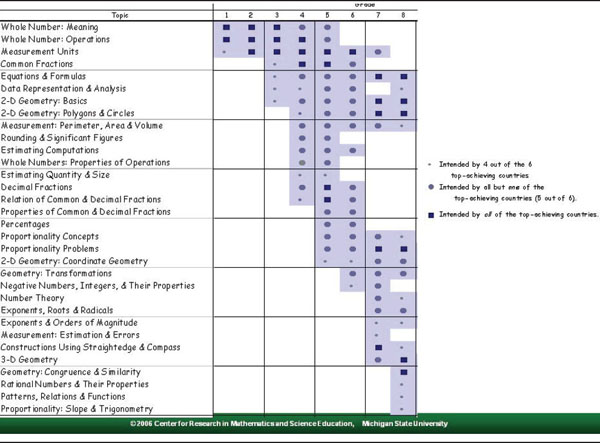
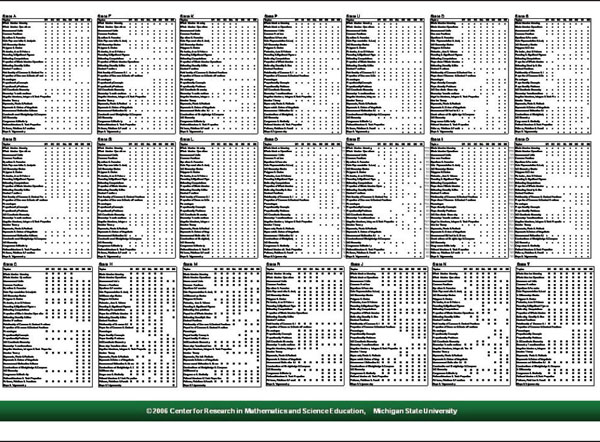
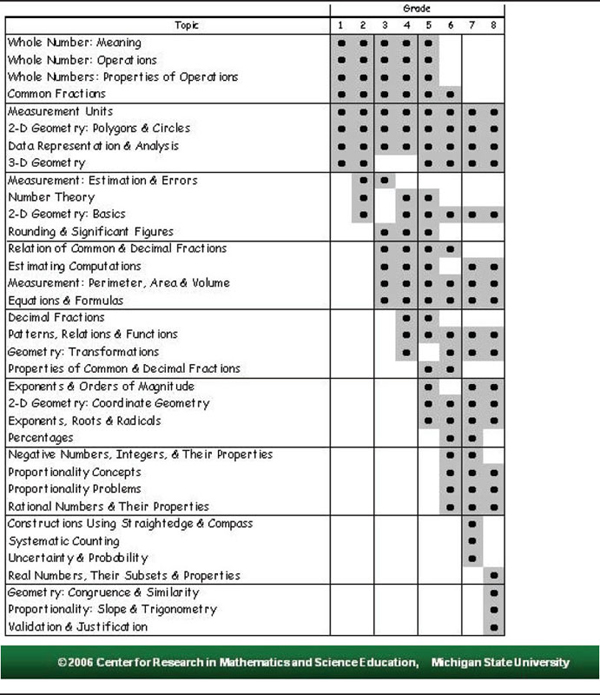
STEM disciplines have a logical structure, he added. Mathematics is very hierarchical, with concepts that build cumulatively. Knowledge in the science disciplines is less hierarchical, but there is still a logical structure that defines the bodies of knowledge. That structure should guide the mapping of topics for school curricula, he observed, so that students can connect the deeper principles. The countries whose students perform at the highest levels tend to have curricula that are very coherent and focused—that is, they cover a few key topics at each grade from K through 8 and progress in a logical fashion from the most basic concepts to more complex material: see Table 2-2. Curricula in the United States, generally set at the state level, are far less orderly, Schmidt said, as Table 2-3 shows. (This table is a graphic representation of the material covered by these curricula. Because it is large, it is printed at a scale that illustrates patterns in the lack of consistency on the coverage but does not allow readers to discern the text.) However, the Common Core mathematics standards more closely resemble the pattern for the high-performing countries: see Table 2-4.
Table 2-2 also suggests the rigor of the curricula used by top-performing countries with all students, not just those who are already beginning to excel in STEM subjects. By 8th grade, for example, students are learning about congruence, the rational number system, the field theorems, and slope trigonometry. In Schmidt’s view, U.S. non-STEM schools have an obligation to provide equal opportunities for all children: “If there are three 2nd grade classrooms, they all should be covering the same basic content. We shouldn’t be trying to differentiate and allow teachers to make decisions about what content to cover.” In other countries, he added, the teachers do not decide what material to cover: “The pedagogy is their purview,” but content is determined by specialists in curriculum development. In contrast, his research shows wide variations in what is presented in classrooms at the same grade level, as well as in the amounts of time devoted to different topics at the same grade. Schmidt said he is not suggesting that classrooms should be completely uniform, but when coverage of basic arithmetic in grade 2, for example, varies from 20 days to 140 days in a year, as he has found, “You can see that there is something afoul.”
Schmidt also argued that tracking of students in non-STEM schools creates problems. His research has shown that students in schools that offer only one curriculum learn significantly more mathematics than those
TABLE 2-2 Top-Achieving Countries in Mathematics, by Type of Curriculum
SOURCE: Schmidt, Wang, and McKnight (2005). Reprinted with permission from the Taylor & Francis Group.
in schools with multiple tracks, for example. Schools with multiple tracks may in fact perform similarly, on average, but disaggregated results show that while the elite students who are tracked perform at the highest levels, “the kids at the bottom pay the price,” performing at lower levels than their counterparts at nontracked schools.
In Schmidt’s view, another problem is that too many schools and systems rely on textbooks and such materials as science kits to dictate the curriculum. These resources should support the curriculum, but many textbooks in the United States are crammed with material so they can satisfy every customer: he pointed out that U.S. textbooks are, on average, 800 pages long, in comparison with those in other countries, which are 250-300 pages long. Thus, it is a district’s responsibility to reorganize the material to make it coherent and consistent with the standards to which its students are being taught. If all states adopt the Common Core standards, he added, which have been internationally benchmarked and are focused, coherent, and rigorous (see Table 2-4), the result would likely be less tracking and perhaps, eventually, more coherent textbooks. The cur-
TABLE 2-3 Mathematics Curricula of 21 U.S. States
SOURCE: Schmidt (2011). Reprinted with permission.
rent teaching force—another key factor—reflects the deficiencies that have existed in STEM education for some time, Schmidt argued: “We have no standards for teacher preparation and the result is enormous variation.”
Schmidt concluded with insights from research he and colleagues are conducting to identify some primary areas of weakness in elementary and middle schools’ mathematics instruction to see whether there would be improvements if a more coherent curriculum were implemented. Preliminary results of a randomized trial in 60 districts suggest that the revised curriculum did have a significant effect on learning in specific geometry and algebra topics, such as shape relationships and properties; perimeter, area, and volume; and manipulating expressions. His conclusion from these results is that when students are offered a coherent curriculum, taught by teachers who have been trained to implement it, “they will learn.”
USING STATE DATABASES TO IDENTIFY SCHOOL OUTCOMES
This review of school types suggested many factors that may contribute to good outcomes for students. Administrative data collected by states can be used in quantitative analyses that can shed light on the relation-
TABLE 2-4 Common Core Mathematics Standards
SOURCE: Schmidt (2011). Reprinted with permission.
ships between schools’ practices and policies and STEM outcomes for students. Michael Hansen described preliminary research he is conducting at the Urban Institute’s Center for the Analysis of Longitudinal Data in Education Research with data from Florida and North Carolina. He emphasized that this research is still in progress and that the preliminary exploratory analysis does not support causal inferences.
For Florida, the data available to Hansen included end-of-grade reading and mathematics scores for public school students in grades 3-10 and counts of courses taken in core STEM subjects, advanced STEM, and vocational and technical education, for the school years 2004-2005 through 2008-2009; for North Carolina the same data were available for 2005-2006 through 2008-2009, as well as end-of-course scores.
Looking first at Florida, he noted a few apparent baseline differences
among school types (traditional, STEM, and charter or magnet).10 For example, STEM schools appear to have more new teachers (26 percent, as compared with 21 percent for traditional schools and 23 percent for the charter and magnet schools). STEM schools also are significantly more likely to offer vocational and technical courses (41 percent, compared with 18 and 19 percent for the other types, respectively). At the same time, students in STEM-focused schools take more advanced courses, as might be expected. Hansen was particularly interested in whether expanding access to STEM instruction generally would mean decreased opportunities for high-achieving students, and whether intense focus on STEM for all students would crowd out learning in other subjects. His early findings suggest the possibility that the availability of more advanced courses may tend to push marginal students into lower-track courses. He and his colleagues did not find any negative effects for achievement in reading when more STEM courses were offered.
Hansen also explored whether students in underrepresented minority groups respond differently to variation in STEM opportunities, and, more broadly, whether current approaches are improving STEM outcomes for all students or just those already interested in STEM. His results suggested that when more advanced courses are offered, there is a “pretty strong negative effect” on students who are members of underrepresented minority groups. In other words, “there appears to be a tradeoff” between helping students who are already doing well in STEM subjects and expanding access for all students. The data also suggest benefit from opportunities to conduct research projects in science and from exposure to instruction that was project-based rather than lecture-based. From the preliminary data, Hansen suggested that it appears that teacher characteristics, such as years of experience, are correlated with outcomes for students. From these findings, Hansen concluded that it is important for policy makers to be precise about their goals for STEM education and to focus on specific attributes. But, he added, “we are just beginning to scratch the surface of these databases.”
________________
10For definitions of these school types, see Hansen (2011).


