
4
Scientific Accomplishments: Earth’s Climate History
Scientific ocean drilling has revolutionized studies of Earth’s climate system and has produced the most important geological archives of global climate history. Combining scientific ocean drilling results from a wide array of geological settings and geographical regions has transformed scientific understanding of the patterns and processes of past climate change, providing records of natural variability against which present and future climate change can be assessed. Deep Sea Drilling Project (DSDP), Ocean Drilling Program (ODP), and Integrated Ocean Drilling Program (IODP) expeditions have focused on many aspects of environmental processes and change, including global-scale orbital climate forcing; processes and thresholds of Northern Hemisphere and Antarctic glaciations and global sea level change; abrupt millennial-scale climate change; and past global warmth and extreme climate events.
Although paleoclimate data from scientific ocean drilling have lower resolution and sometimes lower precision than modern meteorological data, they extend over longer periods of time and provide information regarding various climate states, their stability, and impacts on other Earth systems. Innovations in piston coring technology during DSDP and ODP led to recovery of high-quality and high-resolution sediment cores. One of these innovations was double- and triple-coring sediments at the same site, which allowed for splicing cores together through biostratigraphy and matching physical properties, creating longer, continuous records. These composite records have created a more complete and detailed account of past changes in the ocean environment on annual to orbital (10 to 100 kyr) time scales, providing new insights into ocean-atmosphere, ocean-cryosphere, and ocean-biosphere interactions (ODP, 2007). Progressively higher resolution, better dated sediment records have led to reconstructions of atmospheric carbon dioxide (CO2) concentrations for the past 60 myr (Royer, 2006); Cenozoic history of ice sheets (Zachos et al., 1992; Ehrmann, 1998; Backman and Moran, 2009); sea surface temperature (Huber, 2008; Bijl et al., 2009); and ocean bottom temperatures (Triapati and Elderfield, 2005). Cores from scientific ocean drilling have tied together marine and continental records, further constraining the timing of significant events in global climate history.
As their length and quality have improved, scientific ocean drilling records have strongly contributed to the understanding of dramatic and continuous change in Earth’s climate system over the past ~100 myr, from extremes of expansive warmth with ice-free poles to massive continental ice sheets and polar ice caps. Significantly, these records of millions to tens of millions of years ago provide critical insights into environmental changes when atmospheric CO2 levels were similar to or higher than today. The identification of orbital cycles that drive repeated cycles of polar ice sheet growth and collapse and global sea level fluctuations of up to 120 m (e.g., Chappell et al., 1996) remains one of the most fundamental discoveries of scientific ocean drilling.
The geological record below the seafloor extends beyond instrumental and ice core records for tens of millions of years, when Earth’s climate was warmer than the present. Because of this, scientific ocean drilling records provide important context for assessing future climate change. Over the past decade, there have been moves toward the integration of ocean core proxy data that act as tracers of past climate (Box 4.1; Figure 4.1) and the use of numerical ice sheet and climate models to predict future climates. Past warm periods such as the Pliocene (5.3-2.6 Ma) and Eocene epochs (55-33.9 Ma) offer more realistic future climate analogs, which scientists can use to improve model performance, gaining better understanding of Earth system responses to elevated greenhouse gas levels.
Box 4.1
Proxy Records in
Scientic Ocean Drilling
Over the past 40 years, a wide range of climate proxies that measure different components of marine sediments have been developed for use as tracers of past changes in climate and ocean circulation. These proxies include variations in plant and animal species abundances, which track past changes in environmental conditions at a specific location, as well as evolutionary distributions of fossils, which provide important age control and stratigraphic markers for correlation. Isotopic and geochemical measurements of fossil shell material provide information on past oceanographic conditions (e.g., temperature, salinity), past ocean chemistry (e.g., pH, carbonate ion concentration, deepwater mass circulation), and the concentration of paleo-atmospheric CO2 (boron isotopes and boron-calcium ratios). More recently, chemical measurements of fossil organic compounds have been developed to reconstruct sea surface temperatures (e.g., alkenone saturation ratios, long-chain tetraethers), partial pressure of CO2 (pCO2; e.g., alkenone isotopic chemistry), and hydrology (e.g., leaf wax biomarkers such as compound specific deuterium measurements on alkanes).
A number of proxies are now well established and routinely applied (e.g., stable oxygen and carbon isotopic ratios of foraminiferal calcite), while others are still in a more developmental state. All proxies must deal with various levels of associated uncertainty due to a lack of knowledge regarding precise relationships between the proxy and the environmental characteristic being measured (e.g., some pCO2 and sea surface temperature proxies), particularly when applied to older sediments. Nevertheless, as laboratory studies continue and calibrations improve, there has been significant convergence between different proxies used to estimate temperature and pCO2 (e.g., Beerling and Royer, 2011). This explosive growth in the number, type, and utility of proxies has led to a significantly better understanding of past global environmental conditions. The combination of physical measurements of past temperatures with chemical measurements indicating past atmospheric CO2 concentrations has been particularly valuable for understanding the sensitivity of the climate svstem to CO2 forcing.
PAST WARM CLIMATE EXTREMES AND THE GREENHOUSE WORLD
The reconstruction of Cenozoic surface temperature distributions and their relationship to changes in atmospheric CO2 concentrations have been among the most important contributions of scientific ocean drilling to paleoclimate studies. Climates prior to 3 myr (particularly the past 65 myr) were generally warmer than today, and were associated with higher pCO2 levels. Reconstructions show a long-term decrease in global average temperatures, from a maximum of about 26 °C in the early Eocene Epoch (~ 50 Ma) to a pre-industrial Holocene average value of 14 °C. This pattern of global cooling is associated with declining pCO2 levels, from 2,000-4,000 ppm range in the Paleocene and Eocene to less than 400 ppm by ~24 myr (Pearson and Palmer, 2000; Pagani et al., 2005b; Beerling and Royer, 2011). Studying warm climate extremes recorded in ocean sediments enable new insights into Earth system responses to elevated greenhouse gas levels.
Scientific Accomplishments and Significance
Scientific ocean drilling has significantly contributed to the recognition and quantification of latitudinal differences in temperature in response to pCO2 (Figure 4.1) and other high-latitude Earth system feedbacks (e.g., sea ice albedo) that can lead to polar temperature amplification (e.g., Dowsett, 2007; Huber, 2008; Bijl, 2009). Sea surface temperatures reconstructed from globally distributed drill cores have demonstrated that the early Eocene (55-48 Ma) had the warmest climates of the past 65 myr, depicting a world that was ~10-12 °C warmer and with greatly reduced latitudinal temperature gradients compared with the present day (Bijl et al., 2009; see Figure 4.1).
Cores recovered from the Arctic (ODP Legs 151, 163; IODP Leg 302; Figure 4.2a) and the Antarctic (ODP Legs 113, 119, 120, 188, 189; IODP Leg 318; Figure 4.2b) indicate that polar regions of the greenhouse world could support only small terrestrial ice sheets, or had limited perennial sea ice (Moran et al., 2006; Stickley et al., 2009). This finding implies global sea levels more than 60 m higher than the present, when atmospheric CO2 levels may have been as high as 2,000-4,000 ppm (Pagani et al., 2005b; also discussed in the following section).
Observations of past warm extremes are important for evaluating the performance of climate models in response to higher levels of pCO2 (Huber and Caballero, 2011, and references therein). Although amplification of polar warming during the past warm periods appears to be underestimated by the current generation of climate models, the sensitivity of past tropical temperatures is generally overestimated relative to proxy-based temperatures from scientific ocean drilling. Comparisons between models and paleoenvironmental observations from drill cores play an important role in evaluating the performance of Intergovernmental Panel on Climate Change (IPCC) climate models that simulate warmer global climates.
A key discovery of the Paleocene-Eocene greenhouse world (55-50 myr) was the potential of the climate system
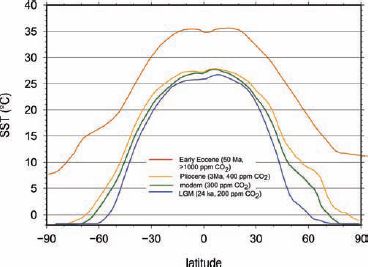
FIGURE 4.1 Latitudinal variations in climate sensitivity, derived from scientific ocean drilling results. These variations consistently show that the effect of higher carbon dioxide on sea surface temperature, and thus air temperature, increases towards the poles. SOURCE: Adapted from Bijl et al. (2009), with additional data from Paul and Shafer-Neth (2003) and Dowsett (2007).
to experience abrupt and transient temperature excursions occurring within 1 to 10 kyr, termed “hyperthermals” (Bohaty and Zachos, 2003; Zachos et al., 2005). These hyperthermals had warming of several degrees C, indicated by changes in oxygen isotope (δ18O) and Mg/Ca records (Kennett and Stott, 1991; Zachos et al., 2003; Tripati and Elderfield, 2005). The first and largest of the hyperthermals was the Paleocene-Eocene Thermal Maximum (PETM; Box 4.2) at 55.8 Ma, which lasted for approximately 100 kyr.
One of the most important high CO2 analogs studied in ocean sediment cores is the Early Pliocene Epoch (5.3 to 2.6 Ma), when continental and ocean configurations, ecosystems, and ice sheet extent were similar to today. Proxy estimates from sediment cores in a range of ocean basins indicate peak Pliocene values that are comparable to present day values of 379 ppm (IPCC, 2007). Although the high latitudes were significantly warmer, tropical sea surface and air temperatures were similar to the present (e.g., Dowsett, 2007). Drill core data (Raymo et al., 2006; Naish et al., 2009) and ice sheet simulations (Pollard and DeConto, 2009) show complete deglaciation of the Greenland and West Antarctic ice sheets and the low elevation margins of the East Antarctic ice sheet, with global sea levels up to 20 m higher than the present (Miller et al., 2011; Raymo et al., 2011).
Other regional phenomena, such as a permanent El Niño-like state in the tropical Pacific during the Pliocene, can be inferred from sediment core proxy data. In conjunction with climate models, they imply drought and a potential collapse of the Asian Monsoon, increased eastern Pacific precipitation, and increased cyclonic activity (e.g., Brierley and Fedorov, 2010; Fedorov et al., 2010; Ravelo et al., 2010). Observations such as these, from the last time global atmospheric pCO2 levels approached ~400 ppm, may provide an analog for assessing the range of future equatorial climate changes due to anthropogenic warming.
Fields of Inquiry Enabled
Scientific ocean drilling has enabled scientists to extend the relationship between atmospheric pCO2 and global surface temperature by millions to tens of millions of years, confirming significantly warmer than present climate extremes that are increasingly relevant to future climate projections. The importance of past climate information was acknowledged in the IPCC’s Fourth Assessment Report (IPCC, 2007), when it introduced a chapter on paleoclimate archives. As the quality and global coverage of pCO2 and temperature proxies from ocean sediments steadily improve, the IPCC’s Fifth Assessment Report (IPCC, in preparation) will place increased emphasis on these observations to verify the performance of climate models during warm extreme intervals.
Cores recovered from scientific ocean drilling have enabled improved estimates of Earth’s climate sensitivity to sustained higher levels of greenhouse gases and to dramatic transient perturbations to the carbon cycle (including ocean acidification). These data have also determined the sensitivity of ice sheets to elevated greenhouse gas concentrations (discussed in more detail in the following section), including greater insight into the processes that lead to temperature amplification in polar regions. Finally, the integration of observations of physical and chemical processes elucidated by drilling records is critical for the next generation of climate models.
Goals Not Yet Accomplished
In a prior review of ODP, the NRC (1992) recommended that the understanding of past climates, especially of rates and magnitudes of climate variability, should be improved. This recommendation was translated into a scientific priority for the IODP Initial Science Plan (IODP, 2001), and expectations in this field have largely been met. In some aspects, such as resolution of past climate extremes, the outcome has possibly exceeded the goals set forth by the plan. However, there is still progress to be made.
Spatial coverage of ocean records of past extreme warm intervals is biased toward the North Atlantic and East Pacific, leaving large swaths of the ocean floor to be sampled. Consequently, sea surface temperature datasets for these times (e.g., Pliocene, Eocene) are inadequate for the robust data-model comparison needed to better constrain future climate projections and understand regional climate variability. The polar regions presently experience temperature increases that are two to three times greater than the global average (Holland and Bitz, 2003; Bijl et al., 2009; Miller et al., 2010), yet the mechanisms and feedbacks are poorly understood, as
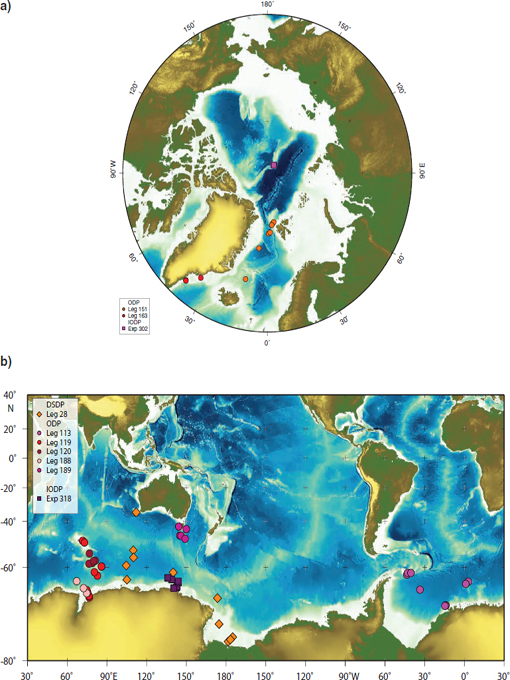
FIGURE 4.2 Location maps of DSDP, ODP, and IODP expeditions in polar regions that were related to past climate extremes. (a) Illustrates the Arctic using a stereographic projection. (b) Illustrates the Antarctic using a Mercator projection. Both have a color range of -9,000 to 9,000 m, with white marking the 0 m depth. SOURCE: IODP-USIO.
Box 4.2
The Paleocene-Eocene Thermal Maximum
Observations of an extreme change in the carbon chemistry of fossils at 55.8 myr suggest that Earth experienced a sudden release of carbon into the atmosphere, followed by a rapid 4 to 8 °C increase in global temperature. This is the best past analog of rapid changes in atmospheric CO2 so far observed in the geologic record. Kennett and Stott (1991) discovered a large Cenozic carbon isotopic (δ13C) excursion at the Paleocene-Eocene boundary, in core from ODP Hole 690B. A 35-50 percent species reduction of benthic foraminiferal taxa was associated with the enrichment of light carbon and a δ18O excursion interpreted as reflecting a > 4-8 °C abrupt increase in surface water temperatures. This event was termed the Paleocene-Eocene Thermal Maximum (PETM). Study of these cores established the onset of the warming event as taking on the order of 1 kyr and lasting over ~130-190 kyr (Kelly et al., 1996; Bralower et al., 1997; Roehl et al., 2000).
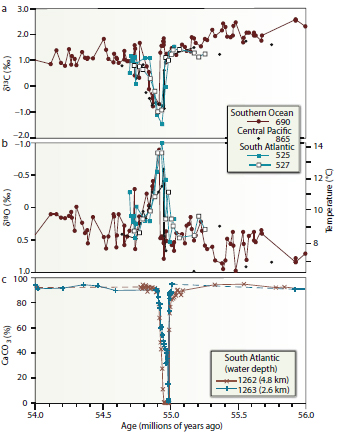
Paleocene-Eocene Thermal Maximum, as recorded in oceanic benthic isotopic records from Antarctic, south Atlantic, and Pacific Ocean drill sites. The rapid decrease in carbon isotope ratios (top panel) indicates a large increase in atmospheric methane and carbon dioxide. This is coincident with 5 °C of global warming (middle panel, presented with oxygen isotope values). Subsequent ocean acidification is indicated by a rapid decrease in the abundance of calcium carbonate (lower panel). SOURCE: Zachos et al., 2008.
Analysis of other scientific ocean drilling cores, such as those from ODP Sites 525, 527, and 865, ODP Leg 208, and IODP Expedition 302 to the Arctic Ocean (Sluijs et al., 2006) showed these excursions were global. Arctic cores recovered by the IODP Arctic Coring Expedition (ACEX) in 2004 reveal that surface temperatures increased from 18 to 23 °C, synchronous with other PETM records. The sudden disruption in the carbon cycle—nearly equivalent to burning modern fossil fuel reserves—produced significant ocean acidification, disrupted the deep ocean ecosystem, and caused significant evolutionary turnover in benthic dwelling foraminifera. Advanced piston coring in 2003 at the Walvis Ridge in the South Atlantic recovered a set of cores that recorded the climate and chemistry changes associated with this event as well as the subsequent, several hundred thousand year recovery of ocean chemistry following the carbon disruption. For the first time it was possible to fully document the size of the carbon perturbation (an initial pulse of 3,000 GT in less than a few thousand years), the response of the surface warming, and the role of the oceans in removing the carbon from the atmosphere and neutralizing the increased pH of the deep sea.
One of the most striking possible explanations for the event is catastrophic and massive ocean floor methane hydrate dissociation triggered by otherwise incremental warming (Dickens et al., 1997b), which could produce abrupt global warming and then later oxidize CH4 to CO2. However, methane derived from heating of organic-rich shales by intrusions of the North Atlantic large igneous province (LIP) provides a plausible alternative (Svensen et al., 2004; see Chapter 2 for a discussion of LIPs).
are implications for ice sheet stability. Polar regions remain woefully undersampled, with only one drilling expedition in the high Arctic Ocean and only a few expeditions in the Antarctic, yet these sparse data points are the basis for many current models of climate responses in polar regions. Improved understanding of the role of the Southern Ocean in the carbon cycle is another priority. Recovering sediment cores from high latitudes presents one of the most important technological challenges for future scientific ocean drilling and will need the innovative use of both mission-specific platforms and the JOIDES Resolution to drill strategic transects. In addition to increased spatial coverage, continued advances in paleoclimatological observations from climate proxies will be needed to provide robust verification of climate models. Achieving this goal will entail close cooperation between the scientific ocean drilling and Earth system modeling communities.
CENOZOIC ICE SHEET EVOLUTION AND GLOBAL SEA LEVEL CHANGE
Changes in global sea level over the past 40 myr reflect the evolution of polar ice sheets from ephemeral, small-medium Antarctic ice sheets (prior to 33.5 myr) to a large Antarctic ice sheet and variably sized Northern Hemisphere continental ice sheets for the past 2.7 myr. Marine sedimentary archives provided by scientific ocean drilling have revolutionized understanding of Earth’s Cenozoic climate system and have imparted new insights into the pattern of behavior of polar ice sheets and their influence on global sea level (Figure 4.3). These studies also have important implications for assessing future sea level rise in a warming world, where uncertainties in sea level projections are large because ice sheet dynamics and climate system behavior during steadily warming conditions are still poorly understood.
Scientific Accomplishments and Significance
Scientific ocean drilling has played an integral role in understanding the transition from a greenhouse to “icehouse” climate system with the onset of Antarctic glaciation 33 myr ago, at the Eocene-Oligocene boundary. In 1973, DSDP Leg 28 drilled on the Antarctic continental shelf in the Ross Sea, providing the first physical evidence of continental glaciation extending back into the Oligocene (Hayes et al., 1975) and dispelling the then-prevailing hypothesis that Antarctica had only been extensively glaciated since the beginning of the Quaternary (2.588 myr). Drilling of continental shelf sites in Prydz Bay (ODP Leg 119) provided the first direct evidence of continental-scale ice sheets calving at the Antarctic coastline (Hambrey et al., 1991), and ice-rafted debris collected at the Kerguelen Plateau (ODP Leg 120) offered further confirmation of glaciation at the Eocene-Oligocene boundary (Wise et al., 1991; Zachos et al., 1992). These same cores indicated that the Antarctic ice sheet grew quickly (within a few tens of thousands of years) and caused at least a 60 m global sea level fall (Zachos et al., 1996). Coring of thick, continuous Paleogene sediments in the Weddell Sea (ODP Leg 113) led to the idea that thermal isolation due to the separation of South America and Australia from Antarctica initiated ice sheet development. However, more recent numerical model simulations imply that a threshold in declining pCO2 was the first-order control on Antarctic glaciations (DeConto and Pollard, 2003; Huber et al., 2004).
High-resolution δ18O records from the Southern Ocean (ODP Site 1090) and the equatorial Pacific (ODP Site 1218) illustrate Antarctic ice sheet behavior during the Oligocene and early Miocene early icehouse world (33-15 Ma; e.g., Pälike et al., 2006). Glacial-interglacial ice volume changes equivalent to 10-40 m of global sea level change were driven by a pervasive 40,000-year orbital forcing, with major glacial events occurring every 1-2 million years. The first physical evidence for orbitally paced variability in the East Antarctic Ice Sheet during the Oligocene and Miocene came from sea ice—based drill cores (e.g., the Antarctic Geological Drilling program [ANDRILL]1; Naish et al., 2001), which confirmed climatic patterns observed in global ice volume proxy records from scientific ocean drilling oxygen isotope records (e.g., ODP Leg 120, Zachos et al., 1996; ODP Leg 154, Zachos et al., 2001b; ODP Leg 199, Pälike et al., 2006). Integrating data from ice-based and ODP cores demonstrated that under warmer climates the Antarctic ice sheets were less stable than today.
Unlike the Antarctic, a detailed, relatively continuous ocean sediment record of the Arctic’s glacial history was unavailable until the mid-2000s, when an astute strategy combining icebreakers and drillships succeeded in recovering the first direct evidence for Cenozoic climate change from this region (ACEX; e.g., Moran et al., 2006). The ACEX cores captured a 55 million year long history of the central Arctic Ocean, including the transition from a warm greenhouse world during the late Paleocene and early Eocene (Brinkhuis et al., 2006; Slujis et al., 2006) to a colder icehouse world influenced by sea ice (Stickley et al., 2009) and apparent sparse icebergs (Eldrett et al., 2007) from the middle Eocene to the present.
In the Northern Hemisphere, the interval from 3.0 to 2.5 myr ago is marked by the progressive expansion of continental ice and global cooling, which initiated a pattern of glacial-interglacial cycles controlled by long-term periodic variations in Earth’s orbit. A major increase in understanding these variations came from DSDP Leg 81, which recovered an almost continuous sediment record from Site 552 in the high-latitude Atlantic Ocean using the newly employed hydraulic piston corer. At this site, Shackleton et al. (1984) were able to show that positive excursions in δ18O correlated with the influx of ice-rafted debris—indisputable evidence for nearby continental ice sheets. They established the first
______________
1 See http://www.andrill.org.
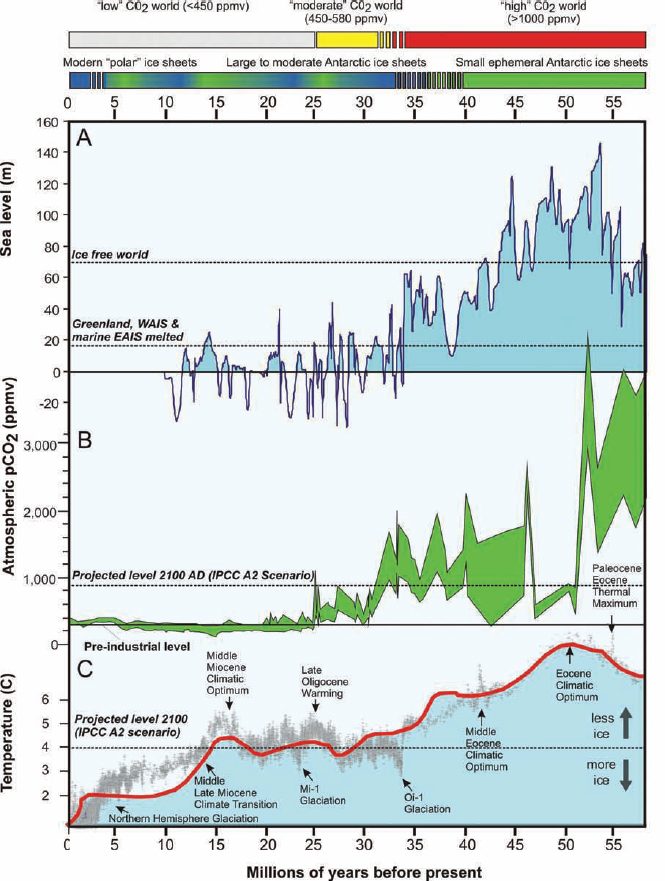
FIGURE 4.3 Illustration of three major contributions to Cenozoic climate studies from scientific ocean drilling. The composite datasets used in the figure were generated from analysis of scientific ocean drilling sediment cores. (A) Global sea level curve from continental margin cores, which represent changes in sea level in response to polar ice volume fluctuation (e.g., Miller et al., 2005; Kominz et al., 2008). (B) Atmospheric CO2 concentrations reconstructed from organic biomarkers and foraminifera preserved in ocean sediments (Pearson and Palmer, 2000; Pagani et al., 2005b). (C) Global atmospheric temperature curve (bold red line) adapted from Crowley and Kim (1995) overlaid on compiled benthic δ18O data representing global ice volume and deep ocean temperature (Zachos et al., 2001a). Major periods of warmth and transitions to cooler climate are also presented. SOURCE: Modified from R. Levy, GNS Science.
age for onset of major continental glaciations (~2.5 myr ago), based on observations that only small amounts of ice-rafted debris were found in the cores before this time. Subsequently, drill cores from the equatorial Atlantic (DSDP Leg 94; ODP Leg 108) and North Pacific (ODP Leg 145) refined this date to 2.7 myr ago (Ruddiman et al., 1986; Haug et al., 1999, 2005).
Drilling of passive continental margins has provided a detailed 100 myr long history of global sea level change (e.g., Miller et al., 1996, 1998, 2005; Kominz et al., 2008). As part of an integrated study of the passive continental margin, ODP drilled a transect across New Jersey that extended from offshore to onshore. ODP Legs 150,174A, and 150X/174AX sampled the slope, outer shelf, and onshore, respectively; dated unconformities produced during sea level fall; and correlated them to increases in δ18O values indicative of periods of polar ice volume growth. More than 30 oscillations in global sea level during the Oligocene and Miocene (33-6 Ma) were identified, proving the validity of the oxygen isotope curve as a proxy for changes in global ice volume (Miller et al., 1998). Stratigraphic patterns (e.g., unconformities, bedding geometries) in the New Jersey siliciclastic basins correspond to scientific ocean drilling cores recovered in carbonate platforms off the margins of Australia (ODP Legs 133, 182, and 194) and the Bahamas (ODP Leg 166), implying a global origin driven by sea level change.
Although early studies of Late Quaternary sea level changes using corals were not done under the auspices of scientific ocean drilling, IODP has recently successfully drilled reefs and shallow water carbonate sequences with mission-specific platforms in Tahiti (IODP Expedition 310; Camoin et al., 2007) and the Great Barrier Reef (IODP Expedition 325). Four transects of the Great Barrier Reef were drilled, with good core recovery of the last glacial cycle. The Tahiti expedition recovered excellent records of the last interglacial global sea level high stand (125 kyr ago) and of the rapid rise in sea level during deglaciation since the last ice age, providing critical constraints on past sea level high stands, the rate of sea level rise (up to 4 m per century; Deschamps et al., 2008), and the potential to fingerprint meltwater sources.
Fields of Inquiry Enabled
Scientific ocean drilling has contributed significantly to understanding the growth of polar ice sheets and the timing of glacial and interglacial cycles in the Northern Hemisphere, as well as their influence on fluctuations in global sea level over the past 100 myr. long-term projections of sea level rise remain highly uncertain, primarily because of poor understanding of the dynamic behavior of ice sheets during sustained warming. Physical records of past ice sheet behavior recovered through scientific ocean drilling have enabled scientists to evaluate the relationship between surface temperature and greenhouse gas concentrations over the full spectrum of climate states, leading to better understanding of thresholds for both Antarctic and Northern Hemisphere glaciation and deglaciation (e.g., DeConto et al., 2008). Consequently, the plausible range of changes in global sea level can be better constrained. In addition, well-dated reconstructions of global sea level rise following the last glaciation, derived from drilling corals, are increasing the ability to identify meltwater sources and rates of sea level rise.
Goals Not Yet Accomplished
Extracting physical records of past polar ice sheet variability and sea level changes will remain a challenge, because it requires integrated onshore and offshore drilling transects on continental margins and core retrieval over multiple time-frames and depositional settings, including difficult drilling environments such as sea ice and unconsolidated sediments. Although IODP mission-specific platforms have begun to address recovery issues, challenges still remain and lead times are long. Increasing the use of logging-while-drilling technology could fill in some of the gaps related to poor core recovery.
Opportunities exist for scientific ocean drilling to build on cooperation with other programs that specialize in drilling on land and in shallow waters (e.g., the International Continental Scientific Drilling Program [ICDP]) and glaciated continental margins (e.g., ANDRILL), especially to address the role of high latitudes in Earth’s climate system. For example, the evidence for ice-rafted debris in ACEX cores has sparked a debate about the existence of continental-scale ice sheets in the Northern Hemisphere prior to 2.7 myr ago (e.g., Eldrett et al., 2007; Tripati et al., 2008; Stickley et al., 2009). Although coupled ice sheet and climate models do not favor significant Northern Hemisphere ice at atmospheric CO2 concentrations above pre-industrial levels (~300 ppm; DeConto et al., 2008), additional long paleoclimate records are critically needed to address these key questions and to provide a better understanding of the climate history of the Arctic.
Understanding the spatial heterogeneity of sea level rise in response to ice mass changes will also be critical for assessing potential regional impacts of rising sea level. Geodynamical models and overlapping sea level records recovered from a range of latitudes in different tectonic and sedimentary settings will be needed to identify the relative contributions of different processes that create a global pattern of sea level change. Scientific ocean drilling will play a critical role in further development of proxies for hydrologic cycles, sea ice coverage, and continental ice volumes.
The study of climate variability due to changes in Earth’s orbit provides one of the best examples of an emerging field of scientific inquiry that blossomed because of scientific
ocean drilling. The earliest observations that glacial-interglacial climate changes at 23, 42, and 100 kyr were paced by changes in Earth’s orbital geometry related to precession, obliquity, and eccentricity (“Milankovitch cycles”) (Shackleton and Opdyke, 1973; Hays et al., 1976) relied on the analysis of conventional short piston cores in relatively low sedimentation rate locations. The advent of hydraulic piston coring (DSDP Leg 64 in 1978) and its first deployment for paleoceanographic studies (DSDP Leg 68 in 1979) produced the first long, undisturbed records of marine sediment from which researchers were able to derive high-resolution records of oxygen isotopic chemistry in a well-dated, independent chronology based on paleomagnetic reversal stratigraphy (see also Chapter 2). The initial records from DSDP Sites 502 and 503 extended the history of marine oxygen isotope variations back to approximately 3.5 myr ago; previous records using traditional piston cores had been limited to observations of the past 1 myr or so. DSDP Leg 81 followed with the striking observation of a significant increase in glacial sediment delivery to the North Atlantic at about 2.5 myr, marking the initiation of Northern Hemisphere glaciation (Shackleton and Hall, 1984). DSDP Leg 94 coring in North Atlantic Sites 607 and 609 quantified the changing nature of the climate system response to orbital forcing, from the evolution of the obliquity-dominated response in the late Pliocene and early Pleistocene to the eccentricity-dominated response in the late Pleistocene. The nature of this change has been well documented elsewhere, but the reasons for the change remain an area of active research.
Based on these early successes, ODP embarked on a global-scale effort (Figure 4.4) to observe and study orbitally forced climate throughout tropical (ODP Leg 108 in the eastern equatorial Atlantic; ODP Leg 117 in the Arabian Sea; ODP Leg 130 in the western equatorial Pacific; ODP Leg 138 in the eastern equatorial Pacific; and ODP Leg 154 in the western equatorial Atlantic) and high-latitude locations of all ocean basins (ODP Leg 145 in the North Pacific; ODP Legs 151, 162, and 172 in the North Atlantic; ODP Leg 177 in the Southern Ocean; ODP Leg 181 in the western South Pacific; ODP Leg 188 in Prydz Bay; and ODP Leg 202 in the eastern South Pacific). This major effort and its successes are easily among the most significant for the scientific ocean drilling community.
Scientific Accomplishments and Significance
The sediments collected by scientific ocean drilling have played a major role in advancing the understanding of orbitally forced climate changes. The very long and highly resolved records provided a means to document the changing effects of orbital forcing as ice sheets grew from modest sizes in the early Pliocene to large, continental-scale glaciers in the late Pliocene (~3 Ma). The response to forcing shifted from obliquity-dominated (41kyr period) to eccentricity-dominated (100-kyr period) about 800 kyr ago (Ruddiman et al., 1986), despite the fact that there were no changes in the characteristics of the orbital variability, and that eccentricity plays only a small role in the amount of energy Earth receives from the sun. Sediments collected by the drilling programs have been used to develop and test models of orbital forcing (Imbrie et al., 1992, 1993; Raymo, 1997; Huybers and Wunsch, 2004; Huybers, 2006) and how the growth of the large ice sheets may have changed the response to the forcing (Raymo and Huybers, 2008). On longer time scales, studies of orbital variability have linked eccentricity forcing at 400-kyr periods with changes in Antarctic ice sheet growth and decay, marine productivity, and carbon burial in the earlier Cenozoic (Pälike et al., 2006). As a result, all known periods of orbital forcing have been documented in the marine records, a feat which would not have been possible without scientific ocean drilling and the development of hydraulic piston coring (more information on piston coring can be found in Box 2.2).
The late Pleistocene records of climate change have also provided important constraints on climate sensitivity—the magnitude of climate change expected from a doubling of atmospheric CO2 concentration (Hansen et al., 2006, 2007)—thus making these records among the most soci-etally relevant accomplishments of scientific ocean drilling and conventional piston coring. Ice core CO2 variations from Vostok and EPICA (European Project for Ice Coring in Antarctica) combined with sea surface temperature variability observed in marine and continental locations provide independent estimates of the sensitivity of climate to changes in atmospheric CO2 concentration. Earlier Cenozoic reconstructions of climate have also been used to constrain climate sensitivity (the Paleocene-Eocene Thermal Maximum, for instance, described in Box 4.2). A low equilibrium sensitivity of warming to greenhouse gas increase is ruled out based on the relationship of glacial-interglacial changes in CO2, the calculated changes in Earth’s energy budget due to orbital variability and albedo changes, and the observed magnitude of climate and ice volume changes. This conclusion would not be possible without the ability to link marine, land-based, and ice core records of climate and CO2.
The development of this understanding of orbital climate variability and its causes has provided a time scale and framework for interpreting scientific results from a wide range of research disciplines. Scientific ocean drilling played a significant role in producing the long time series of marine oxygen isotope variability that was used to modify and constrain the paleomagnetic reversal ages and to develop a revised Astronomical Polarity Time Scale for the Cenozoic (Kent, 1999), thus linking continental- and marine-based research on a common and accurate time scale (see Box 2.2). In the most recent example, Lisiecki and Raymo (2005) correlated a global set of long, marine oxygen isotope records, dominated by the set of advanced piston core sites recovered by ODP in the 1980s and 1990s, to develop a continuous, highly resolved record of oxygen isotope variability and
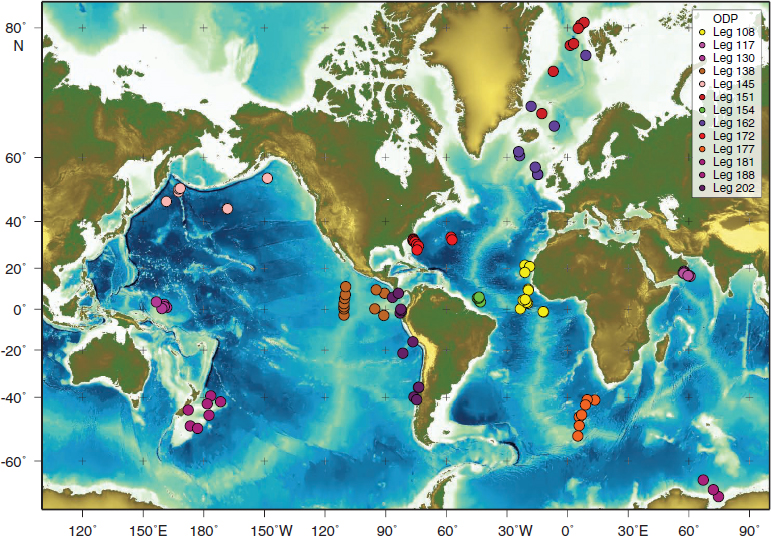
FIGURE 4.4 Location map of ODP legs related to orbital forcing. This is a Mercator projection with a color range of –9,000 to 9,000 m, with white marking the 0 m depth. SOURCE: IODP-USIO.
paleomagnetic reversals (Box 4.3; Figure 4.5). On longer time scales, marine oxygen isotope records and magnetic reversals have been used to refine the Cenozoic chronology for at least the past 40 myr, with refinements to earlier stages still under way. The broad impact of the development of this chronology can be observed in terrestrial-based studies of archeology, anthropology, and climate, including the comparison of major human evolutionary events with changes in climate based on marine oxygen isotope records from ODP sites (e.g., deMenocal, 2011; see section on “Co-evolution of life and the planet” at the end of this chapter).
Fields of Inquiry Enabled
The development of the Astronomical Polarity Time Scale for the Cenozoic has had widespread impact throughout the geosciences, influencing research in paleoclimate studies, archeology, anthropology, and astronomy. The combined sets of proxy records from terrestrial and marine sections of physical (temperature, rainfall) and biogeochemical (carbon isotopes, carbonate system proxies like barium and boron) properties have provided new target datasets for testing a variety of coupled climate and biogeochemistry models in ways that cannot be accomplished using the very short records of climate variability in the historical record. The fundamental understanding of how Cenozoic climate evolved has also provided a framework to evaluate the effects of changing climate on evolution, including hominins.
Scientific ocean drilling did not provide the first evidence for orbital forcing of climate, but without the development of long, continuous, undisturbed sedimentary sections, it is unlikely that the field would have progressed so far in such a short time. Since the late 1970s when orbital forcing was first being observed and quantified using a small number of conventional piston cores, the field has progressed to a much broader understanding and a high degree of confidence in the scale of the forcing and changes in the climate system response. The successes have largely been based on high-resolution data collected from long, continuous hydraulic piston cores. A major outcome of scientific ocean drilling is the understanding of the pervasiveness of orbital forcing on climate change. The study of orbitally forced changes in cli-
mate using marine sediments also provides a great example of what can occur when a field that is ready for explosive growth meets up with a tool (the hydraulic piston corer) that is nearly perfectly suited for the task.
Goals Not Yet Accomplished
There are still unresolved issues about how small, orbitally controlled changes in the total amount of energy received from the sun are amplified by feedbacks within the climate system to cause the large Earth system responses seen during ice ages. In the most recent deglaciation, variations in Earth’s orbit led to a rapid increase in global average temperature, a sharp rise in atmospheric CO2, polar ice sheet collapse, and a rise in global sea level. A better understanding of how these systems interacted will provide important insight into coupling between the atmosphere, ocean, and ice sheets. Scientific ocean drilling will continue to play a major role in furthering these research activities. The progress during the past several decades in this field of inquiry has been remarkable and highly influential, with many major new insights still on the horizon.
At ODP’s advent in the early 1980s, the main focus of its climate research was orbital variability because so little was known about millennial-scale climate variability. In the mid-1980s, the observation that Greenland ice cores recorded rapid, abrupt changes in air temperature on millennial time scales, also known as Dansgaard-Oeschger events, led to interest in determining the causes of these changes and in finding similar records in marine sediments and continental climate archives. Because there was no known external forcing on these time scales, the principal hypothesis to explain the abrupt climate changes centered on coupled ocean-atmospheric interactions (Broecker et al., 1992), and rapid changes in North Atlantic overturning circulation became a major research focus for the paleoceanographic research community. Sampling of legacy cores from prior scientific ocean drilling expeditions greatly facilitated the understanding of changes in the North Atlantic region and associated far field climate effects. Although not included in earlier scientific ocean drilling planning documents, short period climate was listed as a research priority in the ODP Long Range Plan (ODP, 1990); the first legs dedicated to climate variability on millennial or shorter time scales began in 1995. Later expeditions included locations around the globe (e.g., ODP Leg 162: North Atlantic-Arctic Gateways; ODP Leg 167: California Margin; ODP Leg 169: Saanich Inlet; ODP Leg 172: Northwest Atlantic Sediment Drifts; ODP Leg 202: Southeast Pacific Paleoceanographic transects; IODP Legs 303 and 306: North Atlantic Climate I and II; and IODP Leg 323: Bering Sea Paleoceanography).
Box 4.3
Developments in Coring Technology
and Core Recovery
The past four decades of scientific ocean drilling have led to great contributions in riserless deep-water drilling technology, which have significantly improved core quality and extended the amount of core that can be recovered during drilling. Early cor-ing with the Glomar Challenger during DSDP mainly used a four cone commercial industry bit. With this bit, core recoveries were low to moderate, and many of the cores were highly disturbed. The more modern JOIDES Resolution helped to increase the overall core recovery and revolutionized deepwater coring practices (see white papers from Dennis Kent and Ted Moore, Appendix C). Innovations in piston coring technology during DSDP, later advanced by ODR led to recovery of high-quality cores in soft to medium-soft formations (Larson etal., 1980;Gelfgat et al., 1994).
A major technological advance in core recovery occurred when DSDP Site 607 in the North Atlantic was double-cored with the newly developed hydraulic piston corer (see Box 2.2). The cores were then correlated to fill in gaps caused by loss of core material from ship heaving (Ruddiman et al., 1986). Piston cores are now routinely double- and triple-cored and spliced together on the basis of matching continuous logs of physical properties recorded on board the ship to produce a composite depth record. ODR and later IODP, also evolved wireline coring techniques that permitted deeper penetrations into medium to hard formations (Storms, 1990). The scientific ocean drilling programs worked with industry to innovate better coring bits that would have longer life and provide less disturbed cores. One breakthrough was the extended core barrel for drilling harder sediments, which combined piston coring with a follow-up rotary coring bit (Brewer et al., 2005). In conjunction with Schlumberger, IODP also developed logging-while-coring systems that measure gamma rays, resistivity, and full bore resistivity images (Goldberg et al., 2004).
DSDP, ODR and IODP achieved these technological advancements with limited development budgets, especially when compared to the research and development budgets of the commercial offshore drilling industry.
Scientific Accomplishments and Significance
In a series of important contributions, Bond et al. (1992, 1993) used legacy cores from DSDP Site 609 to develop a comprehensive record of ice-rafted debris for the North Atlantic, identifying major ice-rafted debris events
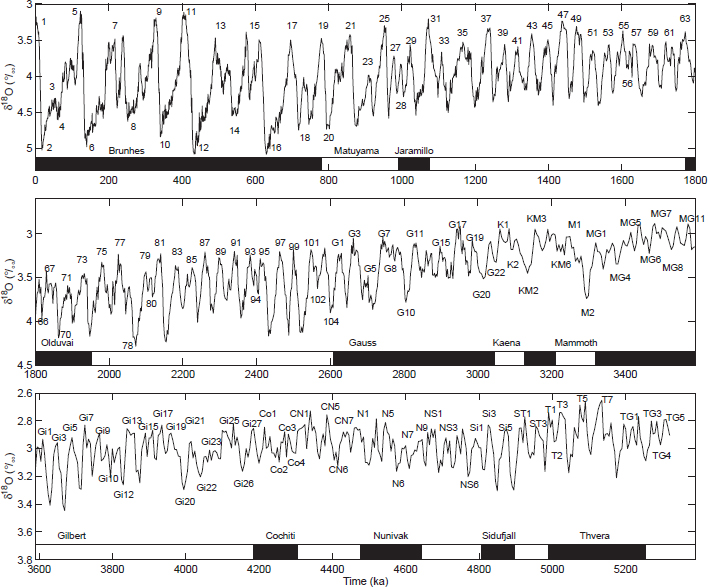
FIGURE 4.5 The marine oxygen isotope and paleomagnetic record for the past 5 myr. SOURCE: Lisiecki and Raymo, 2005. Reproduced by permission of American Geophysical Union.
(Heinrich events) as well-higher frequency changes that correlated with the abrupt air temperature swings observed in Greenland. The close coupling between air temperature and ice-rafted debris strongly suggested that changes in North Atlantic Ocean overturning circulation were related to rapid changes in Greenland air temperatures. McManus et al. (1994) extended the ice-rafted debris record at the same site (DSDP Site 609) through the interglacial period 120 kyr ago, demonstrating that millennial variability was not limited to the glacial climate. At ODP Site 980, McManus et al. (1999) documented pervasive millennial-scale delivery of ice-rafted debris over the last 500 kyr, commencing when Northern Hemisphere continental glaciers reached approximately 50 percent of their maximum size. Raymo et al. (1998) observed millennial-scale fluctuations in the early Pleistocene at ODP Site 983, while McIntyre et al. (2001) found 2 to 5 kyr spacing of ice-rafted debris events in the late Pliocene at the same site, proving that millennial climate fluctuations are found not only in the eccentricity-dominated interval of the late Pleistocene but also in the obliquity-dominated interval of the Pliocene and early Pleistocene.
Scientific ocean drilling also played a major role in understanding the far-field effects of North Atlantic changes at this time by acquiring cores from sites with high sedimentation rates. The Santa Barbara Basin (ODP Site 893) provided evidence that interstadial-stadial fluctuations also occurred in the eastern Pacific (Hendy and Kennett, 1999), with colder intervals (stadials) associated with increased ventilation of the intermediate-depth eastern Pacific (Behl and Kennett, 1996). Cariaco Basin (Site 1002) cores recorded abrupt changes in sediment chemistry and lithology, which, in parallel with the Greenland air temperature record (Figure 4.6), reflected past changes in evaporation and precipitation over northern South America (Peterson et al., 2000a). These
observed changes have been attributed to the migration of the Intertropical Convergence Zone. Combined with other observations of millennial-scale climate fluctuations in the Mediterranean region (ODP Site 977: Martrat et al., 2004) and other continental locations (e.g., Hulu Cave speleothem record [Wang et al., 2001]), the synchroneity of millennial-scale climate changes implies that ocean-atmosphere reorganizations happen quickly and have widespread impact on temperature and moisture patterns in and beyond much of the Northern Hemisphere.
Fields of Inquiry Enabled
Rapid advances in understanding the coupled nature of atmosphere-ocean circulation occurred through comparison of the observational data of abrupt climate change patterns (many derived from scientific ocean drilling records) with the results of high-resolution numerical model simulations of the coupled ocean-atmosphere system. Observations of rapid climate changes in Greenland ice cores and in North Atlantic sediments were quickly confirmed in other continental records, and the patterns were reproduced by coupled ocean-atmosphere simulations of North Atlantic overturning and its response to variations in freshwater forcing. Marine and continental records from tropical locations documented latitudinal shifts in the position of the Intertropical Convergence Zone (Peterson et al., 2000b) forced by changes in North Atlantic surface temperature gradients (Vellinga and Wood, 2002).
Coupled ocean-atmosphere models demonstrate that abrupt reductions in the salinity of the North Atlantic reduce the meridional overturning circulation and cool North Atlantic air temperatures (Manabe and Stouffer, 1997). Temperature and ice rafting patterns in the North Atlantic exhibit this same variability. During periods of higher ice-rafted debris input and greater freshwater delivery into the North Atlantic, colder air temperatures prevailed over Greenland and colder sea surface temperatures were found in the high-latitude North Atlantic. Benthic foraminiferal records also showed that ventilation of the deep North Atlantic Ocean was significantly reduced (Oppo and Lehman, 1995), helping to establish strong coupling between ice sheets, atmospheric circulation, and ocean overturning.
These combined model-data investigations have been instrumental in showing strong coupling of freshwater input and reduced meridional overturning in the North Atlantic, widespread cooling in the circum-North Atlantic region, and perturbation of atmospheric circulation in the tropics and monsoonal regions of southern Asia. The close match between numerical simulations and observations from drill cores provide some of the best independent confirmation of climate model reliability.
Goals Not Yet Accomplished
Although this area of inquiry has grown quickly, many unanswered research questions remain. The origin of climate variability on millennial scales remains elusive, and there is
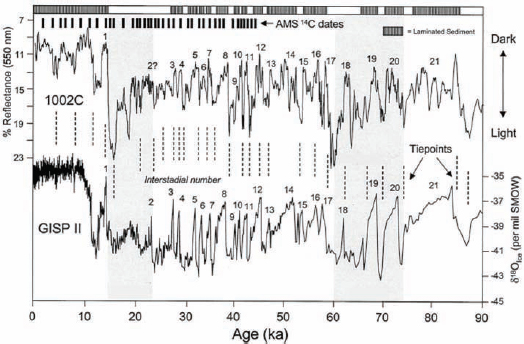
FIGURE 4.6 Comparison of measured color reflectance (550 nm) of Cariaco Basin sediments from ODP Hole 1002C to oxygen isotope composition (δ18O) from the Greenland Ice Sheet Project (GISP) II ice core (Stuiver and Grootes, 2000). Laminated sediments with benthic microfauna (along top) indicate that deposition occurred under anoxic conditions. Deposition of dark sediments occured during warm in-terglacial/interstadial times, and deposition of light-colored bioturbated sediments occurred during colder stadial intervals. Visual tiepoints (denoted by a dashed line) show correlations between cores. SOURCE: Modified from Peterson et al., 2000b.
still significant debate about potential causes. Although there is a close correlation between rapid climate change and North Atlantic overturning, it is not yet known if the North Atlantic is the cause or a response to external drivers (Broecker et al., 1990; Kleiven et al., 2010; Billups et al., 2011).
The selection of sites with appropriate sedimentation rates has lacked geographic coverage and is strongly biased toward the North Atlantic. Many of the legacy cores are from locations that were originally chosen for study of orbital-scale climate variability and thus often have sedimentation rates that are too low for abrupt climate change studies. High-resolution studies of millennial-scale climate variability are likely to remain an important priority for scientific ocean drilling for another decade or more.
CO-EVOLUTION OF LIFE AND THE PLANET
A fundamental distinguishing feature of Earth is the presence of life that modifies planetary processes, including the composition and properties of the atmosphere, hydrosphere, and lithosphere. The ~70 percent of the planet that is covered with oceans is both a living reactor of Earth system processes and a repository for the ocean floor sediments that record changes in oceanic life. Scientific ocean drilling is the best way to access this record in its most pristine form, where it is accessible with minimal alteration and provides the potential to obtain a full history of ocean sediments and the processes active in and on them.
Scientific ocean drilling results, integrated with onshore efforts, have led to radically new concepts of the relationships between evolution and extinction in the context of climate forcing (such as the PETM), many of which have direct societal relevance. Others are scientifically compelling, such as the Chixulub impact and its timing relative to the Cretaceous-Tertiary boundary. For the most part, the ocean floor record extends back well into the Jurassic, with progressively larger areas covered by younger sediments that have been proportionally more densely sampled. Scientific ocean drilling to advance the knowledge of co-evolution of life and the planet has been highlighted as a priority in ODP and IODP planning documents (e.g., IODP, 2001) and past achievements and future needs have been described in recent NRC reports such as The Geological Record of Ecological Dynamics (NRC, 2005) and Understanding Climate’s Influence on Human Evolution (NRC, 2010).
Scientific Accomplishments and Significance
A large proportion of scientific ocean drilling has involved biostratigraphy, as well as organisms that serve as ecological proxies or carriers of chemical proxies of environmental change, or as intrinsically important to basic understanding of life on the planet. Major scientific advancements have been realized in understanding co-evolution of phytoplankton, the atmosphere, and terrestrial ecosystems; the role of giant meteorite impacts on the extinction and evolution of life; the signature of stable isotopic anomalies in relation to global warming events and biological adaptation; and climate change and hominin evolution.
Photosynthesis by marine phytoplankton accounts for about one-half of global primary productivity. As shown in Late Triassic (228 myr ago) to recent records in marine sediments preserved on land and recovered in scientific ocean drilling cores, the nature of the phytoplankton has changed substantially, primarily with major evolutionary radiations and ecological expansions of dinoflagellates, diatoms, and coccolithophores. These changes have directly affected the composition of ocean floor sediments. In one specific example, diatoms alone account for ~40 percent of marine net primary productivity, ~50 percent of carbon export to marine sediment, and about ~20 percent of CO2 drawdown; although their marine appearance has been documented in the Early Cretaceous record at ODP Site 693 (Gersonde and Harwood, 1990), their expansion as a major ecological and biogeochemical force occurred during the early to mid-Cenozoic as documented in ODP and DSDP cores2 (Spencer-Cervato, 1999; Rabosky and Sorhannus, 2009). The temporally parallel rise in diatom productivity and the spread of grasslands have led to a controversial suggestion of a causal link via the silica cycle, which could lower global CO2 as part of a positive feedback system (Johansson, 1996; Conley, 2002; Falkowski et al., 2004). The record of this is carried in marine organisms via alkenone and boron isotopes and other chemical proxies in scientific ocean drilling cores (DSDP Sites 511, 513, 516, 588, 608, 612, 730, and 803; ODP 865, 871, and 872 [e.g., Pearson and Palmer, 2000; Pagani et al., 2005b]).
The discovery of an iridium anomaly by Alvarez et al. (1980), shocked quartz and glass spherules (Bohor et al., 1984), and anomalous fern spore concentrations (Tschudy et al., 1984) in terrestrially exposed marine and continental deposits at the Cretaceous-Paleogene boundary (K-T boundary; 65.5 Ma) led to the meteorite impact hypothesis of mass extinction, the first testable hypothesis for that event. The Alvarez discovery led to a concerted effort in exploring ocean cores to document the global geographic anomaly distribution, temporal distribution of similar anomalies, effects on marine ecosystems, and location of the impact. By the 1990s, many scientific ocean drilling sites had been found with these phenomena clearly expressed (e.g., ODP Site 1049), not only demonstrating the global distribution of the anomalies (Smit, 1999) and the abrupt nature of the extinctions (e.g., DSDP Sites 356 and 384; Thierstein, 1981), but also hinting at the location of the impact site (e.g., Bohor, 1990). The impact site at Chicxulub was discovered by geophysics and coring by Pemex (Penfield and Camargo, 1981), but was not confirmed until 1991 through analysis of oil drill cores (Hildebrand et al., 1991), and later ocean and continental cor-
________________
2 See http://services.chronos.org/databases/neptune/index.html.
ing by the IODP, ICDP, and DOSECC (Drilling, Observation and Sampling of the Earths Continental Crust) programs in the early 2000s (see review by Schulte et al., 2010).
Many additional processes involving the K-T boundary have been investigated by examination of scientific ocean drilling cores, notably the δ13C anomaly (DSDP Site 524; ODP Leg 207; DSDP Sites 528 and 577; ODP Site 1001A; Hsü et al., 1982; Hsü and McKenzie, 1985; D’Hondt et al., 1998; D’Hondt, 2005; Schulte et al., 2010); impact-generated tsunamis (DSDP Sites 536 and 540, Alvarez et al., 1992; ODP Leg 174AX, Olsson, 1997), mass-flow deposits (DSDP Sites 387 and 386; ODP Site 1001; Smit, 1999; Norris et al., 2000), proximal ejecta (Claeys et al., 2002), and rhenium-osmium systems and their relation to the Deccan Traps (DSDP Sites 245, 525, 577, and 245; ODP Site 690; Ravizza and Peucker-Ehrenbrink, 2003; Robinson et al., 2009).
Stable carbon isotopic anomalies have proven to be associated with extinction and biotic turnover events. Studies of the PETM extreme warming event (Box 4.2) demonstrate that excursions and extinctions were coincident with a shallowing of the carbonate compensation depth due to ocean acidification (Zachos et al., 2005) and an intensification of the hydrological cycle involving shifts in the distribution and intensity of precipitation (Schmitz and Pujalte, 2007). Complementary work on the continents showed that there were latitudinal and intercontinental migrations for both terrestrial plants and mammals at the PETM, including the widespread dispersal of modern mammalian orders (see Bowen et al., 2002; Wing et al., 2003). Although not involving extinctions of the magnitude of the K-T boundary, the PETM event did involve a massive reorganization of marine and terrestrial biota with permanent effects and had an inferred forcing (CO2) similar to that of anthropogenic global change (Zachos et al., 2008).
The continuous and detailed records of Cenozoic climatic and biotic change recorded in marine sediments and recovered by scientific ocean drilling have provided environmental context for explanations of biotic events on the continents, particularly the evolution of humans in Africa (NRC, 2010; Ravelo et al., 2010; deMenocal, 2011). While aspects of ocean records integrate global processes such as oxygen isotope anomalies due to ice volume, others capture more regional processes involving dust, freshwater diatoms, phytoliths, and sporomophs blown from adjacent continents. In particular, Indian and South Atlantic Ocean drill cores record processes occurring on the African continent, where humans evolved, within a global framework. ODP coring in the Mediterranean (e.g., at Site 967) has also given rise to excellent dust records that provide important evidence for African continental climate conditions (Larrasoaña et al., 2003). Marine sediment cores from ODP Sites 659, 661, 662, 663, and 664 record dust from plumes originating in West Africa, while DSDP Site 231 and ODP Sites 721 and 722 record dust derived from East Africa and Arabia, allowing for the construction of complete composite sequences for the two areas (deMenocal, 1995, 2004). These records show that North Africa’s continental aridity tracked cold North Atlantic sea surface temperatures associated with Northern Hemisphere glaciations, while East Africa’s aridity was influenced more by Indian Ocean sea surface temperature (NRC, 2010). Dust records also show similar changes in the frequency of climatic (ice) oscillations seen in the δ18O record. Information from these cores suggests that prior to 2.8 myr ago, the African climate was regulated by low-latitude precessional (26 kyr) forcing of monsoonal climate. Evolutionary steps of African hominins and other vertebrates occurred with more arid, open conditions near 2.8, 1.7, and 1.0 myr; these times are coincident with the changes in the frequency modes and climate shifts.
In addition, freshwater diatom records from equatorial Atlantic core V30-40 (Pokras and Mix, 1987) suggested that hemi-precessional cycles (approximately 10- and 5-kyr cycles) were important to African tropical aridity, which was confirmed by cores in Lake Malawi (Cohen et al., 2007; Lyons et al., 2009) that suggest human migrations were tied to orbitally controlled megadroughts. The correlation of speciation events with the climate and vegetation shifts seen in ocean drilling cores has transformed thinking on the origins of humans. These hypotheses are guiding the selection of ocean and continental drilling cores, as well as methodologies to test the hypotheses themselves (e.g., Potts, 2006; Ravelo et al., 2010).
Fields of Inquiry Enabled
More than perhaps any single achievement, the culture of scientific ocean drilling has changed the way the history of life has been studied. Organisms are examined fully integrated in their environmental and geochemical context, sometimes as carriers of chemical environmental proxies, sometimes as parts of communities, and always as part of an integrated stratigraphy in which superposition is unequivocal. Without scientific ocean drilling, the impact hypothesis likely would not have become as forceful a paradigm for extinction processes and certainly not a current mainstay of modern Earth science education (see Chapter 5).
Understanding the co-evolution of life and Earth was not an explicit goal in the DSDP and ODP eras but has come to the forefront with more recent IODP expeditions and recent community workshops (Ravelo et al., 2010), in which life plays a leading role. Another important outcome of this research has been the ability to combine the strength of data from new, specifically tailored drilling expeditions with the great value of the ocean drill core repository for comparative analysis and increased global coverage.
Goals Not Yet Accomplished
The integrated approach to understanding the Earth-life system exemplified by scientific ocean drilling has resulted in a spectacular understanding of some of the largest biotic changes the planet has seen in the past 200 myr. Although some initial discoveries, such as the K-T impact, occurred on land, deeper understanding was achieved by the contextual approach provided by sediments preserved in the ocean basins. However, a number of scientific ocean drilling-related goals for the Earth-life system have yet to be realized. For example, very little new core-based progress has occurred in understanding the roles of LIPs in biotic change or the overall structure of the Chixulub crater. Scientific ocean drilling may also continue to contribute to understanding the processes that link climatic and evolutionary events in hominin evolution. Finally, the effects of the evolution of new life forms and new physiological modalities on biogeochemical cycles has not been examined in scientific ocean drilling studies; organisms and their physiology are a first-order control on processes such as oxygenation, terrestrialization, agronomic revolution, human culture, and technology.


