
1
Introduction to U.S. Scientific Ocean Drilling
For more than 40 years, results from scientific ocean drilling have contributed to global understanding of Earth’s biological, chemical, geological, and physical processes and feedback mechanisms. The majority of these internationally recognized results have been derived from scientific ocean drilling conducted through three programs—the Deep Sea Drilling Project (DSDP; 1968-1983), the Ocean Drilling Program (ODP; 1984-2003), and the Integrated Ocean Drilling Program (IODP; 2003-2013)—that can be traced back to the first scientific ocean drilling venture, Project Mohole, in 1961. Figure 1.1 illustrates the distribution of drilling and sampling sites for each of the programs, and Appendix A presents tables of DSDP, ODP, and IODP legs and expeditions. Although each program has benefited from broad, international partnerships and research support, the United States has taken a leading role in providing financial continuity and administrative coordination over the decades that these programs have existed. Currently, the United States and Japan are the lead international partners of IODP, while a consortium of 16 European countries and Canada participates in IODP under the auspices of the European Consortium for Ocean Research Drilling (ECORD). Other countries (including China, Korea, Australia, New Zealand, and India) are also involved.
As IODP draws to a close in 2013, a new process for defining the scope of the next phase of scientific ocean drilling has begun. Illuminating Earth’s Past, Present, and Future: The International Ocean Discovery Program Science Plan for 2013-20231 (hereafter referred to as “the science plan”), which is focused on defining the scientific research goals of the next 10-year phase of scientific ocean drilling, was completed in June 2011 (IODP-MI, 2011). The science plan was based on a large, multidisciplinary international drilling community meeting held in September 2009.2 A draft of the plan was released in June 2010 to allow for additional comments from the broader geoscience community prior to its finalization. As part of the planning process for future scientific ocean drilling, the National Science Foundation (NSF) requested that the National Research Council (NRC) appoint an ad hoc committee (Appendix B) to review the scientific accomplishments of U.S.-supported scientific ocean drilling (DSDP, ODP, and IODP) and assess the science plan’s potential for stimulating future transformative scientific discoveries (see Box 1.1 for Statement of Task). According to NSF, “Transformative research involves ideas, discoveries, or tools that radically change our understanding of an important existing scientific or engineering concept or educational practice or leads to the creation of a new paradigm or field of science, engineering, or education. Such research challenges current understanding or provides pathways to new frontiers.”3 This report is the product of the committee deliberations on that review and assessment.
HISTORY OF U.S.-SUPPORTED SCIENTIFIC OCEAN DRILLING, 1968-2011
The first scientific ocean drilling, Project Mohole, was conceived by U.S. scientists in 1957. It culminated in drilling 183 m beneath the seafloor using the CUSS 1 drillship in 1961. During DSDP, Scripps Institution of Oceanography was responsible for drilling operations with the drillship Glomar Challenger. The Joint Oceanographic Institutions for Deep Earth Sampling (JOIDES), which initially consisted of four U.S. universities and research institutions, provided scientific advice. Among its numerous achievements, DSDP
________________
1 See http://www.iodp.org/Science-Plan-for-2013-2023/.
2 See http://www.marum.de/en/iodp-invest.html.
3 See http://www.nsf.gov/about/transformative_research/definition.jsp.
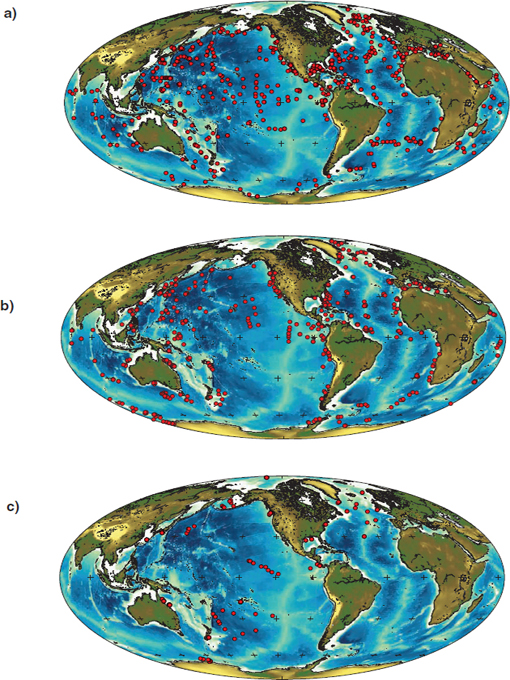
FIGURE 1.1 Global distribution of drill holes and sampling sites from (a) DSDP, (b) ODP, and (c) IODP over four decades of scientific ocean drilling. Drill-hole symbols are greatly exaggerated in size. The depths of the drill holes also vary significantly, depending upon scientific objectives and technical and logistical considerations at each site. This is a Mollweide (equal area) projection with a color range of -9,000 to 9,000 m, with white marking the 0 m depth. SOURCE: IODP-USIO.
Box 1.1
Statement of Task
The National Science Foundation has requested that the National Research Council appoint an ad hoc committee to review the scientific accomplishments of U.S.-supported scientific ocean drilling (Deep Sea Drilling Project [DSDP], Ocean Drilling Program [ODP], and Integrated Ocean Drilling Program [IODP]) and assess the potential for future transformative scientific discoveries. The study committee will undertake two tasks:
1. Identification of DSDP, ODP, and IODP scientific accomplishments and analysis of their significance, with an emphasis on evaluating how scientific ocean drilling has shaped understanding of Earth systems and history. Additional emphasis will be placed on assessing the extent to which the availability of deep ocean drilling capabilities has enabled new fields of inquiry. The analysis will include consideration of the drilling programs’ contributions to capacity building, science education, and outreach activities. The study will not consider organizational framework.
2. Assessment of the potential for transformative scientific discovery resulting from implementation of the draft science plan for the next proposed phase of international scientific ocean drilling (2013-2023). This assessment will include advice on opportunities resulting from stronger collaboration between ocean drilling and other NSF-supported science programs and research facilities.
provided conclusive evidence for the theory of seafloor spreading and added critical information that was the principal driver for the development of plate tectonic theory. DSDP also contributed significantly to the development of the fields of paleoceanography and paleoclimatology and developed piston coring technology that enabled better recovery of core samples. The International Phase of Ocean Drilling (DSDP IPOD) began in 1975, with the recognition that the most effective means of scientific ocean drilling was through a cooperative, international program whereby nations could share intellectual and financial resources. In many ways, the DSDP IPOD phase was a precursor for IODP, because it enacted a model for sharing financial resources between interested nations instead of having only U.S.-funded science and program management. The Shirshov Institute of Oceanology in Moscow was the first international partner, and by 1975 JOIDES included nine U.S. institutions and five international participants.
ODP continued international scientific ocean drilling through the 1980s and 1990s under the primary leadership of the United States, with 18 nations participating. The JOIDES Resolution, a new ocean drillship (Figure 1.2), was converted from use in the oil industry to use in scientific ocean drilling for this program. The JOIDES Resolution’s drilling facilities enabled more effective drilling in both deep and shallow water depths and had better shipboard laboratories than the Glomar Challenger. These technological improvements facilitated the understanding of continental rifting and Earth’s climate history and the development of the global Geomagnetic Polarity Timescale. ODP also significantly moved forward the investigation and understanding of challenging oceanic environments, such as gas hydrates and hydrothermal vents. Throughout ODP, Texas A&M University (TAMU) was responsible for drilling operations, and Lamont-Doherty Earth Observatory of Columbia University (LDEO) was responsible for downhole logging activities. Core repositories were developed at several locations in the United States and Germany before the ODP phase of scientific ocean drilling concluded (Table 1.1). ODP also saw advancement in the use of boreholes for continued study of the subseafloor. While direct sampling through the acquisition of cores and downhole logging of data continued, new experimental approaches to seal drill holes and place in situ sensors led to the creation of long-term subseafloor observatories (see Box 3.2 in Chapter 3). Those dual uses of scientific ocean drilling continue to increase in importance.
The most recent program, IODP, has used a process-oriented approach to conduct research within three broadly defined, global scientific themes: (1) the deep biosphere and the subseafloor ocean; (2) environmental change, processes, and effects; and (3) solid Earth cycles and geodynamics (IODP, 2001). Japan and the United States have co-led the program of 24 countries and, together with a consortium of European countries and Canada, have provided multiple types of drilling platforms with new capabilities. These platforms have greatly expanded the scope of research addressed by scientific ocean drilling and have provided an example of best practices in international scientific cooperation (Box 1.2).
To a large extent, the success of IODP and prior scientific ocean drilling programs has been a result of strong international collaboration.
During IODP, the core repository in Japan was established, and the Japanese riser drillship Chikyu (Figure 1.2) entered service. Chikyu is able to drill in water up to 2,500 m deep and can drill holes up to 7,000 m total.4JOIDES Resolution underwent a major refurbishment (2006-2009), increasing laboratory space by 34 percent, which led to greater efficiency in core handling, improved berthing arrangements, enhanced drilling capability, and better ship stability. The ship re-entered active service with the ability to drill more
________________
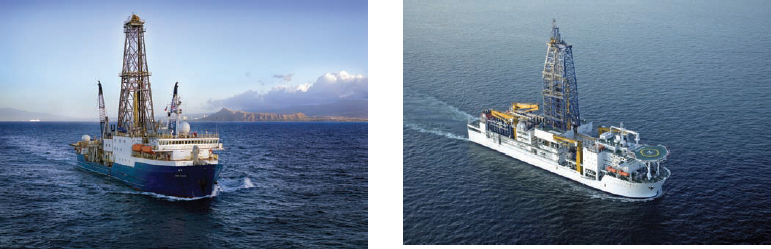
FIGURE 1.2 Current scientific ocean drilling vessels: (left) JOIDES Resolution and (right) Chikyu. JOIDES Resolution was refurbished from 2006 to 2009. Chikyu began service in 2005. SOURCE: Used with permission from IODP.
TABLE 1.1 Scientific Ocean Drilling Core Repository Data
| Gulf Coast Repository ITAMU) | Bremen Core Repository (Germany) | Kochi Core Center (Japan) | |
| Year established | 1985 | 1994 | 2005 |
| Geographic region covered | Pacific (east of western plate boundary), Caribbean Sea, Gulf of Mexico, Southern Ocean (south of 60"S except Kerguelan Plateau) | Atlantic and Arctic Oceans (north of Bering Strait), Mediterranean and Black Seas | Pacific (west of western plate boundary), Indian Ocean (north of 60°S), Kerguelan Plateau, Bering Sea |
| Tola amount of core (km) | 125 | 141 | 93 |
| Tola! sample requests | 4,406 | 4,591 | 2,380 |
| Total samples taken | 1,138,799 | 1.249,652 | 342,715 |
SOURCE: Data from IODP-USIO, 2011, and http://www.iodp.org/repositories/2/.
than 2 km into the ocean floor, and in waters as deep as 6,000 m and as shallow as 75 m.5 TAMU and LDEO, respectively, continue to be responsible for drilling and downhole logging operations. In addition, ECORD manages the use of mission-specific platforms for expeditions that require capabilities beyond those of the U.S. and Japanese drillships (e.g., drilling coral reefs, shallow waters, or high-latitude areas). IODP results have built upon previous program results to increase understanding of relationships between glaciation, sea level changes, ocean circulation, and atmospheric carbon dioxide; past climate change; the deep biosphere; evolution of large igneous provinces; occurrence of bolide impacts; and investigation of fluids and slope failure in the seafloor.
More than 26,000 publications have resulted from these four decades of scientific ocean drilling research, including program reports, maps, abstracts, and other peer- and non-peer-reviewed publications. About one-third of these publications have been in peer-reviewed journals, including more than 400 in Science, Nature, and Nature Geoscience (IODP-MI, 2011). In addition to contributing to research, scientific ocean drilling has fostered an integrated approach to the study of Earth’s history. Drilling samples are collected in an integrated biological, geochemical, geophysical, sedimentological, and structural context that has been framed in a well-defined pre-drill site survey. Some samples are carriers of chemical proxies for the environment of deposition or formation, while others are part of a distinct biogeochemical community.
It is also important to note the impact that scientific volunteers brought to achieving the goals of scientific ocean drilling. Early, mid-career, and internationally established scientists recognized that scientific ocean drilling would open many new fields of inquiry, and they responded by volunteering substantial amounts of time and energy to initiate the overall program and to sustain it through the decades.
TECHNICAL ACHIEVEMENTS OF U.S.-SUPPORTED SCIENTIFIC OCEAN DRILLING
In concert with the wide range of scientific successes that DSDP, ODP, and IODP have achieved across a wide
________________
5 See http://www-odp.tamu.edu/publications/tnotes/tn31/jr/jr.htm.
Box 1.2
IODP as an International Best Practice
IODP is by far the largest Earth science effort to date. Twenty-four countries contribute, with the United States and Japan as the leading participants. The coordinated use of core samples, drillships, and mission-specific platforms has resulted in a community- and facility-oriented approach and a concentration of effort by a diverse group of scientists. Since the early days of scientific ocean drilling, priorities and technological developments have been driven by scientific needs, and this is still the case for IODP. An open application process and transparent, science-based peer reviews of proposals guarantee that scientists from all participating countries are given equal opportunities to set scientific and programmatic goals.The current IODP structure is designed to ensure that proposals are aligned with strategic priorities of an internationally agreed-upon science plan and evaluated on their scientific merits, but also takes feasibility and risk into account. The evaluation process is designed to counteract vested national interests that can plague large, international, scientific cooperative programs.
When a decision is made on a specific drilling target, IODP issues a second call to scientists from participating countries, asking them to take part on a drilling cruise by proposing add-on projects or by applying to participate as experts in already planned projects. The second call provides an important opportunity for young scientists and graduate students from many disciplines in Earth and environmental sciences to engage in scientific ocean drilling and work alongside leading geoscientists. The experience they gain builds capacity for a future career in the ocean sciences by providing access to a global, multidisciplinary scientific network, as well as by offering unique opportunities and facilities for original research.
span of fields, scientific ocean drilling has excelled in generating innovative technologies. Box 1.3 highlights some of the ground-breaking achievements of Project Mohole and follow-on scientific ocean drilling programs. Later boxes (in Chapters 2-4) provide further details of scientific ocean drilling technologies that have helped advance scientific discovery. These accomplishments occurred in concert with attempts by program scientists to answer questions of increasing complexity about processes affecting the Earth system, including the solid Earth, hydrosphere, and atmosphere. Some of these spin-off technologies have had an enormous impact on the evolution of commercial deepwater drilling and oceanographic research. Dynamic positioning (maintaining position through the use of propellers rather than an anchor; Box 1.3), deepwater coring equipment and practices (Boxes 2.2 and 4.3), taking measurements while coring (Box 3.1), long-term borehole monitoring (Box 3.2), and the ability to obtain drill cores in a variety of environmental conditions (Box 3.4) have all been spearheaded by scientific ocean drilling programs. Several of these technological developments, especially those that allow real-time borehole monitoring, have provided additional safety and hazard assessment tools that permit riserless drilling in difficult environments. The drilling statistics in Table 1.2 demonstrate the general increase in penetration depth of the drill cores as well as percentage core recovery as the programs have evolved (also see Figure 1.3).
In response to the first charge in the Statement of Task, the committee identified noteworthy scientific and technological advancements and new fields of inquiry spurred by results accomplished through four decades of scientific ocean drilling. Outstanding questions that have yet to be answered within each major field of study are also outlined. Although these achievements are explored in much more detail in following chapters, the committee felt that a conclusion describing the overall worth of the scientific ocean drilling enterprise was warranted.
The committee found that the U.S.-supported scientific ocean drilling programs (DSDP, ODP, and IODP) have been very successful, contributing significantly to a broad range of scientific accomplishments in a number of Earth science disciplines. In addition, their innovations in technology have strongly influenced these scientific advances.
The second task focused on assessing the science plan, Illuminating Earth’s Past, Present, and Future: The International Ocean Discovery Program Science Plan for 2013-2023 (IODP-MI, 2011), that was produced for the next phase of scientific ocean drilling.
The committee found that each of the four themes within the science plan identifies compelling challenges with potential for transformative science that can only be addressed by scientific ocean drilling. Some challenges within these themes appear to have greater potential for transformative science than others.
For the first task, numerous reports by ODP and IODP have summarized the major accomplishments during specific phases of the program’s existence (e.g., JOI, 1990, 1996,
Box 1.3
Innovations in Riserless Drilling: Project Mohole and Beyond
In 1957, a number of prominent scientists suggested an ambitious project to drill to the Mohorovičić discontinuity (Moho), the sharp increase in seismic velocity 4 to 6 km below the seafloor in the ocean and 30 to 40 km below the surface of the continents. Such a project would require drilling in far deeper water than the routine depths of 20 to 50 m that commercial drilling attempted at the time. There were two major hurdles to accomplishing this feat: drilling in deep water without anchoring (the standard practice for drill ships at that time), and drilling or coring without a riser (a pipe with an outer casing, allowing drilling fluid to circulate between the ship and borehole while maintaining constant pressure within the borehole; see figure below). From 1958 to 1961, many engineering challenges associated with deep scientific ocean drilling were discussed and new approaches designed: a dynamic positioning (DP) system consisting of four shipboard propellers and a series of sonar buoys; a guide shoe to relieve stress on the drill string; a landing base for hole re-entry; and diamond drill bits for biting into hard rock (NRC, 2000; Winterer, 2000; Pete Johnson, PowerPoint presentation, 2011).
During the March 1961 Project Mohole cruise, the CUSS 1 drillship used dynamic positioning to maintain its position over a small circle at a site in the Pacific Ocean offshore of Guadalupe Island, Mexico. The scientists and engineers aboard the ship managed to retrieve both soft sediment and basement rock, reaching a depth of 183 m beneath the seafloor while drilling in 3,570 mof water (NRC, 2000). This definitively proved that an unanchored drillship could maintain station in deep water and have continuous drilling or coring operations. Today, the majority of modern deepwater drillships and other self-contained floating drilling machines (also referred to as mobile offshore drilling units) have DP systems that can maintain a watch circle of 3 to 10 m under normal surface conditions (Ambrose et al., 2003). Without DP systems, many deepwater oil and gas discoveries worldwide would not have been economically viable. In some cases these sites could not have been drilled without DP, especially in water depths beyond 2,000 m (Smith and Parlas, 1979).
Conventional offshore drilling in the 1960s and 1970s with a mobile offshore drilling unit was limited by water depth because of the heavy riser pipe and blowout preventers required for well control purposes. Drilling for sediments and hard rock, while specifically avoiding hydrocarbon formations, could instead be done without a riser system and blowout preventers. The DSDP drillship Glomar Challengerwas specially built to do non-riser drilling by circulating drilling fluids through the drill pipe and out the borehole to the ocean. This practice ultimately led to the now-common deepwater oil field practice of drilling a surface hole before the first long string of casing is installed and a riser employed. The next drillship for scientific ocean drilling, the JOIDES Resolution, was converted from a commercial oil drillship to a riserless scientific vessel. The JOIDES Resolution improved capability for scientific ocean drilling because it could drill in deeper and shallower water depths, had superior station-keeping capabilities, and better heave compensation (Cullen, 1994; NRC, 2000).
TABLE 1.2 Scientific Ocean Drilling Technical Achievements
| Program | Distance Traveled (nmi) |
Total Cored (km) |
Total Core Recovered (km) |
Number of Sites Visited |
Deepest Core Penetration (m) |
Deepest Water Depth (m) |
Number of Cores Recovered |
| DSDP | 375.632 | 170 | 97 | 624 | 1,741 | 7.044 | 19.119 |
| ODP | 355,78 | 321 | 222 | 669 | 2.111 | 5,980 | 35.772 |
| IODPa | 81.008 | 40 | 33 | 91 | 1.928 | 5,708 | 4,840 |
aThrough April 2011. There were commissioning delays with Chiyku and shipyard delays with JOIDES Resolution that led to fewer expeditions and core drilled than were otherwise expected. SOURCE: Data from IODP-USIO, 2011.
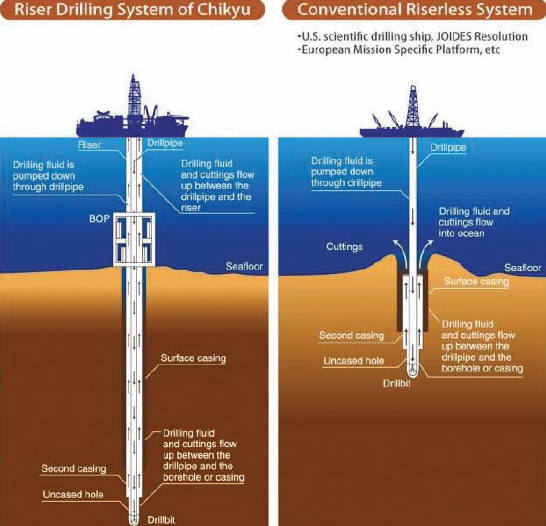
Riser drilling configuration (left) and riserless drilling configuration (right). SOURCE: JAMSTEC/IODR
1997, 2004; IODP, 2001; Gröschel, 2002; ODP, 2007). Initial and technical reports related to specific DSDP,6 ODP,7 and IODP8 legs also provided detailed information. The committee reviewed those reports as well as previous external assessments (e.g., NRC, 1992) and community-led activities. The information-gathering process also included presentations by and discussions with DSDP, ODP, and IODP scientists and engineers, program managers, and invited speakers in a variety of scientific disciplines during the June 2010 committee workshop in College Station, Texas. The committee commissioned white papers from the workshop speakers (see Appendix C); some of this report’s contents build upon those materials.
Scientific ocean drilling accomplishments are organized into three chapters that follow the broad IODP themes: solid Earth cycles (Chapter 2); fluids, flow, and life in the subseafloor (Chapter 3); and Earth’s climate history (Chapter 4). Those chapters present the analyses of significant accomplishments in 14 solid Earth and oceanographic areas, the accomplishments’ impacts on understanding the Earth
________________
6 See http://www.deepseadrilling.org/index.html.
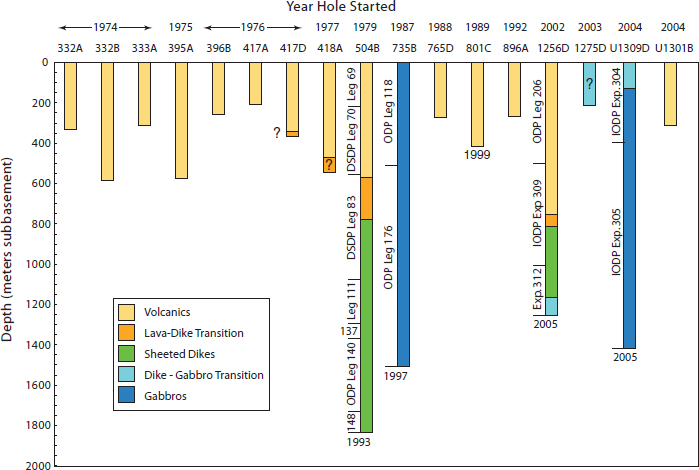
FIGURE 1.3 Graphical representation of DSDP, ODP, and IODP holes drilled between 1974 and 2005 that extend more than 200 m into ocean crust. The most striking observation on this diagram is that most of the holes are shallower than 500 m and sample only the volcanic section (pillows and sheeted dikes) of the basement below the sedimentary cover. SOURCE: Modified from Dick et al., 2006.
system and their importance in developing new fields of inquiry, and identification of goals not yet accomplished. The report also examined capacity building, education, and outreach conducted through DSDP, ODP, and IODP (Chapter 5).
For the second task, the committee relied upon presentations by the science plan writing team, discussions with representatives from IODP and NSF, and review of the plan itself. The committee was presented with several versions of Illuminating Earth’s Past, Present, and Future: The International Ocean Discovery Program Science Plan for 2013-2023 (IODP-MI, 2011) during the course of the study. The draft plan was released in June 2010; the committee met with science plan writing team members during the September 2010 meeting. The committee also received some revised chapters in September and October 2010, which were significantly different in both content and style from the June 2010 version. Revisions continued throughout the rest of 2010, and the revised document was reviewed by an external panel of eight international scientists in early 2011 (IODP-MI, 2011). The final science plan was released in June 2011 and provides the basis for the committee’s assessment of future opportunities for transformative science through scientific ocean drilling (Chapter 6). The committee also identified linkages between scientific ocean drilling, other NSF-supported programs, and non-NSF programs.


