
WELCOME AND WORKSHOP PURPOSE
Presenter: Rafael Pérez-Escamilla
The Food and Nutrition Service (FNS) of the U.S. Department of Agriculture (USDA) administers the Special Supplemental Nutrition Program for Women, Infants and Children (WIC). WIC promotes breastfeeding as the optimal method of infant feeding, and funds are designated for the promotion, education, and support of breastfeeding activities.
In 1997 USDA launched Loving Support Makes Breastfeeding Work,1 a national campaign to promote breastfeeding to WIC participants and their families. More than 10 years later USDA wants to build on the successes of the campaign, taking into account the changes that have occurred and the knowledge gained in this country and in the WIC Program since that time. USDA requested that the Institute of Medicine (IOM) convene a workshop to gather ideas concerning how WIC can best promote and support breastfeeding.
In his opening comments planning committee chair Rafael Pérez-Escamilla welcomed participants and explained the goal of the workshop. The committee structured the workshop to discuss what has changed in the more than 10 years since the campaign began, given changes in the socioeconomic and demographic characteristics of WIC participants, in society,
__________________
1USDA also refers to the campaign by the shortened title Loving Support. Presenters used this shortened form, which is reflected throughout this report.
in the WIC program environment, and in information technology. Three panels, each followed by group discussion, reviewed these changes, covered lessons from other public health campaigns and programs, and provided input on future directions for the WIC breastfeeding campaign.
As he turned over the podium to the next speaker, Pérez-Escamilla thanked the planning committee, speakers, and IOM staff for their contributions. He also noted that the workshop sponsors at USDA/FNS gave the committee the freedom to organize the workshop as it saw fit and provided useful guidance when necessary.
OPENING REMARKS
Presenter: Douglas Greenaway
Douglas Greenaway, president and chief executive officer of the National WIC Association (NWA), lauded USDA’s decision to enlist the IOM Food and Nutrition Board to assist in sorting out the challenges and opportunities associated with offering meaningful support to WIC program administrators and staff. He also expressed his appreciation to the Centers for Disease Control and Prevention for its leadership and dedication in supporting and promoting breastfeeding and also to NWA professionals for their commitment to achieving breastfeeding success for WIC mothers and their infants.
Families who turn to WIC for nutrition assistance are vulnerable and at risk; meeting their nutritional needs is an essential priority of the WIC community and of NWA. NWA represents 12,200 service provider agencies and the more than 9 million mothers and young children participating in the WIC Program. NWA serves as an education arm and advocacy voice on Capitol Hill; before the USDA and other federal agencies; and with the White House, stakeholders, and collaborating partners.
Greenaway said that NWA supports, promotes, and encourages breastfeeding as the first and most important form of infant feeding in order to improve the overall health and nutritional health of WIC mothers and infants. The association recently released a comprehensive national breastfeeding strategic plan for the WIC Program, accompanied by a blueprint with six steps to achieve WIC breastfeeding goals (NWA, 2011). (Several panelists summarized aspects of the plan and the steps later in the workshop.) Greenaway said that it is NWA’s desire for WIC to be known as the “Go-to Breastfeeding Program.”
Greenaway offered feedback from NWA members on the current Loving Support campaign as a new campaign is being considered. He relayed their comments that “the branding has been terrific and is widely recognized” and that the materials are attractive, of professional quality, and
appealing to both participants and the general public. Members have commented that the interactive group activities are engaging and have said that they appreciate that WIC agencies are allowed to integrate the brand into their own materials. The peer counselor curriculum offers positive overall training at an appropriate depth for the new breastfeeding peer counselor.
Greenaway also relayed some recommendations from NWA. NWA members have suggested that the campaign be revised more frequently to reflect emerging evidence and to incorporate social marketing and tools, such as electronic media. They recommended avenues for peer counselors to access clients soon after giving birth so as not to lose new mothers prior to their first postpartum certification for WIC benefits. It would also be helpful to include more role-playing tools, especially those that address issues that breastfeeding mothers confront daily, such as helping them to withstand pressure to wean early, to deal with difficult employer situations, and to manage breastfeeding while working or attending school. They suggested tools for facilitating or implementing breastfeeding support groups in the WIC clinics or other WIC settings as well as expanded partnerships between WIC and community groups, particularly physician partners. Overall, they recommended that the Loving Support campaign be used as the nation’s breastfeeding brand to reach all families, not just WIC families.
Greenaway concluded by thanking participants for their support of the WIC Program and wished the group success in the day’s agenda and the work ahead.
HISTORICAL PERSPECTIVE ON THE LOVING SUPPORT CAMPAIGN
Presenter: Debra Whitford
Debra Whitford, director of the Supplemental Food Programs Division of FNS, has been involved with WIC for more than 30 years. She noted that breastfeeding is a core component of the services that the WIC Program provides and said that Loving Support has helped WIC make great strides in fulfilling its mission to safeguard the health of low-income women, infants, and children. Her presentation was designed to provide the background and context against which to consider current and future directions of the campaign.
According to Whitford, the mission of the WIC Program is to “serve as an adjunct to good health care during critical times of growth and development, in order to prevent the occurrence of health problems . . . and to improve the health status of eligible infants, mothers and children,” (Child Nutrition Act, P.L 94-105, Sec. 17(a) [October 7, 1975]; Child Nutrition Amendments of 1978, P.L. 95-267, Sec. 17(a) [November 10, 1978]). Those
eligible for WIC are pregnant and postpartum women up to 6 months after giving birth, with breastfeeding women served up to 1 year, and also infants and children through 5 years of age.
On average the WIC Program served about 9.2 million women and children per month through 90 state agencies in fiscal year (FY) 2010. About 25 percent of the participants were pregnant and postpartum women, and about 25 percent were infants under 1 year of age. Overall, children 1 to 2 years of age make up the largest population served. Whitford also noted that half of all infants born in the United States every year are WIC participants.
WIC provides participants with supplemental foods, nutrition education (the only program within FNS with this mandate), and referrals to health and social services in addition to breastfeeding promotion and support. Whitford stressed that breastfeeding is a priority for everyone involved with WIC, whether at the local, the state, or the federal level. All mothers are encouraged to breastfeed unless medically contraindicated, so it is important to have all the pieces in place so that mothers have the information and support they need to make this important choice.
The WIC Program supports breastfeeding mothers by providing anticipatory guidance, counseling, and educational materials; a greater quantity and variety of foods for breastfeeding mothers than for non-breastfeeding mothers; one-on-one support from WIC Peer Counselors; longer participation in the program than for non-breastfeeding mothers; and breastfeeding aids, such as breast pumps and shells, to help women continue their commitment to breastfeeding.
Establishing Loving Support
Loving Support Makes Breastfeeding Work is the USDA campaign launched in 1997 to promote breastfeeding to WIC participants and their families with a social marketing strategy that includes mass media, participant education materials, and technical assistance to WIC staff. While it has been USDA’s most comprehensive breastfeeding campaign, Whitford said that other efforts had been undertaken to promote breastfeeding before WIC’s launch.
Whitford reviewed a chronology of legislation and other milestones leading up to the Loving Support campaign. At its inception in 1972 WIC was designed to reach pregnant and lactating women and, at the time, infants and children up to 4 years of age. In 1975, when WIC became a permanent program, the legislation establishing it explicitly used the term breastfeeding. With the passage of the 1989 reauthorization of WIC, greater emphasis was placed on breastfeeding support. That law also required that WIC establish a national definition of breastfeeding, which
USDA did in conjunction with NWA and the U.S. Department of Health and Human Services (HHS).
In the 1990s additional measures were put in place to support breastfeeding. Participants of the first meeting of the Breastfeeding Promotion Consortium, which consisted of USDA, HHS, the American Academy of Pediatrics, and other groups, proposed a national breastfeeding campaign for WIC’s target population. FNS convened a Technical Consultant Group to discuss how to design a campaign, and in 1992, P.L. 102-342 (the Child Nutrition Amendments of 1992) called for a National Breastfeeding Promotion Program. During that same year FNS awarded grants (Breastfeeding Incentive Demonstration Projects) to local and state agencies specifically to foster wider acceptance for breastfeeding, and special food packages were established for fully breastfeeding women. Whitford noted that the changes, while small compared to the food package of today, were the first since the program began in 1980 and underscored the importance of women breastfeeding their infants.
In 1994, P.L. 103-448, the Healthy Meals for Americans Act, revised the funding formula for breastfeeding promotion and support and required agencies to report breastfeeding incidence and duration among participants.
In 1995 FNS entered into a cooperative agreement with Best Start Social Marketing to develop the campaign that became the Loving Support campaign. Research and pilot programs took place in Arkansas, California, the Chickasaw Nation (Oklahoma), Iowa, Mississippi, Nevada, New Jersey, New York, Ohio, and West Virginia, and the initiative that emerged was formally evaluated in Iowa and Mississippi. USDA officially launched Loving Support during Breastfeeding Week, August 1–7, 1997.
The campaign has five goals:
- Increase breastfeeding initiation rates among WIC participants.
- Increase breastfeeding duration among WIC participants.
- Increase referrals to WIC for breastfeeding support.
- Increase general public acceptance and support of breastfeeding.
- Provide support and technical assistance to WIC state and local agencies in the promotion and support of breastfeeding.
The primary target audiences are those directly involved with WIC: participants, local WIC staff, and WIC state breastfeeding coordinators. Secondary audiences include those who interact with WIC mothers: significant others and grandmothers, health care providers, and the general population. The project has a number of components, including consumer research, a media campaign, a community organizer’s kit, a breastfeeding support resource guide, a training conference, and continuing education and technical assistance.
Formative research in the 10 pilot states pinpointed three key barriers that discouraged WIC mothers from initiating or continuing to breastfeed:
- Embarrassment to breastfeed in front of others
- Time and social constraints when breastfeeding while going to work or school
- Lack of social support, especially in the two weeks postpartum
To address these barriers, messages were developed that were designed to help women feel comfortable breastfeeding, to show how breastfeeding can work within a busy schedule, and to encourage the involvement of family and friends so that they support the mother’s breastfeeding decision, and these messages were disseminated through ads, pamphlets, and staff support kits and were integrated into training and technical assistance. Throughout the workshop, presenters and participants returned to the three barriers, stating they had not changed and offering suggestions about how the WIC Program can overcome them.
Changes and Constants
The Loving Support campaign is now almost 15 years old and is used in varying degrees by all WIC state agencies. Whitford summarized the changes that have taken place in the WIC Program and society at large since Loving Support began that will have an impact on a new campaign. For example, both advances in nutrition and breastfeeding research and the country’s expanded food supply and changing dietary patterns will need to be taken into account. Obesity has emerged as a major public health problem. At the same time, the WIC Program not only has grown, but also serves a more culturally diverse population. Changes in benefits offered in the WIC Program include revisions to the WIC food packages that strengthen WIC’s breastfeeding promotion efforts and provide incentive to mothers to initiate and continue breastfeeding their infants. Workplace accommodations for breastfeeding mothers are another important change to consider.
Whitford noted that some obstacles related to breastfeeding have stayed the same. Drawing on findings from the 1997 WIC Infant Feeding Practices Study (USDA/FCS, 1997), Whitford said that unsupportive hospital practices and early formula supplementation were cited among the factors leading to early cessation of breastfeeding. The study found that one-fourth of the WIC mothers who had initiated breastfeeding stopped by the end of the second week and one-half stopped by the end of the second month. Furthermore, mothers who perceived that they did not have an adequate milk supply or that there was something wrong with their milk were more likely to stop breastfeeding. The study also found that Hispanic mothers
believed in the benefits of breastfeeding more strongly than mothers in other racial or ethnic groups, and African American mothers believed more strongly than mothers in other racial or ethnic groups that there were barriers to breastfeeding.
In the decade or so since the 1997 WIC Infant Feeding Practices Study, previous obstacles to breastfeeding still remain for both WIC and non-WIC mothers, according to an article cited by Whitford (Grummer-Strawn et al., 2008). As a result of continuing hospital practices that are not supportive of breastfeeding, 52 percent of babies receive supplemental formula while they are in the hospital. Supplementation begins early: By 3 months of age, 61 percent of mothers regularly give formula to their infants, and half of new mothers have started feeding their infants solid food by 4 months of age. Racial and ethnic disparities continue, with breastfeeding rates at birth 50 percent lower for African American infants than for white infants.
But a number of changes have taken place since the 1990s. Participation in WIC has increased from an average of 7.2 million in FY 1996 to 9.2 million in FY 2010 (USDA/FNS, 2011). There has been a steady decline in the percentage of women participating in WIC who are under 18 and an increase in those who are older; in 2008, 85 percent of women participating in WIC were aged 18 to 34. Breastfeeding women tend to be older, with 11.5 percent over age 34. The demographics of the WIC population are also changing. In 2008 about 60 percent of participants were white, about 20 percent were African American, and about 11 percent were American Indian or Alaskan Native. About 43 percent of participants reported their ethnicity as Hispanic/Latino (USDA/FNS, 2010). Whitford said that changes in the method of collecting these data prevent a direct comparison with the past but that the program is more diverse than in its earlier days.
According to USDA surveys, a larger percentage of WIC women are now initiating breastfeeding than in the 1990s. Based on reporting from 63 state agencies, only about 41.5 percent of WIC mothers nationwide initiated breastfeeding in 1998 (Figure 1-1), whereas about 59 percent initiated breastfeeding in 2008 (Figure 1-2). Whitford noted that breastfeeding is now initiated in most parts of the country by a sizable percentage of WIC mothers, although convincing mothers to continue breastfeeding exclusively remains a challenge.
Loving Support in Action
Since the launch of the Loving Support campaign in 1997, FNS has implemented several initiatives and trainings that are built on the Loving Support theme. In 2002 grants were awarded to state agencies to bring WIC staff together with community partners to develop strategies and conduct trainings to build breastfeeding-friendly communities. WIC staff and part-
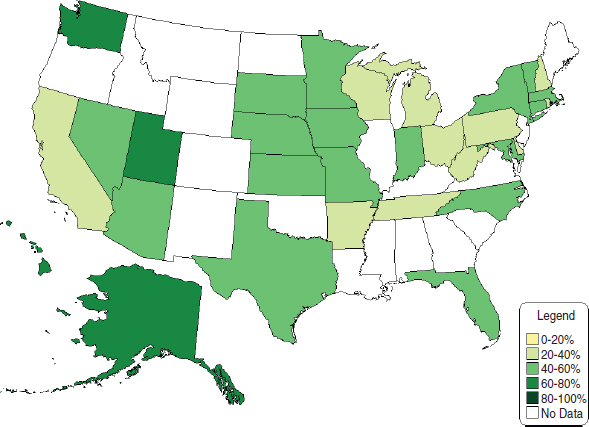
FIGURE 1-1 Breastfeeding initiation rates among WIC infants, 1998.
SOURCE: USDA/FNS, 2000.
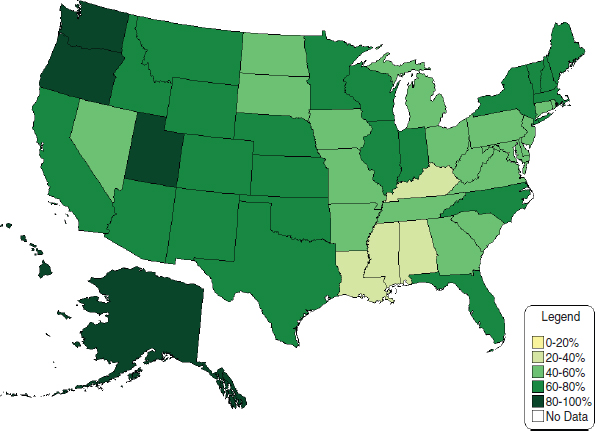
FIGURE 1-2 Breastfeeding initiation rates among WIC infants, 2008.
SOURCE: USDA/FNS, 2010.
ners created strategic plans that addressed barriers to breastfeeding. These plans are useful as technical assistance and for helping other state and local agencies to develop comprehensive community-based breastfeeding programs.
Recently, new WIC food packages were introduced with the goals of better meeting the nutritional needs of breastfeeding mothers and infants, minimizing the amount of formula provided to breastfed infants while mothers develop their milk supply, and increasing the dollar value and attractiveness of the full-breastfeeding food package.
The WIC Peer Counseling Program has also expanded. This is important, Whitford said, because peer counseling combined with other WIC services can have a positive impact on breastfeeding initiation and duration rates. Beginning in FY 2004 Congress has provided funds for breastfeeding peer counseling grants; grants in the first year totaled $14 million, and that amount has since increased substantially, to $80 million in FY 2010. State agencies that use an approved Loving Support model can use these grants to fund salaries, training, tools, print materials, travel expenses, and program expansion. The Loving Support Peer Counseling curricula have been updated, with training sessions planned for fall of 2011.
It was recently announced that $5 million in breastfeeding performance bonuses will be awarded to the 10 states with the highest rates of breastfeeding and the 10 states that have shown the greatest improvement in breastfeeding rates. States can use the funds for a wide range of projects but are encouraged to direct the funds toward projects involving breastfeeding. For example, many state agencies have used the funds to support breastfeeding-related training for staff.
Promotional and training materials for specific groups have been developed through Loving Support. “A Magical Bond of Love” was developed for Hispanic families based on research that identified specific barriers to breastfeeding in Hispanic communities. “Fathers Supporting Breastfeeding” was designed and targeted for African American fathers in an effort to address the disparities in breastfeeding rates for African American infants, although state agencies report that they have successfully used the materials with wider audiences. “Partnering with WIC for Breastfeeding Success” is a program in which health care providers, health care organizations, policy makers, and other stakeholders can partner with WIC to promote breastfeeding for healthy babies, mothers, and families. Finally, the new initiative “Using Loving Support to Grow and Glow” provides a training curriculum for all local agency staff who interact with breastfeeding mothers at the local level.
P.L. 111-296, the Healthy, Hunger-Free Kids Act of 2010, reauthorized the WIC Program and includes provisions supporting breastfeeding. It requires the collection and publication of breastfeeding data at the state
and local levels and requires the review of the food package not less than every 10 years. More broadly, there was acknowledgment in the law that any mention of “nutrition education” in the law includes breastfeeding support and promotion. The legislation extended breastfeeding performance bonuses and doubled the funding for them to $10 million. FNS is designing a local agency recognition program, as set out in the legislation, for agencies and clinics that demonstrate exemplary breastfeeding promotion and support activities. Public comment on the criteria developed for the program will be requested through a notice in the Federal Register.
Next Steps
Whitford closed her historical overview by asking the group for guidance on where to go from here with the Loving Support campaign. She posed a series of questions to consider over the course of the workshop: Where does the campaign go from here? How does the WIC Program sustain the progress in breastfeeding rates and support that have been accomplished thus far? How can the images used in the media for communication efforts with WIC participants be revitalized? How can the WIC Program address the barriers that continue to exist for WIC breastfeeding mothers? What are the staff needs that should be addressed at the local level? What technical assistance materials are needed by the staff? What are the educational materials that the staff may need in their efforts to talk with WIC moms?
Whitford closed by thanking participants for their time and input. The understanding gained today will revitalize the campaign and help with the next steps.
REFERENCES
Grummer-Strawn, L. M., K. S. Scanlon, and S. B. Fein. 2008. Infant feeding and feeding transitions during the first year of life. Pediatrics 122(Suppl. 2):S36–S42.
NWA (National WIC Association). 2011. NWA National Breastfeeding Strategic Plan. http://www.nwica.org/sites/default/files/WIC_2011_Breastfeeding_FINAL.pdf (accessed June 22, 2011).
USDA/FCS (United States Department of Agriculture/Food and Consumer Service). 1997. Final Report: WIC Infant Feeding Practices Study. Alexandria, VA: USDA/FCS. http://www.fns.usda.gov/ora/menu/published/wic/FILES/WICIFPS.PDF (accessed June 22, 2011).
USDA/FNS (Food and Nutrition Service). 2000. WIC Participant and Program Characteristics 1998. Alexandria, VA: USDA/FNS. http://www.fns.usda.gov/ora/menu/published/wic/FILES/PC98rpt.pdf (accessed June 22, 2011).
USDA/FNS. 2010. WIC Participant and Program Characteristics 2008. Alexandria, VA: USDA/FNS. http://www.fns.usda.gov/ora/menu/published/wic/FILES/pc2008.pdf (accessed June 14, 2011).
USDA/FNS. 2011. WIC Program Participation and Costs. http://www.fns.usda.gov/pd/wisummary.htm (accessed August 4, 2011).


