
Summary of the Workshop to Identify Gaps and Possible Directions for NASA’s Meteoroid and Orbital Debris Programs (National Research Council, The National Academies Press, Washington, D.C., 2011), which summarizes the National Research Council workshop held in March 9-10, 2011, in Fairfax, Virginia, is reprinted here in its entirety. Note that the reprinted report’s page numbers reflect the pagination that applies for inclusion in the current report, rather than the pages numbers of the original report.
This page intentionally left blank.
Summary of the Workshop to Identify
Gaps and Possible Directions for NASA’s
Meteoroid and Orbital Debris Programs
Committee for the Assessment of NASA’s Orbital Debris Programs
Aeronautics and Space Engineering Board
Division on Engineering and Physical Sciences
NATIONAL RESEARCH COUNCIL
OF THE NATIONAL ACADEMIES
THE NATIONAL ACADEMIES PRESS
Washington, D.C.
www.nap.edu
THE NATIONAL ACADEMIES PRESS 500 Fifth Street, N.W. Washington, DC 20001
NOTICE: The project that is the subject of this report was approved by the Governing Board of the National Research Council, whose members are drawn from the councils of the National Academy of Sciences, the National Academy of Engineering, and the Institute of Medicine. The members of the committee responsible for the report were chosen for their special competences and with regard for appropriate balance.
This study is based on work supported by Contract NNH10CC48B between the National Academy of Sciences and the National Aeronautics and Space Administration. Any views or observations expressed in this publication are those of the author(s) and do not necessarily reflect the views of the agency that provided support for the project.
International Standard Book Number-13: 978-0-309-21515-2
International Standard Book Number-10: 0-309-21515-3
Copies of this report are available free of charge from:
Aeronautics and Space Engineering Board
National Research Council
500 Fifth Street, N.W.
Washington, DC 20001
Additional copies of this report are available from the National Academies Press, 500 Fifth Street, N.W., Lockbox 285, Washington, DC 20055; (800) 624-6242 or (202) 334-3313 (in the Washington metropolitan area); Internet, http://www.nap.edu.
Copyright 2011 by the National Academy of Sciences. All rights reserved. Printed in the United States of America
THE NATIONAL ACADEMIES
Advisers to the Nation on Science, Engineering, and Medicine
The National Academy of Sciences is a private, nonprofit, self-perpetuating society of distinguished scholars engaged in scientific and engineering research, dedicated to the furtherance of science and technology and to their use for the general welfare. Upon the authority of the charter granted to it by the Congress in 1863, the Academy has a mandate that requires it to advise the federal government on scientific and technical matters. Dr. Ralph J. Cicerone is president of the National Academy of Sciences.
The National Academy of Engineering was established in 1964, under the charter of the National Academy of Sciences, as a parallel organization of outstanding engineers. It is autonomous in its administration and in the selection of its members, sharing with the National Academy of Sciences the responsibility for advising the federal government. The National Academy of Engineering also sponsors engineering programs aimed at meeting national needs, encourages education and research, and recognizes the superior achievements of engineers. Dr. Charles M. Vest is president of the National Academy of Engineering.
The Institute of Medicine was established in 1970 by the National Academy of Sciences to secure the services of eminent members of appropriate professions in the examination of policy matters pertaining to the health of the public. The Institute acts under the responsibility given to the National Academy of Sciences by its congressional charter to be an adviser to the federal government and, upon its own initiative, to identify issues of medical care, research, and education. Dr. Harvey V. Fineberg is president of the Institute of Medicine.
The National Research Council was organized by the National Academy of Sciences in 1916 to associate the broad community of science and technology with the Academy’s purposes of furthering knowledge and advising the federal government. Functioning in accordance with general policies determined by the Academy, the Council has become the principal operating agency of both the National Academy of Sciences and the National Academy of Engineering in providing services to the government, the public, and the scientific and engineering communities. The Council is administered jointly by both Academies and the Institute of Medicine. Dr. Ralph J. Cicerone and Dr. Charles M. Vest are chair and vice chair, respectively, of the National Research Council.
OTHER RECENT REPORTS OF THE AERONAUTICS AND SPACE ENGINEERING BOARD
Final Report of the Committee to Review Proposals to the 2011 Ohio Third Frontier Wright Projects Program (OTF WPP) (Aeronautics and Space Engineering Board [ASEB], 2011)
Recapturing a Future for Space Exploration: Life and Physical Sciences Research for a New Era (Space Studies Board [SSB] with ASEB, 2011)
Advancing Aeronautical Safety: A Review of NASA’s Aviation Safety-Related Research Programs (SSB with ASEB, 2010)
Capabilities for the Future: An Assessment of NASA Laboratories for Basic Research (Laboratory Assessments Board with ASEB, 2010)
Defending Planet Earth: Near-Earth Object Surveys and Hazard Mitigation Strategies: Final Report (SSB with ASEB, 2010)
Final Report of the Committee to Review Proposals to the 2010 Ohio Third Frontier (OTF) Wright Projects Program (WPP) (ASEB, 2010)
America’s Future in Space: Aligning the Civil Space Program with National Needs (SSB with ASEB, 2009)
Approaches to Future Space Cooperation and Competition in a Globalizing World: Summary of a Workshop (SSB with ASEB, 2009)
An Assessment of NASA’s National Aviation Operations Monitoring Service (ASEB, 2009)
Fostering Visions for the Future: A Review of the NASA Institute for Advanced Concepts (ASEB, 2009)
Near-Earth Object Surveys and Hazard Mitigation Strategies: Interim Report (SSB with ASEB, 2009)
Radioisotope Power Systems: An Imperative for Maintaining U.S. Leadership in Space Exploration (SSB with ASEB, 2009)
Assessing the Research and Development Plan for the Next Generation Air Transportation System: Summary of a Workshop (ASEB, 2008)
A Constrained Space Exploration Technology Program: A Review of NASA’s Exploration Technology Development Program (ASEB, 2008)
Launching Science: Science Opportunities Provided by NASA’s Constellation System (SSB with ASEB, 2008)
Managing Space Radiation Risk in the New Era of Space Exploration (ASEB, 2008)
NASA Aeronautics Research: An Assessment (ASEB, 2008)
Review of NASA’s Exploration Technology Development Program: An Interim Report (ASEB, 2008)
Science Opportunities Enabled by NASA’s Constellation System: Interim Report (SSB with ASEB, 2008)
United States Civil Space Policy: Summary of a Workshop (SSB with ASEB, 2008)
Wake Turbulence: An Obstacle to Increased Air Traffic Capacity (ASEB, 2008)
Limited copies of ASEB reports are available free of charge from
Aeronautics and Space Engineering Board
National Research Council
The Keck Center of the National Academies
500 Fifth Street, N.W., Washington, DC 20001
(202) 334-2858/aseb@nas.edu
www.nationalacademies.org/aseb.html
COMMITTEE FOR THE ASSESSMENT OF NASA’S ORBITAL DEBRIS PROGRAMS
DONALD J. KESSLER, NASA (retired), Chair
GEORGE J. GLEGHORN, TRW Space and Technology Group (retired), Vice Chair
KYLE T. ALFRIEND, Texas A&M University
MICHAEL BLOOMFIELD, Oceaneering Space Systems
PETER BROWN, University of Western Ontario
RAMON L. CHASE, Booz Allen Hamilton
SIGRID CLOSE, Stanford University
JOANNE IRENE GABRYNOWICZ, National Center for Remote Sensing, Air, and Space Law, University of Mississippi
ROGER E. KASPERSON, Clark University
T.S. KELSO, Center for Space Standards and Innovation
MOLLY K. MACAULEY, Resources for the Future
DARREN S. McKNIGHT, Integrity Applications, Inc.
WILLIAM P. SCHONBERG, Missouri University of Science and Technology
Staff
PAUL JACKSON, Program Officer, Study Director
LEWIS B. GROSWALD, Research Associate
JOHN F. WENDT, Senior Program Officer
CATHERINE A. GRUBER, Editor
ANDREA M. REBHOLZ, Program Associate
DALAL NAJIB, Christine Mirzayan Science and Technology Policy Graduate Fellow
MICHAEL H. MOLONEY, Director, Aeronautics and Space Engineering Board
AERONAUTICS AND SPACE ENGINEERING BOARD
RAYMOND S. COLLADAY, Lockheed Martin Astronautics (retired), Chair
LESTER LYLES, The Lyles Group, Vice Chair
ELLA M. ATKINS, University of Michigan
AMY L. BUHRIG, Boeing Commercial Airplanes Group
INDERJIT CHOPRA, University of Maryland, College Park
JOHN-PAUL B. CLARKE, Georgia Institute of Technology
RAVI B. DEO, EMBR
VIJAY DHIR, University of California, Los Angeles
EARL H. DOWELL, Duke University
MICA R. ENDSLEY, SA Technologies
DAVID GOLDSTON, Harvard University
R. JOHN HANSMAN, Massachusetts Institute of Technology
JOHN B. HAYHURST, Boeing Company (retired)
WILLIAM L. JOHNSON, California Institute of Technology
RICHARD KOHRS, Independent Consultant
IVETT LEYVA, Air Force Research Laboratory, Edwards Air Force Base
ELAINE S. ORAN, Naval Research Laboratory
ALAN G. POINDEXTER, Naval Postgraduate School
HELEN R. REED, Texas A&M University
ELI RESHOTKO, Case Western Reserve University
EDMOND SOLIDAY, United Airlines (retired)
MICHAEL H. MOLONEY, Director
CARMELA J. CHAMBERLAIN, Administrative Coordinator
TANJA PILZAK, Manager, Program Operations
CELESTE A. NAYLOR, Information Management Associate
CHRISTINA O. SHIPMAN, Financial Officer
SANDRA WILSON, Financial Assistant
Preface
The National Research Council (NRC), under the auspices of the Aeronautics and Space Engineering Board, was asked by NASA Chief of Safety and Mission Assurance Bryan O’Connor to assess NASA’s meteoroid1 and orbital debris (MMOD) programs and provide recommendations on potential opportunities for enhancing their benefit to the nation’s space program. This request came at the urging of the White House Office of Management and Budget and Office of Science and Technology Policy (see Appendix A).
The NRC assembled the Committee for the Assessment of NASA’s Orbital Debris Programs to review NASA’s existing efforts, policies, and organization with regard to meteoroids and orbital debris, including its efforts in the areas of modeling and simulation, detection and monitoring, protection, mitigation, reentry, collision assessment risk analysis and launch collision avoidance, interagency cooperation, international cooperation, and cooperation with the commercial space industry. The committee was also asked to provide its opinion as to whether NASA should initiate work in any new MMOD areas and to recommend whether the agency should increase or decrease effort in or change the focus of any of its current meteoroid or orbital debris efforts to improve their ability to serve NASA and other national and international activities. The committee was instructed to assume that the programs will be operating in a constrained budget environment (see Appendix B for the committee’s statement of task). Through a series of information-gathering meetings, including the workshop that is the subject of this report, the committee received briefings from representatives of NASA and other federal agencies and foreign space agencies, as well as from other experts in the fields of meteoroids, orbital debris, and aerospace technology.
Although the statement of task refers to a singular NASA program in this field, there are in fact numerous program elements spread across NASA mission centers that address MMOD. For the purposes of this report, these elements are referred to as NASA’s MMOD programs.2 The vast majority of NASA’s efforts fall within five program elements (the “programs”), which are:
• Office of Safety and Mission Assurance, NASA Headquarters: Provides top-level budget and programmatic management, technical oversight, and coordination within NASA and with other U.S. government entities; advocate to senior NASA management on MMOD;
___________________
1 This report uses the word “meteoroid” according to its precise definition, rather than the term “micrometeoroid,” a colloquialism for “small” meteoroids and an imprecise term that does not cover the full range of sizes or meteoroids. However, to avoid adding a new acronym to the literature and to minimize confusion, the committee retains use of the acronym “MMOD” (micrometeoroid and orbital debris) as a modifier (e.g., MMOD programs).
2 This term also reflects how the programs were referred to by many panelists and committee members at the workshop.
• Orbital Debris Program Office, NASA Johnson Space Center: Performs many duties that are NASA-specific, interagency, and international in nature; within NASA, in charge of aiding all robotic and human spaceflight missions in determining compliance with NASA policy standards regarding orbital debris mitigation and responsible for technical evaluations of all orbital debris assessment reports and end-of-mission plans;
• Meteoroid Environment Office, NASA Marshall Space Flight Center: Responsible for the creation and stewardship of meteoroid environment models, tools, and documents relevant to spacecraft operations and design;
• Hypervelocity Impact Technology Group, NASA Johnson Space Flight Center: Works to decrease MMOD risk to crew, improve MMOD protection of NASA spacecraft, and decrease the amount of MMOD shielding in terms of cost, volume, and mass; and
• Robotic Conjunction Assessment Risk Analysis, NASA Goddard Space Flight Center: Supports robotic missions by conducting risk assessments of possible collisions between spacecraft in orbit of the close approaches predicted by the U.S. Air Force Joint Space Command.
In addition to these established programs, the National Space Policy of the United States of America,3 released in 2010 (henceforth referred to as the 2010 National Space Policy), also calls for NASA to take on research and development into technologies related to orbital debris retrieval and removal. In addition to research and development, the policy also makes maintaining a sustainable space environment a long-term goal of the United States.
Because of the diversity and number of perspectives and entities involved in space activities within the United States, the committee held a public workshop on March 9-10, 2011, in Fairfax, Virginia, as an efficient way to hear from the various stakeholders. The workshop complements other data-gathering meetings held by the committee throughout the course of its study.
The committee’s statement of task calls for a summary of the workshop, which is the purpose of this report. The presentations and discussions that took place at the workshop are summarized in this report, although the committee does not offer any findings or recommendations. The committee will detail its findings and offer recommendations in its next, and final, report. The committee maintains responsibility for the overall quality and accuracy of the report as a record of what transpired at the workshop, but views and opinions contained in this workshop report were expressed by the presenters, attendees, or individual committee members as attributed and do not necessarily represent the views of the whole committee.
The committee heard from five panels of presenters at the workshop, each of which was composed of three to five members who spoke for a short period of time. Their names and affiliations are listed in Appendix C. Following the presentations, questions and comments were then solicited, first from the committee members and then from the audience, which consisted of government employees, academics, and representatives of the aerospace industry.
___________________
3National Space Policy of the United States of America, June 28, 2010, available at http://www.whitehouse.gov/sites/default/files/national_space_policy_6-28-10.pdf.
Acknowledgment of Reviewers
This report has been reviewed in draft form by individuals chosen for their diverse perspectives and technical expertise, in accordance with procedures approved by the Report Review Committee of the National Research Council (NRC). The purpose of this independent review is to provide candid and critical comments that will assist the institution in making its published report as sound as possible and to ensure that the report meets institutional standards for objectivity, evidence, and responsiveness to the study charge. The review comments and draft manuscript remain confidential to protect the integrity of the deliberative process. We wish to thank the following individuals for their review of this report:
William Ailor, The Aerospace Corporation,
Ravi B. Deo, EMBR,
John L. Junkins, Texas A&M University,
Chris T.W. Kunstadter, XL Insurance, and
Michael F. Zedd, Naval Research Laboratory.
Although the reviewers listed above have provided many constructive comments and suggestions, they were not asked to endorse any of the viewpoints or observations detailed in this report. The review of this report was overseen by M. Granger Morgan, Carnegie Mellon University. Appointed by the NRC, he was responsible for making certain that an independent examination of this report was carried out in accordance with institutional procedures and that all review comments were carefully considered. Responsibility for the final content of this report rests entirely with the authoring committee and the institution.
This page intentionally left blank.
Contents
SUMMARY OF REMARKS MADE BY WORKSHOP PARTICIPANTS
Session 1: NASA Meteoroid and Orbital Debris Programs
Session 2: NASA Mission Operators
Session 3: The Role of NASA’s MMOD Programs and Their Relationship to Other Federal Agencies
Session 4: MMOD and the Commercial Industry Perspective
Session 5: Orbital Debris Retrieval and Removal
Observations of Individual Committee Members
This page intentionally left blank.
Summary of Remarks Made by Workshop Participants
The workshop was opened by the chair of the Committee for the Assessment of NASA’s Orbital Debris Programs, Donald Kessler, who welcomed the guests, provided a synopsis of the overall study underway and the objectives of the workshop, and described the panels that were formed prior to the workshop.
The panels presented at the workshop in the following order:
- Panel on NASA Meteoroid and Orbital Debris Programs,
- Panel on NASA Mission Operators,
- Panel on the Role of NASA’s MMOD Programs and Their Relationship to Other Federal Agencies,
- Panel on MMOD and the Commercial Industry Perspective, and
- Panel on Orbital Debris Retrieval and Removal.
SESSION 1: NASA METEOROID AND ORBITAL DEBRIS PROGRAMS
The leads for NASA’s meteoroid and orbital debris (MMOD) programs, as noted in the Preface, described their organizations, objectives, obstacles to achieving those objectives, and opportunities for advancing the state of the art. The MMOD programs provide a service function, which gives them the capability to go across missions, centers, and agencies in the areas of design assistance, pre-launch review/assessment, launch and on-orbit conjunction assessment, and pre-decommissioning/disposal assistance. The MMOD programs interface with other NASA divisions, U.S. agencies, commercial entities, and international organizations, but there does not appear to be a consolidated research budget for the programs, and NASA does not have the capability to remove existing debris from orbit.
Workshop participants described obstacles to designing spacecraft with reduced risk of damage from MMOD. While extensive research on MMOD effects, mitigation, and elimination has been underway for more than 30 years, and debris can be tracked reliably down to sizes of 10 cm and sometimes less, an issue that has been pervasive since the beginning of the program is that considerable damage to space objects can be caused by particles that are an order of magnitude smaller than 10 cm, which can be more numerous and difficult to eliminate from orbit (Figure 1). This obstacle to fully characterizing the environment sometimes puts NASA in a difficult situation, it was explained, because the agency currently has a gap between detection capabilities and risks inherent to operating in the space environment for many spacecraft systems.
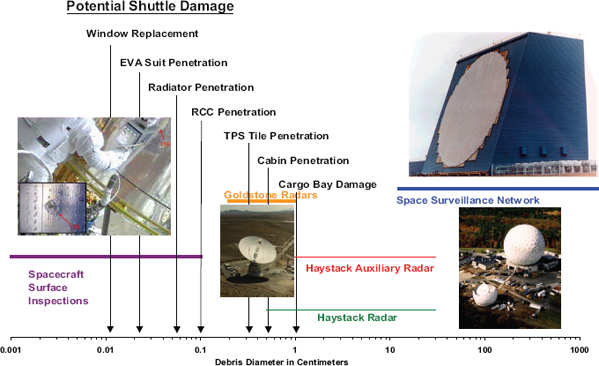
FIGURE 1 Meteoroid and orbital debris detection platforms and capabilities. SOURCE: John Lyver, NASA, presentation at the Workshop to Identify Gaps and Possible Directions for NASA’s MMOD Programs, March 9, 2011.
Another obstacle facing NASA is that even for particles that are centimeters in size, the agency lacks a process for determining how particle shape plays a role in the damage that can be caused by an impact. Methods to incorporate particle shape into impact models have not been validated, and hence the application of a safety factor in spacecraft design techniques may result in uncertainty to both weight and physical dimensions of a spacecraft designed to operate in the MMOD environment.
A third obstacle cited by panelists as adding uncertainties in design is that experimental facilities for testing spacecraft damage, including via hypervelocity testing, generally employ spheres or simple shapes made from aluminum. Moreover, typical impact speeds at these test facilities do not exceed speeds of 7-8 km/s, whereas the average relative impact velocity of orbital debris particles in low Earth orbit (LEO) is around 9 km/s, and orbital debris and meteoroids can reach relative impact velocities of up to 15 km/s and 70 km/s, respectively.1 Although ultra-high-velocity testing facilities exist, they are more expensive than facilities with conventional high-velocity-testing techniques, and they employ particles on the average of several microns in size. Thus extrapolation from such experiments, which do not duplicate debris shape or material properties, introduces even more uncertainties due to a mismatch of collision velocity.
Panelists did point out that the space shuttle and some spacecraft parts returned from orbit, for example solar panels from the Hubble Space Telescope (HST), have exhibited debris damage that can be analyzed, although the conditions of impact (debris shape, size, and impact velocity) are seldom known with precision.
___________________
1 Eric Christiansen, “Hypervelocity Impact Technology (HVIT) Group,” presented at the NRC Workshop to Identify Gaps and Possible Directions for NASA’s MMOD Programs, March 9, 2011.
Research by NASA’s Orbital Debris Program Office (ODPO) has demonstrated that even if additional spacecraft are not placed in LEO and if the 25-year rule2 for the maximum lifetime of a satellite is reduced significantly and followed by all agencies, the amount of debris in orbit has already reached the point that a continued increase in debris is likely due to collisions between objects already in orbit, which produce increasing numbers of collision products as time passes. This reality has impressed on policymakers the need to carry out R&D on the retrieval/removal of objects, particularly large objects, from orbit, and attention to this subject is now increasing as a result of its inclusion in the 2010 National Space Policy. Apart from preparing for the future of orbital debris prevention and mitigation, NASA and the U.S. government already have tools to address this issue to some degree.
Panelists discussed the use of tools such as conjunction assessment risk analysis (CARA) to forecast possible collisions between cataloged objects and operational spacecraft. CARA takes information from the Department of Defense’s (DOD’s) Joint Space Operations Center (JSpOC) and converts it into collision probabilities, which are then sent to the appropriate mission directors, who are ultimately responsible for making decisions on whether to initiate an orbit change for a satellite in potential danger. It was stated that, although this tool works efficiently, it can only be as good as the information entered, since particles smaller than what JSpOC can track can still cause significant damage. A panelist suggested that improving the quality and detail of the data received for CARA was a goal that could be met in part by improvements in how JSpOC screens and cross-checks its ephemeris3 data before sending it to NASA, as well as by having NASA join the Space Data Association, a non-profit organization of commercial satellite operators established to provide this type of support to industry users.
In addition to tracking and collision analysis efforts, it was noted that greater attention is being given to designing spacecraft for “passivation”4 so that spacecraft are less likely to create more debris from explosions or if struck by an object. Space systems can also be designed and constructed so that they are less likely to survive to the ground when they enter the atmosphere, thus posing less risk to people on the ground.
Nevertheless, technology and engineering solutions are still subject to administrative pressures. Such issues were brought up by a number of the NASA speakers, but one administrative issue was repeatedly mentioned: budgets are presently set on a year-by-year basis instead of a 2-year basis as in the past. This makes planning very difficult. For example, it was stated that there will likely be cost-overruns on the Meter Class Autonomous Telescope, which may occur late in this fiscal year. This would present the project manager with a challenge: Should they save a reserve and risk losing it on October 1? Or should they spend it all now and risk running out too early? The funding cycle is absolute; after the fiscal year, any remaining funds from what were provided that year disappear.
Another issue brought forward by the NASA leads is that the workforce in this area is not extensive enough to ensure continuity of expertise, nor are there sufficient resources to train new people or hire young engineers. This, too, is essentially a budgetary problem.
Research in the area of meteoroids is prone to many of the same problems as elucidated above, a point emphasized by one speaker who mentioned that approximately 40 percent of MMOD impacts on the space shuttle’s surface are from meteoroids. The task for the Meteoroid Environment Office is to identify the “background” meteoroid environment and the occasional meteoroid showers and their characteristics and then provide forecasts of possibly damaging effects in the regions of space outside LEO, where orbital debris does not dominate the hazard.
The NASA speakers expressed the need for research to develop a model of meteoroids in the outer solar system (Jupiter and beyond), improve instrumentation calibration for measuring meteoroid properties and trajectories, and resolve the question of whether spacecraft instrument failures are due to inherent component degradation or to electrical effects caused by impact of meteoroids traveling at velocities up to 70 km/s. The latter subject raised a
___________________
2 The “25-year rule” is a guideline adopted by the international organization, the Inter-Agency Space Debris Coordination Committee (IADC) in its “IADC Space Debris Mitigation Guidelines” released in 2002 and revised in 2007. The “rule” encourages entities with objects in low-Earth orbit to ensure that their spacecraft and/or launch hardware are in an orbit that will decay and cause said object to reenter Earth’s atmosphere within 25 years to mitigate the creation of more orbital debris. See http://www.iadc-online.org/Documents/Docu/IADC_Mitigation_Guidelines_Rev1_Sep07.pdf.
3 Data that provides the positions of spacecraft and other astronomical objects at a given time.
4 Passivation is the disabling of a satellite or object in space to prevent that object from creating more orbital debris, such as by exploding in orbit or colliding with another spacecraft. This can be accomplished in many ways, including draining onboard batteries, expending excess propellant, and/or positioning the object for atmospheric reentry.
good deal of commentary, because, until recently, electrical failures were assumed to be caused by either internal effects or space weather and were simply labeled as anomalies. However, one of the panelists described working with hypervelocity and plasma physics experts to investigate electrical anomalies caused by high-velocity meteoroid strikes so as to provide data that will better inform people dealing with this issue.
Recent advances in low-mass and low-power sensors, it was explained, open the possibility of covering large areas of a spacecraft with MMOD impact detection and location systems, which could also provide data for anomalies and failure analysis and perhaps even alerts on debris streams. Moreover, calibrated sensors could provide data on the size and flux of MMOD particles, and multifunctional shielding (combining thermal, radiation, self-healing and MMOD protection functions) could reduce MMOD risk and shielding mass.
At the end of the session, attendees from non-NASA organizations praised the efforts and accomplishments of the NASA MMOD programs, particularly when taking into account the small budgets under which the various entities operate.
SESSION 2: NASA MISSION OPERATORS
Five NASA project and mission managers described specific missions from an operations standpoint, emphasizing the design tools they use to meet MMOD requirements and their experiences with actual MMOD encounters or anomalous effects that may be attributed to such encounters. The missions represented on this panel were the Global Precipitation Measurement (GPM) mission; the ARTEMIS mission, which studies the Earth-Moon environment; the Hubble Space Telescope; the Earth observation missions Jason-1 and Ocean Surface Temperature Mission/Jason-2; and NASA Goddard Space Flight Center’s Space Science Mission Operations project, which is responsible for the management of space science missions from conceptual development through end of operations.
Committee members were interested in learning what MMOD-related problems missions encounter throughout the lifetime of a spacecraft, how NASA’s MMOD programs meet mission planners’ and operators’ needs, and what information mission managers are using to make decisions related to the operations of a spacecraft—in particular, those decisions related to MMOD.
The speakers said that Debris Assessment Software (DAS), which is a single modeling tool, is used for determining compliance with MMOD-related design requirements,5 but a number of speakers indicated that, although the software was easy to use and provided free to the public, it was essentially a “black box.” Users do not know how DAS arrives at its outcomes, so the user is unsure whether the results are conservative or not. The Object Reentry Survival Analysis Tool (ORSAT), which is used to predict the reentry survivability of satellite and launch vehicle upper-stage components that are entering due to orbital decay or from controlled entry, was stated to be more accurate than the reentry survivability predictor in DAS. Nevertheless, DAS was given a favorable opinion by panelists when used for its intended purpose.
In addition to demonstrating compliance with MMOD-related design requirements laid out in NASA Technical Standard 8719.14, the GPM program manager highlighted that the GPM mission used DAS to determine the shielding design for the satellite as well, which is not the software’s primary purpose. Some panelists expressed a desire for better verified software to assist with shielding design, and one speaker explained that the project team would have liked to have verified the design by using the BUMPER model but could not, primarily because of factors out of the project team’s control, namely funding.
Some of the speakers discussed the question of anomalous behavior and whether it could be traced to MMOD effects. Examples were given to illustrate the analysis that must be carried out to explain why a given effect that was initially noted as an instrument response might, for example, lead to conjecture that it could have been due to a meteoroid or orbital debris collision. When the Artemis spacecraft lost functionality of an instrument, the designers concluded that the support structure most likely broke due to fatigue, but the speaker highlighted the difficulty in arriving at a clear reason for the loss of data when first presented with a spacecraft anomaly.
___________________
5 All NASA missions are required to comply with the NASA Technical Standard 8719.14, “Process for Limiting Orbital Debris,” which provides “uniform engineering and technical requirements for processes, procedures, practices, and methods” for NASA projects and programs; available at http://www.hq.nasa.gov/office/codeq/doctree/871914.pdf.
The Hubble Space Telescope presented an interesting case because its development in the 1970-1980 time frame meant that it was not designed to perform any collision avoidance and was constructed with no significant shielding against MMOD impact strikes. As the risk of orbital debris damage increased, the HST team developed an orbit debris conjunction mitigation contingency procedure to handle predicted possible collisions with an object in the tracking catalog. The procedure uses a combination of real-time commanding and flight software macros for configuring HST in the event of a possible conjunction, and myriad contingency actions have been developed as a result. However, no conjunction assessment to date has caused an interruption to HST science operations. In case of a predicted close encounter with orbital debris, HST cannot change orbit but can only orient itself in such a way as to reduce the probability of a collision. The degree of risk involved in such a maneuver, however, needs to be weighed against the potential collision risk. To date, HST has never conducted this type of procedure. HST has furnished a great deal of photographic evidence of meteoroid collisions taken during space shuttle servicing missions, which have helped to build up a catalog of information useful to designers in the future.
The question was asked as to whether there has been any loss of science data or loss of engineering and vehicle performance on HST due to any type of debris. The reply was that most or all of the impacts on HST have been from meteoroids, not orbital debris, and they have not degraded or affected HST operations.
Two other missions represented at the workshop—Jason-1 and Jason-2—are collaborations between NASA, the National Oceanic and Atmospheric Administration (NOAA), and Centre National d’Etudes Spatiales, the French space agency, measuring sea levels, water vapor in the troposphere, and ocean surface temperature, among other scientific measurements. The international partnership necessitates the sharing between the two agencies of information that is protected both by International Traffic in Arms Regulations6 and a similar set of French export regulations. While the results of calculations on such matters as conjunction assessment numbers could be shared, the methods behind the calculations typically could not be shared, so no critical comparisons between the underlying assumptions in the calculations could be made.
The unintended consequences of compliance with debris regulations were illustrated in the case of the next satellite in this series, tentatively referred to as Jason-3 and/or Jason-CS, which is being designed to carry additional propellant that could be used to decommission or passivate the mission. However, carrying extra propellant would result in an increase in the collision cross section of the satellite, leading to a greater probability of collision and a greater debris risk if the propellant tank ruptures. If the mission fails and cannot be fully decommissioned, a drifting spacecraft with a much larger explosive potential would remain in orbit. Most spacecraft used for science missions, in particular those designed and launched prior to implementation of NASA’s current engineering design standards for mitigating creation of orbital debris, typically do not maneuver during their lifetime and lack propulsion systems that would allow them to deorbit for atmospheric reentry or avoid a collision.
SESSION 3: THE ROLE OF NASA’S MMOD PROGRAMS AND THEIR RELATIONSHIP TO OTHER FEDERAL AGENCIES
Representatives from the DOD, Federal Aviation Administration (FAA), NOAA, Department of State, and the Federal Communications Commission (FCC) involved in space policy, space and Earth science, and MMOD issues discussed challenges they face from the space environment, interagency issues and opportunities for collaboration, and how and to what extent they engage NASA’s MMOD programs.
One of the panelists noted that at the beginning of 2010, the Space Protection Program, a joint U.S. Air Force Space Command and National Reconnaissance Office program that advises the intelligence and military community on how to protect their critical space assets, conducted a study on orbital debris and concluded that orbital debris was a very significant problem requiring immediate action. The United States, the study concluded, could not wait to develop removal technologies, and an implementation plan was discussed. That plan was never implemented for the following reasons:
- Most of the proposals had a weapons-like character about them;
___________________
6 International Traffic in Arms Regulations, available at http://www.pmddtc.state.gov/regulations_laws/itar_official.html.
- No agreement could be reached on who would be responsible within the United States or internationally;
- The cost did not justify moving forward; and
- There was a lack of agreement on policy.
When it came to the point of including a statement in the text of the 2010 National Space Policy on actively removing debris from space, a panelist recalled, that phraseology was removed from the final version and the text now reads only that studies related to removal should be carried out.
One of the panelists made the observation that, in his opinion, if there is going to be any active debris removal in our lifetime, it will be done by commercial organizations. He cited an announcement that Intelsat is having informal talks with NASA about refueling satellites in geosynchronous or geostationary Earth orbit (GEO) for removal, and noted that ViviSat and DLR Germany are also working on this approach. He went on to say that U.S. policy for debris removal will not be developed, written, or changed in our lifetimes unless there is a catastrophic event in space. In the interim, NASA could fund commercial activities that would lead to debris removal, and it could also continue to fund research in this area.
A spokesman for the FAA said his agency is a regulatory agency, and its authority is more limited, in a sense, than NASA’s authority. The FAA has the authority to license launches and reentries that are purposeful and designed to survive substantially intact. The only MMOD-related requirement the FAA has is for passivation of upper stages by depleting propellants and drawing down energy sources. He said that his organization receives excellent support from NASA’s ODPO. The FCC is also a regulatory agency and derived the baseline for its guidelines for the mitigation of orbital debris from the Inter-Agency Space Debris Coordination Committee (IADC). However, the FCC representative did say that the FCC often sends people seeking commercial licenses from the FCC to NASA’s ODPO Web site to conduct their own preliminary assessment there before filing for a license. The FCC representative further bolstered NASA’s reputation in the MMOD community by saying that the FCC looks forward to NASA’s continued work, because “it’s where the FCC goes to.”
While NASA has a criterion of a 1 × 10⁻⁴ probability of risk for casualties on reentry, the FAA has a requirement of a 30 × 10–6 probability of ground damage from debris for just a launch, or for launch and controlled reentry combined, thereby underscoring differences in handling MMOD across agencies. This is one of many differences that illustrates the varied MMOD governmental policies in place that are not always coordinated across agencies, a fact that did not go unnoticed at the workshop. The FAA does not follow the 25-year rule, because it has not done a cost-benefit analysis to support its implementation. In order for the FAA to justify new policies or regulations, the agency representative explained, any new policies or regulations would have to decrease the cost of a casualty 10-fold based on the FAA’s current reentry damage/casualty probability threshold. The FCC, on the other hand, does follow the 25-year rule end-of-life guideline, but the FCC representative also noted that the issue of debris mitigation is not at the forefront of the organization’s planning apparatus.
A representative of the State Department discussed international efforts to mitigate the effects of orbital debris. The most prominent international body for information exchange on space debris is the 11-nation IADC. Since 1993, the IADC has conducted annual meetings to discuss research results in the areas of measurements, modeling, protection, and mitigation. The IADC is internationally recognized as a space debris center of competence and influences space debris mitigation activities through the United Nations (UN) Committee on the Peaceful Uses of Outer Space–Scientific and Technical Subcommittee.
As the State Department looks over the horizon, it sees an increasing number of governmental and non-governmental actors operating in space. The State Department is compelled to ensure that all groups conduct themselves responsibly in space, but the optimal approach remains elusive for now. The State Department is looking at what are some minimal actions nations can take to mitigate the creation of orbital debris, as well as reduce the risk to space assets from natural and manmade debris already in orbit. International avenues for addressing MMOD issues are adequate up to a point, but international guidelines are non-binding, and there is no supranational adjudicative body tasked specifically with international space law. The prime challenge in the future will be translating international consensus and standards into action on the national stage for individual countries. Although the majority of the world’s nations are signatories to treaties like the UN Outer Space Treaty and UN Liability Convention, there remain some that have yet to sign. This problem is compounded by countries, including treaty signatories
like Brazil and India, that acknowledge the need for a sustainable space environment but do not want their space programs impeded by guidelines developed by the nations that created the problem of space debris in the first place—namely Russia (and former Soviet Union) and the United States.
The panel speakers all asserted that they derive tremendous value from NASA’s ODPO, which also allows their agencies to speak knowledgeably about MMOD issues in international and interagency forums. In the case of NOAA, NASA builds the spacecraft and treats them as they would a NASA mission. Nonetheless, the relationships between these agencies and NASA’s MMOD programs vary from agency to agency, and it was revealed at the workshop that there were varying degrees of coordination on the matter within the agencies themselves. When asked who the technical lead is within DOD on MMOD issues, the DOD panelist said that there was no such position at DOD, an agency with an even larger space portfolio than all of the U.S. government’s civil space programs combined. When this question was asked for the entire U.S. government, the panelists said that there is no true lead for MMOD in the U.S. government as a whole either.
Responding to a question about data sharing and spacecraft anomaly analysis and cataloging, panelists explained how interagency data either are not shared or are heavily edited before going from classified to non-classified status, and that the commercial industry is not a particularly helpful or reliable source of anomaly information.
SESSION 4: MMOD AND THE COMMERCIAL INDUSTRY PERSPECTIVE
Representatives of the satellite communications firm Iridium Satellite Communications, aerospace manufacturer Lockheed Martin, and insurance firm XL Insurance talked about how MMOD affects business operations, from the manufacturing of spacecraft to making on-orbit decisions about possible collisions. Among many other topics, this panel discussed the tools industry uses to make decisions affecting their space assets, what their relationship is with NASA’s MMOD programs, and what opportunities for collaboration there might be between industry and NASA.
After hearing from various NASA employees and other federal agency representatives, the panel provided a different perspective on the MMOD issue, starting with a description of the Iridium firm and the 2009 collision event between Iridium 33 and the Russian satellite Cosmos 2251. In the past, explained the Iridium representative, there was never any information on orbital characteristics that could be relied on for actionable decisions by program/mission managers, including two-line elements.7 Up until 2009, in fact, Iridium had never adjusted a satellite’s orbit, and the predominant attitude toward spacecraft and orbital slots was the “Big Sky”8 viewpoint. A review of predicted conjunctions for February 10, 2009, showed a possible collision between the Iridium 33 and Cosmos 2251 satellites, but that conflict was 16th on a list of possible conjunctions, so no action was taken.
The Iridium 33-Cosmos 2251 conjunction was the first payload-to-payload collision in the history of spaceflight. Following the collision, Iridium initiated an anomaly recovery process, coordinating with JSpOC throughout this process. As a result, the company has a more robust relationship with JSpOC, but the Iridium representative did not mention involvement from NASA’s ODPO. When asked if a more careful analysis of conjunction using all of the data available would have predicted the collision, the Iridium representative said that the company is in the midst of conducting an analysis, and a report will be published with those results.
Today, Iridium receives daily conjunction assessment updates from JSpOC, which are assessed to gauge the level of risk for each reported conjunction. Since the 2009 conjunction event, Iridium has made 41 maneuvers, whereas before 2009 it had made none.
Although Iridium has not interfaced a great deal with NASA or NASA’s ODPO, the representative from Lockheed Martin explained how that company incorporated NASA’s work in MMOD into the design and construction of NASA’s Orion crew vehicle capsule. Orion is the first human-rated reentry spacecraft designed to stringent
___________________
7 A two-line element is a set of two 69-character lines of data used to describe the orbit and perturbations of a satellite around Earth. New two-line element sets are generated by the Air Force Space Command on an as-needed basis and not according to a previously established timetable.
8 According to “Big Sky” proponents, the number of spacecraft in Earth orbit is negligible, given the overall scale of the environment being considered.
MMOD-related design requirements for a variety of missions, including to LEO, the Moon, and Mars. Engineers make difficult decisions when designing spacecraft shields, since there are always tradeoffs to increasing shielding, such as increased cost, volume, and mass to the spacecraft (for mechanical, not electrical, shielding). The increase of orbital debris in the space environment only makes this task harder. The speaker identified two levels of concern in designing Orion: (1) loss of crew, which includes damage to the Orion vehicle either in orbit or during reentry, and (2) loss of mission, which includes damage that prompts a mission abort or an unsafe vehicle reentry. The project team used the BUMPER II code to analyze more than 500 shield configurations, which will allow Orion to stay in orbit for roughly 6 months. In addition, NASA’s Orbital Debris Environment Model (ORDEM) and Meteoroid Environment Model (MEM) were combined with Orion attitudes and trajectories for calculating a variety of design-related needs based on mission scenarios. Finally, the design team performed shield tests at facilities such as the University of Dayton Research Institute and White Sands Test Facility. These facilities can launch particles at between approximately 6.5 km/s and 10 km/s, but, as some committee members pointed out, these speeds are still below the maximum relative impact velocities for debris in LEO and lower by a factor of 2 to 10 than the speed of all meteoroid populations. The result of these tests and analyses is an MMOD shielding mass that is a little more than 0.5 percent of the total vehicle mass.
The representative of Lockheed Martin also discussed launch vehicles, saying that there are no requirements for launch vehicle de-orbiting of spent stages. However, in the case of a transfer orbit GEO, a launch company can decay the orbit of the spent stage so that atmospheric drag will eventually cause reentry of the rocket. In addition, efforts are made to ensure that propellant tanks are emptied and depressurized after launch.
The potential for further debris creation, perhaps by a spent rocket stage that has not de-orbited yet, relates directly to another area covered by this panel: space insurance. The XL Insurance representative described the state of the space insurance industry as having events that are low in frequency but very high in severity. This issue is compounded by the fact that the space insurance industry does not have a very large funding reservoir. Space insurance covers first-party losses (e.g., loss of asset, loss of revenue) and third-party losses (e.g., liability for damage to third parties) of satellite operators, launch providers, satellite and launch vehicle manufacturers, and others. There are currently 195 insured satellites in orbit for a total insured value of $19.8 billion. Over the past decade, the probability of satellite failure after completion of orbit raising and initial testing, as assumed by the insurance industry, oscillated between 1.5 and 2.0 percent per year. The speaker also noted that MMOD damage is covered by typical space insurance packages.
Third-party insurance claims for objects in space can be complicated by the vagaries of international space law. Determining the cause of an incident and subsequent liability can be very difficult. According to the UN Liability Convention of 1972,9 the launching state is liable for objects in space that were launched from within its borders. Determining the cause of an incident and subsequent liability, however, can be very difficult. According to the UN Liability Convention of 1972, a launching state can be liable for its own launches or launches it procures that occur from its own territory or facilities. Fault is the standard that applies to damage that occurs in space. Determining fault requires proving that the launching state’s conduct violated an applicable standard of care. The treaty regime also makes it illegal for a nation to unilaterally remove an object or derelict spacecraft from orbit if it is not also the launching state. In the case of the Iridium-Cosmos collision, there was no clear onus of responsibility for maneuvering either satellite.
When panelists were asked to suggest areas in which NASA could provide augmented or additional services, one panelist expressed a desire for more and “better” data on the outer solar system environment and more high-velocity shield testing. Another panelist wanted more effort made to enhance the ability to track satellites in orbit, including greater cooperation between NASA and JSpOC. The idea of using hosted payload slots to launch missions to characterize the MMOD environment was brought forward as well. Finally, a panelist said that ODPO’s quarterly newsletter is very useful, but that he would like to see the charts used in the newsletter updated more frequently, as well as for NASA to provide greater access to more regularly updated data elsewhere. After hearing
___________________
9 Convention on International Liability for Damage Caused by Space Objects, available at http://www.oosa.unvienna.org/oosa/SpaceLaw/liability.html.
this comment, a NASA employee told the gentleman to get in touch with him, and he would provide the panelist with whatever information he needed.
SESSION 5: ORBITAL DEBRIS RETRIEVAL AND REMOVAL
The 2010 National Space Policy calls for NASA and DOD to lead research and development efforts in orbital debris retrieval and removal. Representatives of NASA’s technology development programs, DOD, and the Office of Science and Technology Policy (OSTP)10 talked about these efforts and what it would take to help engineer a safer space environment.
Space policies convey themes and opportunities to external organizations, as well as provide guidance to government agencies. There have been national space policies in the United States since the Eisenhower Administration, and, according to the OSTP representative, the UN Outer Space Treaty will continue to be a foundation for U.S. space policies.
The 2010 National Space Policy places significant new emphasis on broad international cooperation with the goal of increasing stability and transparency in space. Preserving and ensuring a sustainable space environment is necessarily an international endeavor, and there will only be more national and non-governmental actors in space over the coming years and decades.
The new space policy, explained the OSTP representative, tries to address orbital debris in multiple ways to strengthen measures to minimize creation of debris; call for agencies to continue to lead in the development and adoption of standards; improve data sharing, both among agencies and internationally; and encourage agencies to utilize tools already in their arsenal to mitigate and possibly remove orbital debris. Some examples include finding synergies between U.S. Strategic Command and NASA models, data collection, and conjunction analyses. Emphasis is placed on research and development because the government does not yet know what technologies will ultimately be necessary or are feasible on the scale required for effective orbital debris retrieval and removal, as well as guaranteed prevention of collisions if such an event is predicted. Although the National Space Policy calls for research and development in this field, it does not specify a threshold or goal, but rather intends such research and development as a beginning to the entire process.
The recently created NASA Office of the Chief Technologist (OCT) plans to work on new “game-changing” technologies across many disciplines, including orbital debris retrieval and removal. Among the new division’s many goals, OCT will be the principal NASA advisor and advocate on matters concerning agency-wide technology policy and programs, direct management of OCT Space Technology Programs, and coordination of technology investments across the agency. OCT will work on technologies from technology readiness levels (TRLs) 1-7, divided into three groups: early-stage innovation (TRL 1-2), game-changing technology (TRL 3-4), and crosscutting capability demonstration (TRL 5-7).
Regarding orbital debris, OCT will participate in studies of the problem and partner with others to develop technologies that allow for orbital debris hazard mitigation and removal, including releasing solicitations for orbital debris-related technologies that have specific parameters. NASA’s ODPO will be the focal point for these activities and, among its other responsibilities, will remain in charge of environment characterization, while OCT focuses on the development of new technologies. In formulating its solicitations, OCT is using responses from requests for information and is conducting discussions with mission directorates, the Orbital Debris Program Office, and industry.
The OCT representative also considered the idea of a U.S. government interagency study to address the issue of orbital debris. None of NASA’s mission directorates have taken responsibility for addressing orbital debris, even though the 2010 National Space Policy tasks NASA with taking a lead. When asked how such a study might proceed, panelists replied that there are a variety of ways a study could be convened. The process could begin
___________________
10 The Office of Science and Technology Policy, an executive branch-level office, is the lead office for providing the president of the United States with scientific and technical advice, as well as coordinating presidential science and technology policy throughout the U.S. government.
in a number of ways, including in the executive branch, at the agency level, or in an informal setting between government employees.
Despite an acknowledgment from NASA and OSTP that MMOD is a major issue that needs to be addressed, an even more immediate concern voiced by a senior NASA official was the agency’s budget, echoing earlier statements made by the Session 1 panelists. Not only is the amount of funding available for the agency a source of anxiety, but so too is the uncertainty of that funding under a series of continuing resolutions instead of a true appropriations bill. One panelist said that he has not yet seen a credible amount of funding for implementation or research into characterizing or improving the space environment.
Nevertheless, NASA will continue to consider MMOD concerns for exploration technologies, and agency-level requirements to reduce crew risk is a driver for spacecraft design. Right now, the International Space Station is the benchmark for safety and protection from MMOD, but NASA wants to expand beyond it. Members of this panel noted that another area that needs improvement is information and data sharing across agencies and international lines.
When asked what some of the obstacles are to sharing MMOD-related data, an issue that was prevalent throughout the workshop, panelists suggested numerous reasons. One panelist explained how there is a tendency toward mission-specific solutions; a mission can be a driver for data sharing, but data sharing in and of itself is not necessarily useful. Another panelist said that figuring out the objective of data sharing is just as important as what is being shared, and who is involved is a challenge all of its own. Perhaps the greatest obstacle, though, is time. Gathering everyone involved to work out solutions is very time consuming, and there is no shortage of other pressing government challenges that all require serious attention. At the end of the session, some panelists noted that they were still not sure what are the greatest risks posed by debris, nor was it clear whether there has been a comprehensive risk assessment conducted about MMOD on a global scale.
OBSERVATIONS OF INDIVIDUAL COMMITTEE MEMBERS
The following observations were made by committee members following the workshop presentations in closed session and were then communicated to the audience and panelists within the hour, constituting the concluding portion of the workshop. As stated during the workshop, they should not be interpreted as findings or recommendations of the committee nor committee consensus, but rather, as the title suggests, observations from individual committee members following the workshop presentations and the subsequent discussions with the panelists and members of the audience.
• The committee heard that one of the NASA MMOD programs’ goals, if not the overriding goal, is to protect the space environment.
• The NASA MMOD programs have well characterized the threat posed by orbital debris and have influenced the space community and industry to take MMOD considerations into greater account in spacecraft designs and human spaceflight operations.
• There is uncertainty surrounding how to move forward with active removal of debris, and there does not appear to be an economic basis for orbital debris retrieval or removal. There seems to be a gap between policy and the capability to implement the policy.
• It remains unclear if a probabilistic risk assessment has been conducted that would help provide overall guidance for the programs, but such an assessment might be a useful activity.
• There are still some areas in which agencies working on MMOD issues are trying to structure a stronger regulatory framework, and this ongoing process should bear some fruit in coming years.
• U.S. foreign policy likes to set examples for other nations as a way of encouraging them to adopt procedures or guidelines that the United States believes are good and appropriate. There seems to be a fractured understanding across U.S. agencies as to their adoption, use, and clarifications of the MMOD guidelines, which became clearer throughout the workshop. If this improved understanding is further refined, the United States could provide a clearer example for other countries of how to structure similar governmental MMOD programs.
• The number and the variety of users of NASA MMOD programs, data, models, and services are impressive, with most of these interactions being carried out without formal contracts, compensation, or acknowledgment.
• If NASA moves forward with actual orbital debris retrieval, it will be a tremendous, time-intensive project.
• A lot of research needs to be done to improve the quality of conjunction assessment models.
• Conjunction analysis has gained greater prominence in the space community, and its use has increased over recent years. Nevertheless, despite U.S. Air Force efforts to provide more data to government agencies and industry on this matter, release of data appears inconsistent and infrequent, according to what was heard at the workshop.
• Engineering models like ORDEM2000 and BUMPER continue to be improved. If NASA could update publicly available models more frequently, the space community would benefit greatly in designing its own spacecraft with the most up-to-date information.
• The large differences between rules among the different agencies to satisfy MMOD guidelines are surprising.
• The fact that the 2010 National Space Policy focuses on the issues associated with orbital debris and is on target is impressive, despite the paucity of technical input in the policy formulation phase.
• Funding and personnel issues pose great challenges to NASA’s MMOD activities.
• Numerous national, international, and commercial entities have extensive spacecraft anomaly databases, yet, based on what was heard at the workshop, efforts to consolidate or summarize the data have been ineffective.
• Not having a single point of contact within NASA with authority over all MMOD program elements, modeling, and tool development appears to undermine ensuring the flexibility, consistency, quality, and relevance of priorities set across NASA.
This page intentionally left blank.
This page intentionally left blank.
Reply to Attn of: Office of Safety and Mission Assurance
Dr. Raymond A. Colladay
Chair, Aeronautics and Space Engineering Board
National Research Council
500 5th Street, NW
Washington, DC 20001
Dear Dr. Colladay:
The White House Office of Management and Budget and Office of Science and Technology Policy have requested that the NASA Administrator “establish a National Research Council [NRC] study of opportunities for NASA to enhance the benefits delivered by its orbital debris program in the context of a fairly constrained budget environment.”
For the past two decades, NASA has built a robust program to evaluate and limit the generation of orbital debris (OD) and the risk to NASA spacecraft associated with OD and micrometeoroids (MM). NASA’s OD and MM programs are recognized worldwide, yet with the growth of orbital debris over the past few years, we recognize the responsibility to use our capabilities and assets to support not just NASA needs, but also to support, as a national resource, other national and international OD and MM activities. The NRC generated foundational studies of these issues in 1989, 1995, and 1997, all of which form the basis for NASA’s role in OD and MM. Therefore, we request that the NRC conduct a study to:
• Review existing NASA policy/efforts and organization with regards to OD and MM, including:
o Modeling and simulation
o Detection and monitoring
o Protection
o Mitigation
o Reentry
o Collision Assessment Risk Analysis and Launch Collision Avoidance
o Interagency cooperation
o International cooperation
o Cooperation with the commercial space industry
• Assess whether NASA should initiate work in any new OD/MM areas.
• Recommend whether NASA should increase or decrease effort, or change the focus of, any of its current MM/OD efforts (within a fairly constrained budget) to improve the office’s ability to serve NASA and other national and international activities.
I would like to request that NRC submit a plan to NASA for this study. NASA will provide a review of current OD and MM efforts and associated data sources to NRC at an early opportunity. The results of this study will be of the highest value to NASA in formulating the FY-2013 budget. We will need the findings and recommendations review completed by March 31, 2011. Once agreement with NRC on the scope and cost of the proposed study has been achieved, the NASA Contracting Officer will issue a task order for implementation. Mr. John W. Lyver, IV, will be the NASA technical point of contact for this effort and may be reached at (202) 358-1155 or by e-mail at JLyver@NASA.GOV.
Sincerely,
The National Research Council, under the auspices of the Aeronautics and Space Engineering Board, will establish an ad hoc committee to assess NASA’s orbital debris programs and provide recommendations on potential opportunities for enhancing their benefit to the nation’s space program.
The committee will:
1. Review NASA’s existing efforts, policies, and organization with regard to orbital debris and micrometeoroids, including efforts in the following areas:
- Modeling and simulation;
- Detection and monitoring;
- Protection;
- Mitigation;
- Reentry;
- Collision assessment risk analysis and launch collision avoidance;
- Interagency cooperation;
- International cooperation;
- Cooperation with the commercial space industry.
2. Assess whether NASA should initiate work in any new orbital debris or micrometeoroid areas.
3. Recommend whether NASA should increase or decrease effort in, or change the focus of, any of its current orbital debris or micrometeoroid efforts to improve the programs’ abilities to serve NASA and other national and international activities.
The committee should assume that the programs will be operating in a constrained budget environment.
The study will result in two reports. The first will be a workshop report and the second will be the committee’s final report at the conclusion of the study.
This project is sponsored by NASA.
| MARCH 9, 2011 | |
| 10:30 a.m. | Workshop Introduction Don Kessler, Chair |
| 10:35 a.m. | Session 1: NASA Meteoroid and Orbital Debris Programs The leads for NASA’s Meteoroid and Orbital Debris (MMOD) programs will speak about program goals, issues, gaps, and opportunities. |
|
Panelists: John Lyver, Office of Safety and Mission Assurance, NASA Headquarters, Manager of NASA’s Meteoroid and Orbital Debris Program Offices Gene Stansbery, NASA Orbital Debris Program Office, Johnson Space Center William Cooke, Meteoroid Environment Office, Marshall Space Flight Center Eric Christiansen, Hypervelocity Impact Technology Group, Johnson Space Center/Human Exploration Science Office Lauri Newman, NASA Robotic Conjunction Assessment Risk Analysis, Goddard Space Flight Center |
|
| 12:00 p.m. | Lunch |
| 12:45 p.m. | Session 2: NASA Mission Operators Project managers and system engineers from various NASA robotic missions will discuss MMOD issues from an operations standpoint. What MMOD-related problems do missions encounter throughout the lifetime of a spacecraft? How do NASA’s MMOD programs meet mission planners’ and operators’ needs? What information are mission managers using to make decisions related to the operations of a spacecraft, and how do mission managers make MMOD-related decisions? |
|
Panelists: Michael Rhee, Systems Engineer, Global Precipitation Measurement Mission, Goddard Space Flight Center |
|
|
Mark Woodard, Senior Flight Dynamics Engineer, ARTEMIS Mission, Goddard Space Flight Center Patrick Crouse, Operations Project Manager, Hubble Space Telescope, Goddard Space Flight Center Glenn Shirtliffe, Project Manager, Jason-1 and OSTM/Jason-2 Missions, Jet Propulsion Laboratory Richard Burns, Program Manager, Space Science Mission Operations, Goddard Space Flight Center |
|
| 2:15 p.m. | Session 3: Role of NASA’s MMOD Programs and Their Relationship to Other Federal Agencies |
| Representatives of U.S. government agencies involved in space policy, space and Earth science, and MMOD issues will discuss challenges they face from the space environment, interagency issues and opportunities for collaboration, and how and to what extent they engage NASA’s MMOD programs. | |
|
Panelists: Andrew Palowitch, Director, Space Protection Program, Air Force Space Command/National Reconnaissance Office Phil Brinkman, Program Lead for Licenses, Office of Commercial Space Transportation, Federal Aviation Administration Mark Mulholland, Senior Advisor, Office of Systems Development, National Environmental Satellite, Data, and Information Service, National Oceanic and Atmospheric Administration Kenneth Hodgkins, Director, Space and Advanced Technology, Bureau of Oceans and International Environmental and Scientific Affairs, U.S. Department of State Karl Kensinger, Associate Division Chief, Satellite Division, International Bureau, Federal Communications Commission |
|
| 4:15 p.m. | Day 1 Adjourns |
| 6:00 p.m. | Committee Working Dinner |
| MARCH 10, 2011 | |
| 9:00 a.m. | Session 4: MMOD and the Commercial Industry Perspective Members of the aerospace and space insurance industries will talk about how MMOD affects business operations, from the manufacturing of spacecraft to making on-orbit decisions about a possible collision. What tools does industry use to make decisions affecting their space assets, what is industry’s relationship with NASA’s MMOD programs, and what opportunities for collaboration are there between industry and NASA? |
|
Panelists: John Campbell, Lt. Gen. (ret.), USAF, Executive Vice President of Government Programs, Iridium Satellite Communications Larry Price, Orion Deputy Program Manager, Lockheed Martin Space Systems Chris Kunstadter, Senior Vice President, XL Insurance |
|
| 10:45 a.m. | Session 5: Panel on Orbital Debris Retrieval and Removal The 2010 National Space Policy calls for U.S. government research and development efforts to be made to retrieve and remove orbital debris, but how will that policy be turned into action? |
| Representatives of NASA’s technology development programs, the Department of Defense, and the Executive Office of the President will talk about these efforts and what it will take to help engineer a safer space environment. | |
|
Panelists: Wilson Harkins, Deputy Chief, Safety Mission Assurance, NASA Steven Meier, Director, Crosscutting Capability Demonstration Division, NASA Office of the Chief Technologist Damon Wells, Senior Advisor, Office of Science and Technology Policy |
|
| 12:30 p.m. | Lunch and Committee Working Lunch in Closed Session |
| 1:30 p.m. | Discussion of Observations and Conclusions from Workshop |
| 2:00 p.m. | Workshop Adjourns |
D
Committee and Staff Biographical Information
COMMITTEE FOR THE ASSESSMENT OF NASA’S ORBITAL DEBRIS PROGRAMS
DONALD J. KESSLER, Chair, retired from NASA as a senior scientist for orbital debris research. He has more than 30 years of experience in scientific research associated with orbital debris, meteoroids, and interplanetary dust, especially in relation to developing mathematical models, deriving collision probabilities, using sampling techniques, and defining the space environment. Mr. Kessler was a consultant to NASA through Lockheed on orbital debris models and to Prairie View A&M University on orbital debris course development. He worked at NASA’s Johnson Space Center as a senior scientist for orbital debris research in the Solar System Exploration Division, where he coordinated NASA’s orbital debris research program. He also participated in national and international reviews of other agencies’ orbital debris programs and participated in establishing the Inter-Agency Space Debris Coordination Committee, an international agency to address orbital debris issues. He also developed orbital debris models; recommended and developed experiments to test models; analyzed orbital debris data; conducted classes, workshops, and symposia on orbital debris; and recommended cost-effective techniques to control orbital debris. Mr. Kessler modeled interplanetary meteoroid environments, flight control of Skylab experiments, and atmospheric environments, and he developed early orbital debris models and began establishing the need for an orbital debris program. Mr. Kessler participated in U.S. Air Force (USAF) and Strategic Defense Command tests and measurements programs, as well as in studies on orbital debris by various organizations, such as the USAF Scientific Advisory Board, AIAA, the Office of Technology Assessment (OTA), and the Government Accountability Office. Mr. Kessler has published approximately 100 technical articles or extended abstracts on meteoroids and orbital debris and is a contributing author or editor of 10 major reports. He was the managing editor for Space Debris, an international journal. He received the IAASS Jerome Lederer Space Safety Pioneer Award, the AIAA Losey Atmospheric Sciences Award in 2000, and the NASA Medal for Exceptional Scientific Achievement. Mr. Kessler received his B.S. in physics from the University of Houston.
GEORGE J. GLEGHORN, Vice Chair, is an independent consultant who retired as vice president and chief engineer of TRW Space and Technology Group, now a part of Northrop Grumman. During his 37 years at TRW, he contributed to a wide range of distinguished spacecraft: Pioneer I, the first NASA spacecraft; Pioneer 5, which reported the first data received from interplanetary space; Intelsat III, the first satellite to broadcast live television worldwide; the Orbiting Geophysical Observatory; and NASA’s Tracking and Data Relay Satellite. He contributed to Pioneer 6, Pioneer 10, and Pioneer 11 and to the development of the Atlas, Thor, and Titan ballistic missiles.
Prior to TRW, Dr. Gleghorn worked at Hughes Aircraft and at the Jet Propulsion Laboratory, and he served as a naval officer in the Korean War. He is a member of the NAE, a fellow of AIAA, and a member of the Institute of Electrical and Electronics Engineers (IEEE). He has also been a member of independent design and readiness review groups on the Hubble Space Telescope refurbishment mission, the Cassini/Huygens orbiter, the probe of Titan, and the Chandra X-Ray telescope spacecraft. Dr. Gleghorn holds a B.S. in electrical engineering from the University of Colorado and M.S. and Ph.D. degrees in electrical engineering and mathematics from the California Institute of Technology. He was a member of the NASA Aerospace Safety Advisory Panel for 10 years and the NRC National Weather Service Modernization Committee, the Committee on Membership, the Aerospace Engineering Peer Committee, the Committee on International Space Station Meteoroid/Debris Risk Management, and the Committee on Space Debris.
KYLE T. ALFRIEND is the TEES Distinguished Research Chair and Professor in the Department of Aerospace Engineering at Texas A&M University. His areas of research include astrodynamics, satellite altitude dynamics and control, space debris, space surveillance, and space systems engineering. Dr. Alfriend has received the American Association for the Advancement of Science (AAAS) International Scientific Cooperation Award, the AIAA Mechanics and Control of Flight Award, and the American Astronautical Society Dirk Brouwer Award. He is a member of the NAE and a fellow of AIAA. Dr. Alfriend earned his M.S. in applied mechanics from Stanford University and his Ph.D. in engineering mechanics from Virginia Tech. He has served as a member of the NRC’s Aeronautics and Space Engineering Board and of the Committee on the Future of the U.S. Aerospace Infrastructure and Aerospace Engineering Disciplines to Meet the Needs of the Air Force and the Department of Defense.
MICHAEL J. BLOOMFIELD is vice president and general manager of space systems at Oceaneering Space Systems. Prior to joining Oceaneering, he was vice president for Houston operations at Alliant Techsystems Inc. (ATK). Mr. Bloomfield is a veteran astronaut of three space shuttle flights. Selected as a NASA astronaut in 1994, he served as pilot on STS-86 and STS-97 and as commander of STS-110. While at NASA he also held important management positions with the astronaut office, including chief instructor astronaut, chief of astronaut safety, and deputy director of flight crew operations. Additionally, Mr. Bloomfield was director of shuttle operations and chief of the shuttle branch. He also served as deputy director of the Flight Crew Operations Directorate before leaving NASA in 2007 to join ATK. Mr. Bloomfield received his B.S. in mechanical engineering from the U.S. Air Force Academy and his M.S. in engineering management from Old Dominion University.
PETER BROWN is a professor at the University of Western Ontario (UWO) and a member of the Western Meteor Physics Group. He studies small bodies of the solar system, with a particular emphasis on meteors, meteorites, meteoroids, and asteroids. His research interests include answering basic questions about the origin and evolution of small bodies in the solar system, such as the origin of meteoroids (comets/asteroids/interstellar and the proportions of each), the origin of meteorites, the physical structure of meteoroids (bulk density/dustballs and what this says about their origin), and the flux and interaction of larger meteoroids at Earth (meteorites, breakup in the atmosphere). Dr. Brown has received the UWO Governor General’s Gold Medal and the Plaskett Medal of the Canadian Astronomical Society and the Royal Astronomical Society of Canada, is the Canada Research Chair in Meteor Science, and won an Ontario Distinguished Researcher Award. He earned his B.Sc. in honors physics from the University of Alberta and his M.Sc. and Ph.D. in physics from the UWO.
RAMON L. CHASE is an associate at Booz Allen Hamilton. He has worked on three new concept efforts: the Fly back Booster System, the Point-to-Point Delivery System, and the Transatmospheric Vehicle. He is also the DARPA representative to the Joint NASA DARPA Horizontal Launch Initiative study advisory group. Previously, he was a principal and division manager at ANSER, where he participated in the development of a National Hypersonic Roadmap and an Air Force Integrated Space Architecture. He has served as a study leader at General Research Corporation and as a propulsion lead to the Jupiter Orbiter Planetary Spacecraft Preliminary Design Team at California Institute of Technology’s Jet Propulsion Laboratory. Mr. Chase has written more than 30 technical papers on advanced space transportation systems, military space planes, single stage-to-orbit launch vehicles, orbital
transfer vehicles, technology readiness assessment, and advanced propulsion systems. He is an AIAA associate fellow and has served on the AIAA Hypersonics Program Committee and the AIAA Space Transportation Technical Committee. He also chaired the Society of Automotive Engineers (SAE) Hypersonic Committee and SAE Space Transportation Committee. Mr. Chase received an M.A. in public administration from the University of California.
SIGRID CLOSE is an assistant professor in the department of aeronautics and astronautics at Stanford University. Prior to joining Stanford, Dr. Close was a project leader at Los Alamos National Laboratory and a technical staff member at the Massachusetts Institute of Technology’s (MIT’s) Lincoln Laboratory, where she led programs to characterize meteoroids and meteoroid plasma using high-power radars. She was also the lead space physicist for spacecraft monitoring and unplanned space surveillance events and was a project leader for characterizing and modeling ionospheric plasma instabilities. Dr. Close’s current research area is in space weather and satellite systems, which includes characterizing and mitigating environmental risks to spacecraft; detecting and characterizing interstellar dust; signal processing and monitoring using radio-frequency satellite systems; and plasma modeling for remote sensing. Her honors and awards include the Joe D. Marshall Award, given by the Air Force Technical Applications Center for Outstanding Technical Briefing, MIT Lincoln Scholar, and first place in the student paper competition at the International Union of Radio Science. She was the vice chair of Commission G of the International Union of Radio Science. Dr. Close received her Ph.D. in astronomy (space physics) from Boston University.
JOANNE IRENE GABRYNOWICZ is director of the National Center for Remote Sensing, Air, and Space Law at the University of Mississippi; and editor-in-chief of the Journal of Space Law. Dr. Gabrynowicz teaches space law and remote sensing law and was a founding faculty member of the University of North Dakota Space Studies Department. She has served as the dean of the NASA Space Academy at Goddard Space Flight Center, as the managing attorney of a law firm, and as an official observer for the International Astronautical Federation to the United Nations’ Committee on the Peaceful Uses of Outer Space. She was a member of the International Institute of Space Law delegation to the Unidroit Committee of Governmental Experts for the Preparation of a Draft Protocol to the Convention on International Interests in Mobile Equipment on Matters Specific to Space Assets. Dr. Gabrynowicz is the organizer and chair of the Federal Advisory Committee for the National Satellite Land Remote Sensing Data Archive, and she served as a member of the OTA’s Earth Observations Advisory Panel and the Department of Commerce Advisory Committee on Commercial Remote Sensing. She advised the Eisenhower Institute on its study “The Future of Space—the Next Strategic Frontier.” She is a member of the International Society for Photogrammetry and Remote Sensing International Policy Advisory Committee, the American Bar Association, the Forum on Aviation and Space Law, the New York State Bar, the International Institute of Space Law, and Women in Aerospace, among other groups. Dr. Gabrynowicz received her B.A. from Hunter College and her J.D. from the Yeshiva University Cardozo School of Law.
ROGER E. KASPERSON is a research professor and distinguished scientist at Clark University. He also taught at the University of Connecticut and Michigan State University. He has written widely on issues connected with risk analysis, risk communication, global environmental change, risk and ethics, and environmental policy. Dr. Kasperson has been a consultant or advisor to numerous public and private agencies on energy and environmental issues and served on various committees of the NRC and the Council of the Society for Risk Analysis. He chaired the International Geographical Union Commission on Critical Situations/Regions in Environmental Change. He was vice president for Academic Affairs at Clark University and was elected director of the Stockholm Environment Institute. He served as co-chair of the scientific advisory committee of the Potsdam Institute for Climate Change and is on the Scientific Steering Committee of the START Programme of the International Geosphere-Biosphere Programme. Dr. Kasperson is a member of the NAS and the American Academy of Arts and Sciences. He has been honored by the Association of American Geographers for his research on hazards and is a recipient of the Distinguished Achievement Award of the Society for Risk Analysis. He received his Ph.D. from the University of Chicago.
T.S. KELSO is currently a senior research astrodynamicist for the Center for Space Standards and Innovation (CSSI) in Colorado Springs, Colorado. He has nearly 30 years of experience in space education, research, analysis,
acquisition, development, operations, and consulting with organizations such as the Air Force Space Command Space Analysis Center; NASA’s Near-Earth Object Science Definition Team; the Air Force Chief of Staff’s SPACE-CAST 2020 and Air Force 2025 future studies; and the Air Force Satellite Control Network. Dr. Kelso has taught on the faculty at the Air War College; the Air Command and Staff College; the Airpower Research Institute; the College of Aerospace Doctrine, Research, and Education; and the Air Force Institute of Technology. He has supported the space surveillance community by operating electronic data dissemination systems to provide the North American Aerospace Defense Command two-line orbital element sets, associated orbital models, documentation, software, and educational materials to users around the world. Dr. Kelso received a B.S. in both physics and mathematics from the U.S. Air Force Academy, an M.B.A. in quantitative methods from the University of Missouri, Columbia, an M.S. in space operations from the Air Force Institute of Technology, and a Ph.D. in mechanical engineering (operations research) from the University of Texas, Austin.
MOLLY K. MACAULEY is a senior fellow and research director at Resources for the Future, where her research has included studies on economics and policy issues of outer space, the valuation of non-priced space resources, the design of incentive arrangements to improve the use of space resources, and the appropriate relationship between public and private endeavors in space research, development, and the commercial enterprise. Dr. Macauley has also served as a visiting professor in the Department of Economics at Johns Hopkins University. She was elected to the International Academy of Astronautics and was selected as a “Rising Star” by the National Space Society. She is on the board of trustees of the National Center for Atmospheric Research and on the board of directors of the American Astronautical Society and the Thomas Jefferson Public Policy Program of the College of William and Mary. She has testified frequently before Congress and serves on many national-level committees and panels. Dr. Macauley earned her B.A. in economics from the College of William and Mary and her M.S. and Ph.D. in economics from Johns Hopkins University. She is a member of the NRC’s Space Studies Board and has previously served on the NRC’s Aeronautics and Space Engineering Board, the Panel on Earth Science Applications and Societal Needs, the Science Panel of the Review of NASA Strategic Roadmaps, and the Committee on a Survey of the Scientific Use of the Radio Spectrum.
DARREN S. McKNIGHT is the technical director at Integrity Applications, Inc. (IAI). He is focused on space systems/environment analysis, sustainable energy modeling, innovation practices, visualization solutions, and data analytics. Before coming to IAI, Dr. McKnight served as senior vice president and director of science and technology strategy at Science Applications International Corporation and as chief scientist at Agilex Technologies. His responsibilities included technical collaboration corporate-wide, strategic technology investments (including independent research and development), and validating innovation methodologies. Dr. McKnight has served recently on the Defense Science Board Summer Study on 21st Century Strategic Technology Vectors, National Science Foundation’s (NSF’s) Industry Expert Panel on Industrial R&D, Harvard Business Review Advisory Council, National Knowledge and Intellectual Property Management Task Force, and IBM’s Global Innovation Outlook Team. He has coauthored two technical books, Artificial Space Debris and Chemical Principles Applied to Spacecraft Operations. Dr. McKnight received his bachelor’s degree from the U.S. Air Force Academy in engineering sciences, his master’s degree from the University of New Mexico in mechanical engineering, and his doctorate from the University of Colorado in aerospace engineering sciences.
WILLIAM P. SCHONBERG is a professor and chair of the civil, architectural, and environmental engineering department at Missouri University of Science and Technology. He has 25 years of teaching and research experience in shock physics, spacecraft protection, hypervelocity impact, and penetration mechanics. The results of his research have been applied to a wide variety of engineering problems, including the development of orbital debris protection systems for spacecraft in low Earth orbit, kinetic energy weapons, the collapse of buildings under explosive loads, insensitive munitions, and aging aircraft. Dr. Schonberg has published more than 65 papers in referred journals and has presented nearly 65 papers at a broad spectrum of international scientific and professional meetings. He is a recipient of the AIAA Lawrence Sperry Award and of the Charles Sharpe Beecher Prize from the Institution of Mechanical Engineers, is a fellow of the American Society of Mechanical Engineers and the American Society
of Civil Engineers, and is an AIAA associate fellow. He received his B.S.C.E. from Princeton University and his M.S. and Ph.D. from Northwestern University. Dr. Schonberg served on the NRC’s Committee on Space Shuttle Meteoroid/Debris Risk Management.
STAFF
PAUL JACKSON, Study Director, is a program officer for the Aeronautics and Space Engineering Board (ASEB). He joined the NRC in 2006 and was previously a media relations contact for the Office of News and Public Information. He is the study director for a number of ASEB’s projects, including proposal reviews for the state of Ohio and the Committee for the Assessment of NASA’s Orbital Debris Programs. Mr. Jackson earned a B.A. in philosophy from Michigan State University in 2002 and an M.P.A in policy analysis, economic development, and comparative international affairs from Indiana University in 2006.
JOHN F. WENDT joined the NRC as a part-time, off-site senior program officer for ASEB in 2002. His main activities have involved proposal evaluations for the Air Force Office of Scientific Research and the state of Ohio. He retired in 1999 as director of the von Karman Institute (VKI) for Fluid Dynamics. The VKI is a NATO-affiliated international postgraduate and research establishment located in a suburb of Brussels, Belgium. As director, Dr. Wendt’s main responsibility was to ensure the continued excellence of the institute’s teaching and research programs by providing effective leadership and administrative and financial management. Dr. Wendt’s career at the VKI began as a postdoctoral researcher in 1964. He served as head of the Aeronautics/Aerospace Department and dean of the faculty prior to becoming director in 1990. His research interests were rarefied gas dynamics, transonics, high angle of attack aerodynamics and hypersonic reentry including major inputs to the European Hermes space shuttle program in the 1980s. Dr. Wendt has served as a consultant to the U.S. Air Force, NATO, and the European Space Agency. He is a fellow of the American Institute of Aeronautics and Aerospace. Dr. Wendt received a B.S. degree in chemical engineering from the University of Wisconsin, and M.S. and Ph.D. degrees in mechanical engineering and astronautical sciences from Northwestern University.
LEWIS B. GROSWALD, research associate, joined the Space Studies Board as the Autumn 2008 Lloyd V. Berkner Space Policy Intern. Mr. Groswald is a graduate of George Washington University, where he received a master’s degree in international science and technology policy and a bachelor’s degree in international affairs, with a double concentration in conflict and security and Europe and Eurasia. Following his work with the National Space Society during his senior year as an undergraduate, Mr. Groswald decided to pursue a career in space policy, with a focus on educating the public on space issues and formulating policy.
CATHERINE A. GRUBER, editor, joined the SSB as a senior program assistant in 1995. Ms. Gruber first came to the NRC in 1988 as a senior secretary for the Computer Science and Telecommunications Board and also worked as an outreach assistant for the National Science Resources Center. She was a research assistant (chemist) in the National Institute of Mental Health’s Laboratory of Cell Biology for 2 years. She has a B.A. in natural science from St. Mary’s College of Maryland.
ANDREA M. REBHOLZ joined the ASEB as a program associate in January 2009. She began her career at the National Academies in October 2005 as a senior program assistant for the Institute of Medicine’s Forum on Drug Discovery, Development, and Translation. Before joining the Academies, she worked in the communications department of a D.C.-based think tank. Ms. Rebholz graduated from George Mason University’s New Century College in 2003 with a B.A. in integrative studies–event management and has more than 9 years of experience in event planning.
DALAL NAJIB is the Christine Mirzayan Science and Technology Policy Graduate Fellow with the ASEB. Dr. Najib recently completed her Ph.D. in space physics at the University of Michigan (AOSS department) on modeling the interaction of non-magnetized planets (Mars, Venus) with the solar wind, working with Dr. Andrew F. Nagy.
During her doctoral work, she developed a new three-dimensional multi-fluid magnetohydrodynamic model and applied it to Mars and Venus. In parallel, she also completed a master’s of public policy from the Gerald Ford School of Public Policy at the University of Michigan with a focus on science and technology policy. Dr. Najib received her undergraduate degree in aerospace and aeronautical engineering from Supaero (Toulouse, France). She is interested in space policy, general science and innovation policy, and efforts to promote cooperation between international science communities.
MICHAEL H. MOLONEY is the director of the SSB and the Aeronautics and Space Engineering Board at the NRC. Since joining the NRC in 2001, Dr. Moloney has served as a study director at the National Materials Advisory Board, the Board on Physics and Astronomy (BPA), the Board on Manufacturing and Engineering Design, and the Center for Economic, Governance, and International Studies. Before joining the SSB and ASEB in April 2010, he was associate director of the BPA and study director for the Astro2010 decadal survey for astronomy and astrophysics. In addition to his professional experience at the NRC, Dr. Moloney has more than 7 years of experience as a foreign-service officer for the Irish government and served in that capacity at the Embassy of Ireland in Washington, D.C., the Mission of Ireland to the United Nations in New York, and the Department of Foreign Affairs in Dublin, Ireland. A physicist, Dr. Moloney did his graduate Ph.D. work at Trinity College Dublin in Ireland. He received his undergraduate degree in experimental physics at University College Dublin, where he was awarded the Nevin Medal for Physics.
| ARTEMIS | Acceleration, Reconnection, Turbulence, and Electrodynamics of the Moon’s Interaction with the Sun |
| ASEB | Aeronautics and Space Engineering Board |
| CARA | conjunction assessment risk analysis |
| DAS | Debris Assessment Software |
| DLR | German Aerospace Center |
| DOD | Department of Defense |
| FAA | Federal Aviation Administration |
| FCC | Federal Communications Commission |
| GEO | geosynchronous/geostationary Earth orbit |
| GPM | Global Precipitation Measurement (mission) |
| HST | Hubble Space Telescope |
| HVIT | Hypervelocity Impact Technology |
| IADC | Inter-Agency Space Debris Coordination Committee |
| JSpOC | Joint Space Operations Center |
| LEO | low Earth orbit |
| MEM | Meteoroid Environment Model |
| MMOD | meteoroid and orbital debris |
| NASA | National Aeronautics and Space Administration |
| NOAA | National Oceanic and Atmospheric Administration |
| NRC | National Research Council |
| OCT | Office of the Chief Technologist |
| ODPO | Orbital Debris Program Office |
| ORDEM | Orbital Debris Environment Model |
| ORSAT | Object Reentry Survival Analysis Tool |
| OSTP | Office of Science and Technology Policy |
| PSFT | Propulsion Systems Foundation Technology |
| R&D | research and development |
| TRL | technology readiness level |
| UN | United Nations |


