Acute Exposure Guideline Levels
PREFACE
Under the authority of the Federal Advisory Committee Act (FACA) P. L. 92-463 of 1972, the National Advisory Committee for Acute Exposure Guideline Levels for Hazardous Substances (NAC/AEGL Committee) has been established to identify, review and interpret relevant toxicologic and other scientific data and develop AEGLs for high priority, acutely toxic chemicals.
AEGLs represent threshold exposure limits for the general public and are applicable to emergency exposure periods ranging from 10 min to 8 h. Three levels—AEGL-1, AEGL-2 and AEGL-3—are developed for each of five exposure periods (10 and 30 min, 1 h, 4 h, and 8 h) and are distinguished by varying degrees of severity of toxic effects. The three AEGLs are defined as follows:
AEGL-1 is the airborne concentration (expressed as parts per million or milligrams per cubic meter [ppm or mg/m3]) of a substance above which it is predicted that the general population, including susceptible individuals, could experience notable discomfort, irritation, or certain asymptomatic, non-sensory effects. However, the effects are not disabling and are transient and reversible upon cessation of exposure.
________________________
1This document was prepared by the AEGL Development Team composed of Robert Young (Oak Ridge National Laboratory) and Steven Barbee (National Advisory Committee [NAC] on Acute Exposure Guideline Levels for Hazardous Substances). The NAC reviewed and revised the document and AEGLs as deemed necessary. Both the document and the AEGL values were then reviewed by the National Research Council (NRC) Committee on Acute Exposure Guideline Levels. The NRC committee concludes that the AEGLs developed in this document are scientifically valid conclusions based on the data reviewed by the NRC and are consistent with the NRC guidelines reports (NRC 1993, 2001).
AEGL-2 is the airborne concentration (expressed as ppm or mg/m3) of a substance above which it is predicted that the general population, including susceptible individuals, could experience irreversible or other serious, long-lasting adverse health effects or an impaired ability to escape.
AEGL-3 is the airborne concentration (expressed as ppm or mg/m3) of a substance above which it is predicted that the general population, including susceptible individuals, could experience life-threatening health effects or death.
Airborne concentrations below the AEGL-1 represent exposure levels that could produce mild and progressively increasing but transient and nondisabling odor, taste, and sensory irritation or certain asymptomatic, non-sensory effects. With increasing airborne concentrations above each AEGL, there is a progressive increase in the likelihood of occurrence and the severity of effects described for each corresponding AEGL. Although the AEGL values represent threshold levels for the general public, including susceptible subpopulations, such as infants, children, the elderly, persons with asthma, and those with other illnesses, it is recognized that individuals, subject to unique or idiosyncratic responses, could experience the effects described at concentrations below the corresponding AEGL.
SUMMARY
Sulfuryl chloride, a colorless to light yellow liquid with a pungent odor, is used as chlorinating, sulfonating, and chlorosulfonating agent in organic synthesis. It is generally used in closed systems, thereby limiting exposure potential.
No information is available regarding exposure of humans to sulfuryl chloride. Because it decomposes to hydrochloric acid and sulfuric acid upon contact with water, it may assumed that exposure would result in notable irritation and corrosive action on the eyes and respiratory tract. Due to this decomposition, metabolism is irrelevant in the toxic response to sulfuryl chloride.
Inhalation exposure data in animals are limited to lethality studies in laboratory rats, all of which confirm toxic effects (dyspnea, ocular irritation, and respiratory tract irritation leading to pulmonary hemorrhage and death) consistent with severe irritation and /or corrosive activity. One-hour LC50 values of 59 to 242 ppm and a 4-h LC50 of 159 ppm have been reported for rats. There was some discrepancy regarding the lethal toxicity of sulfuryl chloride in rats exposed for one or four hours. However, all studies demonstrated that exposure of rats produces clinical signs of ocular and respiratory tract irritation, dyspnea, and body weight loss. Necropsy findings consistently indicated concentration-related pulmonary involvement. Although death may occur during exposure at higher concentrations, post-exposure observation has shown that lethality may be delayed for several days at lower concentrations.
Data were insufficient for development of AEGL-1 values. All exposure regimens in the rat studies resulted in effects that were considered of greater severity than those of the AEGL-1 tier. Specifically, signs of ocular and respiratory tract irritation in rats exposed for one hour to sulfuryl chloride concentrations as low as 31 ppm also exhibited pulmonary hemorrhage upon necropsy.
Toxicity studies on sulfuryl chloride were conducted primarily to assess lethality. All nonlethal exposures in these studies resulted in respiratory tract damage (necrosis, hemorrhage) that was detectable at the end of the 3 to14-day post-exposure observation periods. Lethality threshold estimates (e.g., LC01, BMCL05) from all studies resulted in exposure concentrations that were less than the nonlethal concentrations in the respective studies. Therefore, it was not possible to determine a data-driven estimate of the threshold for AEGL-2 severity effects. Because lethality threshold estimates tended to be less than nonlethal experimental exposures and because of the apparent steep exposure-response curve for sulfuryl chloride, AEGL-2 values were estimated by a three-fold reduction of the AEGL-3 values (NRC 2001).
A 4-h BMCL05 of 70.1 ppm calculated from the Haskell Laboratory study (DuPont 1982; Kelly and Stula 1983) was used as the POD for deriving AEGL-3 values. Although this is a somewhat more conservative approach than use of an LC01 (70.6 ppm) as an estimate of the lethality threshold, its selection may be justified by the known respiratory tract damage observed from nonlethal exposures and the potential uncertainty regarding latent-occurring health effects (including lethality beyond the 3 to 14-day observation periods of the animal studies). Because the effects of sulfuryl chloride appear to be contact tissue damage resulting from the degradation products (sulfuric acid and hydrochloric acid) not resulting from metabolic processes and because rodents will receive a greater dose to target tissues than would humans, the uncertainty factor for interspecies variability was limited to 3. An intraspecies uncertainty factor of 3 was considered sufficient to account for individual variability in direct-contact toxic response to corrosive agents. Additional uncertainty was considered unnecessary because a 4-h exposure of rats to 84 ppm in the DuPont (1982) study was not lethal, and multiple exposures of rats to 55 ppm was not lethal (Kelly and Stula 1983). The exposure concentration-exposure time relationship for many irritant and systemically acting vapors and gases may be described by Cn × t = k, where the exponent, n, ranges from 0.8 to 3.5 (ten Berge et al. 1986). In the absence of an empirically derived chemical-specific scaling exponent, temporal scaling for AEGL-3 values was performed using n = 3 when extrapolating to shorter time points and n = 1 when extrapolating to longer time points using the Cn × t = k equation (NRC 2001).
Results of gentoxicity assays of sulfuryl chloride are equivocal and no carcinogenicity bioassays have been conducted. The AEGL values for sulfuryl chloride are summarized in Table 7-1.
1. INTRODUCTION
Sulfuryl chloride, a colorless to light yellow liquid with a pungent odor, is used as chlorinating, sulfonating, and chlorosulfonating agent in organic synthesis of such chemicals as chlorophenol and chlorothymol (O’Neil et al. 2001). Approximately 10,000 to 20,000 metric tons of sulfuryl chloride were produced worldwide in 2001 (OECD 2005).
The chemical and physical data on DMF are presented in Table 7-2.
TABLE 7-1 Summary of AEGL Values for Sulfuryl Chloride
| Classification | 10-min | 30-min | 1-h | 4-h | 8-h | End Point (Reference) |
| AEGL-1 (Nondisabling) | NR | NR | NR | NR | NR | Not recommended; insufficient data |
| AEGL-2 (Disabling) | 4.7 ppm 26 mg/m3 | 4.7 ppm 26 mg/m3 | 3.7 ppm 20 mg/m3 | 2.3 ppm 13 mg/m3 | 1.2 ppm 6.6 mg/m3 | Data insufficient for derivation of AEGL-2 threshold. Due to steep exposure-response relationship, AEGL-2 values estimated as one-third reduction of AEGL-3 values (NRC 2001) |
| AEGL-3 (Lethality) | 14 ppm 77 mg/m3 | 14 ppm 77 mg/m3 | 11 ppm 61 mg/m3 | 7.0 ppm 39 mg/m3 | 3.5 ppm 19 mg/m3 | BMCL05 of 70.1 ppm estimated as lethality threshold in rats following 4-h exposure to sulfuryl chloride (DuPont 1982; Kelly and Stula 1983) |
TABLE 7-2 Chemical and Physical Data for Sulfuryl Chloride
| Parameter | Value | Reference |
| Synonyms | Sulfuryl dichloride; sulfonyl chloride; sulphuric acid dichloride; sulfuric oxychloride | IUCLID 2000; O’Neil et al. 2001 |
| CAS Registry No. | 7791-25-5 | O’Neil et al. 2001 |
| Chemical formula | Cl2O2S | O’Neil et al. 2001 |
| Molecular weight | 134.96 | O’Neil et al. 2001 |
| Physical state | Liquid | O’Neil et al. 2001 |
| Boiling/melting point | 69.3°C/-54.1°C | O’Neil et al. 2001 |
| Density | 1.67 g/cm3 at 20°C | OECD 2005 |
| Solubility in water | Hydrolyzes in water | O’Neil et al. 2001 |
| Vapor pressure | 148 hPa at 20°C | OECD 2005 |
| Conversion factors in air | 1 mg/m3 = 0.18 ppm | |
| 1 ppm = 5.51 mg/m3 | ||
2. HUMAN TOXICITY DATA
2.1. Acute Lethality
No data were available regarding lethality in humans following inhalation exposure to sulfuryl chloride.
2.2. Nonlethal Toxicity
No information was available regarding the nonlethal effects of sulfuryl chloride in humans. No odor threshold or odor detection limits were available for sulfuryl chloride.
2.3. Developmental/Reproductive Effects
No human developmental/reproductive toxicity data were available regarding sulfuryl chloride.
2.4. Genotoxicity
No human genotoxicity data were available.
2.5. Carcinogenicity
No data were found in the available literature regarding the carcinogenic potential of sulfuryl chloride in humans.
2.6. Summary
There are no human exposure data regarding inhalation of sulfuryl chloride.
3. ANIMAL TOXICITY DATA
3.1. Acute Lethality
3.1.1. Rats
In a Haskell Laboratory study (DuPont 1982; Kelly and Stula 1983), groups of 10 male Crl:CD7 rats (7-8 weeks old, 233-274g) were exposed (head-only) to 84.4, 134, 155, 207, or 273 ppm sulfuryl chloride (100% purity) for four
hours. The rats were observed for 14 days post exposure. All exposed rats exhibited red nasal discharge lasting up to two days post exposure. Rats surviving the exposures exhibited severe weight loss for one to two days post exposure. The response of exposure groups are summarized in Table 7-3. The estimated 4-h LC50 was reported as 159 ppm. A lethality threshold estimate (4-h LC01) of 70.6 ppm was independently estimated using the method of Litchfield and Wilcoxon (1949) (see Appendix B).
One-hour LC50 values (Table 7-4) for sulfuryl chloride indicating a gender-related variability in lethal response have been reported (Bayer AG 1993a; IUCLID 2000). No experimental details were available regarding these values.
An acute inhalation exposure experiment conducted by Western Research Center (Stauffer Chemical Company 1969) provided lethality data for rats exposed to sulfuryl chloride for one hour. In this study, groups of 10 rats (200 g, gender and strain not specified) were exposed to sulfuryl chloride at concentrations of 0.240, 0.394, 0.600, 1.110, 1.400, or 2.180, mg/l (equivalent to 43, 71, 108, 200, 252, and 392 ppm). Rats in all exposure groups exhibited dyspnea and hyperactivity. Exposures at “larger doses” exhibited heavy nasal and pulmonary discharges that were expelled from the mouth. Nasal irritation increased with exposure concentration. Necropsy at 14 days following the 0.240 mg/l (43 ppm) exposure revealed necrosis and erythema in the nasal passages. The lethality data are summarized in Table 7-5.
TABLE 7-3 Toxicity of Sulfuryl Chloride in Male Rats Following a Single 4-h Head Only Inhalation Exposure
| Exposure in ppm (mean ± s.d) |
Exposure concentration range (ppm) |
Mortality |
| 84.4 ± 7.7 | 80-103 | 0/10 |
| 134 ± 39.9 | 70-110 | 2/10 (1 During exposure and 1 within 24 h) |
| 155 ± 19.9 | 135-195 | 8/10 (6 During exposure; 2 within 24 h) |
| 207 ± 23.4 | 172-240 | 7/10 (All died during exposure) |
| 273 ±16.5 | 225-294 | 10/10 (All during exposure) |
Source: DuPont 1982.
TABLE 7-4 Inhalation Toxicity in Rats Exposed to Sulfuryl Chloride
| Gender | Lethality Value | Source | ||
| Male | 1-h LC50 = 131 ppm | Bayer AG 1993a; IUCLID 2000 | ||
| Female | 1-h LC50 = 242 ppm | Bayer AG 1993a; IUCLID 2000 | ||
TABLE 7-5 Lethality in Rats Following 1-h Inhalation Exposure to Sulfuryl Chloride
| Exposure concentration (ppm) | Mortality ratio | Time-to-death | ||
| 43 | 0/10 | – | ||
| 71 | 8/10 | 1-18 h | ||
| 108 | 8/10 | 1-16 h | ||
| 200 | 10/10 | 1-10 h | ||
| 252 | 10/10 | 1-5 h | ||
| 392 | 10/10 | 1-5 h | ||
Source: Stauffer Chemical Company 1969.
In a later study, a 1-h LC50 of 0.33 mg/L (~59.4 ppm) for male and female rats (200 g, strain, age not specified) was reported by Western Research Center (Stauffer Chemical Company 1970). Purity of the test article was specified as “> 1% < 100%”. Results of this study are shown in Table 7-6. Exposed rats exhibited concentration-related increased severity of lacrimation, erythema around the eyes and ears, salivation, and dyspnea. All dead rats exhibited grossly hemorrhagic lungs with severe erythema of the gastrointestinal tract. Rats in the low-dose groups also exhibited areas of pulmonary hemorrhage. Total post-exposure observation time was not specified although it may be inferred that the rats were observed for at least 72 h.
3.2. Nonlethal Toxicity
3.2.1. Rats
In the study reported by Kelly and Stula (1983), male Sprague-Dawley rats (10/group) exposed head-only to a nonlethal exposure of 84.4 ppm sulfuryl chloride exhibited reddish exudate around the eyes and nostrils. Notable body weight loss for two days following exposure was also reported for these rats. The rats were observed for up to 14 days post exposure. No gross or histopathologic findings were reported.
In a 14-day inhalation exposure study, groups of 10 male Sprague-Dawley rats were exposed to sulfuryl chloride (17, 55, or 166 mg/m3, equivalent to 3.1, 9.9, or 29.9 ppm) for 6 h/day, 5 days/week (Kelly and Stula 1983). The highest concentration caused excessive weight loss after two exposures and was reduced to 100 mg/m3 (19.8 ppm) which resulted in the death of two rats after only 8 exposures. Fourteen-day exposure to the lower concentrations was not lethal but produced a concentration-related increase in blood urea nitrogen and histopathologic evidence of respiratory tract damage. Exposure to the lowest dose also exacerbated naturally occurring murine pneumonitis.
TABLE 7-6 Lethality of Rats Exposed to Sulfuryl Chloride for 1 h
| Exposure concentration | Mortality ratio | Time to death | ||
| 0.174 mg/l (31.3 ppm) | 0/10 | – | ||
| 0.346 mg/l (62.3 ppm) | 6/10 | 16-72 h | ||
| 0.695 mg/l (125.1 ppm) | 10/10 | 8-12 h | ||
Source: Stauffer Chemical Company 1970.
3.3. Developmental/Reproductive Effects
Information was not available regarding the developmental/reproducetive toxicity of sulfuryl chloride.
3.4. Genotoxicity
Sulfuryl chloride was negative in an Ames test with Salmonella typhimurium TA 100 (up to 4000 µg/plate) with and without metabolic activation (Bayer AG 1993b). In another assay (Bayer AG 1989) with Salmonella typhimurium TA 100, there was a significant dose-dependent increase in the number of revertants with no metabolic activation. However, tests with strains TA98, TA 1535, and TA 1537 were negative with and without activation (Bayer AG 1989).
3.5. Carcinogenicity
Information was not available regarding the carcinogenicity of sulfuryl chloride.
3.6. Summary
Toxicity data for sulfuryl chloride are limited to lethality studies in rats. One-hour LC50 values for rats ranged from 59-242 ppm. The 1-h LC50 estimates from one study (Bayer 1987) suggested a gender-related sensitivity in lethality; 1-h LC50 of 131 and 242 ppm for male and females, respectively. A 4-h LC50 of 159 ppm was reported for male rats. Because sulfuryl chloride decomposes to hydrochloric acid and sulfuric acid upon contact with water, it may be assumed that much of its toxicity is attributable to corrosive activity of these products on contacted tissues (e.g., respiratory tract). Exposure of test animals to nonlethal concentrations of sulfuryl chloride was associated with signs of ocular and respiratory irritation, body weight loss, and respiratory tract damage. There is a notable discrepancy among the available toxicity data; results of the Stauffer Chemical Company 1-h exposure studies appear to suggest much greater toxicity for sulfuryl chloride than do data from other studies.
4. SPECIAL CONSIDERATIONS
4.1. Metabolism and Disposition
No information was available regarding the metabolism of sulfuryl chloride. Substantial decomposition to sulfuric acid and hydrochloric acid upon contact with moisture (e.g., respiratory tract epithelial surfaces) is expected based upon the chemical properties of sulfuryl chloride.
4.2. Mechanism of Toxicity
No experimental data were available regarding the mechanism of toxicity of sulfuryl chloride. Corrosive activity and subsequent damage to epithelial tissue would be expected from the decomposition products of sulfuric acid and hydrochloric acid.
4.3. Structure-Activity Relationships
Structure-activity relationships were not utilized for AEGL development. Sulfur chloride (S2Cl2) is sufficiently different from sulfuryl chloride in its water solubility (less soluble), its degradation products (hydrochloric acid, sulfur, and sulfur dioxide for sulfur chloride versus hydrochloric acid and sulfuric acid for sulfuryl chloride), and acute toxicity (animal data indicate that sulfur chloride is notably less toxic than sulfuryl chloride). Acute inhalation exposure toxicity data in animals show that sulfuryl chloride is notably more toxic than its degradation products.
5. DATA ANALYSIS FOR AEGL-1
5.1. Human Data Relevant to AEGL-1
No human exposure data are available with which to develop AEGL-1 values.
5.2. Animal Data Relevant to AEGL-1
There were no data with which to develop AEGL-1 values for sulfuryl chloride.
5.3. Derivation of AEGL-1
The lowest concentrations tested in available animal studies were associated with evidence of respiratory tract damage. No exposure-response data are
available to differentiate AEGL-1 type effects from those that may progress to more serious effects. The continuum of toxic responses is likely a function of the corrosive action of the sulfuryl chloride degradation products, hydrochloric and sulfuric acid. The sulfur chloride concentrations at which the corrosive activity of these products becomes more than minor irritation is unclear. Therefore, AEGL-1 values are not recommended (Table 7-7).
6. DATA ANALYSIS FOR AEGL-2
6.1. Human Data Relevant to AEGL-2
No human exposure data were available with which to develop AEGL-2 values.
6.2. Animal Data Relevant to AEGL-2
Rats exposed to 0.174 mg/l (31.3 ppm sulfuryl chloride for one hour exhibited signs of toxicity consistent with contact irritation and respiratory tract damage (lacrimation, erythema around the eyes and ears, salivation, dyspnea, and pulmonary hemorrhage) (Stauffer Chemical Company 1970). Reddish exudate around the eyes and nostrils was also observed in rats exposed to 84.4 ppm (lowest concentration tested) for four hours (DuPont 1982; Kelly and Stula 1983). Neither of these exposures were associated with lethality. Overall, the animal data clearly showed evidence of pulmonary damage in the absence of lethality. In addition, body weight losses were reported for rats at nonlethal concentrations. Repeated (3.1 or 9.9 ppm for 6 h/day, 5 days/week) nonlethal exposures exacerbated naturally occurring murine pneumonitis (Kelly and Stula 1983).
6.3. Derivation of AEGL-2
The reviewed toxicity studies were conducted primarily to assess lethality. Lethality threshold estimates (e.g., LC01, BMCL05) from all studies resulted in exposure concentrations that were less than the nonlethal concentrations in the respective studies. However, all nonlethal exposures resulted in respiratory tract damage (necrosis, hemorrhage) that was detectable at the end of the 3 to 14-day post-exposure observation periods. Because lethality threshold estimates tended to be less than nonlethal experimental exposures and because of the apparent steep exposure-response curve for sulfuryl chloride, AEGL-2 values (Table 7-8) were estimated by a three-fold reduction of the AEGL-3 values (NRC 2001).
TABLE 7-7 AEGL-1 Values for Sulfuryl Chloride
| Classification | 10-min | 30-min | 1-h | 4-h | 8-h |
| AEGL-1 | NR | NR | NR | NR | NR |
NR: not recommended; insufficient data.
TABLE 7-8 AEGL-2 Values for Sulfuryl Chloride
| Classification | 10-min | 30-min | 1-h | 4-h | 8-h |
| AEGL-2 | 4.7 ppm 26 mg/m3 | 4.7 ppm 26 mg/m3 | 3.7 ppm 20 mg/m3 | 2.3 ppm 13 mg/m3 | 1.2 ppm 6.6 mg/m3 |
7. DATA ANALYSIS FOR AEGL-3
7.1. Human Data Relevant to AEGL-3
No human exposure data were available with which to develop AEGL-3 values.
7.2. Animal Data Relevant to AEGL-3
Lethality data in animals are limited to rats. In acute inhalation studies conducted at Haskell Laboratory (DuPont 1982; Kelly and Stula 1983), rats were exposed (head-only) to 84.4, 134, 155, 207, or 273 ppm sulfuryl chloride (100% purity) for four hours. Exposure to 84.4 ppm was without lethality and provided a 4-h LC50 of 159 ppm. Stauffer Chemical Company (1970) reported a 1-h LC50 value of 59 ppm and Bayer (1987) reported 1-h LC50 values of 131 ppm and 242 ppm for male and female rats, respectively. A 4-h BMCL05 of 70.1 ppm (EPA 2005) and an LC01 of 70.6 ppm (Litchfield and Wilcoxon 1949) were derived from the 4-h exposure-response data of the DuPont (Kelly and Stula 1983) study.
7.3. Derivation of AEGL-3
The 4-h BMCL05 of 70.1 ppm calculated from the Haskell Laboratory study (DuPont 1982; Kelly and Stula 1983) was used as the point-of-departure for deriving AEGL-3 values (Appendix B). This is a more conservative approach than use of the LC01 (70.6 ppm) as an estimate of the lethality threshold using these data. This may be justified by the known respiratory tract damage observed in nonlethal exposures and the potential uncertainty regarding latent-occurring health effects, including lethality, beyond the observation periods utilized in the animal studies. The Haskell Laboratory studies were used for AEGL
development in preference to alternate data sets because they contained greater detail than other reports, utilized nose-only exposures, and specified purity of the test article. The interspecies uncertainty factor was limited to 3 because the effects of sulfuryl chloride consist of contact tissue damage of degradation products (sulfuric acid and hydrochloric acid), and not from metabolites, and because rodents will receive a greater dose to target tissues than would humans. An intraspecies uncertainty factor of 3 was considered sufficient to account for individual variability in direct-contact toxic response to corrosive agents. Additional adjustment was considered unnecessary because a 4-h exposure of rats to 84 ppm in the DuPont (1982) study was not lethal, and multiple exposures of rats to at least two 6-h exposures to 29.9 ppm followed by up to seven additional 6-h exposures to 19.8 ppm were not lethal (Kelly and Stula 1983). In the absence of an empirically derived chemical-specific scaling exponent, temporal scaling for AEGL-3 values was performed using n = 3 when extrapolating to shorter time points and n = 1 when extrapolating to longer time points using the Cn × t = k equation (NRC 2001). Because of uncertainties in extrapolating from the 4-h experimental durations upon which the BMCL05 is based to a 10-min AEGL exposure period, the 10-min AEGL-3 value was set equivalent to the 30-min value (NRC 2001). AEGL-3 values for sulfuryl chloride are presented in Table 7-9 and their derivation shown in Appendix A.
8. SUMMARY OF AEGLs
8.1. AEGL Values and Toxicity Endpoints
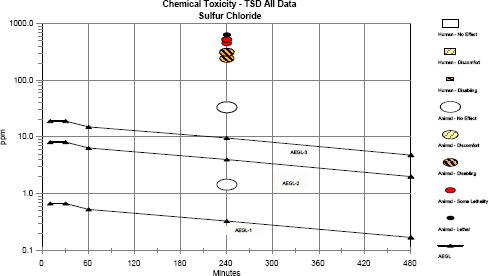
The AEGL values for sulfuryl chloride are summarized in Table 7-10. The AEGL-3 values are based upon a lethality threshold (BMCL05 of 70.1 ppm) estimated from 4-h exposure data in rats. The available lethality studies in rats utilized post exposure observation periods up to 14 days and, therefore, accounted to some extent for the latency in lethal response to chemicals causing pulmonary damage via corrosive activity. Date were insufficient for determining a threshold for AEGL-2 severity effects. Therefore, the AEGL-2 values were derived by a three-fold reduction of the AEGL-3 values. Because all exposure concentrations tested produced effects greater than AEGL-1 severity, AEGL-1 values were not developed and are not recommended. A comparison of the AEGL values to the available animal toxicity data (Appendix D) reveals that all AEGL concentrations are well below those causing any effects in animals.
TABLE 7-9 AEGL-3 Values for Sulfuryl Chloride
| Classification | 10-min | 30-min | 1-h | 4-h | 8-h |
| AEGL-3 | 14 ppm 77 mg/m3 | 14 ppm 77 mg/m3 | 11 ppm 61 mg/m3 | 7.0 ppm 39 mg/m3 | 3.5 ppm 19 mg/m3 |
TABLE 7-10 AEGL Values for Sulfuryl Chloride
| Classification | 10-min | 30-min | 1-h | 4-h | 8-h |
| AEGL-1 (Nondisabling) | NR | NR | NR | NR | NR |
| AEGL-2 (Disabling) | 4.7 ppm 26 mg/m3 | 4.7 ppm 26 mg/m3 | 3.7 ppm 20 mg/m3 | 2.3 ppm 13 mg/m3 | 1.2 ppm 6.6 mg/m3 |
| AEGL-3 (Lethality) | 14 ppm 77 mg/m3 | 14 ppm 77 mg/m3 | 11 ppm 61 mg/m3 | 7.0 ppm 39 mg/m3 | 3.5 ppm 19 mg/m3 |
NR: not recommended; insufficient data.
8.2. Comparisons with Other Standards and Guidelines
No standards or guidelines are currently available for sulfuryl chloride.
8.3. Data Adequacy and Research Needs
Human exposure data for sulfuryl chloride were unavailable. The currently available toxicity information for sulfuryl chloride is limited to data from acute lethality studies and one repeated exposure study in rats. Due to the known degradation of sulfuryl chloride to hydrochloric acid and sulfuric acid, the toxic effects are qualitatively predicable. The available lethality data in rats were sufficient for development of AEGL-3 values although there are apparent discrepancies among the available data sets. Exposure-response data were insufficient for assessing with confidence a point-of departure for AEGL-2 severity effects. It may be assumed that the continuum of the toxic response from irritation to lethality may be attributed to sulfuryl chloride-induced respiratory tract damage but the precise exposure at which this occurs is uncertain. Data were insufficient for deriving AEGL-1 values.
9. REFERENCES
Bayer AG. 1987. Safety Data Sheet No. 008951/03, September 8, 1987 [in German] (as cited in IUCLID 2000).
Bayer AG. 1989. Salmonella typhimurium Reverse Mutation Assay with Sulfuryl Chloride, BALK No. 88/050 (unpublished report no. T 8030690). Cytotest Cell Research GmbH & Co. KG, Darmstadt (as cited in OECD 2005).
Bayer AG. 1993a. Sulphuryl Dichloride. Report No. 22321. June 1993 (as cited in IUCLID 2000).
Bayer AG. 1993b. Sulfuryl Chloride. Salmonella/Microsome Test Using Strain TA 100 (unpublished report no. T 5039139). Bayer AG, Wuppertal (as cited in OECD 2005).
DuPont (E.I. du Pont de Nemours & Co). 1982. Inhalation Median Lethal Concentration (LC50) of Sulfuryl Chloride. Haskell Laboratory Report No. 387-82. Haskell Labo-
ratory for Toxicology and Industrial Medicine, E. I. du Pont de Nemours and Co., Inc. EPA Document No. 88920006761. Microfiche No. OTS0545299. U.S. Environmental Protection Agency, Washington, DC.
EPA (U.S. Environmental Protection Agency). 2005. Benchmark Dose Software. Version 1.3.2. National Center for Environmental Assessment, Office of Research and Development, U.S. Environmental Protection Agency [online]. Available: http://www.epa.gov/ncea/bmds.htm.
Haber, F. 1924. Zur Geschichte des Gaskreiges. Pp. 76-92 in Fünf Vorträge aus den Jahren 1920-1923. Berlin: J. Springer.
IUCLID (International Uniform Chemical Information Database). 2000. Sulphuryl Dichloride (CAS No. 7791-25-5). European Commission-European Chemicals Bureau. February 19, 2000 [online]. Available: http://ecb.jrc.ec.europa.eu/documents/Existing-Chemicals/IUCLID/DATA_SHEETS/7791255.pdf [accessed Dec. 29, 2010].
Kelly, D.P., and E.F. Stula. 1983. Acute and subacute inhalation toxicity of sulfuryl chloride in rats. Toxicologist 3(1):62 [Abstract 248].
Litchfield, J.T., and F. Wilcoxon. 1949. Simplified method of evaluating dose-effect experiments. J. Pharmacol. Exp. Ther. 96(2):99-113.
NRC (National Research Council). 1993. Guidelines for Developing Community Emergency Exposure Levels for Hazardous Substances. Washington, DC: National Academy Press.
NRC (National Research Council). 2001. Standing Operating Procedures for Developing Acute Exposure Guideline Levels for Hazardous Chemicals. Washington, DC: National Academy Press.
OECD (Organization for Economic Co-operation and Development). 2005. Sulfuryl Chloride (CAS No. 7791-25-5). SIDS Initial Assessment Report. Chemicals Screening Information Dataset (SIDS) for High Volume Chemicals, United Nations Environment Programme. May 2005 [online]. Available: http://www.chem.unep.ch/irptc/sids/OECDSIDS/7791255.pdf [accessed Dec. 29, 2010].
O’Neil, M.J., A. Smith, and P.E. Heckelman, eds. 2001. Sulfuryl Chloride. P. 1602 in The Merck Index: An Encyclopedia of Chemicals and Drugs, 13th Ed. Whitehouse Station, NJ: Merck.
Rinehart, W.E., and T. Hatch. 1964. Concentration-time product (CT) as an expression of dose in sublethal exposures to phosgene. Am. Ind. Hyg. Assoc. J. 25:545-553.
Stauffer Chemical Company. 1969. Acute Inhalation LC50: Rats. Stauffer Chemical Company, Western Research Center Toxicology Lab Report T1281. WRC/6-6-69.
Stauffer Chemical Company. 1970. Acute Inhalation LC50, Male and Female Rats. Stauffer Chemical Company, Western Research Center Toxicology Lab Report T1494. WRC/4-21-70. Submitted by ICI Americas Inc. to U.S. Environmental Protection Agency, Washington, DC. EPA Document No. 88920006958.
ten Berge, W.F., A. Zwart, and L.M. Appelman. 1986. Concentration-time mortality response relationship of irritant and systemically acting vapours and gases. J. Hazard. Mater. 13(3):301-309.
APPENDIX A
DERIVATION OF AEGL VALUES FOR SULFURYL CHLORIDE
Derivation of AEGL-1 for Sulfuryl Chloride
Data were insufficient for developing AEGL-1 values for sulfuryl chloride. All exposure regimens in the available studies resulted in effects greater than those consistent with AEGL-1.
Derivation of AEGL-2 for Sulfuryl Chloride
Lethality thresholds (e.g., LC01, BMCL05, one-third of LC50) estimated from the Stauffer Chemical (1969, 1970) and from the DuPont studies (DuPont 1982; Kelly and Stula 1983) reports were less than the respective nonlethal exposures reported in these studies. For this reason and because exposure-response data were insufficient for determination of a threshold for AEGL-2 severity effects, derivation of AEGL-2 values by a three-fold reduction of AEGL-3 values was considered appropriate. The resulting AEGL-2 values are:
| 10-min AEGL-2: | 4.7 ppm |
| 30-min AEGL-2: | 4.7 ppm |
| 1-h AEGL-2: | 3.7 ppm |
| 4-h AEGL-2: | 2.3 ppm |
| 8-h AEGL-2: | 1.2 ppm |
| Derivation of AEGL-3 Sulfuryl Chloride | |
| Key studies: | DuPont (E.I. du Pont de Nemours & Co). 1982. Inhalation Median Lethal Concentration (LC50) of Sulfuryl Chloride. Haskell Laboratory Report No. 387-82. Haskell Laboratory for Toxicology and Industrial Medicine. E. I. du Pont de Nemours and Co., Inc. |
| Kelly, D.P., and E.F. Stula. 1983. Acute and subacute inhalation toxicity of sulfuryl chloride in rats. Toxicologist 3(1):62 [Abstract 248]. | |
| Critical effect: | BMCL05 of 70.1 ppm estimated as lethality threshold in rats following 4-h exposure to sulfuryl chloride. |
| Time scaling: | Cn × t = k where n = 1 or 3. In the absence of an empirically derived chemical-specific scaling exponent, temporal scaling for both AEGL-2 and AEGL-3 values was performed using n = 3 when extrapolating to shorter time points and n = 1 when extrapolating to longer time points using the Cn × t = k equation (NRC 2001). |
| Uncertainty factors: | Total uncertainty factor adjustment was 10. Interspecies: The effects of sulfuryl chloride are mediated by contact tissue damage resulting from the degradation of sulfuryl chloride to sulfuric acid and hydrochloric acid and not the result of metabolic processes. In addition, rodents will receive a greater dose to target tissues than would humans. Therefore, the uncertainty factor for interspecies variability was limited to 3. |
| Intraspecies: An intraspecies uncertainty factor of 3 was considered sufficient to account for individual variability in direct-contact toxic response to corrosive agents and for individuals with compromised respiratory function. | |
| Calculations: | (70.1 ppm)1 × 4 h = 280.4-ppm-h |
| (70.1 ppm)3 × 4 h = 1,377,888 ppm3-h | |
| 10-min AEGL-3 | Due to uncertainties in extrapolating from the 4-h POD to 10-min exposure duration, the 10-min AEGL-3 is set equivalent to the 30 min AEGL-3 (14 ppm) |
| 30-min AEGL-3 | C3 × 0.5 h = 1,377,888 ppm3-h |
| C3 = 2,755,777 ppm3-h | |
| C = 140 ppm | |
| UF application: 140 ppm/10 = 14 ppm | |
APPENDIX B
LC50 AND BENCHMARK DOSE CALCULATIONS FORSULFURYL CHLORIDE
DuPont (E.I. du Pont de Nemours & Co). 1982. Inhalation Median Lethal Concentration (LC50) of Sulfuryl Chloride. Haskell Laboratory Report No. 387-82. Haskell Laboratory for Toxicology and Industrial Medicine, E. I. du Pont de Nemours and Co., Inc.
Rats (male); all exposure concentrations expressed in ppm
| Dose | Mortality | Observed% | Expected% | Observed-Expected | Chi-Square |
| 84.400 | 0/10 | 0 (2.60) | 2.81 | -0.21 | 0.0002 |
| 134.000 | 2/10 | 20.00 | 30.77 | -10.77 | 0.0544 |
| 155.000 | 8/10 | 80.00 | 51.23 | 28.77 | 0.3314 |
| 207.000 | 7/10 | 70.00 | 85.30 | -15.30 | 0.1866 |
| 273.000 | 10/10 | 100 (97.40) | 96.75 | 0.65 | 0.0013 |
Values in parentheses are corrected for 0 or 100% Total = 0.5739
LC50 = 153.718 (133.380 - 177.158)*
Slope = 1.32 (1.19 - 1.47)*
*These values are 95% confidence limits
Total animals = 50
Total doses = 5
Animals/dose = 10.00
Chi-square = total chi-square × animals/dose = 5.7391
Table value for chi-square with 3 degrees of freedom = 7.8200
LC84 = 203.516
LC16 = 116.105
FED = 1.15
FS = 1.11
A = 1.08
Probit Model $Revision: 2.1
$ Date: 2000/02/26 03:38:53 $
Input Data File: C:\BMDS\SO2CL2.(d)
Gnuplot Plotting File: C:\BMDS\SO2CL2.plt
Mon Nov 27 11:22:45 2006
| Exposure | Expected Lethal Dose Values (ppm) |
| LC0.1 | 47.752 |
| LC1.0 | 70.619 |
| LC5.0 | 93.383 |
| LC10 | 105.974 |
| LC25 | 127.633 |
| LC50 | 153.718 |
| LC75 | 185.134 |
| LC90 | 222.972 |
| LC99 | 334.600 |
Benchmark Dose: BMCL05 Rat lethality data DuPont 1982; Kelly and Stula 1983).
BMDS MODEL RUN
The form of the probability function is:
P[response] = Background + (1-Background) *
CumNorm(Intercept+Slope*Log[Dose]),
where CumNorm(.) is the cumulative normal distribution function
Dependent variable = COLUMN3
Independent variable = COLUMN1
Slope parameter is not restricted
Total number of observations = 5
Total number of records with missing values = 0
Maximum number of iterations = 250
Relative Function Convergence has been set to: 1e-008
Parameter Convergence has been set to: 1e-008
User has chosen the log transformed model
Default Initial (and Specified) Parameter Values
Background = 0
Intercept = -14.2564
Slope = 2.83606
Asymptotic Correlation Matrix of Parameter Estimates
(*** The model parameter[s]—background have been estimated at a boundary point, or have been specified by the user, and do not appear in the correlation matrix)
| Intercept | Slope | |||||||||||||
| Intercept | 1 | -1 | ||||||||||||
| Slope | -1 | 1 | ||||||||||||
Parameter Estimates
| Variable | Estimate | Std. Err. |
| Background | 0 | NA |
| Intercept | -17.8499 | 4.6632 |
| Slope | 3.54497 | 0.917185 |
NA: Indicates that this parameter has hit a bound implied by some inequality constraint and thus has no standard error.
Analysis of Deviance Table
| Model | Log(likelihood) | Deviance | Test DF | P-value |
| Full model | -16.1167 | |||
| Fitted model | -19.3819 | 6.53043 | 3 | 0.08847 |
| Reduced model AIC: 42.7638 | -34.4972 | 36.761 | 4 | < .0001 |
Goodness of Fit
| Dose | Est._Prob. | Expected | Scaled Observed | Size | Residual |
| 84.4000 | 0.0168 | 0.168 | 0 | 10 | -0.4128 |
| 134.0000 | 0.3131 | 3.131 | 2 | 10 | -0.7709 |
| 155.0000 | 0.5115 | 5.115 | 8 | 10 | 1.825 |
| 207.0000 | 0.8542 | 8.542 | 7 | 10 | -1.381 |
| 273.0000 | 0.9791 | 9.791 | 10 | 10 | 0.462 |
Chi-square = 6.22
DF = 3
P-value = 0.1015
Benchmark Dose Computation
Specified effect = 0.05
Risk Type = Extra risk
Confidence level = 0.95
BMD = 96.6681
BMDL = 70.1015
APPENDIX C
TIME SCALING CALCULATIONS
The relationship between dose and time for any given chemical is a function of the physical and chemical properties of the substance and the unique toxicological and pharmacological properties of the individual substance. Historically, the relationship according to Haber (1924), commonly called Haber’s Law or Haber’s Rule (i.e., C × t = k, where C = exposure concentration, t = exposure duration, and k = a constant) has been used to relate exposure concentration and duration to effect (Rinehart and Hatch 1964). This concept states that exposure concentration and exposure duration may be reciprocally adjusted to maintain a cumulative exposure constant (k) and that this cumulative exposure constant will always reflect a specific quantitative and qualitative response. This inverse relationship of concentration and time may be valid when the toxic response to a chemical is equally dependent upon the concentration and the exposure duration. However, an assessment by ten Berge et al. (1986) of LC50 data for certain chemicals revealed chemical-specific relationships between exposure concentration and exposure duration that were often exponential. This relationship can be expressed by the equation Cn × t = k, where n represents a chemical specific, and even a toxic end point specific, exponent. The relationship described by this equation is basically the form of a linear regression analysis of the log-log transformation of a plot of C vs t. Ten Berge et al. (1986) examined the airborne concentration (C) and short-term exposure duration (t) relationship relative to death for approximately 20 chemicals and found that the empirically derived value of n ranged from 0.8 to 3.5 among this group of chemicals. Hence, it was shown that the value of the exponent (n) in the equation Cn × t = k quantitatively defines the relationship between exposure concentration and exposure duration for a given chemical and for a specific health effect end point. Haber's Rule is the special case where n = 1. As the value of n increases, the plot of concentration vs time yields a progressive decrease in the slope of the curve. In the absence of an empirically derived chemical-specific scaling exponent, temporal scaling for both AEGL-2 and AEGL-3 values for sulfuryl chloride was performed using n = 3 when extrapolating to shorter time points and n = 1 when extrapolating to longer time points using the Cn × t = k equation (NRC 2001).
APPENDIX D
ACUTE EXPOSURE GUIDELINES FOR SULFURYL CHLORIDE
Derivation Summary for Sulfuryl Chloride
AEGL-1 VALUES
| 10 min | 30 min | 1 h | 4 h | 8 h |
| Not | Not | Not | Not | Not |
| recommended | recommended | recommended | recommended | recommended |
| Reference: Not applicable | ||||
| Test Species/Strain/Number: Not applicable | ||||
| Exposure Route/Concentrations/Durations: Not applicable | ||||
| Effects: Not applicable | ||||
| End Point/Concentration/Rationale: Not applicable | ||||
| Uncertainty Factors/Rationale: Not applicable | ||||
| Modifying Factor: None applied | ||||
| Animal to Human Dosimetric Adjustment: Not applicable | ||||
| Time Scaling: Not applicable | ||||
| Data Adequacy: Data were insufficient for developing AEGL-1 values. | ||||
AEGL-2 VALUES
| 10 min | 30 min | 1 h | 4 h | 8 h |
| 4.7 ppm | 4.7 ppm | 3.7 ppm | 2.3 ppm | 1.2 ppm |
| Reference: NA | ||||
| Test Species/Strain/Sex/Number: NA | ||||
| Exposure Route/Concentrations/Durations: inhalation (see AEGL-3) | ||||
| Effects: NA; estimated as one-third of AEGL-3 | ||||
| End Point/Concentration/Rationale: Due to inadequate data and uncertainties regarding a definitive threshold for AEGL-2 level effects, the AEGL-2 values were estimated as one-third of the AEGL-3. | ||||
| Uncertainty Factors/Rationale: Total uncertainty factor: See AEGL-3 | ||||
| Modifying Factor: None applied | ||||
| Animal to Human Dosimetric Adjustment: Not applicable | ||||
| Time Scaling: See AEGL-3 | ||||
| Data Adequacy: Nonlethal exposure of rats to sulfuryl chloride produced effects of respiratory irritation and pulmonary damage, dyspnea, and body weight loss. Estimated lethality thresholds were less than experimental exposures that were not lethal. Therefore, the AEGL-2 values were derived as one-third of the AEGL-3 values. | ||||
AEGL-3 VALUES
| 10 min | 30 min | 1 h | 4 h | 8 h |
| 14 ppm | 14 ppm | 11 ppm | 7.0 ppm | 3.5 ppm |
| References: | ||||
| DuPont (E.I. du Pont de Nemours & Co). 1982. Inhalation Median Lethal Concentration (LC50) of Sulfuryl Chloride. Haskell Laboratory Report No. 387-82. Haskell Laboratory for Toxicology and Industrial Medicine, E. I. du Pont de Nemours and Co., Inc. | ||||
| Kelly, D.P., and E.F. Stula. 1983. Acute and subacute inhalation toxicity of sulfuryl chloride in rats. Toxicologist 3(1):62 [Abstract 248]. | ||||
| Test Species/Strain/Sex/Number:10 male Crl:CD7 rats (7-8 weeks old, 233-274g) | ||||
| Exposure Route/Concentrations/Durations: Inhalation (head-only) exposure to 84.4, 134, 155, 207, or 273 ppm sulfuryl chloride (100% purity) for four hours; 14-day observation | ||||
| Effects: | ||||
| Exposure Conc. (ppm) | Mortality | |||
| 84.4 | 0/10 | |||
| 134 | 2/10 | |||
| 155 | 8/10 | |||
| 207 | 7/10 | |||
| 273 | 10/10 | |||
| End Point/Concentration/Rationale: The 4-h BMCL05 of 70.1 ppm calculated from the Haskell Laboratory study (DuPont 1982; Kelly and Stula 1983) was used as the point-of-departure for deriving AEGL-3 values. Although a somewhat more conservative approach than use of the LC01 (70.6 ppm), it may be justified by the known respiratory tract damage observed for nonlethal exposures and the potential for latent-occurring health effects, including lethality, beyond the 3 to 14-day observation periods utilized in the animal studies. | ||||
| Uncertainty Factors/Rationale: | ||||
| Total uncertainty factor: 10 | ||||
| Interspecies: The interspecies uncertainty factor was limited to 3 because contact tissue damage results from the degradation products (sulfuric acid and hydrochloric acid) and not metabolism processes, and because rodents will receive a greater dose to target tissues than would humans. | ||||
| Intraspecies: An intraspecies uncertainty factor of 3 was considered sufficient to account for individual variability in direct-contact toxic response to corrosive agents. Additional uncertainty was considered unnecessary because a 4-h exposure of rats to 84 ppm in the DuPont (1982) study was not lethal, and multiple exposures of rats to 55 ppm was not lethal (Kelley and Stula 1983). | ||||
| Modifying Factor: None applied | ||||
AEGL-3 VALUES Continued
| 10 min | 30 min | 1 h | 4 h | 8 h |
| 14 ppm | 14 ppm | 11 ppm | 7.0 ppm | 3.5 ppm |
| Animal to Human Dosimetric Adjustment: Not applicable | ||||
| Time Scaling: In the absence of an empirically derived chemical-specific scaling exponent, temporal scaling for both AEGL-2 and AEGL-3 values was performed using n = 3 when extrapolating to shorter time points and n = 1 when extrapolating to longer time points using the Cn × t = k equation (NRC 2001). | ||||
| Data Adequacy: Toxicity data were available for only one species, although the mode of action is likely very similar across species. Data were sufficient for AEGL-3 development. | ||||