
Moderator:
Brian Darmody
Association of University Research Parks
The Association of University Research Parks has been “into clusters before clusters were cool,” noted AURP President Darmody, who also serves as Associate Vice President for Research and Economic Development for the Maryland university system.
The United States developed the world’s first research parks, but is now losing its global lead, Mr. Darmody contended. He noted that China now has the world’s largest research parks. While the United States once had one of the best university technology-transfer policies when the Bayh-Dole Act52 was passed in 1980, the United Kingdom now says its technology-commercialization system is more efficient. The United States used to have the highest number of business start-ups per capita. Now that title belongs to Israel. The United States also once led the world in the best tax policies for corporate research and development. Now 17 other nations offer more generous tax breaks.
To support his argument, Mr. Darmody cited Commerce Secretary Gary Locke, who recently said: “America has a broken innovation ecosystem that does not efficiently create the right incentives or allocate enough resources to generate new ideas, develop those ideas with focused research, and turn them into businesses that can create jobs.”53

52 The Bayh-Dole Act of 1980 (P.L. 96-517, Patent and Trademark Act Amendments of 1980), or the University and Small Business Patent Procedures Act (P.L. 96-517, Patent and Trademark Act Amendments of 1980), gave universities control over their inventions stemming from federally funded research.
53 From January 7, 2010, remarks by Commerce Secretary Gary Locke to the President’s Council of Advisors on Science and Technology, Washington, DC, <http://www.commerce.gov/NewsRoom/SecretarySpeeches/PROD01_008778>.
The AURP has issued a new report on the topic called the Power of Place 2.0: The Power of Innovation.54 Among the 10 steps for creating jobs and improving technology commercialization, the AURP recommends supporting research park infrastructure and developing “communities of innovation.”
To improve technology transfer, the AURP also calls for reforming the federal grant and contract funding model of the Office of Management and Budget to encourage commercialization efforts by principal investigators. “If you are a principal investigator, there are a lot of accounting rules about what you can directly charge and what you can’t charge,” he said. “If we are really going to create the most efficient tech-transfer system, the first Valley of Death quite often takes place at the fence level, or with the principal investigators and their sponsors’ programs offices.” That system needs to be tweaked.
The AURP also calls for federal financial support for proof-of-concept work. Mr. Darmody noted that President Obama’s proposed budget calls for such funding. He also supported calls for reviewing U.S. export controls, which often present problems for corporate and university research relationships. “If we can get the right set of export control rules, that will improve the amount of corporate and university research,” he said.
Other recommendations include expanding the corporate R&D tax credit, eliminating IRS tests related to university licensing of intellectual property to corporate research in facilities funded by taxpayer bonds, and to include entrepreneurship programs in science, technology, engineering, and math (STEM) initiatives. Essentially, the term STEM should be expanded into STEEM, in order to include the word “entrepreneurship,” he said. “We need to embed entrepreneurship in all of our projects and policies.”
Mr. Darmody concluded by noting that the AURP also is working for passage of federal legislation aimed at promoting science and research parks.
CURRENT TRENDS AND CHALLENGES
IN UNIVERSITY COMMERCIALIZATION
Ashley J. Stevens
Boston University
and Association of University Technology Management
While explaining that he does not have all of the answers to improving university technology transfer, Dr. Stevens, president-elect of the Association of University Technology Management (AUTM), said he could highlight many of the problems with current systems.
54 Brian Darmody, The Power of Place 2.0: The Power of Innovation—10 Steps for Creating Jobs, Improving Technology Commercialization, and Building Communities of Innovation, Tucson: Association of University Research Parks, March 5, 2010, <http://www.matr.net/article-38349.html>.
One reason it is possible to assess university technology-transfer programs in the United States, Dr. Stevens said, is that schools are extremely transparent. AUTM has abundant data going back to at least 1991. “We bear our souls,” he said. “Unlike some countries, like the UK, each individual institution reveals its performance on technology transfer.” One can learn how many licenses each university issued and the income it earned, for example. “You cannot go see what the University of Oxford did.”
Dr. Stevens explained that AUTM, an association of university technology-transfer managers, operates “at the cultural interface between the not-for-profit educational world of universities and the for-profit world of companies that take our technologies and develop them.” He joked that the technology-transfer experience reminds him of the song-writer Tom Lehrer in the 1950s, “who quite elegantly talked about sliding down the razor blade of life.”55
To illustrate how little has really changed in the debate over U.S. competitiveness over the decades, Dr. Stevens displayed a cover story from BusinessWeek magazine published in April 1992 titled “Industrial Policy: Is It the Answer?”56 The cover language said: “The very phrase rattles the teeth. It implies bureaucracy. It suggests government will pick winners and losers. If done badly, it will certainly hurt America. With the Cold War over, and the global economy taking shape, America needs to shore up its competitiveness.” It was a “grim call to arms,” Dr. Stevens noted. “But not something that actually happened.”
Just six months later, BusinessWeek published another cover story called “Hot Spots: America’s New Growth Regions.”57 He noted that many of the so-called “hot spots” on BusinessWeek’s map had names like “ceramics corridor” in New York and “laser lane” in Florida. A large map of hot spots inside the magazine did not include Boston’s Route 128, Silicon Valley, or North Carolina’s Research Triangle Park. This article, Mr. Stevens observed, proved to be remarkably prescient. A table in the article highlighted what were regarded at the time as some of the key ingredients of a high-tech cluster. They included:
• A major research university.
• Quality of life.
• Building on local industry.
• Cooperation between local universities, business, and government.
• Technology transfer from the university.
• Funding sources—state, venture capital, angels, and incubators.
55 From “Bright College Days” that appeared on the 1958 album “An Evening Wasted with Tom Lehrer.” Lyrics can be founded on Wikilyrics.com at <http://wikilyrics.net/song/892258/Tom-Lehrer---Bright-College-Days-Lyrics>.
56 BusinessWeek, “Industrial Policy,” April 4, 1992, pp. 70-77.
57 Kevin Kelly, “Hot Spots,” BusinessWeek, October 19, 1992.
Dr. Stevens said the article was the first to put university research-led clusters in the public consciousness. It also described the development process that since has been widely embraced: Start-ups emerge, divisions of major U.S. companies and foreign companies move in, and export-led growth takes off. “This was the formula and package, and I think we have only seen these predictions borne out in the subsequent 20 years,” he said.
The emergence of the pharmaceutical industry in Massachusetts is one of the most stunning examples of university-led growth, he said. The Boston area has a major concentration of pharmaceutical R&D, biopharmaceutical manufacturing, and related industries. Back in 1971, the only major operation of a pharmaceutical company in the state was the U.S. headquarters offices of Astra ABA, which had very little economic impact.
Everything that followed was the result of spin-offs of the University of Massachusetts, MIT, Tufts, Harvard University, Boston University, and so forth. The other driver was the Massachusetts Biotechnology Research Park, which the city of Worcester put next to the University of Massachusetts Medical Center. The first big tenant was Germany’s BASF, whose facilities were later acquired by Abbot Labs.
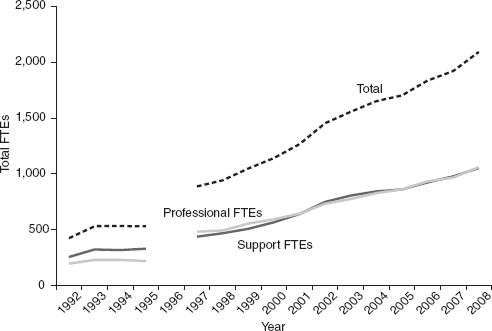
FIGURE 16 U.S. technology transfer employment.
SOURCE: Ashley J. Stevens, Presentation at February 25, 2010, National Academies
Symposium on “Clustering for 21st Century Prosperity.”
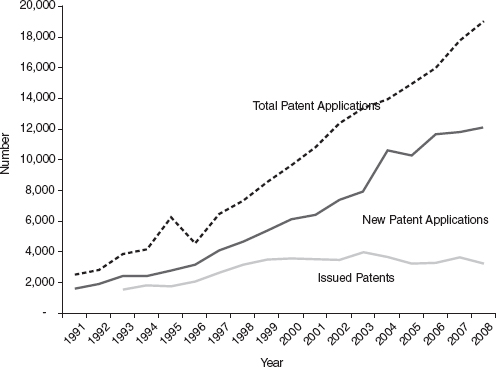
FIGURE 17 U.S. patent activity.
SOURCE: Ashley J. Stevens, Presentation at February 25, 2010, National Academies
Symposium on “Clustering for 21st Century Prosperity.”
Fast forward to 2009, and the Boston area now is home to operations of the Who’s Who of the pharmaceutical world. They include Amgen, Biogen IDE, Genzyme, Astra Zeneca, and GSK. “This has been a stunning example of the power of university spin-outs coming out at the right time,” Dr. Stevens said. The arrival of biotechnology tools caused dislocations in the industry, and “Massachusetts just happened to be very fortunately poised with venture capital and a highly networked city.”
Dr. Stevens then turned to an analysis of technology-transfer trends at U.S. universities based on AUTM data. The analysis reveals mixed success over the past two decades.
On the positive side, Dr. Stevens noted, there have been sharp increases in technology-transfer activity. The number of inventions publicly disclosed by universities surged from 5,000 in 1991 to around 20,000 in 2008. The number of technology-transfer employees at U.S. universities has more than doubled, to around 2,000, since 1997. There also have been sharp increases in new patent applications by universities and licensing revenue. Spending by universities
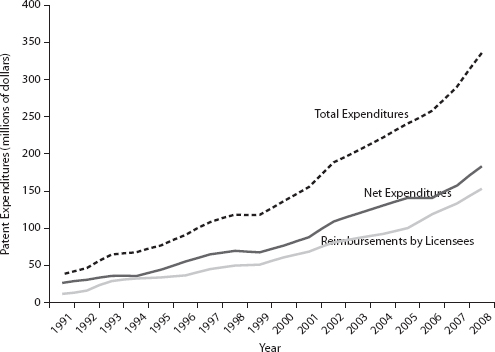
FIGURE 18 Patent expenditures.
SOURCE: Ashley J. Stevens, Presentation at February 25, 2010, National Academies
Symposium on “Clustering for 21st Century Prosperity.”
aimed at turning scientific research into intellectual property that can be licensed by corporations also has surged. Net expenditure rose from less than $50 million in 1991 to around $180 million in 2008.
When one examines actual results, however, the picture is far less impressive. The number of new patents actually awarded to universities has “distinctively flattened out” since 1998. He offered several possible reasons. One is that the U.S. Patent Office has become less liberal in awarding patents. The Supreme Court case KSR vs. Teleflex58 also may have reduced new patents. Another factor could be limited personnel devoted to commercializing university discoveries. Even with the sharp increases in staff, there are only 1,000 full-time employees managing technology-transfer activities at all American research facilities, which Dr. Stevens described as “a very thin base.”
58 In KSR International Co. v. Teleflex Inc., 550 U.S. 398 (2007), the U.S. Supreme Court ruled that a patent by Teleflex was not enforceable on the grounds that its process was obvious to a “person having ordinary skill in the art.”
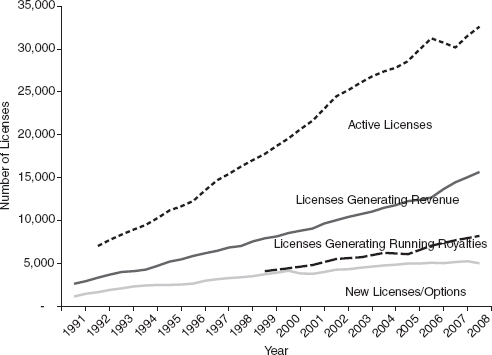
FIGURE 19 Licensing activity.
SOURCE: Ashley J. Stevens, Presentation at February 25, 2010, National Academies
Symposium on “Clustering for 21st Century Prosperity.”
The AUTM asked universities to break down their patent expenditures as a percentage of their total technology-transfer operating budgets. It found that universities spend roughly the same amount of money filing for patents as they spend on people. The survey also revealed that universities devote only 0.59 percent of their research budgets to technology-transfer activities and on protecting patents. Dr. Stevens called that proportion “amazingly low.”
The AUTM also discovered interesting trends in university licensing activity. Since 1991, the number of active licenses has skyrocketed from around 7,000 to more than 30,000. Licenses that generate revenue—meaning royalties universities collect on products in the market—have more than tripled to 15,000. However, the number of new licenses has remained at around 5,000 per year for a decade.
Start-up trends also are revealing. The number of companies launched by AUTM members rose from 200 a year in 1994 to nearly 600 in 2008. However, there is much room for productivity improvement. Of the 19,554 invention disclosures by universities last year, 59 percent resulted in U.S. patent applications. That means more than 40 percent “never made it out of the lab,” he observed. Just 26 percent led to signed licenses, and only 16 percent to U.S. patents issued.
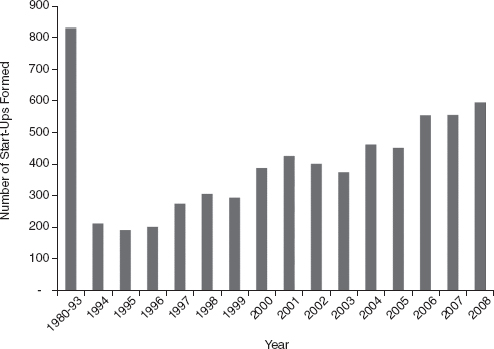
FIGURE 20 Start-ups formed.
SOURCE: Ashley J. Stevens, Presentation at February 25, 2010, National Academies
Symposium on “Clustering for 21st Century Prosperity.”
Furthermore, only 3 percent of those inventions led to the formation of companies. “You are beginning to get a sense of the Valley of Death at this point,” Dr. Stevens said. “So why is it so hard? Why are so many of the babies ugly, as we say in the tech-transfer profession?”
One might think that bigger institutions with bigger research budgets have a huge advantage, he noted. But when one drills in the AUTM data, one finds performance levels are fairly consistent. The medium success rate for all institutions is 21.7 percent, Dr. Stanley noted. Those with annual research budgets of more than $200 million are only marginally more successful, at 22.9 percent. Stanford’s success rate is 24.3 percent, and MIT’s rate stands at only 18.8 percent.
How can this record be improved? Several strategies are being tried, again with mixed success. He noted that Research Corporation Technologies, based in Tucson, has agreements with many universities to develop their technologies. The organization accepted 228 inventions from 1991 through 2008, about 13 per year. Despite being highly selective, only 29 percent of these inventions led to licenses. “Not a whole heck of a lot better,” he said.
Another idea is for universities to make inventions “less embryonic” before
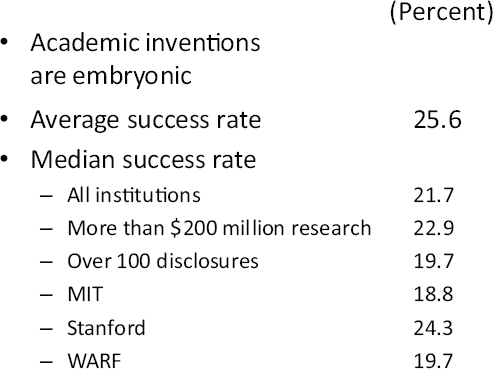
FIGURE 21 Why is this so hard?
SOURCE: Ashley J. Stevens, Presentation at February 25, 2010, National Academies
Symposium on “Clustering for 21st Century Prosperity.”
seeking capital, such as by investing more in developing proofs of concept. That is the idea behind several “translational research” centers established by foundations at big research universities. MIT’s School of Engineering, for example, has the Desphande Center,59 which has full-time staff that help fund and guide start-ups. Another is the von Leibig Center60 at the University of California-San Diego’s Jacobs School of Engineering. Both centers offer seed funding and professional advisory services.
Based on their publicly disclosed data, however, it is not clear whether these centers are more successful. A Kauffman Foundation study found that von Liebig commercializes around 24 percent of projects it takes on, Dr. Stevens noted, while the Deshpande Center commercializes 16 percent. Their combined success
59 The Deshpande Center for Technological Innovation was founded in 2002 with a $20 million donation from Jaishree and Desh Deshpande, co-founder and chairman of Sycamore Networks Inc. Its mission is to provide a sustainable source of funding for innovative research and guidance to help MIT discoveries reach the marketplace.
60 The William J. von Liebig Center for Entrepreneurism and Technology Advancement was founded in 2001 with a $10 million gift from the William J. von Liebig Foundation.
rate is similar to the average for all university technology-transfer programs.61 One difference, he noted, is that some spin-offs from these centers have raised substantial investment.
Universities have been able to sharply boost the revenue they receive from inventions, the AUTM study showed. Since 1996, total income has soared by nearly seven-fold, to almost $3.5 billion a year. Running royalties have risen sharply and account for most of that. Very little comes from sales of stock, he noted, “despite all of the anguish over conflict of interest over the years.”
Perhaps the most important question for universities is whether technology-transfer offices really pay off. One objective, after all, is to make university research financially self-sustaining by selling intellectual property. Dr. Stevens said he was “shocked” to find that 52 percent of the 130 technology-transfer programs studied lose money for their universities. Another 20.8 percent reported they earn a gross profit. Only half of those make a net profit. Nor do universities make much money by selling stock they hold in start-ups. Only 16.2 percent reported that their programs are financially self-sustaining, meaning they do not depend on the university operating budget to remain in operation. One big reason is that technology-transfer offices get only a portion of licensing revenue to offset their expenses. Still, “the results were a lot worse than we ever expected,” he said. “This raises the question: Why?”
Part of the explanation is that tech-transfer remains a business driven by a very few “big hits,” especially in the drug-research field. The U.S. Food and Drug Association approved only 153 drugs, vaccines, biologics, and in vivo diagnostics between 1985 and 2009, Dr. Stevens noted. Northwestern University was fortunate enough to earn $700 million by selling an interest in royalties it receives from its 50 percent interest in Lyrica, a popular drug used to control seizures and nerve pain, in December 2007. Such big hits are rare. Only 198 of 15,498 income-generating licenses in 2008 generate more than $1 million in proceeds.
Dr. Stevens raised the question of whether the Bayh-Dole Act was flawed because it was an “unfunded mandate.” Originally, the act called for financing tech-transfer activities through indirect cost payments, but the funding was never appropriated. Administrative costs at university research programs, what’s more, are capped at 26 percent.62 “It certainly has turned out to be a longer timeline to sustainability than we ever expected,” he said.
Dr. Stevens recommended several improvements. He endorsed the idea of having entrepreneurial post-doctoral fellowships for graduating Ph.D. students or current post-docs who want to commercialize the scientific research they work
61 For an analysis of the Desphande and von Liebig centers, see Christine A. Gulbranson and David B. Audretsch, “Proof of Concept Centers: Accelerating the Commercialization of University Innovation,” Ewing Marion Kauffman Foundation, January 2008, <http://www.kauffman.org/uploadedFiles/POC_Centers_01242008.pdf>.
62 In 1991, the Office of Management and Budget directed that universities could be reimbursed for no more than 26 percent of research grants for administrative costs.
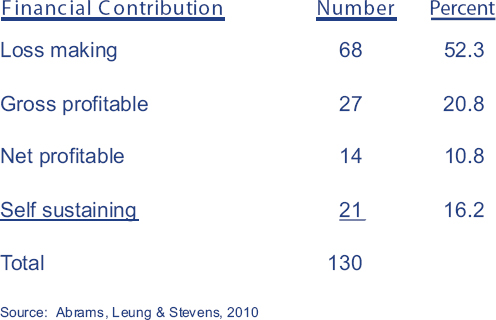
FIGURE 22 Financial performance.
SOURCE: Ashley J. Stevens, Presentation at February 25, 2010, National Academies
Symposium on “Clustering for 21st Century Prosperity.”
on. Such fellowships could be awarded for two years through a state-wide selection process with competitive peer review. Funds would be used for proof-of-concept experiments and developing business plans. Such fellows should either be at a university that has a business school or that has a relationship with one, he said. Schools also should be required to have a business mentorship program. Dr. Stevens said the federal government should fund such a concept.
IMPROVING THE UNIVERSITY MODEL
Aris Melissaratos
Johns Hopkins University
Mr. Melissaratos, a former Westinghouse Electronics executive who now leads the technology-transfer program at Johns Hopkins University, said that “it is time to make technology transfer and innovation a national priority” in the United States. He noted that in his book, Innovation: The Key to Prosperity,63 he
63 Aris Melissaratos and N. J. Slabbert, Innovation: The Key to Prosperity—Technology and America’s Role in the 21st Century Global Economy, Washington, DC: Montagu House, 2009.
has made the case why a national push at the presidential level in technological innovation is critical for the U.S. economy.
Mr. Melissaratos joined Johns Hopkins in 2007 after serving as secretary of economic development for the state of Maryland. During that period, he said he “learned that the current way we play economic development games among the states is about trying to steal somebody else’s company and providing more funds than the next state over is willing to provide. It’s kind of a lose-lose game.”
The best place for states to invest economic-development dollars, he argued, is the university system, which generates new companies and leads to “strategic economic development.” When he worked for Maryland, the state put almost 90 percent of its economic-development budget into universities and research programs. Most were connected to the National Institutes of Health, the Food and Drug Administration, and the military. As a result, Mr. Melissaratos said, Maryland has a diversified base of science and industries, such as biotechnology, defense, aerospace, and information technology. “Maryland itself is a research state,” he said, receiving more research grant money per capita than any other.
University technology-transfer efforts in the state have lagged, however. Johns Hopkins, for instance, ranks as the nation’s top research university, with a $1.6 billion annual research budget. It is the biggest recipient of grants. But Johns Hopkins “is not anywhere near the top in technology commercialization,” he said. “In fact, research commercialization was an anathema among our faculty.” They are interested in research and what makes nature tick. “At Stanford University, it is said anecdotally that faculty don’t get tenure unless they start one or two companies and take one or two public,” Mr. Melissaratos said. “At Hopkins, you are not even thought of being capable for tenure if you even thought about starting a company.” Former Johns Hopkins President Bill Brody recruited Mr. Melissaratos to change that culture.
As a Johns Hopkins alumnus, Mr. Melissaratos said he had a deep understanding of the university’s culture, and was determined to change its attitude toward technology transfer “while fully respecting the research excellence that had been our motto.” At about the same time, Johns Hopkins had received funding to start a business school. Several times in the past, the school’s trustees had rejected such offers, including a $50 million offer that Michael Bloomberg is said to have made in the 1990s. Now, the Carey Business School has been launched at Johns Hopkins. “That gives us an ingredient we didn’t have before,” he said. The school plans to teach entrepreneurialism to researchers.
The greater effort in commercialization is paying dividends. From 1998 to 2008, Mr. Melissaratos said, Johns Hopkins was spinning off four companies a year on average. In the past two years alone, 22 companies were launched that brought in $89.5 million in venture investment.
He said all royalties Johns Hopkins received in fiscal year 2008 were used to encourage professors to tap their contacts in the venture capital industry. Johns Hopkins has helped launch start-ups all over the country. It also has increased its
annual licensing revenue, from $9 million in 2008 to $12 million in 2009. That is still a far cry from other universities, according to data published by the Chronicle of Higher Education, he noted. Johns Hopkins “is still waiting for our first big hit.” He said he thinks that hit will come from oncology or brain research. The National Cancer Institute recently announced it will build a 500,000-square-feet headquarters building at its Montgomery County campus.
Johns Hopkins also now has a research park. A 300,000-square-feet building on campus is nearly filled with researchers and several start-up companies. The oncology center will expand Johns Hopkins’ core strength in life sciences, which consume 93 percent of research spending at the university.
The university leadership now is fully behind such university-industry collaboration. “We want every professor, every researcher, every department head, and the deans of every school to be interested in and applaud the current change in attitude,” Mr. Melissaratos said. “We are open for business. We want to facilitate the process, not throw legal and bureaucratic barriers in the way of progress.” He added that the university is training its researchers “in all of the ways that Silicon Valley and Route 128 have done,” such as with events to match scientists up with entrepreneurs.
Mr. Melissaratos then turned his attention to national issues. He argued that the United States needs a national strategy for promoting innovation and upgrading its global competitiveness. There has been talk about science and technology education year after year. “It is time we get it done,” he said. Science and technology education must improve. Standards should be implemented, and “we should forget about social promotion in our schools,” he said. “Our only strength in the global economy is our innovation and research at universities,” Mr. Melissaratos said. “To improve, we need to create an environment that promotes innovation.”
Greater investment in infrastructure also is needed. “This country is a couple hundred years old, and it shows it,” he said. “Innovators like to be involved at the latest state of the art. So we should put in new infrastructure faster than the developing countries.” The United States must make broadband available everywhere, install smart grids that moves electricity from wherever it is generated to the users, and build modern transportation systems. “Our top 30 metropolitan areas need to have world-class public transit systems,” he said. “It ought to be a national priority.” Mr. Melissaratos called for augmenting or replacing the highway system with a North American network of Maglev64 trains that whisk passengers “from Halifax to Miami, from Anchorage to Vancouver to Mexico City and maybe down into South America.”
Other national priorities should include self-sufficiency in energy, which is also a business opportunity. Mr. Melissaratos said he believes nuclear power is the only alternative energy that can be scaled up quickly enough to meet the
64 “Maglev” refers to magnetic levitation. Maglev trains are lifted and propelled by a system of magnets and have reached speeds of up to 361 miles per hour in Japan.
nation’s needs and address climate change. The United States should license 20 new nuclear power plants instantly “to give this country a chance to build the capability to build nuclear power plants.”
If the United States has a long-term commitment to infrastructure, that also will bring back a distributed, heavy manufacturing base, Mr. Melissaratos predicted. “This is something we don’t have today. We are becoming a prototyping economy.” America once was the world’s leading manufacturing power, and served as an outsourcing location for Europe for decades.
America has a huge opportunity to move the nation forward, Mr. Melissaratos said. To achieve such an agenda, however, America needs to unleash creators of technology that are being held back by bureaucracies.
James Clements
West Virginia University
West Virginia University (WVU) is pursuing a number of different strategies to advance innovation clusters in the state, said WVU President Clements.
The first method is what Dr. Clements described as a “single-source technology transfer model.” In this model, basic research leads to applications that can be commercialized. Then, new businesses spring up and expand. In many cases, this process can begin with a single faculty member with an idea who pushes it forward. Start-ups by other faculty follow, forming a cluster. “It is typically a fairly linear process and can sometimes be quite by happenstance.” He noted that an Arizona State University study characterized such an approach as “the single scientific moment that can define the beginning of an industry.”65
A good local example of this model at work at WVU is Protea Biosciences,66 which has developed and commercialized technologies to discover new proteins in human blood and tissue samples. After the technology was developed in WVU labs, a faculty member co-founded the company at WVU’s Business Incubator. Protea then moved to its own office space in Morgantown, West Virginia. Protea is expanding its product portfolio and global network and is “getting ready to do some really, really cool things,” Dr. Clements said. It continues to collaborate with researchers at WVU’s nearby health care-related companies.
The success of companies such as Protea provide graduates and faculty
65 “Universities and the Technology Intensity of the Local Workforce: Evidence from Metropolitan and Micropolitan Areas,” November 2009 report from the Productivity and Prosperity Project (P3), an initiative supported by the ASU Office of the University Economist. The quote appears on page 4 of the report.
66 Protea Biosciences Inc., based in Morgantown, West Virginia, manufactures products that help companies obtain protein mass spectrometry data from biological samples. See <https://proteabio.com/>.
opportunities to remain in the region, in turn helping the region move toward a more knowledge-based economy, Dr. Clements said.
A second cluster model involves taking advantage of location by leveraging local assets, needs, and companies. West Virginia is developing an innovation cluster based on its traditional endowments of natural resources such as coal, timber, and gas. “To sustain that development, innovation is absolutely critical,” he noted. More than 100 faculty researchers in West Virginia work on advanced energy projects, such as liquefied coal for transportation fuel, environmentally safe access to natural gas reserves, and carbon sequestration. WVU also takes advantage of its proximity to two major research universities, Carnegie Mellon and the University of Pittsburgh, and the Department of Energy’s National Energy Technology Laboratory.
One key to building a cluster is to coordinate all of these research activities, Dr. Clements said. “An ad-hoc series of projects is good, but when not properly coordinated, you don’t get to leverage them.” So recently, the university organized an Advanced Energy Initiative that puts a framework around that research. The program is off to a good start, and has a full-time director who is helping form partnerships with other universities, industry, and government. The initiative also has an advisory board of industry experts.
To bring all of these regional resources together, an alliance has been formed called the Regional University Alliance (RUA) program. In addition to WVU, the University of Pittsburgh, and Carnegie Mellon University, the alliance also includes Virginia Tech and Penn State. The Alliance was part of a team that recently won an approximate $435 million contract to work on energy projects with the National Energy Technology Lab (NETL).
Other assets for the cluster include the National Research Center for Coal and Energy, which facilitates research partnerships around the country and abroad and is based at WVU. The center has several coal-related partnerships in China, for example. West Virginia has also created a trust fund modeled after Kentucky’s Bucks for Brains67 program that allows WVU and Marshall University to recruit scientists that aim to commercialize their research in energy and other fields.
A third innovation cluster strategy used by WVU is “targeting and creating,” Dr. Clements explained. It involves identifying a technology niche and going after it. The biometrics cluster in the Morgantown region is an example of this method. WVU has “a lot of really big stuff going on” in biometrics,” Dr. Clements said.
Since the September 11, 2001, terrorist attacks, federal law-enforcement agencies have become especially interested in technologies that can be used to identify individuals through distinguishing biological traits. West Virginia has a
67 The West Virginia Research Trust Fund, also known as Bucks for Brains, is a $50 million endowment established in 2008 by Senate Bill 287 that is to be matched by private contributions. West Virginia University and Marshall University are to use the funds to recruit research scientists that intend to commercialize their work.
history of more than 40 years in biometric identification,68 Dr. Clements noted. Recently, WVU become the main academic partner with the Federal Bureau of Investigation’s (FBI’s) Biometric Center of Excellence, which is especially active in border-security technology. WVU established one of the nation’s first degree-granting programs in biometrics.
WVU is also a founding and lead partner for the CITeR,69 a National Science Foundation center for identification technology research. Twenty affiliates have operations close to the center, including Booz Allen Hamilton, Northrop Grumman, Lockheed Martin, and Raytheon.70
CITeR also works with agencies such as the FBI, Department of Homeland Security, the Federal Aviation Administration, and the National Security Agency. Some people regard CITeR as the most successful NSF center in the country, he said. CITeR established a second site for credibility assessment at the University of Arizona. A third is planned at Clarkson University in Potsdam, New York.
CITeR promotes cluster-building by offering “very cost-effective research,” Mr. Clements said. It offers its partners access to research at a broad spectrum of research laboratories across the country, helps form inter-disciplinary faculty teams, and facilitates interaction among federal agencies.
Now that West Virginia’s biometrics cluster has critical mass, “more companies are coming in, and more people want to connect with our researchers and students,” Dr. Clements said. The University is working with the Department of Defense to develop algorithms to measure the iris, for example, and on biometric fusion algorithms. These programs already are generating spin-off companies, he added. Among WVU’s more distant partners is Michigan State University, which is teaming up to develop automated systems to help federal agencies identify individuals on the basis of scars, marks, and tattoos.
In summary, Dr. Clements said that WVU’s experience highlights three methods for building innovation clusters: Leveraging faculty discoveries, capitalizing on regional assets, and picking technological niches.
DISCUSSION
Mr. Darmody observed that many regional cluster strategies are premised on federal R&D. With the prospect of looming budget deficits, he asked whether
68 For a concise history of the development of West Virginia’s biometrics cluster, see Kim Harbour, “WV Biometrics: Fertile Ground for Innovation,” on West Virginia Department of Commerce Web site, <www.wvcommerce.org/business/industries/biometrics/fertileground.aspx>.
69 CITeR stands for the Center for Identification Technology Research is a Industry/University Cooperative Research Center funded by the National Science Foundation. The center was founded by West Virginia University and is the I/UCRC’s lead site for biometrics research and related identification technologies.
70 Biometrics is the use of science and technology to measure and statistically analyze biological data.
federal investments in R&D may decline and what opportunities universities have to expand their regional cluster activities in such an environment.
Actually, funding numbers remain fairly constant over the years, Dr. Stevens observed. Over 20 years, federal spending has remained at about two-thirds of total R&D spending in the United States. Industrial spending has ranged from as high as 9 percent, but has been fairly static at 7 percent for the past four or five years. “So I think we will depend on federal funding to continue to grow, and with the decline in asset values in endowments I’m not sure I can see a lot of money from philanthropy at this point,” he said.
Mr. Melissaratos commented that he thinks the nation must triple its investments in R&D. “We must get there,” Melissaratos said. “If you look at the amount of money that has gone into special projects like saving the financial industry and saving the auto industry, tripling basic research at the national level is a small investment to make.” He added that the stimulus package had $11.1 billion in research funding for NIH, $3 billion for the National Science Foundation, and around $1 billion for NIST, numbers that are admirable. Previously, Mr. Melissaratos said, a top presidential advisor had said the Administration was not going to put more money into research because he didn’t believe such funding can be sustained. “We must sustain it,” he said. “That’s the best investment in the future we can make.”
Mr. Darmody noted that Maryland universities were very happy that Mr. Melissaratos put a lot of research money into universities when he was the state’s economic development director. “It turned out to be a model that worked very, very well,” he said.
Dr. Wessner questioned whether a big increase in federal funding for basic research alone can address America’s immediate economic challenges. “We need to do a better job of capitalizing on our existing investments in research now,” he said. Indeed, “the rest of the world is creating jobs, creating growth, and increasing their national capacity by using the research that is already out there,” he observed. He noted that successful strategies such as those pursued by Morgantown, West Virginia, are based on drawing federal programs to their areas and creating jobs and technical capabilities on the basis of existing research.
Dr. Wessner also noted that Dr. Stevens of AUTM showed that three different ways of doing technology transfer all result in success rates of only around 20 percent. “So why the basic research?” he asked.
“Because it starts there,” Mr. Melissaratos responded. He noted that he spent the first 25 years of his career as the manufacturing guru of Westinghouse’s defense business. “You cannot do successful manufacturing, commercial or otherwise, without having the best technology in it. You need to create a foundation of excellence at the base and build from that by targeting the right kinds of products to improve the world’s standard of living.”
In the short term, Mr. Melissaratos said he acknowledges that “for the next 10 to 20 years we will be creating new products that will be built in other countries.”
But that is fine. “We should be thinking about the planet,” he said. Unless the well-being of everybody on the planet improves, there will be inequities. He noted that Apple makes high profits on the iPhone, even though it is put together with components and technologies developed in many other countries. The wealth goes to Apple shareholders. “We need to control the application of intellectual property to develop new products and to sit at the top of the food chain,” he said. It is important for U.S. companies to have technology before other nations do.
Dr. Clements said balance is needed. He noted that he spent most of his life doing applied research. Universities need to find a way to value both basic, theoretical research and applied research to solve real-world problems.
Achieving such a balance is difficult because it is hard for universities to find funding for applied research, Mr. Stevens observed. Proposals for applied research often aren’t approved by peer-review panels, and finding other funding sources is tough. “It is something that the federal labs can do better because they don’t have to compete in peer-review panels,” he said. “They have line-item budgets. If they have something hot going, they can continue to fund and develop it and get it to the point where it can be translated for the private sector.”
Dr. Stevens also was asked about the critique of university tech-transfer programs by the Ewing Marion Kauffman Foundation and its recommendations for reform.71 Among other things, the Kauffman Foundation proposed that regional consortia be established to manage commercialization activities on behalf of universities. Pooling tech-transfer resources could lower costs, it said. The foundation also suggested university scientists become free agents who can sell intellectual property on their own. He said most universities are not in favor of the idea that “some of your profitable stuff can walk off campus,” he said. He noted that most university technology-transfer programs already are unprofitable. “We very much are a system where the winners support the losers,” he said.
Dr. Stevens disagreed that state governments should establish central offices to manage technology-transfer for universities. Efforts to establish such centralized systems in North Carolina and the state of Washington were abandoned. The moment that subsidies for those programs ended, the tech-transfer efforts returned to campus, he said. Central tech-transfer programs for the university systems of California and New York also were dissolved. “The people doing it have to be on campus,” Dr. Stevens said. “This is a business of collisions. You have to bump into people casually. A lot of your best leads come in the lunch line.” Tech-transfer staff must be pro-active. “You can sit and wait for people to bring inventions to you,” he said. “Or you can get out there and look for them.”
Michael J. Cleare, executive director of the Center for Technology Transfer at
71 The Kauffman Foundation proposals are found in Robert E. Litan, Lesa Mitchell, and E. J. Reedy, “Commercializing University Innovations: Alternative Approaches,” Boston: National Bureau of Economic Research, Working paper JEL No. O18, M13,033, 034, 038, 2007. The report can be downloaded at <http://papers.ssrn.com/sol3/papers.cfm?abstract_id=976005>.
the University of Pennsylvania, returned to the issue of funding balance. He said he had spent 30 years in industry and then 10 years in two major research universities. He said he has a great deal of confidence in the Obama Administration and believes it “gets it” in terms of innovation. “But I am absolutely mystified by the balance of funding,” Dr. Cleare said. “I also believe that good funding of basic research is essential.” The reality in industry, though, is that 1 in 10 inventions gets fully developed.
Dr. Cleare said the federal government should be doing much more than the SBIR program, which supports proof of concept. He said even the SBIR program focuses too little on development, he said. The linear model of innovation championed by Vannever Bush “is broken because of a bloody great gap in it called the Valley of Death.” He said the University of Pennsylvania produces hundreds of inventions, and many discoveries “don’t get the attention they deserve because there is not enough funding.” There is peer-reviewed funding for research, but not for proof of concept to take an idea through the stage of validation “to the point where the private sector feels the risk is justified to take it on. “So why, oh why, don’t we with the stroke of a pen” increase funding for applications? Dr. Cleare asked. What the United Kingdom claims to do better, Mr. Cleare added, is at the proof-of-concept stage. “Nearly all proof-of-concept funding is from the government,” he said. “The government gets it in England.”
Dr. Stevens noted that the American Association of Universities, which represents university presidents, is opposed to the idea of expanding the use of SBIR funds. He said he would prefer to see a new stream of funding so that money for product development is not taken out of the basic research pie, “which is what we have done up to now.”
Mr. Melissaratos said that maybe it is better to get rid of some existing streams of funding. Basic and applied research gets done in about every department of the federal government. “It is not well coordinated across departments,” he said. A presidential science advisor could help the departments of Defense, Energy, and Health and Human Services share their research. Companies with large R&D budgets, like Intel and Microsoft, should work more with federal agencies and fill gaps. “We need to really take advantage of what we’ve got in this country,” Mr. Mellisarratos said. “We need to break down some of these bureaucracies because they exist for their own sake. We need a radical re-do of how this money flows.”
Mark McDougal of Sematech commented that the United States could make more progress working with industry on innovation if there were more technology roadmaps. When corporations like Cisco and Intel “are hitting on all cylinders, they are working on three generations at the same time. They are de-bugging their current product; they are working on next-generation technology; and they are working on research. They are like well-oiled machines,” Mr. McDougal said. “When they look at universities and government, they see bureaucracy, inefficiency, and maybe not something they want to invest with.” He said the United
States could achieve more if it better aligned technology roadmaps. Also, private industry, rather than taxpayers, would fund more university research.
An audience member asked what more universities can do internally to change cultural attitudes toward innovation.
Mr. Melissaratos said a major reason Johns Hopkins scientists rank low in commercialization is that “they are comfortable doing research. They know where their next grant will come from. They don’t want to take the risk of jumping over, and having to depend on their own entrepreneurship to succeed.” One way to change thinking is to focus on the payoff of research and what scientists must do to make their research know.
Returning to the topic of why basic research is critical, Mr. Melissaratos said “you must go beyond three generations of a product.” Recalling his experience in aerospace at Westinghouse, he noted that the company had to look beyond the next three generations of a product to succeed. Westinghouse could not rely on the commercial semiconductor industry to provide the components needed to improve performance of certain radar systems, for example. So it developed new semiconductor materials to build systems that would provide a competitive edge. “You need to look at the entire product life cycle,” he said. “When industry and government show an interest across this spectrum, we can move technology forward. The faculty will come along and want to participate.”
Another way to change culture is to make graduate programs more interdisciplinary, he added. “We need to change the way we create Ph.D. programs,” Mr. Melissaratos said. “Digging deep into one area, finishing your dissertation, and not knowing what goes in the world doesn’t work.”


