
Moderator:
Michael Borrus
X/Seed Capital Management
Mr. Borrus thanked the participants for showing up from around the country despite the East Coast’s third blizzard of 2010.
Referring to Dr. Good’s comments on the rest of the world replicating U.S. innovation cluster models, Mr. Borrus noted that Americans often are accused of ignoring history. “As Mary implies, it is a bit hard to ignore your own history when it is coming right back at you,” he said.
The whole subject of clusters has a long and venerable history, Mr. Borrus observed. The classic analysis of modern regional clusters is Alfred Marshall’s study of the 19th century cutlery industry in England.3 More recently, scholars and policymakers have been fascinated with Silicon Valley, Mr. Borrus noted, which is “often studied but often misunderstood.” In addition to the connections between private industry and universities, “Silicon Valley would not exist were it not for gobs and gobs of federal money and federal attention” dating back to the emergence of the radio tube industry in the early 20th century.
While it is nice to “repurpose old historical ideas to meet critical modern needs,” Mr. Borrus said, anybody who has tried to replicate Silicon Valley knows that is very hard to do. “It does imply a very strong role for federal policy.” Mr. Borrus said he is eager to learn from the first panel what the U.S. federal government has in store in this critical area.

3 Alfred Marshall (1842-1924) discussed the origins of British industries such as cutlery, ceramics, and textiles in Book Four, Chapter 10 of his book Principles of Economics, London: MacMillan & Company, 1890.
Ginger Lew
National Economic Council
Washington’s growing interest in innovation clusters is illustrated by the fact that this symposium is the second on the subject conducted by the National Academies in a year, said Ms. Lew, a senior advisor to the White House and Small Business Administration on small-business issues.
In the Obama Administration, she noted that Energy Under Secretary Kristina Johnson and John Fernandez of the Economic Development Agency lead efforts to move forward on the recently announced Energy Innovation Cluster. “Without their leadership, this project could not have taken place,” she said. NIST played an integral role in the inter-agency team that created the initiative.
Ms. Lew said she would start by explaining what the Obama Administration is doing to promote regional innovation clusters—and why. “Our motivation is important, because it provides the context for the Energy Innovation Cluster as well as other projects the Administration will move forward with in 2010,” she said.
Over the past decade, Ms. Lew noted, there has been a growing emphasis on regionalism as whole and the need for communities without regard to boundaries to come together and develop and implement regional plans. In essence, Washington, DC, is a regional economic cluster, she said. “The industry we are all associated with in some form or another is the federal government. But workers do not respect political boundaries. We live in Virginia, Maryland, and DC. So the cluster activity has a regional impact.” Increasingly, businesses look not only for local resources but also regional resources. They want supply-chain vendors and service providers that can support them and allow them to scale.
Besides the familiar examples, such as Silicon Valley and Research Triangle, numerous regional clusters have emerged in the United States. Ms. Lew cited the Sonoma Valley wine cluster as an example. The University of California-Davis has been integral to that cluster. There have been pockets of cluster developments in Austin, Texas; Corning; New York, Seattle, Washington; and Kansas. “All of this occurring on an ad-hoc basis without a formal U.S. policy,” she noted.
Ms. Lew presented a map of the United States featuring a few regional innovation clusters. Denver, for example, has clusters in leather and sporting goods, oil and gas, and aerospace vehicles. Clusters around Chicago include communications equipment, processed food, and heavy machinery, while Boston’s regional clusters include analytical equipment, education, and communications equipment.
Not all clusters are related to high technology. Ms. Lew recalled that she recently met with representatives of an organization called Sustainable Northwest. The group manages forest and timber assets in a 300- to 400-mile area of Washington and Oregon. It is looking to convert those assets, which used to generate
timber and lumber jobs, into new industries and products such as bio-fuel pellets that can regenerate the region.
The aviation industry in Kansas also illustrates the economic benefits of clusters, she said. The industry employs 17.8 percent of all Kansas manufacturing workers. People employed in the aviation cluster earned annual average wages of $63,000 in 2006, more than 50 percent above the average of all industries in the United States. “They are generating jobs at a formidable rate,” Ms. Lew noted. The cluster is expected to add 4,450 net employees from 2004 to 2014 and 10,000 new jobs when retirement and turnover is factored in.4 Most jobs require advanced education. State incentives reward companies for creating high-skill jobs, whether they require technical training at a community college or bachelor’s degrees.
Such activities around the United States stimulated discussion in the Obama Administration about policies that promote regional innovation clusters, Ms. Lew said. Thought leaders such as Michael Porter and the Center for American Progress5 urged the federal government to be more active in regional efforts. Ms. Lew also noted that Karen Mills had written about the federal role in regional innovation strategies before she was appointed SBA administrator.6 “All of this activity generated an ‘ah ha’ moment for the Obama Administration,” she said. “But another key motivation, quite frankly, was the huge economic challenges the Obama Administration inherited when it came to office.”
As an illustration of how difficult it can be to wade through federal bureaucracy, Ms. Lew recalled a meeting in 2009 with a group of business, academic, and community leaders from the Pacific Northwest. They discussed efforts to pursue energy-efficiency grant money. “They showed a mindboggling diagram of 23 program offices they had to apply to, respond to, coordinate with, and manage,” Ms. Lew said. “They talked about how they were in the second year of this particular journey to get access to federal dollars, all related to this particular topic and this same issue.” The challenge for Washington, she said, is to make the process less cumbersome and to coordinate federal and state funding.
The new Energy Regional Innovation Cluster led by the DoE is an important experiment in a regional approach, Ms. Lew said. It aims to identify and align federal programs that can work together. “By linking these federal programs, we hope we can have a more impactful outcome, and support a regional ecosystem that leverages not only federal dollars, but also state, regional, and private dollars,” Ms. Lew said.
4 Data from “Kansas Aviation Manufacturing,” Center for Economic Development and Business Research, W. Frank Barton School of Business, Wichita State University, September 2008.
5 Jonathan Sallet, Ed Paisley, and R. Masterman, “The Geography of Innovation,” Science Progress, September 1, 2009.
6 Karen G. Mills, Elisabeth B. Reynolds, and Andrew Reamer, Clusters and Competitiveness: A New Federal Role for Stimulating Regional Economies, Washington, DC: The Brookings Institution Metropolitan Policy Program, April 2008.
Getting seven different agencies to change the way they operate is a real challenge, Ms. Lew conceded. Each agency has its own program requirements that often are defined by statute. “It was difficult to get seven agencies to overcome some established mindsets and to collaborate,” she said. “But at the end, we believe, it was worth it.”
What does the Administration hope to do with the “grand experiment” in regional innovation clusters? One desired outcome, Ms. Lew said, is to better “link, leverage, and align” resources of federal agencies’ regional partners. This also will help ensure that the supply of resources is linked to demand, she added. The President’s budget proposal for Fiscal Year 2011 calls for more than $300 million to support regional innovation cluster activities by the EDA, SBA, Department of Labor, and the USDA.
The Administration also would like to develop a replicable, joint-funding template that could be used for other projects in 2010, Ms. Lew said. “As we learn from these various pilot projects, we hope this template can be refined and streamlined.”
To show how the federal cluster initiatives are organized, Ms. Lew presented a diagram that she calls a “doughnut.”
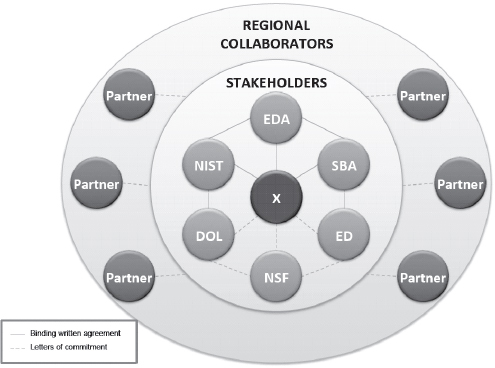
FIGURE 1 RIC operations.
SOURCE: Ginger Lew, Presentation at February 25, 2010, National Academies Symposium on “Clustering for 21st Century Prosperity.”
The diagram depicts seven federal agencies that are involved with the Energy Regional Innovation Cluster initiative. In the center is Agency X, in this case the DoE. Six other agencies are in a circle around the DoE. They are the SBA, NIST, the Department of Labor, the National Science Foundation, and the Department of Education. On an outer ring of the circle are various “regional partners” working with the federal agencies to advance their cluster. They could include community colleges, workforce investment boards, private companies, nongovernment organizations, and regional development agencies at the local, state, and regional level.
With the E-RIC, for example, Ms. Lew said she would like to get community colleges to support the clusters by offering curricula to train workers for the jobs that will be created. The SBA, meanwhile, will tailor its technical assistance to the needs of small businesses that spin out of the energy cluster. “All of these partnerships, we hope, will lead to a more robust kind of regional economy,” Ms. Lew said.
The regional model also can be applied to urban and rural initiatives. “The phrase ‘innovation’ is a term that not only is about technology,” she said. “It is a new way of doing business.” The USDA, for instance, is launching a $130 million pilot project to help five to seven communities coordinate cluster efforts. “I think this model has legs,” Ms. Lew said.
BUILDING A CLEAN ENERGY ECONOMY THROUGH
ACCELERATED INNOVATION
Kristina M. Johnson
Department of Energy
Dr. Johnson, the Under Secretary for Energy, thanked Dr. Wessner and Dr. Good for “their passion, their commitment, and their focus on the innovation imperative.” She also said it was a great pleasure to work with Ginger Lew, John Fernandez of the Economic Development Agency, and Marc Stanley of NIST on regional innovation initiatives.
The Administration’s goals for the DoE, Dr. Johnson explained, range from simply stated missions, such as “grow the green energy economy” and “secure our energy future,” to the highly specific, such as reduce greenhouse gas emissions by 83 percent by 2050. The Administration also wants the United States to regain science and engineering leadership. That requires a great global workforce. “We can have all the hubs and research funding in the world, but it is people that will drive this industry,” she said.
As an engineer would say, the challenge is “design under constraint,” Dr. Johnson said. “We have a lot of problems to engineer, and our constraints are threefold: cost, time, and scale.” The DoE’s research budget for science and technology is $10 billion a year. The department could spend this entire sum to build
one supercollider for basic science. Or, on the applied end, the DoE could spend up to $8 billion on a new nuclear reactor. “Neither of those by themselves will get us to where we want to go,” she said. “It’s going to take trillions of dollars in investment, and it can’t be something the federal government does on its own. It has to be a collaborative, cooperative partnership, which is why I am so happy to be involved in the RIC partnership.”
In addition to having a finite budget, the United States also has a finite amount of time. Other countries are learning from what the United States has done. “As my professor at Stanford told me, ‘There are only two ways: You can do it first or you can do it best,’” Dr. Johnson said. “I hope we do both.”
To get a sense of the scale of challenges facing the United States, Dr. Johnson noted the nation has a decades-old electrical grid. The United States has doubled its dependence on oil in the past 30 years. The United States has seen manufacturing decline from around a 30 percent contribution to GDP after World War II to around 15 percent today. The energy workforce is aging. Over the next decade, more than half of American energy workers will be of retirement age. This comes at a time when only 18 percent of U.S. high school students can pass an international proficiency test, and only 1 percent excel. “So we have a lot of problems to address,” she said.
The DoE’s fiscal year 2011 budget of $28.4 billion shows how the agency is assigning priorities. Of that, $10.4 billion will go for energy and environmental programs and $4.2 billion, about 22 percent, would be spent on research and development of clean energy. She showed a slide depicting where those funds would go. The United States is increasing investment in solar, wind, geothermal, and nuclear energy. The DoE recently approved $8.3 billion to guarantee that two new reactors will be built in Georgia. These expenditures come on top of the $3.4 billion the DoE is dispersing under the American Recovery and Reinvestment Act for carbon-capture sequestration, $4.5 billion for smart-grid technologies, $12 billion for energy efficiency, and $2.4 billion for production of electric-vehicle batteries and components.
To attain these goals with finite resources, federal agencies must team up. “I have to say a signature accomplishment of the past year under the Obama Administration has been that the collaboration across agencies is phenomenal,” she said. “Things are happening that are very hard to do, and it is because we know that we will be stronger by working together.”
To put the Regional Innovation Cluster strategy into perspective, Dr. Johnson discussed the evolution of U.S. science and technology policy. She displayed a graphic with the photos of figures such as Vannevar Bush, Niels Bohr, Thomas Edison, and Madame Curie. The “linear”7 or “feed-forward” model was
7 The “linear model” refers to the process of turning scientific research into commercial products. The steps are basic science, applied science, technology investment, investment in assets, and finally to market.
championed by Bush,8 science advisor to President Franklin Roosevelt. Under this model, the federal government funds basic research, passes it to the private sector and universities to develop into applied technology, and then relies on entrepreneurs and investors to bring technology to the marketplace. “It was always a relay race, and every time you handed over the baton it had to be perfect,” Dr. Johnson explained. “And that is just difficult to do.”
This process has evolved since the 1950s. The transistor was invented, she noted, leading to the computer revolution and software. “It gave us the analytical tools and quantitative approaches to do concurrent design,” she explained. “We could take a problem, develop and design the applied technology in parallel,” she noted, a breakthrough that was highlighted in the book Pasteur’s Quadrant.9
Dr. Johnson displayed a diagram explaining the quadrant. On one axis is fundamental research, as typified by Niels Bohr’s discovery of the atom. On another axis is strictly applied research, such as that of Thomas Edison. She said her favorite Edison quote is that “his goal in life is to make wood and plastic talk.”
In the upper right corner of the chart, where research is both fundamental and applied, is Pasteur’s Quadrant, so named because Louis Pasteur both discovered the causes and preventions of germ-based disease and developed a vaccine. Dr. Johnson noted that Madame Curie also operated in this quadrant. She discovered the field of radioactivity and pioneered the application of radiation to treat cancer. Others who did both fundamental and applied research include computer scientist Alan Turing10 and Claude Shannon.11
The United States needs to engage in use-based research, Dr. Johnson said. “We need breakthroughs in clean-energy storage, carbon capture, nuclear energy, and renewables to solve our problems in energy security,” she said. “If we invest, we have to be strategic, we have to be focused, and we have to follow through.”
One way in which the federal government is acting strategically is by bringing seven agencies together to work on clusters, she said. These agencies also are investing strategically to support science and energy innovation.
With funding through the American Recovery and Reinvestment Act, the DoE is supporting 46 engineering frontier research centers for $140 million. In the fiscal year 2011 budget, the department will ask for base funding to continue
8 Vannevar Bush (1880-1974) was director of the Office of Scientific Research and Development during World War II and is regarded as the architect of post-war U.S. science and technology policy. Dr. Bush maintained that the federal government should invest in basic scientific research, but that converting science into technology and commercial products was the role of private industry.
9 Donald E. Stokes, Pasteur’s Quadrant: Basic Science and Technological Innovation, Washington, DC: Brookings Institution Press, 1997.
10 Alan M. Turing (1912-1954), an English mathematician, is regarded as a father of computer science and with helping create the first modern computer.
11 Claude E. Shannon (1916-2001), a Princeton mathematician and electrician, is regarded as the father of information theory.
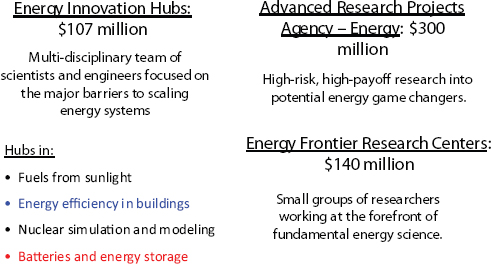
FIGURE 2 FY11: Supporting science and energy innovation.
SOURCE: Kristina M. Johnson, Presentation at February 25, 2010, National Academies Symposium on “Clustering for 21st Century Prosperity.”
these centers, which focus on fundamental breakthroughs in basic science disciplines, Dr. Johnson explained.
The Advanced Research Projects Agency, which was funded with $400 million in the Recovery Act, looks at “technology breakthroughs that can accelerate our advances from fundamental sciences and engineering into the marketplace,” she explained. “They are game-changers, things we expect to pay off soon. The plan is to fund such projects for two to three years. “If they run down a dark alley, we will end them and run down another alley where we can shine light,” she said.
The DoE also is developing “energy-innovation hubs.” These are multi-disciplinary teams coming together to tackle the problems of deploying “at-scale energy systems that can solve our energy-security problems, grow our clean economy, and reduce our greenhouse gas emissions,” Dr. Johnson said. There are hubs in fuel for sunlight, energy-efficiency in buildings, nuclear simulation and modeling, and batteries and energy storage. The idea is to take hubs and build other programs around them to get workforces and businesses engaged and to create start-ups. “We are talking about job application here,” she said. “In addition to investing in what it takes to build one job, we are investing in people who can then create multiple jobs.”
One hub is devoted to fuels from sunlight hub. The Energy Frontier Research Center is investigating fundamental processes of electron transfer, the interaction of light at the bio-molecular level, inspired by bio-synthesis. At the hub, the aim is to go from experiments “in light interaction with a beaker to pilot-scale
processing, so that we can generate fuel economically at scale to meet the goal of 20 billion gallons a year by 2022,” she explained.
By contrast, the Advanced Research Projects Agency for energy, known as ARPA-E, is dedicated to technology projects that are not directly addressed by hubs or the Energy Frontier Research Centers. For example, researchers are looking at the symbiotic relationship between light harvesting and algae, the breaking down of cellulose, converting it from sugars into oil, and large-scale, economic production of fuels. In other words, Dr. Johnson explained, ARPA-E is addressing cost barriers, the hubs are addressing scale barriers, and the research centers are addressing the barriers of fundamental knowledge of processes.
Another hub is for energy-efficient building technologies. Buildings consume 40 percent of U.S. energy, 70 percent of electricity, and 55 percent of natural gas. “When we looked at energy systems, it just seemed to be a natural, because it involves the appliance industry and the building industry, which accounts for 9.5 percent of U.S. GDP and employs nearly 10 million people,” Dr. Johnson said. “It has everything.” The departments of Labor and Commerce, the SBA, NIST, the NSF, and other agencies all can have something to contribute.
The DoE is working with Ginger Lew and her team at the National Economic Council to try to build the energy-efficient buildings hub because it believes it is the best place to start a regional energy innovation cluster program, Dr. Johnson said. In addition to science and technology, the initiative also involves behavior, policy, economics, and design. “We don’t get there by technology alone and by policy alone,” she said.
Looking at systems is important in order to reach energy goals, she said. For example, it is known that if every household in America replaced one frequently used incandescent bulb with a compact fluorescent light (CFL), the United States would save enough electricity to power 3 million homes. However, one must look at the entire system. One reason incandescent bulbs are inefficient is that they give off heat. As a result, they heat rooms. Dr. Johnson noted that United Technologies did a study showing that unless the source of heat also is understood and optimized, CFLs may not reduce greenhouse gas emissions. Therefore, it is very important to look at the system and bring in policy that can get people to change their behavior, she said. For the holidays, Dr. Johnson said she gave all of her friends and families CFLs. “Unfortunately, they are probably the kind of people who already had CFLs,” she said.
To get such projects to scale, partners must amplify what they are doing. “Just like one photon can give off many photons in a laser reaction, we have to make sure that when we invest in a job, it has the potential to grow more jobs,” Dr. Johnson said. “It is a probability game.”
An example of how the Administration is trying to get more impact is the way it is looking at federal programs to help small businesses survive the Valley of Death. To take a technology from the fundamental breakthrough to the market can take 7 to 12 years, Dr. Johnson pointed out. The current small-business
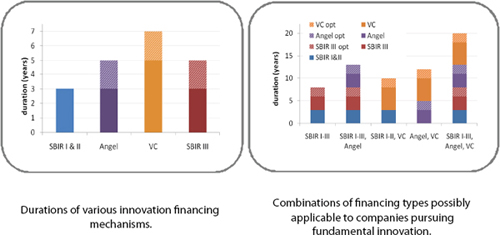
FIGURE 3 Sustaining small businesses.
SOURCE: Kristina M. Johnson, Presentation at February 25, 2010, National Academies Symposium on “Clustering for 21st Century Prosperity.”
innovative research program funds new or existing companies developing a particular product for one to three years, or through the first three or four funding rounds. The hope is that companies by then will be able to find angel investors, who work on a three- to five-year horizon. There can be a time gap, however, before companies are able to raise funding from venture capital investors, who have a five- to seven-year timeline.
Funding only a few phases of a company’s development, therefore, “may not get you staying power,” Dr. Johnson said. Expanding the Small Business Innovation Research (SBIR) program could be a solution. The NSF and DoD offer SBIR Phase III programs that provide funding for another three to five years. Combined with angel funding and venture capital, that could give companies the resources they need to stay in business long enough to reach the market, she said.
Dr. Johnson said that she learned from her experience as an entrepreneur that “the most important thing was to stay long enough to figure out what your customers wanted and be smart enough to respond to it,” she said. Dr. Johnson co-founded ColorLink12 in 1995. Twelve years later, the founders sold ColorLink to RealD, a company that supplies 3-D technology used in movies such as Avatar.
The only reason ColorLink was able to survive long enough is that it received a $2 million, three-year grant from NIST’s Advanced Technology Program to develop the process to make the 3-D glasses worn in theaters. “Without that staying power, we would have died in the Valley of Death,” Dr. Johnson said, adding that she hopes regional innovation clusters will provide staying power to small businesses so they can create the jobs “to put America back to work.”
Marc G. Stanley
National Institute of Standards and Technology
Mr. Stanley noted that he has been involved with cluster development since the time he ran the Advanced Technology Program (ATP)13 from 2003 through late 2009. Now he is working on clusters as Acting Deputy Director of NIST. For all of his years in government service as a congressional aide and in the policy circles, “I have never seen an Administration so coordinated, so open
12 Dr. Johnson co-founded of ColorLink Inc., based in Boulder, CO. It is a photonics company that develops and manufactures polarization applications for consumer polarization consumer electronics, medical diagnostics, avionics, photography, and other products. In 2007, the company was acquired by digital 3-D technology firm RealD.
13 The Advanced Technology Program under NIST supported early-state research by industry. It was terminated in 2007 and succeeded by the NIST Technology Innovation Program.
and transparent, and with the ability to talk to all political appointees about the concerted efforts we are discussing today,” he said. “It is absolutely incredible.”
Mr. Stanley discussed a new model of policy collaboration that he had worked on while at the ATP under former NIST director Dr. William Jeffrey in the George W. Bush Administration. First, however, he presented evidence of a number of “disturbing trends” that highlight the concerns many have about U.S. competitiveness in science and technology. One area where the United States is slipping is in R&D intensity.
By most measures, U.S. spending on R&D has remained flat or has been falling since long before the current recession, Mr. Stanley noted. The United States spends 2.5 percent of GDP annually on R&D. That is behind Israel (which leads with 4.5 percent of GDP) and nations such as Sweden, Finland, Japan, and South Korea. The United States remains just slightly ahead of Taiwan, Germany, and Singapore.14 While industry spending on product development has risen sharply in the past two decades, according to National Science Foundation data, industry investment in applied research has risen slowly. Spending on basic research has remained essentially flat. Mr. Stanley also cited NSF data showing that industry’s share of university R&D funding has declined since the mid-1990s. Federal government funding has dropped steadily as a share of GDP, although the new Administration is trying to change that.
NIST is part of the Administration effort to get the federal government, states, universities, and industry to work more closely together, Mr. Stanley explained. Instead of operating in silos, there should be collaboration among the many parties engaged in economic development on regional policy, economic and industry policy, education policy, and science and technology policy.
For its part, NIST is leveraging all of its programs to aid regional innovation clusters. It is a member of the E-RIC initiative, for example. In 2007, the agency launched the Rapid Innovation and Competitiveness Initiative, which is a public-private partnership for R&D investments. The goal of this initiative, Mr. Stanley explained, is to increase the nation’s return on its scientific investment, collapse the time scale of technological innovation, and stimulate the economy and enhance America’s competitiveness.
NIST believes such initiatives must be led by industry. If there is one thing he has learned after 17 years managing federal technology programs, Mr. Stanley said, “it is that industry knows where to go.” But there is a role for government as a partner that shares costs and has “skin in the game.” NIST also wants to focus on areas of national concern that it believes are under-funded.
For its first rapid-innovation initiative, NIST chose the search for technology to replace CMOS15 as the dominant semiconductor technology. Scientists are
14 Source: OECD Main Science and Technology Indicators.
15 CMOS, patented by Frank Wanlass in 1967, stands for complementary metal-oxide semiconductor. CMOS is a technology for constructing integrated circuits that is used in devices such as microprocessors, static random-access memories, and image sensors.
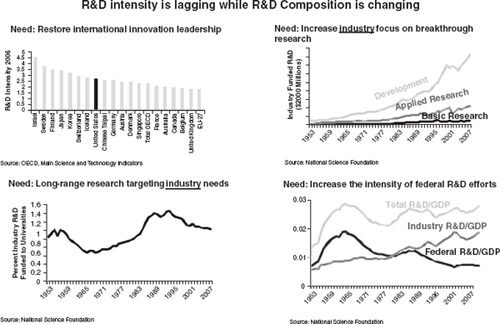
FIGURE 4 Problem: There are disturbing trends in R&D investment.
SOURCE: Marc G. Stanley, Presentation at February 25, 2010, National Academies Symposium on “Clustering for 21st Century Prosperity.”
trying to solve the riddle of what happens when Moore’s Law16 finally reaches its endpoint, Mr. Stanley said. NIST believed this effort was of critical importance to the country, but was under-funded. In 2007, NIST backed launched a pilot program to back the Nanoelectronics Research Initiative (NRI),17 a collaborative effort between industry, government, and academia aimed at accelerating research and innovation in nanotechnologies.
In terms of measurement metrics, Mr. Stanley said an increase in postdoctoral researchers and fellowships is one good benchmark of how well the nanotech initiative is working. Another is start-ups. “We can’t let the little company go away,” he said. “We have to nurture that little concept until its gets sufficient capital to go to the marketplace.”
The nanotechnology initiative illustrates NIST’s approach to collaboration. The pilot program began with a technology roadmap furnished by the Semiconductor Industry Association’s International Technology Roadmap for Semiconductors. “We found that was an incredible place to get the kind of information we want,” Mr. Stanley said. Corporate research partners include Advanced Micro Devices, Freescale, IBM, Intel, Texas Instruments, and Micron Technology.
The initiative also involves 35 universities and 4 research centers in different parts of the country. They are Index, a consortium of 11 universities that is headquartered at the University of New York-Albany, New York; SWAN, based at the University of Texas-Austin; WIN, based at the University of California-Los Angeles; and MIND, based at Notre Dame University. Cooperative agreements last for five years.
Total funding for the nanotech initiative will be in excess of $200 million, Mr. Stanley said. To finance the university-based research at each center, NIST is contributing $2.75 million annually, industry partners are contributing $5 million per year, and states are contributing $15 million. The state contributions tend to come in the form of grants and tax incentives, Mr. Stanley explained. NIST played a role in getting all of the partners to sign up and is monitoring the process.
So far, the nanotech initiative has generated 13 patents. The program is supporting the work of 128 graduate students and 24 post-docs at the four regional centers. The project also has generated 239 publications as of October 1, 2009. This shows that such an initiative can produce results and that government agencies can collaborate with universities and states, which he said “is the benchmark of where we have to go.”
In terms of industry support, Mr. Stanley cited comments by Jim Kelly, IBM’s senior vice-president and director of research. Mr. Kelly said that for
16 Moore’s Law, proposed by Gordon Moore in 1965, states that the number of transistors and resistors on a chip doubles every 18 months.
17 The Nanoelectronics Research Initiative (NRI) is led by Semiconductor Research Corporation, a global consortium of companies and universities to develop novel computing devices capable of replacing the CMOS transistor as a logic switch by 2020.
America to win the global nanotechnology race, “it will take radical collaboration between government, higher education, and industry.” Mr. Kelly called the NRI “the best example of this type of collaboration.” Such praise, Mr. Stanley said, means “industry is recognizing that we can be a partner along with the various organizations and make something successful.”
Mr. Stanley then discussed the vision of NIST Director Dr. Patrick Gallagher of where the agency is going. NIST already is world-class in measurements and scientific research. “There is a sense now in our organization that we can play a really important role in the innovation area,” Mr. Stanley said. The agency is getting involved in meeting critical national needs with the Technology Innovation Program. It also offers the Industrial Technology Fellowship program, the manufacturing extension program, and the Construction Grant Program, which funds universities to expand their laboratories to match NIST priorities and Administration guidelines.
In summary, Dr. Stanley said, “We see NIST engaging even more through its extension programs and through its RICs to help in this process of making the country more innovative.”
DISCUSSION
William Harris, president of Science Foundation Arizona, began by calling Ginger Lew’s “doughnut” diagram depicting collaboration by federal agencies “very impressive.” However, he added, he is concerned that many states do not have programs matching those of the federal government. As a result, “we often talk about these things, we end up spending money, but we fail because things are not sustainable,” Dr. Harris said. “I think we need to mirror at the state level some of the federal entities. That is against all the political rhetoric. But until we get these things matching up, I think we fail as a society and as a system.”
Under Secretary Johnson said the comment “is well taken.” She observed, though, that when one looks at the most robust regional clusters around the country, “there has been a very, very tight partnership” both among regional organizations and state agencies. “I think the challenge, as any bureaucracy has, is how you keep that collaboration going forward and alive,” Dr. Johnson said. “But I think once a state and a region sees the payback to the economy, there is positive reinforcement and things start to move forward.” In California, Massachusetts, and Kansas, for example, “you do have that level of collaboration at the state level. Could it be better? Absolutely.”
Dr. Johnson agreed that sustainability is a serious problem, especially with states under extreme budget distress. She noted that when she was in Colorado, ColorLink benefited from a program offered by the state technology institute. “That program died,” however, when a new governor assumed office.
Mr. Stanley of NIST said he is more optimistic, “maybe because I have been around this game for so long.” He said he could mention at least 10 “very
smart” state economic development organizations that “are putting together the right kinds of programs and are coming to the right kind of people in the federal government and the Administration.” Mr. Stanley agreed that not every state has good economic-development programs. However, many people in the Administration “are looking for new avenues to explore and are trying to change the paradigm from just infrastructure investment to expansion to other ways in which we can help.”
Mr. Stanley re-iterated that states must take the initiative, however. He also agreed with the point that “you can’t rely on VC [venture capital] money any more. That has been drying up significantly because of the economic woes.” He noted that one company in Texas had received an Advanced Technology Program18 grant, but had trouble raising an additional $20 million locally it needed to finish its second stage of clinical trials. It turned to out-of-state venture capitalists. “We have a serious problem in this country, and we have to put all the best minds together and make it happen,” Mr. Stanley said.
Mr. Borrus of X/Seed Capital noted that one of his solar-energy companies is working closely with several states that offer incentive packages to attract solar production. The package of incentives, which includes tax credits and loan guarantees, could be worth up to $50 million and “could be essential to build the first full-scale commercial production facility,” he said. “So there are positive things happening in the states.”
An audience member said his company had been hired by state governments to bring in clean-technology manufacturing. “I see states putting money into clusters, and some are actually pretty sophisticated and focused,” he said. But federal programs often don’t respond to those state efforts because they operate on their own track. “How do you make the federal support more agile,” he asked, “so that they are not just leading but also buying into something on a track that may be faster in driving business, economic development, and links to research?”
U.S. Assistant Secretary of Commerce for Economic Development John Fernandez offered his perspective as “the new guy” in Washington and as former mayor of Bloomington, Indiana. “I think what is happening now is kind of typical in Washington,” Mr. Fernandez said. “State and local leaders tend to be ahead of the curve.” He noted that during his time as mayor, Bloomington already had a long track record of advancing cluster development. “What is new and what is important is that this Administration is acknowledging the notion of aligning resources and integrating programs in a smarter way so that we can amplify these investments,” he said.
As to the question of “how do you drive somebody else’s train,” Mr. Fernandez said “that part of it is to get out of the way and let them tell you what they need.” Regional innovation clusters cannot be legislated, he said. “They are organic.
18 The Advanced Technology Program under NIST was replaced with the Technology Innovation Program under the America COMPETES Act of 2007.
You have to have champions at the local, private-sector, and state levels,” he said. “What we can do is work with those folks as true partners and customize the deployment of federal resources to amplify and accelerate that particular cluster.”
Dr. Johnson noted that hubs target particular areas and applications. She said the SBIR program is trying to make its solicitations broader to put greater focus on commercializing clean energy and creating jobs. Over the past 20 years, she pointed out, 94 percent of the new jobs generated in the United States came from small businesses. “The target really is about getting everyone to come together and create those spin-offs,” she said.


