
3
Technical Assessment of Proliferation Resistance
In addition to soliciting input from policy makers, a second task of the National Academies workshop was to seek input from technical experts in proliferation risk and resistance assessment and implementation. Several technical experts were asked to comment on the potential applicability of proliferation resistance assessment methodologies and measures to policy makers’ concerns, as well as the current maturity level of those methodologies.
Five technical experts presented briefings at the workshop:
• William Charlton, director of the Nuclear Security Science and Policy Institute (NSSPI) at Texas A&M University, associate professor of nuclear engineering, and workshop committee member;
• Christopher Way, associate professor of government at Cornell University;
• Robert Bari, senior physicist at Brookhaven National Laboratory;
• Bartley Ebbinghaus, staff scientist at Lawrence Livermore National Laboratory; and
• Olli Heinonen, senior fellow at Harvard University Kennedy School of Government Belfer Center for Science and International Affairs.
This panel discussion was moderated by William Charlton.
This chapter provides summaries of the key points made by each of these individuals and by participants in the subsequent discussion sessions.
These statements reflect the viewpoints of the individual speakers, not the consensus views of the workshop participants or of the National Academies.
OVERVIEW AND BACKGROUND: TECHNICAL EFFORTS ON PROLIFERATION RISK
William Charlton
The first technical assessments of proliferation resistance and risk associated with nuclear facilities date back to the early 1970s. Since then, significant progress has been made in using technical analyses to inform nuclear safety, but less progress has been made in assessing security and nonproliferation.
In discussions of technical assessments of the vulnerability of nuclear fuel cycle facilities to proliferation, two related terms are often used: proliferation resistance and proliferation risk. These concepts do not refer to the same idea, as discussed in Chapter 1. The definition of proliferation resistance is relatively well-agreed upon as:
The characteristics of a nuclear energy system that impede the diversion of undeclared production of nuclear material or misuse of technology by states in order to acquire nuclear weapons or other nuclear explosive devices (IAEA, 2002).
It should be noted that this definition of proliferation resistance limits the concept only to state actors, not non-state actors.
On the other hand, proliferation risk is not nearly as well defined in the international community. There are several factors, both technical and non-technical, that influence proliferation risk, including:
• Characteristics of the proliferator (e.g., motivation, goals, resources, and technical capabilities);
• Intrinsic features of the nuclear energy system (i.e., technology and design features);
• Extrinsic measures (e.g., domestic institutional measures and international safeguards); and
• Consequences of proliferation success (e.g., increased military capacity, changes in the geopolitical situation and regional stability).
By comparison, only intrinsic features1 of the nuclear energy system and extrinsic measures2 are considered in an assessment of proliferation resistance.3
One possible definition for proliferation risk—a perturbation of the more general definition of risk—can be expressed mathematically as:

Where Ln is the probability per unit time that an adversary might attempt to proliferate along path n; Pn is the probability that an adversary will be successful at proliferation without timely detection, given that he has chosen to proliferate along path n (most closely related to proliferation resistance); and Cn is the consequence of adversary proliferation without detection along path n (Charlton, 2011).4 Most current attempts at understanding proliferation risk focus on Pn; Cn and Ln are very difficult to understand and to estimate.
Since the 1970s, progress has been made in assessing the proliferation resistance of nuclear facilities, and several methods have become fairly well-developed. On the other hand, studies of proliferation risk remain immature. For this reason, the remainder of this discussion will focus on methodologies for assessing proliferation resistance.
There are a number of proliferation resistance assessment methodologies being developed around the world. These methods can be categorized by several key characteristics: the method of analysis; whether a qualitative or quantitative judgment is produced; or by the figure of merit produced.
A range of methods can be used to analyze the proliferation resistance of fuel cycle facilities. For example, the Technology Opportunities for Proliferation Resistance (TOPS)—developed by an international team funded by the Nuclear Energy Research Advisory Committee—and the
__________________
1 As noted in Chapter 1, intrinsic barriers are the technical aspects of the system that contribute to proliferation resistance, and include considerations such as type of special nuclear material (SNM) used (e.g., low enriched uranium vs. highly enriched uranium), technical difficulty of proliferation, and difficulty of detection (IAEA, 2002). (Difficulty of detection also has extrinsic aspects.)
2 As noted in Chapter 1, extrinsic barriers are usually fundamentally non-technical, and include measures such as international treaties and safeguards measures (IAEA, 2002).
3 Some proliferation resistance methods do attempt to incorporate adversary characteristics into the analysis. For example, the Generation IV Initiative Forum’s Proliferation Resistance and Physical Protection approach (discussed elsewhere in this chapter) incorporates a “threat description” describing a proliferator’s capabilities, objectives, and strategy. However, this threat description is not used in a predictive fashion.
4 This definition indicates that proliferation risk is time-dependent.
Japan Atomic Energy Agency’s (JAEA) methods rely primarily on expert judgment. On the other hand, probabilistic risk assessment is used by the Generation IV Initiative Forum’s Proliferation Resistance and Physical Protection (PR&PP)5 analysis and Sandia National Laboratory’s Risk-Informed Probabilistic Analysis (RIPA). Other approaches use different methods (see Ford, 2010 for more detail).
In addition, while all methods require subjective inputs, some methods are intended to produce a qualitative assessment of a facility’s proliferation resistance (e.g., TOPS and JAEA), whereas others attempt to quantify the proliferation resistance of a facility (e.g., PR&PP, Texas A&M University’s Multi-Attribute Utility Analysis [MAUA], North Carolina State University’s Fuzzy Logic method, and RIPA). The primary difference between quantitative and qualitative methods is whether a number is provided as the output. In some cases, a quantitative output can be somewhat misleading, as subjective judgments inevitably are hidden within that output.
Different methods may also produce different figures of merit.6 For example, PR&PP produces six different figures of merit for proliferation resistance,7 while many other methods attempt to aggregate the information produced into a single figure of merit or may even produce none at all. A single figure of merit has both benefits and costs—the decision-maker is provided with a single value, which is clearer; however, some fidelity and information content is lost by merging the various elements of proliferation risk into a single number.
Even though a range of proliferation resistance assessment methods are currently under investigation, none of them are likely to be easily used to answer many of the questions that were discussed by the policy makers in Panel 1 of the workshop (see Chapter 2). This is in large part because many of the methodologies were designed to better understand nuclear energy systems rather than to answer the questions a policymaker might be interested in. Difficulties likely to be encountered in attempting to apply these methodologies to answer policy makers’ questions include the following:
__________________
5 PR&PP can also be considered to be a framework rather than just a methodology. In this case, it is relatively easy to take out the mathematical model and substitute another. However, as currently implemented, PR&PP uses pathway analysis, which is akin to a PRA methodology used for safety assessments.
6 A “figure of merit” is a single—typically quantitative—value that summarizes a range of information about the proliferation resistance of a fuel cycle system.
7 PR&PP produces figures of merit related to technical difficulty, proliferation cost, proliferation time, fissile material type, detection probability, and detection resource efficiency.
• Most proliferation resistance methodologies have generally ignored the characteristics of the adversary, aside from the adversary’s technical capability—however, geopolitical information and creativity in proliferation decision-making (pathway choices) are essential features of real-world proliferation;8
• Many methods require a pathway determination which is rarely complete;
• Many methodologies are static rather than dynamic;
• Not all methods lend themselves well to uncertainty analysis;
• Comparisons between methods have been rarely reported, presenting difficulties in achieving transparency;
• All methodologies have some degree of subjectivity;
• Effectively presenting the results from these methods to decision makers is challenging;
• Consequences of proliferation attempts are typically only handled in a cursory fashion; and
• Most methods have not been used to understand the impact of technology transfers to states.
However, each methodology was developed originally to answer a specific question, either policy-related or technical. It will be essential to establish whether these original questions are relevant to nonproliferation decisions, and whether, ultimately, the methodology is able to provide answers to the original question.
In closing, there is likely to be no truly proliferation-proof nuclear energy system or nuclear fuel cycle, and these methods cannot be expected to identify such a system. A state can eventually proliferate—it’s a question of how much time is required. The methods discussed here are also not predictive tools, and even generating good probability estimates is complex because proliferation is a rare event. Ultimately, a realistic goal is to seek ways to use technical proliferation resistance and risk assessment methods to help inform decisions and manage risks.
METRICS AND METHODOLOGIES FOR ASSESSMENT OF PROLIFERATION RISK
Robert Bari
Technical assessments have the capability to inform a number of nonproliferation policy questions. For example, technical assessments can inform decisions related to: (1) the relative nonproliferation advantages of
__________________
8 One notable exception is the PR&PP methodology.
nuclear energy systems applicable to energy generation, material production, waste treatment, and research; (2) tradeoffs between international arrangements and national programs; and (3) broader tradeoffs between nonproliferation and energy, the environment, economics, security, and safety.
Several steps are involved in preparing a good evaluation of the proliferation risk or resistance of a nuclear fuel cycle facility. First, one must determine how to characterize and measure proliferation resistance or risk, and, second, one must evaluate the risk or resistance. Most research on proliferation resistance and risk has focused on these steps. However, it remains important to keep in mind that proliferation involves both non-technical (motivation, intent) and technical (capability) aspects. For this reason, a good proliferation risk evaluation would consider (1) the host-state context, including the host state’s objectives, capabilities, and strategies, and (2) the fuel cycle facility design features, including the requirements for safeguards and security measures.
Once the evaluation has been completed, it is important to determine how to use the results and how to communicate them to the various stakeholders involved. Some ways in which a proliferation risk or resistance analysis could be used to inform policy makers include:
• Performing absolute or relative assessments on a specific facility;
• Evaluating system risk reduction and informing risk management;
• Informing the design of alternative systems to reduce risk; and
• Constructing a global nuclear architecture.
With the use in mind, the results then must be communicated in an understandable way to each of a broad range of specific users, including policy makers, nuclear fuel cycle facility designers, and other stakeholders, not all of whom will appreciate a highly technical response.
In addition, for a proliferation risk or resistance analysis to be effectively used, it would be useful to have clearly structured interactions between the technical experts performing the analysis and the policy makers who would use the results of the analysis. Ideally, policy concerns should inform the statement of the question to be addressed by the analysis. Once the question is stated, technical analyses can be performed to provide clear statements of alternatives. Finally, policy can be used to choose among the alternatives presented in the technical results.
The remainder of this briefing focuses on the PR&PP methodology for evaluating proliferation resistance. DOE-NE and NNSA co-sponsor the U.S. participation in the international working group for PR&PP under the Generation IV International Forum (GIF).
The technology goal for PR&PP is to determine how to design Generation
IV nuclear energy systems in a way that will increase the assurance that they are not a desirable route for diversion or theft of weapons-usable materials and will provide increased physical protection against acts of terrorism. Key objectives for PR&PP as part of GIF include:
• Facilitating the introduction of PR&PP features into the design process at the earliest possible stage of concept development; and
• Assuring that PR&PP results are an aid to informing decisions by policy makers involving safety, economics, sustainability, and related institutional and legal issues.
PR&PP is a methodology based on the types of PRA methodologies that have been highly successful in evaluating the safety of nuclear facilities. Modern efforts on PRA can be dated back to the 1975 publication of the definitive reference for risk assessment in a nuclear safety context, the WASH-1400 study, which departed from and added to the previous deterministic and prescriptive perspective on nuclear safety regulation (USNRC, 1975). In the years since, PRA has been highly successful when used to understand nuclear safety. Current work on methodologies such as PR&PP seeks to determine whether it is possible to risk-inform nonproliferation measures in a similar way, and also whether the success in the safety arena holds lessons for proliferation risk assessment.
The overall PR&PP framework involves three steps: challenges, system responses, and outcomes, shown in Figure 3-1. For a proliferation risk scenario occurring at a nuclear facility, “challenges” are threats to the nuclear facility, such as diversion, misuse, breakout, or the establishment of a clandestine facility. System responses to the challenge are then evaluated, for example, whether there are physical and technical design features that would combat or slow this particular attempt or safeguards in place that would alert the international community. Finally, the possible outcomes resulting from the challenge and the system response are evaluated. These steps are repeated for many potential challenges and system response variations.
The PR&PP analysis of the system response occurs in three stages. First, the nuclear system is decomposed into system elements to permit a pathway analysis. This involves identifying elements such as the materials, facilities, processes, and transportation links that an adversary could exploit to accomplish his or her goals. Second, the location of operations and materials, their accessibility, and characteristics are identified. In addition, any extrinsic measures and the locations where they are applied are noted, such as material balance areas and locations of safeguards and physical protection systems. Finally, interfaces with other systems that are
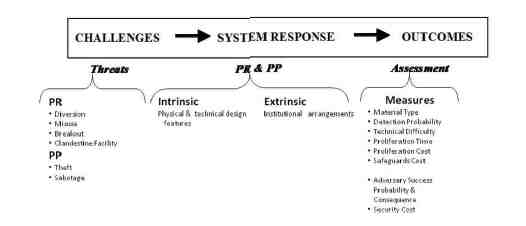
Figure 3-1 The PR&PP Methodology Framework. The overall framework involves three stages: challenges; system response; and outcomes. Challenges are evaluated by generating a threat list. The system response is evaluated using PR&PP’s PRA methodology. The outcomes are assessed using a number of metrics, listed in the figure. SOURCE: Bari (2011).
not part of the analysis (i.e., links to clandestine facilities) are evaluated to identify any additional potential vulnerabilities.
A number of knowledge gaps remain that are associated with PR&PP and with proliferation resistance assessment more generally. These include:
• Scenario completeness;
• Human performance;
• Combination of different types of information to create the final evaluation;
• Harmonizing design understanding with potential safeguards and protection possibilities; and
• Conveying and displaying results, particularly, what we know and what we do not know.
Further work is needed to fill these gaps.
However, progress is being made. Studies9 performed for GIF and others have shown that system studies of proliferation resistance can be performed on a comparative basis (e.g., studying reprocessing alternatives to PUREX). These studies have also shown that there are no simple
__________________
9 See, for example, the study of “Reprocessing Alternatives to PUREX” (Bari et al., 2009) and the study “Advanced Reactor Alternatives to ALWR” (Zentner et al., 2010).
answers regarding proliferation resistance. There are many potential pathways to proliferation, and adversary success is highly dependent on pathway choice and creativity. In addition, the results and applicability of an analysis are dependent on a number of assumptions about adversary capabilities and objectives. These uncertainties make it difficult to effectively collapse the proliferation resistance of a facility into a single value denoting overall proliferation resistance. However, one key conclusion has emerged from the work performed to date for PR&PP: Safeguardability is a very important consideration.
In closing, the overall framework used for PR&PP—quantitative evaluation methods aside—provides a holistic view of the energy system with respect to nonproliferation that has the potential to provide worthwhile insights. Even a qualitative analysis can provide information that is helpful to better understand the system being evaluated. For example, a qualitative analysis is useful for informing decision makers on which threat scenarios are associated with particular nuclear process characteristics.
The benefits of a risk assessment-type approach can go beyond the “final answer,” because the insights gained from the performance of a highly structured analysis can be valuable in themselves. This process is not simply a checklist exercise, but a process that must be repeated throughout the life-cycle of the facility with new potential to provide insights at each iteration.
POLITICAL SCIENCE APPROACHES AND FUEL CYCLE CHOICES
Christopher Way
At present, there is no significant political science research agenda on proliferation risk and the nuclear fuel cycle. There has been considerable work done on drivers and intent for proliferation, but not much on the narrow focus of the workshop (i.e., the relationship of fuel cycle choices to proliferation). Therefore, this briefing will draw attention to three research areas that might be developed further to provide insight into this workshop’s key topics.
Two major patterns can be pulled from the history of nuclear weapons. Although it is not clear that historical patterns indicate future patterns, in the absence of experimental data, history is the primary source of information on proliferation.
First, the motivation to proliferate is very important. No matter what the United States chooses to do with fuel cycle technology, a nation will find a way to acquire a nuclear weapon or a nuclear program if the desire to do so is strong enough. There are several situations that have been shown to drive the desire to proliferate, at least in part. Evidence is quite
clear that the security environment of a state is important in influencing the government’s decision to proliferate. In addition, in recent decades, personalistic10 regimes appear to be more willing and able to proliferate. Finally, a desire for prestige is a known motivator to proliferate.
Second, there are patterns to be drawn from the historical fuel cycle choices of proliferators. Prior to 1970, the back end of the fuel cycle (reprocessing and plutonium production) was favored by proliferators. Six out of seven state attempts at proliferation followed the back-end approach—using the plutonium uranium extraction (PUREX) process—and six succeeded. After 1970, the front-end approach—using enrichment technology to produce highly enriched uranium (HEU)—began to be favored. Seven out of nine state attempts at proliferation after 1970 selected the front end approach; only three succeeded.
Possible reasons for this shift from using reprocessing technologies to using enrichment technologies include the tightening of extrinsic barriers and the attractiveness of new technologies. By the 1970s, previous successful attempts at proliferation led toward a tightening of extrinsic barriers to proliferation. Reprocessing facilities, heavy water, and other sensitive nuclear technologies became harder to acquire, and it became harder to conceal reprocessing facilities. At the same time, centrifuge enrichment technology displaced gaseous diffusion technology as the enrichment method of choice. Compared to gaseous diffusion, centrifuge enrichment was much easier to conceal and the components and information needed were available to potential proliferators, particularly through the A.Q. Khan network.
Although, as noted previously, little political science research has focused directly on the issue of proliferation risk and the nuclear fuel cycle, other political science research exists that could be helpful in analyzing these issues. This research has been conducted in three areas: assessing the risk of the host state’s desire to proliferate; assessing the likely consequences of technology diversion; and assessing the patterns of potential technology and knowledge sharing.
Estimates of how likely a host state is to decide to proliferate have been calibrated using the past 50 years of experience with nuclear proliferation. Nevertheless, these estimates have a great deal of uncertainty associated with them. Fortunately, there have been few instances of proliferation, but with such rare events it is inevitable that huge errors in estimation will be generated. In addition, there is political uncertainty involved in assessing proliferation risks—today’s policymaker may not
__________________
10 In a 2011 paper, C. Way and J. Weeks define personalistic regimes as those in which “a paramount leader enjoys an enormous amount of personal discretion over government decisions, to an extent unseen even in other dictatorships” (Way and Weeks, 2011).
be tomorrow’s policymaker. Over decades and even months political situations can change dramatically.
Work has been done to assess the likely consequences of technology diversion. This includes, for example, determining the ability to convert reprocessing technologies and processes to separate plutonium. It can be very difficult for a host state to use information provided to them or otherwise acquired without a great deal of tacit knowledge, so a high technical capacity should not be assumed.
A large amount of literature exists tracking the patterns of legal and illegal sharing of nuclear weapons-related technology and knowledge. This research could help in assessing the patterns of potential technology/ knowledge sharing in the context of the nuclear fuel cycle. Although research has not addressed fuel cycle choices directly, it could be used to do so. Game theoretical tools might be able to be adapted and combined with red teaming to provide additional insights about the patterns of legal and illegal sharing of knowledge and technology.
In summary, political science research has not to this point addressed fuel cycle choices directly, but research exists that could provide a platform to begin such work. Some additional research on extrinsic barriers and likely compliance with treaties and restrictions could be of value for this purpose.
HOW MATERIALS ATTRACTIVENESS ESTIMATES ARE DONE AND HOW THEY CAN BE USED AS PART OF A PROLIFERATION RISK ASSESSMENT
Bartley Ebbinghaus
The overall goal of estimating materials attractiveness11 is to communicate clearly about how attractive different nuclear materials are for use in a nuclear weapon. Accurate estimates have four key benefits. First, it is possible to correct false or misleading publicly-available statements on material attractiveness that could lead to inappropriate security or proliferation decisions for some materials or processes, such as the claimed proliferation resistance of reactor-grade plutonium12 or uranium-233 containing parts per million (ppm) levels of uranium-232. Second, material attractiveness estimates could be used to prevent inappropriate reductions in existing safeguards and security requirements for nuclear materials.
__________________
11 Material attractiveness is defined as the relative utility of nuclear material for an adversary in assembling a nuclear explosive device.
12 Reactor-grade plutonium is defined as plutonium that contains over 18 percent plutonium-240.
Third, the attractiveness of the materials used in various nuclear fuel cycles (e.g., PUREX vs. UREX or open vs. closed cycles) can be assessed to better understand some aspects of the relative proliferation risks associated with these fuel cycles. Fourth, good materials attractiveness estimates can quantify the relative attractiveness of existing nuclear materials.
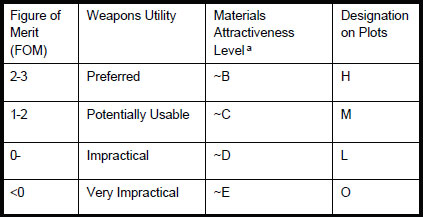
a “Nuclear Material Control and Accountability,” U.S. Department of Energy manual DOE M 470.4-6 Chg 1 (August 14, 2006), http://www.directives.doe.gov.
FIGURE 3-2 Theoretical figure of merit (FOM) for the attractiveness of different nuclear materials. For example, a highly attractive nuclear material would have a FOM of 2-3, a preferred weapons utility, and would have a materials attractiveness level of B. SOURCE: Ebbinghaus (2011).
Materials attractiveness can be communicated in several different ways, with increasing granularity. Official government standards (for example, on the utility of reactor-grade plutonium) are the most general, followed by safeguards and security regulations, such as graded safeguards tables. Most specific are nuclear material attractiveness metrics, such as a “figure of merit of material attractiveness”13 (figure of merit) for a specific nuclear material, discussed below. This last, most granular, approach to discussing materials attractiveness is most useful in considering the proliferation potential associated with nuclear fuel cycles.
A materials attractiveness figure of merit is used to quantify the utility of nuclear material to an adversary. It is a grade relative to established standards that is supported by weapons design and materials processing considerations, and is generally equated with nuclear material attractiveness
__________________
13 A figure of merit of material attractiveness is a quantified measure of material attractiveness.
in safeguards and security applications. For example, as shown in Figure 3-2, an individual material might be graded on a three- or four-step scale. For a host state, the assumption is made that the element can be purified; however, for a substate, it is considered possible that they cannot.
This figure of merit can be used to quantify one proliferation resistance measure: specifically, fissile material type. Other proliferation measures, such as proliferation technical difficulty, proliferation cost, proliferation time, and detection probability, are also important, but cannot be quantified using a material attractiveness metric.
There are four primary physical factors that affect the utility of a material for weapons use:
• Bare critical mass (size factor), which affects the size of the nuclear device constructed from the material, and, necessarily, the difficulty in hiding and moving it;
• Internal heat generation (stability of the device), which affects the difficulty in keeping the device assembled and operable;
• Intrinsic neutron rate (yield factor), which affects the reliability of some nuclear devices; and
• Radiation dose rate (acquisition factor), which affects the difficulty in collecting the materials and assembling the device.
All these factors are used for the material attractiveness metric shown in Figure 3-2, with the exception of the intrinsic neutron rate. The availability (or material quantity) is treated as a separate parameter, aside from the attractiveness of the material.
Figure 3-3 shows that the figure of merit ranks materials consistently with their known utility in a nuclear device. On the other hand, some information that is not common knowledge is also shown by the calculation used to produce this chart—for example, that pure americium-241 is not attractive.
The figure of merit can also be used to show how the material utility changes as a function of different parameters of interest to technical experts or policy makers. For example, it is possible to plot the attractiveness of a material as a function of burnup, as shown in Figure 3-4.
When using material attractiveness metrics, it is important to keep several key points in mind. Material attractiveness is just one of several important measures of proliferation risk, as mentioned previously. In addition, material attractiveness to the adversary is subjective—the choice to proliferate and the determination of how attractive a material would need to be for it to be usable depends strongly on the adversary’s goals.
For this reason, all materials that have utility to a potential adversary should be safeguarded.
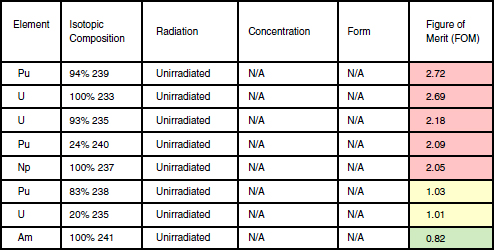
FIGURE 3-3 Materials attractiveness estimates for various nuclear materials. The first column shows the element; the second column shows the isotopic composition of the element, i.e., 94% 239 in row 1 means that the material in question is 94 percent plutonium 239. The third column denotes whether the element was irradiated, the fourth and fifth columns show its concentration and form; and the final column shows the figure of merit calculated for that particular element. SOURCE: Ebbinghaus (2011).
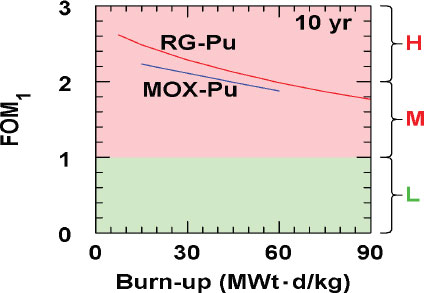
FIGURE 3-4 Materials attractiveness, expressed as FOM, as a function of fuel burn-up, expressed as megawatt-thermal-days per kilogram of uranium. This figure shows that reactor-grade plutonium (RG-Pu) and MOX fuel become somewhat less attractive with increasing burn-up. SOURCE: Ebbinghaus (2011).
On the other hand, material attractiveness is a useful measure because it uses the undisputable physical properties of the material to assess its risk. This estimate is reproducible, unlike many other measures of proliferation risk. Finally, the concepts and calculations involved in materials attractiveness can be expanded to include additional factors that are more relevant to terrorist than host-state threats.
HOW CAN SAFEGUARDS EFFECTIVENESS BE IMPROVED?
Olli Heinonen
International Atomic Energy Agency (IAEA) safeguards are implemented according to facility-specific criteria in a range of facility categories, such as light water reactors, enrichment plants, and reprocessing plants. These safeguards are applied to all facilities in all countries. However, the exact application of the safeguards criteria varies depending on the facility and the material in use. For example, to ensure that a significant quantity14 of the material is not diverted, the safeguards criteria state that plutonium must be verified monthly, and LEU must be verified annually.
A great deal of work will be involved if there is a desire to increase safeguards effectiveness and if these significant quantity criteria are maintained at the current level. In addition, even more work will be added if more nuclear facilities are built around the world. At present, IAEA conducts 800 inspections annually on 900 facilities, largely focused on non-weapons states. Virtually no inspections are performed in the United States, Russia, the U.K., China, or France, with some exceptions involving agreements that have been made with Japan for enriched uranium and plutonium that is sent from Japan to Europe for reprocessing.
A significant global expansion of nuclear power is not unrealistic. Post-Fukushima, it appears that few nuclear programs around the world are changing course from their previous plans to increase nuclear power. At the same time, the proliferators are progressively gaining new capabilities: for example, they are now able to use cyber technology—including Internet hacking and surveillance—to advance their goals.
However, the current world situation needs to be kept in mind when
__________________
14 A significant quantity is defined by the IAEA as the approximate amount of nuclear material for which the possibility of manufacturing a nuclear device cannot be excluded. For plutonium, 8 kg is considered a significant quantity, while 75 kg of uranium-235 contained in LEU is a significant quantity.
considering how the international safeguards system can develop and grow to meet these challenges. The worldwide economic situation, for example, suggests that it will be difficult to simply devote more money to improving safeguards and other anti-proliferation measures, and that the additional work associated with the new facilities will need to be managed using fewer resources. In addition, it is unlikely to be fruitful to simply expand current measures; the challenges of the 21st century (e.g., cyber and information challenges) can only be met with the tools of the 21st century.
The key to increasing the effectiveness of safeguards lies in increasing the amount of information available to the IAEA. The Agency’s strengths include access to information, sites, people, and cooperation. In reality, only one of these strengths can be expanded significantly to increase the effectiveness of nuclear safeguards: access to information. The number of sites, number of people, and amount of cooperation will not increase.
In seeking increased access to information, it is necessary to carefully determine what kind of information is needed, and to keep the purpose of gathering the information in mind. James Montier, the Chief Global Security Strategist at SG Securities in London stated: “Too much time is spent trying to find out more and more about less and less, until we know everything about nothing. Rarely, if ever, do we stop and ask what we really need to know” (Heinonen, 2011b). Intelligent information use would do several things: focus; prioritize; use all tools, authorities, expertise, and in-house and other information; and assess the weaknesses and strengths of the conclusions reached. One solution is the smart use of in-field efforts combined with all-source analyses.
The smart use of in-field efforts might combine unannounced inspections with remote inspection techniques, enhance design information verification, use information analysis to direct in-field inspection activities, and make the best possible use of risk assessment to understand the proliferation risk and the likelihood of detecting the proliferation attempt. For example, if inspectors appear at sites unexpectedly, proliferators are likely to become nervous and stop using declared material for proliferation purposes. When this occurs, the IAEA must analyze available information and return to look for undeclared material.
Current information use at the IAEA focuses on state-level evaluation and approaches. Once a year, the information is combined to make an estimate of all material currently declared. The IAEA analyzes both the state-level and world information to maintain bottom-line safeguards implementation criteria.
IAEA’s information analysis is collaborative and continuous, using all in-house expertise as needed. The analysis used to be mechanistic, but no longer is; IAEA now uses a template and a pathway analysis based on
a mathematical model. Finally, the results of the analysis are red-teamed as a final verification.
However, a number of obstacles make effective information analysis difficult:
• Overlap between the equipment, knowledge, and materials required to develop nuclear weapons and to conduct civilian nuclear research;
• Overlap between defensive and offensive nuclear military activities;
• Nations’ use of secrecy to protect commercial, proliferation-sensitive, and national security related information;
• The limited number of signatures indicating a military program; and
• The complexity of assessing a nation’s intentions and the possibility of making mistakes.
Intelligence information provides another source of increased information; however, there is a cultural divide within the IAEA regarding whether intelligence information should be used. One side favors the use of intelligence, as exemplified in a statement by Hans Blix: “We cannot inspect every nook and cranny in a large country.” The other side objects to the use of intelligence information as part of IAEA’s work, as exemplified in a statement by Mohamed ElBaradei:
It isn’t realistic for an international organization to have an intelligence branch … Having our own spies going around the world is contrary to our nature. We do our work above ground; we don’t work underground. So I continue to preach transparency.
Unfortunately, transparency loses in the real world. Once a clandestine program realizes that IAEA inspectors are aware of its existence, it will immediately retreat deeper underground.
However, if intelligence information is used, it needs to be used intelligently. Intelligence information is not evidence itself; however, it can be used to direct inspectors to the needed evidence. Intelligence information, to provide reliable information, needs to be corroborated.
In summary, access to as much information as possible is essential for the safeguards regime to be effective. Ultimately, the IAEA is as effective as its member states want it to be. To be truly effective, the IAEA Secretariat needs to use all its authorities, including special inspections, to gather information, and the IAEA needs to be provided with up-to-date tools and adequate resources. Finally, member states need to provide support
to the IAEA in reinforcing non-compliance cases using all provisions of the IAEA statute.
SUMMARY OF QUESTION AND ANSWER SESSION
As with the policy panelists in the previous chapter, the briefings from the technology panelists were also followed by a lively Q&A session. In the section to follow, some key points that were brought up related to this session are summarized.
Proliferant choice of front- or back-end paths. William Dunlop (Lawrence Livermore National Laboratory) asked Dr. Way to comment further on his discussion of the path (front- or back-end approaches) selected by the largest number of successful proliferators. Dr. Dunlop suggested that most countries pursued both options early on, but now it simply appears to be more inexpensive to get into the enrichment business. Dr. Way agreed that both front- and back-end approaches were typically pursued by most proliferating states prior to the 1970s, but added that in many cases the back end seemed to receive more effort. Drs. Heinonen and Charlton agreed as well and noted that this is also true for current proliferating states such as Iran. Dr. Charlton commented that although the effort may be focused on either the front end or back end, programs typically develop both options, perhaps as insurance. The path chosen is the one that is most easily available and most successful.
Utility of proliferation risk tools and unannounced IAEA inspections. Mark Mullen (Los Alamos National Laboratory) asked Dr. Heinonen, first, what role proliferation risk assessment tools play in the IAEA’s efforts to strengthen safeguards, and, second, whether he believes that there are truly surprise IAEA inspections. Regarding the first question, Dr. Heinonen replied that he was personally hesitant to recommend adopting too many tools at the IAEA, and stated that the first question that needs to be settled is how information will be used and how expertise will be acquired. As to the surprise inspections, Dr. Heinonen stated that in some ways surprise inspections work, but in others they do not—for example, in China, an unannounced inspection is likely to be impossible because the inspection team would be very conspicuous. On the other hand, because IAEA representatives are posted in Iran all the time, their unannounced inspections are far less conspicuous.
Fuel cycle facilities and hedging by states. Sharon Squassoni (Center for Strategic and International Security) noted that in many cases, a state might not make a specific decision to proliferate but, rather, might make
a decision to hedge its bets by acquiring fuel cycle technology. Thus, the concern may ultimately be about preventing unnecessary transfers of technology to other countries. She asked the panelists if they believe that the United States and other countries concerned about proliferation have been complacent about the capabilities of safeguards in bulk-handling facilities such as enrichment plants.
Dr. Heinonen replied that he is very comfortable with the declared facilities. However, there are ways of misusing facilities, for example, if more material is passed through the facility than is declared. If this occurs, undeclared material can be transported to another location for processing. Another possibility is if an enrichment facility design is changed to create HEU. He stated that the IAEA, within a month’s time, should be able to identify a change in facility design, but undeclared enrichment or diversion of plutonium from a reprocessing plant is more difficult to detect. However, over time, the detection probability will become higher.
Dr. Way added that he agrees that hedging is a concern—because it is impossible to know the future, it makes sense to many governments to be several steps ahead in the event that a nuclear capability might be desired. In the best of all possible worlds, you restrict the information spread of many aspects of enrichment and reprocessing, but in reality, this might not be possible.


