
Key Points
• Uranium mining and processing have planning, construction, production, closure, and long-term stewardship phases, and best practice requires a complete life-cycle approach during the project planning phase. Planning should take into account all aspects of the process—including the eventual closure, site remediation, and return of the affected area to as close to natural conditions as possible—prior to initiation of a project. Good operating practice is for site and waste remediation to be carried out on a continuous basis during ore recovery, thereby reducing the time and costs for final decommissioning, remediation, and reclamation. Regular and structured risk analyses, hazard analyses, and operations analyses should take place within a structured change management system, and the results of all such assessments should be openly available and communicated to the public.
• Development of a mining and/or processing project should use the expertise and experience of professionals familiar with internationally accepted best practices, to form an integrated and cross-disciplinary collaboration that encompasses all components of the project, including legal, environmental, health, monitoring, safety, and engineering elements.
• Meaningful and timely public participation should occur throughout the life cycle of a project, so that the public is both informed about—and can comment upon—any decisions made that could affect their community. All stages of permitting should be transparent, with independent advisory reviews.
• Development of a comprehensive environmental impact statement for any proposed uranium mining and processing facility would be an essential element for public participation and the transparent sharing of information.
• A number of detailed specific best-practice documents (e.g., guidelines produced by the World Nuclear Association, International Atomic Energy Agency, and International Radiation Protection Association) exist that describe accepted international best practices for uranium mining and processing projects. Although these documents are by their nature generic, they provide a basis from which specific requirements for any uranium mining and processing projects in Virginia could be developed.
• Some of the worker and public health risks could be mitigated or better controlled if uranium mining, processing, and reclamation are all conducted according to best practices, which at a minimum for workers would include the use of personal dosimetry—including for radon decay products—and a national radiation dose registry for radiation- and radon-related hazards; and exposure limits lowered to at least the levels for radon, diesel gas and particulates, occupational noise, and silica hazards recommended by the National Institute for Occupational Safety and Health (NIOSH).
• A well-designed and executed monitoring plan, available to the public, is essential for gauging performance, determining and demonstrating compliance, triggering corrective actions, fostering transparency, and enhancing site-specific understanding. The monitoring strategy, encompassing baseline monitoring, operational monitoring, and decommissioning and postclosure monitoring, should be subject to annual updates and independent reviews to incorporate new knowledge or enhanced understanding gained from analysis of the monitoring data.
• Because the impacts of uranium mining and processing projects are, by their nature, localized, modern best practice is for project implementation and operations, whenever possible, to
provide benefits and opportunities to the local region and local communities.
• Regulatory programs are inherently reactive, and as a result, the standards contained in regulatory programs represent only a starting point for establishing a protective and proactive program for protecting worker and public health, environmental resources, and ecosystems. The concept of ALARA (as low as is reasonably achievable) is one way of enhancing regulatory standards.
The committee’s charge requests that the report describe the best practices that would apply to any uranium mining, processing, and reclamation operations in Virginia. In responding to this charge and identifying and briefly describing these best practices, the committee is not implicitly endorsing or proposing that the moratorium should be lifted or that uranium mining or processing in Virginia should be undertaken.
Because the characteristics of any uranium mining or processing facility in the Commonwealth of Virginia would be highly dependent on the circumstances that would apply in any specific case—controlled in large part by the detailed geological character of an ore deposit and the characteristics of the local environment—a detailed compilation of internationally accepted best practices would undoubtedly include many that would not be applicable to a specific situation in Virginia. Accordingly, rather than assemble an encyclopedic compilation, the committee has outlined three overarching best-practice concepts, followed by specific suggestions for best practices that the committee’s analysis has identified as likely to be applicable should the moratorium on uranium mining in Virginia be lifted.
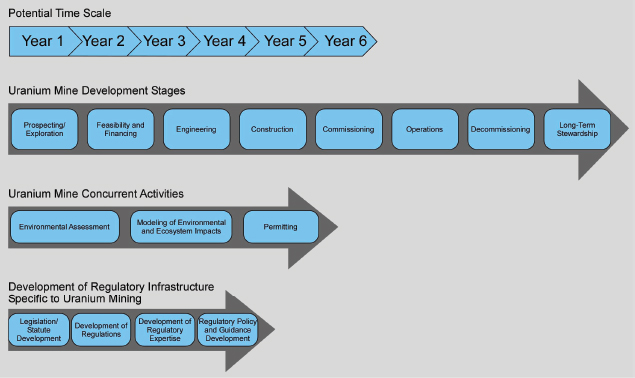
The committee recognizes that should Virginia’s uranium mining moratorium be lifted, mining and processing activities are very unlikely to commence for at least 5 to 8 years after the initial decision to permit uranium mining and processing (Box 8.1). Full use of this period will be essential for development of a regulatory culture that promotes environmental and human health protection, for instituting a broad range of human health and environmental baseline monitoring activities, for development of a robust legal and regulatory infrastructure, and to assemble a management team that is responsive both to the regulatory process and to the full range of citizen and stakeholder needs.
OVERARCHING BEST-PRACTICE PRINCIPLES
During committee deliberations, there were themes that recurred during the discussions, often transcending specific disciplinary areas, which are the focus of this section.
Complete Life-Cycle Planning and Regular Reevaluations
Development of a uranium mining and/or processing facility has planning, construction, production, closure, and long-term stewardship phases. The complete life cycle of the facility and its activities should be conceived as one integrated process from the start (i.e., when the design begins) to the end (i.e., when long-term stewardship starts). Good operating practice is for site and waste remediation to be carried out on a continuous basis during ore recovery, thereby reducing the time and costs for final decommissioning, remediation, and reclamation. Project management should not be stagnant, but should evolve in an iterative manner to take full advantage of international advances. Regular and structured risk analyses, hazard analyses, and operations analyses should take place within a structured change management system. The results of all such assessments should be openly available and communicated to the public. All stages of permitting should be transparent, with independent advisory reviews. In addition, ongoing communication with other facilities, both operating and in closure, is essential to capture lessons learned and incorporate them through an adaptive management approach to avoid public health or environmental consequences that were not anticipated at the outset of the project.
Need for Qualified Experts
Development of a mining and/or processing project should use the expertise and experience of professionals familiar with internationally accepted best practices, to form an integrated and cross-disciplinary collaboration that encompasses all components of the project, including legal, environmental, health, monitoring, safety, and engineering elements. As a corollary to the first best practice, above, this collaboration of highly qualified persons or organizations should incorporate experience that encompasses all stages of a project—design, operation, closure, and long-term stewardship. Although this best practice would apply generally throughout the United States, where no new uranium mines have been developed for decades and there is no experience with a positive water balance environment, this best practice is particularly important in Virginia where there is no background or local experience with uranium mining, processing, or reclamation.
BOX 8.1
Life-Cycle Analysis and Holistic Planning
The development of a regulatory infrastructure that can specifically focus on and specialize in the entire life cycle of any proposed uranium mine will undoubtedly be at first a lengthy political process and then a demanding regulatory buildup. The former will span different administrations and legislative cultures that may vary in policy view and political stamina. Moreover, the regulatory buildup may have to overcome established and entrenched regulatory cultures and increasingly limited resources. A generic scenario (Figure 8.1) would suggest that development of a comprehensive regulatory infrastructure might take at least 4 years. Concurrent development of the regulatory structure would need to occur at least by the early stages of the permitting phase, because the time to mine operations may be at least 6 years in this scenario. Note that recent experiences worldwide indicate that these time estimates are optimistic, and there can be delays for many reasons. The timing of both development of the regulatory structure and permitting are crucial, so that the convergence point results in a viable operation that is safe for public health and the environment. If the Commonwealth of Virginia chooses to simply rely on the existing regulatory agencies and the patchwork of existing applicable public health and environmental protection authorities, although many do not apply to uranium mining and production, then the time line to an operational mine and mill will be more dependent on the development of the mine and associated facilities themselves and be much less influenced by any infrastructural needs of the regulatory entities involved.
Transparency, Information Exchange, and
Meaningful Public Involvement
Meaningful and timely public participation should occur throughout the life cycle of a project, beginning at the earliest stages of project planning. This requires creating an environment in which the public is both informed about, and can comment upon, any decisions made that could affect their community. One important contribution to transparency is the development of a comprehensive environmental impact statement for any proposed uranium mining and processing facility. Another requirement is that notice is given to interested parties in a timely manner so that their participation in the regulatory decision-making process can be maximized. This requirement would include substantial advance notice, including sufficient detail about the status of the project so that members of the public can easily understand the information that will be conveyed to them. The public should also be able to understand how the information they convey to the operators or regulators will be used in decision making. All stages of permitting should be transparent, with independent advisory reviews. As part of this best practice, the facility or regulatory agency should consider whether it is appropriate to appoint an ombudsman to facilitate communication. An additional important consideration is that because mining projects and mining impacts are by their nature localized, modern best practice is for project implementation and operations to—wherever possible—provide benefits and opportunities to the local region and local communities.
Literature Resources
Although not seeking to endorse or recommend any specific best practices in existing literature, the committee noted that many of the overarching themes that it identified coincide with concepts put forward by the World Nuclear Association (WNA; see Appendix C), the International Atomic Energy Agency (IAEA, 2010), and the International Radiation Protection Association (IRPA; see Appendix D). The WNA, based in London, is an international industry group that has the goal of promoting nuclear energy, and a mission to seek to foster interaction among top industry leaders to help shape the future of nuclear power. The IAEA, based in Vienna, Austria, is an autonomous international organization that seeks to promote the peaceful use of nuclear energy. It is not under the direct control of the United Nations, but it does report to both the U.N. General Assembly and Security Council. The IRPA, based in France, is an international professional association focused on radiation protection. Although the WNA, IAEA, and IRPA documents are by their nature generic, they provide a basis from which specific requirements for any uranium mining and processing projects in Virginia could be created.
At a more specific level, best-practice guidelines that encompass a diverse range of issues that should be considered during planning for any uranium mining and processing project in Virginia are described below (e.g., the development of a site-specific conceptual and/or numerical model and baseline environmental characterization; comprehensive analysis, and predictive assessment of potential off-site water, soil, air, and ecological impacts, with specific attention to acid mine drainage control; design standards that address potential natural disasters; spill prevention and response strategies; the utility of personal dosimeters, etc.). These examples are not intended to be an exhaustive compilation of best-practice guidelines, but rather represent a range of issues and suggestions that the committee considers important for operational and regulatory planning if the moratorium on uranium mining is removed. In addition, two specific examples are presented in more detail—on the overarching best practices for closure and postclosure and best practices for emergency management.
Best Practices for Minimizing Potential Health Effects
This section presents a series of best practices for minimizing the potential adverse health effects, described in Chapter 5, resulting from radiation exposure, exposure to diesel particulates, hearing loss, and silica exposure.
Radiation
Uranium mines and processing facilities should have a radiation program in place that safeguards the health and safety of workers as well as the general public. Radiation doses and risks should be kept as low as is reasonably achievable (ALARA), while taking economic and social factors into account. Best practices also include the use of personal dosimetry for radon decay products, rather than area monitors, to record workers’ exposures to radiation. A continuous personal alpha activity dosimeter is already in routine use outside the United States for uranium mining and processing operations. Such dosimetry represents a best radiation safety practice, as opposed to relying on area level sampling as has been typical in uranium mining in the United States. When calculating a dose to an individual, all potential sources of exposure should be identified (Chambers, 2010). In developing best practices for setting radon decay product exposure limits for uranium miners and processors, it is important to consider that NIOSH recommended in 1985 a permissible exposure limit 75 percent lower than the current U.S. Department of Labor’s Mine Safety and Health Administration (MSHA) and Occupational Safety and Health Administration (OSHA) exposure limit of 4 working level months (WLM) per year, and that the NIOSH director at that time stated that a permissible exposure limit as low as 1 WLM/yr did not
satisfy NIOSH’s commitment to protect the health of all the nation’s miners. Unlike Canada, although the USNRC does require tracking of dose, a formal national U.S. radiation dose registry does not currently exist. A radiation dose registry represents a best practice, allowing the tracking of individual workers as they move from site to site.
Diesel Particulates
Reducing diesel exposure-related risks requires engineering controls to guarantee adequate ventilation and to reduce emissions at their source by ensuring that newer diesel engine technologies are used that generate lower amounts of particulate and other combustion byproducts. Appropriate industrial hygiene assessments of potential exposures should be carried out on a routine basis.
Hearing Conservation
Protection from the adverse effects of excess occupational noise exposure has been previously summarized by NIOSH; a cornerstone of such practices is the recognition that exposure at levels currently allowable under OSHA regulations will result in noise-induced hearing loss (NIOSH, 1988). NIOSH has also generated extensive recommendations for injury reduction and risk control that reflect best practices in that regard.
Silica
The appropriate control measures for silica hazard abatement include the use of wet as opposed to dry operations, enclosure of toxicant point sources that present a potential exposure hazard, local ventilation to draw dust away from the worker’s breathing zone, and appropriate respiratory protection including externally supplied air for jobs that have the potential for high exposure. For workers with ongoing silica exposure—in particular, exposures approximately half the lower level of recommended exposure limits—ongoing health surveillance programs are appropriate. The NIOSH recommended exposure limit for respirable silica dust is considerably lower (in the direction of health protection) than current U.S. Department of Labor MSHA or OSHA legally enforceable standards as currently promulgated.
Best Practices for Environmental Monitoring
A well-designed and -executed monitoring plan is essential for gauging performance, determining and demonstrating compliance, triggering corrective actions, fostering transparency, and enhancing site-specific understanding. Additionally, a well-designed and adequately supported monitoring program
can lead to better-informed management, public, and regulatory decisions. The three main phases of a monitoring strategy include baseline monitoring, operational monitoring, and decommissioning and postclosure monitoring. Ideally, the monitoring strategy (including details of sampling locations, frequency, monitored parameters, sampling methods) would be developed through collaboration among facility staff, technical experts, regulatory officials, community members, and public interest groups to meet the overall goals of the many stakeholders. A multitiered strategy that follows a rigorous sampling protocol, where the mining and processing facility, local community groups, and local government agencies conduct parallel monitoring programs, can be an effective strategy to address multiple concerns and maintain trust. Accordingly, before any uranium mining and/or processing facility is established, modern best practice requires that a comprehensive baseline environmental monitoring and assessment program be conducted, incorporating three components:
1. Baseline environmental characterization (both on- and off-site), including chemical, physical, and radioactive elements of the water, air, and soil; biological indices (e.g., benthic index); habitat characterization; and identification of species or communities of special interest that could be affected by construction or operation. The establishment of natural background for uranium, its decay products, and other nonradiological contaminants associated with uranium mining is essential in order to compare operational and postreclamation levels (see also NCRP, 2011). The length and frequency of baseline monitoring needs to be of sufficient duration to capture the natural variability (both inter- and intra-annual) of measured parameters. The spatial extent of baseline monitoring should encompass the mine site and offsite areas with potential for environmental impacts. Because Virginia is a positive water environment (i.e., precipitation exceeds evapotranspiration on an annual basis), particular attention should be paid to downgradient groundwater resources and downstream water resources that could be affected by water pollutants released from the mining operations.
2. Development of a site-specific conceptual and/or numerical model to guide development of a site-specific monitoring program.
3. A comprehensive analysis and predictive assessment of potential off-site water, soil, air, and ecological impacts, such as that performed for an environmental impact assessment.
In addition, best practice is to undertake an assessment of the appropriate mitigation and remediation options that would be required to minimize predicted environmental impacts, including but not limited to
• Acid mine drainage (AMD) control. The production of AMD is a serious and nearly ubiquitous environmental problem associated with many types of mining, with the potential to adversely affect downstream water resources. Identifying
the amount of metal sulfides present in the ore or waste rock is a first step in mitigating potential impacts; uranium ores containing lesser amounts of metal sulfides can be mined and processed more safely with lesser impacts on downstream systems. To reduce the production of AMD and the associated leaching of heavy metals and radionuclides, very careful handling (including temporary storage and landfilling) is necessary for materials containing metal sulfides. Strict segregation and burial of such wastes in low-permeability strata might be considered as an option. Discharge of all wastewaters from mining and processing operations into a carefully engineered and appropriately sized treatment facility should be used to neutralize AMD and precipitate contaminants prior to release to receiving waters off-site to meet discharge standards.
• Tailings and waste management. Modern tailings management facilities differ significantly from those used in the past. Engineered tailings facilities for both belowgrade and partially abovegrade facilities employ, among other things, geomembranes, leachate collection systems, and hydraulic isolation using a combination of extraction wells and materials of contrasting permeability (see Golder Associates, 2008). In Virginia’s positive water balance environment, best practices would not include long-term tailings storage aboveground. Instead, the tailings could be emplaced and compacted so that they have a much lower permeability than the surrounding aquifers to lessen the potential for groundwater contamination. Tailings management systems should be designed to withstand the extreme event scenarios that could reasonably occur at a site.
• Treatment of all water discharged. All water generated from dewatering and ore processing should be treated in an on-site water treatment facility and held in an on-site facility pending verification that it meets water quality criteria prior to being discharged to the environment (CNSC, 2010). Modern industry practice is for much of the water from dewatering and ore processing to be recycled within the processing plant, often numerous times, prior to eventual discharge.
• Spill prevention and response strategies. Best practices should emphasize sound management practices and administrative and engineering controls that prevent the release of hazardous substances to the environment, such as employee training, periodic inspections of storage tanks, adequate secondary containment, and standard operating procedures for routine operations and maintenance. Both regulatory and mine- and processing-site employees should be empowered to report and address deficiencies that occur. In addition, response plans, trained personnel, and emergency equipment should be at hand to respond to any incident that occurs (see also Box 8.2).
• Dust control. During construction and throughout all the other uranium mining and processing steps where dust may be generated, control measures would include dust suppression systems, spraying or wetting dust, use of tactifers, and washing construction equipment before it leaves the site. Underground mines should have extensive exhaust systems to protect workers from exposure
to dust and radon, and air pollution control systems can be installed on vents to prevent dispersion to ambient air. Control measures for uranium mills include enclosure of dusty operations, dust collection systems, dust suppression systems, spraying or wetting dust, and ventilation systems specific to conveyor belts and other rock-moving systems. Fugitive dust from overburden, uranium ore that is not economically viable for processing, and waste piles should be controlled through capping or other means (Martin Marietta Laboratories, 1987).
A comprehensive environmental monitoring and assessment program should be conducted throughout all phases of project development, from construction through closure (see also Box 8.3). The monitoring and assessment program should include chemical, physical, and biological sampling and analysis. Monitoring during the operational lifetime should cover the same spatial extent as described for baseline monitoring. The postclosure monitoring plan may need to be amended (e.g., different spatial extent or temporal frequency) to account for site reclamation efforts and cessation of active operations. Specific components of a best-practices monitoring and assessment program include the following:
• Public involvement. Public involvement in the design and implementation of the monitoring program is valuable to build credibility and ensure that stakeholders’ concerns are addressed. In addition to the primary on- and off-site monitoring program, funding should be provided to potentially affected communities to conduct independent monitoring of attributes of particular concern to the community.
• Annual independent monitoring data assessment and review. An independent annual assessment and trending analysis should be performed to test the accuracy of predictions and, if need be, to recommend modifications to the operations and remediation practices. The annual assessment can also be used to refine the predictions and adaptively modify the monitoring plan as needed. For example, on the basis of data collected, this independent review panel might recommend expanding the monitoring of pathways or potential impacts that appear more significant and to reduce monitoring of pathways or potential impacts that appear of lesser importance.
• Transparency and accessibility. All data and independent reviews should be available to the public, and this information should be discussed at annual public meetings for transparency and to build credibility.
Site-specific conceptual and numerical models are essential to quantify the understanding of the full earth system, determine appropriate mitigation and response strategies, and develop and modify a monitoring plan. Therefore, these models need to undergo annual updates and independent reviews, to incorporate new understanding gained from analysis of the monitoring data or new knowledge (e.g., changes to process design and operation).
BOX 8.2
Overarching Best-Practice Principles of Emergency Management
Emergency management planning is crucial to all aspects of uranium mining, processing, reclamation, and long-term stewardship. Emergency management plans should cover how to prepare for, mitigate, respond to, and recover from an emergency. Systematic emergency management preparations are needed for both on-site uranium mining and processing activities and off-site transport of materials.
There are common elements in emergency management for any industrial facility. Emergency response planning is always a work in progress. The emergency plan should be viewed as a living document, with annual reviews to incorporate lessons learned at the facility and from similar facilities worldwide to make continuous improvements in safety. Although planning is critical, there are other elements that are equally important: training, exercising, testing equipment, and coordination with off-site responders. Best practices dictate that linkages between people and equipment need to be well established before an emergency occurs.
The types of emergencies that should be considered for planning purposes range from natural events (e.g., earthquakes, hurricanes, floods) to manmade events (e.g., spills or releases of hazardous substances, whether due to human error or terrorism). The initiating event could be from a variety of reasons, but response to the emergency can be standardized, so that regardless of the cause, the event can be properly handled. The root cause of the emergency can be investigated after the situation is stabilized.
The U.S. Federal Emergency Management Agency (FEMA) recommends a four-step process for planning for emergencies.a The first step is to establish an emergency planning team, including representatives from all aspects of the processing facility or mine—management, labor, engineering, safety/environmental, public affairs, human resources, security, legal, community relations, finance, and purchasing.
The second step is to identify the hazards that require planning and the resources that are available for response. This step should include consultation with off-site agencies such as fire, police, hospitals, utilities, and community service organizations such as the Red Cross. A vulnerability analysis that determines the probability and potential impact of each emergency will help guide the planning process. The vulnerability analysis will be informed by historical data for emergencies
Best Practices for Regulation and Oversight
Regulatory programs are inherently reactive. Accordingly, standards contained in regulatory programs represent only a starting point for establishing a protective and proactive program for defending worker and public health, and the environment. Embracing the concept of ALARA1 is one way of enhancing
_________________
1ALARA (acronym for æas low as is reasonably achievable’) is defined as “means making every
that have occurred in the area, as well as using geographic information for proximity to seismic faults, dams, floodplains, other industrial facilities with hazardous materials, etc. Technological failure of mining and processing processes and human error should be considered. The assessment of impact should include human impact, property impact, and business impact. The resource list should include internal and community resources.
Step three is to develop the plan, which should include the following:
• Direction and control—who is in charge under various emergency conditions
• Communication—warning systems, notification systems
• Life safety—evacuation, accountability, shelter
• Property protection—emergency shutoffs, fire suppression, water-level monitors, preservation of vital records
• Community outreach—training, exercising with counterparts, mutual aid agreements, community service, public information, media relations
• Recovery and restoration—essential equipment repair, contractual services, continuity of management, insurance, employee support, resumption of operations
• Administration and logistics—maintenance of written plan, notification lists, equipment and supplies, backup utilities, backup communications
Step four is to implement the plan, which involves integrating emergency planning into the operation of the mine and mill. The plan should be reviewed at regular intervals and after any event at any similar facility for lessons learned that could be applied. Training and exercising with off-site responders will allow them to be comfortable responding to emergencies at the facility.
In Canada, because there is consistency of regulatory authority in the regulation of uranium mining, processing, reclamation, and long-term stewardship, emergency planning for uranium mines and mills is summarized in a single regulatory guide. The guidance is in general agreement with the U.S. FEMA guidance, but is more specific about radiation exposure, limiting the spread of radioactive contamination, postaccident monitoring for radioactive contamination, and maintaining the security of radioactive materials.
_________________
aSee http://www.fema.gov/business/guide/section1a.shtm; accessed September 2011.
regulatory standards. In addition, a culture in which worker and public health, protection of environmental resources, and preservation of ecological resources
reasonable effort to maintain exposures to radiation as far below the dose limits … as is practical consistent with the purpose for which the licensed activity is undertaken, taking into account the state of technology, the economics of improvements in relation to state of technology, the economics of improvements in relation to benefits to the public health and safety, and other societal and socioeconomic considerations, and in relation to utilization of nuclear energy and licensed materials in the public interest” (10 CFR § 20.1003).
BOX 8.3
Best Practices in Closure and PostClosure
When a uranium mining or processing site reaches the end of its active operation, the ultimate goal is to ensure that the site will be safe and ecologically healthy indefinitely into the future. Hazards may include nonradiological as well as radiological hazards to workers, members of the public, and the environment; both types of hazards should be addressed during decommissioning (IAEA, 2006b). Decommissioning activities for a uranium mine may include, for example, capping shafts, removing chemicals and fuels from the site, filling and contouring water treatment ponds, removing structures, revegetating, and restoring normal water flow (IAEA, 1998). Postclosure stewardship activities also will be required. These activities may include, for example, ongoing monitoring, collecting and treating contaminated water, managing and storing water treatment sludges, and maintaining covers, water diversion structures, etc. (see IAEA, 2010). Decommissioning and subsequent stewardship activities should be done within the context of a site-specific closure plan.
Three broad principles should guide closure planning for uranium processing or mining sites:
• Closure planning should be anticipatory.
• Closure planning should be iterative and adaptable.
• Closure planning should recognize the need for and limits of long-term stewardship.
Closure planning should be anticipatory. According to the IAEA (1998), closure plans should be developed for prospective uranium mining projects before a project proceeds. Decommissioning principles should be identified: for example, the maximum acceptable effective dose to any person at any time, the use of state-of-the-art engineering practices even if analyses suggest that lesser efforts may be sufficient. The plan should be prepared by the facility operator and discussed with and approved by the regulatory agencies (IAEA, 1998). Similarly, early consideration of stewardship issues and preparation for a stewardship program is important: According to the IAEA (2006a), stewardship plans typically are required as part of the licensing procedure for a new operation.
Closure planning should be iterative and adaptable. A closure plan developed at the time of permit application is, in effect, an interim plan that is based on forecasts and projections. The plan for closure and decommissioning should be reevaluated periodically as the operation goes on (IAEA, 1998). Similarly, a postclosure stewardship program needs to be capable of responding and adapting to changes in societal and governance structures, stakeholders and perceptions of risk, economic circumstances, and state-of-the-art science and technology (IAEA, 2006a). Allowance also should be made for the possible need for emergency interventions—that is, actions taken to avert or reduce exposure to radiological and nonradiological risks as a consequence of an accident or uncontrolled practice (IAEA, 2006b).
Closure planning should recognize the need for and limits of long-term stewardship. Within the context of sites with long-term radiological and non-radiological hazards, stewardship in its broadest sense includes all of the activities required to manage any potentially harmful residual contamination left on-site after a facility has stopped operating and its site has been remediated (NRC, 2000). These activities may include the following:
• Measures to maintain isolation of residual contamination
• Measures to monitor the migration and attenuation or evolution of residual contamination
• Restrictions on land use and site access
• Conducting oversight and, if needed, enforcement
• Gathering, storing, and retrieving information about residual contaminants and other conditions on-site, as well as about changes in relevant off-site conditions
• Disseminating information about the site, including any use restrictions
• Periodically evaluating how well the protective system is working
• Evaluating new technological options to eliminate, reduce, prevent the migration of, or monitor residual contaminants (NRC, 2000)
Long-term stewardship of residually contaminated sites also has been described as entailing the following roles (NRC, 2003, p. 2, emphasis in the original):
• A guardian, stopping activities that could be dangerous
• A watchman for problems as they arise, via monitoring that is effective in design and practice, activating responses and notifying responsible parties as needed
• A land manager, facilitating ecological processes and human use
• A repairer of engineered and ecological structures as failures occur and are discovered, as unexpected problems are found, and as re-remediation is needed
• An archivist of knowledge and data, to inform the future
• An educator to affected communities, renewing memory of the site’s history, hazards, and burdens
• A trustee, assuring the financial wherewithal to accomplish all of the other functions
Together with this broad spectrum of activities and roles, effective stewardship programs appear to have a common set of attributes: long-term reliability; clarity of objectives and roles; adequate and dependable funding; ease of implementation; transparency; flexibility, iterativity, adaptability, and the ability to deal with contingencies; durability or replaceability; and means to incorporate scientific, technical, and societal changes (IAEA, 2006a).
The nature and duration of the necessary activities and roles will depend on the nature and duration of the residual contamination. It is quite possible, however, that the duration of risks from residual contamination will exceed the institutional capacity to reliably perform stewardship activities. It is widely recognized that
predicting how economic, social, and institutional systems will evolve is fraught with uncertainty—uncertainty that grows larger as the time frame grows longer (NRC, 2000, 2003; Falck, 2008; IAEA, 2006a). A major challenge for a successful stewardship program is to reduce the risks arising from this uncertainty (IAEA, 2006a).
One suggestion is to focus the stewardship program on a realistic time frame, such as 100 years, and on short-term solutions that will keep people involved in the site while allowing for evaluation of changes needed over time (IAEA, 2006a). A complementary decision-aiding tool is to rate the risks of the site if active control of its residual contamination were to break down in the future (Falck, 2008). In addition, defining the stewardship program from the bottom up, at the practical level of implementation, is essential (IAEA, 2006a).
are highly valued, and continuously assessed and strengthened, is the ultimate goal of a regulatory program. To encourage and facilitate best management practices and social responsibility commitments to local communities, it is necessary to take advantage of continual improvement in technologies and develop performance-based and risk-informed regulations and policies. In the event that the uranium mining moratorium is lifted, the statutes and regulations that enable the development of a mining and/or processing facility would ideally be written to ensure minimal permanent impact on the environment and protect public health. Such statutes and regulations would encompass the following points:
• Ensure that life-cycle costs as well as long-term stewardship needs are reflected in the type of, and amount of the financial surety. Financial security needs are set at the level necessary to maintain the integrity of the integrated system so that the system is a sustainable enterprise. Cost estimates need to be reviewed and updated throughout the life cycle of the project to ensure that they accurately reflect the costs and resources that are needed. The burden is on the facility to demonstrate that the amount of the financial surety is sufficient. Instruments to demonstrate financial surety should have the flexibility to be applied in temporary shutdown conditions as well as planned closure. In the event that remediation is necessary and complete cleanup is not possible, the facility would have to demonstrate financial capability to proceed with remediation as well as having resources dedicated to long-term stewardship activities.
• Ensure that inspection and enforcement tools are transparent, practical, sufficient, available, independent, and sustainable. “Transparency” requires that the enforcement tools be clear and comprehensible to the regulated community, the public, and the regulator; “practical” requires that the enforcement tools be
easily implemented; “sufficient” means that the enforcement tools are effective in producing deterrence; “available” means that regulatory agencies should have available adequate funding and other resources to function in an environment of continuous improvement to enable them to take full advantage of international uranium mining and processing innovations; “independent” means that the regulatory agency would provide independent verification of compliance and not be overly influenced by the industry that it is regulating, even if the funding for the regulatory agency is derived from a fee placed on the industry; and “sustainable” requires that enforcement actions be supported by strong scientific and other evidence that will meet legal standards.
• In the event that the uranium mining moratorium is lifted, Virginia will be required to establish a regulatory program for uranium mining. It might also establish a regulatory program for uranium processing and reclamation. Development of this new regulatory structure could theoretically be based on existing laws, but the optimum approach would be for an entirely new uranium mining, processing, and reclamation law or laws to be enacted. In addition, a new regulatory program would be required to implement this law or laws.
• In the event that Virginia decides to lift its uranium mining moratorium, it is possible that regulatory authority could be distributed among several agencies. If this is the case, effective interagency integration and coordination will be imperative. Interagency integration and coordination will require more than co-location in the same facility; it will require commitment and leadership by the legislative and executive branches of the government, and it will also require that sufficient resources be available for developing and fine-tuning a regulatory program.
• The committee recognizes that the federal regulations governing uranium processing are currently under consideration for revision by the USNRC. Additionally, the USEPA is reviewing and potentially revising its health and environmental standards for uranium processing facilities. Virginia should be actively involved in the regulatory processes of these federal agencies to ensure good federal-state coordination. The international community has considerable knowledge of regulating uranium mines and mills and can offer additional insight into regulatory best practices.
• At present, the laws applicable in Virginia do not require that an environmental impact assessment be undertaken before hard-rock mining operations commence. Modern best international practice requires an environmental impact assessment prior to the commencement of any mining activities.
The committee’s charge was to provide information and advice to the Virginia legislature as it weighs the factors involved in deciding whether to allow uranium mining. This report describes a range of potential issues that could arise if the
moratorium on uranium mining were to be lifted, as well as providing information about best practices—applicable over the full uranium extraction life cycle—that are available to mitigate these potential issues.
If the Commonwealth of Virginia rescinds the existing moratorium on uranium mining, there are steep hurdles to be surmounted before mining and/or processing could be established within a regulatory environment that is appropriately protective of the health and safety of workers, the public, and the environment. There is only limited experience with modern underground and open-pit uranium mining and processing practices in the wider United States, and no such experience in Virginia. At the same time, there exist internationally accepted best practices, founded on principles of openness, transparency, and public involvement in oversight and decision making, that could provide a starting point for the Commonwealth of Virginia were it to decide that the moratorium should be lifted. After extensive scientific and technical briefings, substantial public input, reviewing numerous documents, and extensive deliberations, the committee is convinced that the adoption and rigorous implementation of such practices would be necessary if uranium mining, processing, and reclamation were to be undertaken in the Commonwealth of Virginia.


