
Session 2: Understanding the Universe: How Did It Begin and How Is It Evolving?
|
Moderator: |
Alan Dressler, The Observatories of the Carnegie Institution; Space Studies Board Member |
|
Speakers: |
Roger Blandford, Stanford University; Chair of the National Research Council 2010 Astronomy and Astrophysics Decadal Survey Jean-Pierre Swings, Université de Liège (Belgium); Chair of the European Space Sciences Committee of the European Science Foundation |
|
Panelists: |
Miles O’Brien, Television and Internet Science Journalist Linda Billings, George Washington University School of Media and Public Affairs |
Alan Dressler, an astronomer at the Observatories of the Carnegie Institution and an Space Studies Board (SSB) member, began the session by commenting that much has happened over the past century that has “changed the notion of where we are,” but only a “fraction of the human beings on this planet” knows it. He believes the challenge for space scientists is to widen that audience, but worries that the success of the Hubble Space Telescope has produced “overconfidence” about how well scientists communicate with the public. Hubble is a “classic redemption story” that people like. The Hubble photos “connect with our inner psyches” and while better photos could be produced with PhotoShop, the Hubble photos are authentic.
Much of the scientifically compelling data from Hubble and other spacecraft, however, do not translate into fascinating photos. If one looks at a microwave image of temperature variations in the universe, for example, it is not even obvious that it is a map of the sky. It is difficult to communicate to non-astronomers. “If we’re going to widen the audience, we have to communicate better,” he said, and is interested to learn if the new social media will help.
Roger Blandford, who chaired the 2010 National Research Council Astronomy and Astrophysics Decadal Survey,1 began his talk by putting things into perspective: “Earth is just one of the larger pieces of debris orbiting a rather modest star, one in a few hundred billion such stars in the inner suburbs of an unpretentious spiral galaxy … one in a few hundred billion galaxies in the observable universe.” Characterizing the universe as a “cosmic zoo full of strange beasts,” he observed that “we do not appear to be that special.”
What we know about the universe today is that it 13.7 billion years old; it is flat; and the proportions are dark energy (70 percent), dark matter (25 percent), and matter (5 percent). Looking into the universe is a look back in time, he said. “When did the first stars, galaxies, and black holes form?
________________
1 National Research Council, New Worlds, New Horizons in Astronomy and Astrophysics, The National Academies Press, Washington, D.C., 2010.
When was our cosmic dawn? When did the dark ages preceding this end?” These are some of the pressing questions in astronomy. The answers will come from ground- and space-based telescopes operating in the infrared, x-ray, optical, and radio bands.
Blandford took the audience on a trip back in time to the beginning of the universe and through its evolution, reviewing the basics of cosmology, including the discovery of the cosmic microwave background by Penzias and Wilson and the discoveries by the Cosmic Background Explorer, the Wilkinson Microwave Anisotropy Probe, and the Planck observatory. He outlined the challenges facing astrophysicists in understanding the universe today: dark matter, dark energy, and understanding why the universe is so uniform.
He then asked, What lies outside our universe? He said some physicists posit that there are many universes, or “the multiverse,” and conclude that very special conditions are needed for a universe to last as long as ours and have the conditions for life to develop. “Then they turn the problem on its head” and conclude that most universes are “still born.” “But by our very existence, we are self-selecting the rare example that allows us to be.” This is called the anthropic principle: “Things were as they were because we are as we are…. It is a wonderful and yet very disturbing idea.”
Scientists have gained an enormous amount of knowledge in just a few decades, not centuries likes the Greeks and the Enlightenment, thanks in large part to NASA’s ongoing outstanding success in launching, operating and supporting its fleet of scientific discovery machines. “The means are at hand to complete the story, to understand our origins, and know our cosmic fate,” Blandford said, adding, “I hope that we have the will to match this quest.”
Jean-Pierre Swings, honorary professor at the Université de Liège (Belgium) and chair of the European Space Sciences Committee of the European Science Foundation, focused on Europe’s contribution to answering the type of questions raised by Blandford. He reviewed the many European spacecraft that have been launched and cooperative programs with other (non-ESA) countries (Figure 3). The European Space Agency (ESA) contributed 15 percent to NASA’s Hubble Space Telescope, for example, and built the Huygens probe that landed on Saturn’s moon Titan as part of the NASA/ESA Cassini-Huygens mission.
ESA also participates in the International Space Station (ISS), and one has to ask about the science being done there in addition to showing pretty pictures of astronauts and modules. Scientific American and the European Science Foundation have each published reviews of the science that is being performed and planned and “there is some quite good stuff being done there.”
Some scientists believed that ground-based radio astronomy would answer all the questions, but that is “completely wrong.” Optical observations also are needed, and ground- and space-based researchers need to work together. Countries also need to work together and he views the future as “coopetition”—a combination of cooperation, competition, and collaboration.
Swings described ESA’s mechanism for determining scientific priorities. The United States uses the decadal survey process, while ESA has the “Cosmic Vision” program, which involves a lot of international cooperation and collaboration. That program ends in 2025, however, and Swings wondered aloud what would come after that. He stressed that a way must be found to attract new scientists and engineers and to maintain expert instrumentation teams.
As for communicating with the public, he asked what we can do besides “awe and beauty.” He noted that in Europe there is no single “public” because so many countries are involved with different interests. He is from Belgium, and a Belgian astronaut has commanded the ISS, so in his country there is more public interest in the ISS itself than in science. He concluded by saying that he believes “outreach and communication is better” in the United States. He asked if it is only a matter of more money, and he hopes not.
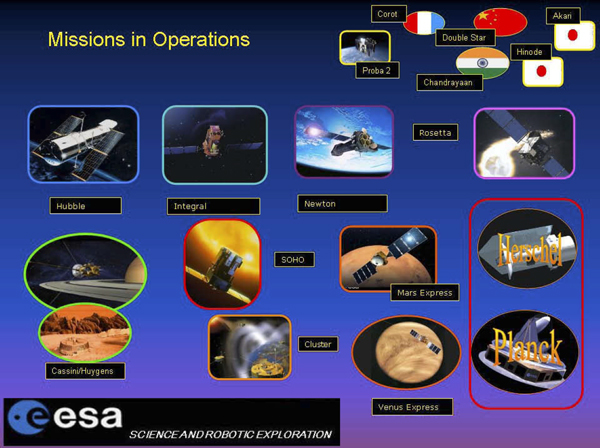
FIGURE 3 Missions in operations. SOURCE: Jean-Pierre Swings, presentation to the workshop on Sharing the Adventure with the Public—The Value and Excitement of “Grand Questions” of Space Science and Exploration, November 8, 2010. Courtesy of NASA, ESA (J. Huart, P. Carril, D. Ducros), and AOES Medialab.
Miles O’Brien, television and Internet science journalist, and Linda Billings, George Washington University School of Media and Public Affairs, joined Dressler, Blandford, and Swings for the panel discussion.
During the panel discussion, Dressler noted that Blandford’s talk assumed a lot of knowledge on the part of the audience and asked how it would have been different for a general audience. Blandford said that he did not have a lot of experience in public talks but tends to cover less breadth and focus on a few specifics and explain how the information was obtained—making it a detective story as Swings had done in his talk.
Dressler then asked Swings if Europe has the same type of outlets for interacting the public as in the United States—planetariums, natural history museums, television, and public lectures, for example. Swings evoked laughter when he said that when Europeans want information they go to NASA websites. ESA and the European Southern Observatory are improving in this regard, he added, and Europe does have a lot of amateur societies that have conferences and provide opportunities for the public to look at the sky.
Dressler agreed with a comment O’Brien made earlier that NASA is reluctant to “build tension” around its stories of scientific discovery. Dressler thought NASA would do more regarding the Kepler mission, which is searching for other Earth-sized planets, but NASA did not want to do anything until data were available, he said. O’Brien agreed that it was ironic that an agency “devoted to pushing the envelope … is frankly very timid” in telling its story to the public. He asserted that NASA is “more afraid of certain members of Congress than … what can happen in space.” The agency does not want to raise expectations for fear of losing support if the mission does not work out, he believes. Instead, he thinks NASA should embrace the risk inherent in spaceflight and make it part of the narrative.
Billings, who is a principal investigator with NASA’s astrobiology program, said that the astrobiology field has learned to make communications part of its mission plan from the beginning. By contrast, she said, Kepler is a good example of what happens when that is not done. She drew the distinction between communications and “branding and marketing” which has been the space community’s historic approach to public relations efforts, and it has not been very successful. “The aim of marketing is to build public support, and what we all are talking about here is … informing people about the work of science and scientists. Who’s not interested in where the universe came from?”
Billings’s comments sparked an exchange with Dressler who said that he was glad to hear her say that, since her expertise is astrobiology, a topic that some people find threatening. Billings pointed out that there have been workshops on the intersection of interests between religious and science communities that have found that there is a difference in talking with theologians about science versus “church-going people.” Theologians do not see a conflict between science and religion, but it can be more challenging with other groups.
The discussion turned to the Mars rovers, Spirit and Opportunity, and whether the public attention was a surprise to NASA. Billings said it was not a surprise to her, at least, because Mars is always interesting to the public. In response to a question about whether it was important that Steven Squyres2 be part of the story or if the rovers themselves were sufficiently engaging to capture public interest, O’Brien enthused that Squyres was great at being part of the story. The “plight of Spirit, that [it] couldn’t get out of a sand trap”—the story had “everything. It’s got that narrative art….”
Dressler wondered whether having the same “discovery” repeated was a problem in communicating with the public, noting that black holes in the center of the galaxy have been “rediscovered again and again.” The media want to push us to these story lines, even though they are repeated, he asserted. Billings said that journalism is different from science and the standards of practice are different. She thinks that if the scientific community pays more attention to telling the story and keeping people informed of the progress, they will understand how a new discovery fits into the picture.
Billings also responded to an earlier comment from Swings that there is no single public in Europe by saying that there is no single public anywhere. “There’s no such thing as a monolithic public.” It is important to know which public you want to reach, she said, and “find a common language.”
O’Brien had said during his keynote speech that the conventional media did not like incremental stories, but he changed his mind during the discussion: “It does occur to me … that in the world of social media and tweets … maybe incremental is OK,” and could make the eureka moments mean even more.
Dressler said he was “scared” of social media mechanisms for distributing science because of all the “kook mail” he gets. With traditional media, there is an editorial process to help sort out who people are and what their knowledge level is—to vet them. He cited the climate change debate in particular as where one sees the “democracy” of comments by many people, but there is no information about who they are or their knowledge level on that topic. Billings said that “community building” becomes the vetting process in social media. O’Brien said that the conventional media no longer have the expertise in science to vet anyone, and it is better done by the masses.
________________
2 Steven Squyres, Cornell University, is the principal investigator for the Mars Exploration rovers Spirit and Opportunity.
SSB member Sara Seager asked Dressler if he was on Facebook and he said no. She challenged him to join, saying, “You can’t describe it unless you’re part of it,” and then you would see that it operates differently than you thinks. She expressed determination to get Dressler to join Facebook by the end of the workshop.
Another audience member said that he totally rejects Facebook and Twitter. He thinks there is a loss of the interrelationship between the sciences and the humanities, the “two cultures,” when using social media.
Christie Nicholson, journalist and online contributor for Scientific American, urged everyone to try the new social media because it is very abstract, and “if you don’t get into it, you really can’t understand what use it is.” If it turns out to not be valuable, then stop using it.
As for the relationship between the sciences and the humanities, she finds that in using social media she can interact with people in other disciplines that she would never encounter otherwise. She agrees, however, that “there is no substitute for human connection,” and she understands the concern that people are getting into niche communities that could stifle serendipity. While Dressler is wary of social media platforms and is not on Facebook, Nicholson encourages everyone to “experiment with it,” and if it is not valuable, then stop.


