
The abundance of liquid water sets Earth apart from almost every planetary body yet discovered in the galaxy. The hydrologic cycle, or the movement of water through evaporation, atmospheric transport, precipitation, and river and groundwater flows, shapes the terrestrial surface of the planet and transports the resulting solutes and sediments from mountaintops to the ocean depths. Water supply and temperature together determine the form, life history strategies, and productivity of vegetation, ultimately controlling rates of photosynthesis in the biosphere. Liquid water serves as habitat to an immense variety of aquatic species and as a necessary resource for all terrestrial species. Understanding the storage and movement of water through the biosphere is essential for understanding the physical structure, chemistry, biodiversity, and productivity of the biosphere.
Although water is renewable, it is not inexhaustible. Throughout history, civilizations and ecosystems have flourished with the presence of water, executed engineering feats to secure its presence, and collapsed due to the lack thereof. Today, human influences are even greater, dominating the natural cycle of freshwater and causing environmental changes that are argued to have moved the planet into a new geologic period termed the “Anthropocene” (Crutzen, 2002; Vince, 2011). Global population growth has led to increased demand for water to support agricultural, industrial, and drinking water needs, with water withdrawals outstripping water supply in many parts of the world. Climate variability and change, land use change, and demographic change place varying stress on the planet’s water resources. Access to safe water supplies remains a challenge in many parts of the world. The rates of species extinction are highest for freshwater
organisms because of habitat destruction, changes in water quantity, and water quality degradation and the introduction of foreign species looms large (Dudgeon et al., 2006). The risk of future extinction of freshwater biota is projected to be five times higher than that of terrestrial biota and two times higher than that of coastal mammals (Ricciardi and Rasmussen, 1999). At the core of these challenges is hydrologic science.
Hydrologic science or hydrology is, at its most basic level, the “science of water” that embraces topics from research on fundamental processes through operations associated with flood protection, drinking water supply, irrigation, and water contamination. The National Research Council (NRC) report Opportunities in the Hydrologic Sciences, known as the “Blue Book,” defined hydrologic science as a distinct geoscience—“a geoscience interactive on a wide range of space and time scales with the ocean, atmospheric, and solid earth sciences as well as with plant and animal sciences.” However, hydrologic science is also firmly anchored by phenomena that have direct and important relationships with the well-being of humans and natural systems. In fact, as noted by Thomas Dunne, hydrologic science:
will remain vital only if (1) it discovers new phenomena, processes, or relationships governing the behavior of water and its constituents and (2) it focuses on real hydrologic phenomena, such as floods, droughts, drainage basins, material storages and fluxes, and even large-scale engineering effects such as streamflow modification, soil conservation, or channel modifications (NRC, 1998).
Hydrologic scientists are driven in their research by curiosity about how the natural environment functions. How water shapes landscapes is intimately interrelated with life on land as well as in water bodies and is a primary ingredient in the planet’s climate engine. Some of the curiosity, however, arises directly from a desire to solve problems associated with a variety of hydrologic phenomena, as suggested by Dunne. This blend of “curiosity-driven” and “problem-driven” research in hydrologic science is one of the aspects that makes the field so vibrant and exciting and represents a defining feature of the future challenges and opportunities for the field.
“[Water is the] elixir of life, the climatic thermostat and the global heat exchanger.”
Opportunities in the Hydrologic Sciences, NRC, 1991
Hydrologic science’s origins lie deep within the engineering applications community. Greeks and Romans, who were pioneering hydraulic engineers, built aqueducts. Herodotus, Plato, Aristotle, and Hippocrates theorized about the hydrologic cycle, and this understanding was advanced in the Renaissance and the years following. Yet it was because of water’s role in human affairs, primarily its availability and avoiding hazards, that the evolution of the science of hydrology followed the leadership of civil and agricultural engineers. During the 17th, 18th, and a large part of the 19th centuries the scale of hydraulic engineering efforts was modest yet, in the United States, dominated by engineers concerned with water supply and sanitation.
The evolution of hydrologic sciences in the United States throughout the late 19th century and the 20th century was one of ever expanding scope largely driven by societal needs. In 1879, the United States established itself as the primary supporter of water research by forming the U.S. Geological Survey, which has contributed major advances in areas such as sediment transport in streams and rivers, groundwater, and water chemistry since that time. At the turn of the 20th century, hydrologic science was introduced into U.S. universities. This introduction was largely in departments of civil engineering with a focus on floods, surface runoff, water supply, soil-plant-water relationships, agriculture, and groundwater but also within geography departments focusing on river and streamflow and other surface-water processes related to geomorphology. Subsequent teaching and research on hydrologic processes was introduced into agriculture and forestry departments, largely focusing on soil-plant-water relationships, and geosciences departments, largely focusing on groundwater. In 1930 the Hydrology Section of the American Geophysical Union (AGU) was created. By the mid-1900s research focused on various aspects of the hydrologic cycle and was being conducted in government and university labs throughout the United States.
In 1991—some 20 years ago—the NRC released the aforementioned report Opportunities in the Hydrologic Sciences, which was a thoughtful reflection upon the field of hydrologic science. The “Blue Book” envisioned hydrologic science as a distinct geoscience and set forth a corresponding research agenda for the field. In the years following its publication, the document stimulated discussion and various actions, which culminated in the widespread recognition of hydrologic science as a separate field within the Earth Sciences. These actions included strengthening of existing university programs and establishing new ones, as well as establishing the Hydrologic Sciences Program within the National Science Foundation’s (NSF’s) Directorate of Geosciences. The “science of water” was recognized as a critical component of geosciences linking the atmosphere, land, and oceans and contributing to the understanding of life on Earth.
The hydrologic community took on a separate identity as scientific hydrologists1 and those in the community were and are proud to call themselves such. Hydrologic science developed into a discipline with a number of interrelated subdisciplines, some of which were created and active before the Blue Book’s publication. These subdisciplines can be roughly categorized as pertaining to either the subsurface or the surface, despite the great deal of overlap in processes and interactions between the two and related research. An example of the former is groundwater hydrology, which deals with the movement of water in the upper layers of Earth’s surface, compared to catchment hydrology, which is the study of surface water fluxes, particularly runoff, and transport of substances within a catchment or hydrologic basin.
The NRC formed the Committee on Hydrologic Sciences (COHS) in 1998 to provide a mechanism for continued promotion, integration, and advancement of hydrologic science at the interface with other related sciences. The COHS has produced and organized several reports, such as Integrating Multiscale Observations of U.S. Waters (NRC, 2008) and Global Change and Extreme Hydrology: Testing Conventional Wisdom (NRC, 2011). Other entities have issued visionary manuscripts to promote the field. For example, the Royal Netherlands Academy of Arts and Science published a forward-looking agenda in hydrologic sciences for its country and the globe (Royal Netherlands Academy of Arts and Sciences, 2005). The “Chinese Blue Book” took a holistic view of groundwater science in China and recommended priority research areas and strategies for advancing groundwater research and education (Zheng et al., 2009). Membership in AGU’s Hydrology Section has more than doubled since 1998 (A. Orr, personal communication, May 19, 2010). Today it is acknowledged that a successful and distinct science has evolved, and much fundamental progress has been made (Box 1-1).
TECHNOLOGICAL AND SCIENTIFIC ADVANCES
Over the past few decades and accelerating in time, leaps in technology have enabled unprecedented measurement, observation, and fundamental advances in the conceptual understanding of hydrologic processes. Just comparing the technological capabilities available in 1991 to those available today attests to near-term opportunities available to realize the scientific vision and test the scientific hypotheses set forth in the original Blue Book and advanced in the following chapters. The Blue Book stated:
____________
1 Here and throughout the report the term “scientific hydrologists” includes hydrologists, engineers, and those in related disciplines and subdisciplines participating in hydrologic research.
BOX 1-1
Water in Geosciences:
Celebrating the Past and Looking Ahead,
a Special Session at the 2009 AGU Fall Meeting
A special session was held at the 2009 AGU Fall Meeting titled “Progress in Hydrologic Sciences since the Blue Book” with the aim of taking a look at the scientific developments in hydrologic sciences since the Blue Book was published and to discuss perspectives for the open problems that lie ahead. The session was organized in honor of the founding Director of NSF’s Hydrologic Science program (L. Douglas James) on his retirement after 17 years of leadership and dedicated service to the hydrologic science community. The presentations in this special session provided a perspective of the past accomplishments in hydrologic science with an eye toward the future. The session opened with remarks by Peter S. Eagleson, Professor Emeritus, Massachusetts Institute of Technology, who chaired the 1991 NRC Blue Book committee, on the origins of the Blue Book and his perspectives on where future opportunities lie. The talks that followed emphasized the vitality of hydrologic science at its disciplinary core as well as at the boundaries with atmospheric sciences, biogeochemistry, geomorphology, social sciences, and engineering. The talks also presented major breakthroughs in land-atmosphere interactions such as the effect of deforestation on hydrometeorological predictions, advances in generalized scaling theories of floods, the value of remote sensing data of precipitation, vegetation, and soil moisture in improving hydrologic modeling and prediction, new methodologies for characterizing hydrologic uncertainty, advances in data assimilation, advances in coupling geochemical and surface-groundwater systems, the role of social sciences in hydrologic prediction, and the need to translate increased scientific understanding into better management of water resources systems. The talks also presented a worldview perspective of water and international efforts in hydrologic science and practice, a renewed educational agenda for hydrologic science at the interfaces of geosciences using community collaboration, and the use of high-performance computing capable of resolving processes at scales of the order of meters in advancing hydrologic predictions in an Earth systems perspective. The need for changing perspectives to engage interdisciplinary synthesis and data-driven exploration to develop predictive models that can function in a changing environment was noted.
“In the history of the hydrologic sciences as in other sciences, most of the significant advances have resulted from new measurements.” This remains as true today as when it was originally stated in 1991 although since then there have been game-changing innovations in measurement technologies. Many instruments are now deployed with remarkable pervasiveness and exchange data wirelessly with little to no latency. Devices are available to detect chemical and biological constituents with remarkable sensitivity. Taken together, hydrologic science is poised to advance in leaps and bounds enabled by the new measurements and the insights they afford.
Paired with or perhaps as a result of these game-changing innovations is a change in the context of how hydrologic science is done. Human impacts and inputs now represent a major wellspring of research questions and directions in the hydrologic sciences. The recognition of human-driven climate change has challenged hydrologic scientists and engineers with new questions and has resulted in development of new paradigms. For example, hydrologic science is now challenged to understand, quantify, and delineate the contribution of human land use change to flooding in comparison to those changes driven solely by anthropogenic changes in greenhouse gases. Hydrologic science has seen a transition in philosophy from strict river control to river control achieved through maintenance of river ecosystems and their natural geomorphology—a fundamental and controversial move away from flood conveyance to floodplain maintenance. A subdiscipline studying the exchange between surface and groundwater, termed “hyporheic exchange,” has emerged. Conceptual advances in the hydrologic sciences extend beyond these Earth-centric environments as well. Evidence of water cycles on other planets, in particular Mars, has led to the entirely new science of exohydrology and the development of water-cycle models for planets. Hydrologic science has evolved into a science that both derives strength from other sciences and provides strength to other sciences and societal issues.
Although the advances mentioned above are not all-inclusive, these and other advances correspond to and describe an evolution of the context in which hydrology is done—an evolution that points the field in certain directions (for example, the development of models linking hillslopes to river connectivity across the landscape). Certain advancements in particular have allowed the community to understand, respond to, and address issues within this changing context. The committee anticipates that the field of hydrologic sciences will use these advances to surge ahead, in part because capabilities in such areas as imaging the Earth, measuring minute quantities of molecules in water and in organisms, performing calculations on amazingly fast computers, and employing techniques developed in microelectronics will enable the community to formulate and answer new questions and to approach recalcitrant old questions effectively. To underscore the advanced state of water science in 2012, the committee highlights four areas where progress has revolutionized hydrologic science—chemical analytical instrumentation, remote sensing and geophysics, embedded sensor systems, and computation. These also exemplify areas in which expectations of further progress indicate significant opportunities for future advances in hydrologic science.
Chemical Analytical Instrumentation
In Chapter 3 on critical and emerging scientific areas, the Blue Book acknowledged that tools and knowledge from the fields of environmental chemistry and aqueous geochemistry are key to understanding water movement, establishing erosional and climatic histories, and describing important biogeochemical processes such as solute transformation, ecological function, and contaminant fate. Since the publication of the Blue Book, there have been significant gains in making fast, accurate, and low-level chemical measurements of compounds in aquatic environments. These advances have greatly benefitted the hydrologic science community by helping to answer a wide range of hydrologic questions and providing the information for posing new ones.
Mass spectrometry (MS) is a technique used to determine the mass of particles or the chemical structure of molecules and was first applied in the mid-19th century. Since then, MS has been continually refined and advanced. Today it is a ubiquitous scientific tool that has evolved, for example, with the use of novel ionization techniques, through coupling with chromatography, and with the use of mass analyzers in a series. As a result, a variety of instrument configurations can produce more sensitive, cost-efficient, and specialized measurements. Geochemical applications of MS have dramatically changed since the Blue Book was published. Back then inductively coupled plasma mass spectrometry (ICP-MS), commercially introduced in the 1980s, was the state of the art for detecting most trace elements, especially transition and heavy metals, and stable isotope MS was (and still is today) used in a number of hydrologic applications (e.g., separation of baseflow and overland flow, dating of groundwater, etc.). Today, MS techniques in many labs utilize “nontraditional” stable isotope analysis, which included elements such as lithium and boron and now includes rock-forming and biologically important elements such as silicon and calcium, as well as many trace metals such as copper, molybdenum, and even mercury. These new techniques provide insights into geochemical and biogeochemical processes as well as describe water pathways.
In addition, development of the measurement technology to detect cosmogenically produced isotopes such as 10Be and 26Al in minerals has transformed the field of geomorphology by providing dates of topographic surfaces and rates and patterns of erosion processes. These measurements help set the stage for advancing the understanding of hydrologic processes (and the coupling to biotic and chemical processes) as well as providing ways to age-date hydrologic events such as glaciations and extreme floods. In another application, noble gas spectrometry is being used to estimate the age of groundwater, which is important for understanding impacts of groundwater pumping and rates of recharge.
The technology used to analyze more “traditional” stable isotopes (H, C, and O) has evolved to include portable, high-sensitivity cavity ring down spectroscopy approaches that are very low cost and involve far less maintenance and training compared to benchtop isotope-ratio mass spectrometers. These new endeavors will lead to more robust databases. For example, the Global Network of Isotopes in Rivers2 globally monitors  18O and D in river water, which allows for better assessment and evaluation of anthropogenic activities such as water storage and irrigation practices as well as climate change on river runoff.
Chromatography, a method used to separate and analyze complex chemical mixtures, is used extensively in scientific research. Like mass spectrometry, some instruments developed based on this fundamental technique have evolved over the past 20 years and have spread to a variety of scientific disciplines and subdisciplines, while others have remained mostly unchanged. Ion chromatography, used to separate ions and polar molecules based on their charge, allowing rapid and precise analysis of dissolved major ions such as fluoride, chloride, nitrate, nitrite, calcium, magnesium, and many others at low concentrations, has not changed significantly over the past 20 years. Yet newer chromatography techniques can now separate and detect of organic compounds (naturally and anthropogenically derived). These include the development of highly selective stationary phases and fundamental changes to the liquid chromatography (LC) hardware. For example the relatively recent development of ultra performance liquid chromatography (UPLC) pushes the bounds of traditional high-performance liquid chromatography (HPLC) by providing excellent analyte resolution coupled with rapid sample analysis.
Perhaps the most significant advance over the past two decades is the coupling of HPLC with MS (single and in tandem), which was accomplished through the development of electrospray ionization, a groundbreaking method used to ionize high-mass compounds with subsequent analysis by MS.3 This method significantly expanded the suite of compounds identifiable by modern analytical techniques, and is critical in the identification of new contaminants in water around the globe. Used with HPLC or UPLC and tandem MS such as triple-quads or quadrupole-time-of-flight MS, this highly selective technique can elucidate complex chemical mixtures such as contaminants of emerging concern in complex environmental matrices.
The sophistication of many of these newer techniques and instruments has allowed for more detailed temporal or spatial sampling and analysis, enabling hydrologic scientists, engineers, aquatic geochemists, and envi-
____________
2 See http://www-naweb.iaea.org/napc/ih/IHS_resources_gnir.html.
3 John B. Fenn and Koichi Tanaka were awarded the Nobel Prize in Chemistry in 2002 for working on this ionization method.
ronmental chemists to unravel the impact of such processes as photosynthesis and photo-oxidation on transition-metal dynamics and speciation. An astounding number of new contaminants (“contaminants of emerging concern”) have been detected in the aquatic environment. New and more sensitive geochemical and isotopic techniques have added to the ability to age-date and trace groundwater movement over various temporal and spatial scales. The presence of sophisticated analytical equipment extends into the field, as well. Hydrologic scientist are now deploying new in situ (“in position”) analyzers or field-deployable boxes, especially for nutrient chemicals such as nitrate, that were originally developed by the oceanography community. These allow for higher-frequency temporal analysis and potentially almost real-time data return. Finally, fourier transform ion cyclotron resonance (FTICR) MS is one of the latest developments of MS to be applied to the hydrologic sciences. Developed in the 1970s, this high-resolution technique is one of the advanced methods—if not the most advanced method—of mass analysis with unprecedented resolution especially for larger and more complex organic molecules such as dissolved organic matter, proteins, and so on.
Remote Sensing and Geophysical Techniques
The inherent and pervasive irregularity of Earth’s surface and subsurface properties presents an impasse in the ability to characterize and predict hydrologic processes. However, recent breakthroughs in satellite and remote imaging and sensing and ground-based geophysical techniques have provided unprecedented opportunities to break this impasse by collecting and analyzing a massive amount of field data. A few examples are provided, below, to highlight the currently available techniques that have contributed greatly to new ideas but have yet to be fully exploited in advancing hydrologic science.
Weather radar has facilitated spatially extensive estimates of rainfall that are unavailable using sparse rain gauge networks. For example, the completion of the Next Generation Radar (NEXRAD or WSR-88D4) surface-based radar network over the United States led to a synoptic view of evolving and migrating rainstorms that transformed both the researcher and the public view of this fundamental flux in the hydrologic system. The dynamic national composite precipitation maps, albeit with coarse measurement accuracy, inspired a new line of hydrometeorological research, including work done as part of the Advanced Hydrologic Prediction Service at the National Oceanic and Atmospheric Administration.5 For example,
____________
there is now an almost real-time assessment capability for estimating the average recurrence interval of extreme rainfall events. National precipitation maps that track storms across the continent have brought about a new public appreciation of weather-related natural hazards. The upgrade of radars to allow for polarimetric measurements promises to significantly enhance the accuracy of continental precipitation mapping and to result in research quality high-resolution mapping of this important forcing of the hydrologic cycle.
The accuracy of current estimates of global precipitation monitoring, which are on a larger scale and based on new spaceborne sensors, is to within about 40 percent for precipitation rates in the range of 1 mm/h to 10 mm/h (Hou et al., 2008). Drizzle, heavy precipitation, and solid-phase precipitation are even more difficult to capture. The current data sets are formed by combining data from passive and active satellite sensors with data from precipitation gauges. The spatial resolution and data refresh rates are limited by today’s technological capabilities. In the coming decades with the launch of the National Aeronautics and Space Administration’s (NASA’s) Global Precipitation Measurement (GPM) project,6 which includes follow-on missions building on the success of the Tropical Rainfall Measuring Mission (TRMM) (Figure 1-1), a constellation of spaceborne sensors on board multiple satellite platforms will allow for mapping of global precipitation fields with unprecedented relative accuracy across a larger range of rain rates and with higher spatial and temporal resolutions.
Remotely sensed observations of many other land-surface conditions from current and forthcoming sensors on board spaceborne satellites and suborbital aircraft will provide ever greater streams of unprecedented high-resolution data on surface soil moisture, soil surface temperature, topography, vegetation structure and health, snow cover, and other variables. (For example, the satellite microgravity measurements described in Box 2-3 have proven extremely valuable for estimating groundwater depletion.) These data will allow hydrologists to examine patterns that could not otherwise be easily discerned and will potentially lead to new theories about hydrologic processes in relation to land-surface properties. The forthcoming Earth-observing NASA satellites now include instruments and missions that are principally justified by applications in the water-cycle sciences. For example, NASA’s Soil Moisture Active Passive mission7 that is in development and due to launch in 2014 is designed to produce high-resolution estimates of the near-surface (0-5 cm) soil moisture field and its frozen or thawed status. Similarly the GPM mission,8 also in development and due
____________
6 See http://pmm.nasa.gov/GPM.
7 See http://smap.jpl.nasa.gov/.
8 See http://pmm.nasa.gov/GPM.
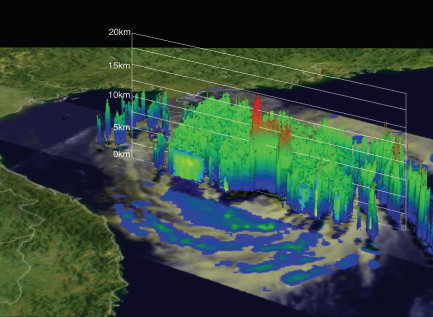
FIGURE 1-1 The microwave radar and radiometer instruments on board the Earth-orbiting Tropical Rainfall Measuring Mission (TRMM), launched in 1997, allow unprecedented insights into the three-dimensional structure of precipitating clouds. This image is of Typhoon Neoguri in the Southern Pacific, April 17, 2008. SOURCE: NASA’s Earth Observatory, available online at http://trmm.gsfc.nasa.gov/trmm_rain/Events/neoguri_17apr08_0729_utc_15dbz.jpg and through the TRMM extreme event image archives, http://trmm.gsfc.nasa.gov.
to launch in 2014, will map global precipitation as part of a constellation of Earth-observing satellites. One of the main goals of the Surface Water and Ocean Topography mission,9 which is under study for launch later in the decade, is to provide estimates of surface water extent, elevation, and slopes and therefore storage and storage change in lakes, reservoirs, wetlands, and rivers (especially flood plains) based on spaceborne measurements. Discharge will be modeled from those measurements.
In February 2000, during an 11-day mission using the Space Shuttle Endeavour, the Shuttle Radar Topography Mission produced a near global-scale, high-resolution (as fine as 30 m) digital topographic database of Earth. These digital elevation data quickly became the gateway data set for watershed studies and enabled studies of landscapes that had not been
____________
possible previously. Now the availability of lasers (using LiDAR, Light Detection and Ranging) to measure the elevation of the land surface provides the hydrologic community with yet another data source that potentially can change the discipline in fundamental ways. The discovery that water flows downhill is lost in antiquity (undoubtedly it occurred well before written history), but until fairly recently precise maps to indicate what direction was “downhill” at any point on Earth’s surface were lacking. The ability to produce LiDAR maps at a vertical resolution of several centimeters enables new inferences to be drawn; for example, clear pictures of exactly where stream channels begin can be drawn (Figure 1-2). Other information relevant to hydrologic modeling that can be extracted from meter-scale,
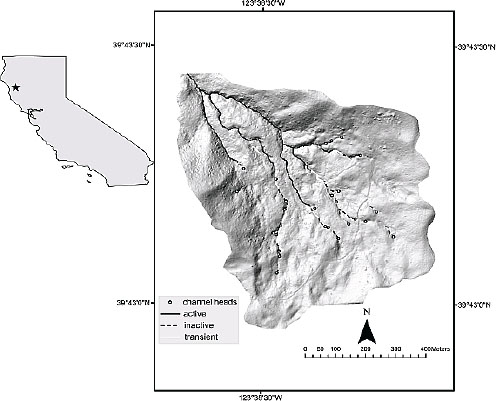
FIGURE 1-2 LiDAR has accuracy (error in height determination on the order of less than 20 cm), spatial resolution, and capability in sensing across vegetated and low-terrain landscapes, which allows for digital mapping of terrain that is excpetional when compared to those based on radar, stereographic optical, and other methods. In this example, a shaded relief image of ground surface that lies under a dense forest canopy in the Skunk Creek Watershed, Northern California, is shown. Data were collected from an aerial survey by the National Center for Airborne Laser Mapping, an NSF center. SOURCE: Reprinted, with permission, from Passalacqua et al. (2010). © 2010 by the American Geophysical Union.
high-resolution topography includes stream cross-section morphology, floodplains, landslide scars, roads and cuts contributing to sediment production during floods, and even vegetation height and biomass. Of course, with any new sensor come new challenges in data interpretation and accurate extraction of geomorphic features, requiring the development of filtering techniques that remove error while allowing accurate and automatic extraction of geomorphic features of interest (e.g., Passalacqua et al., 2010).
As a final example, geophysical characterization techniques provide opportunities to discover new processes that occur in soil waters and in groundwater. Recently it has been proposed that bacteria in the ground facilitate conduction of electricity (Revil et al., 2010). Thus, areas with high concentrations of bacteria (e.g., where contaminants may have stimulated bacterial growth) may be “visible” to geophysical techniques, which allow for creation of images using electrical signals (e.g., Figure 1-3). While these new observations are exciting, they generate research challenges in quantifying the uncertainty of these remotely sensed or multisensor merged
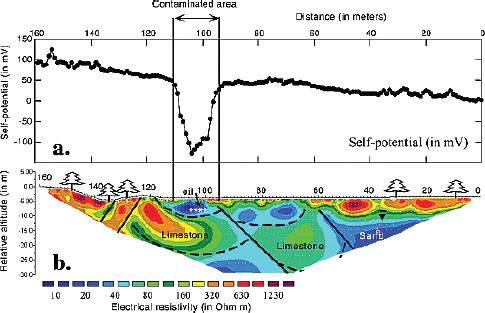
FIGURE 1-3 An oil spill in the south of France showing electrochemical signals in the ground where biodegradation is taking place. (a) Two electrodes measure the self-potential in mV and (b) the electrical resistivity of the site is shown in cross-section. This method offers a promising, nonintrusive method of detection for these spills. SOURCE: Reprinted, with permission, from Revil et al. (2010). © 2010 by the American Geophysical Union.
products and in understanding how this uncertainty propagates to hydrologic predictions.
Computation and Hydrologic Modeling
Computation continues to transform scientific research by enhancing what can be studied and generating new questions to ask and answer. Computers have been used in hydrologic research almost as long as they have been in existence. Numerical models for watersheds and groundwater reservoirs are widely available and used extensively by both practitioners and researchers.
Since the 1991 publication of the Blue Book, peak floating point operations per second of high-performance computers (a measure of a computer’s performance) have increased around five orders of magnitude. Because of advances in computing power, hydrologists now can design numerical experiments that were impossible just a few decades ago (e.g., Kollet et al., 2011). Hydrologists now have the capability to study the spatially distributed feedback from the land surface and oceans to weather events and the climate system using realistic models of physical and biophysical processes at appropriate scales. Similarly, hydrologists can create models of groundwater flow that can resolve processes at quite fine scales and investigate hypotheses about geological controls on flows. Computations are carried out even at the atomic scale to understand how biogeochemical reactions take place on the mineral grains of a rock. Uncertainty analysis and optimization through Monte Carlo techniques will continue to transform application of hydrologic models. Beyond facilitating application of models, the added computational capability allows posing and addressing new science questions that were not possible previously.
As the field continues to expand the scope of its research, computers with far greater computational and storage capacity will be needed. Computation is the key to handling the massive amounts of data generated from, for example, Earth-observing satellites and real-time sensors. To keep pace with data generation, new tools to enhance community access and tools for data and model visualization will need to be developed. Advances will be required in data assimilation, which provides a synthesis of observations and increasingly sophisticated numerical models to provide detail on the movement, storage, and quality of water in and on Earth. Development of a community hydrologic model or modeling platform (Famiglietti et al., 2008) in a vein similar to the Community Climate Model developed by the National Center for Atmospheric Research has received recent attention and is likely to be pursued by the hydrologic sciences community in the future. Hydrologic science will benefit from the expected explosion of
computing power in the future, just as the science has evolved in parallel with the computer revolution.
A Sensor Revolution
Advances in microelectronics have produced a host of useful measurement techniques, including tiny wireless sensors known as motes, complete with software and on-board low-power communication systems that can be deployed in watersheds, mounted on trees or structures, or embedded in the soil. These systems hold the promise of measuring across a relatively large scale (hundreds to 10,000 m) a wide variety of hydrologic and meteorological parameters at relatively low cost. As sensor cost continues to decline, due to demand within and outside the hydrologic sciences, arrays of wireless, autonomous sensing platforms have become an expected component of any watershed study. For example, similar arrays such as those used by Weather Underground have already captured the public’s attention, providing web-based services to link the public with both scientific and personal meteorological stations across the world. The hydrologic sciences can benefit greatly by riding this “wave” of sensor and information technology. The potential for advancement in hydrologic science is described in a recent study:
Sensors are being developed that are smaller, less expensive, and require less power, allowing for deployment in much larger numbers. Researchers are designing sensors to provide previously unavailable information, such as real-time measurements of nutrient concentrations in surface, soil, or groundwater. Sensors are being arrayed in networks that enable the sharing of information and hence produce synergistic gains in observational capacity; these sensor networks offer the promise of filling critical gaps between traditional point and remotely sensed measurements (NRC, 2008).
Advances in sensor technology make it possible to address questions on finer time scales than was possible in the past. Sensor arrays now routinely measure dissolved oxygen, nitrate, solar irradiance, and temperature in surface waters. For example, continuous in situ sensor data (Figure 1-4) were used to estimate gross primary production, ecosystem respiration, and nitrate uptake and from these estimates to partition nitrate uptake among organisms producing their own energy (“autotrophs”) and denitrifiers. This kind of detailed information leads to new insights about how critical ecosystem processes such as gross primary production relate to nitrogen uptake at time scales ranging from minutes to seasons and yield insights into the dynamic connections between ecosystem energetics and nutrient kinetics.
Hydrologic science is also now utilizing a much wider range of sensors than ever before. For example, advances in distributed sensing along fiber
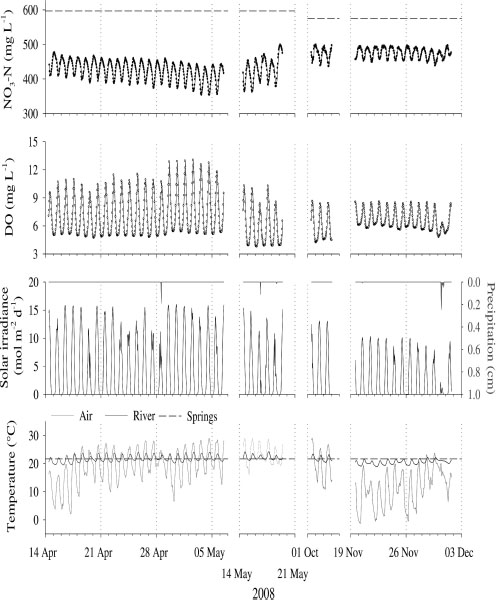
FIGURE 1-4 Continuous sensor data for temperature, solar irradiance, dissolved oxygen (DO), and nitrate (NO3). These measurements were used to probe direct and indirect coupling of primary production and diel nitrate dynamics in a subtropical spring-fed river. SOURCE: Reprinted, with permission, from Heffernan and Cohen (2010). ©2010 by the American Society of Limnology and Oceanography.
optic cables, first developed for the petroleum and electric power industries, are becoming widely available and deployed for measuring temperature and strain almost continuously in time and space. The ability to measure temperature at very high spatial and temporal resolutions, using only the scattering properties of optical fibers, has brought tremendous insights into, for example, the fields of groundwater and surface interaction. Whereas in the past, hundreds of individual sensors would be needed to characterize the spatial patterns of groundwater inflows, along with daily stream energy budgets, these can now be easily measured using standard telecommunications optical fibers (Figure 1-5).
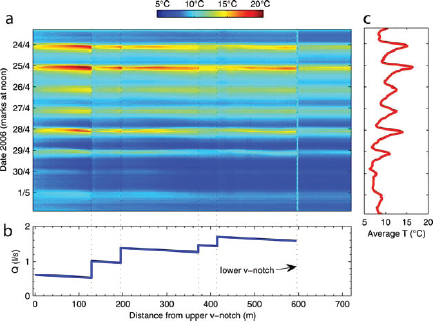
FIGURE 1-5 The time evolution of temperature along a 700-m reach of the Maisbich stream in Luxembourg using fiber-optic distributed temperature sensing. Distinct steps in stream temperature represent zones of upwelling groundwater, while the variation in both time and space in stream temperature are the result of variations in solar energy input and shading. This figure represents more than 8 million individual data points collected by a single instrument operating remotely and demonstrates the revolution in both spatial and temporal data that can now be collected. SOURCE: Reprinted, with permission, from Selker et al. (2006). © 2006 by the American Geophysical Union.
Twenty-five years ago, the subsurface was a data-poor environment constrained by a few point measurements. Today, operational measurements of soil moisture, soil temperature, and energy balances at very high spatial resolution are available. Advances in geophysical tools such as electric resistance tomography and ground-penetrating radar have led to much higher resolution maps of subsurface petrophysical properties. Significant challenges remain in translating the geophysical responses to traditional properties of interest such as hydraulic conductivity, but the field of hydrogeophysics has emerged to tackle these difficult questions.
Soil moisture, increasingly recognized as an important driver of climate along with coupled ocean and terrestrial processes such as monsoon cycles, has long been difficult to measure at the scales necessary for agriculture, meteorology, and hydrologic science. Most sensors to date (e.g., time-domain reflectometry) have been essentially point sensors providing a relatively accurate measurement, but one that was both difficult to scale up appropriately and expensive to obtain. Traditional microwave remote sensing can provide large spatial coverage (>1 km) but typically only interrogates the upper few millimeters to centimeters of the soil profile. In addition to the low-cost wireless sensing mentioned above, advances in both microwave sensing and other passive sensing systems now appear capable of bridging the gap between the point scale measurements of soil moisture and the watershed scale. Fiber-optic sensing, using buried fiber-optic cables and a variety of natural and induced heating, has been applied to estimate soil moisture distribution at the watershed scale. The recently developed Cosmic-ray Soil Moisture Observing System (COSMOS) utilizes the naturally produced cosmic ray neutron flux to infer hydrogen content (and therefore moisture content) at scales of 500 m to depths of 50 cm—scales very appropriate for catchment, agricultural, and advanced climate modeling (Desilets et al., 2010). Currently deployed at more than 30 sites in North America, these sensors represent a significant leap forward in the ability to measure hydrologic variables at the appropriate scales.
Higher temporal sampling and resolution has already been mentioned in light of biogeochemical cycling, however perhaps the greatest contribution of higher temporal sampling (coupled with more rapid data transmission) has been the near-real-time analysis of hydrologic fluxes across landscapes. Rather than a daily mean flow from a catchment, forecasters and the public now expect near-real-time and continuous streamflows and precipitation measures. Along with traditional sensors and the explosion in data transmission capacity, either by cell network, wireless, or Internet, new high temporal frequency techniques are constantly being developed. For example, the recognition that cellular phone tower communication is influenced by rainfall intensity along the path length of the transmission
has led to the second-by-second reconstruction of rainfall rates in Europe (Messer et al., 2006).
The sensor revolution has enabled hydrologists to look at much higher spatial and temporal frequency processes that dominate hydrologic science. As in most scientific disciplines, higher resolution measurements lead to fundamental discoveries, e.g., Leeuwenhoek and his microscope.10 Higher spatial resolution, through either less expensive point sensors or better resolution remote sensing, has allowed the discipline and its collaborative disciplines to radically alter its views of the rapidity of climate change (Taylor et al., 1993). Sensors have also furthered understanding of the architecture of subsurface heterogeneity, via hydrogeophysics, leading to fundamental theories of contaminant transport in the subsurface and have allowed using ever finer, analytical and X-ray tomography to understand the importance of the microscale distribution and the phase of geochemical constituents critical to human and ecosystem health.
Wireless self-organizing networks (e.g., Kido et al., 2008) are within the reach of any researcher, and new techniques are continuously being developed. The “sensor revolution” represents a fundamental advance in the field of hydrologic science. Testing, tuning, and maintaining fully operational sensors and sensor networks will, of course, continue to require expenditure of effort, particularly in those areas where sensors are not fully operational or remain costly. Fortunately, hydrologists will not work alone in this effort, because other research communities dependent upon environmental data, such as oceanography, environmental engineering, meteorology, and ecology, can provide synergy in sensor development, testing, and deployment. For hydrologic science, a more significant challenge will be to incorporate these sensor data into models that operate at coarser or similar high spatial resolutions.
THE INTERDISCIPLINARY INTERFACE
As a distinct geoscience, hydrologic science poses many important research questions that will be addressed by work within the discipline. However, the hydrologic cycle is a central element for many environmental disciplines that are neighbors to hydrologic science, and so it is not surprising that meeting many of the present and future challenges and opportunities will require collaboration among hydrologists, engineers, and scientists in other biogeoscience disciplines. Indeed, this collaboration has already
____________
10 Antonie van Leeuwenhoek (1632-1723) is known for his contributions to improving the microscope, allowing unprecedented high-resolution observation of, for example, single-celled organisms. As a result, he is best known for his contribution toward establishing the field of microbiology.
begun. For example, the study of vegetation patterns has, until relatively recently, been segregated by discipline. Ecologists explored connections based on specific competition, biogeochemists sought explanations based on heterogeneous distributions of soil and rock chemical properties, and hydrologists and geomorphologists considered controls on fluxes of water and sediment. In reality, of course, complex interactions exist among a host of factors, and hydrologic science is important in almost all critical processes. As a result of this and other similar examples, new disciplines have emerged that define these new areas of research (e.g., hydroclimatology, hydrometeorology, geobiology, hydroecology, hydrogeomorphology, ecogeomorphology, and Earth-surface dynamics). Hydrologic science is central to all of these fields and, in being so, is becoming redefined by these fields.
Interdisciplinary research is a mode of research by teams or individuals that integrates information, data, techniques, tools, perspectives, concepts, and/or theories from two or more disciplines or bodies of specialized knowledge to advance fundamental understanding or to solve problems whose solutions are beyond the scope of a single discipline or field of research practice.
Facilitating Interdisciplinary Research, NRC, 2004
In addition to the scientific desire to delve into fascinating questions at disciplinary interfaces, emergence of high-profile, multifaceted problems such as water management and ecological restoration in California, restoration of the Everglades, Mississippi River nutrient loading and Gulf Hypoxia, sediment management in the Missouri River, and water management in the Colorado River basin highlights how collaboratively driven work is a critical component of research that focuses on real hydrologic phenomena. The committee mentions a few examples of areas where past collaborative research yielded major new insights and where future concerted effort is needed.
Paleohydrology is the science concerned with the study of hydrologic systems as they existed before direct observation and modern hydrologic records. This interdisciplinary field uses methods of analysis and information from hydrologic science, climate science, botany, and geology. Concern about the impacts of climate variability and change and the corresponding desire for forecasting changes have heightened interest and resulted in increased activity in this area, beginning in the early 1990s (NRC, 1991) extending to the present. An increasing number of high-resolution records have been developed over the past several decades, especially from tree
rings. These records are important because they provide a more complete picture of past hydrology, documenting both spatial and temporal patterns of hydroclimatic variability over the past several millennia, and allowing recent hydrologic trends and events to be placed in a long-term context. Significant contributions include documentation of the spatial extent of droughts in many regions over North America over the past 2,000 years that indicate persistent droughts of much greater length and severity than any in the past century over broad areas of the western and southwestern parts of the United States (Figure 1-6). These droughts are also manifested in a multitude of watershed-scale reconstructions of streamflow, which are now being used by a number of water resource management agencies to plan for drought.
The linkages between ecology and hydrologic science at the land surface are complex and, like paleohydrology, scientific progress requires interdisciplinary collaboration. Water from the atmosphere as rain, snow, or dew obviously is essential for plants to thrive. But plants also affect the soil, which determines how much water is held for use by vegetation and how much is “lost” from the near-surface soils. Similarly, the atmosphere drives evaporation and transpiration (the movement of water from soils through plants to the atmosphere). Plant canopies create an environment
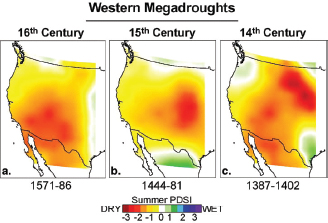
FIGURE 1-6 Droughts lasting for several decades have been identified by paleoclimatologists. Megadroughts during the 14th, 15th, and 16th centuries were determined using tree-ring reconstructed summer Palmer Drought Severity Indices (PDSI) averaged and mapped over the western United States. SOURCE: Reprinted, with permission, from Stahle et al. (2007). © 2007 by Springer Science and Business Media.
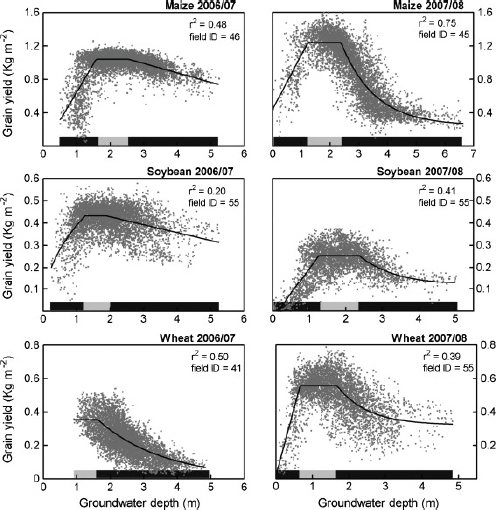
FIGURE 1-7 In agroecosystems crop yield is affected by groundwater depth, which in turn is affected by the use of water by plants. To identify groundwater depths that optimized crop yield, the authors combined data on corn, soybean, and wheat yields with topographic maps and groundwater-depth sampling. In this figure, piecewise regressions with two breakpoints were used. SOURCE: Reprinted, with permission, from Nosetto et al. (2009). © 2009 by Elsevier.
with different temperature and humidity relative to, say, a concrete parking lot and so affect the behavior of the atmosphere. Furthermore, soil properties affect how readily water and nutrients can be taken up from the soil by plant roots but again the growth of the roots themselves changes the soil structure, which is relevant to vadose zone hydrology, the subdiscipline concerned with water in soils.
Hydroecologic interrelationships are of considerable practical importance, for example in agriculture (Figure 1-7). Beginning in the late 1970s and 1980s, leading researchers from traditionally “agricultural” and “hydrogeology” backgrounds began to recognize that hydrologic processes from the soil surface to the water table were continuous and that collaboration among soil scientists and geologists was a fruitful way to make progress. Cross-fertilization between the agricultural and geologic communities led to advances in solute transport models, commercialization of field measurement systems, inclusion of vadose zone monitoring in waste disposal design and remediation, and recognition of the role of land use change and paleoclimates on fluxes to the water table.
Mechanisms exist to promote these and other interdisciplinary collaborations and are discussed in more detail in Chapter 5. For example, in recent years a group of scientists has worked collaboratively within the Critical Zone Network to investigate “processes within the Critical Zone, defined as the Earth’s outer layer from vegetation canopy to the soil and groundwater that sustains human life.”11 Critical Zone Observatories (CZOs) study the operation and evolution of the Critical Zone. (For more information, see Box 3-1.) These collaborations are in the spirit of discovering fundamental relationships among physical and biological processes where expertise from the fields of geosciences, hydrologic science, microbiology, ecology, and soil science participates. Problems being addressed range from acid mine drainage to release of arsenic to groundwater.
HYDROLOGIC SCIENCE: LOOKING AHEAD
Important challenges lie ahead in understanding the complexity of the Earth system, and water will never cease to play an important role in that system (NSF, 2009). Almost 20 years after its publication, the Blue Book remains fresh and compelling, and its statements take on even greater urgency in view of a stressed planet:
[Water] … is a hazard, a resource to be managed, and an enabler and sustainer of civilization. It is important to and affected by physical, chemical and biologic processes within all compartments of the earth system: the atmosphere, glaciers and ice sheets, solid earth, rivers, lakes and oceans. Water vapor is the working fluid of the atmospheric heat engine; water, as the primary greenhouse gas, is instrumental in setting planetary temperature; water, through fluvial erosion and sedimentation, together with tectonics, shapes the land surface; water, is the universal solvent and the agent of element cycling. Finally, water is necessary for life.… (NRC, 1991)
____________
11 See http://www.czen.org/.
The hydrologic community should be ready to face the complex water-related challenges of today and tomorrow by continuing disciplinary and interdisciplinary research toward a predictive understanding of the atmosphere-hydrosphere-biosphere-lithosphere system from the microscopic to the global scale, by continuing the transformation of hydrologic education to ensure the workforce needed for the years ahead, and by translating new scientific understanding to decision-making tools for solutions that achieve sustainable outcomes.
The NSF recognized the significance of emerging water issues and the need to strengthen and adjust its hydrologic science research efforts to address these issues. NSF acknowledges that understanding the complexity of the Earth system, which is driven by water, is critically important. It also recognizes the importance of interdisciplinary efforts among its various programs, divisions, directorates, and other agencies. The present study was undertaken by the NRC’s Water Science and Technology Board at the request of NSF Earth Sciences officials.12 The committee’s charge is to review the current status of hydrology and its subfields and the coupling with related geosciences and biosciences, and to identify promising new opportunities to advance hydrologic sciences for better understanding of the water cycle that can be used to improve human welfare and the health of the environment (Box 1-2).
With respect to the restrictions of the study to not make budgetary recommendations or to critique existing NSF programs, embedded within the statement of task was certain language that the committee interpreted as a request from the NSF for specific advice pertaining to the foundation. This includes reference in the task to current research modalities,13 educational opportunities, and strengthening observational systems, data management, modeling capacity, and collaborations including interfaces with mission agencies. These capabilities are integral to the NSF Hydrologic Science program and other NSF programs within the foundation; they represent the mechanism(s) used to promote the foundation’s mission.14 In addition,
____________
12 Original language from the study proposal that was included in the grant from the National Science Foundation to the National Research Council authorizing and scoping the study is as follows: “The primary focus of this study will be the NSF program in hydrologic science but given the importance of water issues to the nation, the report should also serve the academic/educational community, other agencies with programs in hydrology and water resources, Congressional staff, the Office of Science and Technology Policy, professional societies, and other entities with missions related to Earth sciences and water resources.”
13 The committee interprets the term “modalities” in the statement of task as referring to capabilities within the NSF and other federal agencies used to advance hydrologic research including contracts and research grants, instrumentation and facilities, and so forth.
14 To “promote the progress of science; to advance the national health, prosperity, and welfare; to secure the national defense…”; see http://www.nsf.gov/about/.
This study will identify the challenges and opportunities in the hydrologic sciences, including (1) a review of the current status of the hydrology and its subfields and of their coupling with related geosciences and biosciences, and (2) the identification of promising new opportunities to advance hydrologic sciences for better understanding of the water cycle that can be used to improve human welfare and the health of the environment. The goal is to target new research directions that utilize the capabilities of new technologies and not to critique existing programs at NSF or elsewhere. The resulting report will not make budgetary recommendations.
Specifically, the study will:
• Identify important and emerging issues in hydrology and related sciences,
• Assess how current research modalities impact the ability of hydrologic sciences to address important and emerging issues,
• Identify needs and research and education opportunities for making significant advances in hydrologic sciences, and
• Assess current capabilities in and identify opportunities to strengthen observational systems, data management, modeling capacity, and collaborations needed to support continued advancement of hydrologic sciences, and also their relationships to and value for mission-related agencies and, reciprocally, how observational systems of mission-related agencies relate to and contribute to hydrologic sciences.
these capabilities are integral to other agencies and organizations that support research in the hydrologic sciences.
The Committee on Challenges and Opportunities in the Hydrologic Sciences met six times, heard presentations from scientists and engineers who work in several areas of hydrologic science and related disciplines, and solicited input from the community at an open town hall meeting at the 2009 Fall Meeting of the American Geophysical Union. Despite fundamental progress in the field, the challenges and opportunities that lie ahead have intensified rather than diminished in view of the increasing pressure on Earth’s water resources. Many open questions demand renewed and strategic research in the field. Water shapes landscapes and life, which, in turn, affect water flows and stored volumes of water. How do hydrologic systems, landscapes, and their biological communities co-evolve? Scientists are learning more and more from records encoded in rocks, trees, and ice. How does knowledge about the hydrologic past prepare us for society’s water future? Does the planet face shrinking ice and growing deserts? How are bioclimatic zones evolving? Humans continue to intervene in the hydrologic cycle of Earth via diversions, dams, and pumps. What are the
consequences of this planetary “replumbing?” Can sufficient clean water be supplied where and when humans and natural ecosystems need it? Through a host of natural and human-induced changes, ecosystems have been altered extensively. How can scientists tell if freshwater ecosystems are broken and, when they are found to be broken, how can they be fixed? How much water does an ecosystem need? Arguably the most important advance in public health came toward the end of the 19th century when water contamination was recognized as the cause of widespread disease outbreaks such as cholera, and sanitation was introduced. Yet today society still grapples with issues related to water quality. Can water quality be assessed and managed to protect human and ecosystem health? How can new detection, treatment, and modeling tools be used to protect the public against contaminants of emerging concern?
The questions posed above are examples of intriguing puzzles that engage scientists and engineers in hydrologic science and related disciplines. A discussion of such questions could be organized along many different pathways. This committee chose to write three separate chapters, which stand on their own but are intimately linked, that cover fundamental questions in hydrologic science and related biogeosciences. All three chapters present examples of “curiosity-driven” and “problem-driven” research; both are important. The sum of these chapters is not an exhaustive list spanning the entire range of hydrologic and related research. Rather, it is intended to enumerate some of the most challenging concepts and to identify some of the research areas most important to promoting progress in the field.
The research opportunities in each chapter are arranged into several sections paired with a succinct boldface statement intended to extend the meaning of the section title as well as to interest and inspire the reader. Some of these areas will obviously overlap, a reflection of the intertwined, high-level challenges facing the community. Each section drills down into more specific, italicized questions and ends with specific exemplary questions for readers seeking more detail. The tiered structure of the central chapters is intended to cater to an audience ranging from the aspiring hydrologist or engineer seeking an introduction to hydrologic research to an established scientist seeking detailed information. The chapters contain numerous boxes and figures to draw attention to interesting contributions and examples, and to support concepts articulated in the surrounding text. The committee cited publications only when critical: to properly attribute a figure or image, quotation, point of fact, or explicit concept, thus avoiding a literature review. The reference section at the end of each chapter contains references not only called out in the text but also from key citations (“Suggested Reading”) that provide additional source material as an educational tool and a resource for aspiring scientists. The Suggested Reading lists are composed of review papers, synthesis documents, or landmark papers to
provide the reader with material containing both depth and breadth on a given issue.
The report is designed to be of use to members of the hydrologic community, mainly the research community, which includes not only academics but scientists and engineers from the private sector, federal agencies (most notably the NSF Hydrologic Science program and other Earth Science programs within NSF, when appropriate), decision makers interested in water research and policy, and those with Earth sciences and water resource-related missions interested in where hydrologic science fits into the surface-earth sciences. The report is also written for graduate and undergraduate students seeking inspiration, general knowledge, or guidance when selecting a focus within the field. Although the primary audience is the hydrologic community, the challenges and opportunities are intentionally broad, illustrating the necessity of interdisciplinary work needed to face the complex water related challenges of today and tomorrow.15
The signature of a scientific challenge is that it is compelling—both in the domain of intellectual curiosity as well as in the domain of consequences for human and ecosystem welfare. The following chapters, titled “The Water Cycle: An Agent of Change,” “Water and Life,” and “Clean Water for People and Ecosystems,” outline major areas of opportunity and challenge for hydrologic science. The content of each is intended to be a vision statement, identifying areas that deserve emphasis because they present challenges and opportunities which are both intellectually compelling and socially relevant to human and ecosystem welfare. The fifth and final chapter also discusses the challenges and opportunities, but in the context of accomplishing these goals for the hydrologic community and, more specifically, NSF. This chapter points out that “translational hydrology”—highly collaborative work that includes social scientists and a wide variety of stakeholders—will be required to establish a healthy, resilient, and sustainable planet.
Opportunities in the Hydrologic Sciences cemented the foundation of the field. Hydrologic science in the 21st century is a broad field that encompasses all of traditional hydrologic science as defined in Opportunities in the Hydrologic Sciences and extends into areas that are traditionally of interest to other fields and related subdisciplines. This report builds on that foundation by stressing not only further building of hydrologic science, but also the interdisciplinary potential of a science with an established foundation.
____________
15 The committee was asked to report on challenges and opportunities in the hydrologic sciences. The charge was not to discuss the distinction between “scientists” and “engineers.”
Crutzen, P. J. 2002. Geology of mankind. Nature 415:23.
Desilets, D., M. Zreda, and T. Ferre. 2010. Nature’s neutron probe: Land-surface hydrology at an elusive scale with cosmic rays. Water Resources Research 46:W011505. doi: 10.1029/2009WR008726.
Dudgeon, D., A. H. Arthington, M. O.Gessner, Z. I. Kawabata, D. J. Knowler, C. Lévêque, R. J. Naiman, A. H. Prieur-Richard, D. Soto, M. L. J. Stiassny, and C. A. Sullivan. 2006. Freshwater biodiversity: Importance, threats, status and conservation challenges. Biological Reviews 81:163-182. doi: 10.1017/S1464793105006950.
Famiglietti, J., L. Murdoch, V. Lakshmi, and R. Hooper. 2008. Community Modeling in Hydrologic Science: Scoping Workshop on a Community Hydrologic Modeling Platform (CHyMP); Washington, DC, 26-27 March 2008, Eos Transactions. American Geophysical Union 89(32):292. doi: 10.1029/2008EO320005.
Heffernan, J. B., and M. Cohen. 2010. Direct and indirect coupling of primary production and diel nitrate dynamics in a subtropical spring-fed river. Limnology and Oceanography 55(2):677-688.
Hou, A. Y., G. Skofronick-Jackson, C. D. Kummerow, and J. M. Shepherd. 2008. Global precipitation measurement. Pp. 131-164 in Precipitation: Advances in Measurement, Estimation, and Prediction. S. Michaelides (ed.). Berlin, Heidelberg: Springer.
Kido, M. H., C. W. Mundt, K. N. Montgomery, A. Asquith, D. W. Goodale, and K. Y. Kaneshiro. 2008. Integration of wireless sensor networks into cyberinfrastructure for monitoring Hawaiian “mountain-to-sea” environments. Environmental Management 42(4):658-666. doi: 10.1007/s00267-008-9164-9.
Kollet, S. J., R. M. Maxwell, and C. S. Woodward. 2010. Proof of concept of regional scale hydrologic simulations at hydrologic resolution utilizing massively parallel computer resources. Water Resources Research 46:W04201. doi: 10.1029/2009WR008730.
Messer, H., A. Zinevich, and P. Alpert. 2006. Environmental monitoring by wireless communication networks. Science 315:713.
Nosetto, M. D., E. G. Jobbágy, J. B. Jackson, and G. A. Sznaider. 2009. Reciprocal influence between crops and shallow ground water in sandy landscapes of the Inland Pampas. Field Crops Research 113:138-148. doi: 10.1016/j.fcr.2009.04.016.
NRC (National Research Council). 1991. Opportunities in the Hydrologic Sciences. Washington, DC: National Academy Press.
NRC. 1998. Hydrologic Sciences: Taking Stock and Looking Ahead. Washington, DC: National Academy Press.
NRC. 2004. Facilitating Interdisciplinary Research. Washington, DC: The National Academies Press.
NRC. 2008. Integrating Multiscale Observations of U.S. Waters. Washington, DC: The National Academies Press.
NRC. 2011. Global Change and Extreme Hydrology: Testing Conventional Wisdom. Washington, DC: The National Academies Press.
NSF (National Science Foundation). 2009. GEO Vision: Unraveling Earth’s Complexities through the Geosciences. The National Science Foundation’s Advisory Committee for the Geosciences. Available online at http://www.nsf.gov/geo/acgeo/geovision/nsf_ac-geo_vision_10_2009.pdf [accessed January 24, 2012].
Passalacqua, P., T. Do Trung, E. Foufoula-Georgiou, G. Sapiro, and W. E. Dietrich. 2010. A geometric framework for channel network extraction from LIDAR: Nonlinear diffusion and geodesic paths. Journal of Geophysical Research 115:F01002. doi: 10.1029/2009JF001254.
Revil, A., C. A. Mendonça, E. A. Atekwana, B. Kulessa, S. S. Hubbard, and K. J. Bohlen. 2010. Understanding biogeobatteries: Where geophysics meets microbiology. Journal of Geophysical Research 115:G00G02. doi: 10.1029/2009JG001065.
Ricciardi, A., and J. B. Rasmussen. 1999. Extinction rates of North American freshwater fauna. Conservation Biology 13(5):1220-1222. doi: 10.1046/j.1523-1739.1999.98380.x.
Royal Netherlands Academy of Arts and Sciences. 2005. Turning the Water Wheel Inside Out, Foresight Study on Hydrological Science in the Netherlands. Royal Netherlands Academy of Arts and Sciences, Amsterdam, The Netherlands. Available online at http://www.knaw.nl/Content/Internet_KNAW/publicaties/pdf/20041090.pdf [accessed August 31, 2011].
Selker, J., N. van de Giesen, M. Westhoff, W. Luxemburg, and M. B. Parlange. 2006. Fiber optics opens window on stream dynamics. Geophysical Research Letters 33:L24401. doi: 10.1029/2006GL027979.
Stahle, D. W., F. K. Fye, E. R. Cook and R. D. Griffin. 2007. Tree-ring reconstructed megadroughts over North America since AD 1300. Climatic Change 83:133-149. doi: 10.1007/s10584-006-9171-x.
Taylor, K. C., G. W. Lamorey, G. A. Dolye, R. B. Alley, P. M. Grootes, P. A. Mayewski, J. W. C. White, and K. L. Barlow. 1993. The “flickering switch” of late Pleistocene climate change. Nature 361:432-436. doi: 10.1038/361432a0.
Vince, G. 2011. An epoch debate. Science 334:32-37.
Zheng, C., L. Wan, Y. Wang, X. Feng, L. Ren, G. Li, W. Li, J. Wu, R. Zhang, Y. Zhang, S. Ge, and H. Dong. 2009. Challenges and Opportunities in Chinese Groundwater Science. Committee on Chinese Groundwater Science, Beijing. Beijing, China: Science Press. 200 pp.
Burges, S. J. 2010. Invited perspective: Why I am an optimist. Water Resources Research 47: W00H11. doi: 10.1029/2010WR009984.
CIRES (Cooperative Institute for Research in Environmental Sciences) Water, Earth, and Biota (WEB) Report. 2000. A Framework for Reassessment of Basic Research and Educational Priorities in Hydrologic Sciences. V. Gupta, Chair, University of Colorado. Available online at http://cires.colorado.edu/science/groups/gupta/projects/web/report/#1 [accessed January 9, 2012].
Dozier, J. 2011. Mountain hydrology, snow cover, and the fourth paradigm. Eos 92(43): 373-384.
Hannah, D. M., P. J. Wood, and J. P. Sadler. 2004. Ecohydrology and hydroecology: A ‘new paradigm’? Hydrological Processes 18(17):3439-3445. doi: 10.1002/hyp.5761.
NRC. 1991. Opportunities in the Hydrologic Sciences. Washington, DC: The National Academies Press.
NRC. 1998. Hydrologic Sciences: Taking Stock and Looking Ahead. Washington, DC: National Academy Press.
NRC. 2008. Earth Observations from Space: The First 50 Years of Scientific Achievements. Washington, DC: The National Academies Press.
Stephens, D. B. 1996. Recent trends in hydrogeology and environmental consulting and perspective on maturing of hydrogeology profession. Journal of Hydrologic Engineering 13(1):20-27.


