Research Universities
and the Future of America
America is driven by innovation — advances in ideas, products, and processes that create new industries and jobs, contribute to our nation’s health and security, and support a high standard of living. In the past half-century, innovation itself has been increasingly driven by educated people and the knowledge they produce. Our nation’s primary source of both new knowledge and graduates with advanced skills continues to be our research universities.
However, these institutions now face an array of challenges, from unstable revenue streams and antiquated policies and practices to increasing competition from universities abroad. It is essential that we as a nation reaffirm and revitalize the unique partnership that has long existed among research universities, the federal government, the states, and philanthropy, and strengthen its links with business and industry. In doing so, we will encourage the innovation that leads to high-quality jobs, increased incomes, and security, health, and prosperity for our nation.
A PARTNERSHIP FOR INNOVATION
As America pursues economic growth and other national goals, its research universities have emerged as a major national asset — perhaps even its most potent one. This did not happen by accident; it is the result of forward-looking and deliberate federal and state policies. These began with the Morrill Act of 1862, which established a partnership between the federal government and the states to build universities that would address the challenges of creating a modern agricultural and industrial economy for the 20th century.
The government–university partnership was expanded in the 1950s and 1960s to contribute to national security, public health, and economic growth. Through this expanded partnership, basic research — the source of new ideas for the long term — would be increasingly funded by the federal government and largely concentrated in the nation’s research universities.
This partnership, which over time grew to include industry and philanthropy, has led to significant benefits for America’s economy and quality of life. Lasers, radar, synthetic insulin, blood thinners, magnetic resonance imaging (MRI), computers, and rocket fuel are among the countless innovations in which university research has played an essential role. And talented graduates of these institutions have created and populated many new businesses that have employed millions of Americans.
NEW AND CRITICAL CHALLENGES
American research universities are widely recognized as the best in the world, admired for their education and research. They have the potential to drive innovation in areas important to America’s future, including health and medicine, energy security and efficiency, education, and defense and homeland security.
Yet research universities now confront critical pressures, including unstable revenue streams, demographic shifts in the U.S. population, changes in the organization and scale of research, and shifting relationships between research universities, government, and industry. Research universities also face growing competition from their counterparts abroad. While U.S. institutions have long attracted outstanding students and scholars from around the world who have contributed substantially to our research and innovative capacity, other countries are rapidly strengthening their institutions to compete for the best international students and for faculty, resources, and reputation.
With these developments in mind, we have identified a set of specific challenges and opportunities that a reasoned set of policies must address in order to produce the greatest return to our society, our security, and our economy:
• Federal funding for university research has been unstable and, in real terms, declining at a time when other countries have increased funding for research and development (R&D).
• State funding for higher education, already eroding in real terms for more than two decades, has been cut further during the recent recession.
• Business and industry have largely dismantled the large corporate research laboratories that drove American industrial leadership in the 20th century (e.g., Bell Labs), but have not yet fully partnered with research universities to fill the gap at a time when the new knowledge and ideas emerging from university research are needed by society more than ever.
• Research universities must improve management, productivity, and cost efficiency in both administration and academics.
• Young faculty have insufficient opportunities to launch academic careers and research programs.
• There has been an underinvestment in campus infrastructure, particularly in cyberinfrastructure that could lead to long-term increases in productivity, cost-effectiveness, and innovation in research, education, and administration.
• The cost of sponsored research is not fully covered by those who procure it, which means that universities have to cross-subsidize sponsored research from other sources.
• A burdensome accumulation of federal and state regulatory and reporting requirements increases costs and sometimes challenges academic freedom and integrity.
• Doctoral and postdoctoral preparation could be enhanced by shortening time-to-degree, raising completion rates, and enhancing programs’ effectiveness in providing training for highly productive careers.
• Demographic change in the U.S. population necessitates strategies for increasing the success of female and underrepresented minority students.
• Institutions abroad are increasingly competing for international students, researchers, and scholars.
The principles and recommendations that follow are designed to help federal and state policymakers, universities, and businesses overcome these hurdles and capitalize on these opportunities. Strong leadership — and partnership — will be needed by these parties if our research universities and our nation are to thrive.
REVITALIZING THE PARTNERSHIP
We believe that America’s research universities are today a key asset for our nation’s future. They are so because of the considered and deliberate decisions made in the past by policymakers, even in difficult times. Our future now depends on the willingness of our current policymakers to follow their example and make the decisions that will allow us to continue to compete, prosper, and shape our destiny.
It is essential that we as a nation reaffirm, revitalize, and strengthen substantially the unique partnership that has long existed among the nation’s research universities, the federal government, the states, and philanthropy by enhancing their individual roles and the links among them and also by providing incentives for stronger partnership with business and industry. In doing so, we will encourage the ideas and innovations that will lead to more high-end jobs, increased incomes, and the national security, health, and prosperity we expect.
PRINCIPLES
Reaffirming and strengthening the unique partnership that has long existed among the nation’s research universities, the federal government, the states, and business will require:
• A balanced set of commitments by each of the partners — the federal government, state governments, research universities, and business and industry — to provide leadership for the nation in a knowledge-intensive world and to develop and implement enlightened policies, efficient operating practices, and necessary investments.
• The use of requirements for matching funds among these commitments, which provide strong incentives for participation at comparable levels by each partner.
• Sufficient flexibility to accommodate differences among research universities and the diversity of their stakeholders.
• A commitment to a decade-long effort that seeks both to address challenges and to take advantage of opportunities as they emerge.
• A recognition of the importance of supporting the comprehensive nature of the research university, spanning the full spectrum of academic and professional disciplines, including the physical, life, social, and behavioral sciences; engineering; the arts and humanities; and the professions, all of which enable universities to provide the broad research and education programs required by a knowledge- and innovation-driven global economy.
Within this partnership, our research universities — with a historical commitment to excellence, academic freedom, and service to society — must pledge themselves to a new level of partnership with government and business, strive anew to be the places where the best minds in the world want to work, think, educate, and create new ideas, and commit to delivering better outcomes for each dollar spent.
TEN STRATEGIC ACTIONS
We recommend ten actions designed to accomplish three broad goals:
Revitalizing the partnership. The first four actions will strengthen the partnership among universities, federal and state governments, philanthropy, and the business community in order to revitalize university research and speed its translation into innovative products and services.
Strengthening institutions. The next three actions will streamline and improve the productivity of research operations within universities.
Building talent. The final three actions will ensure that America’s pipeline of future talent in science, engineering, and other research areas remains creative and vital, leveraging the abilities of all of its citizens and attracting the best students and scholars from around the world.
Recommendation 1
Federal Action
Within the broader framework of U.S. innovation and R&D strategies, the federal government should adopt stable and effective policies, practices, and funding for university-performed R&D and graduate education so that the nation will have a stream of new knowledge and educated people to power our future, helping us meet national goals and ensure prosperity and security.
TO IMPLEMENT THIS RECOMMENDATION:
- The federal government should review and modify policies and practices governing university research and graduate education that have become burdensome and inefficient, such as research cost reimbursement, unnecessary regulation, and awkward variation and coordination among federal agencies.
- Over the next decade, as the economy improves, the federal government should invest in basic research and graduate education sufficient to produce the new knowledge and educated citizens the nation needs to reach its goals. As a core component of a national plan to raise total national R&D funded by all sources — government, industry, and philanthropy — to 3 percent of gross domestic product, Congress and the administration should provide full funding of the amount authorized by the America COMPETES Act, doubling the level of basic research conducted by the National Science Foundation, National Institute of Standards and Technology, and the Department of Energy’s Office of Science. A portion of the increase should be directed to high-risk, innovative research. Investment should also be sustained in other key areas, such as biomedical research.
- On an annual basis in the President’s annual budget request, the Office of Management and Budget (OMB), together with the White House Office of Science and Technology Policy (OSTP), should develop and present a federal science and technology budget that addresses priorities for sustaining a world-class U.S. science and technology enterprise. And every 4 years, OSTP and OMB should review federal science and technology spending and outcomes to ensure that spending is adequate to support our economy and targeted to meet national goals. We recommend that this process consider U.S. global leadership, a focus on developing new knowledge, balance in the science and technology portfolio, reliable and predictable streams of funding, and a commitment to merit review.
By completing funding increases that Congress has already authorized through the America COMPETES Act, the nation would ensure robust support for critical basic research programs, achieving a balanced research portfolio capable of driving the innovation necessary for economic prosperity. Together with cost-efficient regulation, this stable funding will enable universities to make comparable investments in research facilities and graduate programs. And because research and education are intertwined in universities, this funding will also ensure that we continue to produce the scientists, engineers, and other knowledge professionals the nation needs.
Recommendation 2
State Action
Provide greater autonomy for public research universities so that these institutions may leverage local and regional strengths to compete strategically and respond with agility to new opportunities. At the same time, restore state appropriations for higher education, including graduate education and research, to levels that allow public research universities to operate at world-class levels.
TO IMPLEMENT THIS RECOMMENDATION:
- State governments should move rapidly to provide their public research universities with sufficient autonomy and agility to navigate an extended period with limited state support.
- As state budgets recover from the current recession, states should strive to restore and maintain per-student funding for higher education, including public research universities, to the mean level for the 15-year period 1987-2002, as adjusted for inflation.
- Federal programs designed to stimulate innovation and workforce development at the state level, including those recommended in this report, should be accompanied by strong incentives to stimulate and sustain state support for their public universities, which are both state and national assets.
For states to compete for the prosperity and welfare of their citizens in a knowledge-driven global economy, the advanced education, research, and innovation programs provided by their research universities are absolutely essential. And the importance of these universities extends far beyond state borders; these institutions play a critical role in the prosperity, public health, and security of their regions and the entire nation.
However, an alarming erosion in state support for higher education over the past decade has put the quality and capacity of public research universities at great risk. State cuts in appropriations to public research universities over the years 2002 to 2010 are estimated to average 25 percent, ranging as high as 50 percent for some universities — resulting in the need for institutions to increase tuition or to reduce either activities or quality.
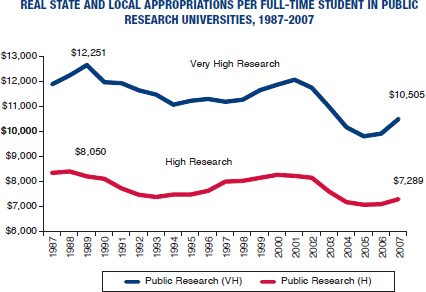
There has been a downward trend since the late 1980s in state and local funding per full-time student for public universities with high and very high levels of research, with the steepest decline starting in 2002.
While over time states should strive to restore appropriations that were cut during that decade, budget challenges and shifting priorities may make this very difficult in the near term. Therefore it is equally important for states to provide their public research universities with enough autonomy to navigate what could be an extended period with inadequate state funding. Both steps — restoring state funding and increasing university autonomy — are in the long-term interests of the states and the nation.
Recommendation 3
Strengthening Partnerships with Business
Strengthen the business role in the research partnership, facilitating the transfer of knowledge, ideas, and technology to society, and accelerate “time-to-innovation” in order to achieve our national goals.
TO IMPLEMENT THIS RECOMMENDATION:
- The federal government should continue to fund and expand research support mechanisms that promote collaboration and innovation.
- The federal government should, within the context of also making the R&D tax credit permanent, implement new tax policies that incentivize business to develop partnerships with universities (and other research organizations as warranted) for research that results in new economic activities located in the United States.
- The relationship between business and higher education should become more peer-to-peer in nature, stressing collaboration in areas of joint interest rather than remaining in a traditional customer-supplier relationship, in which business procures graduates and intellectual property from universities.
- Businesses and universities should work closely together to develop new graduate degree programs that address strategic workforce gaps for science-based employers.
- Collaboration among national laboratories, the business community, and universities is encouraged because the large-scale, sustained research projects of national laboratories both support and depend on the participation of university faculty and graduate students as well as the marketplace.
- Universities should improve management of intellectual property to improve technology transfer.
Using research support mechanisms that promote collaboration between business and universities will lead to the creation and efficient use of knowledge to achieve national goals. Tax incentives can also provide practical motivation to establish new partnerships. Although these tax policies will have a cost to the federal budget as a “tax expenditure,” it would be a relatively minor component of the cost of current proposals to make permanent the R&D tax credit. And the partnerships that result will generate new knowledge and ideas, achieving national goals in key policy areas and the economic growth and jobs that result from new activity. Meanwhile, improving university management of intellectual property will result in more effective dissemination of research results, generating economic activity and jobs.
Protecting Earth’s Ozone Shield
The ozone layer is an important component of Earth’s upper atmosphere that protects human health. Ozone absorbs medium-wavelength ultraviolet rays from the Sun, providing a protective barrier from harmful radiation that contributes to the development of skin cancer and cataracts in humans. Important work from American research universities has shown that the ozone layer is directly endangered by human activity — specifically by chlorofluorocarbon (CFC) gases released into the atmosphere by aerosol cans, older model refrigerators, and other sources.

NASA image of ozone hole over Antarctica, 1985.
In 1970, Dutch atmospheric chemist Paul Crutzen, then affiliated with Oxford University, demonstrated that nitric oxide reached the stratosphere and could deplete the ozone layer. Building on this work, Mario Molina of the Massachusetts Institute of Technology and F. Sherwood Rowland of the University of California, Irvine, who had studied the properties of CFC gases, hypothesized that these gases could deplete the ozone layer as well. Based on their research, Molina and Rowland published an influential article in the journal Nature in 1974 that predicted the destruction of the ozone layer through the breakdown of CFC gases in the upper atmosphere. Two years later, a National Academy of Sciences report found strong scientific evidence to support the Rowland–Molina hypothesis, leading the United States and other governments to restrict use of CFC gases. In response to the environmental and health concerns raised by the hypothesis, the use of CFC gases in aerosol cans was banned in the United States in 1978.

Scientists release a balloon from McMurdo Station in Antarctica carrying instruments that measure ozone depletion in the stratosphere.
Seven years later, in 1985, a team of British scientists announced that they had discovered ozone depletion over Antarctica, proving the Rowland–Molina hypothesis correct. A global response to the crisis followed, with international agreements in 1985 and 1987 providing specific means for reducing the production and use of ozone-depleting substances. Fully in force by 1989, the Montreal Protocol on Substances That Deplete the Ozone Layer relied on scientific findings from American research universities to build an international consensus on action to phase out the use of ozone-depleting substances. Had these steps not been taken, nearly two-thirds of Earth’s protective ozone would have been destroyed by 2065, according to a team of atmospheric chemists from NASA, Johns Hopkins University, and the Netherlands Environmental Assessment Agency.
Recommendation 4
Improving University Productivity
Increase university cost-effectiveness and productivity in order to provide a greater return on investment for taxpayers, philanthropists, corporations, foundations, and other research sponsors.
TO IMPLEMENT THIS RECOMMENDATION:
- The nation’s research universities should set and achieve bold goals in cost containment, efficiency, and productivity in business operations and academic programs. Universities should strive to limit the cost escalation of all ongoing activities — academic and auxiliary — to the inflation rate or less through improved efficiency and productivity. In addition to implementing efficient business practices, universities should review existing academic programs from the perspectives of centrality, quality, and cost-effectiveness, adopting modern instructional methods such as cyberlearning. Universities should also encourage greater collaboration among research investigators and among research institutions, particularly in acquiring and using expensive research equipment and facilities.
- University associations should develop and make available more powerful and strategic tools for financial management and cost accounting that enable universities to determine the most effective ways to contain costs and increase productivity and efficiency. As part of this effort, they should develop metrics that allow universities to communicate their level of cost-effectiveness to the general public.
- Working together with key stakeholders, universities should intensify efforts to educate key audiences about the unique character of U.S. research universities and their importance to state, regional, and national goals, including economic prosperity, public health, and national security.
By increasing cost-effectiveness and productivity, institutions will realize significant cost savings in operations that may be used to improve their performance, allowing them to shift resources strategically and/or reduce growth in their need for resources such as tuition. Many institutions have already demonstrated that significant cost efficiencies are attainable. If research universities can take action, states and the nation will realize greater returns on their investments, and the savings associated with cost containment and greater productivity can then be deployed to other priorities such as constraining tuition increases, increasing student financial aid, or launching new programs.
Forensic DNA Analysis
Forensic DNA analysis — familiar to many from TV crime shows such as CSI: Crime Scene Investigation — produces reliable evidence used in criminal investigations and trials, helping to identify the guilty and exonerate the innocent. The technique, which depends on a process called polymerase chain reaction (PCR), became possible and practical because of discoveries at American research universities.
PCR works by repeatedly copying DNA, which is composed of two strands that fit together to form the now well-known double helix. First, the DNA is “unzipped” into two strands — a process that uses high heat — and then a copy of the segment of interest is made using an enzyme called DNA polymerase. This process is repeated multiple times to generate copies of the DNA sequence; having many copies of the sequence allows it to be read clearly and reliably. It is then possible to determine whether the DNA sequence in a piece of evidence — say, the root of a human hair — matches that of a suspect or victim.

Kary Mullis invented PCR in 1983 while working for Cetus Corporation, but at first the process was slow and impractical for wide use, because there was no version of DNA polymerase available that could endure the high temperatures needed to unzip the DNA, a step that happens repeatedly during the PCR process. To make it possible to do PCR quickly and reliably on a broad scale, Mullis and his colleagues drew on two discoveries by university researchers.

Thomas Brock of Indiana University stands next to Mushroom Spring in Yellowstone National Park, one of the hot springs where he and his colleagues found the bacterium Thermus aquaticus.
In 1969, Thomas Brock and Hudson Freeze of Indiana University had isolated the heat-loving bacterium Thermus aquaticus from thermal springs in Wyoming and California. In subsequent work in 1976 at the University of Cincinnati, John Trela and his coworkers isolated the DNA polymerase enzyme from Thermus aquaticus. Harnessing this enzyme — which continues to function despite the high heat used in the unzipping stage of the PCR cycle — allowed the Cetus researchers to turn PCR into an automated process, an advance that made the technology useful in the criminal justice system, the Human Genome Project, and a wide range of biotechnology applications.
Recommendation 5
A Strategic Investment Program
Create a Strategic Investment Program that funds initiatives at research universities critical to advancing education and research in areas of key national priority.
TO IMPLEMENT THIS RECOMMENDATION:
- The federal government should create a new Strategic Investment Program to support initiatives that advance education and research at the nation’s research universities. This should be designed as a “living” program that responds to changing needs and opportunities; as such, it will be composed of term-limited initiatives requiring matching grants in critical areas that will change over time.
We recommend that the program begin with two 10-year initiatives: an endowed faculty chairs program to facilitate the careers of young investigators and a research infrastructure program initially focused on advancing campus cyberinfrastructure, but perhaps evolving later to address emerging needs for physical research infrastructure. Federal investments in these initiatives would be intended for both public and private research universities, and they would require institutions to obtain matching funds from states, philanthropy, business, or other sources. We recommend that the federal government support these first two initiatives in the Strategic Investment Program at $7 billion per year over the next decade. These funds will leverage an additional $9 billion per year through matching grants from other partners. - Universities should compete for funding under these initiatives, bringing in partners — states, business, philanthropy, and others — that will support projects by providing required matching funds.
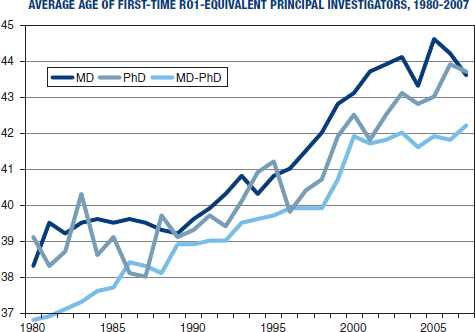
In the biomedical sciences, fewer recent doctorates are obtaining tenure-track faculty positions and, as this figure shows, the average age at receipt of one’s first NIH research grant has increased to over 43 years old.
This program will develop and enhance the human, physical, and cyberinfrastructure necessary for cutting-edge research and advanced education. The investment in rapidly evolving cyberinfrastructure will increase productivity and collaboration in research and may also increase productivity in administration and education. Also of critical importance is the endowment of chairs, particularly for promising young faculty, during a time of serious financial stress and limited faculty retirements. This initiative will ensure that we are building our research faculty for the future, so that the nation can reap the rewards of their work over the long term.
Recommendation 6
Full Federal Funding of Research
The federal government and other research sponsors should strive to cover the full costs of research projects and other activities they procure from research universities in a consistent and transparent manner.
TO IMPLEMENT THIS RECOMMENDATION:
- The federal government and other research sponsors should strive to support the full cost, direct and indirect, of research and other activities they procure from universities so that it is no longer necessary to subsidize these sponsored grants by drawing on resources intended to support other important university missions such as undergraduate education and clinical care. Both sponsored research policies and cost-recovery negotiations should be developed and applied in a consistent fashion across all federal agencies and academic institutions, public and private.
Over the past two decades, universities have had to cover an increasing share of the costs of research that the government has procured but not fully supported. If the government covers the full costs of research it procures, universities will be able to hold steady or reduce the amount of research funding they contribute from other sources, such as tuition revenue or patient clinical fees. Consequently, universities will be able to allocate their resources from other sources more strategically, directing them to the programs and purposes for which they were originally intended. This change will entail no net change in cost to the federal government, since federal coverage of a higher portion of indirect costs would, at the margins, shift part of federal research funding from direct to indirect costs.

Recommendation 7
Reducing Regulatory Burdens
Reduce or eliminate regulations that increase administrative costs, impede research productivity, and deflect creative energy without substantially improving the research environment.
TO IMPLEMENT THIS RECOMMENDATION:
- Federal policymakers and regulators (OMB, Congress, agencies) and their state counterparts should review the costs and benefits of federal and state regulations, eliminating those that are redundant, ineffective, inappropriately applied to the higher education sector, or that impose costs that outweigh the benefits to society.
- The federal government should also make regulations and reporting requirements more consistent across federal agencies so that universities can maintain one system for all federal requirements rather than several, thereby reducing costs.
Reducing or eliminating regulations can reduce administrative costs, enhance productivity, and increase the agility of institutions. Minimizing administrative and compliance costs will also provide a cost benefit to the federal government and to university administrators, faculty, and students by freeing up resources and time to support education and research efforts directly. With greater resources and freedom, universities will be better positioned to respond to the needs of their constituents in an increasingly competitive environment.
Although the staff time to review regulatory and reporting requirements has a small cost in the near term, the savings to universities and federal and state governments over the long run will be substantial. It is not feasible to estimate the savings in advance of a review, but we believe they could run into the billions of dollars over the next decade.
Making the Web Easy to Navigate
The first widely-used World Wide Web browser, NCSA Mosaic, heralded the beginning of a new era in the development and use of the Internet. In 1991 the Internet was largely a network connecting federal agencies, universities, and companies that was accessible only to those capable of navigating its cumbersome interface through dial-up connections. That changed with the development of the Mosaic browser, a university invention that transformed use of the Web by making it easier for people to navigate.

Funding provided under the High Performance Computing and Communication Act of 1991 promoted the development of the National Information Infrastructure, better known as the “information superhighway.” This legislation facilitated the work of researchers Marc Andreessen and Eric Bina, who developed the Mosaic browser at the National Center for Supercomputing Applications (NCSA) at the University of Illinois at Urbana–Champaign.
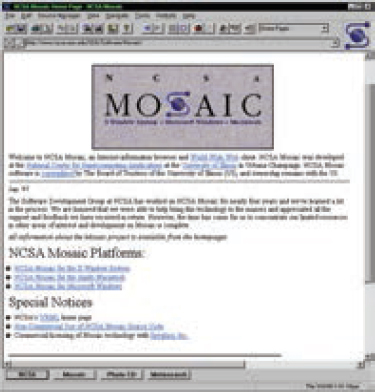
A screen shot of the Mosaic home page from 1997, viewed in the Mosaic browser window.
Released publicly in 1993, Mosaic revolutionized how users accessed information on the Web and provided many of the fundamental tools of Web browsing we still use today, such as the “back” button, bookmarks, and the address bar. Although Mosaic ceased development in 1997, it influenced the development of later browsers such as Internet Explorer, Mozilla Firefox, and Google Chrome.
Through Mosaic, and later through other browsers whose technology built upon Mosaic, the Web empowered individuals and stimulated online commerce. In recent years it has exploded into a major source of economic growth, technological innovation, and social interaction. It is not hard to see that the Web has changed the world, and a university’s development of the first popular Web browser played an essential role in that transformation.
Recommendation 8
Reforming Graduate Education
Improve the capacity of graduate programs to attract talented students by addressing issues such as attrition rates, time-to-degree, funding, and alignment with both student career opportunities and national interests.
TO IMPLEMENT THIS RECOMMENDATION:
- Research universities should restructure doctoral education to enhance pathways for talented undergraduates, improve completion rates, shorten time-to-degree, and strengthen the preparation of graduates for careers both in and beyond the academy.
- Research universities and federal agencies should ensure, as they implement the above measures, that they improve education across the full spectrum of research university graduate programs — including the social and behavioral sciences, the humanities, and the arts — because of the increasing breadth of academic and professional disciplines necessary to address the challenges facing our changing world.
- The federal government should significantly increase its support for graduate education through balanced programs of fellowships, traineeships, and research assistantships provided by all science agencies that depend upon individuals with advanced training.
- Employers — businesses, government agencies, and nonprofits — that hire master’s- and doctorate-level graduates should more deeply engage programs in research universities by providing internships, student projects, advice on curriculum design, and real-time information on employment opportunities.
The number of federal fellowships and traineeships should be increased to support 5,000 new graduate students per year in science and engineering, an investment amounting to $325 million in year 1 and climbing to a steady-state expenditure of $1.625 billion per year. This funding is not designed to increase the overall numbers of doctoral students per se, but to provide incentives for students to pursue areas responding to national needs and to shift support from research assistantships to mechanisms that strengthen doctoral training. Implementing other aspects of our recommendation will save money for the federal government, universities, and students. Improving completion rates and reducing time-to-degree in doctoral programs, for example, will increase the cost-effectiveness of federal and other investments in this area.
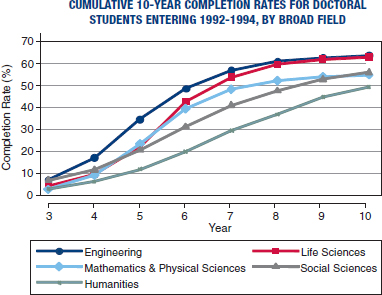
Overall, 57 percent of doctoral candidates complete their degrees by the end of 10 years, with a high of 64 percent in engineering and a low of 49 percent in the humanities.
On the whole, improving pathways to doctoral degrees will ensure that we draw strongly from among the “best and brightest” across fields that are critical to our nation’s future. Strengthening preparation of doctorates for a broad range of careers, not just those in academia, assists students in their careers, along with employers who need their staff to be productive in the short term.
Providing Data on U.S. Households
The Panel Study on Income Dynamics (PSID), which collects data on a representative sample of the U.S. population over time, is the longest-running household survey of its kind. PSID has helped researchers and policymakers stay in touch with the status of individuals and families — including their income, social connections, and health — for more than 40 years. The survey was developed at an American research university with federal funding.
PSID began in 1968 at the University of Michigan with a survey of 5,000 households. The survey questions were designed to gather a wide range of information about each household — from family members’ income and education levels to the number of rooms in the house. Over time, the study has expanded and evolved. The study now surveys over 9,000 families every 2 years and has collected data on more than 70,000 individuals over the past four decades.
PSID has proved essential to understanding long-term trends in Americans’ labor market participation, family connections, and economic well-being. Last year, for example, the study found that 23 percent of families had no savings at all in liquid assets such as savings or checking accounts. Researchers from universities across the country use the survey’s data to investigate issues as diverse as the use of food stamps by different age groups, the effect of childhood relationships on future job performance, and the health effects of losing one’s job. By enabling this kind of research — which has both informed the development of laws and helped policymakers understand the impact of their work — American universities have contributed an essential data resource for the social sciences and the public.




Recommendation 9
STEM Pathways and Diversity
Secure for the United States the full benefits of education for all Americans, including women and underrepresented minorities, in science, mathematics, engineering, and technology.
TO IMPLEMENT THIS RECOMMENDATION:
- Research universities should engage in efforts to improve education for all students at all levels in the United States by reaching out to K-12 school districts and by taking steps to improve access and completion in their own institutions.
- Research universities should assist efforts to improve the education and preparation of those who teach science, technology, engineering, and mathematics (STEM) subjects in grades K-12. Universities should also strive to improve undergraduate education, including persistence and completion rates in STEM.
- All stakeholders — the federal government, states, local school districts, industry, philanthropy, and universities — should take urgent, sustained, and intensive action to increase the participation and success of women and underrepresented minorities across all academic and professional disciplines, especially in science, mathematics, and engineering.
Our nation’s greatest asset is its people. Improving the educational success of our citizens at all levels improves our democracy, our culture and society, social mobility, and both individual and national economic success. As career opportunities in science, technology, engineering, and math continue to expand at a rapid pace, recruiting more underrepresented minorities and women into STEM careers and ensuring that they remain in the pipeline is essential not only for meeting the workforce needs of an increasingly technological nation, but also for obtaining the intellectual vitality and innovation necessary for economic prosperity, national security, and social well-being.
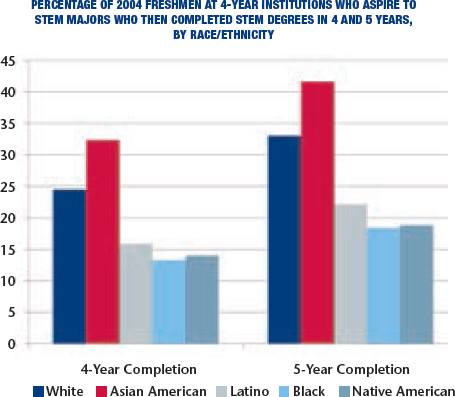
Latino, Black, and Native American students have significantly lower completion rates after 4 and 5 years of study in STEM fields than white and Asian American students.
A Sustainable Cancer Treatment
Nature provides researchers with many compounds that can potentially be used as drugs or precursors to drugs to treat a wide variety of human illnesses. Occasionally the harvesting of these natural compounds comes at a cost to the environment, as happened with the development of Taxol, a breakthrough drug in the treatment of ovarian, breast, and lung cancer. Taxol was isolated from the bark of the Pacific yew tree, a threatened species that is home to another threatened species, the spotted owl. Production of Taxol initially required harvesting enormous quantities of bark from the trees, leading to their destruction and a loss of habitat for spotted owls.

In response, chemist Robert Holton of Florida State University set out to find a method of producing Taxol that did not kill the Pacific yew trees. While others were looking for a completely synthetic alternative, Holton focused on finding a semi-synthetic method. After years of research, in 1991 Holton succeeded in developing a method that used only the needles and twigs from English yew trees, leaving the trees themselves to thrive. Taxol continues to be hailed as a fundamental anticancer tool, and research conducted at American universities resulted in an environmentally sustainable method for its preparation.

Spotted owl perching in a Pacific yew tree, old growth forest, Oregon.
Recommendation 10
International Students and Scholars
Ensure that the United States will continue to benefit strongly from the participation of international students and scholars in our research enterprise.
TO IMPLEMENT THIS RECOMMENDATION:
- Federal agencies should ensure that visa processing for international students and scholars who wish to study or conduct research in the United States is as efficient and effective as possible consistent with homeland security considerations.
- To ensure that a high proportion of non-U.S. doctoral researchers remain in the country, the federal government should streamline the processes for these researchers to obtain permanent residency or U.S. citizenship. The United States should consider taking the strong step of granting residency (a green card) to each non-U.S. citizen who earns a doctorate in an area of national need from an accredited research university. The Department of Homeland Security should set the criteria for and make selections of areas of national need and of the set of accredited institutions, in cooperation with the National Science Foundation and the National Institutes of Health.
- The federal government should proactively recruit international students and scholars.
The United States has benefited significantly over the past half-century and more from highly talented individuals who have come to this country from abroad to study or conduct research. Today, there is increasing competition for these students and researchers both in general and from their home countries. It is in our nation’s interest to attract and keep individuals who will create new knowledge or convert it to new products, industries, and jobs in the United States.
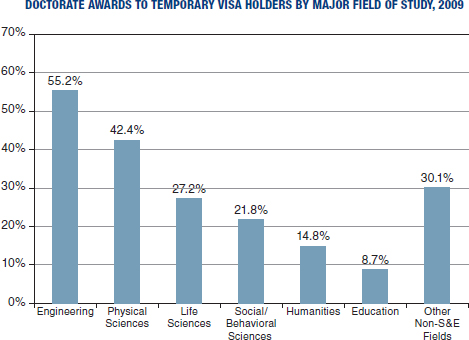
The number of doctoral degrees awarded to temporary visa holders (international students), shown here by field, is particularly high in the physical sciences and engineering.
Protecting Against Terrorism at U.S. Ports
Since the terrorist attacks of September 11, 2001, a major security concern has been that a terrorist group would try to smuggle nuclear or chemical weapons, or materials that could be used to make them, in one of the 10 million to 15 million cargo containers that enter U.S. ports every year. A new imaging technology that had its beginnings at an American university may enable rapid security screening of these containers without the need to physically inspect each one.
Nuclear resonance fluorescence imaging, which is being developed by researcher William Bertozzi of the Massachusetts Institute of Technology, uses gamma rays to determine the chemical composition of concealed materials. Bertozzi had been working on NRF imaging for over a decade when the 2001 attacks galvanized efforts to protect the nation against further attack. Private and government funding helped to establish a company dedicated to developing NRF as a method to image cargo.
Using rays that can penetrate even lead-lined vessels, this technology allows for fast, easy identification of the materials inside sealed containers. The continued development of NRF imaging may provide an efficient way to scan cargo entering American ports, improving security without disrupting the pace of international trade.