
Academic Basic Research and Education
The U.S. government has important missions that require technical innovation and scientific expertise that are applicable to national and global security, energy security, environmental stewardship, and human health (as discussed in several chapters of this report). Those missions are typically focused and applied, yet they are accomplished on a foundation of basic research and human development, principally executed in the academic community and related basic research institutions. The academic environment is typically well-suited for long-term research investigations, and is capable of focusing on the longer-term time horizons that are difficult—if not impossible—to accomplish in applied programs. This perspective is especially important for developing graduate research efforts that educate new staff to a depth of expertise unattainable in other venues, and a significant fraction of the basic research funding that goes into academia goes to support these students.
Basic research in the nuclear and radiochemistry field supports the numerous and varied applications of the discipline. For example, a list of 14 grand challenges identified by a committee of the National Academy of Engineering in 2008 (NAE 2008) included at least four challenges that directly involve nuclear chemistry:
• Provide Energy from Fusion;
• Reverse Engineer the Brain;
• Prevent Nuclear Terror (forensics, aftermath, and cleanup); and
• Engineer the Tools of Scientific Discovery (particularly space-based systems).
An illustrative list of the types of applied needs that would benefit from basic research in the academic environment by major programs is given below.
Nuclear Medicine and Radiotracer Applications
• New diagnostic tools are needed that include both novel radiopharmaceuticals and new applications of nuclear monitoring techniques. Examples that have recently expanded medical frontiers include Positron Emission Tomography (PET) in vivo imaging (example shown in Figure 3-1) and Accelerator Mass Spectrometry (AMS) that can bring attomole sensitivity to pharmacokinetic measurements within a patient.
• New radioisotopes and radiopharmaceuticals for therapeutic applications in cancer research are needed that will allow more specific targeting of individual cancer cells when combined with next-generation drug delivery systems.
• Alternative methods for producing and separating radioisotopes that have potential medical applications are needed, such as those produced with new accelerator systems, or from harvesting reactor produced elements.
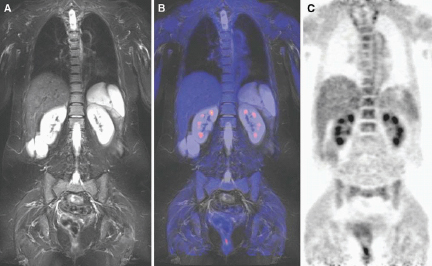
FIGURE 3-1 A typical FDG-MR/PET image in coronal view. Magnetic resonance/Positron Emission Tomography (MR/PET) imaging of a 53-year-old female patient with suspicion for tumor recurrence of cervix cancer. (A) coronal T2 weighted inversion recovery sequence (STIR). (B) corresponding superimposition. (C) F-18 fluorodeoxyglucose (FDG) PET acquired with the whole-body MR/PET system (three bed positions, 6 min per bed, 120 min post injection of 361 MBq (9.8 mCi) FDG).
SOURCE: Schwenzer et al. 2012.
• Nuclear imaging provides critical information about the potential viability of new pharmaceuticals early in the course of drug development. Preclinical information about the pharmacokinetics and early pharmacodynamic behavior of the pharmaceutical is used to determine the advancement of the new drug into human clinical trials. Likewise imaging studies conducted in parallel with the clinical phases of drug development may assist in making the important go/no-go decisions that will save time, cost, and effort.
• New nanoparticles and nanomaterials are being explored as carriers for medical imaging contrast agents and the targeted delivery of therapeutics. The pharmacokinetics and potential toxicity of these materials is largely unknown. Nuclear imaging techniques may be employed to evaluate the distribution and fate of these new materials in preclinical and clinical research studies on the microdose scale.
• Energy production from biomass, biofuels, is a rapidly emerging area of alternative energy research. Radiotracers are being used to map the enzymatic pathways involved with synthetic fuel production.
Homeland Security
• Additional nuclear forensics techniques are needed that will allow for rapid and more precise post-detonation detection and source attribution with microscopic samples that are often widely dispersed geographically.
• Novel methods to detect illicit transport of radioactive materials on a global scale need to be developed as well as sophisticated remote detection of nuclear activities.
Weapons
• There is a need to develop and to interpret radiochemical signatures to accurately analyze performance and maintain reliability when direct experiments are no longer possible.
• New initiatives are needed to obtain the basic nuclear data necessary to reduce uncertainty in extremely complex models of what occurs on very short timescales in high-energy environments, for example as the weapon is exploding, or the impact of the explosion on the atmosphere, planet surface, etc.
Non-proliferation and Arms Control
• An expanded collaboration with the International Atomic Energy Agency is needed to design and conduct global environmental sampling for compliance verification and treaty-monitoring activities.
• Additional nuclear forensics signatures need to be developed for non-proliferation efforts worldwide.
Nuclear Power
• Next generation actinide-based fuels will need new chemical separations methods to provide the future fuels for society’s energy demands.
• Significant nuclear and radiochemistry and materials science issues with nuclear fuel under extreme conditions need to be resolved as a function of fuel burn-up. This includes both experimental methods development as well as significant theoretical development in f-shell element modeling.
• Fuel recycling and reprocessing will require new and improved advanced separations technologies in complex environments, especially with respect to actinide elements (example shown in Figure 3-2).
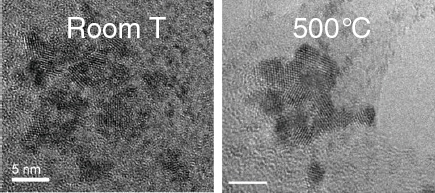
FIGURE 3-2 Thermal stability and sintering behavior of the uranium oxide (UO2) nanoparticles studied utilizing transmission electron microscopy (TEM) with an in situ heating stage. These UO2 nanoparticles exhibit sintering temperatures in the range of 500°C–600°C, which is between 700–1000°C lower than reported bulk UO2 sintering temperatures.
SOURCE: Nenoff et al. 2011.
• The national need for waste processing and long-term disposal needs to be addressed, especially with respect to radioisotope fate and transport in the environment.
Environmental Remediation and Management
• There is a mostly untapped potential for novel isotopic methods for environmental monitoring that needs to be developed. This is strongly connected to both theoretical and experimental studies of radioisotope sequestration and fate and transport within the environment and can include topics as diverse as the modality of energy dissipation in materials or the improvement of detection limits for large-area sampling methods.
• Novel separation technologies need to be developed as part of long-term remediation strategies, especially for long-lived radionuclide fission products and actinides (example shown in Figure 3-3).
Clearly much of the research in nuclear and radiochemistry is of national importance, but for the most part it is not funded significantly by the private sector. Although public-private partnerships are certainly possible in areas of nuclear power and medicine, the bulk of the nuclear and radiochemical research and development must be supported by the federal government if these applications of nuclear and radiochemistry are to continue—or in the case of environmental management, because they have already occurred extensively in this country and elsewhere. Nuclear and radiochemistry has also become a mature research field over the past 50 years or so, and while this short list of current and future research needs clearly indicates that there is significant fundamental research left to be conducted in this field, a good number of the exciting new developments lie at the interface of traditional nuclear and radiochemistry with other areas such as medicine, materials science, environmental science, and forensic science. Broadening the definitions of nuclear and radiochemistry to encompass and engage academic interests beyond traditional boundaries would in general infuse the discipline with new scientists that can help address personnel shortfalls. An example of networking interdisciplinary academic scientists in actinide research has occurred in Europe with the formation of ACTINET-I3, the Integrated Infrastructure Initiative for Actinide Science (ACTINET 2012).1 This
_______________
1 The objective of the present European Commission Seventh Framework Program (FP7) Integrated Infrastructure Initiative (I3) ACTINET-I3 is to reinforce the networking of existing European infrastructures in actinide sciences, and to facilitate their efficient use by the European scientific community in order to keep a leading position in the field of nuclear energy. For more information see ACTINET 2012.
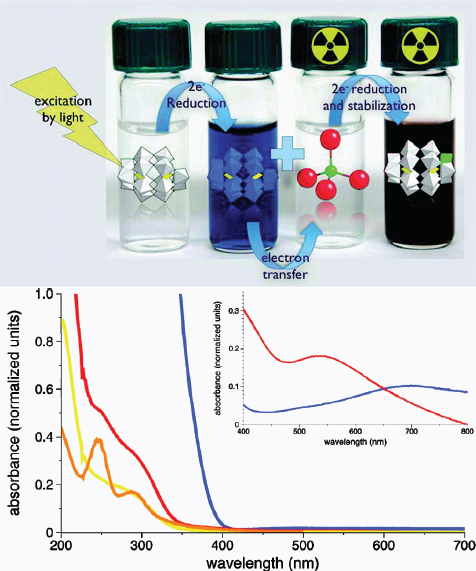
FIGURE 3-3 A new strategy for the reduction of 99TcO4– and the chemical incorporation of the reduced 99Tc into a metal oxide material. Color changes obtained during the photolytic reduction of 99TcO4– using α2-[P2W17O61]10–. Upon exposure to sunlight in the presence of 2-propanol, the clear colorless α2-[P2W17O61]10– (A, yellow trace) becomes reduced and exhibits the characteristic blue solution (B, blue trace). Upon addition of a clear colorless solution of 99TcO4– (C, orange trace), the solution changes color from blue to dark orange (D; red trace).
SOURCE: Burton-Pye et al. 2011.
organization encompasses classical nuclear and radiochemistry disciplines, but also includes research scientists working in closely related fields that are impacted by nuclear and radiochemistry.
NUCLEAR AND RADIOCHEMISTRY ACADEMIC PROGRAMS
Academic research programs in nuclear and radiochemistry have traditionally been found within chemistry departments in the university setting. They are typically at the program level (individual faculty research groups); these programs are not distinct efforts from their home departments. There are exceptions, for example, the nuclear chemistry efforts at the University of Texas, Austin are located within the Nuclear Engineering Program in the Department of Mechanical Engineering (University of Texas 2011). There are other engineering programs such as the biomedical engineering program at the University of California, Davis that offers courses that teach radiochemistry as applied to nuclear medicine imaging (UC Davis 2011). These niches have often been established to locally optimize around funding streams or critical research facilities. These academic research programs provide a critical role in graduate-level education for those who will become future faculty members in academia and staff at national laboratories, as well as undergraduate education for the bulk of the nuclear and radiochemistry scientific workforce, which is especially important for industries such as nuclear energy, nuclear medicine, and environmental monitoring.
At the start of this study, there was no comprehensive up-to-date listing of nuclear and radiochemistry academic research programs. Thus, the committee had to collect information on the current status of the academic research and education components of nuclear and radiochemistry in the United States.
Faculty Members
The committee once again looked to a list of faculty compiled by the American Chemical Society (ACS) Division of Nuclear Chemistry and Technology (DNCT) as a starting point (ACS 2008). The DNCT list of nuclear and radiochemistry graduate programs can be found on its website, and is based on the ACS Directory of Graduate Research (DGR) listing of graduate chemistry programs (mainly in the United States) and DNCT membership. The committee then used the online version of DGR (DGRWeb; ACS 2009) to determine year of birth and age of faculty, and to verify faculty appointments for those on the 2008 DNCT list. Faculty appointments were also verified by checking department websites. Additional nuclear and
radiochemistry faculty (not on the 2008 DNCT list) were identified using DGRWeb by searching the research area field, as well as by conducting a survey of chemistry department chairs (see Appendix H). From the compiled information (shown in Figure 3-4), the committee observed that the number of faculty dropped from 72 in 1999 to 60 in 2005. There was also a decrease of 24 faculty from 2005 to 2011, but due to the addition of 26 new nuclear and radiochemistry faculty members at 22 universities, the number of faculty increased from 60 professors in 2005 to 62 in 2011.
Figure 3-5 shows faculty by year according to age for 1999-2009, and indicates that about half of faculty over this time range is at or is approaching retirement age (61 or older). However, the proportion of those who are 71 or older grew significantly.
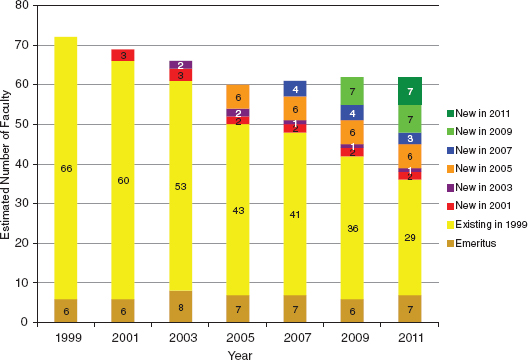
FIGURE 3-4 Total reported number of existing and new nuclear and radiochemistry faculty at U.S. graduate institutions.
SOURCE: DNCT listing (ACS 2008), ACS Directory of Graduate Research (ACS 2009), faculty websites, and survey of chemistry department chairs (see Appendix D and H).
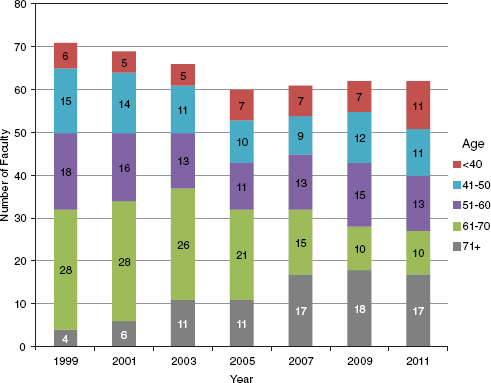
FIGURE 3-5 Total reported number of nuclear and radiochemistry faculty at U.S. institutions, by year and faculty age.
NOTE: Year of birth not available for all faculty, so yearly totals are slightly less than those shown in Figure 3-4.
SOURCE: Data from ACS 2008, 2009.
Doctoral Education
As noted in Chapter 2 of this report, a decline in nuclear and radiochemistry Ph.D. recipients had been observed for decades (1970-2000). However, ProQuest Dissertations and Theses (PQDT) data (Figure 2-1) suggests the decline may have reached a plateau or even a rise recently. There has also been a stabilization in the number of academic faculty—as indicated in the data above (Figures 3-4 and 3-5).
The committee gathered further information about faculty advisors identified on the 2008 DNCT list. According to that list, there are 20 U.S. graduate programs with at least one faculty member conducting research in the
area of nuclear and radiochemistry (Table 3-1). Half of the universities in the list are members of the American Association of Universities (AAU), which are considered to be the leading research-intensive U.S. universities. The AAU members also account for about half of the total faculty members listed in the table. Out of the 20 graduate programs listed in Table 3-1, 13 have two or more faculty and are advising the majority of Ph.D. theses (91/114 or 79 percent). Again, half of those are from AAU member institutions. However, only three of the departments listed are ranked among the top 25 chemis-
TABLE 3-1 Number of Faculty Advisors and Ph.D. Theses They Advised for U.S. Nuclear Chemistry and Radiochemistry Graduate Programs Identified by ACS DNCT in 2008
| University | Home Department | Number of Nuclear Chemistry Faculty in 2008** | Number of Nuclear Chemistry advisee Ph.D. theses completed 2000-2010 |
| Auburn University | Department of Chemistry | 2 | 11 |
| Clemson University | Department of Environmental Engineering and Earth Sciences |
3 | 6 |
| Indiana University* | Department of Chemistry | 1 | 3 |
| Michigan State* | Department of Chemistry | 3 | 13 |
| Oregon State University | Department of Chemistry | 2 | 1 |
| Pittsburgh State University | Department of Physics | 1 | 1 |
| Stony Brook University— State University of New York* |
Department of Chemistry | 2 | 2 |
| Tennessee Technological University | Department of Chemistry | 2 | 2 |
| Texas A&M University* | Department of Chemistry | 3 | 7 |
| University of Alabama | Department of Chemistry | 1 | 4 |
| University of California, Berkeley* | Department of Chemistry | 4 | 13 |
| University of Idaho | Department of Chemistry | 1 | 10 |
| University of Kentucky | Department of Chemistry | 1 | 1 |
| University of Maryland, College Park* | Department of Chemistry | 1 | 7 |
| University of Missouri-Columbia* | Department of Chemistry | 3 | 6 |
| University of Nevada-Las Vegas | Department of Chemistry–Radiochemistry | 3 | 6 |
| University of Rochester* | Department of Chemistry | 1 | 0 |
| University of Washington* | Department of Chemistry; Department of Radiology | 2 | 1 |
| Washington State University | Department of Chemistry | 6 | 11 |
| Washington University in St. Louis* | Department of Molecular Biology and Pharmacology; Department of Radiological Sciences |
4 | 9 |
| TOTAL | 46 | 114 | |
*Member AAU (American Association of Universities)
**Only includes faculty who advised Ph.D. theses for 2000-2010.
SOURCE: Data from ACS 2008, 2009, and ProQuest 2011.
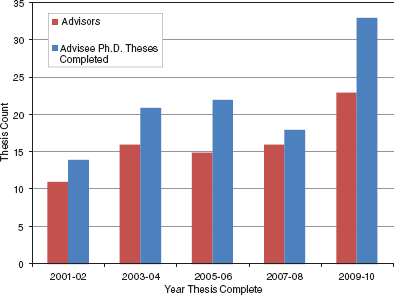
FIGURE 3-6 Count of nuclear and radiochemistry Ph.D. thesis advisors and corresponding advisee theses completed at U.S. institutions, by year, for faculty listed in Table 3-1.
SOURCE: Based on faculty data from ACS 2008 and thesis advisor search (ProQuest 2011).
try departments (for determination of rankings, see NRC 2011). Figure 3-6 shows the number of nuclear and radiochemistry faculty advisors from the 2008 DNCT list and the number of advisee Ph.D. theses completed for those same advisors, which has clearly grown over the past decade.
Nuclear Chemistry and Radiochemistry Coursework
Another measure of nuclear and radiochemistry education in the United States as evidence for estimating the supply of expertise, is the number of institutions that offer specific coursework for undergraduates and graduates. In order to assess this number, the chairs of approximately 138 chemistry departments of graduate institutions (including the approximate top 100 according to National Research Council 2011 assessment of research-graduate programs [NRC 2011]; for a list of chairs and departments, see Appendix H) across the United States were contacted by e-mail and asked “Does your department offer courses which are devoted entirely or in part to nuclear and/or radiation chemistry?” Forty-four chairs responded to the survey and
twelve replied yes.2 This roughly corresponds with the departments listed in Table 3-1, with two or more nuclear and radiochemistry faculty. Eight respondents indicated their departments offer two courses, and only two respondents (Washington State University and Washington University at St. Louis) offer three or more courses. Course enrollment numbers ranged from 5 to 30. Only five courses offered included a laboratory component. Examples of course titles offered include:
• Nuclear and Radiochemistry Laboratory
• Radioactivity and its Applications
• Modern Nuclear Chemistry
• Nuclear Chemistry
• Nuclear and Radiochemistry
• Radiochemistry: Introduction to Inorganic Chemistry
• Radioactivity and Radiation Safety
• Selected Topics in Physical Chemistry II (Radiation Detectors)
An important aspect of offering focused courses in nuclear and radiochemistry is to provide students with content on actinide chemistry. The chemical behavior of elements with 5f orbitals and electrons (actinides) is an appropriate part of advanced inorganic chemistry. Because all isotopes of the actinides are radioactive, actinide chemistry is also an appropriate component of nuclear chemistry and radiochemistry courses and textbooks.
The committee also performed a web search to identify nuclear and radiochemistry programs and course offerings at the 25 top ranked chemistry departments (for determination of rankings, see NRC 2011). The results of the search are presented in Table 3-2. Six chemistry departments in the top 25 were found that offer courses in nuclear and radiochemistry, and only two also have faculty members conducting nuclear or radiochemistry research. This raises concerns, because if the maturation of the field means less involvement in nuclear and radiochemistry research from the top research schools, it will grow increasingly difficult to attract top students into the field.
Supply of Bachelor’s and Master’s Degrees
Given that there is no specific nuclear chemistry or radiochemistry undergraduate degree granted, it is difficult to determine the number of B.S.
_______________
2 This estimate (12/44 or 27.3% of programs) must be viewed with caution, given that only about 31.9% of departments responded and respondents were inconsistent with providing identifying information.
TABLE 3-2 Nuclear Chemistry Program Information Identified at Top 25 U.S. Chemistry Departments
| School | Nuclear and Radiochemistry Program Information | Course Title |
| California Institute of Technology | One undergraduate course |
CHEM127 Nuclear Chemistry |
| Pennsylvania State University | One graduate course |
CHEM 406 (NUC E 405) Nuclear and Radiochemistry |
| Texas A&M University | Multiple active research faculty, three undergraduate courses |
CHEM 102 Fundamentals of Chemistry II (first year program); CHEM 464 Nuclear Chemistry; CHEM 474 Experimental Nuclear and Radiochemistry |
| University of California, Berkeley | Multiple research faculty, two undergraduate courses, and one graduate course |
CHEM 143 Nuclear Chemistry |
| University of North Carolina, Chapel Hill | One undergraduate course |
073 First-Year Seminar: From Atomic Bombs to Cancer Treatments: The Broad Scope of Nuclear Chemistry |
| University of Washington, Seattle | Two undergraduate courses |
CHEM 410 Radiochemistry Laboratory |
SOURCE: Program information and course titles were identified by searching available department websites and university course listings. For determination of rankings, see NRC 2011.
level nuclear and radiochemists that might be available to supply expertise. However, it is possible to make a rough estimate based on those departments that are known to have nuclear and radiochemistry faculty and coursework (Table 3-1), and numbers for chemistry as a whole obtained from available survey data. Table 3-3 shows the number of chemistry bachelor’s degrees awarded (NSF 2012) at 11 universities the committee identified as having two or more nuclear and radiochemistry faculty and course offerings. The data show that there was an average of 494 bachelor’s degrees awarded per year for the past 5 years (2006-2010) for these universities. With a conservative estimate that 10 percent of the students would take an upper level course in nuclear and radiochemistry, there would be a supply of 49 B.S. level chemists with some background in nuclear and radiochemistry. That number of B.S.-level chemists roughly corresponds with the information about course enrollments from chemistry department chairs discussed earlier, which had a range of 5-50 students per course focused on nuclear and radiochemistry.
Degree data is also available for master’s degrees (NSF 2012) at the same 11 universities listed in Table 3-3. It was determined that an average of 98 M.S. degrees were awarded per year at these universities over the
TABLE 3-3 Bachelor’s Degrees in Chemistry Conferred for Universities with Nuclear and Radiochemistry Faculty and Coursework in Chemistry Departments, 2001-2010
| University* | 2001 | 2002 | 2003 | 2004 | 2005 | 2006 | 2007 | 2008 | 2009 | 2010 |
| Auburn University | 8 | 9 | 7 | 4 | 7 | 11 | 16 | 17 | 9 | 12 |
| Michigan State University | 50 | 43 | 36 | 44 | 63 | 60 | 62 | 50 | 53 | 50 |
| Oregon State University | 10 | 10 | 19 | 21 | 27 | 34 | 34 | 30 | 26 | 32 |
| Stony Brook University | 19 | 2** | 26 | 18 | 24 | 31 | 28 | 31 | 35 | 42 |
| Tennessee Technological University | 16 | 27 | 24 | 17 | 25 | 24 | 33 | 25 | 16 | 21 |
| Texas A&M University | 44 | 34 | 37 | 42 | 43 | 47 | 47 | 51 | 68 | 49 |
| University of California Berkeley | 74 | 64 | 71 | 60 | 89 | 100 | 147 | 147 | 147 | 106 |
| University of Missouri Columbia | 23 | 19 | 20 | 20 | 19 | 28 | 27 | 23 | 28 | 21 |
| University of Nevada Las Vegas | 13 | 8 | 9 | 7 | 8 | 49** | 8 | 9 | 8 | 7 |
| University of Washington Seattle Campus | 39 | 56 | 66 | 63 | 86 | 89 | 101 | 112 | 112 | 103 |
| Washington State University | 13 | 8 | 14 | 6 | 13 | 12 | 12 | 9 | 10 | 13 |
| Subtotal | 309 | 280 | 329 | 302 | 404 | 485 | 515 | 504 | 512 | 456 |
| TOTAL CHEMISTRY | 9,822 | 9,448 | 9,332 | 9,305 | 9,937 | 10,891 | 11,255 | 11,825 | 12,131 | 12,321 |
*Universities from Table 3-1 with two or more nuclear and radiochemistry faculty in chemistry departments.
**All values are given as reported, but these two seemed inconsistent with values for the series. They may be the result of institutional changes in reporting.
SOURCE: Department of Education, National Center for Education Statistics, Integrated Postsecondary Education Data System (IPEDS) completion survey for National Science Foundation population survey specific academic institutions, by level of degree and detailed standardized academic discipline (NSF 2012).
past 5 years (2006-2010). Again, with a rough estimate that 10 percent of the students at these universities would take coursework or be involved in nuclear and radiochemistry research, there would roughly be a supply of 10 M.S level chemists per year.
Current Educational Initiatives
Earlier reports have recommended efforts be undertaken to sustain academic programs in nuclear and radiochemistry.3 One of the first initiatives to attract new undergraduate student interest in the field of nuclear and radiochemistry was the Summer School in Nuclear and Radiochemistry, supported by the U.S. Department of Energy. This program began in 1984, hosted in the Nuclear Science Facility at San José State University, and subsequently expanded to two concurrent offerings at San José State University and Brookhaven National Laboratory (Clark 2005; Kinard and Silber 2005; Peterson 1997). Data collected about the graduates of the summer schools indicate many of them go on to nuclear and radiochemistry related careers (See Box 9-1). Other early-stage academic pipeline initiatives in related areas have been established more recently, including a Nuclear Forensics Undergraduate Summer School; and are listed in Tables 9-2 and 9-3. All of the initiatives target students or young faculty with a goal of providing an introduction to nuclear or radiochemistry.
Constraining Factors and Barriers
Academic nuclear and radiochemistry programs—especially academic experimental research programs—face a number of factors that create costs, complexity, or other organizational challenges that affect decisions to enter or remain in this field. These factors hinder the ability to establish new programs and are often considered when university leaders are deciding whether to replace retiring nuclear and radiochemistry staff. Absent a clear perceived benefit to the university (specifically, for example, extramural research funds), the likelihood of starting a new program or sustaining an existing program is diminished.
Examples of factors that serve as constraints or barriers include:
• Cost of experimental facilities for handling dispersible radionuclides. This includes both initial capital costs and ongoing operations, regulatory, and maintenance costs.
_______________
3 See Chapter 1.
• Regulatory complexity. Associated issues including licensing, inspections, waste disposal, and liability language in research contracts. Particular trans-uranic elements such as plutonium may be very difficult to use in research outside of the national laboratory setting which argues strongly for close academic ties to the national labs.
• The lack of long-term stability in funding opportunities. In particular, this issue can have a dramatic effect on the attractiveness of an academic field to young students and faculty alike. If there is a perception that jobs and funding opportunities will not be available over the long term, then it is very difficult to convince students to enter the field. Without students entering the field and without competitive access to extramural research funds, nuclear and radiochemists are unlikely to compete favorably in the academic setting with other disciplines.
• Lack of presence or mention in university curriculum. Once the number of people trained in nuclear and radiochemistry drops below a critical mass, there is far less awareness of it as a potential field of interest for young students to pursue. Even more than the uncertainty of jobs in the field in the future, ignorance that the field even exists will drastically reduce the number of students entering the field. Since so few educational institutions even offer coursework in nuclear and radiochemistry, it is unlikely that a significant fraction of the academic population has even heard of the discipline in the context of current research opportunities and needs.
The number of Ph.D.s and faculty members in nuclear and radiochemistry appears to have stabilized, but is still fragile. While, there had been a continuing decline in the number of nuclear and radiochemists in the United States since the 1970s, there is evidence that it has leveled off over the past 5 years:
• The number of theses with nuclear chemistry as a subject keyword grew from 5 in 2005 to 15 in 2010 (Figure 2-1).
• The total number of nuclear and radiochemistry faculty remained at around 60 from 2005 to 2011 (Figure 3-1).
As will be discussed in Chapter 9, this stabilization may be due to recent increases in funding opportunities aimed at academic pipeline issues.
Data sources for tracking nuclear and radiochemistry expertise are limited and sporadic. Many of the data sources typically used to assess workforce, such as the Survey of Earned Doctorates or Bureau of Labor Statistics Employment Outlook do not specifically track the nuclear and radiochemistry field. For years, the ACS DNCT has attempted to keep track of and make available information on educational opportunities in nuclear and radiochemistry, largely through the efforts of one person. Thus, there is no comprehensive and complete data source regarding nuclear and radiochemistry workforce from which to draw data on a routine basis. The lack of a consistent basis set of data makes it difficult to assess the effectiveness of various programs attempting to address academic pipeline issues, since it is harder to quantify, make comparisons, and interpret trends. Tracking the supply and demand of nuclear and radiochemists is a relatively low-cost endeavor that will be important for prudent investment of public funds and to assure that future significant gaps between the human resource supply and the job market are identified with sufficient advance notice to effect any needed changes.
There are currently few active graduate programs that have more than one nuclear chemist in the department. Out of over 100 chemistry graduate programs across the United States, only 13 have two or more active nuclear and radiochemistry faculty members (Table 3-1). At the same time, these institutions produced the majority of Ph.D.s in the field over the past 10 years (91/114 or 79 percent). This strongly suggests that programs that are centered upon a single nuclear or radiochemistry faculty member are unsustainable. Critical facility needs for nuclear and radiochemistry research and education are lost when university programs are lost through attrition. The costs to re-initiate a research facility at a new institution are much higher than maintaining or upgrading existing facilities, but neither will take place without sufficient critical mass of faculty to support the facility.
There is little or no nuclear and radiochemistry coursework being offered at U.S. universities. The committee identified only 12 chemistry departments that offer one or more courses developed entirely or in part to nuclear and radiochemistry. Only two offer three or more courses. In addition, the committee found that only five out of the top 25 ranked U.S. chemistry departments have nuclear and radiochemistry research and/or coursework.
ACS (American Chemical Society). 2008. Universities Offering M.S. and Ph.D. Programs in Nuclear and Radiochemistry. American Chemical Society, Division of Nuclear Chemistry and Technology [online]. Available: http://spinner.cofc.edu/~nuclear/ACS%20NUCL%20and%20RADIOCHEM%20EDU%20US%20and%20CAN%20List11-12-08.pdf [accessed September 7, 2011].
ACS. 2009. DGRweb 2009 [online]. Available: http://dgr.rints.com/ [accessed September 7, 2011].
ACTINET (Integrated Infrastructure Initiative). 2012. ACTINET-I3 [online]. Available: http://www.actinet-i3.eu/ [accessed February 27, 2012].
Burton-Pye, B. P., I. Radivojevic, D. McGregor, I. M. Mbomekalle, W. W. Lukens, Jr., and L. C. Francesconi. 2011. Photoreduction of 99Tc pertechnetate by nanometer-sized metal oxides: New strategies for formation and sequestration of low-valent technetium. J. Am. Chem. Soc. 133(46):18802-18815.
Clark, S. B. 2005. The American Chemical Society. Summer Schools in Nuclear and Radiochemistry. J. Radioan. Nucl. Chem. 263(1):107-110.
Kinard, W. F., and H. B. Silber. 2005. The Department of Energy/American Chemical Society Summer School in Nuclear and Radiochemistry at San José State University. J. Radioan. Nucl. Chem. 263(1):155-158.
NAE (National Academy of Engineering). 2008. Grand Challenges for Engineering. Washington, DC: National Academy of Sciences [online]. Available: http://www.engineeringchallenges.org/Object.File/Master/11/574/Grand%20Challenges%20final%20book.pdf [accessed December 20, 2011].
Nenoff, T. M., B. W. Jacobs, D. B. Robinson, P. P. Provencio, J. Huang, S. Ferreira, and D. J. Hanson. 2011. Synthesis and Low Temperature In Situ Sintering of Uranium Oxide Nanoparticles. Chem. Mater. 23 (23):5185-5190.
NRC (National Research Council). 2011. A. Data-Based Assessment of Research-Doctorate Programs in the United States, J. P. Ostriker, C. V. Kuh, and J. A. Voytuk, eds. Washington, DC: The National Academies Press.
NSF (National Science Foundation). 2012. Integrated Postsecondary Education Data System (IPEDS) completion survey for National Science Foundation population institutions. WebCASPAR [online]. Available: https://webcaspar.nsf.gov/ [accessed February 24, 2012].
Peterson, J. R. 1997. The American Chemical Society’s Division of Nuclear Chemistry and Technology’s Summer Schools in Nuclear and Radiochemistry. J. Radioan. Nucl. Chem. 219(2):231-236.
ProQuest. 2011. ProQuest Dissertations &Theses Database [online]. Available: http://www.proquest.com/en-US/catalogs/databases/detail/pqdt.shtml [accessed November 14, 2011].
Schwenzer, N. F., H. Schmidt, and C. D. Claussen. 2012. Whole-body MR/PET: Applications in abdominal imaging. Abdom Imaging 37:20-28.
UC Davis (University of California, Davis). 2011. Biomedical Engineering [online]. Available: http://www.bme.ucdavis.edu/ [accessed November 14, 2011].
University of Texas. 2011. Nuclear and Radiation Engineering Program. University of Texas at Austin [online]. Available: http://nuclear.engr.utexas.edu/ [accessed September 9, 2011].


