
In the second half of the forum, the panelists responded to questions from Ali Velshi, anchor and chief business correspondent, CNN, and the audience. The conversation ranged widely, but four topics came up repeatedly: job creation, the role of government, the benefits of diversity, and the importance of K–12 education.
At a time of high and enduring unemployment, the creation of jobs was a prominent concern for all the panelists. Manufacturing can provide good jobs, but jobs are not regulated or stimulated into being, said Lawrence Burns, former vice president for research and development and strategic planning, General Motors Corporation. “They’re earned by serving customers through the creation of value.” Craig Barrett, former chairman and CEO, Intel Corporation, agreed: “The United States in its actions has to want and earn this capability. It is not a native right of the United States to have all of manufacturing.”
Technology has given companies the ability to change the structure of a company to reduce waste, said Burns. Reducing waste sometimes cuts the number of jobs without reducing outputs. Similarly, new methods of manufacturing can increase throughput without adding jobs. “The digital economy underlying our physical economy has changed the nature of things.”
In addition, technological shifts can affect jobs in unpredictable ways. When General Motors was deciding where to make the lithium-ion batteries for the Chevrolet Volt, it decided that it needed to control the quality of the battery pack, so it assembled the battery modules in

CNN chief business correspondent Ali Velshi and forum panelists.
a plant in Michigan. But it chose a Korean battery cell manufacturer because of their know-how in manufacturing the cells. Also, because a battery-powered vehicle has far fewer moving parts than a combustion engine vehicle, fewer people are needed to design and build such a car. “Battery manufacturing is radically less labor intensive than machining lines would be,” said Burns.
Of course, new technology also has the potential to create jobs. Rodney Brooks, founder, chairman, and CTO of Heartland Robotics, and MIT professor emeritus, pointed out that the United States has many thousands of small and medium-sized companies that are involved in manufacturing, and many of these companies are operating the same way they were 50 years ago. New technologies could revolutionize and reinvigorate these companies, returning manufacturing jobs to the United States.
To keep value in the United States, the know-how responsible for creating that value needs to exist here. This know-how is not always in high technologies. As Ursula Burns, chairman and CEO, Xerox Corporation, observed, Xerox wants to build things in the United States but is having trouble in the Northeast finding manufacturing engineers. The United States has “lost the low end—the building of the physical gear
boxes and things like that.” Once those capabilities are lost to other countries, they can be very hard to get back.
Burns also pointed out that half of Xerox’s revenue comes from outside the United States. Xerox therefore can justify opening a plant in another country because the company has as many customers outside the United States as inside it. The real question is what the United States needs to do to attract and retain manufacturing jobs. Deciding where to locate a manufacturing factory is not a social choice, like making a friend, Burns observed. Xerox has to choose the best place to get business done. In that respect, what the company needs is a good infrastructure, a good tax system, and skilled workers. “I sometimes feel guilty, as if I should be employing more people here. Then I have to wake up and say that I’m employing as many people here as I need to get the job done, no less and, interestingly enough, no more.” Barrett made essentially the same point, observing that the majority of high-technology companies get more of their revenue from outside the United States than inside the United States. If these companies choose to manufacture their products in the United States, other countries want to know why the manufacturing is not being done in their countries.
Lawrence Burns urged the forum attendees not to overlook the importance of design. Apple’s market capitalization now exceeds that of Toyota, Daimler, and Ford combined, he said, despite the amount of capital required to be in the auto business. Apple is “an enormous innovator,” and its products “clearly delight people.”
Apple’s history reveals another lesson. Not every idea is going to work. As Burns pointed out, people need to accept the idea that failures will occur. Dugan said that one of the reasons DARPA has been successful is because its program managers are encouraged to succeed big, and when they are pushed in that direction, leaders must not fear failure. “Failure is not the problem. Fear of failure is the problem.”
Velshi pointed out that solutions to many current problems already exist. But a sense of paralysis obstructs action, and usually that paralysis is associated with government.
The steps that government needs to take are clear, said Barrett. It should institute a permanent R&D tax credit, a reasonable immigration policy, a tax structure conducive to innovation and manufacturing, and supportive policies in areas such as education and trade. It is counter-
productive for the public sector to be “driving companies out of the United States and then vilifying them for doing what makes sense,” Barrett said. “We’re not serious. We have not chosen, as a country, to compete. We talk about it, but we have not chosen to compete because we have not taken the actions necessary to compete.”
How to overcome this paralysis was a prominent concern of the panelists. Ursula Burns observed that it is not possible for either government or business to solve most big problems, like energy, on their own. But to work with business, government needs to be constructive and fast-moving. “I don’t know if we are structured as a government to do that,” Burns said. If government cannot help, then business must do what it can do. “Let’s help one kid at a time, one school at a time, and one area at a time.”
One way to generate movement would be to have more scientists and engineers in government, and the panelists discussed how this might happen. Ursula Burns noted that the financial returns from being a lawyer, a doctor, or a banker are much greater than the financial returns from engineering, especially during the early portions of their working lives. Since it takes a lot of money to run for Congress, that is a barrier for engineers. Also, lawyers are trained to argue positions, whether they believe in that position or not. “Engineers’ brains are not wired that way,” she said.
Lawrence Burns agreed that the thought processes are very different. In the policy world, the questions are poorly defined, the data are messy, the methodology rarely fits, and there is usually more than one right answer. “We’re wired a little bit differently than politicians, [but] it doesn’t mean we can’t have a big impact.” Meeting with staff is very useful, he said. Staff may be poorly trained to deal with some of the technical subjects with which engineers deal. But engineers have know-how and need to disseminate that know-how to people who are making policy decisions.
Brett Giroir, vice chancellor for strategic initiatives, The Texas A&M University System, agreed that, based on his experiences at DARPA and now in a university setting, the people to try to influence first are the permanent staff in Congress. They inform the legislative agenda to a large degree. Also, by getting more technical people onto these staffs, it would be possible to integrate that knowledge into decision making, “and, quite frankly, that’s where the money and the programs originate.”
Regina Dugan, director, Defense Advanced Research Projects Agency (DARPA), said there are various reasons why scientists and
engineers are not more engaged, but the important question is how they can engage more through a variety of mechanisms. DARPA, for example, brings scientists and engineers into the agency for 3 to 5 years. It is their “contribution and their service to country.” DARPA tries to use the perspectives of scientists and engineers to inform difficult questions and debate through a structured analytical process. DARPA also pays a great deal of attention to how to communicate these issues to people who are not experts in the subject matter. “We have to be able to communicate in a way that is understood to non-subject-matter experts. We have to treat communication as a discipline.”
In addition, people can serve their country in different ways, Dugan noted. DARPA recently conducted some large-scale data analysis in support of forward operations in Afghanistan. It discovered, said Dugan, that what was needed was “25-year-old kids who breathe data like we breathe air.” Many of these individuals were graduate students who felt compelled to serve their country. However, when they joined the military, they lost their fellowships, and DARPA had to go back and restore their fellowships one by one. “If you see something like that happen in your university, fix it,” said Dugan.
Dugan and David Kelley, founder and chairman of IDEO and Stanford University professor of mechanical engineering, elaborated on their remarks about diversity and innovation during the question-and-answer session. Diversity can take different forms, said Dugan. For example, diverse people, diverse technologies, and diverse cognitive approaches can all spur creativity. An example of technological diversity is when people began to use personal computers to do programming, resulting in an explosion of software engineering, she observed. The same thing is beginning to happen with the production of pharmaceuticals as approaches become more modular and decentralized.
Diverse cognitive approaches can be even more productive. As an example, Dugan cited the recent success of Foldit. Nature’s rules for protein folding are extremely varied and complex, yet how a protein folds is crucial to the action of biological molecules and plays a role in many diseases. High-power computers have been used to determine how proteins fold, but even computers cannot predict the structures of many proteins. Several years ago, a group of researchers at the University of Washington created a protein-folding game called Foldit, which
exposed challenges in protein folding to hundreds of thousands of non-experts. People who turn out to be savants at protein folding have become involved—“you would have never known, 15-year-old kids, 43-year-old marketing executives.” In 2011, Foldit players deciphered in 10 days the structure of a protein involved in AIDS in rhesus monkeys that had defied solution for 15 years. “It’s that kind of speed to innovation and advance that I think we can hope for as we dramatically increase the number and diversity of people who are participating,” said Dugan. “In almost all situations, cognitive diversity trumps ability from the perspective of creating innovative ideas.”
Kelley described a comparable process at the Hasso Plattner Institute of Design at Stanford, where teams of students, doctors, lawyers, business people, engineers, and educators work together on problems. The engineers tend to be process leaders but tend not to lead the entire team, said Kelley. However, they could be team leaders, he added, if they received leadership training in the same way that business schools and law schools teach leadership skills as a part of their curricula.
THE IMPORTANCE OF K–12 EDUCATION
Finally, K–12 innovation is the fundamental base on which success is built, the panelists observed. Today, the bright spots in education, said Barrett, are magnet schools or charter schools outside the existing system. Because they are less bound by entrenched bureaucracies, they are more able to innovate. These schools can in turn leverage change in the rest of the system. “You have to get in at the local level and create centers of excellence,” he said. “[You have to] show what can be done if you have competent teachers, high expectations, and short feedback loops to help struggling students and teachers.”
Dugan pointed out that the ideas behind Foldit can be extended to teaching—for example, to teach young students fractions. “It’s not gaming for the sake of gaming. It’s very purposeful.” By working their way through various pathways, students can find the best way to learn fractions. Furthermore, individual students who are learning this way can inform the larger discussion about the diverse strategies needed to learn many topics. Every keystroke, every place in the game a student visits, each occasional frustration or success is recorded and can lead to real-time modification of the game.
Students who receive individualized tutoring learn at a much accelerated rate compared with typical classrooms, Dugan observed. Tech-
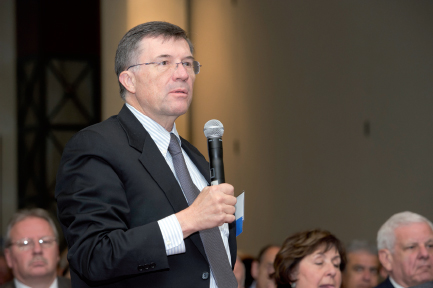
Member participation in a group discussion.
nology tools and interactions with games now provide what amounts to individualized tutoring.
Hands-on experience can also make the difference in a student’s life, Kelley said. Early in his career, every student in mechanical engineering at Stanford had torn apart a car or redesigned a bicycle. Now they are more likely to be computer experts, but most are still interested in design. Getting students involved in large-scale projects can build on that interest. For example, if high school students are told that they have to maintain a C average to work on a solar car project, they tend to bring up their grades in all subjects so they can participate. Projects “that get kids involved with doing things with their hands result in them being turned on to innovation,” said Kelley.
Dugan, too, emphasized the importance of inspiration. Many of today’s scientists and engineers were inspired by the hard but compelling challenge of the moon shot. “It became an intellectual challenge, something to engage in.”
Businesses can help inspire and support students and teachers. Ursula Burns observed that the leader of a corporation can decide what is important and people will align behind that decision. Companies can “set a tone that says that education is important, and we can back that
tone with money.” Companies also can allow their engineers, scientists, finance people, and other employees to get engaged with education on a local level. She suggested that members of the NAE find some students, some school administrators, “anybody who will listen and start… solving the problem that way.” Changing education is slow, steady work, but “the work is not going to be done by anyone but us, so we have to get to it.” As Barrett said, a small deed done is better than a great deed planned.
Barrett also emphasized the importance of working at the systems level. For example, only about two-thirds of all math teachers have content expertise in the subject, which means that virtually all students will have a math teacher without a firm grasp of the subject at some point from kindergarten through high school. “It’s a perfect filter,” observed Barrett. Teach for America and charter schools are trying, in different ways, to address this problem, and their efforts need to be supported.
Also at the systems level, the adoption of the internationally bench-marked common core standards for mathematics, language arts, and, soon, science by every state in the nation would establish a set of goals suitable for every student. “That’s a key to the United States education system going forward, and the governors are the key to making it happen,” Barrett said.
THE GLOBAL EFFECTS OF LOCAL ACTION
Thinking globally and acting locally remains the best way of attacking these problems, said Charles Vest, NAE president, in summing up the forum. Engineers focus on the here and now even as they attempt to solve problems that can be global in scale. These problems can be daunting, but engineers have the tools and knowledge needed to solve them. “There’s never been a more exciting time.”


