
PANEL 1: EMERGING SCIENCE AND TECHNOLOGY IN THE NEXT 15 YEARS
Identify emerging science and technology that could significantly impact the STEM workforce needs of the DOD and its defense contractors over the next 15 years.
Summary of Lead-off Presentations
Donald Burke, dean of the Graduate School of Public Health at the University of Pittsburgh, gave his presentation from the point of view of the life sciences. He went over the DOD priorities list for high-priority science and technology areas,1 noting where these areas touch on the life sciences. He discussed the various spatial and temporal scales on which biological systems operate (see Figure 4-1), noting the tendency to focus on the small scale.
In surveying the emerging S&T, Burke first turned to the area of nanoscience, noting that this is a maturing field that has been in existence for 20 years and has several prominent dedicated journals, notably Nature Nanotechnology. Some of the applications to life sciences have included the development of new vaccines, and there is potential for new technologies for their delivery. These latter technologies could include intradermal injections to deliver to specific cells. Burke then turned to synthetic biology and the idea of using cells as programmable entities. This is an engineering discipline that has been applied to the development of antimalarial drugs through the creation of novel compounds. He then discussed cognitive neuroscience, referring to a recent NRC report on the subject, and took note of “neurophysiological advances in detecting and measuring indicators of psychological states and intentions of individuals.”2
Burke then turned to the subject of STEM at scales larger than a human being. He noted that there are population health problems—obesity, drug addiction, violence, and mental health—that have directly impacted military

1Secretary of Defense William Gates. April 19, 2011. Memorandum for Secretaries of the Military Departments; Chairman of the Joint Chiefs of Staff; Undersecretary of Defense for Acquisition, Technology and Logistics; Assistant Secretary of Defense for Research and Engineering; Directors of the Defense Agencies: Science and Technology (S&T) Priorities for Fiscal Years 2013-2017 Planning. Washington, D.C.
2National Research Council. 2008. Emerging Cognitive Neuroscience and Related Technologies. Washington, D.C.: The National Academies Press.
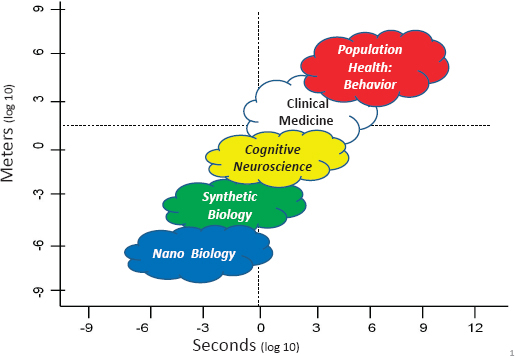
FIGURE 4-1 Scales of health science research. SOURCE: Donald Burke. 2011. “Emerging Science and Technology in the Life Sciences.” Presentation to the committee at the Workshop on Science, Technology, Engineering, and Mathematics (STEM) Workforce Needs for the U.S. Department of Defense and the U.S. Defense Industrial Base, Arlington, Va., August 1.
recruiting. He gave examples of four novel programs at his home institution: (1) simulation using agent-based models of pandemic spread through the United States, (2) data acquisition and analysis of historical disease patterns, (3) modeling of human health behaviors, and (4) measurement of population-level immunity. He discussed these four in detail, touching on the methodologies and the challenges in accessing and analyzing the data. One noteworthy example was the mining of the Department of Defense Serum Repository (Silver Spring, Maryland) of 50 million human serum specimens. In concluding his talk, Burke reiterated the theme of multiple scales, adding that at higher levels of sociobehavioral analysis we are seeing a “data tsunami.”
Anthony Tether, president of the Sequoia Group, discussed the topic of emerging S&T in the next 15 years from the perspective of his current work and his former service as the director of the Defense Advanced Research Projects Agency (DARPA). He offered a “baker’s dozen” of important technologies and explained the significance of each to the DOD mission:
• Alternative energy. Alternative energy is critical because all U.S. wars are conducted offshore, and a modern army moves on energy.
• Critical biological technologies. There is a need for timely, tailored therapeutic response capability.
• Cognitive computing and high-productivity computing systems. These systems could be used to simulate operations and eliminate extensive experimentation.
• Laser systems. These systems are of perennial importance, dating back 40 years, and have multiple military uses, from sensing to communication to electronic warfare to target designation.
• The ability to manufacture very quickly. This capability makes possible the response to unanticipated situations like wars in Iraq and Afghanistan.
• Structural, functional, and smart materials. Many fundamental changes in warfighting capabilities have sprung from new or improved materials.
• Mathematics. There continues to be value in supporting very intuitive people who are able to identify patterns in very complex data.
• Advances in microelectronics. Scientists will need to find a new way to continue Moore’s law using three-dimensional constructs and will need to learn how to make monolithic analog-to-digital chips.
• Communication networks. The network may become more important than the node (e.g., the airplanes that it supports).
• Quantum information science. It can be envisaged that this technology will have a major impact as scientists learn to operate at atomic level and shrink our sensors.
• Real-time accurate language translation. U.S. forces do not necessarily understand the culture or the language in the operational area, and so they need automated translators that are 95 percent accurate 95 percent of time (i.e., equivalent to a level IV linguist). A translator system could be embedded in a helmet equipped with a microphone and speakers. Although English is currently the preferred language globally, this may not be the case much longer.
• Trustworthy integrated circuits (ICs). DARPA has only a couple of foundries in the United States; most ICs are made offshore. Can we be sure that electronics manufactured abroad have nothing added or deleted that would lead to a catastrophic failure?
In conclusion, Tether asked how we can ensure that tomorrow’s youth will learn S&T. He believes that the result of such study must lead to something exciting, and proffered that one might change the 7th-, 8th-, and 9th-grade syllabi to include reading one science fiction book per week. In interviewing job candidates, he commented, he always looks for imagination.
The session then turned to the four members of Panel 1 who had been asked to prepare brief remarks on the panel’s topic, emerging S&T in the next 15 years.
The first panelist was Thomas Russell, director of the Air Force Office of Scientific Research, who began his remarks noting an underlying theme: seeking to educate people who can solve challenging problems. He said that academics are risk-averse and seek to ensure that research is successful even if it turns out that only the knowledge benefit rather than a deployable technology is applicable to future work. He noted that in the Air Force, there are six disruptive basic research areas identified in the “6.1” category (i.e., DOD-funded basic research): (1) engineered materials, including metamaterials and plasmonics; (2) quantum information sciences, with applicability to cryptological problems; (3) cognitive neuroscience; (4) nano science and engineering—although Russell conceded that nanotechnology and nanobiology have been talked about for two decades; (5) synthetic biology—he pointed out the importance for vaccine development of getting beyond the use of eggs and tobacco to produce them in order to have a rapid-response capability; and (6) the modeling of human behavior. Russell noted that, although these six areas are the ones that the Department has identified, in looking to the future one must not forget the past. He gave the following as an example: in the Air Force, aerospace sciences will continue to be important; the future is in autonomous systems in which the factor of trust will be paramount. Other areas of ongoing importance will be information assurance, network sciences, and thermal sciences—important for energy sciences and electron-phonon coupling. For the design of materials, there will be three-dimensional materials with n-dimensions in functionality. He also touched on the question of how humans interact with machines. Fractionated systems must be brought together, and we will require digital-based systems that are more generic. A question will be how to couple quantum architectures and how to bring them together in real time.
The next panelist to present brief remarks was Lyle Schwartz, past chair of the ASM Materials Education Foundation. This speaker decided against the approach of providing a list of critical technologies in favor of examining
a couple of technologies that in his view will be growing in importance at DOD; he also wanted to touch on some aspects of the STEM workforce that are not included in traditional thinking on S&T. The first of the technologies that he chose to focus on was robots, of which about 8,000 were in use in Iraq at the peak of the conflict. In future conflicts, he said, we will see autonomous systems—for example, insect-size surveillance robots or land-mobile robots teaming with soldiers. He noted that there will be a need for an increasingly sophisticated warfighter.
The second technology that Schwartz described involved materials requirements for applications such as personnel protection or higher operating temperatures in engines. He noted that autonomous systems in particular will benefit from functional materials that also provide energy storage. The implementation of computational tools now reaching maturity will enable materials by design—that is, the materials genome. Within the materials field, the most dramatic change will be in the implementation of computational materials. He commented that there is a need for academia to integrate computation more fully into the engineer’s toolbox.
Schwartz next turned to a discussion of the more efficient energy sources needed to meet expanding equipment loads. He noted that there are investments by DOD in energy, but that DOD will need to address warfighter needs specifically: for example, autonomous systems run by batteries currently create logistics complexity, and jet propellant 8 (JP8) fuel standardization creates problems for small-engine ignition.
Autonomous systems will require interdisciplinary and systems-organized research, Schwartz observed; it will not be possible to maintain the necessary depth of expertise in just the DOD laboratories, but other government laboratories and universities, including those abroad, should probably be accessible. We will need systems-organized collaboration and more flexible communication with these other entities. He pointed to what he considered an excellent model: the Army’s establishment of technology alliances.3
Schwartz then discussed issues that will be critical to maintaining aging transport and attack vehicles, which remain in use beyond their designed lifetimes. It is possible to upgrade such vehicles during the life-extension process in order, for example, to decrease fuel costs. Reduced investment in traditional areas by DOD has led to less academic attention to these topics; corrosion engineering, one of the major costs to DOD budgets, has all but disappeared as a subject taught in engineering education. We will need a trained maintenance workforce, for which community colleges will remain a critical element. DOD will continue to need a STEM workforce, ranging from individuals who have vocational training to those with advanced degrees in the soft and hard sciences.
The next panelist to present brief remarks was John Sommerer, Space Sector head at the Johns Hopkins University Applied Physics Laboratory. He began by commending to the workshop participants a Naval Research Advisory Committee (NRAC) summer study from 2010.4 Sommerer expressed mixed feelings about lists and about crowdsourcing, which, although it has a certain amount of convergence, tends to be market-driven. He presented a list, noting that it was Navy-focused, from the NRAC report, in a two-parameter framework (supplier base and customer base), to enable the Navy to maintain leadership in central areas while identifying the need for “agile adoption” within a much larger enterprise. Within the two-parameter framework (see Figure 4-2), there are two quadrants of interest: (1) “Most Navy control” and “Highest cost,” which quadrant is fragile because the government takes end-to-end ownership of cost, governed by current acquisition policy; and (2) “Least Navy control” and “Lowest cost,” which is the global marketplace. In the latter, it falls to DOD more and more to take advantage of the global supplier base and customer base.
Sommerer then asked participants to consider that the United States makes up 5 percent of the global population, or 10 percent if least-developed countries are excluded. Based on this calculation, one could posit that only 1 in 10 good ideas will emerge from the United States, underscoring that we must rely on agile adoption. Sommerer noted that this paradigm is used by Apple, currently the most valuable brand in the high-tech universe, using research to expand from its base as a boutique firm to overtake Microsoft. It is in the discovery arena, Sommerer suggested, that we need to prepare the workforce to make its contribution and understand the unique value that it has to national security. Referring to the NRAC report, he noted that the summer study also came up with a set of agile-adoption areas. He offered that if he had to pick only two areas to add to an emerging S&T list, one addition
3Further information is available at http://www.arl.army.mil/www/default.cfm?page=93. Accessed October 17, 2011.
4Naval Research Advisory Committee. 2010. Status and Future of the Naval R&D Establishment. Available at www.nrac.navy.mil/docs/2010_Summer_Study_Report.pdf. Accessed October 17, 2011.
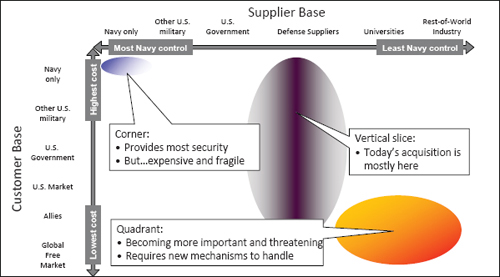
FIGURE 4-2 Framework of technology development and deployment. SOURCE: Naval Research Advisory Committee. 2010. Status and Future of the Naval R&D Establishment. Available at www.nrac.navy.mil/docs/2010_Summer_Study_Report.pdf.
would be applied neuroscience: the brain is not understood in terms of information processing even though there are astounding feats of pattern recognition. One could envisage neurally controlled fighter planes. The other addition to the list of emerging S&T that he suggested was information systems assurance. If he were to add a third and fourth, these would be materials and nanoscience.
In concluding, Sommerer stated that the real issue is not the list of technologies but the competitiveness of U.S. students and universities. He observed that this competitiveness is imperiled as both citizens and non-citizens leave academia to look for opportunities overseas. He suggested that the DOD intervention should be in policies that drive technology development, commercialization, and globalization, and career paths for the STEM workforce. With respect to the latter, he contends that the day of lifetime careers in government is over, and we will need to figure out how to pull in an increasingly globalized workforce. Generation Y is easily bored, amenable to working globally, and will move on if not kept engaged.
The fourth panel member was Leonard Buckley, technology division director at the Institute for Defense Analyses. Commenting on the lists of technologies already discussed, he noted that, for materials, there is a need to develop new dielectrics. He raised the matter of communication, which is an issue for STEM, offering as an example that nuclear power is not bad and that the public needs to be educated on this subject. Buckley discussed the modeling of complex systems, varying from weather to advanced aircraft to autonomous vehicles. S&T of complex systems also includes the interplay across fields, including autonomous operations, cognitive science, psychology, and the “creativity option”; creativity might not be desirable in a bus driver, but it may be key in robotic operation. Buckley also discussed quantum effects, noting that there are not a lot of materials to work with to build such systems. He noted that he was in broad agreement with list presented by Anthony Tether at the start of the panel session.
The panelists having made their remarks, session moderator and committee member Frances Ligler posed a few questions. Noting that the United States is facing the threat of terrorism and the build-up of sophisticated paramilitary forces, she asked the panel what is needed to make this a safer world.
• John Sommerer suggested that this is not a technological problem and challenged the premise that we need to engage militarily as broadly as we have. Information dominance is our strong point and our weak point; we need to maintain good awareness with intelligence, surveillance, and reconnaissance (ISR) without compromising our ability to orient and observe. Sommerer expressed the view that we will need an appetite and an infrastructure for ISR that are in good match, but at the present time the former exceeds the latter.
• Thomas Russell noted that sociobehavioral work centers on the question, what does it mean to influence? Sociobehavioral experiments generally evaluate influence based on some action during a specific scenario, not on the future outcomes. There has been minimal examination of what role DOD plays in the influence process.
• Leonard Buckley added that the ability to influence is very important and that psychology is very important and should be embraced more in DOD.
Ligler then posed the next question, commenting first that nanotechnology is an example of a field in which analytical inventions produced by the hard sciences led to breakthroughs in materials and biomedical engineering and will continue to do so for many years to come. Her question was, from what areas of S&T will the next major game-changing technologies emerge?
• Sommerer reflected that although he was repulsed by the excessive hyping of nanotechnology in the early days, the successes have proved otherwise. He noted that nanotechnology is an example in which the research community went beyond the 6.1-to-6.3 pipeline (of DOD basic research to applied research to development) and into the innovation web. Nonetheless, he stated the belief that there is a long way for nanotechnology to go, and still to be addressed are very large systems integration (VLSI) and thermal management. In addition, there is the breakdown of Moore’s law that many have envisaged.
• Schwartz noted that nanotechnology is the result of an evolutionary and continuous process: it is an extension of our understanding of solid state science. Now underway is the attempt to do something similar with evolutionary activities in materials associated with computation.
The moderator then took questions from the floor. One participant noted that the workshop had generated several lists of technologies that will be important over the next 10 or 20 years and asked where risk is actually examined.
• Russell replied that in order to answer this, one would need to define risk. We often look at the transition past the “valley of death” in innovation, which occurs after the basic science segment. This depends on where the risk is: Does it entail risk to create a capability? Is there innovation risk? Companies do not invest in basic research because they need a 5-year return on investment. One might conclude from this that basic science is high-risk.
• Sommerer noted that we are asking STEM personnel to do a game-theoretic assessment in order to determine which field to go into—and that assessment, moreover, is based on what fields DOD will fund in the future. The most important output of 6.1 investment is human capital.
Another participant asked if DOD can really predict the top technology in the next 15 years.
• Sommerer noted that hard problems can engender a lot of good results—for example, the steam engine had huge benefits for physics. He suggested that the interfaces between existing disciplines will be the source of the most interesting developments.
The session moderator then asked, with regard to systems thinking, if the panel could foresee any fields of endeavor emerging that might enable this systems focus from smallest component to largest assemblages.
• Buckley suggested that we will need to think more about building systems thinking into the various curricula and some fundamental courses in that area.
• Schwartz reiterated his point about the technology alliances used by the Army. These are reviewing specific areas of computational materials to create a systems effort that does not involve just individual DOD laboratories but the group of them collectively. The expertise cannot all be corralled in DOD. There is global exchange occurring in academia very freely, but we can only access this if we can collectively interact with it.
The participants asked the panel to state its number one area of S&T on which to focus.
• Russell suggested that we cannot focus on one area. He further noted that we are often trained in different disciplines than the ones that we pursue in our careers.
• Sommerer noted that prospective members of the STEM workforce will need to graduate with a lot of higher mathematics. The mathematics needed to practice physics for example has been around for 100 years and is not the mathematics at the frontiers of research. People who leave college without a significant armamentarium of higher mathematics will not be entering the STEM workforce.
Participants asked whether there is enough emphasis on just letting people discover things.
• Russell referred to Pasteur’s quadrant, in which one can have a basic science result when working on a practical problem. Such a construct can support research that borders on Bohr’s quadrant (basic science without a direct practical result) or Edison’s quadrant (research on a practical problem leading to a practical result).5
• Sommerer agreed that it was good to ask whether all the emphasis should be on application and development. He suggested that the decadal surveys that the NRC conducts of physics and astronomy are a good model of a process to identify key areas for research amid competition. He noted that such a Delphic model can identify the grand challenges. Another example is the 20 questions to mathematics posed by David Hilbert circa 1900. Sommerer underscored the need to get away from the limitations posed by the question, “What have you done for me lately?”
• Schwartz noted that diversity presents a funding opportunity: there are extensive opportunities to broaden the spectrum. He emphasized that DOD is a small player in funding for academia—smaller than it was years ago. Schwartz noted there are activities in which DOD is the only source of funding: here you want to encourage free thinking in addition to development for a DOD-specific need. He further noted that there are also broad areas of S&T, the responsibility for which is shared across various government agencies among which DOD is a small player.
Ligler then asked if we can conceive of defense as a technology intended to bring more benefits to humans rather than destroying them.
• Sommerer answered that security depends on well-being. It is our economy that led to our century of preeminence.
PANEL 2: ESTIMATING STEM WORKFORCE NEEDS UNDER FUTURE SCENARIOS
Estimate the STEM workforce needs by number and field of the DOD and its defense contractors under each of the following three budget scenarios:
5D.E. Stokes. 1997. Pasteur’s Quadrant: Basic Science and Technological Innovation. Washington, D.C.: Brookings Institution Press.
a. The current 5-year defense budget continues under identical basic assumptions.
b. An abrupt change in security threats calls for an abrupt 35 percent DOD budget increase over that in (a) above.
c. A peace dividend calls for reallocating 25 percent of the DOD budget in (a) to other national needs.
Summary of Lead-off Presentation
Rolf Lehming, director of NSF’s National Center for Science and Engineering Statistics (NCSES) introduced the topic of Panel 2—estimating STEM workforce needs under future scenarios—with his presentation on background data relevant to the STEM workforce needs of DOD. He began by acknowledging the use of the Defense Manpower Data Center (DMDC) and stated that he would be giving a brief sketch of the civilian side of DOD, including data by major job title (Figure 4-3).
Lehming noted that NASA is the largest STEM employer in the federal government. He then discussed the trends in STEM employment in the federal government, such as the trends in minority employment. Here he noted that the ability to attract STEM workers from minority populations will be an ongoing focus; he mentioned that DOD is doing a commendable job of recruiting minorities vis-à-vis the percentage in the population.
Lehming then presented a historical look over the 1999-2009 period at the number of science and engineering bachelor’s degrees by broad field (e.g., engineering). Temporary-visa holders are a small portion of these. He noted that Asian Americans have more than a pro rata number of natural science and engineering degrees. (NS&E in this presentation includes the three basic sciences, but also ocean and Earth sciences as well as information technology [IT]; it does not include psychology or social sciences.) Temporary-visa holders account for 5 percent of such degrees in the life sciences and 25 percent overall. In summary, Lehming stated that DOD is a major employer
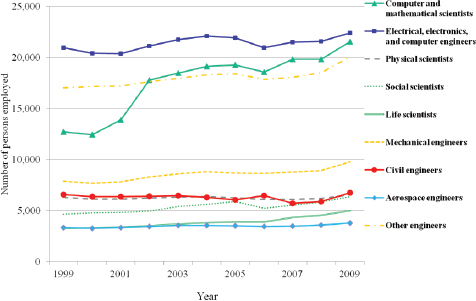
FIGURE 4-3 Department of Defense science, technology, engineering, and mathematics (STEM) workforce employment by major job title: 1999-2009. SOURCE: National Science Foundation/National Center for Science and Engineering Statistics, special tabulations (2011) from data provided by the Office of Personnel Management and the Defense Manpower Data Center.
of STEM, especially in the field of IT. Looking at the level of educational attainment, there has been a modest increase in engineering and physical sciences bachelor’s degrees. Blacks and Hispanics earn NS&E degrees in percentages well below their population shares. At the doctoral level, one-third of doctorates of NS&E are earned by temporary-visa holders.
A few questions were asked after the presentation was concluded. One participant asked about the decrease in temporary-visa holders and whether this was related to difficulties with obtaining such visas that were observed 6 or 7 years ago.
• Lehming noted that admittances of persons with student visas dropped slightly after 2000, but the 7 years allowed for getting the degree could explain what one sees in terms of a drop.
A follow-up questioner asked if there were country data showing where the temporary-visa holders are from.
• Lehming indicated that most were from China, India, and Japan and that, further, only a very few were from countries that might be termed “unfriendly.”
• In response to another question that sought clarification on what specifically was included in IT, Lehming noted that this includes all hardware and system components.
Session moderator and committee member Anita Jones thanked Rolf Lehming for his presentation and noted the value of the biennial science and engineering indicators report. Then the four members of Panel 2 who had been asked to prepare brief remarks presented their comments on the panel’s topic of estimating STEM workforce needs under future scenarios.
The first panelist, committee member Leif Peterson, managing partner at Advanced HR Concepts and Solutions, LLC, was asked to provide a brief review of selected, previous Air Force studies regarding STEM workforce issues. He went back 10 years, beginning with the USAF Scientist and Engineer Future Study of 2002.6 His presentation included the National Defense University review in 20087 and the National Research Council STEM workforce study8 published in 2010. He concluded by giving an overview of Bright Horizons: The Air Force STEM Strategic Roadmap (2011) and the Senate Report to Accompany S. 1253, the National Defense Authorization Act (NDAA) for Fiscal Year 2012 (Report 111-26).9
The USAF Future Study established the first-ever S&E projections of 2010, 2015, and 2025. It defined the tools used to establish the projections, derived workforce trends, and identified current and emerging technical degree profiles. It concluded that in order to manage a workforce with acceptable risk, the Air Force needed to man to authorized levels with the right skills. Peterson went on to identify future technology areas that would drive a shift toward academic degrees in the following major areas: directed energy (e.g., electrical engineering), space vehicles (e.g., astronautical engineering), information technology (e.g., computer science), and human factors (e.g., behavioral science).
In July 2008 the National Defense University review arrived at three key conclusions: (1) future S&T efforts in DOD would be in competition for funding with other federal outlays (e.g., Medicare, the national debt, and so on); (2) it is critical that the DOD S&T workforce have the ability to renew itself and develop effective leaders who can maintain advocacy for new S&T initiatives; and (3) DOD should be aware of the implications of the S&T “shadow workforce” (i.e., non-organic personnel such as contractors).
6U.S. Air Force. 2002. USAF Scientist and Engineer Future Study. Washington, D.C.
7Timothy Coffey. 2008. Building the S&E Workforce of 2040, Challenges Facing the Department of Defense. July. Washington, D.C.: Center for Technology and National Security Policy, National Defense University.
8National Research Council. 2010. Examination of the U.S. Air Force’s Science, Technology, Engineering, and Mathematics (STEM) Workforce Needs in the Future and Its Strategy to Meet Those Needs. Washington, D.C.: The National Academies Press.
9U.S. Senate. 2011. Report to Accompany S. 1253, National Defense Authorization Act (NDAA) for Fiscal Year 2012. Report 111-26. Washington, D.C., June 22, p. 171.
Peterson stated that in 2010 the National Research Council completed its study of the current and future STEM needs of the Air Force.10 He discussed a few of the 25 recommendations (e.g., conduct a current and future manpower STEM requirements review, define STEM, among others) that were incorporated into the Air Force’s strategic roadmap Bright Horizons. This effort by the Air Force was recognized in the NDAA for FY 2012.
The next panelist to make a brief presentation was Assistant Commissioner of Labor Statistics at the Department of Labor Dixie Sommers, who explained that she would present some of the data that the Bureau of Labor Statistics has about STEM occupations and where the data come from. BLS uses the Standard Occupational Classifications (SOCs) approved by the Office of Management and Budget’s Office of Information and Regulatory Affairs. Qualifications generally are not used. There are 23 major groups; one example is life, physical, and social science occupations. Sommers then posed a question about STEM vis-à-vis SOCs, noting that her office recently published a visual essay11 on this topic: an open question is whether STEM should not include fields in the social sciences, health, or teaching. Sommers further noted that BLS surveys more than 1 million businesses in a 3-year period and publishes these data for the country as a whole, once a year, in May. Further, BLS carries out employment projections looking prospectively 10 years; these are updated every other year. BLS also produces the Occupational Outlook Handbook (see www.bls.gov/oco/), which is the most widely used compendium of its kind.
The next panelist to speak was John Fischer, director of the Defense Laboratory Office within ASD(R&E), who provided an overview of the DOD laboratories. The data from the Defense Manpower Data Center show that in 2011, roughly one-third (approximately 37,000) of DOD’s scientists and engineers are in the DOD laboratories (Figure 4-4). Fischer noted that the laboratories have lost people in electronics engineering as well as in operations research, many of whom were trained at the Naval Postgraduate School. He provided data showing that, since 2008, the DOD laboratory S&E workforce has experienced a hiring resurgence in five prominent occupational series, including general engineer (26.2 percent increase over 2008), mechanical engineer (7.8 percent), aerospace engineer (10.6 percent), and electrical engineer (21.5), as well as chemistry (10.3 percent).
Fischer then turned to the question of what might be needed in the future. Some focal areas might include cloud computing, cyber science and technology, quantum computing, smart grid, metamaterials, and synthetic biology. These might have an impact on defense needs. He then discussed some challenges and possible solutions, such as retirements and the gaps created by them, the new skill sets that will be needed, and the limited resources. Fischer expressed the view that the current budget crunch will have a huge impact on the workforce. In this context, retirements are not a concern owing to the eligibility requirements, inherent in the Federal Employee Retirement System (FERS) and based on age and “creditable service,” which may act as a deterrent. This might create an excess of persons who are close to retirement-eligible, leaving no vacancies to be filled by new hires. Fischer discussed some solutions, citing the Section 219 authority of the National Defense Authorization Act of 2008 and the Science, Mathematics, and Research for Transformation (SMART) scholarship program, through which personnel receive educational benefits and then work for the DOD laboratories. Finally, he noted that DOD looks at academia for research trends.
The final panelist for Panel 2 was Edward Swallow, the vice president of Business Development, Civil Systems, for Northrop Grumman Information Systems, and the chair of the STEM Workforce Division of the National Defense Industrial Association (NDIA). Swallow began his remarks by noting that he had worked on this issue being addressed by the workshop in 2004 and received a charge from then-Undersecretary of the Air Force Ron Sega similar to the statement of task for the present study. For past 3 years, Aviation Week and Space Technology, NDIA, and the Aerospace Industries Association (AIA) have collaborated on an aerospace and defense (A&D) industries-wide survey of STEM employment. Swallow enumerated three key points from the AIA and NDIA data: (1) Budget variability does not correlate to industrial STEM employment, but it does correlate to program shifts; the latter—for example, in the space shuttle main engine or the Joint Strike Fighter—are responsible for changes. (2) Overall, the perfect storm has been postponed but not avoided. As others have noted, people are
10National Research Council. 2010. Examination of the U.S. Air Force’s Science, Technology, Engineering, and Mathematics (STEM) Workforce Needs in the Future and Its Strategy to Meet Those Needs. Washington, D.C.: The National Academies Press.
11Bureau of Labor Statistics. 2011. “Science, Technology, Engineering, and Mathematics (STEM) Occupations: A Visual Essay.” Monthly Labor Review (May), pp. 3-15.
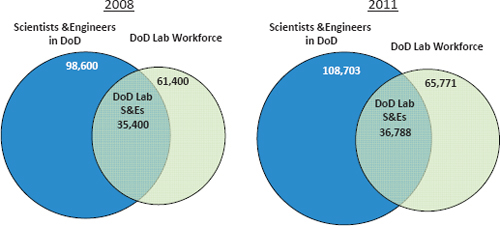
FIGURE 4-4 Scientists and engineers in the Department of Defense (DoD) workforce and in the DoD laboratory workforce, 2008 and 2011. SOURCE: John Fischer, Department of Defense, ASD(R&E).
postponing retirement because their 401(k)s have not performed. Looking at retirement, those who actually retire versus those who are eligible to retire, there is a 10 percent rate of retirement. (3) Supply does not always meet demand: there are open requisitions, defined as positions that remain open for 90 days or longer: systems engineering, for example, currently has more than 800 open.12 All of these are funded positions. Swallow also showed a supply-chain model being developed by NDIA (see Figure 4-5). Responding to a question on shortfalls, he noted that there was an excess of engineers and mathematicians due to the Apollo program. On the positive side, these personnel were attracted to solving national issues through science and mathematics. This created a big supply of labor, and these workers were able to solve other problems as well. The problem emerged in the mid-1990s as the Apollo generation retired.
The members of Panel 2 having made their remarks, the session moderator Anita Jones asked the panel what have been the most successful government interventions to grow the STEM workforce.
• Leif Peterson noted the importance of the Apollo program to growth of the STEM workforce in that it provided inspiration.
With questions being opened to the floor, committee member Mary Good asked about the pool of people who can be granted clearances and, given the numbers of persons graduating in engineering, where one will get these clearable people. Further, she asked why Americans do not go to graduate school. She noted that many are first-generation college students who will prefer to take a job that pays $62,000 per year rather than go to graduate school with a stipend of $18,000.
Another participant asked John Fischer a question related to the small numbers of significant advances in technology initiated outside the academic sector. This is true now, but it was not so in the past—for example, with Bell Labs, Xerox PARC, IBM’s Thomas J. Watson Research Center, and so forth. The participant asked whether DOD laboratories can provide leadership at that level.
• John Fischer responded that the uniformed services and the Office of the Secretary of Defense (OSD) could push the laboratories to serve in that role. The expected decline in budgets will shift demand toward
12C.R. Hedden. 2011. Aviation Week Workforce Study. Arlington, Va.: Aviation Week.
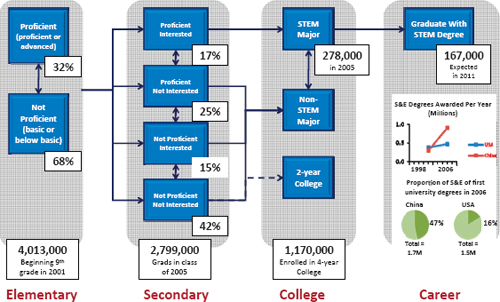
FIGURE 4-5 Supply-chain model: current science, technology, engineering, and mathematics (STEM) graduates. NOTE: S&E, science and engineering. SOURCE: Michael Lach, Special Assistant to the Secretary for STEM, Department of Education, 2011.
near-term needs. DOD is discussing at the level of the Office of Science and Technology Policy (OSTP) and OSD how to turn the DOD laboratories into such an incubator.
• Edward Swallow noted that there has been in the recent years a significant drop in R&D as a percent of revenues, to roughly 3 percent today.13 R&D is almost exclusively tied to a business plan. The only increase in R&D is in small business innovative research (SBIR).
• Leif Peterson noted that Fischer had said that the number of electrical engineers had dropped by 8 percent, but Peterson noted that this did not constitute a demand signal change but a lack of qualified and available talent, and further that this is one of the most competitive job categories for DOD. Next, Peterson suggested that we look at what actions the commercial aerospace companies and DOD are taking to protect their STEM “seed corn” when they experience perturbations in the workforce.
Committee member Robert Hermann asked whether corporations are doing a substantial amount to attract and retain engineers.
• Swallow replied that the Aviation Week survey had asked corporations to provide information on what they were doing in that regard and on how much they were investing. The survey identified $300 million in incentives, of which $100 million were for scholarships.14 Swallow noted that this is overall 1 to 2 percent of total revenue.
13Data are based on the survey of companies with 50,000 or more employees that was conducted as part of the 2011 Aviation Week Workforce Study. The same survey in 2010 found that approximately 6 percent of revenues were devoted to organic R&D.
14C.R. Hedden. 2011. Aviation Week Workforce Study. Arlington, Va.: Aviation Week.
• Peterson suggested that as we go forward into a competitive, resource-constrained environment, it will behoove us to know the return on investment of these interventions.
Another participant noted that many in the workforce will be eligible for retirement soon and asked, in the context of a 15 percent decrease in DOD budget as posited in the workshop charge, if there are plans to use incentives or policies to encourage buyouts.
• Fischer noted that 10 or 15 years ago there was just such a decline in budget, and although buyouts were offered, the amount was only $25,000, which did not constitute much of an incentive. Eventually people retire if their jobs are eliminated, as might occur if the budget crunch gets bad enough. Fischer stated that within the past 2 weeks he had asked the DOD laboratories if they had unfilled staffing needs, and they said that they did not.
• Peterson commented that although the DOD laboratories may not have unmet needs, that is not to say that there are no larger STEM issues at DOD; in the Air Force most engineers are not in the laboratories.
Committee member C. Kumar N. Patel commented on the relationship between technological change and the workforce, noting that in 1944 there was a movement to solid state electronics, and this attracted William Shockley and others. These scientists also worked on fibers. In that era, Bell Labs had very aggressive recruiting.
• Peterson noted that the workforce structure has changed since then.
• A participant offered that she had indeed been recruited by Bell Labs by means of a fellowship, but then she had returned to the Georgia Institute of Technology.
Committee Co-Chair Norman Augustine expressed the opinion that there will never be an engineering shortage in this country again; corporations will continue the trend of opening an engineering facility overseas. DOD, however, will have to hire U.S. citizens. He asked if we cannot just get these jobs from abroad.
• Swallow responded that in his work he is building a supply-chain model and has identified a mismatch between the number and quality of engineers that we need and the number and quality of engineers that are available. Salary acceleration has grown above the pro rata 3.2 percent Cost of Living Adjustment (COLA), and direct labor is a large portion of cost overruns.
An e-mailed question asked what effect base realignment and closure (BRAC) has had on the S&T workforce.
• Fischer noted that a study of the acquisition workforce had shown that since 1995, the number of acquisition programs that had gone into the red had skyrocketed. He noted that, in recent testimony before the House Armed Services Committee, Assistant Secretary of Defense Lemnios was asked what was being done to ensure our acquisition workforce.
• Peterson added that, if during a BRAC activity one is moving a workload or closing it down, there are programs available to place the affected people at either the losing or the gaining activity, or both. His experience indicates that if the BRAC implies moving the workload geographically, historically less than 20 percent will make the move.
• Anita Jones noted that with the Defense Intelligence Agency (DIA) moving to Charlottesville, Virginia, some staff with houses “under water” will not be able to move.
PANEL 3: LIMITATIONS TO MEETING WORKFORCE NEEDS OF DOD AND THE INDUSTRIAL BASE
Assess the limitations in meeting the above workforce needs [refers to the question addressed by Panel 2] and the forces shaping those limitations.
Summary of Lead-off Presentation
Harold Salzman, professor and senior faculty fellow, John J. Heldrich Center for Workforce Development of Rutgers University, introduced the topic of Panel 3—limitations to meeting the workforce needs of DOD and the industrial base—with his presentation entitled “New STEM Labor Market Segmentation: Implications for Meeting Workforce Needs of DOD and the Industrial Base.” He began by attempting to define the problem and asked the following questions: (1) whether there has been a market failure leading to an insufficient labor pool, (2) why there might be such a shortage (e.g., lack of interest at the college level), and (3) what the solution to such a shortage might be—for example, a new, Sputnik-like initiative or the workings of market forces. Salzman reviewed the size of the STEM labor force vis-à-vis recent trends, noting that student performance since 1973 has been rising in mathematics, for example.15 He also noted that the United States has a bimodal distribution in educational performance. Compared to other countries of the Organisation for Economic Cooperation and Development, the United States has a high percentage of high-performing students in science, reading, and mathematics (see Figure 4-6).16
Salzman next turned to the subject of transition rates and yields in the “STEM pipeline.” He noted that the retention rates—related to those who stayed in STEM fields after graduating—have been improving, although the number graduating with degrees in engineering has been flat, at 72,000, for the past 6 years. Salzman then offered his analysis of what has been changing in the pipeline. He discussed the transition from high school graduation to 5 years later (i.e., college outcomes), noting a slight decline since 1977 in the percentage who graduate from college with STEM degrees. Significantly, the number of such graduates who were most prepared (defined as the top quintile of the Scholastic Assessment Test [SAT] or American College Testing [ACT] Assessment) at the time they entered college has declined by roughly half since its peak in 1997. By the next transition point, 10 years after high school graduation, roughly 45 percent of those who graduated from college with STEM degrees remained in the STEM workforce. The data also show increasing retention for most STEM graduates from the 1980s through the early part of this decade. The percentage of the top performers in STEM jobs at that point actually declines, particularly beginning in the mid-1990s through today.
Salzman also discussed the segmentation in STEM education and identified some trends. There has been a decline in the obtaining of STEM degrees by white males but increases in all other demographic groups from 1985 to 2006. He also identified a large increase in the number of temporary-visa holders receiving degrees. He noted, however, that since the STEM definition used in the analysis excludes medicine and patent law, if one were to broaden the definition of what STEM includes, one would find that the gap between native- and foreign-born degree recipients would narrow.
Finally, Salzman posed the question of whether labor markets work to address shortages. He gave the example of the IT labor market, in which, in response to increases in demand, the numbers of persons graduating with IT degrees peaked in 2000, coinciding with the dot-com bust. He also gave an example of the petroleum engineering labor market, which has recently experienced an increase in demand following nearly flat hiring for much of the past 30 years (see Figure 4-7). Evidence of a “temporary” shortage had been exemplified in the increased difficulty in recruiting for jobs in the Alaska North Slope. The market has responded with a sharp increase in annual salaries since 2005. Indeed, salaries for petroleum engineers are now $22,000 above those for chemical engineers, for example. Concurrently, there has also been a sharp increase in the numbers of persons graduating
15B.D. Rampey, G.S. Dion, and P.L. Donahue. 2009. NAEP 2008 Trends in Academic Progress. NCES 2009–479. Washington, D.C.: National Center for Education Statistics, Institute of Education Sciences, U.S. Department of Education.
16H. Salzman and L. Lowell. 2008. “Making the Grade.” Nature 453:28-30.
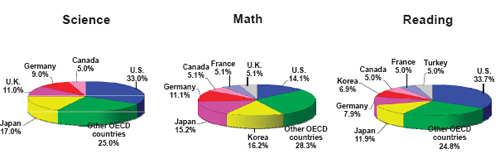
FIGURE 4-6 U.S. share of Organisation for Economic Cooperation and Development (OECD) high-performing students. SOURCE: Calculations by H. Salzman and L. Lowell based on data from OECD Progamme for International Student Assessment.
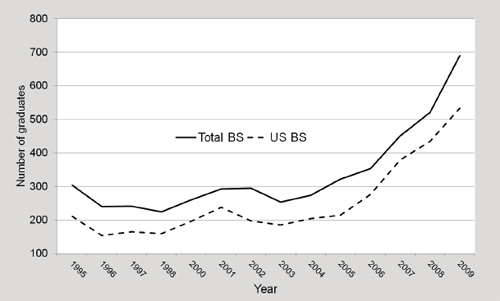
FIGURE 4-7 Petroleum engineering graduates: total and U.S. (citizens and permanent residents) graduates, 1995-2009. NOTE: BS, bachelor of science degree. SOURCE: Daniel Khuen, Hal Salzman, and Leonard Lynn. 2011. “Dynamics of Engineering Labor Markets Petroleum Engineering and Responsive Supply.” Presented at U.S. Engineering in the Global Economy, The National Bureau of Economic Research, Cambridge, Mass., September 26-27, p. 9.
in petroleum engineering, and, significantly, all of the response to the demand signal was from domestic students (including Green Card holders).
A few questions were asked after the presentation. One participant asked, assuming that workforce is of high quality and able to meet the needs of the future, whether we would not need to produce a different type of worker who can think on his or her own and be agile in responding to change. How might we do this?
• Harold Salzman noted that when he has looked at what engineering skills will be needed in the future, what is in short supply are skills to work across boundaries. Employers are looking for persons who may not necessarily have had the strongest technical skills but are nonetheless broad-minded, willing to travel, and so forth.
Another participant referred to Charles Vest’s keynote presentation (see Chapter 3) in which the speaker commented that he believes we are heading for a train wreck; the participant asked whether Salzman sees this as well.
• Salzman said that he sees a different type train wreck ahead: he did not see the lack of students to draw from, nor any shortages not responsive to market demand. Instead, he sees the danger as one of creating an oversupply, as happened recently in the life sciences for example.
One participant noted that Salzman’s presentation focused on high school and college graduates and asked about those who do not go that far. The participant offered the example of Boeing, where it now takes 13 weeks to train a new hire for factory work, whereas it used to take 6 weeks. The participant noted that although engineers today may have excellent technical skills, they cannot always apply them to real-world problems, nor are they necessarily innovative or creative.
• Salzman noted that in the past, companies did not expect an engineer to be productive for the first 5 years of employment and that cooperative-type education programs are an attempt to address this issue.
• Committee Co-Chair C. Dan Mote, Jr., noted that the OECD’s Programme for International Student Assessment showed the United States to be average in science, mathematics, and reading—essentially at the 40th percentile—and that Shanghai was ranked first in all categories.
• Salzman commented that although that is true of averages, the distribution is bimodal, with large numbers at the top and bottom, and that the United States does very well when the top of the pool is considered.
The session then proceeded to the brief presentations by four panelists on the topic of Panel 3, limitations to meeting workforce needs of DOD and the industrial base.
Burt Barnow, Amsterdam Professor of Public Policy at the George Washington University, discussed the nature of labor shortages. Economists generally view a shortage as a situation in which demand exceeds supply at the prevailing wage for an extended period of time, but in reality there is no single definition of a shortage that is universally accepted. For example, Kenneth Arrow has defined a “social demand” shortage17 as one in which the market clears but the jobs are filled with those who, while they are good enough, do not necessarily have the right qualifications. Moreover, a “skills” shortage is sometimes defined differently from an “occupational” labor shortage. Furthermore, others define a shortage as occurring when supply increases less rapidly than the number demanded, implying that shortages can persist for a long time.
Barnow noted that there are many reasons why shortages may arise. For example, price restrictions such as those imposed by third-party payers, a fixed-labor-price long-term contract, or restrictions on entry such as licensing requirements can create a shortage environment. With respect to measuring the size and severity of a shortage,
17K.J. Arrow and W.M. Capron. 1959. “Dynamic Shortages and Price Rises: The Engineer-Scientist Case.” Quarterly Journal of Economics 73(2, May):292-308.
Barnow warned that occupational codes are often too broad for the task. For example, the code for programmer does not distinguish between expertise in FORTRAN and Java. Employers can often adjust to shortages in various ways, such as by relaxing any unnecessary employment requirements or by substituting capital equipment for scarce labor or by restructuring around the shortage. Barnow then posed the question of how one can determine whether a shortage exists, and offered several indicators to look for, including an increase in the number and duration of vacancies, evidence of the adjustments described above, and changes in wages, especially relative wages. If these signs are not present, then one must question whether there really is a shortage. If there is indeed a shortage, he said, one should observe that relative wages in the affected labor market segment go up as the market adjusts.
The next panelist was Assistant Commissioner of Labor Statistics at the U.S. Department of Labor Dixie Sommers. She presented data on employment and wages, employment projections, and educational attainment by occupation. She discussed the standard SOCs and what might be considered STEM occupations and presented a list of STEM-related SOCs. In addition to the array of occupations normally included in STEM employment numbers—engineers, mathematicians, and computer scientists and life and physical scientists—the Bureau of Labor Statistics includes, for example, technicians in the life and physical sciences, architects, postsecondary teachers in STEM fields, and STEM managers, as well as those in STEM-related sales jobs, as part of the STEM labor force. Altogether, there were 7.8 million employed in STEM in the civilian sector in May 2009, with the largest number employed in computer-related jobs. From 2004 to 2009, STEM employment increased by 7.9 percent—the last year included a recession. For 2008 to 2018, BLS is projecting STEM employment (excluding postsecondary STEM teachers) to increase by 16.6 percent, with the greatest growth (22.2 percent) predicted in computer and mathematical occupations. Finally, Sommers presented data from the American Community Survey on educational attainment showing that the majority of those in STEM by occupation have earned a postsecondary degree, especially at the PhD level in the life and physical sciences occupations.
Michael Finn, senior economist at the Oak Ridge Institute for Science and Education, the next panel member to speak, presented his analysis of the rate at which non-citizen U.S. PhD recipients remain in the United States. Analysis of data from the Social Security Administration shows an average 5-year stay rate in 2007 of 62 percent, with doctorate recipients from China and India having the highest percentages at 92 and 81, respectively. For the 1995 and 1997 cohorts of non-citizen doctorate recipients, the stay rates tend to fall slightly among those remaining in the United States each year 6 to 10 years after graduation. There are tremendous differences by source country in stay rates, but these rates have remained stable with time. Relative to earlier cohorts, stay rates for more recent cohorts have risen slightly. Finally, data from the Survey of Earned Doctorates on the plans of non-citizen doctorates to stay in the United States have shown a steady increase from the early 1990s.
The fourth panelist was Rick Stephens, vice president for human resources of the Boeing Company and chair of the Aerospace Industries Association workforce steering committee. Stephens indicated that the STEM workforce at Boeing will grow by about 8,000 versus last year, and, given the anticipated number of retirements, Boeing can expect to fill 16,000 positions, for which it will anticipate 2.5 million resumes. At present, 20 percent of the workforce is eligible to retire, and 20 percent more will be in 5 years’ time. Stephens also noted that Boeing invests about $650 million in its workforce per year and at present has 3,000 personnel attending school full time.
Stephens voiced concern over the quality of Boeing’s new hires, noting that whereas it used to take 6 or 7 weeks to train someone from high school to work on the factory floor, it now takes 13 weeks. He noted that new hires often are information-savvy but not necessarily handy. Employers find that engineers who have not served an internship are not always good at design, even though they may be technically strong. Stephens noted that this problem is, if anything, more acute with the second- and third-tier suppliers who cannot tap the best hiring sources. Overall, he noted that workers today need to be more broadly trained; for example, a lineman working for an electric power company needs to know some basic electrical engineering, not just to be able to climb a pole.
Stephens explained that Boeing has the ability to move staff between its commercial and defense divisions, mitigating any workforce impact of a downturn in one sector or the other, and he suggested that DOD might be able to do this across its agencies, noting that this would be a tremendous opportunity. Turning back to the STEM workforce issues at Boeing, he indicated that one of the reasons for the delay in delivering the 787 aircraft was a lack of workforce capacity in the area of design. Offering an example of the close relationship that Boeing tries to cultivate with the education sector, Stephens noted that Boeing had assisted with developing the systems
engineering curricula at a number of universities. In Boeing’s view, students are spending too much time working in simulator models, in which consequences of failure are non-existent. He concluded his remarks by suggesting that mentors and role models and incentives are needed to create and maintain a high-quality STEM workforce.
After the panelists had concluded their prepared remarks, session moderator and committee member Sharon Levin briefly recapped the session. She noted that the panelists had covered a wide range of limitations facing the defense-related STEM workforce, including educational qualifications, the size of the pool, leakages in the pipeline, foreign-born stay rates of those educated in the United States, competing demands from the private sector, and the need for people with hands-on experience. Levin asked the four panelists what they considered to be the most cost-effective way to deal with the DOD STEM workforce concerns.
• Michael Finn offered a comparison to work performed by the Department of Energy’s (DOE’s) laboratory system, in which there is a much greater willingness to hire foreigners than at DOD. He wondered whether it is necessary to be a citizen to do the work. The approach at DOE is that the strongest science gives the United States the strongest defense; that is the DOE rationale for hiring foreign citizens.
• Burt Barnow suggested that in some government jobs the pay scale is such that engineers cannot be paid what they would earn in the private sector and therefore they spurn DOD positions. Some agencies have authority to go above the general federal pay scale and use that authority to do so, and he suggested that perhaps DOD needs to do this as well.
• Rick Stephens indicated that there may be scope for shifting workers around to maintain stability as needs change. Electrical engineers, for example, may be able to move into cyber science and technology, although aeronautical/astronautical engineers might not be able to move in that direction. The cancellation of the space shuttle, however, might have removed some of the incentive for students to enter the field of aeronautical/astronautical engineering.
Addressing Rick Stephens about the difficulty encountered in training factory workers, a participant asked whether Boeing engages with public schools and community colleges.
• Stephens replied that, yes, Boeing does. He noted there have nonetheless been some shifts in education; for example, vocational courses are no longer taught in high school, and 1.7 million persons drop out of high school each year because they do not see the relevance of their coursework.
Another participant asked about the development of a skilled labor force and offered the comparison with Germany, which trains a skilled labor force, not all of whom attend a university.
• Barnow noted that the United States does not have a national credentialing system but devolves this onto the states. This differs from other countries.
• Stephens suggested that we have been telling our citizens who go to college that they will be guaranteed a job, when in fact they cannot always get a job and then they have loans to repay. We could do a better job of helping people work backward from jobs to an understanding of the degree requirements necessary.
Committee Co-Chair Mote referred to the data on PhD recipients returning to India and China and whether the rate at which they stay is really increasing. He added that this April, a report by the Kauffman Foundation18 included survey results showing that people of Indian and Chinese origin expressed a strong desire to return to their home countries to start a company.
• Finn noted that surveys are not always useful. What people say their aim is in a survey and what they do are not necessarily the same. Stay rates for bachelor’s and master’s degree recipients may be lower than
18V. Wadhwa, S. Jain, et al. 2011. The Grass Is Indeed Greener in India and China for Returnee Entrepreneurs. Washington, D.C.: Ewing Marion Kauffman Foundation, April.
that of doctorates. It can be easier to demonstrate at the PhD level that no American is available. Finn noted that the difficulty in getting visas following September 11, 2001, has subsided. Furthermore, China and three other countries (Mexico, Philippines, and India) have quotas with the Immigration and Customs Enforcement (ICE) agency of the Department of Homeland Security. Nevertheless, the stay rate among the Chinese doctoral recipients has never fallen below 90 percent.
Estimate the fraction of the above workforce needs [refers to the question addressed by Panel 2] that will not be met by the civilian educational enterprise without supplemental DOD intervention. Where and how should DOD invest to achieve its workforce need?
Summary of Lead-off Presentation
Carl Wieman, associate director for science of the Office of Science and Technology Policy, delivered his talk “Creating a More STEM-Capable DOD Workforce,” beginning with the assumption that DOD needs more and better technical capabilities at all levels. He further discussed the nature of the STEM problem and said that he considers it to be no worse now than in the past. He cited indicators such as the fraction of 20- to 24-year-olds receiving STEM degrees, which, although it saw a bump after Sputnik, has been flat. Likewise the mathematics and science proficiency test scores have been flat for as long as there have been data. He noted that there was a campaign to make the United States first in the world in STEM education 20 years ago, noting that although the acronym has changed from SMET to STEM, nothing else has changed.
Wieman suggested that in seeking a solution, it would be important to think of education as a system and to focus on the higher-education component, which is neglected in the STEM discourse. He noted that historically the nature of federal funding after the Second World War and the rise of the research universities led to the separation of their higher-education STEM departments from schools of education, the latter offering K-12 teacher preparation. Wieman suggested that the two distinct components have become optimized to their respective, differing incentives. The research universities became optimized for research productivity and acquiring research funding, whereas the schools of education were optimized for bringing in the greatest numbers of students drawing on student tuition and education funding. The education degree evolved to have the lowest STEM requirements of any major. In the science and engineering departments of the research university, there was a disincentive to increase the number of undergraduate majors; there was no teacher training, and there were disincentives to change teaching methods. At the institutional level there was a focus on research. Indeed, there was an increase in the amount of university funds going to research, which by 2009 amounted to roughly $5 billion, or $5,000 per undergraduate, per year, above and beyond what the government provides for research.
Wieman nonetheless suggested that there was potential for improvement and described some potential areas. Brain research and cognitive science have made dramatic advances in how to achieve learning at a high level of expertise. He noted that there are roughly 1,000 papers in peer-reviewed literature on STEM vis-à-vis college course tests. The literature has found that new methods of learning that go beyond the lecture or “chalk and talk” approach can be twice as effective. Another area for improvement is in learning to attract and retain more people in STEM fields. Wieman cautioned, however, that to accomplish this would entail some transition costs and stressed that there is a very great opportunity not now being realized because, in his view, the incentives are wrongly aligned. The K-12 level unfortunately does not offer a window to improve STEM participation because at that level the subject mastery is not sufficient.
Wieman offered the idea that finding how DOD might achieve change starts with the realization that metrics and incentives are centered on the federal research funding system. One can see why the money is being diverted from education to research by ascertaining that research output is the metric of significance. DOD is unique because
it must worry not just about research output but also about workforce training needs. He suggested that DOD would need to establish a set of incentives and metrics that optimize both of these. More specifically, he suggested that DOD might link funding for R&D at a university to education (learning) performance at that university. The link is already in place, but the feedback has the wrong sign. How might one go about doing this? It might be possible to link departmental STEM teaching practices as a prerequisite for research funding and to create incentives to create joint schools of education together with STEM departments. In closing, Wieman urged that what is needed is to change the basic structure of the research and education system.
Committee Co-Chair Norman Augustine asked whether linking research and education and taking away the subsidy to research would not then lead to getting less research.
• Wieman agreed that this would be a trade-off, and we would be wise not to go past the optimum.
Committee member Lawrence Delaney asked if there is an example of a research university that is doing this right now.
• Wieman replied that if a research university were to attempt this, it might lose its competitive position—think, for example, of asking a car company to install pollution controls for a compound that is not in fact regulated. He added that while at the University of Colorado, Boulder, he was part of a project examining how to bring about widespread change.
A participant asked if funding agencies could somehow weight the optimization—research and education—during proposal review.
• Wieman replied that he did not think so, as the review panels are composed of experts in the subject matter of the research under review.
Another participant noted that NSF has tried to increase women and underrepresented minorities in STEM, and asked what has been learned from this.
• Wieman replied that it is not just NSF by any means that is doing this. OSTP has been conducting an inventory of all the federal STEM programs on women and underrepresented minorities, and a total of $1 billion per year is spent on these programs. Another $2 billion is spent on STEM, for which increasing the numbers of women and underrepresented minorities has always been at least a secondary goal. The results are not very impressive given the level of investment, and the trends in STEM for minorities and women do not look any different from broader societal trends or, for example, architecture, a field in which we do not spend $1 billion per year.
Noting that in his talk Wieman had considered making changes to top research universities, a participant asked if other schools with different business models might not be more receptive.
• Wieman replied that these too are focused on research, reflecting what is valued by the system. At the same time, 4-year or liberal arts colleges have a greater focus on education.
Another participant picked up on the theme of liberal arts colleges and noted that they graduate people who want to do great things and that this is the basis for success of these colleges.
• Wieman said that he had reviewed some liberal arts schools, but that the faculty are all from research universities, and that is reflected in their value system.
Lastly, a participant asked if DOD could not partner with states on certification to raise STEM on a par with other teaching areas.
• Wieman conceded that this is in the K-12 level, and he had not gotten into this, but he noted that there is Race to the Top, a Department of Education program, which is pushing states to do this. He suggested that although there is the needed expertise among teachers in the discipline being taught, unfortunately what is being asked is to adopt a non-intuitive approach: we intuitively think that you just tell students what they should know, but this does not work for achieving complex expertise.
The session then proceeded to the brief presentations by four panelists on the topic of Panel 4, institutional capacity in education and the DOD investments needed to ensure a sufficient workforce.
Katrina McFarland, president of the Defense Acquisition University, began her remarks with her own story, noting that she had entered the workforce with theoretical as opposed to practical knowledge. Recently, she was asked by Ashton Carter, Undersecretary for Acquisition, Technology and Logistics (AT&L), to take on the university. McFarland expressed the view that we are seeing evidence in our workforce of mediocrity and adduced as an example a mathematics quiz administered within the DOD workforce that assumed a college-graduate level of proficiency but which 40 percent failed. Some of the questions included doing the math to complete a pie chart.
Next, McFarland explained that there is a need to practice the art of science and engineering, which includes management, since DOD has to deliver products. In the community, she noted, they are finding degreed engineers who cannot manage the business side of their programs. She noted that when we try to apply science, the theory needs to be coached and mentored; we want to take teaching into the job. In the military, she commented, we take people out of jobs to give them specific training; we ask them to break service and they demonstrate competency and we return them to field. In the education world, by contrast, we do not do this. But it is nonetheless paramount to learn by doing. McFarland noted that in benchmarking done throughout the world, formal learning is not the area in which people get measured, but rather they are measured in their ability to perform their jobs. Nonetheless, there is a window for improvement if we can change how we teach: it is fun to try out what you have learned, and, further, it gives people confidence in knowing that they can perform.
The next panelist was Wesley Harris, associate provost and Charles Stark Draper Professor of Aeronautics and Astronautics at the Massachusetts Institute of Technology (MIT). He addressed the topic by presenting the results of a recent NRC report on corrosion engineering education.19 He enumerated the four critical factors considered in the report that will have an impact out to 2030: (1) legacy systems, in that budget constraints will continue to increase the half-life of complex defense systems; (2) the need for ground personnel; (3) mobility, which will become more of a force multiplier; and (4) energy and the environment, in that energy (fuel) and environmental concerns will increase. The corrosion education study identified STEM personnel needs for 2010 to 2030, in particular a need for sustainment engineers, of which no university has such a department. Understanding corrosion is an important component of this. In addition, personnel protection specialists will be needed to develop new materials to combat new threats. The study also identified a need for light, survivable, agile systems specialists and chemical engineers, chemists, and atmospheric modelers. Harris presented estimates of the cost of corrosion, placing it at 3.1 percent of GDP. This can be broken down into three large components: the first is drinking water and sewers, the second is motor vehicles, and, significantly, the third is defense, at $20 billion. Harris presented a pyramid (see Figure 4-8) depicting corrosion education and the workforce and how the various categories of workers interact, explaining that at the top of the pyramid there are corrosion scientists and at the bottom are technologists and plant/equipment inspectors.
Next, Harris presented demographics from the National Association of Corrosion Engineers (NACE), which showed that 24 percent of the corrosion workforce does not have a college degree. Further, the age profile shows a peak at age 41 to 60, which, in view of the small number currently taking corrosion courses, does not bode well.
19National Research Council. 2009. Assessment of Corrosion Education. Washington, D.C.: The National Academies Press.
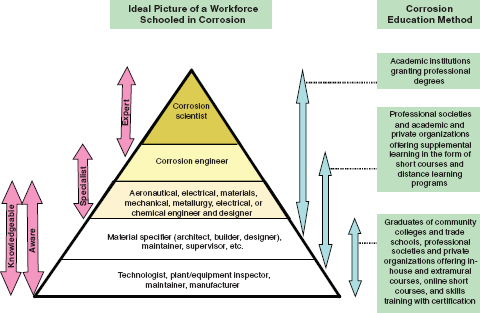
FIGURE 4-8 The corrosion workforce education pyramid. SOURCE: National Research Council. 2009. Assessment of Corrosion Education. Washington, D.C.: The National Academies Press. Adapted from John R. Scully, presented at 16th International Corrosion Conference, Beijing, China, September 2005.
NACE had also asked recent graduates to rate their knowledge of corrosion, and the overwhelming majority rated their knowledge fair or poor. Harris concluded his remarks noting that DOD’s proactive stance will be undermined by the shortage of scientists and engineers with knowledge of corrosion.
The next panelist, Vice Admiral (ret.) Paul Gaffney, president of Monmouth University, began his talk by noting that he was conflicted in that he had spent 10 years giving large amounts of money for education to so-called R-1 universities.20 Nonetheless, he is not the president of an R-1 university, and indeed Monmouth has a large school of education, he noted, referring to the dichotomy posed by the panel’s first speaker, Carl Wieman.
Gaffney advised the panel not to forget that DOD operates a large, through-career, technical training and education system for its enlisted personnel and officers and that a large percentage of science and technology is based at all levels of postsecondary education. Referring to the report Rising Above the Gathering Storm: Energizing and Employing America for a Brighter Economic Future,21 he suggested that the DOD in-house technical training and education system might nonetheless need a boost in the area of science and technology. As the earlier panelist from the Boeing Company noted, this might entail longer training times. With 55 percent of the DOD STEM workforce working as managers, how do we ensure that they are or stay current on the latest S&T information and trends and the latest DOD needs relevant to their assigned technical areas? Gaffney expressed the view that we must determine the critical disciplines because we cannot be broad and deep in everything. It will be the job of those at DOD who make S&T investments (i.e., the research offices of the three military departments, the Office of the Director of Defense Research and Engineering [DDR&E], the Defense Threat Reduction Agency [DTRA], Medical Research & Development Headquarters, and DARPA) to steer disciplines that require clear priority for DOD needs, but we also need “rowers” in the performer organizations (DOD laboratories, universities, and con-
20That is, universities classified as “Research Universities I” by the Carnegie Foundation. The classification underwent a major update in 2005. A.C. McCormack and C. Zhao. 2005. “Rethinking and Reframing the Carnegie Classification.” Change 37(5):50-57.
21National Academy of Sciences, National Academy of Engineering, and Institute of Medicine. 2007. Rising Above the Gathering Storm: Energizing and Employing America for a Brighter Economic Future. Washington, D.C.: The National Academies Press.
tract industry), who work broadly across all S&T areas and remain alert to emerging threats and opportunities. For the Navy, identifying the important fields will be relatively simple: ocean acoustics is the hot topic. Gaffney identified a problem, noting that these are disciplines that might not be picked up by industry, but that at the same time Apple might know something about cybersecurity. He posed the question of how DOD should intervene. He suggested that DOD should ensure that money goes to non-R-1 STEM education as such institutions graduate half of the degrees and account for 57 percent of those seeking PhDs later on. He commented that DOD will be well served if it also invests in undergraduate STEM research, not just in PhD graduate students, since exposure to STEM research in the undergraduate years is a strong predictor of future STEM career pursuit. He also urged consideration of the career reward potential for pursuing STEM.
Next he asked if academia has the capacity. In his view they do, although it could be improved, and he would like to see stability in so-called 6.1 funding (of basic research) and a broadening of support beyond R-1 graduate students. Lastly, he suggested that DOD may need to stimulate the supply, but he cautioned as previous speaker Harold Salzman had that we do not want to hijack the workforce for defense needs.
The fourth panelist was S. James Gates, the John S. Toll Professor of Physics and the director of the Center for String and Particle Theory at the University of Maryland, College Park. He explained that for his remarks he would draw on his experience with the President’s Council of Advisors on Science and Technology (PCAST) looking at STEM in the K-12 system, including the report Prepare and Inspire.22 Of the latter’s recommendations, that on the STEM master teacher corps has been accepted by the Administration, although a similar recommendation on the creation of an advanced research projects agency for education, or “ARPA-Ed,” was not. He noted that there is in preparation a second report to go to the White House, focused on the community colleges and 2-year colleges. In the process of preparing these reports, it was learned that 32 percent of the STEM workforce is initiated in community colleges and, further, the enrollment of minorities is heavily in such colleges. Gates suggested that if we want a robust STEM workforce, we will need to pay attention to new areas.
Reviewing some OECD statistics, he noted that the United States ranks third overall, but when looking at age cohorts the United States is in ninth place in the 25- to 34-years-of-age range. Continuing, he pointed to the wage premiums for a college degree, which have increased from 30 percent in 1950 to 81 percent now; even dishwashers get an 83 percent boost in pay from a college degree. Referring to the study entitled The Undereducated American,23 Gates described an emerging skills pay gap in which the growth in demand for skilled labor by business would continue to outpace growth in supply. He estimated that the fraction not met by the civilian education enterprise might be as many as 1 million additional STEM workers by 2020, with an upper-bound estimate of 2.5 million (see Figure 4-9).
Gates next turned to the levers with which to change the department, the relevant unit of change at the university. He referred to an appendix of the aforementioned PCAST report Prepare and Inspire that covered high-quality studies of learning and noted that PCAST continues to look for appropriate models.24 Referring to Carl Wieman’s talk at the start of the panel session, he concurred that it is desirable to break the antivirtuous cycle—the split between the research community and the schools of education. Gates suggested that there may be some disruptive edges to be found, and he offered the example of Harrisburg University, which was created with input from the business community to address a perceived shortage. In closing, Gates noted that in the military we do not leave our people behind and suggested that we might instill this culture in education.
Session moderator and committee member Vice Admiral (ret.) Daniel Oliver, president of the Naval Postgraduate School, noted that “the big hammer” that Assistant Secretary of Defense Lemnios possesses is the billions of dollars that he invests, but asked the panelists what other hammers Lemnios might have.
22President’s Council of Advisors on Science and Technology. 2010. Report to the President: Prepare and Inspire: K-12 Education in Science, Technology, Engineering, and Math (STEM) for America’s Future. September. Available at http://www.whitehouse.gov/sites/default/files/microsites/ostp/pcast-stemed-report.pdf. Accessed October 10, 2011.
23A.P. Carnevale and S.J. Rose. 2011. The Undereducated American. Available at http://www9.georgetown.edu/grad/gppi/hpi/cew/pdfs/undereducatedamerican.pdf. Accessed November 15, 2011.
24President’s Council of Advisors on Science and Technology. 2010. Report to the President: Prepare and Inspire: K-12 Education in Science, Technology, Engineering, and Math (STEM) for America’s Future. September. Available at http://www.whitehouse.gov/sites/default/files/microsites/ostp/pcast-stemed-report.pdf. Accessed October 10, 2011.
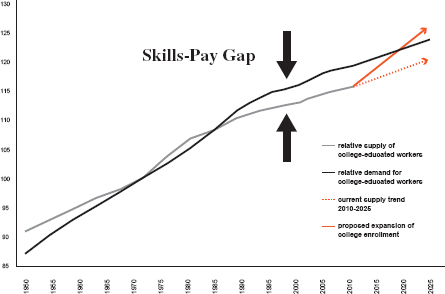
FIGURE 4-9 Supply and demand with two paths forward to 2025. SOURCE: A.P. Carnevale and S.J. Rose. 2011. The Undereducated American. Washington, D.C.: Georgetown University.
• Paul Gaffney suggested that DOD needs to look at the hiring system and the personnel system. In addition, he stressed that funding stability is wonderful and that it is much better to send a signal of say $100 million for 10 years than the same cumulative total with fluctuations from year to year. Gaffney also noted the value of undergraduates doing research and that peer-to-peer interaction is important. Lastly, he suggested that internships in the laboratories at DOD should be encouraged.
• S. James Gates noted that the PCAST education report that is in progress asks this question. He stated that this is the first administration to have raised STEM education to the level that it resides in the PCAST standing portfolio. Gates suggested that Lemnios could similarly make such gestures to get the message out.
• Wesley Harris noted that there were in fact three stakeholders: DOD and its industrial base, the education community, and also the financial community. He asked why is it that Germany is able to maintain high-tech manufacturing at a level we do not and suggested that this is likely not due to a lack of STEM training but due to a lack of engagement with the financial sector.
• Katrina McFarland suggested that the issue is one of how we reward people at the country level. For industry, the leadership was once engineers. Now it is chief financial officers, pointing to profit as the guiding message. McFarland further suggested that we consider the message sent to our children by the cancellation of the space shuttle program. Novels with an engineering theme are similarly uninspiring.
Oliver next discussed the rigidity of the higher-education system and asked the panelists to comment on what drives this rigidity.
• Gates suggested that professors look at the path of least resistance when executing their teaching duties; there is no incentive at R-1 universities on teaching. What are needed are tools for making a sustainable change.
• Gaffney commented that the rigidity that he sees can be attributed to tenure and to professors’ being unionized. The professional education societies and discipline-specific accrediting organizations in Washington,
D.C., can further constrain the latitude for change. He noted that introducing undergraduate research can change the culture of the student who learns to stand up and defend his or her work and who becomes a better problem solver.
• Harris agreed that this was an important question in the context of R&D. Drawing on his experience at MIT, he noted that change does occur and there are rewards for teaching; in the past 30 years he has seen the importance of teaching move from being considered insignificant to the point at which it is now considered in promotions. Harris suggested, however, that the economy would suffer greatly if we were to swing too much toward teaching at R-1 universities at the expense of research and would result in some departments being folded or merged.
• McFarland remarked that she was in a different position than are most university presidents in that she can control the faculty, who are limited to terms of 4 years, resulting in the turnover of 120 of 700 last year. She suggested that accreditation is a possible lever for change.
A participant referred to the U.S. News and World Report rankings which also drive culture and that do not include teaching. Noting that DOD operates schools on bases, the participant asked whether DOD might not look at what it does correctly there.
• Gates noted that he had attended schools on a military base from kindergarten through 5th grade and agreed that this experience was beneficial: posts were very special places, sheltered as they were from the problems experienced in the larger society. He suggested that there may be a correlation to what was going on with the parents.
Another participant asked if there is a crucial age window for intervention.
• McFarland responded that DAU is teaming with 9th and 10th graders and disadvantaged schools that are more open to new opportunities. She has observed an 80 percent attrition from STEM. She suggested that interventions must go beyond policy and noted that “it takes a village”: it used to be that the neighborhood helped children understand what is important.
One participant noted two factors worth considering: (1) State university budgets are being affected by budgetary pressures. (2) Faculty receive a 9-month salary, which leaves a gap that they must fill by finding work. He contrasted this with the German model, in which faculty at the national universities are supported 12 months of the year. Lastly, he commented that the dichotomy of teaching versus research does not appear to be healthy for the future.
• Gates agreed that the research/teaching split is not healthy, as had been set forth in Carl Wieman’s talk. He noted that there have been calls for an even sharper split, for example in Texas, with the idea, which has become moot, of removing research from the University of Texas.
A participant noted that economics has become a popular major even while STEM has remained flat overall. He posited that the increase in college wage premium was less due to STEM fields than to law, medicine, and so forth. He asked the panel to comment on whether Lemnios does not already have tools, such as scholarships and so forth, to strengthen STEM.
• Gates said that he had looked at curves of output of STEM versus non-STEM during the dot-com boom, but those curves resumed normal shapes after the bust in 2000.
• McFarland remarked that wages are based on supply and demand. If the community is focused on short-term return on investment, then this will be reflected in demand signal. Apple and Microsoft, for example, are focused on cost. How does one create an environment that has a high payoff for research?
• Harris suggested looking to the financial sector and noted the lack of a conversation between DOD and financial concerns.
• Gaffney, by way of illustration, posited two recent college graduates—one with a degree in artificial intelligence and the other with a degree in aeronautical/astronautical engineering, both of whom go to work at Goldman Sachs upon graduation. He further noted that 50 percent of chief executive officers of firms in the S&P 500 have a background in STEM.
PANEL 5: ENSURING AN ADEQUATE WORKFORCE CAPABILITY IN AN UNCERTAIN FUTURE
Given the unpredictability of: scientific and technological change; levels and trajectory of DOD budgets; advancements and emerging threats; and the historical inadequacy of past projections of future workforce needs—how can DOD ensure an adequate workforce capability for itself and its defense contractors in the future?
Summary of Lead-off Presentation
Ruth David, the president of ANSER, began her remarks explaining that the scope of her talk would not encompass quantifying the workforce needs but would instead offer a framing of the issues that should enter into any planning. What are these planning considerations? She observed that in looking at a number of documents on what STEM is, there appears not to be a consensus. She suggested that we are in a fourth scientific paradigm, e-science, reflecting the changing nature of scientific discovery, which in the future may entail moving from hypothesis through discovery to data generation. Computational capacity and accessibility of information are changing the nature of scientific discovery. Regardless of whether one believes that e-science is the way of the future, one must understand that scientists are being impacted.
David discussed the trend toward convergence between disciplines and noted that computational-X fields (where X is chemistry, physics, and so forth) are evolving and relating to themselves and to other disciplines. She observed that convergence is reshaping products toward downloadable functionality. She also discussed “mash-ups,” noting that one of Lemnios’s key areas for investment is data to decisions. One tool is to encourage these mash-ups. There are also accelerators with all scientific data moving online; one could think of a pyramid with peer-reviewed literature at the top, below which are derived and recombined data, and then raw data. Researchers can stand on one another’s shoulders to accelerate. These accelerators will drive rates of change that DOD will have trouble keeping up with. How will we tell if we are preeminent amidst this rate of change? Whether one operates under a principal-investigator-centric model versus a multidisciplinary team will be important to understanding results. This will have implications for behaviors as well and a different kind of skills. Referring to the report The Engineer of 2020: Visions of Engineering in the New Century,25 David pointed out the need for teamwork and collaboration skills. She also noted the split of systems engineers versus systems thinkers and that we will need the latter who understand the soft systems aspects. A further dichotomy is that of engaged (connected to information and people) versus controlled or isolated people. David observed in the context of cyber science and technology, for example, that we know how integral the human is.
Next, David turned to the expectations for future STEM workers. She expressed the view that technologists had worked behind the fortress walls to such an extent that they had lost touch with drivers in commercial markets; purely defense technologies comprise a shrinking list. Referring to the challenges of needing to follow what is happening worldwide and of being presented with too much information, David suggested that there is a new set of skills needed that will allow people to cope with this; some domains will want to do their science but need these new skills to explore their data. Disciplines that must be brought to bear include graphic design and human-computer interface. She observed that the market for these skills is exploding, driven in large measure by the private sector’s desire for business intelligence, and she commented that the competition for these new skills is quite fierce. She pointed to the nature of the STEM enterprise changing to encompass metamaterial and presented a global
25National Academy of Engineering. 2004. The Engineer of 2020: Visions of Engineering in the New Century. Washington, D.C.: The National Academies Press.
geographic analysis of publication data from Scopus, noting an increasingly globalized distribution of activity, but also rapid growth in certain regions of specific countries. She suggested that we need to understand these trends as they manifest themselves overseas if we want to be preeminent as a country, but she cautioned that data tend to be trailing indicators. She presented similar geographic data showing the globalization of autonomous systems.
Turning to an analysis of scientific trends, David noted the top-20 publishing cities in the time frame 2004 to 2008 and used this to calibrate the rate of growth as compared with that of the period 1996 to 2000. She observed that the eastern seaboard had decreased or stayed constant but that Asia is growing (see Figure 4-10).
David continued with a discussion of publication quality, including a citation analysis comparing the same 4-year periods. She observed that the United States is doing very well despite dropping its market share and offered the further caveat that the sample population is limited in this study because it does not include foreign-language publications. The new entrant is China, with 4 percent.26
Resuming the theme of accelerators, David discussed collaboration, for example on scientific publications, and the expanding global networks and presented analysis of the connection between collaboration across countries on publication impact. Taking an integrating slant, she noted that the overall purpose of such analyses is to establish the importance of tracking the numerous factors working together to change the environment fundamentally, which DOD will need to evaluate.
In closing her remarks, David offered some provocative questions: Should STEM be redefined and expanded to include the soft sciences, inter- and multidisciplinary fields, and computational-X? Further, how can we develop and understand leading (versus trailing) indicators? How can we ensure that our STEM workers are web-savvy in every dimension? She posed a question for the panel: Do we have the right bins to understand what the STEM workforce is, given the changing environment? David then observed that in her view a better understanding of the role of technology is needed in national security. The STEM workforce need not be PhD engineers but will need a degree of literacy. She observed that we tend to bin people by their degrees, but this oversimplifies the complexity of the kind of workforce that we need in the future. The bottom line, she contends, is that if we accept our tasking to take inventory, then job codes are an inadequate characterization. We will need to look at credentials versus experience; degrees rarely reflect proficiency. Systems engineers, for example, need to go through failure to get the requisite experience. There is the dichotomy of personnel who are committed (to DOD and its mission) versus personnel who are engaged (rapidly accessible as skills change). She suggested that we will never have the right skills in-house. David noted that there are some barriers and that we are not driving innovation in the right areas (e.g., IT, energy). In addition, there is competition with the private sector for a limited talent pool. The final barrier is the challenge posed by the need for clearances and controls on the one hand and by the need for global engagement on the other.
Session moderator Robert Hermann asked Ruth David if she could offer a model of how to address the point on clearances and controls versus global engagement.
• In reply, David noted that one of the underlying causes of the STEM problem is the lack of appreciation for who is doing what elsewhere. The sense in the national security community is that “we are ahead so we must protect.” She adduced the example of deemed exports: studies of this have put forward the conclusion that controls are a result of lack of awareness. She stressed that it will be critically important to develop leading indicators and suggested that if presented with data, people will rationalize the environment.
Committee member Mary Good observed that the subject of the significance to STEM of the soft sciences has been brought up a number of times and noted that we have a political climate that is trying to eliminate funding for the soft sciences.
• David replied this is a serious problem and may be more challenging to solve than security.
26The Royal Society. 2011. Knowledge, Networks and Nations: Global Scientific Collaboration in the 21st Century. London: The Royal Society.
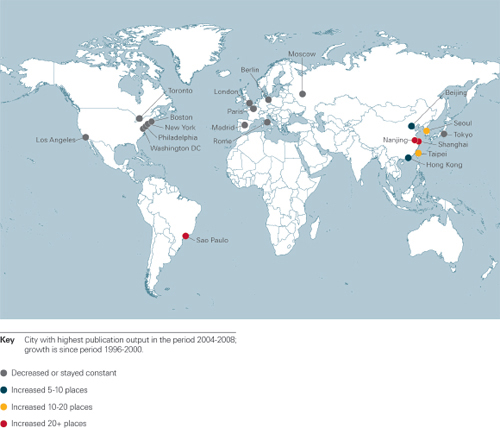
FIGURE 4-10 Top 20 publishing cities, 2004-2008, and their growth since 1996-2000. SOURCE: The Royal Society. 2011. Knowledge, Networks and Nations: Global Scientific Collaboration in the 21st Century. London: The Royal Society.
Committee member Daniel Hastings asked, with respect to global engagement, if there is not a model in which the STEM workforce is updated and refreshed by being engaged globally.
• David replied that there are groups such as ONR Global, which has a global footprint with some singletons in various countries in order to engage with the local technology base. She again stressed the importance of collaborative projects.
A participant noted the difficulty posed by collaborative work in that it entails having to transfer knowledge to a foreign entity and navigate through export controls.
• David stressed the need for export reform and suggested that research per se should be exempt from these controls, understanding that there is a blurry line between research and development. She observed that large research universities have collaborative programs with universities elsewhere or campuses elsewhere.
The session then proceeded to the brief talks by the four members of Panel 5 on the panel’s topic, ensuring an adequate workforce capability in an uncertain future.
The first panelist was Vallen Emery, the outreach program manager at the U.S. Army Research Laboratory (ARL). He began his remarks by noting the challenges that we face in STEM education and the concerns and visions expressed by Assistant Secretary of Defense Lemnios. He referred to the DOD’s board of directors for STEM and suggested that the output from the board has to give a cohesive strategy. Emery observed that DOD has programs that it has been investing in for a long time and that there is a need to take a look at the outputs and whether these have produced people who entered the STEM workforce.
He turned to the topic of opportunities for students, noting that ARL has about 300 people at the undergraduate level who come in to ARL and are exposed to possible careers in STEM. This is critical from the standpoint that as children they were exposed to PlayStations, but they do not understand the engineering behind them. Emery noted there are statutory authorities that allow DOD to make equipment donations, for example, that facilitate their having direct relationships with academia.
Next, Emery turned to the question of where and how DOD invests. He observed that the services (Army, Air Force, and Navy) focus on technologies and not necessarily on the human capital responsible for them. He suggested that there needs to be a policy document from DOD stating that the services are permitted to go on high school and college campuses to show the depth and breadth of DOD research. He pointed to current Office of Personnel Management (OPM) procedures, under which it takes a long time to bring someone into the organization. Emery also observed that the majority of the workforce does not have these skills, and many do not have the graduate degree needed for senior positions. The refresh rate at DOD is sufficient because of the connection to the academic partners. Referring to the discussion about clearances and controls versus globalization, Emery stressed the need to incentivize the recruitment of students who can meet DOD employment criteria.
The next panelist was Jennifer Byrne, the vice president for corporate engineering and technology at Lockheed Martin. She began her remarks noting that when she decided to become an engineer, she had originally thought that she would go into research, but she wished that she could have seen today’s world of technology with quantum computing, spacecraft, and so forth. Byrne noted that her job allows her to see research and development across the company while at the same time funding university research. She observed that through technical interchanges with universities, it has become clear to her that the composition of the classroom has not changed much in the United States since the time when she was the only woman in the class. Byrne did observe, however, that internationally there is a better mix, in India in particular, where females are encouraged to go into engineering and entrepreneurial professions. She discussed the experience sponsoring the USA Science and Engineering Festival in September 2010 (and upcoming on April 27-29, 2012), which was held on the National Mall in Washington, D.C. There they wore shirts that said, “Ask me about being green,” indicating the wavelength for green in the electromagnetic spectrum. Byrne also discussed the perception of science vis-à-vis the media and noted that Lockheed Martin is an adviser on technology integration for the television series NCIS Los Angeles, whose producers want technology to be a star of the show, and hold a biweekly teleconference with Lockheed Martin to receive background on the technology. Byrne noted that working in India she observes that the engineering profession is held in high regard by women engineers and entrepreneurs; she wondered what lessons this might hold for the United States. Byrne observed that in the decade after she obtained her electrical engineering degree in 1990 there had been a steep decline in the number of workers in aerospace and defense. She noted that Lockheed Martin has in its workforce 66,000 scientists and engineers and wants to see growth. Picking up on Ruth David’s remarks, in closing Byrne commented that the future workforce would need to be both collaborative and super-smart.
Katherine McGrady, the chief operating officer of CNA, began her remarks as the fourth panelist noting that at CNA about 70 percent of its employees have PhDs in STEM and extensive experience with STEM in the field. McGrady explained that in preparing for the session, she spoke with people at CNA who have been dealing with more recent technologies, like cyber, as well people from CNA’s business that trains DOD employees, both uniformed and civilian. She noted that, like Vallen Emery, she wondered what we can do now as opposed to what we can do in the long term. For example, CNA staff were not convinced that if the fiscal environment were one of
limited resources, one would want to increase the STEM skills of enlisted personnel: the high-tech in the battlefield has nothing to do with the science. It would be better to put STEM money toward laboratories and defense industry business lines. That said, McGrady acknowledged that some fields really demand STEM; submariners, for example, really need this to operate the nuclear power plant on a carrier. Another point is that a recent study by CNA on the Navy’s officer corps27 found that they were well prepared for their time in the warfare community but not so well prepared for their later careers, in which critical thinking skills are needed. The latter, moreover, are not the exclusive purview of scientists: having a STEM background may impart these skills, but many people from other backgrounds can contribute as well. An example of the latter is the intelligence community, in which staff collect and analyze a large volume of data, which involves judgment and awareness that do not necessarily come from STEM. Another conclusion from CNA’s study was that a technical undergraduate education does not appear to confer an advantage because of the training for new officers. Those with backgrounds in STEM were retained and promoted at the same rates. McGrady then suggested that the leverage point for STEM is the defense industrial base and the laboratories and that it is bigger than just the DOD workforce and noted the difficulty in attracting people of high caliber who are graduating right now and of bringing them into the government; some parts of the government can pay a huge salary, but they are few in number. In contrast, defense contracting does seem to pay enough and is able to retain staff; they have incentives and, for example, allow off-ramps so that you could have children and return to the job.
McGrady’s final point was that it is hard to interest people in the sciences, and the time window in which you can affect this is at the high school level. In addition, it will be important to consider military technical training, which is 12 to 18 months long, and where all these people go and how this science is used on the battlefield.
The final panelist was David S.C. Chu, the president of the Institute for Defense Analyses. He began his remarks by challenging the supply focus of the STEM discourse and suggested that the focus be on demand. He observed that defense today is too small a fraction of the nation’s output to have a significant impact on supply; it is still only 4.5 percent of GDP. He raised the questions of whether the compensation that we are paying is not too modest, or too unexciting, or whether there are not simply barriers. With respect to the government workforce, he expressed the opinion that the answer to all three questions is yes.
On compensation, he adduced the example from the national security personnel system of persons stranded at the level of GM-15, Step 10. He noted that the laboratories and the acquisition workforce have demonstration authority to set pay scales. There are other tools in the civil service tool kit and, for example, one can pay recruiting and retention bonuses. The government still has experts who can be paid a salary of $200,000.
Chu then turned to the question of whether the compensation is unexciting, and he noted that DARPA has successful contests for robotic vehicles or that Teach for America, which does not pay much or offer good working conditions, is successful. He asked whether we might not want to have a “Science for America” program to try and identify opportunities that would excite young Americans. Chu observed that there is no recruiting strategy on the civilian side that is comparable to that of the uniformed side. He noted that to make prompt offers requires direct-hire authority and that OPM has been sympathetic at granting this when a shortage can be identified. At the same time, he observed, there are more pedestrian issues such as the need to write the job description better.
Turning to the question of the citizenship requirement for cleared work, Chu observed that 3.5 percent of uniformed recruits are not U.S. citizens and that the law provides military accession for national security interests similar to that used to recruit non-American scientists after the Second World War. Lastly, Chu discussed the issue of minorities and women, which he adjudged to be a supply issue.
In conclusion, Chu offered several points, starting with the view that paying dollars on the supply side amounts to paying rents, as this is paying people to do what they would have done in any case, or if not, the practice simply displaces other funds. Next, he suggested that one size will not fit all: each domain is different, whether science, engineering, or mathematics; with regard to the latter, DOD is a large source of demand. Third, and finally, Chu observed that the field in which you start is not necessarily the one in which you apply your talent and that the most significant contribution is from people who can think outside their fields.
27CNA. 2011. Developing an Education Strategy for URL Officers. Arlington, Va.: CNA, Inc.
The panelists having concluded their opening remarks, session moderator Robert Hermann asked them to comment on the citizenship requirement and on how DOD can make use of non-U.S. citizens.
• Vallen Emery described a barrier that he encountered when he was invited to China to give a seminar on toxicity. The Department of State did not approve his travel, citing his Army affiliation. Emery urged that we take a serious look at such a parochial view of what are really intellectual exchanges.
• Jennifer Byrne observed that to prepare for technological surprise, the best way of keeping ahead is situational awareness. Further, she observed that in the BRIC,28 people are not encumbered in their thinking by technologies but that by contrast the United States is made complacent because of technologies. She noted that Lockheed Martin funds work in Canada, Australia, and other countries where it sees capabilities developing that could not be developed here. The flip side is that innovation thrives on diversity. Byrne gave the example of “jugaad,” an Indian expression meaning “cheap innovative solutions.” She described a situation in which Lockheed Martin needed 200 cleared Java programmers overnight and, not being able to find such, had to develop a method of partitioning the work between classified and unclassified so as to accommodate the shortage.
• Katherine McGrady noted that her adviser made regular trips to China, so globalization is not news to her. She concurred with Vallen Emery and others who observed that if you are recruiting the best and brightest but people are disallowed from traveling, this is a significant disincentive.
• David Chu advised that a stronger bridge to academia would be a good way to access what is going on around the world and suggested that some dollars be used for sabbaticals in the government. Also, he asked, why not hold more exchanges with other scientific enterprises overseas the way services do with war colleges? He further adduced the example of British Commonwealth citizens who are seconded to the U.K. government as if they were U.K. citizens. Lastly, Chu urged that the investment dollars be spent recognizing those who are fluent in critical languages; we assume that the dominant language will always be English.
Robert Hermann, referring to the practice of exchange in technical domains for improving understanding in S&T, noted that a common problem is procurement. He described how at the National Security Agency (NSA), where the work is on highly sensitive activities, there were extensive interactions with the United Kingdom and Commonwealth based on a degree of trust.
A participant noted Chu’s skepticism about the ability of DOD to address the supply-side problem but added that attracting an all-volunteer force is based on incentives. He proposed that telling civilian DOD to skip incentives would compromise its recruitment ability. Establishing personal relationships and internships are part of the supply-side package, for example.
• Chu replied that the emphasis on scholarships is too much. DOD is a small part of the overall picture. He asked about the kind of career opportunities that DOD is offering and said that sometimes DOD does not pay enough or hire promptly or describe the opportunity in a compelling way—all of which is on the demand side. Chu suggested that if people think there is something interesting and rewarding, they will go even if they do not have a strong intrinsic interest. For example, in the United States we do not try to improve the nation’s high schools (supply) but we offer a great job environment for those with a high school diploma.
• Emery expressed the view that there were not enough internships at DOD. He described the need to show the relevance of the theory that people learn in a classroom and suggested a competition involving the writing of a paper that entails understanding the utility of the science and engineering that the writers are practicing.
Another participant noted that two of the speakers had said that DOD has the authority that it needs but does not use it. He stated that such authorities have a way of becoming disused, as it is the Secretary of Defense who has the authority, and he cannot delegate it.
28BRIC: Brazil, Russia, India, and China.
• Emery agreed that these authorities are not consistently applied across the services, but, for example, the laboratory directors themselves have such authority.
• Chu advised that we should judge the system on performance not on processes.
Committee member Anita Jones commented that “the carrot” being used does matter. DOD invests in research areas that have promise and, for example, during the 1970s and 1980s paid tuition and living expenses for computer scientists who designed chips at Intel, National Semiconductor, and so forth. DOD was growing the pipeline.
A participant made the suggestion that Congress could authorize 2,000 or 3,000 graduate fellowships, and these could be spread around rather than being converted to department-specific uses.
• Chu said that although programs of this kind are very popular, they are (maybe) not the best.
• Hermann suggested that it is possible that someone will work on some supply segment, for example, devices, but that foresight is needed to identify such areas.
A participant observed that there is a focus on scientists and engineers with advanced degrees, but that DOD’s needs can fall into other categories of the workforce that need some training in science and engineering, such as engine maintenance. These are critical areas, and these workers need STEM education in high school or it is too late; welding is a critical skill, for example.
• McGrady noted the practice of precision-based logistics, in which the person in the field can pull whatever module is not working and send it back to the manufacturer. She observed that with DOD going to such a system that obviates the need for STEM in the field, it may be working at cross-purposes by continuing to push for STEM overall.
• Hermann noted that the example given by the participant may be representative only of a class of activities, such as knowing how to get a generator to work when it stops. He noted that the example may not extrapolate to the general.
• Emery added that we do not do a good job of describing opportunities. There are opportunities for those with associate’s degrees and with bachelor’s degrees and so forth.
• McGrady offered an example that she had observed while deployed, in which generators broke down all the time. The person who was the best at fixing them was the guy from a family of car mechanics, and he had never been to college.
Another participant referred to the workshop charge and the mention of “uncertainty” and asked the panel to comment on how DOD might mitigate the impact of uncertainty.
• Chu suggested that broader preparation is needed and that this is how you can cope with developments that you cannot forecast.
• Emery noted that through some of his visits to industry, he has learned that there is psychological profiling performed to ensure that those hired in scientific and engineering fields can think in a flexible manner. He commented that today it is necessary to be more multidisciplinary in approach, a point seconded by McGrady.
A participant observed that the panel had touched on two big issues: (1) it takes a long time to get clearances, and (2) it takes a long time to get hired into civil service. He suggested that engineers and scientists have to be nurtured or they will leave their field to become, for example, a hedge-fund manager.
Committee member Daniel Hastings referred to data presented by Ruth David on the globalization of some fields. He observed that Lockheed Martin is engaged globally at the same time that it is involved in classified government work. He asked Jennifer Byrne how Lockheed Martin was taking advantage of this and absorbing global work into its business lines.
• Byrne replied, noting that Lockheed Martin has 15 strategic technology threads in which it has seen disruption that might be important to its customers. These threads mesh with Lockheed Martin’s organizational competences. She described the company’s use of business intelligence software to observe trends in patents and research. This allows it to see for a given country where its technological capabilities and interests lie.
Committee Co-Chair Augustine made an observation on the ability of program managers of R&D projects and the like to make lateral moves—specifically that 30 years ago you could work in DOD and then back into industry. Today, however, there is a regime in force related to conflict of interest that would prevent one from doing this.
• Chu agreed that this is a serious problem that has made it difficult to attract mid-career talent. He stressed the need to ask the question, Why don’t people come? Chu suggested that the input of the NRC to that evidentiary process would be of great value.


