
CHARLES VEST, PRESIDENT, NATIONAL ACADEMY OF ENGINEERING
In his keynote presentation, President of the National Academy of Engineering Charles M. Vest set the larger context for the workshop, comparing the educational enterprise and workforce of the United States to those in the rest of the world. He observed that the United States has a science and engineering workforce problem but primarily an engineering workforce problem: roughly 13 percent of university graduates in the United States have degrees in the natural sciences and only about 4.5 percent have degrees in engineering. Vest underscored that this is a problem: compared with the respective percentages for China and other countries, this is lower. He noted that there are a number of problems, including gender imbalances. Data on college-enrolled students, he said, show that there is a decline over the 4 years during which they are enrolled between the number of college students intending to major in science and those who actually graduate with such a degree. Along the way, of those who had earlier declared their majors in science, there is a loss of one-quarter of women students—in absolute numbers, from 13 percent down to 9 percent—but a modest increase for males, from 12 to 15 percent. Vest again noted the huge gender imbalance among those coming into universities who are pre-intended engineering majors: 3 percent of women versus 17 percent of men. A further 50 percent overall are lost over the 4 years of college. He believes that this points to an opportunity to make engineering more engaging and to retain these students and thereby double the numbers of graduates.
Turning next to a discussion of the demography of students in the 18- to 23-year-old age range, Vest noted that the percent in this age group represented by minorities is increasing, but that the fraction represented by minorities earning degrees in engineering has been flat since 1995. Considering the percentage share of engineering undergraduate degrees going to minorities and women, he believes that there is an impending workforce train wreck and that there is a need to increase the shares of minorities and women in the growing segment of the population in view of its impact on the absolute numbers of graduates.
Vest then discussed what he called “the three elephants in the room,” starting with the citizenship requirement for classified work. He explained how this requirement further shrinks the eligible workforce and presented data (see Figure 3-1) showing that the U.S. S&E workforce includes 25 percent born outside the United States and, when PhDs are considered, the workforce is 40 percent born outside the country. If the production of PhDs were considered, then the fraction of those born outside the United States would rise to above 50 percent. He asked whether we cannot do something to better access this talent that does not happen to be born in the United States.
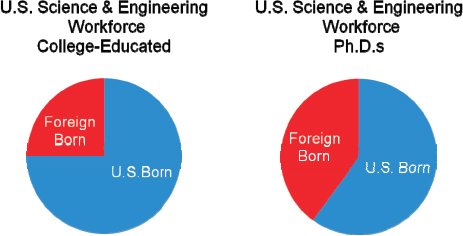
FIGURE 3-1 Foreign-born share of the U.S. science and engineering workforce. SOURCE: National Science Board. 2010. Science and Engineering Indicators 2010. NSB 10-01. Arlington, Va.: National Science Foundation.
The second elephant in the room, Vest noted, is that things (i.e., people, ideas, technology) flow in different ways. He pointed out that, whereas in the past there was the problem of brain drain to (versus from) the United States, this flow has been altered so that what we have now is “brain circulation” as economies heat up in Asia and Brazil. We are moving toward “brain integration”: this has been going on in industry for a while and is beginning to grow in academia; we work on problems worldwide and do not have to be physically present in a country in order to collaborate. Vest believes that it is important for recognition of the latter to figure into solving the problems of how we vector young men and women into fields that are needed by the security community.
Finally, the third elephant, Vest commented, is export controls and deemed exports: generating new knowledge in technology is far more important than obsessing about every leak: this is the “leaky bucket” theory of security.
ZACHARY J. LEMNIOS, ASSISTANT SECRETARY OF DEFENSE FOR RESEARCH AND ENGINEERING
The Honorable Zachary J. Lemnios, Assistant Secretary of Defense for Research and Engineering, opened his keynote presentation by offering some context for the workshop. He explained how the topic of the STEM workforce requires looking out 5 to 20 years from now and that he has made it a priority early on in his tenure to focus on what the technical workforce should look like in years to come. This entails consideration of what we put in place today in order to build the needed technical depth, align it to the fields that we need to be in, understand where we are relative to the rest of the world, and build an innovation engine at DOD that is competitive with the private sector.
Lemnios referred to the joint operating environment put together in 2010 by the Joint Forces Command. It posited a shift in world demographics amid globalization and the pace of innovation. He noted that the time available to address threats and deliver capabilities has been shortened considerably. He observed that the National Academies report Rising Above the Gathering Storm: Energizing and Employing America for a Brighter Economic Future1 put into perspective the position of this country relative to the rest of the world and that of industry and

1National Academy of Sciences, National Academy of Engineering, and Institute of Medicine. 2007. Rising Above the Gathering Storm: Energizing and Employing America for a Brighter Economic Future. Washington, D.C.: The National Academies Press.
where we need to be as a competitive nation. He noted that the report included the first use of the term knowledge capital as a concept for considering human capital and how we train future leaders in STEM.
The offshore outsourcing of technical R&D is cause for concern, according to Lemnios. General Electric (GE), for example, has moved most of its research overseas. Four of the top-10 patenting companies are overseas, and the United States has lost its position in test scores. Globalization of R&D, from basic to applied, amounts to roughly $1.2 trillion, of which about one-third resides in United States, with another third being in Asia. Of the $400 billion in the United States, he continued, half is accounted for by industry, and so DOD leverage is very small. He noted that DOD is the consumer and needs to leverage its suppliers. Noting that another trend is the shift in alliances and the shift in R&D funding leadership, he asked how DOD can put forward a strategy to maintain U.S. leadership.
Lemnios noted that across DOD there are laboratories, basic research, and independent research and development (IRAD, performed by the contractor base) comprising an enormous enterprise of innovators. There are areas in which it will be of great importance to develop new capabilities but also core competencies for enduring capabilities. The 2010 Quadrennial Defense Review (QDR) identified S&T priorities that are vectoring DOD to where it needs these core competencies. The challenge will be to align these elements to build these disciplines, including those in the industrial base. Then, he noted, there is still the question of how to transition these ideas from a laboratory or a small business to one that allows DOD to develop these capabilities.
Lemnios then described the system of 62 DOD laboratories with 60,000 people employed and with operating budgets of about $2 billion; another $1 billion in research funding goes to academia. Further, there is a connection with industry’s IRAD that totals about $4 billion from DOD, but the connection is mainly through advanced development or pre-production. The federally funded research and development centers (FFRDCs) and university affiliated research centers (UARCs) provide surge capacity in S&T areas where DOD does not have insight. The purpose of all of this, he said, is to build an S&T enterprise for DOD that operates across these lanes rather than in the traditional “pillars of excellence.”
Next, Lemnios turned to a discussion of what is referred to as the S&T priorities memorandum2 and of how these priorities were developed. DOD considered the architectures identified in the QDR and critical capabilities vis-à-vis the invented technology base and asked whether and how it could support these architectures and capabilities. Lemnios discussed force multipliers that could address these, including data-to-decisions capability, autonomy (i.e., autonomous systems that reliably and safely accomplish complex tasks), engineered resilient systems, and human systems—areas for which there are pockets of research in the industrial base but for which developing a technical discipline will take some time. He then discussed two of three listed complex threat areas:3 (1) Regarding electronic warfare, he noted that in the past this had been a hot-topic area. He described how he had gone to graduate school supported by Hewlett Packard (HP) in the then-emerging area of radio-frequency engineering. Noting the continued evolution in this field, he asked what electronic warfare might look like in 10 or 15 years and whether a new training ground would not be needed. (2) On cyber science and technology, Lemnios observed that this is talked about all the time in the Pentagon, but the way in which new concepts in cyber science and technology are built and the way in which cyber systems are validated are not well understood. He stressed the difficulty of building a technical discipline around secure networks and of handling massive amounts of data in unstructured environments.
Lemnios then discussed the high-interest basic science areas that are orthogonal to the priority S&T areas, and which include synthetic biology, engineered materials, quantum systems, modeling of human behavior, cognitive neuroscience, and nano-science and -engineering. He described the evolution of this list: Robin Staffin4 led a set of meetings at colleges to look at what the emerging fields are. Lemnios noted that part of the challenge to the NRC committee will be to identify those areas to which ASD(R&E) should pay attention over the next decade.
Lemnios then discussed the STEM-related programs underway in ASD(R&E). These encompass K-12 students, undergraduate and graduate students, and more than 23,000 teachers and 300 faculty. He said that ASD(R&E)
2Secretary of Defense William Gates. April 19, 2011. Memorandum for Secretaries of the Military Departments; Chairman of the Joint Chiefs of Staff; Undersecretary of Defense for Acquisition, Technology and Logistics; Assistant Secretary of Defense for Research and Engineering; Directors of the Defense Agencies: Science and Technology (S&T) Priorities for Fiscal Years 2013-2017 Planning. Washington, D.C.
3The third such area is counter weapons of mass destruction.
4Director of Basic Research, ASD(R&E).
needs to know how to use this collection of programs for effect across DOD; the challenge is not so much how to execute these various programs as how to use the results: that is, how might DOD best incorporate students into DOD laboratories and the industrial base? Lemnios observed that, in terms of numbers of graduates annually, the United States is losing 10 to 1 to China. He said that in the past month, ASD(R&E) has put in place a board of directors model for STEM, drawing its membership from across the military services and civilian ranks of DOD. He described three key areas for the board: First, what are the future needs of the department in technical depth, discipline, and numbers? Second, how do we fill those needs today? Third, how do we scale up academia in new areas, perhaps implying new departments?
In closing his remarks, Lemnios reviewed the five-point statement of task given the NRC committee and reemphasized the need to think about new and emerging disciplinary focuses and cross-disciplinary interactions.
Committee Co-Chair Norman Augustine asked Mr. Lemnios a two-part question: (1) With respect to microelectronics, he noted that some of the defense systems on which he had worked had taken 10 or 20 years to develop and deploy into the field. He asked whether this could not be shortened. (2) The co-chair also noted that the leading edge of R&D lies in the private sector, not DOD, where it had been in the past, and that moreover companies are evolving global research consortia. The latter, however, become ensnared in export controls that constrain anything that passes through the United States, and this has led companies to simply bypass this country. Augustine asked if it would not be possible to change the rules to accommodate this aspect of globalization in a DOD framework.
• In response to the first question, Lemnios replied that he agreed that no one is going to graduate from a first-rate school and choose to work in the defense industrial base if the person thinks that his or her first product will reach the market in 10 years. He offered an example of the iPod, which in the design phase had three requirements: 10,000 songs, three clicks, and fits in your pocket. Further, the iPod had to be ready in a year. This is the sort of problem that will attract the best and brightest. Lemnios suggested that there might be real benefit to shortening the DOD acquisition cycle if for no other reason than that it would increase the odds that project staff could see the result. Regarding Augustine’s second question, Lemnios responded that although he believed export controls to be outside his purview, he nonetheless recognized that regardless of the technology in question, many of the elements are available globally, and adduced as an example field-programmable gate arrays (FPGAs). Few core technologies reside entirely inside the United States, placing a premium on systems engineering.
Committee member Leif Peterson asked where the Secretary of Defense stands on STEM issues. He also asked Lemnios to discuss the budgetary pressures due to the deficit crisis and asked whether the Secretary of Defense would still be interested in addressing the issue of the STEM workforce in an environment of greater competition for funding.
• Lemnios replied that STEM was part of the secretary’s confirmation testimony. Part of the department’s posture has been to have disciplines to execute ideas in a timely way. He noted that there are now pressures to reduce costs: DOD turns over every single rock, so to speak, to find the best value for the department.
A workshop participant noted that “best” is the enemy of the good, and this is why it takes 20 years, rather than 8, to field a new system, as procurement officers continually write new requirements.
• Lemnios noted that the fast-track acquisition addresses this, and he adduced as an example the mine-resistant ambush protected (MRAP) vehicle. He said that 1,000 MRAP vehicles are made per month, although these are not optimal and are in fact now being retrofitted. He noted that combatant commanders are asking him for the “80 percent solution,” and further, they tell DOD that they cannot wait for the 10-year solution. By contrast, however, Lemnios expressed the view that we must understand the risk and that much in question is addressed by good systems analysis.
Referring back to the Secretary of Defense’s memorandum on STEM,5 another participant asked how this has affected the priorities of ASD(R&E).
• Lemnios noted that ASD(R&E) had developed the list, but he noted that neither stealth technology nor undersea warfare is on the list. The core of discussion revolves around asking, What are fields for which we do not have an infrastructure in place?
A participant noted a new focus by the administration on advanced manufacturing and asked what DOD is doing in this area.
• Lemnios replied that the STEM board of directors is focusing on this issue and is looking across the department at where it is making investments. DOD will need new ideas from academia and industry to build a new technology base.
Augustine said that Kelly Johnson, the chief designer of Skunk Works, worked on 32 airplanes that flew. Today’s engineers will be lucky to see 2 in their careers. He suggested that there is a need for more prototyping.
Lemnios concurred with Augustine on this point and allowed that he had heard this in other discussions with industry. He remarked that “you grow systems engineers” through experience. Elaborating on Augustine’s suggestion, he asked: (1) How do we put together challenging problems that can be the basis for training future engineers? (2) How might we get access to testbeds and data sets?
5Secretary of Defense William Gates. April 19, 2011. Memorandum for Secretaries of the Military Departments; Chairman of the Joint Chiefs of Staff; Undersecretary of Defense for Acquisition, Technology and Logistics; Assistant Secretary of Defense for Research and Engineering; Directors of the Defense Agencies: Science and Technology (S&T) Priorities for Fiscal Years 2013-2017 Planning. Washington, D.C.


