
CHALLENGE SUMMARY
Modern society depends on harvesting dense, but nonrenewable resources. While fossil fuels are the most obvious examples, mining of phosphate rock and metals also falls into the nonrenewable category. In general, the nonrenewable sources will be depleted, which will cause major cost increases and severe disruption to social/economic patterns. In many cases, the use of the nonrenewable resources also causes serious environmental disruptions, such as global climate change for fossil fuels, eutrophication, and the pollution impacts of mining operations.
It is possible in some cases to develop processes that can create renewable substitutes for nonrenewable resources or that can capture the nonrenewable resources so that they can be reused. In the energy arena, photosynthetic biomass can be grown using sunlight as the energy source, which (at least in principle) generates renewable, C-neutral energy feedstock. Likewise, phosphorus can be captured from agricultural and food waste streams, while metals can be captured from used products.
The challenge is that the scale of these renewable technologies must be massive to have an impact. For example, about 84% of the energy use from human society today comes from fossil fuels; this is about 11 terawatts (TW) of fossil energy (or the equivalent of 160 million barrels of oil per day). Replacing fossil energy with renewable energy directly from photosynthesis at the TW level will demand that large expanses of the earth’s surface be devoted to photosynthesis targeted to bioenergy production, and production systems will need to be managed so that they are highly intensive.
Phosphorus is now mined at a rate of about 17.5 metric tonnes per year, with about 80% being applied to crops. Since the supply of minable phosphorus ore will last only for a few more decades, technologies will need to be developed to recover most of the P being lost to runoff, animal waste, and human waste. Likewise, the so-called “green minor metals” have finite supplies and will need to be recycled. The most critical are tellurium, indium, and gallium, which are key to photovoltaic technology.
Key Questions
• What resources can be produced renewably or recovered by developing intense technologies that can be applied on a massive scale?
• What resource do we need to produce/recovery this way?
• What is the likelihood that we can develop intense, massive technology to do it?
• What are the impacts that need to be evaluated before we implement the technologies?
• Economic—how much will it cost to develop, implement, and operate? How can we afford to make the investments?
• Ecological—how will ecosystems be altered by massive implementation of renewable technologies that necessarily take up a large surface area?
• Environmental/climate—how will the massive implementation of renewable technologies alter climate or other environmental conditions? What other environmental conditions?
• Social—how will the organization of societies be altered by the massive implementation of renewable production/recovery technologies?
• Social/Economic—who will benefit or be hurt by the shift to renewable sources on a massive level?
• What are the foreseeable successes?
• Are catastrophic failures foreseeable?
Reading
Buchert M, Schüler D, and Bleher D. Critical metals for future sustainable technologies and their recylcling potential. United Nations Environment Programme & United Nations University, 2009.
Carpenter SR and Bennett EM. Reconsideration of the planetary boundary for phosphorus. Environ Res Lett 2011;6:1-120.
Elser J and White S. Peak phosphorus. Foreign Policy 2010.
Rittmann BE. Opportunities for renewable bioenergy using microorganisms. Biotechnol Bioeng 2008;100:203-212. [Abstract available.]
IDR TEAM MEMBERS
• Shota Atsumi, University of California, Davis
• John M. Beman, University of California, Merced
• Gautam Dantas, Washington University School of Medicine
• Catherine M. Febria, University of Maryland
• Wei Liao, Michigan State University
• Mercedes Talley, W.M. Keck Foundation
• Berrin Tansel, Florida International University
• Kristina M. Twigg, Texas A&M University
• Paul K. Westerhoff, Arizona State University
• Fengqi You, Northwestern University
IDR TEAM SUMMARY
Kristina Twigg, NAKFI Science Writing Scholar Texas A&M University
IDR Team 2 was asked to identify what resources can be produced renewably or recovered by developing intense technologies applied on a massive scale.
Ecosystem Services and Renewability of Resources
The 2011 National Academies Keck Futures Initiative (NAKFI) focused on ecosystem services—those benefits provided to people by nature. Some ecosystem services are difficult to value, like a wetland’s ability to filter water. Others provide marketable goods, such as oil or lumber. However, because of increasing demand, growing population and many other factors, humans are straining ecosystem services and using resources at an unsustainable rate. Many resources formed over hundreds of years, and at current rates of use, some of these nonrenewable resources will diminish within decades. Oil and phosphorus are two examples.
Sustainable Solutions: An Issue of Scale
Without viable alternatives, running out of nonrenewable resources will cause widespread social and economic disruption. In addition, the current use of nonrenewable resources is often unsustainable for social and
environmental reasons. Phosphorus, for example, is a key component of fertilizers used in high-yield agriculture. Early agriculturalists used bat guano and other animal manure. However, fertilizer use spiked after the green revolution, which greatly increased the yield of previously marginal lands through irrigation and nutrient inputs. To supply the necessary fertilizer, mining of phosphate rock became the primary source of phosphorus. While the green revolution allowed for much greater food production, there were environmental trade-offs. The mining of phosphorus, as with many other materials, causes widespread soil and water degradation. Furthermore, the overuse of nutrients—primarily nitrogen and phosphorus—has led to algal blooms and dead zones in inland and coastal water bodies.
In addition to finding renewable replacements for nonrenewable resources, pursuing a sustainable course also requires conserving, recycling and recovering resources. Phosphorus is currently used at an unsustainable rate of 17.5 metric tons per year with scientists projecting that supplies will last only a few more decades. Phosphorus can be recovered from waste streams. However, while technology currently exists to recover resources and harvest renewables, it cannot yet be applied at the massive scale required to meet demand. In addition, developing these intense technologies must be done with social and environmental costs in mind.
IDR Team 2: The Discovery Process
IDR Team 2 created a list of resources that will likely need to be produced renewably on a massive scale in the coming decades. The list included
• Rare earth elements
• Other metals (iron, potassium, copper, etc.)
• Phosphorus
• Energy
• Water
• Plant-based products (e.g., palm oil and rubber)
• Environmental buffers (ecosystem services)
The EcoInteractome Map
The team decided that a generalized process map, which the group termed an EcoInteractome Map, could be applied to each resource on the list and would be a helpful output from this meeting. Starting with rare
earth elements, the group examined resource extraction and processing all the way to products and waste streams. Mapping allowed the group to investigate points throughout the process for improving efficiencies, substituting renewables, and recovering resources. The map also provided an aid for understanding externalities such as social, economic, and environmental impacts and drivers along spatial and temporal scales. Figure 1 is an example of a generalized EcoInteractome Map.
Rare earth elements are actually not rare, but rather, they are difficult to mine due to high dispersion throughout the earth’s crust. Examples include neodymium, cerium, and gadolinium. Rare earth elements are important in an increasing number of technologies, particularly those with magnets and lasers. However, because they are in the early stages of use, the amount of rare earth elements in the environment may not allow for effective recovery or recycling. Since the amount still available is quite large, the issue is not as time sensitive as phosphorus, for which resource depletion projections are rapidly approaching.
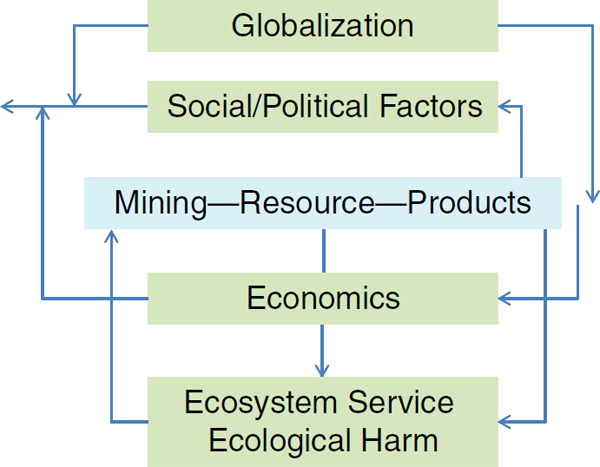
FIGURE 1: A generalized EcoInteractome Map used for assessing the process of resource recovery or large-scale production of renewables within a social, ecological, and economic framework.
Therefore, the group applied the EcoInteractome Map framework to phosphorus, as shown in Figure 2. The map follows the global movement of phosphorus, going from mined phosphorus ore to fertilizer production to application on arable lands. As a fertilizer, phosphorus adsorbs to soil particles, which are subject to wind and water erosion. During heavy rain events, runoff transports phosphorus into nearby waterbodies and is the greatest source of phosphorus loss globally. Phosphorus is a main component of fertilizer because it is a very important element biologically. It is a major component of bones and is imperative for DNA formation and cell respiration. Therefore, phosphorus is also released as a waste product in animal manure. The disposal, erosion and other removal of animal waste represents the second greatest loss of phosphorus from the system.
Phosphorus recovery pilot study
After completing the phosphorus EcoInteractome Map and identifying points of major phosphorus loss, IDR Team 2 brainstormed ways to recover phosphorus from the environment. “We need to close the loop,” said one IDR Team member. Ideas ranged from proven technologies, such as struvite extraction, to a seemingly outrageous robot army—designed to collect phosphorus in sediments and aquatic systems. The group then arranged these ideas based on where they fit within the map (see Figure 3).
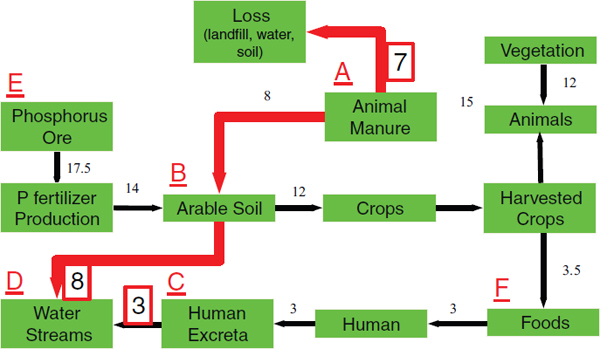
FIGURE 2: A simplified EcoInteractome Map of global phosphorus mass flow. The numbers express phosphorus in million tons and are derived from Cordell et al., 2009.
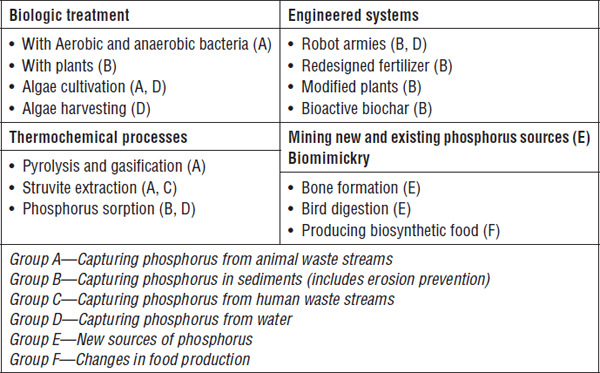
FIGURE 3: A list of innovations or technologies to generate or recover phosphorus on a massive scale. The letters correspond with points along the EcoInteractome map shown in figure 2.
Some solutions focused on phosphorus recovery from sediments, manure, and municipal wastewater while others proposed entirely new sources, such as mimicking bone formation. In the end, the group decided the technology most amenable to massive scale up would be a process for extracting phosphorus from animal manure (see Figure 4).
While concentrated animal feeding operations (CAFOs) come with their own set of environmental issues, they are now used to meet the world’s demand for cheap meat. According to the U.S. Environmental Protection Agency, there were approximately 20,000 CAFOs in the U.S. in 2006. This number is only a subset of the 450,000 U.S. animal feeding operations. The U.S. Department of Agriculture estimates that the amount of manure produced annually at all animal feeding operations in the U.S. exceeds 335 million tons of dry manure.
IDR Team 2 developed the framework for a pilot study to test a manure-based phosphorus recovery strategy at two percent (400) of CAFO facilities. While starting small, the project goal would be a massive scale-up of the technology that could provide a large portion of phosphorus used within the U.S. Another project goal would be to quantify ecosystem benefits and impacts of the technology, such as water quality improvements, a decrease in antibiotic resistant genes, and lower greenhouse gas emissions.
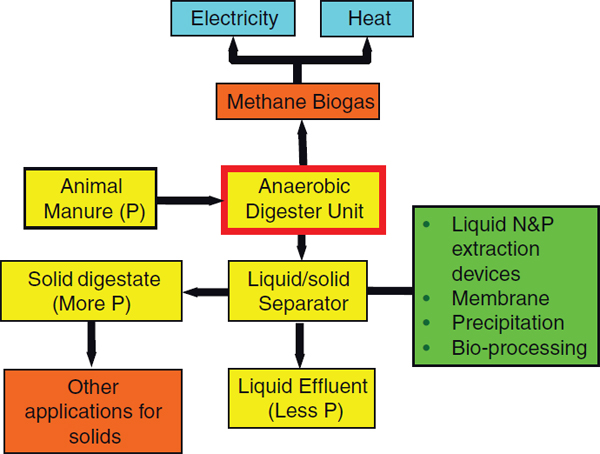
FIGURE 4: Shows how phosphorus could be recovered from animal waste on a massive scale.
The pilot would also allow researchers to anticipate social, economic, and political barriers to the scale up. For example, the program might explore incentives for CAFOs to use this technology and evaluate the willingness of fertilizer production facilities to accept phosphorus from the pilot farms.
Moving Forward
Progress toward recovering resources and producing renewables on a massive scale has been slow due to opposition from industries that rely on nonrenewable resources and because renewables are still more expensive to produce—a cost passed on to the consumer. Research and development, such as the suggested pilot study, are necessary to move forward sustainably. Acceptance by the public and decision makers is also a major component. Along with education, the ability to produce affordable renewable alternatives will help garner this acceptance. Society needs to accept that nonrenewable resources are finite and move forward with sustainable solutions now in order to successfully develop the capacity to meet the demand of a growing population.


