
Develop social and technical capabilities to respond to abrupt changes in ecosystem services.
CHALLENGE SUMMARY
Abrupt changes to ecosystem services imply rapid changes in the structure and function of ecosystems such that thresholds or tipping points are reached that affect the quantity or quality of the expected services from the ecosystem. Much attention has been given to abrupt climate change (e.g., Alley et al. 2003; Lenton et al. 2008), and various studies point to past abrupt changes, such as the flushing of Lake Agassiz into the North Atlantic shutting down the thermohaline circulation and generating global cooling. Owing to the sharp loss or change in services, the presumption is that the affected human population will experience a disservice, perhaps registered as disaster.
A substantial research tradition examines societal risk and hazards to environmental events. Much attention has also been given to human responses to environmental events (e.g., tornadoes, tsunamis, floods), which may be viewed as abrupt disservices. More recently, attention has focused on the vulnerability and resilience of social-ecological systems under stress, illuminating the interactions among the two subsystems and the synergies and tradeoffs in their respective responses. This work, perhaps more often than not, suggests abrupt changes in ecosystem services involve the emergent properties of complex social-ecological systems, such as the Dust Bowl on Great Plains of the U.S. generated by climate and land management interactions (Cook et al. 2009); and the human responses to these properties are far more complex and nuanced than is captured in popular societal collapse interpretations.
Much of the work on abrupt emergent properties is hypothetical and that on human responses captured in (pre)historical interpretations, before the human-environment conditions of the Anthropocene. The challenge is gleaning the lessons about societal responses to projected and “surprise” abrupt changes in the Anthropocene.
Key Questions
• What are the types of projected abrupt change for which society has demonstrated a willingness to prepare?
• What characteristics of changes in ecosystem services and societal coping mechanisms make human populations more robust and resilient, and less vulnerable to abrupt change?
Reading
Alley RB, Marotzke J, Nordhaus WD, Overpeck JT, Peteet DM, Pielke Jr. RA, Pierreumbert RT, Rhines PB, Stocker TF, Talley LD, and Wallace JM. Abrupt climate change. Science 2003;299:2005-2010.
Cook BJ, Miller RL, and Seager R. Amplification of the North American “Dust Bowl” drought through human-induced degradation. Proc Natl Acad Sci 2009;106:4997-5001.
Dillehay TD and Kolata AL. Long-term human response to uncertain environmental conditions in the Andes. Proc Nat Acad Sci 2004;101(12):4325-4330.
Lenton TM, Held H, Kriegler E, Hall JW, Lucht W, Rahmstorf S, and Joachim Schellnhuber H. Tipping elements in the Earth’s climate system. Proc Natl Acad Sci 2008;105:1786-1793.
Stafford Smith MD, McKeon GM, Watson LW, Henry BK, Stone GS, Hall WB, and Howden SM. Learning from episodes of degradation and recovery in variable Australian rangelands. Proc Nat Acad Sci 2007;104(52):20609-95.
IDR TEAM MEMBERS
• Wai Kin (Victor) Chan, Rensselaer Polytechnic Institute
• George Hornberger, Vanderbilt University
• Jane Carter Ingram, Wildlife Conservation Society
• Louise E. Jackson, University of California, Davis
• Gregory M. Masters, University of Maryland
• Katrina Mullan, University of California, Berkeley
• Shahid Naeem, Columbia University in the City of New York
• Jennifer K. O’Leary, OneReef
• Jennie C. Stephens, Clark University
IDR TEAM SUMMARY
Greg Masters, NAKFI Science Writing Scholar University of Maryland
IDR Team 3 was asked to design social and technical capabilities to respond to abrupt changes in ecosystem services. An abrupt change can be truly sudden—a sharp shock to the system such as a tsunami, asteroid impact, volcanic eruption, or earthquake—or years in the making. The farmers who first populated the Great Plains of the United States, for example, engaged over a number of years in agricultural practices that were ill-suited to the environment. When the wet cycle gave way to sudden drought in 1931, wind carried the over-plowed topsoil into great dust clouds that blackened skies and destroyed crops. Another example of a “slow-onset” yet abrupt change is the sudden collapse of the Northern Cod fishery in 1992, which followed decades of overfishing.
Team 3 considered these kinds of changes in the context of ecosystem services: the range of benefits that humans derive from the natural world. Changes in the environment are distinct from changes in ecosystem services, but the former generally cause or trigger the latter. The Dust Bowl, a rapid change in the physical environment, affected food supply. Deforestation affects timber supply, flood prevention, carbon sequestration, and nutrient cycling. And many abrupt changes in the environment have the potential to affect recreation, ecotourism, and the spiritual enrichment that nature can provide. An abrupt change might affect few, several or all types of services.
The team recognized that some perturbations may actually increase certain ecosystem services while causing a decline in others. Slash-and-burn deforestation in tropical areas, for example, increases that land’s ability to provide food while reducing its capacity to absorb carbon. It is important to consider the possibility of trade-offs in ecosystem services following abrupt changes.
Organizing and Classifying Abrupt Changes
To begin, the team found it useful to organize the range of environmental changes that trigger abrupt changes in ecosystem services. While these involve multiple variables, the two the team thinks most essential are spatial scale and rate of onset. A large asteroid impact, for example, may have an intermediate- or large-scale impact, but the onset is always fast. Slash-
and-burn deforestation also has a fast onset but a more local impact. The collapse of a fishery often has a slow onset and an intermediate impact. To show these kinds of relationships, the team developed the diagram shown in Figure 1. The abrupt changes in the diagram are color-coded to represent the number of ecosystem services affected.
Some kinds of abrupt changes display complex interrelationships among variables. The impact of the loss of biodiversity, for example, varies according to spatial scale; local biodiversity loss affects only a few ecosystem services, while global biodiversity loss may affect all of the services in the system. Drought has a fast start (one day it stops raining) but a slow onset because it takes days before dramatic changes occur. Also, spatial scale and rate of onset seem to be coupled in the case of drought; the wider the impact, the slower the rate of onset.
The team focused on three basic classes of change: outliers, state changes, and tipping points. An ecosystem may bounce back to its original state following a dramatic change (such as a 100-year flood) or it may persist in a different state; these two scenarios are outliers and state changes,
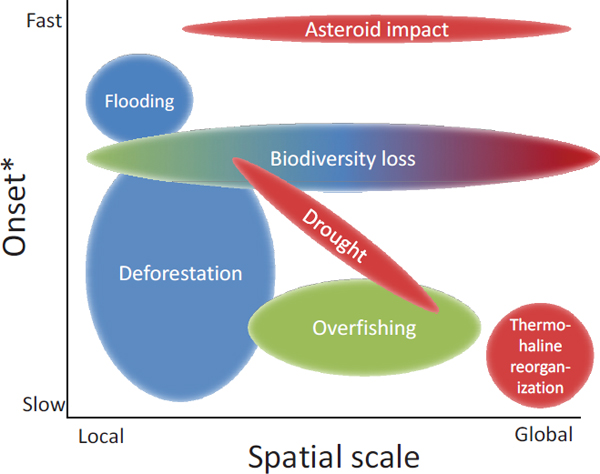
FIGURE 1: Potential abrupt changes in the environment are organized according to their expected rate of onset, spatial scale, and number of affected ecosystem services.
respectively. The third type of abrupt change occurs when the ecosystem passes a “tipping point” or threshold after a period of chronic stress and repeated perturbations. After passing a tipping point, the system often persists in the altered state. Easter Island’s civilization collapsed suddenly when a species of palm went extinct following centuries of overharvesting. According to climate scientists, a potential tipping point in the world’s climate may soon be reached if enough fresh meltwater enters the North Atlantic to shut down the thermohaline circulation, the density-dependent ocean conveyor that provides heat to northern latitudes.
Willingness to Prepare: A Matter of Perception
The team considered the kinds of changes for which society has demonstrated a willingness to prepare. Whether people have direct experience with a certain change, whether the change can be predicted and whether it can be managed are all factors the team thought to be important in influencing willingness to prepare. Also, society sometimes shows a disproportionately strong response to ecosystem disruption that causes a direct threat to public health. The spread of novel diseases such as West Nile virus, for example, usually inspires a significant response even when the number of people affected is small. Another example is E. coli-contaminated spinach; when an outbreak occurred in California’s Salinas Valley in 2006, only three people were killed yet one of the consequences was a drastic change in food safety policy in California.
Examples like these highlight the importance of perception in influencing responses to abrupt changes in ecosystem services. The team discussed the need for more human behavioral research into people’s perceived sense of risk. One interesting question is whether abrupt changes inspire overreaction while chronic changes lead to complacency. For example, does sudden raiding of crops by elephants in Africa or Asia inspire a stronger reaction than consumption of exposed grain stores in the Midwestern United States by rats, even though the latter (chronic) situation ends up costing farmers more in terms of loss of grain?
Anticipating response
The team considered several categories of preparation for an abrupt change in an ecosystem service. Of course, one common response is to simply accept life’s inherent risks (the “fateful” response). Putting aside
this untroubled approach, actual preparations can broadly be labeled either mitigation or adaptation; mitigation is working to prevent the change, while adaptation is planning some kind of response in the event the change occurs. Adaptive responses might be reactive—a rush of activity that addresses only the most immediate vulnerability and the associated ecosystem service—or active, addressing multiple ecosystem services through continuous refinement of strategies based on lessons learned.
How vulnerable people perceive themselves to be strongly influences the number and type of strategies they will embrace and pay for. Where the perception of vulnerability is high, there likely will be more mitigation strategies and more active adaptive responses. Where the perception of vulnerability is low, one would expect to find fewer mitigation activities and more reactive adaptive responses. If the abrupt change in question occurs, the people who perceived their risk to be low may begin to change their perception and shift their portfolio of strategies. The team represented these hypothesized behavioral patterns in a flow chart, shown in Figure 2.
What Makes Societies More Robust and Resilient?
Robustness and resilience are often conflated; robustness refers to a system’s ability to withstand change, while resilience refers to the time it takes for the system to return to its previous state. The team considered
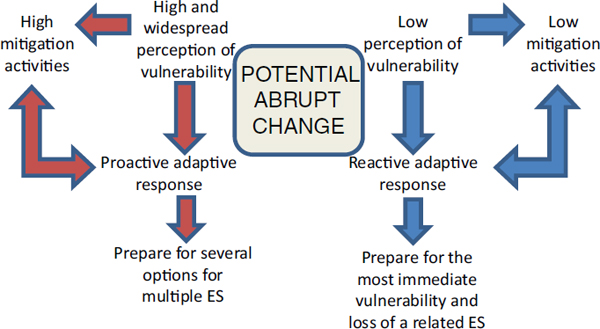
FIGURE 2: How perception of vulnerability to a potential abrupt change might affect mitigation activities and adaptive responses.
factors that make societies more robust and resilient in the face of abrupt changes, including characteristics of the abrupt changes themselves as well as societal coping mechanisms.
Societies are more likely to prepare well for (and be less vulnerable to) slow-onset abrupt changes (as opposed to sharp, unexpected shocks), changes that are predictable, reversible and local-scale, changes that increase rather than decrease ecosystem services, and changes in which technology can replace the lost ecosystem service.
To improve robustness and resilience, societies should provide multiple options for people to cope and adapt, and institutions should be flexible. Societal coping mechanisms should include access to insurance, technology for mitigation and adaptation, and the ability to diversify livelihoods so as to decrease dependence on a single ecosystem service. Also important are social networks, which can be considered a kind of insurance. As one person in the team observed, many people in Japan who live in high-risk areas decided not to move after the tsunami because they did not want to accept the risk associated with losing their network of family and friends.
Future Research
Given the important role of perception in governing responses to abrupt ecosystem change, future research should focus on understanding the reasons behind human behavioral responses to abrupt changes. The team suggests a project to build a library of case studies of past abrupt changes and information about how people prepared or coped. Information should be gathered on the abrupt changes themselves, including specific ecological functions and services that underwent change, as well as the social dimensions of the societal responses. Of interest would be the role played by social networks, information systems and governmental institutions, as well as the livelihood practices of people affected—whether, for example, farmers used multicropping or other means of biological insurance to reduce risk. The team also noted the need for research concerning the relationships between specific ecological functions and ecosystem services they provide; this knowledge can help in the monitoring of service changes.
Lastly, the team suggests the development of specific early warning systems—including ecological indicators of tipping points—and tools that allow people to explore the mitigation and adaptation options available to them. A computer simulation game, for example, could serve this purpose while also informing research on risk perception.
This page intentionally left blank.


