
Develop appropriate methods to accurately value natural capital and ecosystem services.
CHALLENGE SUMMARY
Ecosystems provide a wide array of goods and services of value to people (“ecosystem services”). Some ecosystem services lead to the provision of marketed commodities (e.g., fish, timber) but most ecosystem services do not flow through markets (e.g., provision of clean water, habitat for species). There is little direct signal of the importance of these nonmarketed ecosystem services and little incentive to manage ecosystems to maintain natural capital necessary for the sustained provision of ecosystem services. One way to give incentives for sustained provision is to assess the value of ecosystem services in a common monetary metric and provide payments for provision. Valuing ecosystem services requires both the ability to quantify the amount of a service produced and methods of nonmarket valuation. Economists have developed a range of methods of nonmarket valuation that can be applied to value ecosystem services. Critics of the economic approach raise questions about the incompatibility with the economic approach to value services that are centered on human well-being and the intrinsic value of nature. Critics also question whether the aesthetic beauty of a landscape or the continued existence of a species can or should be measured in monetary terms. These debates raise fundamental questions about our understanding of the contribution of ecosystem processes to human well-being and whether we can accurately gauge, in either a quantitative or qualitative manner, the relative importance of various ecosystem services.
Key Questions
• Should we attempt to express ecosystem processes in terms of ecosystem services? Can we accurately assess the provision of ecosystem services?
• At the global and regional level how can ecosystem service delivery be assessed through time utilizing remote sensing technology?
• Should we attempt to estimate monetary values for ecosystem services and natural capital? Can or should all values of nature be measured in monetary terms? Is it possible to accurately measure such values as aesthetic beauty and the existence of species in monetary terms that can be compared to the value of crop or timber production?
• What is the relationship between the value of natural capital and the value of ecosystem services?
• What are the main difficulties involved in estimating monetary values for ecosystem services and natural capital?
• What are the main methods used by economists to value ecosystem services and natural capital? What are the strengths and limitations of these methods?
• What are the main methods used by other social scientists besides economists to value ecosystem services and natural capital? Are the methodological approaches of economists and other social scientists consistent, conflicting, or nonoverlapping?
• Because of the difficulty of valuing some ecosystem services, the U.S. Office of Management and Budget recommends quantifying benefits that can be quantified, monetizing benefits that can be monetized, and giving a qualitative description of benefits than can be neither monetized nor quantified. Do you think that doing so will mean that ecosystem services that are only qualitatively described will be taken less seriously than those that are given monetary or quantitative values? In other words, is there a bias against evidence that is not based on “hard” numbers?
• How should we weight benefits from ecosystem services to different groups? If harm from loss of services accrues to poor or disadvantages groups should that be weighed differently than loss of services to wealthy groups?
• How can we design a reporting system for natural capital that is equivalent to measures of manufactured capital and other forms of assets to derive a measure of inclusive wealth? How can we design a reporting system for ecosystem services and incorporate these values into national income accounting? Can these reports be updated annually and reported at the country, state, and national levels, analogous to and supportive of the FAOstat on agricultural commodities.
• Can markets for regulating services (erosion control, local climate control, disease control, etc.) be developed?
Reading
Balmford A, Bruner A, Cooper P, Costanza R, Farber S, Green RE, Jenkins M, Jefferiss P, Jessamy V, Madden J, Munro K, Myers N, Naeem S, Paavola J, Rayment M, Rosendo S, Roughgarden J, Trumper K, Turner RK. Economic reasons for conserving wild nature. Science 2002;297:950-953.
Goulder LH and Kennedy D. Daily GC, ed. Valuing ecosystem services: philosophical bases and empirical methods. In Nature’s Services: Societal Dependence on Natural Ecosystems, pp. 23-47. Island Press: Washington, DC, 1997. [For purchase.]
McCauley, D. Selling out on nature. Nature 2006;443:27-28.
National Research Council. Valuing ecosystem services: toward better environmental decision-making, chapter 4. The National Academies Press: Washington, DC, 2005.
Nelson E, Mendoza G, Regetz J, Polasky S, Tallis H, Cameron DR, Chan KMA, Daily GC, Goldstein J, Kareiva PM, Lonsdorf E, Naidoo R, Ricketts TH, and Shaw MR. Modeling multiple ecosystem services, biodiversity conservation, commodity production, and tradeoffs at landscape scales. Frontiers in Ecology and the Environment 2009;7(1):4–11.
Because of the popularity of this topic, three groups explored this subject. Please be sure to review each write-up, which immediately follow this one.
IDR TEAM MEMBERS—GROUP 6A
• Clyde F. Casey, United States Geographical Survey
• Judy J. Gunderson, The Dow Chemical Company
• Hillary B. Huffer, ECU and NOAA
• Sarah Jane Keller, University of California, Santa Cruz
• Kevin J. Krizek, University of Colorado
• Yiqi Luo, University of Oklahoma
• David A. Mortensen, The Pennsylvania State University
• Richard Ready, The Pennsylvania State University
• Jessica A. Sanderson, USG Corporation
• Sabina L. Shaikh, University of Chicago
Sarah Jane Keller, NAKFI Science Writing Scholar University of California, Santa Cruz
IDR Team 6A was asked to develop appropriate methods to accurately value natural capital and ecosystem services. Human population growth and the expanding material appetites of many societies are straining the world’s natural resources and ecosystems. Taking a full account of the services we derive from those systems could help reveal nature’s unappreciated benefits to humanity and inform choices that will secure the long-term viability of ecosystems.
While many ecosystems provide us with tangible benefits, such as timber and seafood, the pricing of these benefits—or ecosystem services—may not reflect the total value of the ecosystems that produced them. Other ecosystem services, such as seed dispersal, nutrient cycling, and water purification are typically not reflected in markets at all.
The team faced well-trod ground. There have been many attempts to incorporate the qualitative or quantitative values of ecosystem services into decision-making. Additionally, debates about whether or not it is appropriate to assign dollar values to ecosystem services have been waged for decades.
With economists, ecologists, an urban planner, and two industry representatives in the group, IDR Team 6A was well-equipped to address the problem of valuing ecosystem services. Then the question became, with so many existing frameworks for valuing ecosystem services, what could IDR Team 6A contribute?
The Ecosystem of Valuation Methods
The team developed a thought exercise that exposed the diversity and specificity of possible pathways to arrive at the “how” of valuing ecosystem services.
What is the structure and function of systems being valued?
The team agreed that this is the foundation for valuing ecosystem services. Gaps in spatial and temporal understanding of a system could begin as small uncertainties, but become magnified as ecosystem data are combined
with uncertainties in valuations. Also, ecological studies are generally not tailored to meet the needs of the valuation methods that economists use.
An important ecosystem consideration is that some ecosystem services are derived from disturbance of ecosystems by human activities, and that sometimes the most altered and exploited ecosystems provide a great deal of service in the short term. An example is pastoral land compared to pristine forest. How can we compare the carbon sequestration and erosion control benefits of the forest with the food production and aesthetic benefits that people receive from mixed woodland and agricultural areas?
Why they are being valued?
Is a business trying to weigh tradeoffs in locations for building a new plant, is the government trying to determine how wetlands should be remediated, or is a nonprofit trying to calculate a global value of a service to make a statement? The purpose of the valuation will help determine which methods to apply.
Who is interested in the information?
The valuation may be dependent on the stakeholder group. A beachfront landowner will value the services from his or her property differently than the rest of the community will value the property’s flood protection services.
These considerations create context for how ecosystems services should be valued and demonstrate that IDR Team 6A’s challenge went beyond methodological concerns. To eliminate some of the dizzying array of options, the team focused on quantitative valuation of ecosystem services and elected not to tackle qualitative valuation problems.
Within the world of quantitative valuation, there are still a number of methods to consider, including the market price method, productivity method, hedonic pricing method, travel cost method, substitute cost method, contingent value method, contingent choice method, and benefit transfer method.
Improving Benefit Transfer
IDR Team 6A elected to focus on benefit transfer based on the method’s familiarity to the group and its ongoing application by government. Given
the specificity and diversity of ecosystem services and applications, it would be ideal to quantify and value services for each situation, but this is not practical. So, benefit transfer is used to generalize valuation estimates and apply them across locations and time. For example, agencies such as the U.S. Environmental Protection Agency use it to assess the benefits and costs of federal environmental regulation when time and money limit site-specific measurements.
The team then identified ways in which benefits transfer could be improved. According to team members, benefits transfer is subject to large inaccuracies and validity concerns. The economists in the room also noted that effort going into valuation studies has been declining over time and new technologies and models should be considered to improve value transfers.
An Alliance Between Social Science and Natural Science
The team set out to answer the question: “How can natural scientists and social scientists improve the validity and accuracy of benefits transfer?” Specifically, they wanted to address the following challenges to the accuracy of benefit transfers:
• Ecosystem knowledge is incomplete.
• Temporal and spatial scales vary.
• Valuation of ecosystem services is context dependent.
• Source studies establishing ecosystem services values may be inadequate.
• What matters to the affected population is site specific.
• There is a vast number and variety of ecosystem services.
The group considered the possibility of standardized methods for valuing ecosystem services but decided that would be intractable. They settled on a framework that centers on ecosystem service indicators to improve benefits transfers. Indicators would translate what ecologists know is important for ecosystem services into what stakeholders care about. For example, the public may not care about lake sediment levels, but they may value the ability to see their feet when they walk into the lake to swim. They may be willing to drive farther to use a lake where they can see their feet, versus one where they cannot.
The team identified a number of approaches to address the problem of valuing ecosystem services and decided that the approaches should be implemented simultaneously to produce more reliable ecosystem valua-
tions. First, primary valuation estimates at the source should continue, because they are integral to improving benefit transfers. Ecological models should continue to be integrated into economic valuations. Nonmonetary measures of value such as tradeoffs and thresholds should also be considered as options when monetary valuation is not appropriate for the decision-making context.
Developing and Applying Ecosystem Service Indicators
IDR Team 6A’s final product was a conceptual, iterative framework for developing ecosystem service indicators that could be used for more reliable benefit transfers between sites (Figure 1). The general framework relies on the natural sciences to apply ecological models that ingest site-specific data to generate indicators of ecosystem services. Those indicators will act as proxies to inform economic valuations of ecosystem services which account for the values and specificity of interests of the affected populations.
The team used ecosystem services in a generalized forest to think through the application of an ecosystem service indictor derived from one system (Figure 2). Forests provide services of carbon sequestration, water quality regulation, aesthetics, cultural value, temperature regulation, recre-
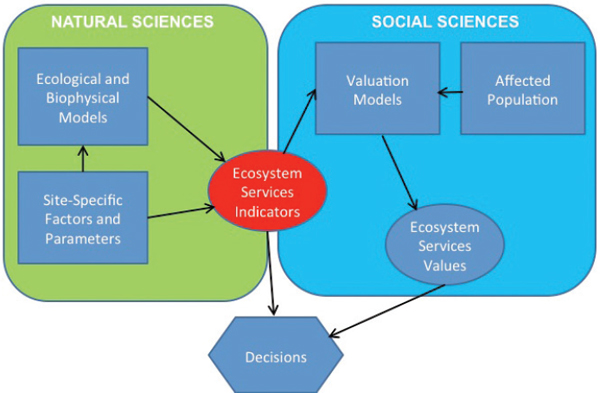
FIGURE 1
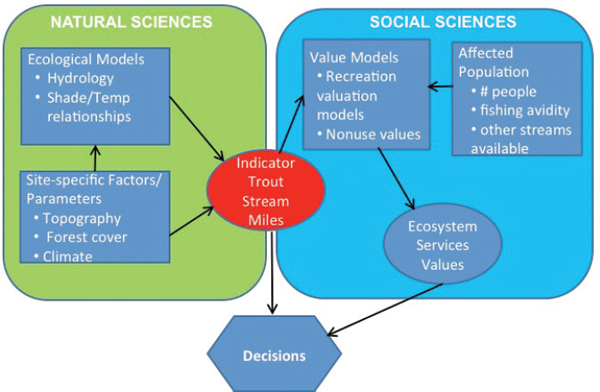
FIGURE 2
ational value, and habitat, among others. There are many ways to measure these services but it is generally not practical when performing a benefit transfer. Therefore, could one measure represent many ecosystem services?
The group selected the indicator “trout stream miles” as a known forest indicator that could be applied in ecosystems that are relevant as trout habitat. Trout habitat requirements could become a proxy for other ecosystem services. Trout depend on the temperature regulation afforded by forest cover over streams; they depend on aquatic invertebrates, which are intolerant of polluted water and they depend on clear water that is not contaminated with sediment from runoff. If you buy the ecosystem service indicator of trout stream miles, you get at least three or four more indicators free.
The group concluded with two main science questions that need to be answered to implement their framework. First, how will we know if indicators are working in different contexts such as varied scales of space and time or at different levels of governance? For example, could indicators developed in one country be applied in another? The team’s discussion ended with the open question of how natural and physical scientists can develop ecosystem service indicators that will be transferrable, accurate and useful.
IDR TEAM MEMBERS—GROUP 6B
• Julia K. Baum, University of Victoria
• Robin L. Chazdon, University of Connecticut
• Francie Diep, New York University
• Anantha K. Duraiappah, United Nations University
• Jimena Forero, University of Puerto Rico
• Andrea Ghermandi, Cà Foscari University of Venice, Italy
• Gary W. Johnson, Gund Institute for Ecological Economics
• Eduard T. Niesten, Conservation International
• Darius J. Semmens, U.S. Geological Survey
• Ariana E. Sutton-Grier, National Oceanic and Atmospheric Administration
Francie Diep, NAKFI Science Writing Scholar New York University
IDR Team 6B was asked to create a quantitative valuation system for ecosystem services. The team framed its challenge as a way of arriving at a larger, more consumer-oriented goal: Correcting the prices shoppers see in the grocery store.
The cheapest shrimp shoppers can find in the seafood section may well extract a high cost on the environment where it was harvested. If trees were cleared from a mangrove swamp to make way for the farm where the shrimp were grown, then people living near the mangroves would have lost an important tool for fighting erosion—hence, lost the mangroves as a source of ecosystem services. If the shrimp farm put antibiotics or high-nutrient feed into its water, then local populations would suffer a reduction in water quality. Yet those costs, which are real but difficult to quantify in dollars, do not show up in the final store price of the shrimp that most consumers see. At the 2011 National Academies Keck Futures Initiative Conference on Ecosystem Services, IDR Team 6B was especially interested in putting quantitative values on ecosystem services such as erosion protection and water quality, in the hope that such values might translate into fuller, truer prices on shrimp or any other consumable item.
The team was composed of ecologists, economists, and a computer scientist. The group reviewed what is being done now to give values to
ecosystem services, then discussed what additional components ecologists wished valuations could include, such as the value of biodiversity or the social cost of environmental degradation to the people who live near exploited ecosystems. Ultimately, it outlined what is needed for a next-generation mathematical model that would put quantitative values on ecosystem services. Because of the state of current research, such a model is not yet possible, but IDR Team 6B’s outline points to what research is needed.
If IDR Team 6B’s model were implemented, one of its greatest benefits would be to inform everyday shoppers. More accurate ecosystem values might get incorporated into the global market. Therefore, more environmentally damaging goods would cost more, while more environmentally friendly goods would cost less. Right now, people often choose to buy less expensive, more environmentally damaging goods but have no idea that they are doing so. Only if goods are consistently priced to reflect full environmental costs, will the public know the connection between price and its relation to ecosystems.
How Ecosystems Are Valued Now
One way that economists put price tags on ecosystems now is by conducting primary surveys, in which a large sample of people are asked how much they would pay for the protection of ecosystem services such as water filtration through a forest or storm protection from wetlands. The researchers estimate the value of each service through the aggregated answers from everyone they survey.
These valuations have several weaknesses. Most people are not exactly practiced at trying to buy anything as large and valuable as an ecosystem service. Also, people’s decisions about their money don’t always follow rational economic models, and valuing ecosystem services is no exception.
Primary surveys are a static snapshot of an ecosystem service’s worth at a moment in time. Such surveys are poor at predicting what would happen to a service’s value if its ecosystem were to suffer further degradation or to improve under protection or restoration efforts. This approach also has a hard time accounting for how changes in one ecosystem service affect other ecosystem services, an important facet in an ecosystem’s overall functioning.
Beyond primary surveys, different research groups and consulting companies have created different computer programs and surveying methods to put quantitative values on ecosystem services. Each group’s program may give a different value for the same ecosystem service, however, which industry groups and policymakers find frustrating.
Benefit transfer approaches involve taking valuation estimates derived for one ecosystem and extrapolating to apply those estimates to another area. For instance, if a valuation study finds that a forest in Washington State is worth $100 per acre for carbon sequestration, watershed, and habitat services, then valuing a similar forest in Oregon using benefit transfer methodology would use the same parameter of $100 per acre. This saves time and money since primary research is not necessary, but a potential weakness is that the ecosystem to be valued using benefit transfer methods is not similar enough to any ecosystems for which we already have values.
A Better Model
IDR Team 6B’s imagined model would amend many of primary surveys’ weaknesses. It would be easy to tweak the model whenever conditions in the ecosystem changed. The model would include equations to represent the relationships between people and environmental services, and the relationships between environmental services.
Team members decided to use shrimp farming in mangrove habitats to demonstrate their idea. If someone wanted to clear some mangroves to make a shrimp farm now, the price of doing so would just be the price of the land, equipment, and labor required to build the farm. The farmer would not pay for the native fish habitat, storm protection, water filtering, and carbon sequestering abilities that would vanish with the cleared trees.
A better model of the price of the shrimp farm would allow the modeler to set constraints. The constraints would be ecosystem services that local residents want to maintain at a certain level: A certain native fish population dynamic, for example, or certain degree of storm protection. Within those constraints, the model would maximize the shrimp harvest for the farmer. As another example, a tourist company could use the model to maximize the number and hours of tours they gave, while keeping within constraints set by local residents to protect ecosystems.
The idea of creating a fuller, truer price for goods, including the ecosystem damage their production causes, is not new. What IDR Team 6B’s model adds, team members say, is the inclusion of constraints. Team members also hope to apply their model to ecosystems all over the world and hope the outputs from the model would be in the same units, so that people could compare what is happening in different ecosystems.
Right now, it is not possible to create the model IDR Team 6B envisions because there is not enough research to write all the equations needed.
Team members identified research questions in various fields that would fill the gaps. Researchers need more ecological data to better characterize how individual constraints affect the overall system and how ecosystem services affect one another. Researchers who work on valuing services in similar ecosystems, such as mangroves in Central America, Asia, and Africa, should share their results. More computer scientists are needed to work on ecosystem services, to create new, better models.
Better Pricing from a Better Model
Even if researchers did create a better model for valuing ecosystems, there is still a leap between accurate modeling and seeing prices in stores that reflect ecosystem damage or protection. Prices from the ideal model could inform regulators who could require companies, such as a shrimp farming business or a tourism outfit, to absorb more of the price of the environmental damage they cause. “Correct” or more accurate prices could go into the Environmental Impact Assessments that construction companies need to file before they build. Risk rating agencies and insurance companies could look at a database of more accurate pricing and levy higher premiums on environmentally pricier projects.
If these adjustments still don’t bring prices in stores close enough to the theoretical model price, stores could still post model price information, so consumers know the true price of what they’re shopping for. That information may help some shoppers change their habits, though more behavioral studies are needed to find how people will really react to seeing valuations of ecosystem services.
Beyond Valuation
Valuation is one of many ways of encouraging the protection of ecosystem services, and all ways are useful in different situations because different people respond to different strategies.
If IDR Team 6B’s model successfully made the leap to actually influence prices in stores, it would target consumers looking for the best bargains they can find. If not, having accurately modeled valuations would be useful with business people and some policymakers, who might respond best to monetary values.
With other people, appealing to their emotions or environmental interests might play a role. Cultural changes that make environmentally friendly
decisions, such as buying local produce or fair trade products, socially valuable would be necessary.
IDR TEAM MEMBERS—GROUP 6C
• David L. Bael, University of Minnesota
• Robert Costanza, Portland State University
• Rose Eveleth, New York University
• Miroslav Honzak, Conservation International
• Bonnie L. Keeler, University of Minnesota
• Carolyn Kousky, Resources for the Future
• Helene Morlon, CNRS/ Ecole Polytechnique, France
• Maria Pellegrini, W.M. Keck Foundation
• Austin R. Troy, University of Vermont
• Lisa A. Wainger, University of Maryland Center for Environmental Science
• Stephen L. Young, University of Nebraska-Lincoln
Rose Eveleth, NAKFI Science Writing Scholar New York University
The problem IDR Team 6C set out to solve was creating a functional and accurate valuation system for ecosystem services. The team focused most of its discussion around one reason that valuation can be hard: some services are easier to quantify than others.
For example, there is a park in Northern Ontario that hardly anybody visits. It’s remote, beautiful, and isolated. But, is it valuable?
Valuing the ecosystems services of that park in Northern Ontario is hard. The park keeps a watershed clean, but since no one lives nearby the immediate economic value is minimal. The global service it provides—carbon sequestration—is small in comparison with the planet, and yet it does have some value. The ecosystem services that the park really confers are, as group 6C put it, somewhat squishy. They are cultural and aesthetic. People value simply knowing that there are pristine ecosystems out there in the world, even if they never visit them. People have spiritual connections to land that are hard to quantify.
This divide between the easily quantifiable components of ecosystem services, and those that are more qualitative—or squishier—is the problem that group 6C debated. How do economists and ecologists construct a system of ecosystem valuation that takes into account and properly weights, both easily quantifiable variables like food output or carbon sequestration and the more qualitative variables like the value of leaving some places on Earth uncompromised by human use?
Here’s another example that caught Team 6C’s attention: Recently, a photograph of a Brazilian chief crying whipped through a number of online news outlets and blogs. The caption on the picture explains that Chief Raoni was crying because the Brazilian government had just approved a dam that would flood 400,000 hectares of land and displace 40,000 indigenous people. It has since come out that Chief Raoni was not actually crying over the dam, but rather crying over seeing someone he had not seen in a very long time, as is custom for his tribe. (He did say, however, that he was extremely angry and distraught about the dam).
The Problem
The tradeoffs that the Brazilian government considered to make the decision to build the dam are a perfect example of the challenge of integrating quantitative and qualitative ecosystem services. On the one hand, the government can calculate how much power the dam would produce, and how much it would cost. It can measure the amount of land lost, and the amount of food that would not be produced. It has a much harder time measuring the value of something like Chief Raoni’s tribe, or the value to someone of just knowing that the there are pristine ecosystems in the world.
The basic distinction between squishy and non-squishy variables seemed to be Quantification. The absence of quantification leaves a set of characteristics that affect the ways economists characterize services that ecosystems provide, how they might make decisions about them, how easily those services are traded, and so on. The squishier a service gets, the more necessary it is to have stakeholder participation and good communication in order to give it a value.
Take, for example, two very different cases of flood plain management: The Charles River in Boston and Napa Valley in California. In the case of the Charles River, the Army Corps of Engineers, looking for a way to manage flooding did a very straightforward cost-benefit analysis, and figured out
that restoring the flood plain and river system was the most cost effective way to go. From their expert knowledge and valuation they went ahead and restored the area. In Napa Valley, the restoration of floodplains came about from a grassroots movement that dealt more with regional pride and aesthetics. The community organized to restore the flood plain. While the benefits certainly included flood protection, that was not the primary driving force for the project’s approval.
In these two cases we see a similar outcome—the restoration of a floodplain—but with very different histories. The Charles River case was very quantitative, expert driven and top down. The situation in Napa Valley was based on local consensus, and came from the ground up. One was, as the chart says, less squishy, and the other was more squishy. That’s the kind of valuation that IDR Team 6C really focused on.
Challenges to Participation
So how does a government or agency measure those squishy values when making decisions about ecosystems? There are some traditional economic tools—like surveying people and asking them a set of questions about what they think is important and what is less so. And with more subjective things like cultural value and spiritual importance—the importance that an indigenous community places on the ecosystem as part of the local belief system—getting stakeholders involved is often the only way to get a real sense for that value.
But getting large-scale stakeholder participation isn’t easy. Identifying which stakeholders should participate can take time, as can designing a valid questionnaire. On the other side, the cost of participation by stakeholders can be higher than they might be willing to incur—while it might seem easy to get people to take a simple questionnaire, the response rates for many surveys is very low. And to get valuable information, you often have to take more than a few minutes of people’s time, and ask them to think about several situations they have never encountered before. And often those stakeholders aren’t given a process for conferring with one another about their decisions.
Therein lies the true problem that IDR Team 6C tackled: to achieve a valuation based on more qualitative ecosystem services requires more citizen participation and that participation can be difficult to effectively and efficiently facilitate.
Gaming for the Greater Good
What the IDR Team settled on was a gaming approach. The basic premise was to harness the power of interactive games to learn more about what people really think about ecosystem services, and what value they place on services that cannot be readily quantified.
Within the gaming structure, IDR Team 6C saw several advantages. First, researchers could present gamers with multiple scenarios that are easy to understand. Unlike standard surveys, in which people are asked to imagine a scenario they’ve never encountered, the game could actually present players with various scenarios in a way they could move around in and explore. This would make their responses to those scenarios far more accurate. This use of game-playing would also allow economists to perform conjoint analysis on the various aspects of those ecosystem services tradeoffs to figure out which individual characteristics are most valuable to people playing the game. The approach lends itself to valuation of ecosystem services using both monetary and nonmonetary metrics. Monetary values for services might be associated with ecosystem goods and services by requiring players to make tradeoffs among alternative outcomes that have monetary consequences in terms of taxes, job opportunities, or economic outputs. Further, the gaming could shortcut the process of identifying ways to characterize ecosystem services that are meaningful to people to improve results from contingent valuation surveys that are used to monetize squishy outcomes.
Second, one could design the game that would require players to communicate with one another to come to a decision about the ecosystem they are interested in protecting or changing. Those interactions could be useful for economists to mine information about the way people think things should be, and how they justify their choices. When players have to discuss their decisions, economists no longer have to guess why players are acting in one way or another.
Third, games can greatly reduce the cost of participation. Often, the most vocal citizens on a subject are those who can afford the time and money to attend meetings and calling into their representatives. Sometimes, entire segments of the community are completely overlooked because they don’t have access or don’t know how to participate in the conversation about their ecosystems. Games could allow these overlooked stakeholders to participate more than they normally might. Rather than having to come to a town hall meeting, or call up a representative, stakeholders could play from their homes. Parents could put their children to bed and log on. People who
don’t have the time, or don’t feel strongly enough to attend public meetings could suddenly be provided a voice in the decision making process.
Of course, gaming has its own issues, both logistic and conceptual. However, it is clear from present day experience that there are already a number of online games that can be used to obtain data about human behavior and values, so it is a reasonable approach to explore.
This page intentionally left blank.


