
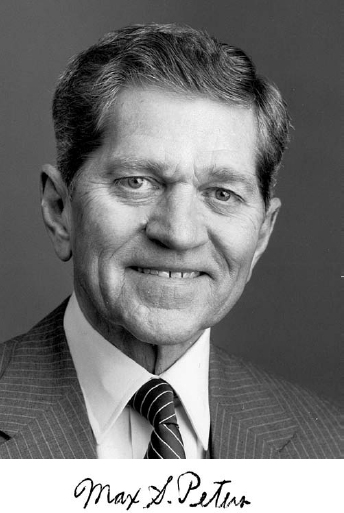
1920–2011
Elected in 1969
“For contributions to the study of kinetics and
mechanisms of chemical reactions.”
BY CAROL ROWE
SUBMITTED BY THE NAE HOME SECRETARY
MAX S. PETERS, who will be remembered for his strong leadership and remarkable achievements over 16 years as dean of engineering at the University of Colorado, Boulder, as well as for his fun-loving personality, athleticism, and service to the engineering profession, died on June 20, 2011, at the age of 90.
Born in Delaware, Ohio, on August 23, 1920, Max grew up in State College, Pennsylvania, the son of a noted professor of education at Pennsylvania State University—Charles C. Peters—and his wife Dixie. It is said that Max loved to run footraces as a child for the sheer joy of competing and doing well, a trait he exhibited throughout his life. After graduating from State College High School, where he ran track and made an early name for himself by scoring five touchdowns at the football field dedication game, Max went on to study chemical engineering at Penn State. He was active in a variety of organizations, including serving as captain of the ski team, before graduating with his bachelor’s degree in chemical engineering in 1942.
After graduation he worked for two years as the supervisor of a nitric acid production unit for the Hercules Powder Company and then joined the Army in the middle of World War II. This reportedly occurred over the protests of his college dean, who claimed Max was needed more by the chemical
engineering profession. But Max wanted to be where the action was, and he chose rigorous infantry training as an Army ski trooper in the 10th Mountain Division, A Company, 85th Regiment. He participated in the Italian Apennine Mountains and Po Valley campaigns, winning numerous medals for his service, including two Bronze stars, the Silver Star, and the Purple Heart.
Following World War II, Max returned to Penn State as a graduate student and earned his master’s degree in chemical engineering in 1947. He also married his childhood sweetheart, Laurnell Louise Stephens, that year and went to work as a technical plant superintendent for the G. I. Treyz Chemical Company in New York. In 1949 he returned once again to Penn State, where he completed his Ph.D. in chemical engineering in 1951.
Thus began a career in which he would have a far-reaching impact as a teacher, an administrator, and a leading air pollution researcher. He joined the faculty of the University of Illinois in 1951, and within a few years started research on air pollution controls, including studies on reducing nitrogen oxide from automobile exhausts catalytically and the effects of lead on these catalysts. Eventually, his work and that of others led to the use of catalytic converters in automobiles and the elimination of lead from gasoline.
Max rose to become head of the Division of Chemical Engineering at the University of Illinois. He spent just 10 years at Illinois before leaving to become the eighth dean of the College of Engineering and Applied Science at the University of Colorado, Boulder. From 1962 to 1978, Max led the engineering school through the construction of a new, modern-day engineering center and oversaw significant increases in research funding and improvements to graduate education. “It was a golden time for research funding,” he recalled upon his retirement in 1987.
Richard Seebass, who was dean of engineering at the University of Colorado, Boulder, when Max retired, is quoted as saying that “Max never ran a race he couldn’t win.” Indeed, he succeeded in winning a $7.2 million grant from the state of
Colorado and a $1.3 million grant from the National Science Foundation to build the new engineering center in 1965—and that was only the beginning. His team, which included longtime friend Klaus Timmerhaus—whom he recruited from Illinois to be associate dean, also won a $3 million National Science Foundation Excellence Grant for faculty development and a large grant from the Sloan Kettering Foundation to develop joint graduate research with the University of Illinois.
At the same time he was building the school’s capacity for research and graduate education, Max was able to continue the school’s emphasis on undergraduate learning for its 2,000 students. He did not relinquish his teaching and research activities while dean, choosing instead to teach courses ranging from the freshman introduction to the senior design course in chemical engineering. He also wrote many technical papers and several textbooks on chemical engineering, including the widely known Plant Design and Economics for Chemical Engineers (McGraw-Hill, 1958), which is now in its fifth edition and has sold over 100,000 copies. After Max wrote the original book, Klaus and Ronald West joined him as coauthors on the later editions.
Max also was active in professional service, so much so that the College of Engineering and Applied Science created the Max S. Peters Faculty Service Award and presented it to him as the first recipient the year he stepped down as dean. Previously, Max had served as president of the American Institute of Chemical Engineers (AIChE), chairman of the President’s Committee on the National Medal of Science, and chairman of the Colorado Environmental Commission, which presented a detailed report in 1972 on actions recommended for the future of the state. He also served on the National Research Council’s Advisory Board on Military Personnel Supplies from 1977 to 1980 and later on the NAE Nominating Committee.
Max also was active in the American Society for Engineering Education (ASEE) and received its Lamme Gold Medal Award for Distinguished Service in Engineering Education in 1973. He also received ASEE’s George Westinghouse
Award for Outstanding Teaching in 1959 while at the University of Illinois. Max served on the Board of Directors and the Accreditation Committee for the Engineers’ Council for Professional Development, and he chaired the National Research Council Committee on Alternatives for the Reduction of Chlorofluorocarbon Emissions in 1979. He also was active in the 10th Mountain Division Association, serving as secretary and president of the Rocky Mountain Chapter and on various boards and committees in the Boulder community.
In 1969, Max became the first resident of the Rocky Mountain region to be honored by election to the National Academy of Engineering. The same year he received the Award of Merit from the American Association of Cost Engineers. He was named Engineer of the Year by the Professional Engineers of Colorado in 1971, and he received the AIChE Founders Award in 1974 and the Warren K. Lewis Award for Outstanding Teaching in 1979. The University of Colorado honored Max with its Distinguished Engineering Alumnus Award (as a special recipient), the Robert L. Stearns Award, and the University Medal. Penn State University recognized his achievements with its Distinguished Alumnus and Distinguished Engineering Alumnus awards.
Max was a registered professional engineer in Pennsylvania and Colorado and a fellow of AIChE. In 1983, AIChE selected Max as one of 30 Eminent Chemical Engineers in the United States, and in 1994 he received the Colorado Engineering Council’s Gold Medal Award in recognition of his distinguished engineering career. He also received centennial awards from the ASEE for outstanding service in engineering education and from the College of Engineering and Applied Science of the University of Colorado, Boulder, for being one of the “Top 100” individuals in the college’s history.
Throughout his life Max enjoyed competing in athletics, including running, skiing, ice skating, and later race walking. In addition to being a member of Penn State’s ski team during his college years, he served as an assistant coach of the team as a graduate student, and as president of the Penn Valley Ski Club, and he helped organize the Pennsylvania Ski
Federation, serving as its first president in 1946. He won first place in cross-country skiing at the 1947 Pennsylvania State Ski Championships and was named “Outstanding Skier” of the event. After leaving Penn State in 1948, Max had his own ski school in Phoenecia, New York, and he continued to compete in skiing events after moving to Colorado in 1962. He did well in skiing competitions with the Rocky Mountain Masters Ski Series, winning first place in his class in the downhill, and second place in the slalom, giant slalom, and the combined, in 1986–1987. He was also a figure skater, focusing on ice dancing, and he ran regularly in the Bolder Boulder 10K Road Race.
For Max, competition and fun went hand in hand. As dean he shared his competitive nature with his students, racing them annually during so-called engineering days. Creating races that only he could win, Max manipulated the rules before and during the races. His antics ranged from announcing that the winner would have to wear an unusual hat and then producing the wildest hat possible to devising rules that the winner had to finish last, next to last, or third from last, then running backwards, turning somersaults, and running around trees with the baffled students following him. “I was the only one who knew the rules,” he said playfully. “But the students didn’t get mad. They just tried to outwit me.”
He served as dean of engineering until 1978, when he returned to full-time teaching and research. Subsequently, he served as chairman of the Department of Chemical Engineering from 1981 to 1985 and retired from active duties in 1987, when he became professor emeritus of chemical engineering and dean emeritus of the college.
Max is survived by his wife of 63 years, Laurnell Stephens Peters, to whom he first proposed at the age of 6 while visiting his grandparents who lived up the road from Laurnell’s family, and their two children, Margaret and Stephen, and four grandchildren, Emily, Katie, Hannah, and Grace.


