
TA01 Launch Propulsion Systems
INTRODUCTION
The draft roadmap for technology area (TA) 01, Launch Propulsion Systems, consists of five level 2 technology subareas:1
• 1.1 Solid Rocket Propulsion Systems
• 1.2 Liquid Rocket Propulsion Systems
• 1.3 Air Breathing Propulsion Systems
• 1.4 Ancillary Propulsion Systems
• 1.5 Unconventional/Other Propulsion Systems
TA01 includes all propulsion technologies required to deliver space missions from the surface of Earth to Earth orbit or Earth escape. The Earth to orbit launch industry includes mature technologies, proven designs, and well-established companies, as well as innovative technologies and designs and some relatively new companies. For launch propulsion, in particular, the fundamental technologies are based on chemical propulsion and are decades old. Only small incremental improvements are possible in these technology areas. Breakthrough or game changing technologies in launch are not on the near-term horizon, although many ideas exist and were included in the roadmap.
The challenge for the panel was to prioritize these technologies in light of 50 years of spaceflight development experience, the current status of all the technologies, an assessment of the likely benefits that would result from successfully developing new technology, and a general understanding of NASA’s mission objectives. The main challenge in launch is cost, measured by the cost per kilogram to low Earth orbit (LEO).
Prior to prioritizing the level 3 technologies included in TA01, the panel considered whether to rename, delete, or move technologies in the technology area breakdown structure (TABS). No changes were recommended for TA01. The TABS for TA01 is shown in Table D.1, and the complete, revised TABS for all 14 Tas is shown in Appendix B.

1The draft space technology roadmaps are available at http://www.nasa.gov/offices/oct/strategic_integration/technology_roadmap.html
TABLE D.1 Technology Area Breakdown Structure for TA01, Launch Propulsion Systems
| NASA Draft Roadmap (Revision 10) | Steering Committee-Recommended Changes |
| TA01 Launch Propulsion Systems | The structure of this roadmap remains unchanged. |
|
1.1. Solid Rocket Propulsion Systems |
|
|
1.1.1. Propellants |
|
|
1.1.2. Case Materials |
|
|
1.1.3. Nozzle Systems |
|
|
1.1.4. Hybrid Rocket Propulsion Systems |
|
|
1.1.5. Fundamental Solid Propulsion Technologies |
|
|
1.2. Liquid Rocket Propulsion Systems |
|
|
1.2.1. LH2/LOX Based |
|
|
1.2.2. RP/LOX Based |
|
|
1.2.3. CH4/LOX Based |
|
|
1.2.4. Detonation Wave Engines (Closed Cycle) |
|
|
1.2.5. Propellants |
|
|
1.2.6. Fundamental Liquid Propulsion Technologies |
|
|
1.3. Air Breathing Propulsion Systems |
|
|
1.3.1. Turbine Based Combined Cycle (TBCC) |
|
|
1.3.2. Rocket Based Combined Cycle RBCC) |
|
|
1.3.3. Detonation Wave Engines (Open Cycle) |
|
|
1.3.4. Turbine Based Jet Engines (Flyback Boosters) |
|
|
1.3.5. Ramjet/Scramjet Engines (Accelerators) |
|
|
1.3.6. Deeply Cooled Air Cycles |
|
|
1.3.7. Air Collection & Enrichment System |
|
|
1.3.8. Fundamental Air Breathing Propulsion Technologies |
|
|
1.4. Ancillary Propulsion Systems |
|
|
1.4.1. Auxiliary Control Systems |
|
|
1.4.2. Main Propulsion Systems (Excluding Engines) |
|
|
1.4.3. Launch Abort Systems |
|
|
1.4.4. Thrust Vector Control Systems |
|
|
1.4.5. Health Management & Sensors |
|
|
1.4.6. Pyro & Separation Systems |
|
|
1.4.7. Fundamental Ancillary Propulsion Technologies |
|
|
1.5. Unconventional /Other Propulsion Systems |
|
|
1.5.1. Ground Launch Assist |
|
|
1.5.2. Air Launch /Drop Systems |
|
|
1.5.3. Space Tether Assist |
|
|
1.5.4. Beamed Energy /Energy Addition |
|
|
1.5.5. Nuclear |
|
|
1.5.6. High Energy Density Materials/Propellants |
|
TOP TECHNICAL CHALLENGES
The panel has identified two top technical challenges for launch propulsion, listed below in priority order.
1. Reduced Cost: Develop propulsion technologies that have the potential to dramatically reduce the total cost and to increase reliability and safety of access to space.
One major barrier to any space mission is the high cost of access to space. In spite of billions of dollars in investment over the last several decades, the cost of launch has not decreased. In fact, with the end of the Space Shuttle Program and uncertainty in the future direction in human spaceflight, launch costs for NASA science missions are actually increasing. This is because without the space shuttle or a human spaceflight program, the propulsion industrial base is at significant overcapacity. The resulting high costs limit both the number and scope
of NASA’s space missions. Finding technologies that dramatically reduce launch cost is a tremendous challenge given the past lack of success.
Reliability and safety continue to be major concerns in the launch business. For NASA space missions, the cost of failure is extreme. Finding ways to improve reliability and safety without dramatically increasing cost is a major technology challenge.
2. Upper Stage Engines: Develop technologies to enable lower cost, high specific impulse upper stage engines suitable for NASA, DOD, and commercial needs, applicable to both Earth-to-orbit and in-space applications.
The venerable RL-10 engine is the current upper stage engine for both the Atlas V and Delta IV launch vehicles, but it is based on 50-year-old technology, and it has become expensive and difficult to produce. There are alternative engine cycles and designs that have the promise to reduce cost and improve reliability, and the opportunity exists for a joint NASA-Air Force technology development effort. Also, as discussed below, high-rate production can substantially reduce unit costs. To maximize production rates, new technologies should be applicable to both upper stage and in-space applications.
QFD MATRIX AND NUMERICAL RESULTS FOR TA01
The results of the panel’s quality function deployment (QFD) scoring for the level 3 launch propulsion technologies are shown in Figures D.1 and D.2. Two technologies were assessed to be high priority based on their QFD scores:
• Air Breathing Propulsion Systems: Rocket Based Combined Cycle (RBCC)
• Air Breathing Propulsion Systems: Turbine Based Combined Cycle (TBCC)
These technologies, which received identical QFD scores, both burn oxygen extracted from the atmosphere (during the atmospheric portion of flight) giving some promise for increased efficiency and reduced cost. As discussed below, however, the greatest potential to reduce launch cost actually comes from high-priority technologies in other roadmaps.
Two medium-priority technologies deserve some mention. RP/LOX propulsion offers potential benefit for booster stages for all NASA space missions. However, this technology is already at a very mature state of development and application in Russia, and it is available commercially through products such as the RD-180 and AJ-26 engines. Therefore any decision for NASA to invest in this technology should primarily be made for programmatic and political reasons (e.g., the desire to create a domestic production capability), not technological reasons. These non-technological reasons could be important, even compelling, but the priorities in this report are based on technical— not political— considerations.
LH2/LOX propulsion is used for both upper stage and in-space applications. This basic technology area appears here in TA01 and in TA02, In-Space Propulsion (see technology 2.1.2, Liquid Cryogenic). LH2/LOX propulsion scored medium in both of these Tas, though it might have ranked higher if these two areas had been ranked together.
CHALLENGES VERSUS TECHNOLOGIES
A matrix showing the linkage between technology rankings and top technical challenges is shown in Figure D.3. The highest ranked launch propulsion technologies are strongly correlated to the first technology challenge. The various air breathing technologies offer some prospects for reducing the cost of launch, but the correlation with launch propulsion technologies is diluted by the fact that these breakthrough technologies are somewhat speculative. The launch industry has searched for a breakthrough to lower launch costs for decades and, unfortunately, it has yet to materialize. The greatest potential for reduction in launch costs may reside in technologies included in other roadmaps, as discussed below.
There is a very strong correlation between the second challenge and the third ranked technology area.
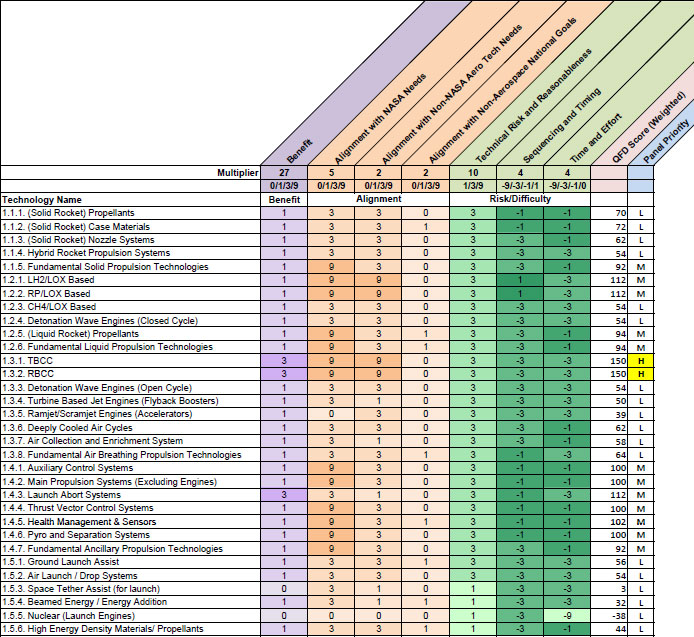
FIGURE D.1 Quality function deployment (QFD) summary matrix for TA01 Launch Propulsion Systems. The justification for the high-priority designation of all high-priority technologies appears in the section “High-Priority Level 3 Technologies.” H = High Priority; M = Medium Priority; L = Low Priority.
Some of the medium-ranked technologies and all of the low-ranked technologies are judged to have a weak linkage because of the limited benefit of investing in these technologies regardless of how closely they may overlap with various challenges in terms of subject matter.
HIGH-PRIORITY LEVEL 3 TECHNOLOGIES
Panel 1 identified two high-priority technologies in TA01: Turbine Based Combined Cycle (TBCC) and Rocket Based Combined Cycle (RBCC). The justification for ranking each of these technologies as a high priority is discussed below. TBCC and RBCC would benefit other users, such as the DOD, which also has the ability to advance these technologies. However, they are ranked as a high priority for NASA because they would provide a
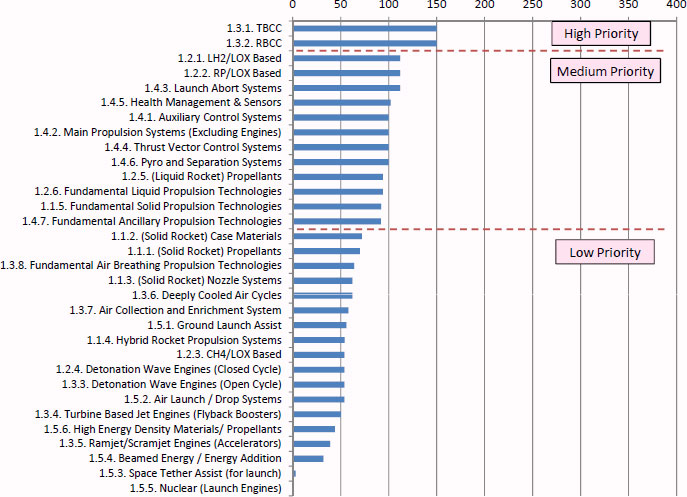
FIGURE D.2 Quality function deployment rankings for TA01 Launch Propulsion Systems.
large benefit to NASA and because they are a good match with NASA’s mission and expertise. In fact, the current state of the art in TBCC and RBCC technology has benefited from past research supported by NASA’s aeronautics research and technology program.
The International Space Station is not an appropriate test bed for any launch propulsion technologies.
Technology 1.3.2, Rocket Based Combined Cycle
Rocket Based Combined Cycle (RBCC) propulsion systems combine the high specific impulse of air breathing ramjet and scramjet engines with the high thrust-to-weight ratio of a chemical rocket. They promise to deliver launch systems with much lower costs than present launch systems. A vehicle using an RBCC propels itself from the ground using a rocket with secondary air to increase its thrust (ejector ramjet). At high enough Mach numbers (M ~ 3) for ramjet operation, the rockets turn off and air breathing propulsion is used. The ramjet mode transitions to scramjet mode at even higher Mach numbers. After the altitude is high enough to make scramjet operation impractical due to lack of oxygen, the vehicle reverts to a pure rocket mode. This type of propulsion system usually has a single flow path for the entire operating range. RBCC system components are at TRL 3 to 4.
NASA has been investigating rocket-air breathing cycles for many years and has been at the helm of experimental and numerical studies. The experimental X-43 program exemplifies NASA’s commitment to and expertise in hypersonic air breathing cycles. There is also considerable Air Force expertise in air breathing hypersonic flight as demonstrated by the recent X-51 flight of a hydrocarbon scramjet. Based on the common need within NASA
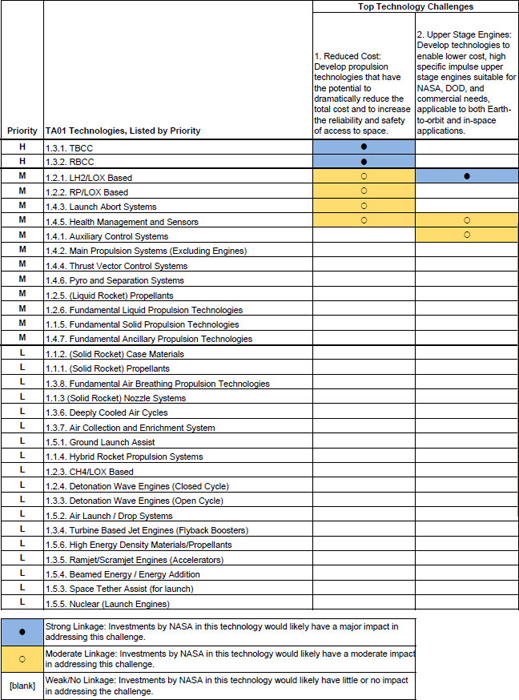
FIGURE D.3 Level of support that the technologies provide to the top technical challenges for TA01 Launch Propulsion Systems.
and DOD for lower launch costs, it would be appropriate for NASA to embark on a joint RBCC development effort with DOD.
RBCC technology is potentially game changing because it could enable revolutionary new launch systems that could be used for a broad spectrum of missions. The performance of RBCC engines is projected to be higher than that of separate rocket and ramjet/scramjet systems, with an average specific impulse at least twice that of a rocket (Bulman and Siebenhaar, 2011; Hampsten and Hickman, 2010). RBCCs have also been considered as part of reusable launch systems and as candidates for operationally flexible and cost-effective launch systems for the Air Force (Hampsten and Hickman, 2010). A reusable booster combined with a reusable RBCC orbiter is projected to offer significant launch cost savings (Hampsten and Hickman, 2010). Compared with a Turbine Based Combined Cycle (TBCC) systems, an RBCC system would be lighter due to the lack of turbine engines and additional ducting (Bulman and Siebenhaar, 2011). However, with state-of-the-art technology, an RBCC system would be heavier than traditional rockets. This is a key design trade that technology development should address.
Some of the challenges associated with RBCCs include high-temperature materials, thermal management, airframe integration, the air-breathing engines, nozzle design, ejector-ramjet optimization, and the smooth transition between modes. The panel believes it will take decades of research and development and a large and sustained financial investment to make this technology feasible.
Technology 1.3.1, Turbine Based Combined Cycle
Turbine Based Combined Cycle (TBCC) propulsion systems have the potential to combine the advantages of gas turbines and rockets in order to enable lower launch costs and more responsive operations. A TBCC-equipped vehicle, which could be configured as a two-stage reusable vehicle to improve payload capacity while reducing life cycle costs, would propel itself using a gas turbine engine. At high enough Mach numbers (M ~ 3) the engine would shift modes and operate as a ramjet. The engine would then transition to a scramjet mode at even higher Mach numbers. The vehicle would then transition to a pure rocket mode when high altitude makes scramjet operation impractical due to lack of oxygen. For most TBCC concepts, the turbine engines are mounted in separate ducts to protect them from damage during hypersonic flight conditions (Bulman and Siebenhaar, 2011). TBCC system components are at TRL 3 to 4.
As noted in the discussion of RBCC technology, above, NASA and the U.S. Air Force have been investigating rocket-air breathing cycles for many years, and it would be appropriate for NASA to embark on a joint TBCC development effort with the DOD.
TBCC technology is potentially game changing because it could enable revolutionary new launch systems that could be used for a broad spectrum of missions. Because of the air-breathing operation from take-off to scramjet, TBCCs offer loiter, fly-out, and abort capabilities (Eklund et al., 2005). Also, they provide horizontal take-off and powered landing. If hydrocarbon fuels are used for all propulsion modes, then the turnaround times and launch responsiveness could resemble that of aircraft (i.e., the launch turnaround time could be hours instead of days or weeks) (Bulman and Siebenhaar, 2011; Eklund et al., 2005). TBCCs have been considered as candidates for operationally flexible and cost-effective launch systems by the Air Force (Eklund et al., 2005).
Some of the challenges associated with TBCCs include high-temperature materials, thermal management, airframe integration, high-speed air-breathing engines, and the smooth transition between propulsion modes. TBCCs may have poor transonic acceleration, and so rockets might be needed for additional thrust (Bulman and Siebenhaar, 2011). Although gas turbines have very high specific impulse, they are heavy, and the overall system weight could be heavier than conventional launch vehicles (Bulman and Siebenhaar, 2011; Hampsten and Hickman, 2010). TBCCs are expected to be heavier than RBCCs due to the use of turbine engines and the need for additional ducting. The committee believes it will take decades of research and development and a sustained and large financial investment to make this technology feasible.
MEDIUM-AND LOW-PRIORITY TECHNOLOGIES
The assessment of the TA01 roadmap technologies identified 30 level 3 technologies as medium or low priority. Two medium-ranked technologies (RP/LOX and LH2/LOX) are so widely used that they are particularly important to the overall launch industry and future NASA programs and missions.
RP/LOX Based Propulsion
RP/LOX based propulsion systems are a good choice for main propulsion stages of expendable launch vehicles. The combination of high-density fuel, allowing for smaller volume tanks, and high thrust and reasonably high Isp are all desirable attributes for booster stages. The technology for RP/LOX main engines is quite mature and many RP/LOX engines are employed in expendable launch vehicles around the world. These include the RD-170 used in the Russian Zenit rocket, the RD-180 which powers the U.S. Atlas V vehicle, and the AJ-26 (formally the Russian NK-33) which will be the booster engine for the U.S. Taurus II vehicle. Thrust from these engines ranges from approximately 400,000 lb for the AJ-26 to 1,500,000 lb for the RD-170. Unfortunately the nexus of this technology resides within Russia. The high-performance engines described above use staged combustion, a process that can produce very high combustion chamber pressures, which results in high specific impulse. Staged compression, however, requires specialized materials, coatings, and combustion chamber design for engine parts to resist these high temperatures and pressures. Nozzle designs also need to be carefully considered to ensure proper propellant-oxidizer mixing and to prevent coking.
The technology for staged combustion RP/LOX engines can be imported from Russia or developed independently within the United States. Significant progress on each approach has been made over the last decade. U.S. companies Pratt & Whitney Rocketdyne and Aerojet have made progress in being able to establish a U.S. production capability for the RD-180 and AJ-26 engines, respectively. AFRL and NASA have both invested significant funds in establishing an independent U.S. RP/LOX technology base.
If a U.S. capability to produce RP/LOX main engines is deemed necessary, a national strategy should be developed that considers the interests of NASA, DOD, and industry. For example, the U.S. Air Force and NASA could jointly invest in the development of a modular family of RP/LOX engines to meet a wide range of mission requirements (medium lift through super heavylift) in partnership with a team from the U.S. propulsion and launch industry. The cost of such an endeavor is likely to be on the order of $1 billion to $3 billion.
Because RP/LOX technology is applicability to such a wide range of missions, this technology received the highest possible score for both NASA mission needs and non-NASA aerospace needs. However, technology investment in this technology would provide little additional benefit in terms of launch vehicle performance given that the technology is available commercially. U.S. capabilities are at TRL 4 to 5, but Russian technology is at TRL 9.
LH2/LOX Based Propulsion
LH2/LOX based propulsion systems are especially useful for launch system upper stages and in-space stages where thrust and volume are less important but high specific impulse is critical. The technology for LH2/LOX engines is quite mature. The 25,000 lb thrust RL-10 engine has been used for decades in many different variants to power virtually every NASA mission beyond Earth orbit. It is also the workhorse for DOD launches. The RL-10, however, has become increasingly expensive and difficult to produce. NASA is developing the J-2X engine with roughly 250,000 lb of thrust. This engine is appropriate for very large upper stages but is too big and heavy for in-space applications.
A low-cost, producible engine is needed to replace the RL-10 for upper stages, to power an in-space cryogenic propulsive stages for exploration missions, and for other in-space applications. Several options exist, including turbine-based, piston-pump-based, and staged-combustion-based configurations.
As with RP/LOX, if the decision is made to develop a new LH2/LOX engine, it may be prudent for NASA to partner with DOD and industry. One key to achieving low cost is high production rate, so a new engine should be designed to meet the needs of as many launch users as possible (in the upper stage configuration) and the maximum number of in-space applications.
LH2/LOX received the highest possible score in terms of NASA needs because it is applicable to nearly every NASA mission. Currently the U.S. Air Force and industry are investing in this technology for upper stage applications. For those applications, additional NASA technology investment would have little impact in terms of overall cost and performance of the launch system. However, for in-space applications, there are unique requirements that may not be addressed without a NASA technology investment.
Other Medium- and Low-Priority Technologies
The panel assessed 12 technologies in TA01 as medium priority and 18 as low priority. Two of the low-priority technologies, nuclear propulsion and tethers, were deemed non-credible for launch propulsion applications. One medium-priority technology, launch abort systems, has the potential for a major improvement in mission performance. All of the other medium- and low-priority technologies were determined to have the potential for only a minor improvement in mission performance, life cycle cost, or reliability.
The major discriminator between medium- and low-priority technologies in TA01 was alignment with NASA needs. With one exception (launch abort systems), all the medium-priority technologies scored higher in this area than all of the low-priority technologies.
DEVELOPMENT AND SCHEDULE CHANGES FOR THE
TECHNOLOGIES COVERED BY THE ROADMAP
The development timeline for launch propulsion technologies will be critically dependent on the overall strategy and architecture chosen for exploration, and the funding available. Until these factors are known, it makes little sense to define a timeline.
OTHER GENERAL COMMENTS ON THE ROADMAP
The economics of an operational launch system are described by the following equation:
$/kg = ((fixed cost) + N * (variable cost)) /(N * (kg/launch)),
where fixed cost = annual cost of the fixed infrastructure and critical skill base, variable cost = cost to build and launch one unit, N = launch rate (number of launches per year), and kg/launch = payload mass delivered by one launch.
The fixed cost for a launch vehicle program is typically very high. Rockets for orbital launches are large, complex objects and require large factories, large and specialized transportation and handling equipment, and extensive infrastructure at the launch site. For example, the fixed cost of the Space Shuttle Program was historically $3 billion to $4 billion per year. The fixed cost of the Evolved Expendable Launch Vehicle (EELV) program exceeds $1 billion per year. Both the fixed cost and the variable cost are non-linear increasing functions of the size of the rocket. In general, the fixed cost is many times the variable cost of a single launch.
Given the fundamentals of launch economics, it is clear that one way to significantly reduce launch cost per kilogram is to increase N, the launch rate. The launch rate is largely determined by the market demand, but for complex missions that require very large payload mass, there is an architecture choice between one large launch carrying all the payload mass and two or more launches, each of which delivers a smaller payload mass. All else being equal, the economics of launch would prefer the latter option. Of course, launch economics is only one consideration, albeit a very important one. This consideration has to be balanced with the difficulty and complexity of breaking payloads into smaller pieces and the logistics of multiple launches and assembly in space.
Some of the technologies in other Tas, especially TA02 (in-space propulsion) and TA04 (robotics) could open the trade space to architecture options that use smaller rockets to increase launch rate. For example, many of NASA’s most challenging space missions require large quantities of propellant be delivered to LEO. Technologies that enable the storage and transfer of propellants (especially cryogenic LOX and LH2) would allow propellants to be launched in smaller quantities. These technologies could be more effective in reducing launch costs than
specific launch vehicle technologies. In fact, one could imagine a commodity market being established for propellant launches to LEO, where market forces come to bear to reduce cost.
PUBLIC WORKSHOP SUMMARY
The workshop for the Launch Propulsion Systems technology area was conducted by the Propulsion and Power Panel on March 23, 2011, on the campus of the California Institute of Technology in Pasadena, California. The discussion was led by panel member George Sowers, who started the day by giving a general overview of the roadmaps and the NRC’s task to evaluate them. He also provided some direction for what topics the invited speakers should cover in their presentations. Experts from industry, academia, and government were invited to lead a 25 minute presentation and discussion of their perspective on the draft NASA roadmap for TA01. At the end of the session, there was a short open discussion by the workshop attendees that focused on the recent session. At the end of the day, there was a concluding discussion led by Sowers summarizing the key points observed during the day’s discussion.
Session 1: Academia
Bill Anderson (Purdue University) started the session with academia by emphasizing the need for the NASA roadmap to reduce the number of options and focus on a few of the most promising options. He suggested that an objective, rigorous, and transparent study of launch missions and requirements is necessary to determine the proper focus. At the present time when there is no clear and compelling mission, he urged NASA to systematically investigate foundational engineering challenges such as variable-fidelity modeling of advanced and new propulsion systems and their components, whereas incremental development and implementation of heritage launch systems should be left to industry. He also discussed the need to maintain a skilled workforce, and NASA’s important role of inspiring and developing new scientists and engineers by identifying and providing new and challenging problems, including actual flight.
Bob Santoro (Penn State) noted that most NASA personnel who worked on the development of earlier generations of launch propulsion systems have or soon will retire. He stated that the biggest factor in lowering the cost of launch is increasing the flight rate. (This point was made throughout the workshop by multiple presenters.) He suggested that in the near term, the most promising launch propulsion technology is a hydrocarbon-based liquid engine. Over the long term, he said NASA should invest in technologies to support a two-stage, air-breathing, combined cycle launch vehicle. He believes at the moment there is no need to down-select between TBCC and RBCC systems because of their many commonalities. He also thought that it might be beneficial to invest in pulse detonation engines because of their game-changing potential. Finally he observed that the current roadmap is too broad and needs focus.
Bill Saylor (Air Force Academy) remarked that his role as an educator at the Air Force Academy is to make his students smart buyers of commercial systems. He suggested that NASA’s main role in technology development should be basic research, and that such investments promote science, technology, engineering, and mathematics education and improve the excising workforce. He acknowledged that industry partners are probably most useful for making near-term improvements. He suggested that perhaps that could be encourage by higher launch rates. He also agreed that the most promising long-term technology is air-breathing propulsion systems such as TBCC and RBCC.
In the discussion period that followed many speakers endorsed the development of air-breathing technologies as potentially the biggest game changers in TA01. However, there also was some skepticism that there would be a large enough market to support a reusable launch system that leveraged air-breathing technology.
Session 2: U.S. Air Force
Toby Cavallari (USAF /SMC/LR) started the U.S. Air Force session with a presentation that focused on the history of the Air Force launch vehicle program, its current status, and near-term plans. He noted some of the near-term challenges that face the Air Force include parts obsolescence, increasing costs, dependence on foreign suppliers, and a declining U.S. industrial base. He said that a new affordable upper stage engine is needed, and that such an engine should leverage both Air Force and NASA technology investments. He concluded by saying
the Air Force and NASA should pursue joint development programs with interagency cooperation and commercial partnerships, particularly for liquid rocket engines, noting that neither agency can afford standalone programs.
Greg Rudderman (Air Force Research Laboratory; AFRL) presented charts generated by Richard Cohn (AFRL) who was not able to attend the workshop. This presentation started with a review of relevant research, past and present, by AFRL, including the Integrated High Payoff Rocket Propulsion Technology (IHPRPT) program. IHPRPT is a joint DOD-NASA-industry program to develop technologies that will lead to more capable rockets. Military applications of interest include tactical missiles, strategic missiles, and spacecraft. The IHPRPT goals are similar in nature to many of the goals laid out in NASA’s draft roadmap for TA01. Propulsion Directorate is interested and actively working on both solid and liquid motor technologies as well as improved modeling while other parts of AFRL pursue air-breathing engine concepts. In reviewing the draft TA01 roadmap Cohn noted that it includes some technologies that have been shown in the past to lack promise and agreed that greater focus on a smaller number of promising technologies would be beneficial.
Randy Kendall (The Aerospace Corporation) said that modern launch options have plenty of performance and reliability, but are very expensive. He also stated that increased flight rates were key to reducing launch costs. He described current Air Force plans to build a reusable booster system and said that a combustion engine suitable for a reusable hydrocarbon stage would be the most promising NASA technology to support a reusable booster system. Over the mid- to long-term, he said that the highest priorities should be air-breathing propulsion technologies (RBCC and TBCC), pulse detonation engines, and an air collection and enrichment system.
Tim Lawrence (Air Force Institute of Technology) included comments on in-space propulsion and more advanced concepts. He suggested that nuclear-based propulsion technologies are good options for solving NASA’s transportation needs, but there are several challenges to be overcome before they can be implemented. He strongly encouraged development in the field of green propulsion technologies (that do not include hazardous materials) because they are compatible with small scale and student-run spacecraft. In addition, revolutionary advances in propulsion technology would enable missions that are currently inconceivable.
In the discussion period many speakers discussed how the U.S. Air Force and NASA should cooperate. It was noted that, although the two agencies are trying to cooperate, it is difficult to execute joint programs because of the potential for redirection by either participant. It was also mentioned that the nation may have too many underused test facilities because of overlap between the Air Force and NASA. One speaker said the Air Force launch rates would probably remain unchanged unless a revolutionary system is developed that leads to higher launch rates.
Session 3: Propulsion System Manufacturers
Stan Graves (ATK) started the session with propulsion system manufacturers by noting that current launch systems all use a combination of liquid and solid propulsion systems. He expects that trend to continue due to the physics, economics, and programmatics of the launch vehicle industry. Having reviewed the draft NASA roadmaps for TA01, he observed that many of the technologies would benefit both commercial and NASA heavy lift launch systems and both liquid and solid propulsion systems. He also suggested that two technologies, electrical-hydrostatic and electrical-mechanical thrust vector control, should be high priorities. Graves also asserted that investments should be made in developing a low-cost, safe, and green system.
Jeff Greason (XCOR) stated improving rocket performance is not likely to be a cost effective approach for NASA to improve the economics, reliability, and safety of access to space. Instead, he advocated increasing flight rates and reducing production costs. He declared that one of the best approaches for increasing flight rate is for commonality in performance requirements established by launch customers, and NASA could contribute to this approach by investing in technologies that allow large exploration missions to be broken into smaller pieces for launch. With a higher flight rate, reusable launch systems become more advantageous, especially if maximum payload mass per launch is contained. He identified two other high priorities: thermal protection systems for reusable launch vehicles and low-cost engines with adequate performance.
Russ Joyner (Pratt Whitney Rocketdyne) said that the current roadmaps are too broad and should be focused, but not before NASA establishes mission priorities. In the meantime, he urged NASA to invest in crosscutting technologies, such as manufacturing. He also called for technology investments to focus on reducing cost rather
than increasing performance. He also supported providing a steady level of funding for small-scale efforts to improve capabilities over the long term, with periodic reviews.
Todd Neill (Aerojet) provided very specific suggestions for the full list of launch propulsion technologies. In particular, he mentioned that NASA should move toward HTPB (hydroxy-terminated polybutadiene) propellants for solids, develop a nozzle extension for hydrogen engines and develop a new hydrocarbon boost engine. He saw little benefit to either hybrid propulsion systems or advanced propellants (besides the previously mentioned HTPB).
In the discussion session a few members of the audience suggested that hybrid propulsion systems should be high priority. They argued that hybrid systems have improved significantly in recent years, suggesting that they have higher efficiency than solid propulsion system, that they are less complex than liquid engines, and they are easy to manufacture and operate. There was also a discussion on the IHPRPT program as a model for propulsion technology development, with some suggesting that is a good program for attracting bright talent and developing new tools. Others criticized IHPRPT for starting with too much of a focus on improving performance, with not enough attention to cost reduction. One speaker disagreed that increasing launch rates is the best solution for reducing costs, suggesting that mission payloads could generally be repackaged in such a way to significantly increase the national launch rate. When asked what technologies would help improve affordability, various speakers mentioned improved materials, manufacturing, and health monitoring, and they cautioned that industry’s ability to invest in these technologies as they pertain to launch vehicles is constrained by high costs and low production rates.
Session 4: Launch Vehicle Manufacturers
Bernard Kutter (United Launch Alliance) started the session with launch vehicle manufacturers by emphasizing some of the points made earlier in the day. These include increased flight rates as a key to reducing cost and investing in cost reduction and operability instead of performance. Kutter noted that numerous attempts in the past 30 years to develop revolutionary systems had failed. He also said that it is unclear if reusability will show economic benefit. One technology he supported was integrated vehicle fluids, which would use primary engine propellants to serve the needs of auxiliary vehicle systems that currently use other fluids. Given the uncertainty in the future optimum vehicle configuration, he favored making technology investments in crosscutting technologies with broad applicability.
Gwynne Shotwell (SpaceX) reviewed the history of SpaceX. She believes that the highest priority propulsion technology would be a hydrocarbon boost engine with a thrust on the order of 1.5 million pounds or greater. Such an engine could support a NASA super heavy lift vehicle as well as smaller commercial launch systems. She suggested that this engine should be developed through a public-private partnership using a fixed price competition similar to the one NASA used for its Commercial Orbital Transportation Services program. This approach gives industry the flexibility and the incentives to produce optimum solutions.
John Steinmeyer (Orbital) agreed that a new high-thrust hydrocarbon boost engine should be the highest priority launch development. He suggested that the current Russian engines could be used as starting points, with the goal of a developing a propulsion system that could support the proposed NASA super heavy lift vehicle, smaller commercial launchers, and the proposed Air Force RBS. He asserted that the recent U.S. industrial space policy has hampered emerging technology through lack of focus and constancy. He said that new efforts should be properly funded and coordinated programs that capitalize on past developments and strategic, focused investments.
In the discussion session the hydrocarbon engine was further discussed with several speakers endorsing it as the best path forward for a super heavy lift system, especially if it were also used in other launch vehicles to reduce costs. Some speakers said that two competing engines should be developed to foster competition, but others countered that the market might be too small to support two vendors.
REFERENCES
Bulman, M.J., and Siebenhaar, A. 2011. Combined cycle propulsion: Aerojet innovations for practical hypersonic vehicles. AIAA Paper 20112397. American Institute of Aeronautics and Astronautics, Reston, Va.
Eklund, D.R., Boudreau, A.H., and Bradford, J.E. 2005. A turbine-based combined cycle solution for responsive space access. AIAA Paper 2005-4186. American Institute of Aeronautics and Astronautics, Reston, Va.
Hampsten, K.R., and Hickman, R.A. 2010. Next Generation Air Force Spacelift. AIAA Paper 2010-8723. American Institute of Aeronautics and Astronautics, Reston, Va


