
TA02 In-Space Propulsion Technologies
INTRODUCTION
The draft roadmap for technology area (TA) 02, In-Space Propulsion Technologies, consists of four level 2 technology subareas:1
• 2.1 Chemical Propulsion
• 2.2 Non-Chemical Propulsion
• 2.3 Advanced (TRL<3) Propulsion Technologies
• 2.4 Supporting Technologies
TA02 includes all propulsion-related technologies required by space missions after the spacecraft leaves the launch vehicle from Earth. The technology area includes propulsion for such diverse applications as fine pointing of an astrophysics satellite in low Earth orbit (LEO), robotic science and Earth observation missions, high-thrust Earth orbit departure for crewed vehicles, low-thrust cargo transfer for human exploration, and planetary descent, landing and ascent propulsion. This wide range of applications results in a very diverse set of technologies, including traditional space-storable chemical, cryogenic chemical, various forms of EP, various forms of nuclear propulsion, chemical and electric micropropulsion, solar sails, and space tethers. The challenge for the panel was to prioritize these technologies in light of 50 years of spaceflight development experience, the current status of all the technologies, an assessment of the likely benefits which would result from successfully developing each technology, and a general understanding of NASA’s mission objectives.
Prior to prioritizing the level 3 technologies included in TA02, several technologies were deleted. The changes are explained below and illustrated in Table E.1. The complete, revised technology area breakdown structure (TABS) for all 14 Tas is shown in Appendix B.
The steering committee deleted the following level 3 technologies
• 2.4.1. Engine Health Monitoring & Safety,
• 2.4.3. Materials & Manufacturing Technologies,
• 2.4.4. Heat Rejection, and
• 2.4.5. Power.

1The draft space technology roadmaps are available at http://www.nasa.gov/offices/oct/strategic_integration/technology_roadmap.html
TABLE E.1 Technology Area Breakdown Structure for TA02, In-Space Propulsion Systems
| NASA Draft Roadmap (Revision 10) | Steering Committee-Recommended Changes |
| TA02 In-Space Propulsion Technologies | Four technologies have been deleted. |
|
2.1. Chemical Propulsion |
|
|
2.1.1. Liquid Storable |
|
|
2.1.2. Liquid Cryogenic |
|
|
2.1.3. Gels |
|
|
2.1.4. Solid |
|
|
2.1.5. Hybrid |
|
|
2.1.6. Cold Gas/Warm Gas |
|
|
2.1.7. Micro-Propulsion |
|
|
2.2. Non-Chemical Propulsion |
|
|
2.2.1. Electric Propulsion |
|
|
2.2.2. Solar Sail Propulsion |
|
|
2.2.3. Thermal Propulsion |
|
|
2.2.4. Tether Propulsion |
|
|
2.3. Advanced (TRL <3) Propulsion Technologies |
|
|
2.3.1. Beamed Energy Propulsion |
|
|
2.3.2. Electric Sail Propulsion |
|
|
2.3.3. Fusion Propulsion |
|
|
2.3.4. High Energy Density Materials |
|
|
2.3.5. Antimatter Propulsion |
|
|
2.3.6. Advanced Fission |
|
|
2.3.7. Breakthrough Propulsion |
|
|
2.4. Supporting Technologies |
|
|
2.4.1. Engine Health Monitoring & Safety |
Delete: 2.4.1. Engine Health Monitoring & Safety |
|
2.4.2. Propellant Storage & Transfer |
|
|
2.4.3. Materials & Manufacturing Technologies |
Delete: 2.4.3. Materials & Manufacturing Technologies |
|
2.4.4. Heat Rejection |
Delete: 2.4.4. Heat Rejection |
|
2.4.5. Power |
Delete: 2.4.5. Power |
The scope of each of these technologies actually falls outside the scope of TA02, and NASA’s draft roadmap for TA02 does not suggest that any of them should be developed as part of TA02. Except for item 2.4.2, this section of the roadmap is used to highlight level 1 or level 2 topics in other roadmaps that are important to the TA02 roadmap— but that belong to other roadmaps. For example, with regard to 2.4.5. Power, the roadmap says:
Power systems play an integral role in all in-space propulsion systems for both human and robotic missions. The reader is referred to the Technology Area 3, Space Power and Energy Storage Systems.
Similarly, with regard to technologies 2.4.1, 2.4.3, and 2.4.4, roadmap TA02 refers readers to roadmaps TA04, TA12, and TA14, respectively, to learn the details of what should be done in these areas.
TOP TECHNICAL CHALLENGES
The panel identified four top technical challenges for TA02, all of which are related to the provision of safe, reliable, and affordable in-space transportation consistent with NASA’s mission needs. The challenges are listed below in priority order.
1 High-Power Electric Propulsion (EP) Systems: Develop high-power EP system technologies to enable high-ΔV missions with heavy payloads.
EP systems have a higher propellant efficiency than other in-space propulsion technologies that will be available in the foreseeable future, with applications to all NASA, Department of Defense (DOD), and commercial space
mission areas. Specifically, low-power EP systems are currently used for small robotic interplanetary missions (e.g., Hayabusa and Dawn), for post-launch circularization of the orbits of large geosynchronous communications satellites (e.g., Advanced Extremely High Frequency satellite), and stationkeeping for a wide range of spacecraft (e.g., GOES-R and commercial communications satellites). Development of high-power EP systems (30 kW to 600 kW) will enable larger scale missions with heavy payloads, including development of a more efficient in-space transportation system in Earth-space, sample returns from near-Earth objects (NEOs), the martian moons, other deep space destinations (including extensions of the JUNO mission to Jupiter), precursor demonstrations of in situ resource utilization (ISRU) facilities, and pre-placement of cargo for human exploration missions. In addition to these specific propulsion and power system technologies, demonstration of large scale EP vehicles is required to ensure adequate control during autonomous rendezvous and docking operations necessary for either cargo or small body proximity operations.
2. Cryogenic Storage and Transfer. Enable long-term storage and transfer of cryogens in space and reliable cryogenic engine operation after long dormant periods in space.
Deep space exploration missions will require high-performance propulsion for all mission phases, including Earth departure, destination arrival, destination departure, and Earth return, occurring over the entire mission duration. Both high-thrust propulsion options, LOX/H2 chemical propulsion and LH2 nuclear thermal rocket (NTR), will require storage of cryogens for well over a year to support all mission phases. Chemical and NTR engines must also operate reliably after being dormant for the same period. While LOX can currently be stored for extended periods, LH2 boil-off rates using state-of-the-art technology are far too high for deep-space missions, allowing only a few days of storage. Additionally, cryogenic fluid transfer technology would enable other exploration architectures, including propellant aggregation and the use of propellants produced using ISRU facilities. This technical challenge is enabling for the most plausible transportation architectures for human exploration beyond the Moon.
3. Microsatellites: Develop high-performance propulsion technologies for high-mobility microsatellites (<100 kg).
The broader impact of small satellites is hindered by the lack of propulsion systems with performance levels similar to those utilized in larger satellites (high ΔV, high Isp, low mass fractions, etc.). Most existing propulsion systems are not amenable for miniaturization and work is needed to develop concepts that scale and perform favorably. In addition to small satellites, high-performing miniature propulsion would also provide functionality in different applications, for example in distributed propulsion for controlling large, flexible structures and address missions requiring fine thrust for precise station keeping, formation flight, accurate pointing and cancellation of orbital perturbations. A moderate investment in many of these technologies (including chemical, electric, and advanced propulsion concepts, such as tethers and solar sails) could validate their applicability to small satellites.
4. Rapid Crew Transit: Establish propulsion capability for rapid crew transit to/from Mars.
Trip times for crewed missions to NEOs, Phobos, and the surface of Mars should be minimized to limit impacts to crew health from radiation (galactic and solar), exposure to reduced gravity, and other effects of long-duration deep space travel. Developing high-performance, high-thrust propulsion systems to reduce transit times for crewed missions would mitigate these concerns. Two realistic high-thrust options exist that could be available for missions in the next 20 years: LOX/H2 and NTR. Engines used for rapid crew transport must be capable of multiple restarts following prolonged periods of inactivity, and they must demonstrate extremely high reliability. There are no engines of either type currently available that meet the requirements of performance, reliability, and restart capability. The two LOX/H2 engines that come closest are the J2X, with about ~250,000 pounds of thrust and the RL-10, with about ~25,000 pounds of thrust. Both are high-performance engines and both have some restart capability, but neither has demonstrated the ability to accomplish multiple restarts following prolonged dormancy. Also, NTRs have never been tested in space, and the last ground test was conducted more than 40 years ago. There is also considerable uncertainty regarding the effort it would take to reconstitute the state of the art as it existed 40 years ago or to define test and operational requirements, and the environmental issues are substantial.
QFD MATRIX AND NUMERICAL RESULTS FOR TA02
The panel evaluated 23 In-Space Propulsion level 3 technologies. The results of the panel’s QFD scoring for the level 3 in-space propulsion technologies are shown in Figures E.1 and E.2. As noted above, four technologies in the draft roadmap for TA02 were eliminated from consideration (2.4.1. Engine Health Monitoring & Safety, 2.4.3. Materials & Manufacturing Technologies, 2.4.4. Heat Rejection, and 2.4.5. Power) because they are properly addressed in other roadmaps. The results of the QFD scoring are shown in Figure E.3. The seven technologies in the Advanced Propulsion Technologies subarea received the same score and they are listed as a single (low priority) line item. Four technologies were assessed as high-priority technologies:
• Electric propulsion
• Propellant storage and transfer
• Thermal propulsion
• Micropropulsion systems
The first three technologies were designated as high-priority technologies because they received the highest QFD scores based on the panel’s initial assessment. The panel subsequently decided to override the QFD scoring results to designate micropropulsion systems as a high-priority technology to highlight the importance of developing propulsion systems that can support the rapidly developing micro-satellite market, as well as certain large astrophysics spacecraft.
CHALLENGES VERSUS TECHNOLOGIES
Figure E.3 shows how each of the TA02 level 3 technology supports the top technical challenges described above. This shows that the high-priority technologies, which are discussed in the next section, provide potential
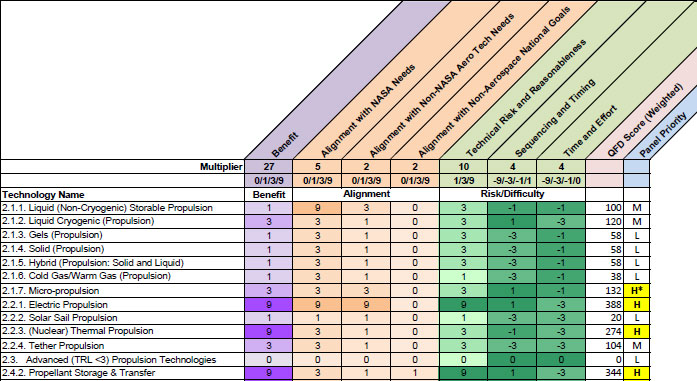
FIGURE E.1 Quality function deployment (QFD) summary matrix for TA02 In-Space Propulsion Systems. The justification for the high-priority designation of all high-priority technologies appears in the section “High-Priority Level 3 Technologies.” H = High Priority; H* = High Priority, QFD score override; M = Medium Priority; L = Low Priority.
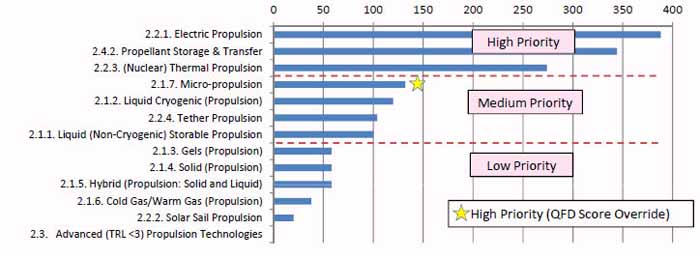
FIGURE E.2 Quality function deployment results for TA02 In-Space Propulsion Systems.
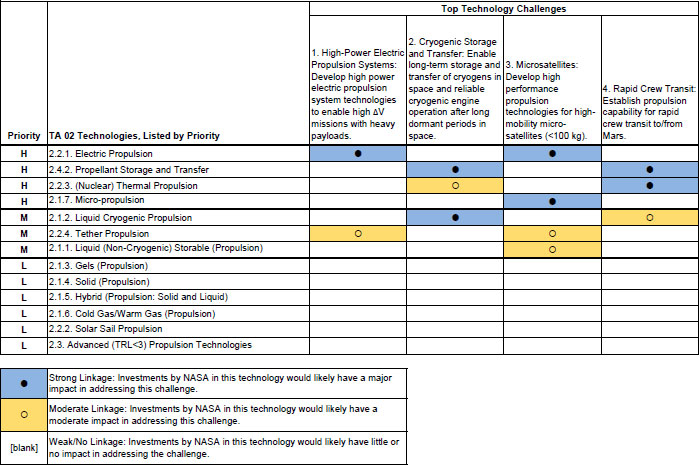
FIGURE E.3 Level of support that the technologies provide to the top technical challenges for TA02 In-Space Propulsion Systems.
solutions that will meet these challenges. The low-ranked technologies are judged to have a weak linkage because of the limited benefit of investing in these technologies regardless of how closely they may overlap with various challenges in terms of subject matter.
HIGH-PRIORITY LEVEL 3 TECHNOLOGIES
Panel 1 identified four high-priority technologies in TA02. The justification for ranking each of these technologies as a high priority is discussed below.
Technology 2.2.1, Electric Propulsion
Technology 2.2.1, electric propulsion (EP) uses electrical power produced onboard a spacecraft to accelerate propellant to extremely high speeds. Solar electric propulsion (SEP), including arcjet, Hall thruster, and ion thruster systems, is routinely used today on more than 230 space vehicles for spacecraft maneuvers, mostly north-south station-keeping and orbit-raising. A handful of U.S. and international lunar and interplanetary probes (SMART-1, Hayabusa, Dawn) use or have used SEP for primary propulsion. SEP has also been used for drag make-up in LEO (GOCE) and for orbit-raising and station-keeping of large geosynchronous communications satellites. These systems are at TRL 9.
Modern laboratory-model ion thrusters and Hall thrusters have been demonstrated on the ground by NASA at 30 kW and ~100 kW, respectively. These systems are at TRL 3. Laboratory-model Hall thrusters at the 100 to 250 kW power level are currently being developed by NASA and the U.S. Air Force. Flight versions of these thrusters may be developed in the mid-term (2017 to 2022) timeframe. Over the longer term, multi-MW systems enabled by space nuclear power systems could use flight versions of the lithium magnetoplasmadynamic thrusters, pulsed inductive thrusters, field reversed configuration thrusters, and VASIMR thrusters that are in early laboratory testing today.
NASA has the expertise and ground facilities to lead the critical EP technology developments in cooperation with the U.S. Air Force, industry, and academia. There is also potential for international cooperation as Europe, Japan, and Russia have very productive EP programs. In addition to thruster development, advances in high-power EP systems will require:
• Developing the components and architectures needed for high-capacity power processing units;
• Gaining a better understanding of thruster wear mechanisms so full-length life tests are not always necessary;
• Characterizing EP/spacecraft interactions more completely;
• Developing the infrastructure needed to test high-power EP systems on the ground; and
• Demonstrating autonomous operation and control of high-power, large-scale EP systems in space.
The International Space Station is not well suited as a test platform for high-power EP. In its current configuration, the ISS provides no benefit to high-power EP testing in space given the limited power available (~5 kW) and the requirement to validate vehicle system operation in rendezvous and docking scenarios
The primary benefit of EP is its high specific impulse, which is typically an order of magnitude greater than those of chemical propulsion systems: 103 to 104 s for EP versus 500 s or less for chemical propulsion systems. As a result, EP systems are the most propellant efficient in-space propulsion technology available for the foreseeable future, with applications to all NASA, DOD, and commercial space mission areas. While EP’s large specific impulse enables a host of space missions that are not possible or affordable with conventional propulsion, its thrust is low, which results in long trip times for many missions. This characteristic of EP places constraints on departure orbits and travel through deep gravity wells. The development of high-power SEP systems (from ~100 kW to ~1 MW) would enable missions with heavier spacecraft and/or shorter transit time, resulting in more efficient in-space transportation systems in Earth orbit; more affordable sample return missions from destinations such as the Moon, Mars, and the asteroid belt; pre-positioning of cargo and ISRU facilities for human exploration missions
to Mars orbit; and efficient crew transfers to near-Earth objects (NEOs) and Phobos from departure points such as the Earth-Moon Lagrange points. The large benefits, broad applicability, and reasonable development timescales and challenges are the basis for the high priority placed on EP technology.
Technology 2.4.2, Propellant Storage and Transfer
Technology 2.4.2, propellant storage and transfer in space, includes both the long-term storage of cryogens (liquid hydrogen, oxygen, and potentially methane, as well as propellants for EP) and the transfer of these fluids between refueling stations (depots) and the propulsion systems on spacecraft, upper stages, and Moon/Mars landing and ascent vehicles. This technology has only been validated at the component level for cryogenic fluids in laboratory environments (TRL 4), although “storable” (non-cryogenic) propellant storage and transfer has been demonstrated in space (TRL 7).
NASA has the expertise and facilities to lead this development effort, with multiple ground test facilities and considerable experience in cryogenic fluid management at several NASA centers. The ISS could easily contribute to the development of this technology. Simple yet extremely beneficial experiments could be performed to validate long-term storage and handling of cryogenic propellants. Alternatively, expendable launch vehicles could carry large masses of residual cryogens into orbit for independent experiments, without introducing any risk to the ISS. This could lead to precursor demonstrations of the ISS as a deep space transportation node.
Propellant storage and transfer is a game changing technology that could provide big benefits for NASA exploration missions, and it may also benefit DOD and commercial missions. Propellant storage and transfer in space can reduce operational costs and enable affordable human exploration of the Moon and Mars, as follows:
• Human exploration of Mars: high-V maneuvers will be required for all mission phases, including Earth departure, Mars arrival, and Earth return. The time-scales for these mission phases will require long-term storage of propellants. Additionally, it is likely that vehicles departing from Earth will need more cryogenic propellant than can be reasonably carried to orbit in a single launch, and therefore long-term storage of propellant is an absolute requirement for human missions to Mars.
• Refueling vehicles in lunar or Mars orbit with ISRU propellants has the potential to reduce exploration costs by perhaps an order of magnitude (compared to an exploration architecture that requires all fuel to be carried into space from Earth).
• Enabling launch of unfueled deep space vehicles, reducing the mass of deep space vehicles, and potentially reducing the maximum required launch mass per launch.
This technology requires in-space demonstrations to validate cryogenic fluid management in microgravity. Propellant storage and transfer is an interdisciplinary capability, which may overlap with other technology areas such as advanced thermal control to minimize boil-off and perhaps to provide active cooling. Propellant storage and transfer is a game changing technology for a wide range of applications because it enables long-duration, high-thrust, high-V missions with large payloads and crew.
Technology 2.2.3, Thermal Propulsion
Technology 2.2.3, thermal propulsion, includes the option of using either solar and nuclear thermal sources to heat hydrogen propellant for high specific impulse. Of these two, only nuclear thermal propulsion is rated as a high-priority technology. Solar-thermal propulsion has limited benefit compared to other propulsion options and comes with a high degree of complexity and mission constraints.
Nuclear thermal rockets (NTRs) are high-thrust propulsion systems with the potential for twice the specific impulse of the best liquid hydrogen/oxygen chemical rockets. Multiple mission studies have shown that nuclear thermal rockets would enable rapid Mars crew transfer times with half the propellant and about 60 percent of the launch mass required by chemical rockets. Demonstrated NTRs use a solid-core nuclear reactor to heat hydrogen propellant, exhausting it through a standard nozzle to achieve a specific impulse of 800 s to 900 s. An extensive
development program, Project Rover, was conducted between 1951 and 1971, during which 20 separate reactors and engines were tested at thrust levels between 7,500 and 250,000 pounds of thrust. The program culminated with the Nuclear Engine for Rocket Vehicle Applications (NERVA) system, which fired for almost 2 hours with 28 restarts. Since then intermittent demonstration efforts have been focused on advanced nuclear fuels development, non-nuclear validation of advanced engines such as the LOX-augmented NTR, assessments of ground test requirements, cost reduction studies, and mission studies.
Critical NTR technologies include the nuclear fuel, reactor and system controls, and long-life hydrogen pumps. Technology development will also require advances in ground test capabilities, as the open-air approach used during Project Rover is no longer environmentally acceptable. While NTR technology was close to TRL 6 in 1971, inactivity since then has resulted in the loss of experienced personnel and facilities, and the current TRL is probably at TRL 4 or less. The immediate challenge is to capture the engineering and technical knowledge base of the NERVA program. The next steps would be to validate nuclear fuels for long life at high temperature, to ensure no nuclear material would be released during ground tests, and to validate ground test site capability for handing NTR effluents. NERVA used graphite-based fuels, whereas modern fuels rely on cermets or tungsten to ensure a radiation-free exhaust. In parallel with the development of nuclear fuels, sub- and full-scale evaluations of ground testing NTRs using existing borehole testing would be needed to fully characterize effluent behavior. Initial studies for using existing boreholes at the Nevada Test Site have shown no major roadblocks to date, though considerable development and validation remains. Use of existing boreholes may minimize the cost of ground testing. NTR development could readily take a phased approach, with parallel efforts to develop nuclear fuels, validate ground test capabilities, and develop and demonstrate a low-thrust (5,000 pounds) NTR. This would be followed by full-scale development and flight of an NTR with 20,000 to 25,000 pounds of thrust. Such a system would have enough thrust for a crewed Mars mission. Growth options exist for follow-on systems such as the LOX-Augmented NTR, which can provide much higher thrust (at lower Isp) for operation in planetary gravity wells.
NTR technology development will require NASA to collaborate closely with DOE (Department of Energy) national laboratories and the Nevada Test Site. NASA has all the expertise required to develop an NTR except for the nuclear fuels and reactor, which by statute are the responsibility of the DOE. There is ample precedent for NASA-DOE collaboration in developing nuclear systems. There is no need for access to the ISS for NTR development.
The reduction in launch mass enabled by this technology could significantly reduce the cost and mission complexity of crewed missions to Mars. The panel could not identify credible non-NASA or non-aerospace applications of NTR technology. Although NTR development would be a major program, its benefits resulted in ranking NTRs as a high-priority technology.
Technology 2.1.7, Micro-propulsion
Technology 2.1.7, micro-propulsion, encompasses all propulsion options, both chemical and non-chemical, that could be used to fulfill the propulsion needs of (1) high-mobility micro-satellites (<100 kg) and (2) the extremely fine pointing and positioning requirements of certain astrophysics missions. Recent advances in the miniaturization of spacecraft subsystems have triggered a large growth in the field of micro-satellites (<100 kg), nano-satellites (~10 kg), pico-satellites (~1 kg), and femto-satellites (<1 kg). Small satellites, operating individually or flying in formation, are being considered for increasingly complex missions (e.g., flight testing and validation of new technologies, scientific missions, and commercial missions). Low costs, fast development times, and the potential to perform tasks so far limited to large systems have made small satellites an area of interest for NASA, DOD, other government agencies, and many research centers and educational institutions worldwide. The lack of micro-propulsion is currently a roadblock in the development of advanced high-mobility micro-satellites. Ideally, new and evolved micro-propulsion technologies would be characterized by:
• Low mass and low volume fractions, scalable to the smallest of satellites,
• Wide range of ΔV capability to provide hundreds or even thousands of m/s,
• Wide range of Isp capability, up to thousands of seconds,
• Precise thrust vectoring and low vibration for precision maneuvering,
• Efficient use of onboard resources (i.e., high power efficiency and simplified thermal and propellant management),
• Affordability, and
• Safety for users and primary payloads.
Many micro-propulsion technologies have been proposed, including miniaturization of existing systems and innovative concepts, but very few are beyond TRL 3. Nevertheless, several promising technologies based on chemical, electric, and other propulsion concepts have advanced to the point where modest investments in a low to moderate risk environment may be able to validate their operational principles in the laboratory, accelerate their engineering development, and enable their in-space demonstration. NASA has built expertise in the field over the last decade, and this trend could be improved by working with industry and research institutions to retain U.S. leadership in this globally growing area. The ISS could be used for in-space demonstrations of micro-propulsion technologies. In fact, microsatellites could be used to remotely inspect the ISS.
The benefits of developing micro-propulsion concepts are not confined to small satellites, to NASA, or to the aerospace industry. For instance, micro-propulsion could be used by larger satellites for missions requiring accurate thrust delivery to counteract orbital perturbations (e.g., LISA). They could also be used for precise formation flying of spacecraft clusters or as modular distributed propulsion for the control of large space structures. These and many other concepts are currently being explored by NASA, the Air Force, the National Reconnaissance Office, the Defense Advanced Research Projects Agency, and a growing community of commercial users. In addition, many micro-propulsion technologies are based on the use of non-conventional materials and micro/nano-fabrication processes that will likely find non-aerospace applications.
The ability to increase the value of space missions at a relatively modest costs as enabled by micro-propulsion would be “game-changing.” However, the broad field of micro-propulsion appears as a level 3 technology in the draft TA03 roadmap as part of the chemical propulsion technology subarea. Limiting research in the technology to chemical propulsion alternatives would exclude many other promising alternatives. The panel ranked this technology as a high priority assuming that the scope of this technology would be broadened to include all applicable propulsion technologies.
MEDIUM-AND LOW-PRIORITY TECHNOLOGIES
A total of 11 technologies in TA02 were not ranked as high priority by the steering committee. A clear break in QFD score is observed between the six initially ranked as medium priority, and the other six ranked as low priority. (As noted above, Technology 2.1.7, micro-propulsion, which was initially ranked as medium priority, was subsequently designated by the panel as a high-priority technology despite its relatively modest QFD score.) The remaining technologies in the medium-priority group include Liquid Cryogenic and Liquid Storable, which the committee agreed were less focused on technology development than on engineering implementation. Tether Propulsion technology is believed to provide a low return on investment. In particular, electrodynamic and momentum exchange tethers have been investigated in the past with mixed results. Materials and Manufacturing technology is relevant to propulsion, but is already included in TA12. Likewise, Engine Health Monitoring and Safety is better served by investments in different technology areas (TA04).
The rest of the TA02 technologies were ranked low. This group includes Hybrid, Solid, Gelled, and Metalized-Gelled propellants. The benefit to NASA from the development of these technologies would be marginal, as they do not significantly improve the performance or reduce the cost of in-space propulsion systems. Solar Sail Propulsion is ranked low mostly because of the limited improvement to NASA or other agencies’ capabilities that can be achieved in the near- or medium-term. Cold Gas/Warm Gas propulsion is already at a high TRL, and minimal gains would be expected from continued investment under a technology development program. Finally, the category of Advanced (TRL<3) Propulsion Technologies is ranked low because, even though success in developing any of these technologies would be “game-changing” in every possible sense, it is highly unlikely that any of the approaches described in the roadmaps will materialize in the next 20 to 30 years. However, this low ranking of such advanced concepts should not be interpreted as a recommendation to eliminate them from NASA’s portfolio.
The panel recommends that the NASA Institute for Advanced Concepts provide a low level of funding for this category of low-TRL, very-high-risk technologies.
DEVELOPMENT AND SCHEDULE CHANGES FOR THE
TECHNOLOGIES COVERED BY THE ROADMAP
The key to successful technology development is to establish a phased, evolutionary approach with reasonable decision gates for down-selecting options. For an unconstrained funding environment the TA02 roadmap presents a reasonable approach, particularly when focus is placed on the high-priority technologies listed above. However, in a funding constrained environment it is unlikely that all the level 3 technologies shown on the schedule will be affordable.
OTHER GENERAL COMMENTS ON THE ROADMAP
The planetary decadal survey identifies Mars ascent propulsion and precision landing as key capabilities. Mars ascent systems are unproven, but initial systems will likely rely on conventional solid rockets or storable liquids with strong environmental control systems to enable long-term storage in the martian environment. Additionally, Mars human exploration will require the delivery of large payloads to the surface of Mars. Current entry, descent, and landing technologies are near their limits for the martian atmosphere, and some improvement in propulsion systems for descent and landing will be required. While new engineering developments are certainly required, the propulsion challenges are more in system implementation than technology development.
PUBLIC WORKSHOP SUMMARY
The workshop for the In-Space Propulsion Systems technology area was conducted by the Power and Propulsion Panel on March 22, 2011, on the campus of the California Institute of Technology in Pasadena, California. The discussion was led by panel member Roger Myers, who started the day by giving a general overview of the roadmaps and the NRC’s task to evaluate them. He also provided some direction for what topics the invited speakers should cover in their presentations. Experts from industry, academia, and government were invited to lead a 25 minute presentation and discussion of their perspective on the draft NASA roadmap for TA02. At the end of the session, there was a short open discussion by the workshop attendees that focused on the recent session. At the end of the day, there was a concluding discussion led by Myers summarizing the key points observed during the day’s discussion.
Session 1: In-Space Low Thrust
Scott Miller (Aerojet) started the session on in-space low thrust technologies with a discussion of the need to meet future mission requirements rather than focus on performance improvements. He said that NASA should resist the urge to fund a little bit of everything, while at the same time providing a consistent level of low-TRL funding for future high-payoff technologies. He also suggested that NASA partner with other agencies and industry to increase advocacy, reduce costs, and develop common requirements. He said his top priority technologies for in-space propulsion would be high-power EP and in-space cryogenic propulsion. In the low thrust area he would focus on high-power Hall and ion thrusters, advanced storable bipropellant engines, and advanced monopropellant systems for attitude control.
Mike Micci (Penn State) focused his remarks on micropropulsion technology, which he said can be used both as a main propulsion system for small spacecraft and fine control of larger spacecraft. He believes that micropropulsion is a young technology that is poised to make a large impact on near term missions. Micci said that micropropulsion also has significant terrestrial applications as well as providing substantial benefits to small business and academic projects. In critiquing the NASA roadmap, Micci stated that there were significant gaps in micropropulsion technologies that are currently being developed outside of NASA, and the roadmap seems to place too much emphasis on low-performing technologies that show little promise.
Vlad Hruby (Busek) focused his presentation on micropropulsion and electrostatic and electromagnetic thrusters, which he believes are mission enabling and potentially game changing. He suggests that the United States should continue to develop EP systems at all power levels to cover a wide range of applications. In the near term he suggests deploying a small EP demonstration tug to gain operational experience. He identified Hall Effect Thrusters as the most promising approach for high-power EP systems. He also emphasized the need to improve the entire EP system, including power conditioning and power control components subsystems.
Lyon (Brad) King (Michigan Technological University) made a presentation on behalf of the American Institute for Aeronautics and Astronautics (AIAA) Electric Propulsion Technical Committee. He noted the large number of spacecraft currently in operation that employ EP systems. He believes that there are numerous technologies within the EP field that are near tipping points. He said that most of the work in advancing EP involves the often difficult challenge of scaling technologies to higher and higher power levels. He perceived two gaps in the draft roadmap for TA02:
• A lack of facilities, which will create technology development bottlenecks (there are only about one or two facilities in the United States capable of ground-testing 50-kW-class EP devices, and these are in government laboratories). In order for EP technology to grow, King asserted that universities, small businesses, and large corporations need to work in parallel, which would require additional facilities.
• The reliance on xenon propellant, which is typically the propellant of choice for EP systems. The United States may need to consider alternative propellants (to include condensables) that may have reduced performance, but which may mitigate other hurdles to development, such as the cost of fuel materials and the availability of facilities.
Dave Byers (consultant) discussed technology development strategies. He said that in the current environment, major economic forces and near-term payoffs dominate. He suggested prioritizing in-space technology investments to be responsive to multi-sector drivers that are relevant to the larger community and competitiveness. He would place a high priority on technologies that improve U.S. competitiveness in the global market place. He also suggested that technology developments must lead to practical solutions to be successful.
In the group discussion it was noted that power processing units for EP systems must be significantly improved to realize the advances made in EP thrusters. This led to a discussion on the importance of optimizing EP using a systems perspective that considers (1) all elements from power generation to thrust generation and (2) mission needs. Several speakers expressed agreement about the value of end-to-end in-space demonstrations of EP that scale to higher power over time. Several speakers also expressed shared concerns over the future availably of Xenon propellant as well as the quality and number of ground test facilities.
Session 2: In-Space High Thrust
Russ Joyner (Pratt & Whitney Rocketdyne) started the session on in-space high-thrust propulsion technologies with a discussion of the need to build on established technologies to achieve progress within affordable limits. He suggested that focusing on the current set of missions laid out by NASA is the best path forward, because propulsion technologies will most likely remain applicable even if the missions change. In his examination of the roadmap he recognized six technologies that he would consider a high priority for advancing high-thrust systems:
• Liquid cryogenic rockets,
• Liquid storable rockets,
• Nuclear thermal propulsion,
• Manufacturing/materials,
• Engine health monitoring, and
• Propellant storage.
Bruce Schnitzler (Idaho National Laboratory) focused his talk on nuclear thermal propulsion (NTP). He briefly reviewed the history of U.S. NTP efforts, which resulted in full scale engine ground testing in the 1960s and 1970s. He then noted the main advantage of NTP relative to conventional chemical propulsion systems is the much higher specific impulse that NTP can provide. This significantly reduces the launch mass requirements for human exploration missions. The challenges that must be overcome to develop a NTP system include identifying the best fuel, long development times, finding a safe and affordable means of testing, and overcoming the complications that typically arise with joint agency missions. (As with all nuclear systems developed for NASA, NTP would necessarily be a joint NASA-DOE effort.) Schnitzler suggested the best way to overcome these challenges would be to begin with a relatively low thrust system.
Joe Cassady (Aerojet) stressed the importance of a framework to guide the development of technologies and missions to prevent wasted efforts. He suggested basing this framework on an analysis of technical alternatives that examines relative merits and synergies between technologies and the flexibility of various technologies to support multiple missions and/or multiple destinations. He suggested that the technologies to be considered should be realistic for use within 20 years and have performance metrics from already demonstrated ground tests. The high-thrust options that meet this requirement are LOX/H2 cryogenic engines, LOX/methane engines and NTP. He suggested that the keys to affordable missions is to maximize the use and reuse of common components and developing in-space propulsion technologies that allow for smaller launch vehicle. Finally he noted that technology selection has ripple effects. For example, ISRU capabilities that can produce a particular fuel would increase the usefulness of propulsion systems that can use that fuel.
Much of the group discussion focused on the challenges in pursuing NTP technology. The main challenges mentioned were developing the capability to work with specific fuels, down selecting to narrow the fuel options, the need for safe and affordable ground testing, the long time and high cost required to mature NTP technology, and anti-nuclear groups that could oppose development, testing, transportation, launch, and operation of a nuclear propulsion system. An architecture built around methane engines and ISRU production of methane fuel was suggested, but in response it was noted that development of methane engines would be difficult to develop and they would not satisfy near-term needs for advanced propulsion.
Session 3: In-Space Propulsion: Supporting Propulsion Technologies
Bernard Kutter (United Launch Alliance) started the session on supporting propulsion technologies by discussing his top priorities for in-space propulsion technologies:
• Developing an integrated vehicle fluid system so the main propellants could be used for attitude control, pressurization, and power generation.
• Improving in-space cryogenic storage.
• Improving in-space cryogenic fluid transfer.
These three technologies, when combined with efficient structural design, would lead toward an integrated cryogenic propulsion stage that would have much better performance than NASA is currently projecting. He supports a series of integrated ground tests and low-cost flight demonstrations to mature these technologies. He also supports small EP demonstrators to advance EP design and improve operating experience.
Tom Kessler (Boeing Phantom Works) focused his talk on high-power EP systems in the belief that they offer the greatest payoff in terms of affordability for a wide range of exploration and commercial space missions. He noted that EP systems are well proven at lower power levels and that a concerted effort is underway to increase EP power levels in the near term at a much faster rate than historical trends. He suggested that a 30 kW SEP flight demonstration could be conducted within the next 5 years and that a 200 to 400 kW reusable demonstrator could be flight tested by 2020. The technical challenges he identified for these EP systems concerned the availability of:
• Reliable, high-yield next generation solar cells,
• High-power, high-voltage power processing units,
• A 200 volt spacecraft power system, and
• A long-life/high-power thruster.
Al Herzl (Lockheed Martin) discussed how past technological advances are often made to directly support an identified mission need. He presented numerous examples, such as the advances in hydrogen propellant operations that were achieved during the development of the space shuttle external tank. He suggested that it is important to identify the technologies actually needed by future NASA missions, seek out adjacent commercial markets, and have those projects invest in the technology. At the same time, he indicated that projects should only be approved when required technologies are mature. He then reviewed his proposed list of near term technology needs:
• High-pressure, low-mass systems,
• Autonomous and integrated health management,
• Long-life cryogenics storage and refueling capabilities
• EP, and
• Development tools.
Jim Berry (Northrop Grumman) emphasized the need to prioritize technology investments based on benefit and cost impacts to reference missions for both exploration and science. He said NASA can only afford to invest in a limited number of technologies, and the selection of which technologies to fund should be based on approved missions. Once NASA has committed to conduct a particular mission, Berry suggested that NASA should stick with those decisions and carry them through. He also proposed choosing suites of technologies that work well together, and he urged NASA to establish technology backup options when a preferred technology is particularly risky. Berry also saw value in improving the operational lifetime of cryogenic engines and their supporting systems, including long-term in-space storage and propellant transfer. For EP systems he suggested that advances in power processing units and radiators will be keys for high-power systems. Berry also observed that small flight experiments can demonstrate the potential to operate at larger scales while validating the small systems.
The group discussion spent much of its time focused on cryogenic storage. Some speakers suggested that long-term in-space cryogenic storage should be addressed as a systems problem. One participant stated that a flight demonstrations should validate models before architectures with cryogenic storage move forward. Several speakers asserted that cryogenic fluid transfer will be required for almost any future human exploration beyond LEO. One participant questioned the value of high-power SEP in an era with low flight rates.
Session 4: In-Space Advanced Concepts
Terry Kammash (University of Michigan) started the session on advanced concepts with a discussion of fusion-based propulsion. He presented four paths that might be used to realize a fusion-based system, all of which involve technologies that are much less mature than the propulsion technologies discussed in the earlier sessions.
Rob Hoyt (Tethers Unlimited) presented an overview of three potential uses for space tethers:
• Electrodynamic tethers: a current is applied along the tether which interacts with Earth’s magnetic field, imparting a force without using propellant.
• Momentum exchange tethers: enable the kinetic energy of one spacecraft to be transferred to another.
• Formation flying: tethers join multiple spacecraft that need to fly in a tight formation.
Kammash presented multiple operational scenarios using tethers. For example, a tug could boost payloads using momentum exchange tethers, and then the tug could restore its kinetic energy using an electrodynamic tether. Kammash also observed that tether flight tests had experienced a 70 percent success rate; all the failures were caused by engineering problems, not unexpected physics problems. He said that an operational demonstration of electrodynamic tethers is possible in the near term; demonstration of momentum exchange would be a long-term project.
Andrew Ketsdever (Air Force Research Laboratory) expressed support for NASA’s new effort to support advanced, low-TRL concepts. He suggested that investments into advanced concepts should be agile and based on sound physics. He identified three technologies that he believes should be high priority:
• Micropulsion, which Ketsdever said was enabling for small satellites and could be developed at a low cost.
• Beamed energy, which would use ground-based power generation infrastructure to provide power to spacecraft, particularly for EP.
• Advanced high-power EP, including a concept that uses field reverse configurations and rotating magnetic fields.
Robert Frisbee (formerly of JPL) remarked that developing advanced concepts to the point where they can be used by operational systems can take a very long time and a lot of money. He noted the value in looking back at historical developments to avoid reinventing the wheel. He said that the draft roadmap for TA02 did a very good job of covering all the advanced concepts, but it should possibly add advanced tethers such as the “space elevator” concept. He noted that both fusion and advanced fission propulsion technologies would enable astronauts to complete a round trip to Mars in just 3 or 4 months, instead of the multiyear missions envisioned with near-term technology. He went on to state that, except for these advanced concepts, NTP is the only technology that allows for reasonably quick human missions to Mars. Frisbee also pointed out several crosscutting technologies from other roadmaps, such as advanced radiators and lightweight materials and structures, that are vital to advances in in-space power systems.
In the group discussion some speakers suggested making improvement in in-space infrastructure via tethers or beamed energy. Several speakers suggested that a large number of low-TRL technologies and less mature advanced concepts should be investigated at a low level of effort.


