
Determining the Deterrent Effect of Capital Punishment: Key Issues
Many people have strongly held views on the deterrent effect of the death penalty. To some a deterrent effect is self-evident—who would not at least take pause before committing murder when the potential consequence may be forfeiting one’s own life? To others it is equally self-evident that there is no deterrent effect due to the rarity of the imposition of the death penalty and the emotionally charged circumstances of most murders. Both views may have some merit, as the deterrent effect of the death penalty may vary across persons and circumstances. This chapter provides an overview of the difficulties of empirical analysis of the potential deterrent effect. The difficulties arise both from conceptual issues about how the death penalty might deter and from statistical issues that must be successfully overcome to measure the size of that effect, if any.
To argue for the deterrent effect of the death penalty in such ways as “because the death penalty increases the price of murder, there will be less of it” is to gloss over critical elements of understanding how it might work. The magnitude of the deterrent effect of the death penalty, including the possibility of no effect, will depend both on the scope of the legal authority for its use and on the way that legal authority is actually administered. It might also depend on such factors as the publicity given to executions, which are beyond the direct control of the criminal justice system.
One reflection of this complexity is that research on the deterrent effect of capital punishment in the post-Gregg era has itself examined diverse issues. Some studies have attempted to assess whether the legal status of capital punishment is related to the homicide rate. And some of these studies have addressed whether statewide homicide rates are associated with
whether capital punishment is a legally permissible sanction. Other studies have examined whether homicide rates are associated with moratoriums on executions ordered by governors or courts. There is also a distinct set of studies that have examined whether the frequency of and publicity given to actual executions are related to homicide rates. One part of this research has examined whether execution events seem to affect homicide rates; another part has examined whether homicide rates are associated with various measures of the probability of being executed for homicide.
Our overview of key challenges to making an empirical assessment of the effect of capital punishment on homicide rates is necessarily selective. There is an enormous research literature on the mechanisms by which legal sanctions, of which the death penalty is but one, might affect crime rates. There is also a very large research literature on the econometric and statistical methods used to estimate the effect of the death penalty on homicide rates. We focus on those issues that are particularly important to the reviews and critiques of the panel and time-series literatures in Chapters 4 and 5, respectively. These issues include data limitations, factors beyond the death penalty that contribute to large differences in murder rates across place and over time, possible feedback effects by which homicide rates might affect the administration of the death penalty, how sanction risks are perceived, and the concept of a sanction regime.
There is also a literature that examines the argument that executions may actually exacerbate homicide rates through a brutalization effect. This argument has been studied using the same statistical tools as deterrence, although the mechanism being studied is different. With one exception, all of these are time-series studies, and we review them in Chapter 5.
Going back at least 200 years to the legal philosophers Cesare Beccaria in Italy and Jeremy Bentham in England, scholars have speculated on the deterrent effect of official sanctions. At its most basic level, deterrence is typically understood as operating within a theory of choice in which would-be offenders balance the benefits and costs of crime. In the context of murder, the benefits may be tangible, such as pecuniary gain or silencing a potential witness, but they may also involve intangibles, such as defending one’s honor, expressing outrage, demonstrating dominance, or simply seeking thrills. The potential costs of crime are comparably varied. Crime can entail personal risk if the victim resists (see, e.g., Cook, 1986). It may also invoke pangs of conscience or shame (see, e.g., Braithwaite, 1989).
In this report we are mainly concerned with the response of would-be offenders to the sanction costs that may result from the commission of murder. Such sanction costs will typically include lengthy imprisonment. Properly
understood, the relevant question regarding the deterrent effect of capital punishment is the differential or marginal deterrent effect of execution over the deterrent effect of other available or commonly used penalties. We emphasize “differential” because it is important to recognize that the alternative to capital punishment is not no punishment or a minor punishment such as probation. Instead, it is a lengthy prison sentence—often life without the possibility of parole.
The theory of deterrence is predicated on the idea that if state-imposed sanction costs are sufficiently severe, certain, and swift, criminal activity will be discouraged. Concerning the severity dimension, a necessary condition for state-sanctioned executions to deter crime is that, at least for some, capital punishment is deemed an even worse fate than the possibility of a lifetime of imprisonment.1 Severity alone, however, cannot deter. There must also be some possibility that the sanction will be incurred if the crime is committed. For that to happen, the offender must be apprehended, charged, successfully prosecuted, and sentenced by the judiciary. As discussed in Chapter 2, none of these successive stages in processing through the criminal justice system is certain. Thus, another key concept in deterrence theory is the certainty of punishment. Many of the studies of the deterrent effect of capital punishment attempt to estimate whether homicide rates seem to be affected by variation in various measures of the likelihood of execution beyond the likelihood of apprehension and conviction.
Across the social science disciplines, the concepts of certainty and severity have been made operational in deterrence research in very different ways. In Becker’s (1968) seminal economic formulation of criminal decision making, individual perceptions of certainty and severity are assumed to correspond to reality. The decision to commit a crime is also assumed to correspond with a precisely formulated set of axioms that define rational decision making. In contrast, among criminologists, models of criminal decision making are less mathematically formalized and place great emphasis on the role of perceptions. These models also explicitly acknowledge that perceptions of certainty and severity may diverge substantially from reality and are probably heavily influenced by experience with the criminal justice system (Cook, 1980; Nagin, 1998). More recent theorizing about criminal decision making also incorporates insights from behavioral economics on biases in risk perceptions to better model the linkage between sanction risk perceptions and reality (Durlauf and Nagin, 2011; Kleiman, 2009; Pogarsky, 2009). For example, prospect
__________________
1 Another way sanctions may prevent crime is by making it physically impossible for the offender to commit another crime. Execution achieves this end by the death of the offender. Note, however, that a death sentence will not, on the margin, be more effective in preventing crime (outside a prison) than the incapacitation that accompanies a sentence of life imprisonment without parole.
theory (Kahneman and Tversky, 1979) predicts that low probability events, such as execution, are either overweighted compared to models based on objective probabilities or not considered at all. While each of these perspectives on the deterrence process shares a common view that criminal decision making involves a balancing of costs and benefits, the conceptualization of how this balancing occurs varies greatly across theories. Most importantly for our purposes, the different models are based on different conceptions of how sanction risks are perceived and affect behavior.
A less studied dimension of the classical formulation of deterrence is the concept of celerity—the speed with which a sanction is imposed. In the case of the death penalty, celerity may be a particularly important dimension of the classical formulation. According to the Bureau of Justice Statistics (2010), the average time to execution for the executions that occurred between 1984 and 2009 was 10 years. This statistic, however, pertains only to the small minority of persons sentenced to death who have actually been executed. Only 15 percent of death sentences imposed since 1976 have been carried out. Thus, some individuals have been on death row for decades and indeed may die by other causes before they can be executed. Indeed, according to the Bureau of Justice Statistics (2010, Table 11) there have already been 416 such deaths (1973-2009) among death row inmates. For these offenders, their sentence was, in fact, equivalent to a life sentence.
The studies we review do little to reveal the underlying mechanisms that generate the associations that are estimated between the death penalty and the homicide rate. Indeed, it is possible that these associations reflect social processes that are distinct from deterrence in the narrow sense discussed above. For example, Andenæs (1974) and Packer (1968) speculate that independent of the sanctions prescribed in the criminal laws, the laws themselves may reduce the incidence of the prohibited acts by moral education and related social processes. Thus, providing the legal authority for the use of the death penalty for a special class of murders might prevent murders of that type by making clear that these types of murder are deemed particularly heinous. Alternatively, the brutalization hypothesis predicts the opposite effect.
Given these possible and unknown underlying mechanisms, in the remainder of this report we discuss empirical estimates of the effects of the death on the homicide rate, not “deterrent” effects. Even more important than this point of nomenclature are the implications of alternative possible mechanisms for using empirical findings on the death penalty effects to predict effects on the crime rate of alternative sanction regimes. As we discuss below, alternative mechanisms can imply very different inferences and interpretations. We emphasize this point because the issue of mechanisms is one of several reasons that inferences about the causal effect of capital punishment on homicide rates cannot be reduced to a simple statistical exercise:
the validity of the inferences also depend on the validity of the theories used to construct the statistical models that generate the estimated effects.
The mechanism by which capital punishment might affect homicide rates also has implications for the time frame over which the effect operates. The socialization processes about which Andenæs (1974) and Packer (1968) speculate would likely take years or even decades to materialize and if present would probably operate gradually. Gradual change over long time frames, even if cumulatively large, is often extremely difficult to measure convincingly.
Another issue related to time frame, to which we return in the conclusions of this report, is the processes by which perceptions of sanction risk are formed and are influenced by changes in sanction policy. For example, immediately following the Gregg decision, 33 states had capital punishment statutes in place (see Chapter 2). Individual states subsequently followed very different paths in the frequency, relative to the murder rate, with which death penalties were imposed and carried out. If would-be murderers are responsive to this relative frequency, it would take time for them to calibrate the intensity in the state in which they reside and to recognize any changes in intensity resulting from policy shifts. Thus, any effect on homicide rates of changes in the frequency of execution may not occur until after some unknown interval.
The remainder of this chapter lays out key challenges to estimating the causal effect of capital punishment on murder rates. Many of these challenges stem from the necessity of using nonexperimental data to estimate this effect. A useful way of conceptualizing these challenges is to note the important differences between data generated from experiments and data generated under nonexperimental conditions. In an experiment, the effectiveness of a treatment is tested by administering the treatment to a randomly selected group of subjects and comparing their outcomes to another group of randomly selected subjects who receive the control treatment. Randomization of treatment status is intended to ensure the equivalence of the treatment and control groups except for treatment status. The purpose of an experiment is to measure the effect of a specified treatment on one or more outcomes relative to an alternative treatment, generally referred to as the control treatment. Experiments are a widely accepted way of scientifically testing for causal effects: there is general agreement that the findings are reflective of causal effects.
For obvious reasons, it is not possible to conduct a randomized capital punishment experiment. Suppose, however, that such an experiment were possible. In such an experiment, three key features would be relevant: (1) specification of what constitutes treatment, (2) randomization of the capital punishment treatment, and (3) experimental control of the treatment. In addition, in an experiment, the experimental and control treatment al-
ternatives must be specified prior to the beginning of the experiment, and treatment status is controlled by the experimenter, not the subjects of the experiment. We develop below the implications of each of the features of experiments for the study of the effect of capital punishment with nonexperimental data.
A sanction regime defines the way a jurisdiction administers a sanction. In an experiment, the differences between the sanction regimes in the treatment and control jurisdictions would define what constitutes treatment. In a capital punishment jurisdiction, specification of the sanction regime would require a delineation of the types of crimes and offenders that would be eligible for capital punishment and the rules that would be used to determine whether an eligible offender could be sentenced to death. It would also require a specification of the appeals and pardon processes. In addition, sanctions for individuals not sentenced to death would have to be specified. The sanction regime in a jurisdiction without capital punishment would have to be similarly specified. Such an experiment, therefore, would not test the efficacy of “capital punishment” in the abstract. Instead, it would test a particular capital punishment against a specific alternative regime without capital punishment. Only after specification and assignment of the capital and noncapital sanction regimes could the experiment begin and the data collected.
By contrast, in studies based on nonexperimental data, sanction regimes are not specified and assigned prior to data collection. Instead, the researcher has to make assumptions about the theoretically relevant dimensions of the sanction regimes of the entities administering the punishment, usually states. Thus, a key question in an assessment of the validity of a capital punishment study involves those assumptions: How convincingly does a study specify and explain aspects of the capital punishment sanction regime it is studying?
The legal status of the death penalty in the jurisdiction is one relevant dimension of a sanction regime. States with and without the death penalty have clearly defined differences in their sanction regimes. However, the numerous differences across states in the types of offenses that are capital eligible and the administrative processes related to the imposition and appeal of the death sentences (as described in Chapter 2) may be relevant to defining aspects of the sanction regime that have the potential to influence deterrence. For example, Frakes and Harding (2009) attempt to examine whether the explicit delineation of the killing of a child as an aggravating circumstance for the use of the death penalty deters child murder. Still another important dimension of the sanction regime is the severity of non-
capital sanctions for murder in both capital and noncapital punishment states, a point we return to below.
A sanction regime is also defined by how aggressively the authority to use the death penalty is actually applied. Among states that provide authority for the use of the death penalty, the frequency with which that authority is used varies greatly. As pointed out in Chapter 2, since 1976 three states—Florida, Texas, and Virginia—have accounted for more than one-half of all executions carried out in the United States, even though 40 states and the federal government provided the legal authority for the death penalty for at least part of this period. Constructing measures of the intensity with which capital punishment is used in states with that authority is a particularly daunting problem. In an experiment, the intensity of application would have to be specified ex ante by delineating the circumstances in which capital punishment should be applied. With nonexperimental data, intensity must be inferred ex post by the rate of application. The panel studies calculate intensity by an assortment of measures of the probability of execution based on variations over time and among states in the frequency of executions to distinguish, for example, the very different sanction regimes of Texas and California. Chapter 4 discusses these measures at length.
The concept of deterrence predicts that one relevant dimension of a sanction regime is the probability of execution given conviction for a capital eligible murder. However, if deterrence is predicated on the perception of the risk of execution, short-term or even longer term variations in the rate of executions may not produce changes in the homicide rate, even if the death penalty is a deterrent. If such temporal variation in the actual rate of administration is perceived as confirming stable perceptions about this probability, rather than signaling change in the probability, such variations will not be associated with changes in the homicide rate even though the intensity of the use of capital punishment does deter.
An example from gambling on the outcome of the role of a dice can illustrate this point. Suppose a person knows that the dice are fair. For that person, the actual outcomes of successive roles of the dice will not cause the person to change the estimate that the chance of each number is 1/6. Therefore, that person’s betting patterns will not change in response to short-term variations in the frequency of each of the numbers 1 to 6. The analog for deterrence research is that variations over time in the actual frequency of executions may not alter would-be murderers perceptions of the risk of execution and therefore not alter behavior even if there is a deterrent effect.
However, it is possible that perceptions are influenced by the actual outcomes. If so, a bettor’s betting pattern would change in response to the outcomes of the dice rolls. But if this is the case, it is necessary to posit a specific model of how those perceptions change to infer how behavior changes. For example, the so-called gambler’s fallacy (Gilovich, 1983) pos-
its that if one number, say 6, is rolled several times in a row, people will surmise that the probability of a 6 is reduced at least temporarily and thus reduce their betting on 6. In the context of deterrence, the gambler’s fallacy model suggests that the event of an execution might increase, not decrease, murders because people will surmise that the probability of execution has declined at least temporarily. Alternatively, people may surmise that the dice is weighted to favor 6 and therefore increase their betting on 6. Under this model, the event of an execution might cause individuals to increase their perception of the risk of execution and thereby reduce the murder rate. We do not specifically endorse any of these models of risk perception. Our purpose in this discussion is to emphasize that in the analysis of nonexperimental data, the sanction regime must be constructed ex post on the basis of the researcher’s assumptions about theoretically relevant constructs. In turn, this fact implies that the relevant dimensions of a sanction regime cannot be specified outside of a model of sanction risk perceptions and their effect on behavior.
It is a truism that sanction threats cannot deter unless at least some would-be offenders are aware of the threat. There is a large literature on sanction risk perceptions that demonstrates that the general public is very poorly informed about actual sanction levels and the frequency of their imposition (Apel, in press). These studies might be interpreted as demonstrating that legal sanctions cannot deter (since people do not really know what they are). This interpretation neglects the possibility that some would-be offenders may be deterred by the mere knowledge that there is a criminal sanction even if the severity of the sanction is not specifically known to them. Moreover, most people do not commit crimes for a host of reasons that are unrelated to the certainty and severity of criminal sanctions. These people have no reason to know, for example, the frequency with which executions are carried out, because they have no intention of committing murder. Some degree of deterrence only requires that some people who are actively considering committing a crime are aware of the penalties and that their behavior is influenced by this awareness.
Still, as the dice example illustrates, the issue of how the death penalty sanction is perceived is fundamental to the interpretation of the evidence on its deterrent effect. Consider an actual, not hypothetical, example. Donohue and Wolfers (2005) compared trends in homicide rates between states with and without capital punishment from 1960 to 2000, a period that spans the 1972 Furman decision that stopped use of the death penalty and 1976 Gregg decision that reinstated it. The time-series data for the two states closely track each other, with no obvious perturbations at the time of the Furman and Gregg decisions. From these data one could conclude there is no obvious evidence that the moratorium on capital punishment or its reinstatement had an effect on murder rates. However, because the last ex-
ecution prior to the Furman decision was in 1967 and executions were rare throughout the 1960s, there are two very different possible interpretations of the data. One interpretation is that the deterrent effect of the potential for a death sentence is small or nonexistent. The other is that the near absence of executions in the decade prior to Furman resulted in people’s stable perceptions in both abolitionist and nonabolitionist states that there was no realistic chance of the death penalty being imposed. With such perceptions there would be no possibility of a deterrent effect even if would-be murderers would otherwise be deterred by the threat of execution.
The issue of how sanction threats are perceived is also important in correctly interpreting evidence that is taken as reflecting deterrence. For example, some time-series studies report evidence that suggests reduced homicides in the immediate aftermath of an execution. Suppose this is, in fact, a reflection of a causal effect of an execution on murder. Depending on how the threat of execution is perceived, there are a number of very different interpretations of this evidence. One possible model of perceptions is that people respond to the event of an execution, with each execution reducing the number of murders that would otherwise occur according to a dose-response relationship relating murders averted to number of executions in a given time frame. A second model is that people respond not to the event of an execution but to the perceived probability of execution given commission of a murder, and that the event of an execution causes them to update this perceived probability. In this model, the number of both executions and murders is relevant to the updating process. Unlike the first model, there is no single dose-response relationship between number of executions and murders. If the frequency of execution does not keep pace with the rate of increase in murders, would-be murderers might infer that the probability of execution is declining. Yet a third model of such time-series evidence is that the event of an execution only alters the timing of the murder—a murder averted in the immediate aftermath of an execution occurs at a later date. We do not endorse any of these interpretations: we offer them to make concrete the proposition that the interpretation of evidence requires a model of sanction risk perceptions and of the effect of those perceptions on behavior.2
__________________
2 We also emphasize that this same observation about the need for a model of sanction risk perceptions and their influence on behavior applies to the interpretation of evidence from an experiment. Only in an impossibly idealized experiment would it be possible to specify the sanction regime in such detail to avoid the need to extrapolate from the experimental findings to explain their implications for unspecified aspects of the sanction regime. Furthermore, even with a completely specified sanction regime, extrapolation of the findings to other settings or modified versions of the tested sanction regime would require a theory of perceptions and behavior.
In any empirical study it is important to question the adequacy of the data used in the analysis. In the context of the studies reviewed for this report a key question is whether the data being used are adequate to produce credible estimates of the effects of those aspects of the sanction regime under investigation.
As noted above, most studies of the deterrent effect of capital punishment are based on U.S. data. Although the U.S. data on murder show far less underreporting than data on other types of crime, the data on murders contain flaws that are important to recognize in studies on deterrence. The murder rates used in most studies include murders that are not eligible for capital punishment, either because of characteristics of the perpetrator (such as age or IQ) or because of characteristics of the offense (such as the absence of legally defined aggravating factors). The supplemental homicide reports, a dataset compiled by the Federal Bureau of Investigation (FBI) that provides more detailed data on homicide incidents than the agency’s standardized Uniform Crime Report, in principle provide details of the perpetrator and the event that allow researchers to exclude murders that likely are not eligible for capital punishment; but these data have their own set of problems due to widespread recording errors and omissions about characteristics of the perpetrator and the event itself (Messner, Deane, and Beaulieu, 2002; Wadsworth and Roberts, 2008).
As we emphasize above, the deterrent effect of capital punishment is a meaningful concept only relative to another key dimension of the sanction regime—the severity of noncapital sanctions. After all, as a practical question of public policy, the key question is not whether a hypothetical capital punishment regime in which execution is the only available sanction for murder would deter some offenders. Rather, it is whether a plausible capital punishment regime will have a meaningful incremental effect on homicide rates in the United States when added to a specific program of lesser sanctions. Hence, state-level data on alternative punishments are necessary, most specifically, the prison sentence lengths for murders that might also be candidates for capital punishment.
Such data do not exist. This gap is potentially a serious one for studying deterrence. If the severity of noncapital sanctions for murder is correlated with the legal status or the frequency of use of capital punishment, failure to account for the severity of noncapital sanctions may result in serious bias in estimates of deterrent effect. If, for example, capital punishment jurisdictions tended also to impose more severe imprisonment sanctions than noncapital jurisdictions, a reduced level of homicide in such jurisdictions may be attributable to these other features of their sanction regime and not to the death penalty. Or, if capital punishment jurisdictions are otherwise
more lenient, any deterrent effect achieved by adding capital punishment might not translate into a similar effect of adding capital punishment in a jurisdiction that already imposes severe prison sentences for murder. Or, if a state relied on the threat of capital punishment to counter an inadequate budget for investigating and prosecuting crimes, the deterrent effect of capital punishment might be masked relative to a noncapital punishment state with more effective crime control policy. Again, we do not endorse any of these hypotheses, but delineate them to illustrate the difficulty of isolating deterrent effects of a single component of any sanction regime.
The severity of noncapital sanctions is but one example of other factors that may affect murder rates. If the data being analyzed were the product of a randomized capital punishment experiment, the question of how other factors influence murder rates would not have to be addressed. Randomization of the capital punishment sanction regime would insure that the use of capital punishment was uncorrelated with other factors influencing murder rates. Thus, for example, if a capital punishment sanction regime were randomized across states, capital punishment would not be more commonplace in the Southern states, as in practice it is. By breaking the correlation between treatment, in this case capital punishment, and other factors that may be influencing the outcome of interest, in this case murders, randomization ensures that the capital punishment deterrent effect estimate is not contaminated by the independent influence of these other factors on murder rates. Because capital punishment research is based on nonexperimental data, equivalence of states without and without capital punishment on all other factors is not insured. Hence, consideration of the influence of factors other than capital punishment on murder rates must be addressed.
Homicide rates in the United States vary enormously over time and place. In 2009, Louisiana had the highest statewide rate, 11.8 homicides per 100,000 population; the state with the lowest rate, New Hampshire, had 0.8 homicides per 100,000 population, 93 percent fewer (Bureau of Justice Statistics, 2010; Federal Bureau of Investigation, 2010). Variations over time are also large. Figure 3-1 plots the U.S. homicide rate over the 25-year period from 1974 to 2009. From 1974 to the early 1990s, the rate rose, then fell, then rose again, and then began declining steadily until leveling off in the early 2000s.
As we emphasize throughout this report, these variations are important to making a valid determination of the deterrent effect of the death penalty, because if other influences on the murder rate are correlated with the use of the death penalty, the estimated deterrent effect may be contaminated by the effect of these other influences on the homicide rates. Such other
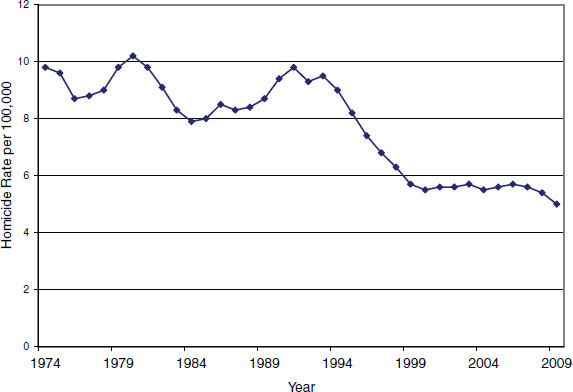
FIGURE 3-1 Homicide rates in the United States: 1974 to 2009.
SOURCES: Data from Bureau of Justice Statistics (2010) and Federal Bureau of Investigation (2010).
influences may reflect factors related to the criminal justice system. One has already been described: the severity of noncapital sanctions. Another is police effectiveness in apprehending murderers. If the probability of apprehension is correlated with the imposition of the death penalty, a finding that the death penalty seemingly deters murders might actually reflect police effectiveness in deterring murder. Such contamination may also come from social, economic, or political factors that affect the homicide rate and that are outside the criminal justice system.
There have been numerous commentaries on the sources of variation in U.S. homicide rates, with many focusing specifically on the sharp drop in homicides since the early 1990s (Blumstein and Wallman, 2000, 2006; Levitt, 2004; Zimring, 2010; Zimring and Fagan, 2000). However, these commentaries provide very limited guidance on how to account for other possible sources of change in homicide rates in a statistical analysis of the deterrent effect of the death penalty.
To provide a concrete illustration of the challenges of inferring the deterrent effects of the death penalty, consider Texas, the state that makes the most frequent use of the death penalty (in absolute numbers). Figure 3-2 plots the annual frequency of executions in Texas from 1974 to 2009. Texas’s first post-Gregg execution occurred in 1982, and executions re-
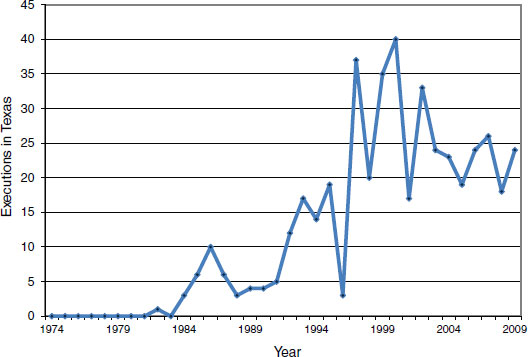
FIGURE 3-2 Executions in Texas: 1974 to 2009.
SOURCES: Data from Espy and Smykla (2004) and Texas Department of Criminal Justice (2011).
mained relatively infrequent until the early 1990s; the frequency then escalated rapidly to a peak of 40 in 2000. Thereafter, there has been drop-off to about 20-25 per year. Figure 3-3 plots the homicide rate in Texas (as well as California and New York) over the same period. The pattern for all three states closely resembles the U.S. national trend. From 1974 through the early 1990s the Texas homicide rate rose then fell and then rose again before falling steadily from 1991 to the early 2000s, when it leveled off. For the period from 1976 to 1991, there is no apparent relationship between the homicide rate and the frequency of execution. However, the steady decline in the homicide rate since 1991 does correspond with the dramatic increase in executions that occurred in the early 1990s. Thus, if the early 1990s is assumed to be the demarcation of Texas shifting to a dramatically higher use of capital punishment, the data are consistent with that shift having a deterrent effect.
However, the data from California and New York challenge that interpretation. The death penalty has been an available sentencing option in California for the entire post-1976 period, but the frequency of executions in California is low in comparison with Texas—from 1976 to 2009, California executed 13 people, and Texas executed 447. Both states, however, sentenced sizable numbers of people to death. In this regard, New York offers still another interesting contrast. It sentenced only 10 people to
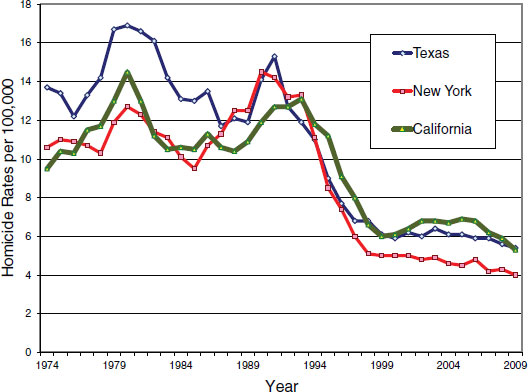
FIGURE 3-3 Homicide rates in California, New York, and Texas: 1974 to 2009.
SOURCES: Data from Bureau of Justice Statistics (2010) and Federal Bureau of Investigation (2010).
death between 1973 and 2009 and had executed none as of 2009 (Bureau of Justice Statistics, 2010).3
As shown in Figure 3-3, the California, New York, and Texas homicide rates move in close unison for the entire 1974-2009 period. Like Texas, the California and New York rates rise, then fall, and then rise between 1974 and the early 1990s; the rates for all three states then begin a steep decline to the early 2000s and level out. Thus, even though California, New York, and Texas have made very different use of the death penalty, particularly since 1990, their homicide rates are remarkably the same over about three decades.
Our purpose in reporting these data is not to draw any conclusion about the deterrent effect of the death penalty. The three states were purposely selected to illustrate the importance of accounting for variations, across time and place, in factors that influence murder rates other than the use of capital punishment. If informal comparisons of data from a few self-selected jurisdictions were sufficient to settle the question of the deterrent effect of the death penalty, the reviews of the panel studies in Chapter 4 and the of time-series studies in Chapter 5, which are based on application of
__________________
3 In New York, the legal authority for the death penalty was available only from 1995 to 2007.
formal statistical methods, would be unnecessary. For example, the panel studies are based on data from all 50 states, not just three selected ones.
In addition, and most critically, any inferences about the effects of the death penalty that are based on the data reported in Figure 3-3 require a conception—that is, a plausible hypothesis—of how the death penalty might affect homicide rates. Suppose, as is assumed in some of the time-series studies reviewed in Chapter 5, the residents of these three states respond to deviations away from their state’s long-term trend in executions or death sentences and not to the trend lines themselves. Informal inferences based on visual inspection of long-term homicide rates and death penalty sanction trends cannot provide the basis for detecting such relationships: in Chapter 5 we apply the formal statistical methods that can detect those relationship. More generally, if valid inferences about the effect of the death penalty on homicide rates could be drawn from superficial analysis of data plots like those in Figure 3-3, the question of its effect would have been settled long ago. For the committee’s discussion of this point, see the section on cross-polity comparisons in Chapter 5.
RECIPROCAL EFFECTS BETWEEN HOMICIDE RATES AND SANCTION REGIMES
In an experiment, one very important consequence of random assignment of treatment is that treatment assignment is not affected by the outcome of interest. For example, in a randomized experiment of the effectiveness of a therapy in reducing depression, the probability of participants receiving the experimental treatment is not influenced by their level of depression at the time of treatment assignment. As a consequence, the direction of causality is clear—any difference in symptoms of depression between the experimental and control groups is a consequence of the treatments assigned and not of the level of depression at the time of treatment. In analyses of nonexperimental data, attribution of direction of causality in an association between two variables is often far less clear.
Going back to deterrence research in the 1960s, there has been concern about the possibility that estimates of deterrent effects were biased by reciprocal effects between crime rates and sanction levels. That is, while sanction levels may be influencing crime rates through the processes of deterrence, crime rates may simultaneously be affecting sanction levels. Crime rates may influence sanctions by a variety of mechanisms. One possibility is that, in the short run, increases in crime may strain the resources committed to the criminal justice system and result in a reduction in overall effective sanction levels. Over the longer term, the political process might respond to rising crime rates by increasing the resources committed to crime control and increasing the severity of sanctions.
The possibility of reciprocal effects greatly complicates estimation of the deterrent effect of capital punishment. For example, suppose that states with high rates of executions (as measured by the percentage of homicides that result in executions) tend also to have lower homicide rates. One interpretation of this negative association is deterrence: that is, more certain application of the death penalty reduces murders. However, if there are reciprocal effects of crime rates on sanction levels, this negative association might just as well reflect the resource saturation effect noted above: that is, higher murder rates and crime rates tend to overwhelm the capacity of the justice system to respond to crime. Higher crimes rates may, for example, reduce the effectiveness of police in apprehending criminals or may make overburdened prosecutors more receptive to accepting plea bargains for noncapital sanctions in order to avoid trials. Both such mechanisms could contribute to reductions in the frequency of executions.
The possibility of reciprocal causation is not addressed in the time-series research, and only a subset of studies in the panel research make any attempt to address this very challenging problem. Given enough assumptions, it is possible to disentangle empirically causal effects in the presence of reciprocal causation. Thus, in principle, in the above example, the deterrent effect of execution certainty can be distinguished from the effect of murder rates on execution certainty. However, such analysis requires the imposition of what are called “identification restrictions.” Identification restrictions can come in many forms, and isolating the role of any one restriction is difficult and sometimes impossible.
In the panel studies in which reciprocal causation is addressed, an important component of identification involves the use of “instrumental variables.” Chapter 4 includes an extended discussion of the validity of the assumptions that underlie the instrumental variable applications in that research. Here we emphasize only that in the presence of reciprocal causation, estimation of causal effects ultimately depends on more than just the data. This is still another example of the fact that the validity of the estimates of the effects of deterrence depends significantly on modeling assumptions—in this case the plausibility of untestable assumptions about identification restrictions. This is not, by itself, a fatal criticism, since identification restrictions can often be derived from social science theories. However, not all assumptions are equally plausible, so their validity has to be judged in context.
The presence of reciprocal effects also complicates the interpretation of findings on the deterrent effect of the death penalty even if based on plausible identification restrictions. For example, suppose that a state changes its death penalty sanction regime by expanding the types of murders that are eligible for the death penalty and that this change has the desired deterrent effect, which is estimated, based on plausible identification restrictions, to
reduce the murder rate by 5 percent. In the presence of feedback effects, the ultimate reduction in the murder rate will not be 5 percent: it may be more or it may be less because the change in the murder rate may affect other aspects of the sanction regime, such as the way prosecutors and defense attorneys approach plea bargains or the resources available to the criminal justice system. These changes, in turn, may further influence the murder rate. Furthermore, the sentencing regime that caused the 5 percent reduction may differ from a regime without the death penalty, not just because of the possibility of a death sentence, but also because the availability of the death penalty as an option provides prosecutors with greater leverage in plea negotiations (which may result in a greater number of long prison sentences) and because the extra resources required to try capital cases may affect the resources available to prosecute and try other crimes.
In North Carolina, for example, 25 percent of first-degree murder cases are initially prosecuted capitally. Each of these cases requires relatively more resources because of extra care for due process. The in-kind costs include the equivalent of nine assistant prosecutors each year, as well as 345 days of trial court time, approximately 10 percent of the resources of the Supreme Court, and $11 million in cash outlays (Cook, 2009). Only after all these feedbacks have played themselves out could the ultimate effect of a change in sanction regime on the murder rate be determined. This kind of feedback is still another reason that throughout this report we describe empirical estimates of the effects of the death penalty as effects on the homicide rate, not as deterrent effects.
In this and the preceding chapter we lay out some of the key challenges to using data from the studies reviewed in the next two chapters to infer the causal effect of the death penalty on the homicide rate. Some of these challenges can be resolved empirically. For example, with data on the severity of noncapital sanctions, it is possible to test empirically whether the inclusion of these data in the analysis alters estimates of the causal effect of capital punishment on murder rates. More generally, it is also possible to analyze the sensitivity of findings to a specified set of alternative model specifications. We discuss examples of such tests in those chapters.
However, it is also important to recognize that inferences about the effect of alternative capital punishment regimes cannot be reduced to purely statistical questions. Interpretations will always depend on assumptions about the underlying mechanisms by which sanction regimes affect behavior and how behavior in turn affects sanction regimes and that those assumptions are not testable with the data used in the analysis. As a consequence, inferences about the effects of capital and noncapital sanction
regimes on murder rates will depend on more than the data that generate the estimates: the inferences will also depend on the validity of the theories used to construct the models on which the estimates rest.
Andenæs, J. (1974). Punishment and Deterrence. Ann Arbor: University of Michigan Press.
Apel, R. (in press). Sanctions, perceptions, and crime: Implications for criminal deterrence. Submitted to Journal of Quantitative Criminology, 28.
Becker, G.S. (1968). Crime and punishment: An economic approach. Journal of Political Economy, 76(2), 169-217.
Blumstein, A., and Wallman, J. (2000). The Crime Drop in America. New York: Cambridge University Press.
Blumstein, A., and Wallman, J. (2006). The crime drop and beyond. Annual Review of Law and Social Science, 2(1), 125-146.
Braithwaite, J. (1989). Crime, Shame, and Reintegration. New York: Cambridge University Press.
Bureau of Justice Statistics. (2010). Capital Punishment, 2009—Statistical Tables. Washington, DC: U.S. Department of Justice. Available: http://bjs.ojp.usdoj.gov/index.cfm?ty=pbdetail&iid=2215 [December 2011].
Cook, P.J. (1980). Research in criminal deterrence: Laying the groundwork for the second decade. Crime and Justice, 2, 211-268.
Cook, P.J. (1986). The relationship between victim resistance and injury in noncommercial robbery. Journal of Legal Studies, 15(2), 405-416.
Cook, P.J. (2009). Potential savings from abolition of the death penalty in North Carolina. American Law and Economics Review, 11(2), 498-529.
Donohue, J.J., and Wolfers, J. (2005). Uses and abuses of empirical evidence in the death penalty debate. Stanford Law Review, 58(3), 791-845.
Durlauf, S., and Nagin, D. (2011). The deterrent effect of imprisonment. In P.J. Cook, J. Ludwig, and J. McCrary (Eds.), Controlling Crime: Strategies and Tradeoffs (pp. 43-94). Chicago: University of Chicago Press.
Espy, M.W., and Smykla, J.O. (2004). Executions in the United States, 1608-2002: The Espy File. Available: http://www.deathpenaltyinfo.org/executions-us-1608-2002-espy-file [December 2011].
Federal Bureau of Investigation. (2010). Crime in the United States 2009. Washington, DC: Author.
Frakes, M., and Harding, M.C. (2009). The deterrent effect of death penalty eligibility: Evidence from the adoption of child murder eligibility factors. American Law and Economics Review, 11(2), 451-497.
Gilovich, T. (1983). Biased evaluation and persistence in gambling. Journal of Personality and Social Psychology, 44(6), 1,110-1,126.
Kahneman, D., and Tversky, A. (1979). Prospect theory: An analysis of decision under risk. Econometrica, 47(2), 263-291.
Kleiman, M. (2009). When Brute Force Fails: How to Have Less Crime and Less Punishment. Princeton, NJ: Princeton University Press.
Levitt, S.D. (2004). Understanding why crime fell in the 1990s: Four factors that explain the decline and six that do not. The Journal of Economic Perspectives, 18(1), 163-190.
Messner, S.F., Deane, G., and Beaulieu, M. (2002). A log-multiplicative association model for allocating homicides with unknown victim-offender relationships. Criminology, 40(2), 457-480.
Nagin, D.S. (1998). Criminal deterrence research at the outset of the twenty-first century. Crime and Justice, 23, 1-42.
Packer, H.L. (1968). The Limits of the Criminal Sanction. Stanford, CA: Stanford University Press.
Pogarsky, G. (2009). Deterrence and decision-making: Research questions and theoretical refinements. In M.D. Krohn, A. Lizotte and H.G. Penlly (Eds.), Handbook on Crime and Deviance (pp. 241-258). New York: Springer.
Texas Department of Criminal Justice. (2011). Executed Offenders. Available: http://www.tdcj.state.tx.us/death_row/dr_executed_offenders.html.
Wadsworth, T.I.M., and Roberts, J.M. (2008). When missing data are not missing: A new approach to evaluating supplemental homicide report imputation strategies. Criminology, 46(4), 841-870.
Zimring, F.E. (2010). The scale of imprisonment in the United States: Twentieth century patterns and twenty-first century prospects. Journal of Criminal Law and Criminology, 100(3), 1,225-1,246.
Zimring, F.E., and Fagan, J. (2000). The search for causes in an era of crime declines: Some lessons from the study of New York City homicide. Crime & Delinquency, 46(4), 446-456.


