
Panel I
The Federal Outlook for the U.S. Battery Industry
Moderator: Charles W. Wessner The National Academies
This panel “will be interesting” because it features “top-flight people who are intimately involved” with the issues of advanced batteries, said Dr. Wessner
He then introduced Patrick Davis who manages the Energy Efficiency and Renewable Energy Vehicles Technology Program at the Department of Energy. Mr. Davis is responsible for two major government-industry partnerships: the Freedom Car and Fuel Partnership and the 21st Century Truck Partnership. The DoE’s Vehicle Technologies Program is the major source of funding for the electric vehicle effort.
He also welcomed Dr. Grace Bochenek, director of the U.S. Army’s Tank Automotive Research, Development, and Engineering Center (TARDEC) in Warren, Mich. TARDEC, which he said “is recognized as the ground vehicle center of excellence and the premier laboratory for advanced military automotive technology. Dr. Wessner also welcomed the third panelist, Dr. John Pellegrino, who directs the sensor and electronic device program at the Army Research Laboratory.
THE DEPARTMENT OF ENERGY PERSPECTIVE
Patrick B. Davis U.S. Department of Energy Vehicle Technologies Program
Although several people have lauded the DOE for moving quickly on the advanced battery funds, “what was important for us was to do this right,” said Mr. Davis, who runs the agency’s Vehicle Technologies Program. “From the start, we really viewed this as an once-in-a-lifetime opportunity.”
Mr. Davis noted that he started working on battery technologies 30 years ago. “During my career, never has an opportunity like this come up, to establish an advanced battery manufacturing capability in the U.S.,” he said. “So for us, it was all about getting it right, not blowing this once-in-a-lifetime opportunity.”
The DOE began working with the National Academy of Sciences very early in the process, “to start the ball rolling to get to where we are today,” Mr.
Davis explained. “It is not just about manufacturing something and throwing money at the problem. We also want to make sure that we’re doing everything we can from a technology standpoint.” The agency also has been working with modeling “to help make sure we succeed,” he said.
The overarching goals of the Vehicle Technologies Program are reducing petroleum dependency and mitigating carbon, Mr. Davis explained. The Recovery Act “layered on top of that the idea that we are trying to stimulate the economy and domestic jobs, and to do it pretty quickly,” he said.
Two-thirds of petroleum used in the U.S. is in the transportation sector, Mr. Davis noted. Consumption in that sector has grown from around 7 million barrels of petroleum per day in 1970 to around 14 million in 2010. Use is projected to near 17 million barrels in 2035. He presented a chart showing that petroleum use for air, heavy trucks, light trucks, and cars all are projected to keep rising. However, U.S. domestic production of oil has dropped by more than 40 percent, to less than 8 million barrels per day, since 1970, and is not expected to increase by much.
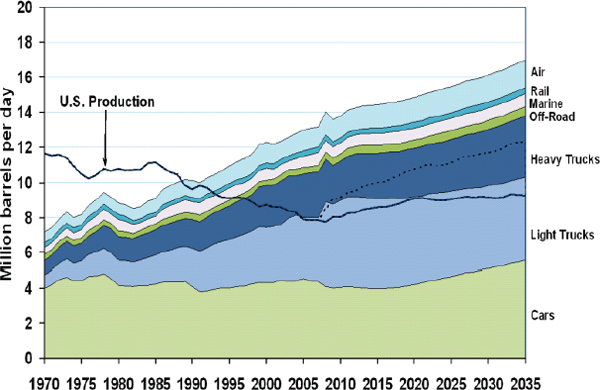
FIGURE 1 U.S. Petroleum Production and Consumption, 1970-2035.
SOURCE: Stacy C. Davis, Susan W. Diegel, and Robert G. Boundy, Transportation Energy Data Book: Edition 30, Oak Ridge, TN: Oak Ridge National Laboratory, June 2011.
Two-thirds of the petroleum consumed in transportation is used in on-road vehicles, Mr. Davis added. There now are 240 million vehicles on U.S. roads. An average of 15.7 million new cars and light trucks were added annually from 2002 through 2007, while 13 million such vehicles were taken out of the market.
This data suggests it will take a long time for electric vehicles to make a national impact. “It takes time for a new technology to take over a market,” he said. “And after you have achieved maximum market share, it takes a lot longer than that to essentially replace the vehicles that are already on the road. If you are trying to realize maximum benefit from a new technology introduced today, it takes three or four decades to get to that point. Petroleum is a very serious problem, but it takes time to solve.”
Transportation accounts for about one-third of greenhouse gas emission, Mr. Davis noted. Over the past year, the DOE has developed projections of emissions for different kinds of vehicles through 2030. The aim is to look at “what types of vehicles produce what kind of benefits in terms of greenhouse gas emissions and petroleum,” he said.
The vehicles roughly fall into three categories, he said. The first group of vehicles uses conventional technologies and some hybrids. They emit an average of 430 grams of CO2 equivalent per mile. The middle group of vehicles includes plug-in hybrids or that are advanced but run on conventional fuels. They emit less than half the CO2, between 150 and 200 grams per mile. The last group consists of electric-drive vehicles or ones using renewable fuels such as hydrogen. Emissions in that group range from around 50 grams to 130 grams. “Those are the only cases that really achieve drastic reductions,” Mr. Davis said. “So electric drive is very important to solving those overarching problems.”
In terms of budget, the DOE has significant ongoing activities in electric vehicles that go beyond the programs funded by the Recovery Act, Mr. Davis explained. It has a $101 million budget in Fiscal Year 2010 for R&D in batteries and electric-drive technology—with $75 million of that focusing on batteries. The request for FY 2011 is for $121 million. Of that, three-quarters is to be dedicated to batteries. The DOE also has a $44 million program for vehicle and system simulations and testing, $57 million for research on combustion, $51 million for materials research, and $24 million for fuels technology. In addition, the DOE also has a $33 million budget for deploying technologies.
In all, half of the DoE’s annual budget for vehicle research is devoted to electric-drive technologies “of one kind or another,” Mr. Davis said. What’s more, the agency’s Vehicle Technologies Program has seen its annual budget increase by 50 percent since 2008.
These are only some of DOE programs, however. The Recovery Act allocated $2.8 billion to advancing electric vehicles, Mr. Davis noted, with about $1.5 billion of that dedicated to batteries. The Advanced Technology Vehicle Manufacturing Loan Program has included awards that involve electric drive, he said. Other critical work at the DOE includes programs by the Office of Science, ARPA-E, and the Office of Electricity.
The DOE has set very aggressive targets for batteries. “We are a very target-driven organization,” Mr. Davis said. Much of these targets regard cost. As a benchmark, hybrids such as the Toyota Prius in 2008 cost $1,000 to $1,200 per kilowatt-hour. Vehicles like the Chevy Volt in 2010 are expected to cost $700 to $950 per kilowatt-hour. Currently, the DOE estimates the average cost at about $800 per kilowatt-hour, but Mr. Davis added that if “you ask 10 different people you get 10 different answers.”
The goal is to get the cost down to $500 per kilowatt-hour in 2012 and $300 in 2014 for a plug-in hybrid. He pointed out that these standards are meant for laboratory demonstrations. “We’re not saying you are going to be able to go out and purchase one at that cost at that time,” Mr. Davis said. But tests will demonstrate that the technology could cost that much if vehicles are produced in high volume.
Estimates of the future electric-vehicle batteries market vary widely. Some $8 billion in lithium barriers were made in 2009. “But if you think about it from an order of magnitude basis, the lithium battery market today is pretty big but is all based in consumer electronics,” he said. “And it is largely based in Asia,” he said.
Today’s market for hybrid vehicle batteries is dominated by nickel metal hydride, Mr. Davis noted. Assuming that some 50,000 hybrid electric vehicles are sold a year and that the average battery pack costs $3,000, that makes the market worth only $1.5 billion.
Projecting into the future gets “really sketchy,” he said. One study estimated the market in 2015 could be worth $8 billion, assuming that 800,000 electric vehicles will be sold and that the average battery packs will cost $10,000 each.11 Another study, which projected 6 million electric vehicles would be sold in 2020 at an average cost of $5,000, fixed the market at that time at $30 billion.12 “I’m certainly not standing up here saying this will be so,” Mr. Davis said. “But even if they are off by a factor of five, you still are talking about a large market. You are talking about something that is significant not only from an economic standpoint but from a jobs standpoint.”
The U.S. has its work cut out to achieve global market share. The U.S. currently produces only about 1 percent of lithium-ion batteries, Mr. Davis pointed out. China accounts for 25 percent, South Korea for 27 percent, and Japan for 46 percent.
The DoE’s strategy through the Recovery Act was to establish the complete value chain for advanced batteries, Mr. Davis said. “We knew from the start we didn’t just want to look at cell production or battery assembly,” he said. “It was about the entire chain, everything from electrodes to separators to supplying a cell-manufacturer who then supplies a battery assembler who then delivers to an OEM. That was important from the start.”
______________________
11 See H. Takeshita, 26th Battery Seminar, Ft. Lauderdale, Florida, March 2009.
12 Estimates from Roland Berger Strategy Consultants and Pike Research 2010.
The agency is not trying to convey that all of this funding “in and of itself establishes an industry,” Mr. Davis said. “It doesn’t. It is seed money, really.” Some people may regard $1.5 billion as a lot of money, he said, especially since that is matched by private investment that brings the total to $3 billion. But that capacity will only supply about 5 percent of the existing vehicle market, “and in the long term we want to do much better than 5 percent,” he said. “So we have looked at this from the start as the money that will help get an industry started. We certainly hope that industry will grow, and we honestly expect it to grow without further government funds to support the build-out of it.”
The DOE began soliciting funding proposals under the Recovery Act on March 19, 2009, and announced 48 winners on August 5, 2009. “We are really pleased that every one of those projects is signed, and work is underway today,” Mr. Davis said.
The Recovery Act funds were spread across the entire battery manufacturing supply chain, Mr. Davis said. While most funds went to makers of cells and battery packs, which require large production facilities, they also support “key supplier industries,” he said. Chemetall Foote Corp., for example, received grants to produce lithium. Three companies received funds to make cathode material and three others to make anode materials. A grant also went to a recycler of lithium ion.
In terms of manufacturers, most of the funds went to factories for lithium-ion batteries. They include Johnson Control plants in Holland, Mich., and Lebanon, Ore., involving $600 million in investment; A123 plants in Romulus and Brownstown, Mich.; a $191 million Saft America plant in Jacksonville, Fla.; and EnerDel’s $180 million plant in Indianapolis. Many of these facilities use different battery chemistry technologies.
The DOE funds are not limited to lithium-ion. Its funding announcement was for “advanced batteries,” Mr. Davis noted. The DOE is interested “not only in whether the technology could do what it needed to do in a vehicle, but also the ability of the companies to succeed,” he said. “Did they have customers lined up? What was their viability?”
Non-lithium projects receiving funds include East Penn Manufacturing Co.’s $98 million plant in Lyon Station, Penn., and Excite, which is making cells and batteries in Bristol, Tenn., and Columbus, Ga. Both companies are doing work in advanced lead acid technology. “The reason they were awarded is that we thought there was a compelling case that this technology could be used in the micro-hybrid market,” Mr. Davis said.
Almost all of the battery manufacturing plants are located east of the Mississippi River. That is because governments in those states offered incentives that convinced companies to locate there, he said. When all of the facilities are in operation, they will be capable of making around 500,000 batteries a year. The estimate assumes that the average battery will produce the equivalent of 10 kilowatt hours of power.
The DoE’s Advanced Vehicle Technology Manufacturing Program offers grants to projects that will add capacity for another 480,000 batteries. Projects funded by both programs will boost production of advanced batteries from 50,000 units to nearly 300,000 in 2012. By 2015, “you are talking about a capacity of almost 1 million batteries per year,” he said. The AVTM program facilities, however, focus on batteries for electric vehicles that would be larger than 10 kilowatts each, he added.
Another DOE program that will advance the industry funds transportation electrification demonstration projects. So far, eight grants have been awarded under the program, which Mr. Davis said is the “largest-ever coordinated electric-drive vehicle and charging infrastructure demonstration effort” in the U.S., he said. These demonstration projects and others will lead to deployment of 10,000 electric-drive vehicles and chargers. The vehicles include medium- and light-duty trucks and heavy-duty passenger and commercial vehicles that will operate in a variety of climates and environments. The chargers included devices for the home and some public charging units.
The transportation electrification program studies consumers. “We are very interested in how people will use these vehicles,” Mr. Davis said. It is assumed that people will charge vehicles at home every night. “We’re not exactly sure people will do that,” he said. “How often will they actually charge a vehicle? Where will they charge it? Those kinds of questions are important for commercialization of this technology.”
Education and outreach are other DOE priorities. The goal is to encourage and support local and state governments to adopt practices that advance the energy, economic, and environmental security of the U.S., Mr. Davis explained. The DOE has awarded 10 grants to education programs for everyone from grade-schoolers to university graduate students and first-responders and technicians, he said.
The DoE’s Clean Cities program works with 86 active coalitions in 45 states. It has been working with alternative vehicles for 15 years. More than 2,000 hybrids and electric vehicles and 1,600 charging stations have been deployed through the Clean Cities program, Mr. Davis said.
The government’s Smart Grid initiative also is important to the rollout of electric vehicles, Mr. Davis said. The DoE’s Office of Electricity manages a program that has invested more than $8 billion, both in federal and non-federal funds, in more than 100 projects. These programs so far have led to deployment of more than 18 million smart meters that now are being used by 13 percent of America’s 142 million electricity customers. They also are responsible for 100 plug-in hybrid charging stations, 176,000 load control devices, 206,000 “smart transformers” that allow for preventive maintenance, and 671 automated substations that account for 5 percent of the 12,466 transmission and distribution substations in the U.S.
Smart grid will not be very important for the rollout of the first electric vehicles in the fall of 2010, Mr. Davis said. “But when you start talking about a
million vehicles, and we certainly hope to do that in this decade, smart grid becomes very important pretty quick.”
Grace Bochenek U.S. Army Tank Automotive Research, Development and Engineering Center
Advanced batteries are very important technology for the military’s future and for the future of our nation, said Dr. Grace M. Bochenek, Director, U.S. Army Tank Automotive Research, Development and Engineering Center, better known as TARDEC.
“TARDEC’s prime mission is to get the best capability we can to those soldiers who go into harm’s way every day on behalf of all of us. We work very diligently to make sure we are building the next-generation systems and the best capabilities we possibly can.” Dr. Bochenek explained.
Within the Army command structure, TARDEC’s R&D programs work under the Research Development Engineering Command, known as RDECOM. At the U.S. Army Research Laboratory, Dr. John Pellegrino leads a technology focus team. Dr. Pellegrino brings together all of our capabilities to refocus power and energy. The R&D operations bring specialists from different disciplines together to solve complex problems, while Dr. Pellegrino looks at power and energy challenges across the full spectrum. My role is to determine how to integrate that technology onto platforms and to help shape investment strategies, Dr. Bochenek explained.
TARDEC has a full spectrum of R&D and systems engineering responsibilities for the entire life cycle of Army ground vehicles. With more than 500,000 vehicles, the U.S. Army maintains one of world’s largest fleets, she noted. One of TARDEC’s most important tasks is “developing next-generation capabilities” for this vehicle fleet, Dr. Bochenek said.
Transforming energy use is a “large strategic goal” for the Army, Dr. Bochenek said. Its priorities are explained in the Army Energy Security Implementation Strategy13 published in 2009. The document discusses cutting fuel consumption, boosting energy efficiency “at the platform and installation level,” increasing use of renewable energy, increasing access to petroleum and other resources, and reducing adverse effects to the environment.
______________________
13 See Army Senior Energy Council and the Office of the Deputy Assistant Secretary of the Army for Energy and Partnerships, “Army Energy Security Implementation Strategy,” Department of the Army, Jan. 13, 2009 (http://www.asaie.army.mil/Public/Partnerships/doc/AESIS_13JAN09_Approvedpercent204-03-09.pdf)
By improving fuel efficiency, the U.S. Army can use fewer convoys to move petroleum fuel to its ground vehicle fleets, Dr. Bochenek explained. According to one estimate, a $10 increase in the barrel of oil can translate into $1.3 billion in added costs to the Defense Department. While the economic drivers are substantial, the force structure and force protection impacts are even more important to the Army, she said. The biggest end items the Army moves on the battlefield are fuel and water. “When we use logistics convoys to move both fuel and water, it is important for us to attack energy efficiency on all our platforms.” In Kuwait, the Army moves around 431 million gallons a year. That translates into 140,000 trucks and 9,300 convoys, with an average of 120 soldiers per convoy. It adds up to 644,000 soldier trips per year, she said. “So if you have fuel savings of only 1 percent, that reduces the number of soldiers you have to put in harm’s way by 6,444 fewer soldier trips, which is significant,” she said. “Putting it into the perspective of a warfighter adds a different dimension from what we often think about.”
One reason the Army’s fuel use keeps rising is the kind of equipment it uses on its vehicles, Dr. Bochenek explained. “Those vehicle platforms that used to just carry soldiers in convoy formation from Point A to Point B are now becoming much more complex machines,” she said. There are jammers, satellite remote sensing equipment, systems for defeating improvised explosive devices, and active protection systems. “Each of those systems, added with new weapons, adds a new layer of energy requirements at the platform level,” she said.
Fuel costs and operational issues also are important considerations. In World War II, the Army consumed about one gallon of gas a day per soldier. Today, it consumes around 20 gallons. Half of that is used to generate electrical power, she said.
Strategically, the Army looks at energy as “a system-of-systems.” Dr. Bochenek said. The needs of soldier power, air power, vehicle power, and field/base power are interconnected. “It really is the integration of all of those different assets that we think about in this whole business of power and energy,” she said. The Army assesses the full spectrum: “from the way you generate power to how you store it, integrate it, and move it around. We look at the potential for moving around from soldier, to vehicle, to air, to installations.”
The major “outcomes” the energy strategy strives to achieve are:
- Enhance ground force effectiveness, flexibility, protection, and freedom of movement by reducing the need to transport fuel.
- Dramatically reduce the sustainment footprint and lighten soldier load and extend platform range and self-power endurance by combining component functions.
- Increase flexibility by expanding capabilities to use alternative energy sources, recycle energy, water and waste, and redistributing resources among systems.
- Reduce the size and number of soldiers and systems required in forward areas by deploying unmanned systems.
- Integrate power and energy situational awareness and management functions with Mission Command to optimize energy use and enable “energy-informed operations.”
In the future, the Army aims to reduce fuel-consumption by 40 percent, both in terms of weight and volume. That would increase tactical range and reduce supply demands that are part of the burden of going to war, Dr. Bochenek explained.
One example is the Joint Light Tactical Vehicle program, or JLTV. The Army would like to improve fuel-efficiency with the JLTV, which aims to replace the HMMWV, to 10 Payload Ton Miles per gallon over the JLTV OPS/MP.14 That represents a 15 to 20 percent improvement in fuel efficiency over the current HMMWV, she said. The Army also wants a 20 percent increase in continuous power available on vehicles. Pulse power-based systems for survivability and lethality power needs range from kilo joules to tens of mega joules, Dr. Bochenek said.
Another goal is to increase fuel economy by 40 percent. The Army wants Abrams tanks, for example, to operate one or two days in combat without refueling, she said. The Stryker armored combat vehicle requires a cruising range of around 330 to 380 miles for a fully loaded vehicle.
Power requirements for vehicles also are rising. New Army vehicles will need anywhere from 10 to 30 kilowatts of on-board power, Dr. Bochenek said. The Army wants vehicles that have an export power capability that would boost their power needs by another 10 to 30 kilowatts. The Army also wants systems that can supply “boost power,” enabling vehicles to accelerate quickly. Other goals are for batteries that will enable a silent mobility range of one-quarter mile to one mile for ground combat vehicles and a range of two to eight hours for Silent Watch.
To address such needs, TARDEC has been “investing in understanding this entire range of requirements and how they then translate into vehicle needs, as well as the subsystems necessary to achieve those requirements,” she said. It has been developing components such as batteries, intelligent power management systems, solid-state silicon carbine power electronics, high energy-density capacitors for weapons systems, and new fuel cells.
The Army’s needs touch on the entire continuum of battery capabilities, no matter if we go to full electrification or to more conventional solutions. That is important as one looks at the entire business case for developing batteries with higher energy and power density along with lower costs, Dr. Bochenek said.
TARDEC uses a “systems approach” to addressing its energy needs, Dr. Bochenek explained. The first level is components, such as motors, batteries, engines, and high-temperature electronics. At the “system integration” level, it
______________________
14 Ton-miles per gallon is a measure of fuel efficiency used in transportation. The measure refers to the amount of fuel needed to move one ton by one mile. Sixty ton miles, therefore, means it would take one gallon of fuel to move 60 tons of freight.
develops concept vehicles and conducts analysis, simulation, and testing. At the “platform level,” TARDEC develops demonstration vehicles using new technologies. “My organization over the last 15 years has done a whole host of demonstrators,” Dr. Bochenek said. She estimated the Army has invested along with industry in nearly 100 different demonstrators “in order to understand the whole, broad spectrum of electrification.” Through this work, the Army has learned that hybrid-electric technology is feasible for meeting many of its needs. “Fuel economy is directly related to the engine operating in the most efficient areas of the fuel map and to regenerative brake energy recovery” she said.
TARDEC has had an ongoing robust testing and evaluation program to understand hybrid systems, Dr. Bochenek noted. These tests show fuel-economy improvements of 10 percent to 15 percent. There still are many issues, however, such as reliability of systems and design optimizations, she said.
To convey the rapid advances in energy storage technology to date, Dr. Bochenek displayed a chart on energy-density improvements over time. In the1860s, lead acid batteries stored around 30 watts of energy per kilogram. Densities rose to 60 watts per kilogram with nickel-cadmium batteries in the 1980s and to 120 watts with nickel metal hydride batteries in the 1990s. Today’s lithium-ion batteries produce 145 watts per kilogram, while lithium-ion polymer batteries are projected to offer 200 watts by 2012. Big leaps are expected in 2035 and beyond with future technologies. These higher energy densities will be needed for future vehicles. For example, today’s JLTVs require around 15 kilowatts of power, and in the future, they will need around 40 kilowatts. Electrical power needs of the Stryker also will rise dramatically. Future ground combat systems will need nearly 50 kilowatts. “Our Silent Watch and silent mobility requirement really is driving the need for higher energy-density batteries,” Dr. Bochenek said. “We really need to increase the power and energy density of the batteries. That is one of the biggest issues we see in this whole area of energy storage and battery technology.”
The military’s needs present several special challenges for battery technologies, Dr. Bochenek said. One is that “military duty cycles are extremely different from the commercial market, which makes it a little bit of a challenge for us to use solutions that are similar to those of commercial industry,” she said. Army vehicles sometimes operate off road, in desert conditions, and on pavement. “Sometimes these hybrid systems are tweaked and refined based on that duty cycle,” she said. This also makes it challenging to achieve the desired fuel economies. The military also has “low tolerances for system failure,” Dr. Bochenek said. “Reliability and safety are important to us.” These needs are especially important for vehicles that rely more on electricity. TARDEC is addressing reliability and the risk of thermal events with new battery chemistries. “We have been working to reduce various types of hazards that might occur,” she said. For example, ballistic testing on the cell, module, and pack level has been conducted for lithium-ion batteries. Integration and packaging also are very challenging. “You can’t achieve the goals we are hearing about today without understanding how you will integrate them on the platform and the
tradeoffs between the various technologies and other requirements,” Dr. Bochenek said. Cost is another critical consideration. With the Joint Light Tactical Vehicle program, for example, advanced lead-acid batteries producing about 2 kilowatt hours of power cost $800 to $900 and weigh 180 pounds. The same packaging for lithium-ion batteries produces 3 kilowatt hours and weighs around 60 pounds. They cost around $3,000 to $4,000 each. “So there is a trade there,” Dr. Bochenek said. “We need to work really hard to decrease the unit cost over time and at the same time get the payoffs you can get from these advanced battery systems, such as the performance and volume, which are really critical.”
In conclusion, Dr. Bochenek said that she thinks electrification and hybridization is “well on its way within the Department of the Army.”
John Pellegrino U.S. Army Research Laboratory
As one looks at the major strategic opportunities for reducing energy use for the military, “you will note that batteries run rampant throughout them in almost every capacity,” Dr. Pelligrino of the Army Research Laboratory said.
Dr. Pellegrino listed the major opportunities as follows:
- Tactical unit energy independence
- Autonomous platform power
- Adaptive Power Networks
- Energy Optimized Platforms
- Electric Weapons and High-Power Sensors
The battery technologies must be put together in different ways and each have challenges, Dr. Pellegino pointed out. “But nonetheless, the same kind of technologies work across them,” he said.
The military will deploy these technologies in three key domains: The soldier, mobile devices and vehicles, and platforms and weapon systems. A soldier uses tens of watts of power, but weapons systems require tens of thousands of watts, Dr. Pellegrino said. “They are the same technology bases put together in very different ways to enable them,” he said.
Tactical unit independence means enabling soldiers and marines to work longer periods of time and being able to reduce convoys, Dr. Pellegrino explained. “If you can be independent for a few days or a week longer, that would be a great boon. New technologies for energy storage and generation are really key to making that happen.”
The Army allocates power and energy-technology R&D resources to address four general challenges. Electric power generation and conversion research gets 25.6 percent of the Fiscal Year 2010 budget. Another 27.2 percent is devoted to energy storage, 16.6 percent to power control and distribution, and
30.6 percent to thermal management. These percentages vary in U.S. military services based on their different needs, he said.
The Army has its own technology road map for each battery technology, Dr. Pellegrino explained. “Part of the reason is that we see more extreme environments than the average citizen,” he said. “We not only are in more extreme temperature environments, but we also get shot at and have fires. Safety is really important to us. So we need different battery chemistries and technologies.”
As the Army invests in new technologies, it can expand upon work done in the commercial sector and offer commercial opportunities, Dr. Pellegrino said. As a result, the battery area is “very, very ripe for partnerships,” he said. “The paradigm we have been following in the Army has changed over the past five or 10 years in that we are doing much, much more early collaboration with industry.” The Army still awards traditional contracts to corporations to develop technology, Dr. Pellegrino said. But the Army is making greater use of cooperative R&D agreements, partnership intermediary agreements, and “all of the other variety of tools to get government and the universities to engage very early on,” he said. “That tends to make the transition go much faster. So that paradigm shift is very, very important.”
The Army Research Lab is looking at a number of new technologies. One research project focuses on new electrolytes for higher-density lithium-ion batteries for Army applications, he said. There can be significant commercial benefits as well, he said.
Another research project looks at biologically inspired construction for high-performance anodes for high-power, lightweight lithium ion batteries for light electric vehicles and unmanned aerial vehicles. The bio-inspired construction catalytic synthesis process grows tin nano-particles inside graphite. This can increase the surface area and boost energy density, Mr. Pellegrino explained. It also can prevent disintegration of metal and loss of capacity that occurs with other anodes.
Army labs have collaborated with the University of California at Santa Barbara for years. “It illustrates the new approaches of being very, very multidisciplinary,” he said. In order to bring up the next generation of researchers, there is more cross-over between physics, electrical engineering, electrochemistry, chemistry, and biology than ever before, he said. “So training these students, putting them in cross-disciplinary teams, and having them work with the system integrators early on so they understand the issues and technology challenges is important.” Another collaboration is with the University of Michigan, Dr. Pellegrino said. Researchers are developing autonomous micro-systems for both mobility and electrical generation.
Battery technology “is kind of at the center of the universe as we go more toward a systems and system of systems approach,” Dr. Pellegrino said. There are still challenges, such as the life, endurance, voltage, capacity, and operating characteristics of batteries. “But they play into a formulation where you can start thinking of smart grid applications and sharing of technology among different
parts of a base,” he said. A simple example is that there are generators at different parts of military bases. “We have neither the devices nor the technology to share energy across the base,” he said. “One generator may be working at over-capacity and the other at under-capacity, so we use tons more fuel than we have to.”
Bringing smart-grid networking capability together with renewable resources can have a major impact, Dr. Pellegrino said. “While each of these technologies offers a small contribution, together they offer a huge contribution in getting more toward energy independence, either on a small scale or a larger scale,” he said.
Partnerships between Army labs, universities, and industry are critical, Dr. Pelligrino said. New Army partnerships cross many barriers and offer” paradigms that just were not there several years ago,” he said. These partnerships “are key to bringing it home to those who protect us.”
DISCUSSION
To put the discussion into context, Robert Bachrach of Applied Materials noted that the U.S. market for light vehicles is 20 percent of the global market. “We have the largest installed base, but that is not the market,” he said. “It may be a used parts market, but it is not where the industry is going.” The U.S. military purchases perhaps 10,000 vehicles per year, Mr. Bachrach said. “But we are looking at having to manufacture millions of vehicles a year and millions of battery packs.” He said one must “really look at where the U.S. is in the world today, and most of the market is global.”
Dr. Wessner asked whether he thought the U.S. can to export to those markets. “Well, I think we have to, don’t we?” Mr. Bachrach responded.
Dr. Wessner pointed out that “most countries are willing to export to us, but the other way is harder.”
“The world is changing, and we have to get back to exporting,” Mr. Bachrach said.
The U.S. Army and the DOD in general “are indeed among of the smallest users of battery technology and electronics technology in the world,” Dr. Pellegrino responded. “But we don’t want each of those vehicles to cost $1 billion. It is only by leveraging and working with the commercial market in those higher volumes that you spoke of that we are going to be able to do that.”
In order to export, however, “the stars have to align a lot differently than they have in the past,” Dr. Pellegrino said. “It not only has to be a partnership with the military, industry, and universities across the board. It has to be a partnership as well with policies, taxes, and the whole manufacturing infrastructure together. If you get one piece without the other, it’s not going to work.”
Dr. Wessner concluded the session by commenting that “not everyone in the world is looking forward to us exporting batteries to them. We have to think hard about that component in the strategy if it is a determining one.”


