
Computer simulations, which are built on mathematical modeling, are used daily in scientific research of all types, for informing decision making in business and government, including national defense, and for designing and controlling complex systems such as those for transportation, utilities, and supply chains, and so on. Simulations are used to gain insight into the expected quality and operation of those systems and to carry out what-if evaluations of systems that may not yet exist or are not amenable to experimentation.
As an example, one of the most important and spectacular events in the universe is the explosion of a star into a supernova. Such explosions seeded our own solar system with all of its heavier elements; they also have taught us, indirectly, a great deal about the size, age, and composition of our universe. But within our galaxy, the Milky Way, supernovas are exceedingly rare. How can you study something that cannot be duplicated in a laboratory, would fry you if you got close to it, and rarely even occurs?
That is where mathematical sciences enter the story, via computer simulation. In scores of applications, from physics to biology to chemistry to engineering, scientists use computer models—whose construction requires the formulation of mathematical and statistical models, the development of algorithms, and the creation of software—to study phenomena that are too big, too small, too fast, too slow, too rare, or too dangerous to study in a laboratory.
While scientists and engineers have long been able to write down equations to describe physical systems, before the computer age they could only solve the equations in certain highly simplified cases, literally using a pen and paper or chalk and a blackboard. For example, they might assume the solutions were symmetric, or simplify a problem to two or three variables, or operate at only one size scale or time scale.
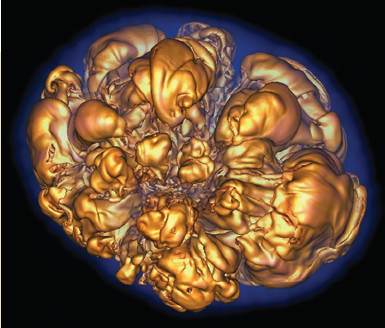
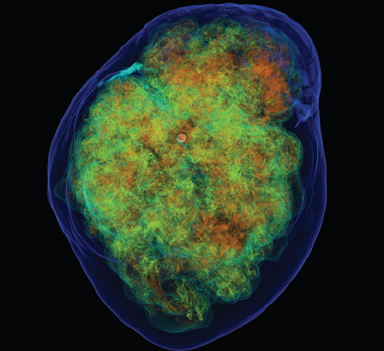
3 / Image from a three-dimensional simulation of an exploding supernova. Reprinted with permission from Professor Adam Burrows, Princeton University. /
Now, however, the scientific universe has changed. The study of supernovas is a perfect case in point. It is possible to create a rudimentary theory of supernovas by assuming that the star is perfectly symmetrical. Astrophysicists call this a one-dimensional theory because all of the quantities depend on one parameter, the distance from the center of the star. Unfortunately, it doesn’t work: You can’t get a one-dimensional star to explode, and so simulations based on that simplified model cannot represent all of the important aspects of this complex system. Of course, real stars are not so symmetric; they bulge at the equator, due to rotation. So astrophysicists began to simulate stars with a shape parameter as well as a size parameter, and they called these two-dimensional simulations. However, such simulations still cannot capture the behaviors of interest: Some fail to explode, while others explode but with less energy than a real supernova.
Only with fully three-dimensional simulations have astrophysicists started to produce supernovas with realistic energy outputs. And this tells us something important: The energy of the supernova must be coming from convection, a process that cannot be properly modeled in two dimensions. In a supernova, the core of a star collapses and then rebounds outward, forming an expanding shock wave. The shock wave then stalls as it runs into matter falling in from the outside the star. That’s the hurdle that two-dimensional simulations have trouble getting over. But in three dimensions, the matter inside the shock wave starts to churn as it is irradiated by neutrinos, like soup being heated in a microwave oven. This convection reenergizes the shock wave over a period of several seconds, and the star’s contents explode out into the universe (see Figure 3).
While many are aware of the amazing gains in raw speed from Moore’s law—the approximate doubling of computer hardware capabilities every 2 years—successful simulation on this scale also depends to an equal degree on new algorithms that perform the needed computations. For example, the transition from two to three dimensions invariably increases (usually by an enormous factor) the difficulty of a problem, requiring mathematical advances in representing reality as well as problem solving. Three-dimensional simulations on this scale are possible only through a combination of massive computing power and smart mathematical algorithms. The transition from a two- to a three-dimensional model requires more than simply running the same code with more data points. Often, new mathematical representations must be incorporated to capture new phenomenology, and new comparisons against theory must be made to assess the validity of the resulting three-dimensional model. More generally, advances in mathematics and statistics and improved algorithms provide leapfrog advances in computational capabilities. Scholarly studies have estimated that at least half of the improvement in high-performance computing capabilities over the past 50 years can be traced to advances in mathematical sciences algorithms and numerical methods rather than to hardware developments alone.
Scholarly studies have estimated that at least half of the improvement in high-performance computing capabilities over the past 50 years can be traced to advances in mathematical sciences algorithms and numerical methods rather than to hardware developments alone.
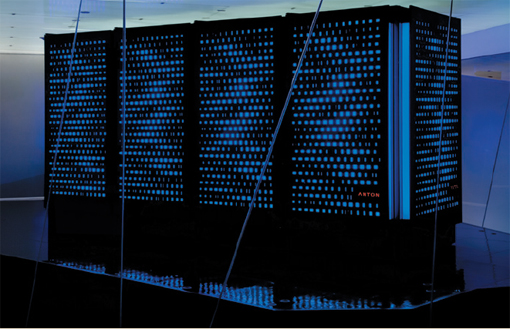
4 / Anton, a special-purpose supercomputer, is capable of performing atomically detailed simulations of protein motions over periods 100 times longer than the longest such simulations previously reported. These simulations are now allowing the examination of biologically important processes that were previously inaccessible to both computational and experimental study. Printed with permission from D.E. Shaw Research. /
The value of simulation is not limited to real-world problems of huge scale: It is just as useful for tiny problems such as understanding processes within our cells. Many of the cell’s functions are carried out by proteins—large molecules that fold into a precise shape to accomplish a particular task. For example, the proteins in an ion channel, which regulates the flow of ions across a cell membrane, need to fold autonomously into a pore that will admit a potassium atom into the cell but not a sodium atom. A mistake at the subcellular level can have implications that affect the whole body. In cystic fibrosis the channels that are supposed to transport chlorine ions don’t work correctly, possibly resulting in a buildup of fluid in the lungs; in certain kinds of heart arrhythmias, the potassium channels do not properly regulate the movement of potassium ions, which can interfere with the normal muscle contractions that create each heartbeat.
At present, nobody knows how to take the chemical formula for a protein and predict the shape it will fold into. The shape is determined by the forces between the many atoms within the protein and between those atoms and their surroundings.
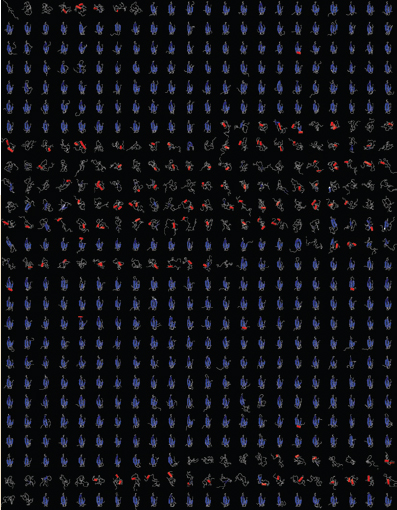
5 / Snapshots of the folding and unfolding of a protein, obtained from a simulation of unprecedented length performed on the special-purpose supercomputer Anton. Multiple transitions are observed between a disordered “unfolded state” (red and gray) and an ordered “folded” state (blue). Printed with permission from D.E. Shaw Research. /
Calculating the net result of all those forces is a daunting computational challenge, but simulations are getting close to that goal. Recently a special-purpose supercomputer managed to simulate the motion of a relatively small protein called FiP35 over a period of 200 microseconds (one five-thousandth of a second), during which time it folded and unfolded 15 times (see Figures 4 and 5). Again, while part of this capability was made possible by the special-purpose hardware, it also depends on mathematical advances. First, the precise but computationally intractable force field must be replaced by a good approximation based on empirical data and on simpler systems, and mathematical analysis is necessary to characterize the adequacy of the approximation. Second, computational algorithms have been developed to speed the computation of the interactions between atoms. For the story of one such algorithm, see a later section, “Fast Multipole Method: A Long-Term Payoff.”
These success stories illustrate the kinds of problems that scientists now routinely ask computer simulations to solve. For decades, biology had only two modes of research—in vivo (experiments with living organisms) and in vitro (experiments with chemicals in a
test tube). Now, there is a third paradigm, in silico (experiments on a computer). And the results of this kind of experiment are taken just as seriously.
At the cutting edge of research, the importance of new and better algorithms cannot be overstated.
Nevertheless, simulations face major challenges, which will be the focus of ongoing research over the next 20 years.
First, real-world processes often require simulation over a wide range of scales, both in space and in time. For instance, the core collapse of a supernova takes milliseconds, while the crucial convection step takes place over a span of seconds and the aftermath of the explosion lasts for centuries. Spatially, the thermonuclear flame of the supernova varies from millimeters to hundreds of meters during the explosion.
In biology, the range of scales is just as daunting. Subcellular processes, like the opening and closing of ion channels, are linked to events at the scale of a cell. These effects cascade upward, affecting heart tissues, then the heart, and finally (in the event of a heart attack) the health of the whole body. Likewise, the timescales also span a vast range: microseconds for the folding of a protein, fractions of a second for the choreography of a single heartbeat, minutes for a heart attack, weeks or months for the body’s recovery. It is very difficult to incorporate all these scales into a single mathematical model.
Related to the multiscale problem is the multiphysics problem. Often the types of models used at different scales are incompatible with one another. Events at a subcellular level are often chemical and random, influenced by the presence or absence of a few molecules. In the heart, these events translate into electrical currents and mechanical motions that are governed by differential equations, which are usually deterministic. Multiphysics can also characterize a single scale: The heart is simultaneously an electric circuit and a hydraulic pump. It’s not easy to reconcile and simultaneously model those two identities. Progress in such cases often depends on a combination of insights from the domain science and the mathematical sciences.
Given the complexity of simulations, model validation also becomes an important challenge. First the modeler has to make sure that the individual parts of the program are working as expected; for a complex simulation, this can be very difficult. Then he or she will test it to see if it reproduces the behavior of simple real-world systems and matches existing data. Finally, the model will be used to make predictions about genuinely new phenomena. But there is no universal procedure for deciding when a model is good enough to use, so to some extent model validation is still more art than science.
Another major challenge for simulations in the near future has to do with hardware and software. It goes without saying that any scientist who does simulations would like more computing power. That is the main bottleneck in the supernova and protein folding simulations. Three-dimensional simulations are just barely feasible today, but astrophysicists would really like to go up to six dimensions! That would allow more accurate simulation of the velocity as well as the location of each particle.
But raw computing power is not the only solution. At the cutting edge of research,
the importance of new and better algorithms cannot be overstated. To put it simply, you can wait 2 years for Moore’s law to hand you a computer that is twice as fast—or you can get the same speedup today by developing better algorithms.
Apparent advances in raw computation speed do not translate directly, and perhaps not even indirectly, to simulations that are faster or more accurate. Today’s expectation is that the high-end computers of the future will have huge numbers of very fast “cores”—processing units operating individually at extremely high speed—but that communication between cores will be relatively slow. Hence, software written for computers with a single core (or a small number of cores) will not be efficient, and standard computations, such as those for linear algebra, will need serious reworking by mathematical and computer scientists.
The mathematical sciences help to predict the path and strength of a tsunami following an earthquake or other oceanic event (such as a massive landslide or volcano eruption). Mathematical models underpin tsunami warning systems by estimating where a tsunami will make landfall, how high the waves will be, and how fast the waves will be traveling. More fundamentally, the mathematical sciences help to map the topography of the ocean floor and infer large-scale wave behavior from independent ocean tide gauges that are irregularly spaced and can be hundreds of miles apart. This knowledge is behind emergency warnings and evacuations, which help to avoid potentially devastating consequences.
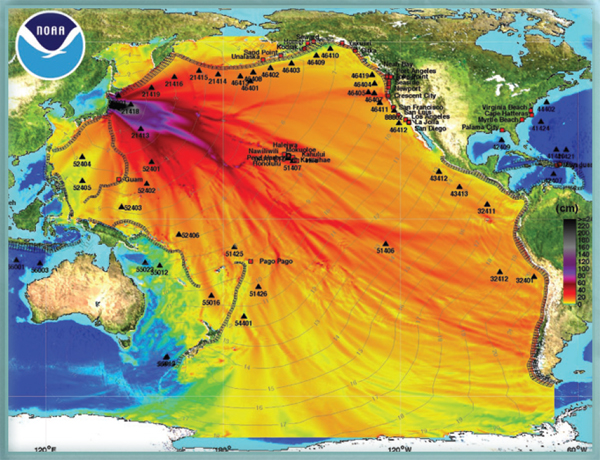
Numerical models are used to simulate the earthquake, transoceanic propagation, and inundation of dry land. To save time in the event of an emergency, these simulations are run for a variety of possible earthquake sizes and locations, and these scenarios are then combined with ocean tide readings as they become available. This figure shows the predicted sea level increase (in cm) resulting from the deadly 9.0 magnitude earthquake off the coast of Japan in March 2011.
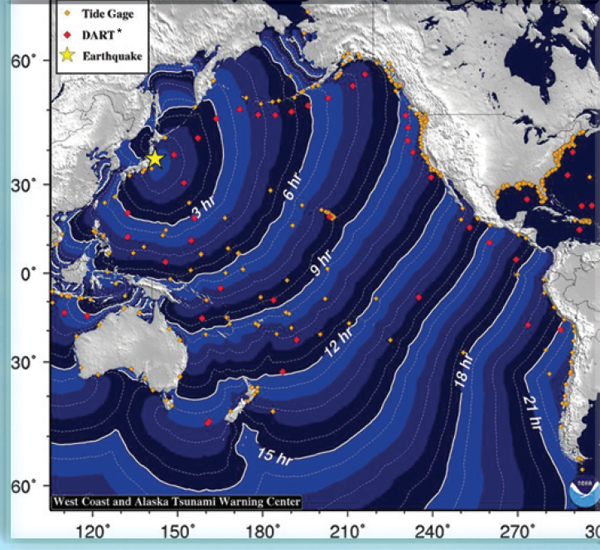
Mathematical science models help predict the timing and trajectory of tsunami waves based on ocean floor mappings and ocean tide gauge readings. This information is used to predict when tsunami waves will hit different coasts. *Deep Ocean Assessment and Reporting of Tsunamis
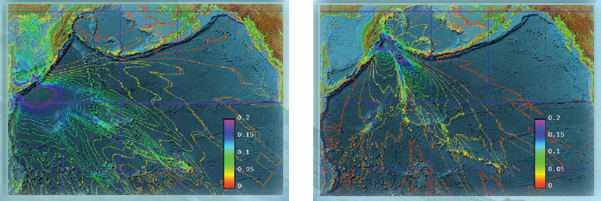
High-resolution computational models are used to simulate wave-heights for a traveling tsunami, shown here for two different earthquakes. These estimates help to identify evacuation zones and routes. The impacts of tsunamis vary widely, due to local topography, long-term sea level rise, annual climate variability, monthly tidal cycles, and short-term meteorological events.


