
EXPLORING SUSTAINABLE SOLUTIONS FOR INCREASING GLOBAL FOOD SUPPLIES
A second workshop, held in May 2011, was built on the discussions at the first workshop in which expert participants explored the availability and quality of metrics that helped us understand the concept of “sustainable food security.” The workshop objectives included identifying the major challenges and opportunities for change associated with achieving sustainable food security and identifying needed policy, science, and governance interventions.
The workshop opened with a recap of some ideas presented at workshop one, reflecting the availability and quality of data indicators and projections of both poverty/food security and resource use trends as they are currently understood, while also framing the potential of various factors to pose new opportunities, risks and vulnerabilities that would affect trends going forward. These presentations enabled participants to review the existing evidence regarding the magnitude of the problems and challenges and opportunities for their solutions. Subsequent sessions dug more deeply into the trends associated with natural resources that are believed to pose hard constraints to food supply and availability. The second day of the workshop explored several of the policy, market, and governance approaches currently thought to be needed to resolve the constraints posed by natural resources to food availability at various scales: global, regional, and local. The third day engaged participants in consideration of what changes (in public policy and regulatory institutions, markets and other economic institutions dominated by the private sector, and social and cultural institutions) would be needed to raise the probabilities for ensuring that food availabilities in 2050 respond to global food demands and the nutritional needs of more than 9 billion people.
The following section includes a summary of the presentation by the committee chair, Per Pinstrup-Andersen, providing a contextual framework for the workshop. The first chapter in Part II includes summaries of a set of presentations examining the challenges in and opportunities for achieving sustainable food security, including an overview of current and expected future food and nutrition security. It also includes descriptions of key natural resource constraints and the role of climate change. Chapter 2 summarizes various approaches to achieving sustainable food supplies, including sustainable intensification, reducing yield gaps, addressing waste in the food chain, and the role of global public goods. Chapter 3 focuses on the political, economic, and institutional opportunities and barriers, and the final chapter discusses options for moving forward.
The organizers of the workshop recognize that the content of the workshop and this summary report leave out many important topics and perspectives associated with sustainable food supplies and the related natural resource constraints and policies. However, the time constraints of a two and a half day workshop forced the planning committee to limit the number of topics that could usefully be examined. One important topic that the workshop was to have
addressed was the complex links between energy and agricultural productivity. However, due to unforeseen circumstances the speaker for this session was unable to attend the workshop. In addition, most participants focused on the production of the three dominant staple crops rather than a broader range of food crops. Hopefully, the energy-agriculture nexus as well as other important topics that are not included can be examined in other workshops or future meetings.
CONTEXTUAL FRAMEWORK FOR WORKSHOP 21
Per Pinstrup-Andersen opened the meeting by asking a set of questions:
- Can the world feed future generations?
- Can it do so sustainably?
- At what food price?
- At what price volatility?
- Will everybody have access?
- What action is needed?
- Action by whom?
Pinstrup-Andersen answered the first two questions by saying that the world can feed future generations and—with appropriate action—can do it sustainably. This meeting will focus on sustainable food supplies, which is just one part of the food security equation (Figure II I-1). He noted that adequate food supplies are necessary but not sufficient for assuring food security for all. Who will have access to food depends on many factors including prices and incomes. Furthermore, household behavior, intra-household decision making processes and gender-specific time allocation are important components of the access issue that will not be considered in this supply-focused workshop. In addition, there are several non-food factors that influence food security, such as health, access to clean drinking water and good sanitation.
____________
1 The presentation is available at http://sites.nationalacademies.org/PGA/sustainability/foodsecurity/PGA_062564, presentation by Pinstrup-Andersen (May 2, 2011).
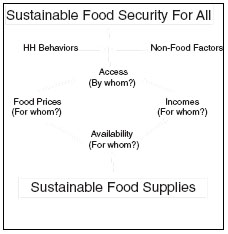
FIGURE II I-1 The Workshop Focus
SOURCE: Presentation by Per Pinstrup-Andersen, Cornell University, May 2, 2011.
The workshop will focus on three elements critical to assuring long term sustainable food supplies: (1) barriers to sustainable food supplies, (2) approaches and action, and (3) incentives and limitations to action. Among the major barriers to sustainable food supplies are natural resource constraints—water, land, forest, soil, biodiversity and energy—and human-made resources—knowledge, technology, and infrastructure—as well as climate change.
The discussion on approaches and action will include examining R&D to reduce yield gaps and raise yield ceiling, farm level intensification and ecosystem management. Speakers will also discuss ways to improve value chains, reduce wastes and losses, and improve energy efficiency and enhance private investments in land.
The final workshop segments will examine some of the incentives and limitations to action, looking at the specific roles of the public sector, the private sector and civil society. For example, what kind of public goods need to be in place for the private sector to operate?
The intent of the workshop is not to answer all the questions noted above but to provide input to the debate about what the answers are. Per Pinstrup-Andersen noted that the debate about food security currently tends to the extremes with arguments such as “The world is running out of food,” “Billions of people will starve to death,” “We are losing our most critical natural resources,” etc. This workshop should aim to provide evidence to enlighten the debate and support evidence-based decision making.
This page intentionally left blank.


