
Chapter 7
Clusters and Regional Initiatives
Clusters foster the collaboration needed to develop new ideas and bring them to market. In this way, successful clusters significantly improve the return on public investments in R&D and provide global leadership in key technologies. Recognizing this impact, both advanced and emerging economies are making investments and promulgating polices to encourage cluster development.
This chapter explores several ways in which U.S. regions are rising to the challenge, focusing on Regional Innovation Cluster initiatives and new types of science and research parks. In this chapter, we explore a sample of some of the more interesting regional innovation cluster initiatives underway in the United States. The second part of this chapter assesses new strategies for developing research parks, both in the United States and abroad.
U.S. regional economies face mounting global competitive challenges. No longer do U.S. states and cities primarily compete among themselves for talent, investment, and entrepreneurs in technology-intensive industries. They also compete against national and regional governments that are executing comprehensive strategies that seek to create innovation clusters in many of the same important, emerging industries. National and regional governments in Europe, Asia, and Latin America are backing up these strategies with heavy investment in universities, public-private research collaborations, workforce training, early-stage capital funds, and modern science parks.1 They are further reinforced by strong policy focus from top leaders. National and regional governments also can offer investors financial incentives that state governments cannot, such as exemption from all corporate taxes.
______________________
1 Francisco Grando, Brazil’s Secretary of Innovation, and Alberto Duque Portugal, State Secretary for Science, Technology and Higher Education of the Brazilian state of Minas Gerais presented a review of initiatives underway in Brazil at the National Academies conference on Clustering for 21st Century Prosperity, Washington, DC, February 25, 2010.
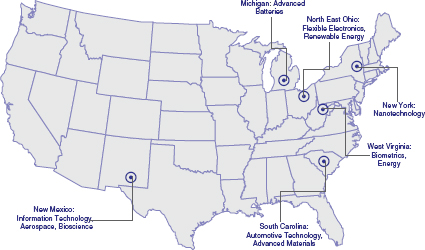
FIGURE 7.1 U.S. regional innovation clusters discussed in Chapter 7.
In a number of Asian clusters, most notably Taiwan’s Hsinchu Science Park, research and manufacturing functions are tightly linked, an entire industry chain is present within the cluster to manufacture and commercialize the technologies emerging from the laboratories. While this phenomenon is observable in many U.S. clusters, a number of the clusters featured in this study, have seen U.S. developed technologies2 manufactured outside the United States because so much of the value chain is located there.
John A. Matthews, an Australian academic who has extensively studied the cluster phenomenon in Asia recently noted the actual and prospective advent
______________________
2 In nanotechnology, a specialty of a number of U.S. clusters, a number of U.S. firms that have originated promising new technologies have outsourced the manufacturing to Asia. In 2011, U.S.based Nova Centrix entered into an agreement with Japan’s Showa Denko pursuant to which the latter would manufacture and sell nanoparticle inks developed by Nova Centrix. An industry journal commented as follows: “Nova Centrix is one of several nanomaterials suppliers working with Japanese and other Asian partners to support production and commercialization of their technology. Experience of industrialized production methods can be leveraged as these technology developers try to commercialize their technologies, and much of the world’s display and electronics manufacturing occurs in Asia.” “Nanomaterials firms turn to Asia for Commercial Opportunities” Plastic Electronics (April 15, 2011).
of research and industrial clusters in China and India and commented that “”the success of these emerging industrial giants of the 21st century cannot be understood without reference to the industrial cluster phenomenon that is embedded within them, housed within such institutional settings as Special Economic Zones and science-based industry parks. All the intellectual machinery developed to understand the rise of clusters in the advanced world is now going to have to be applied in order to make sense of this same phenomenon in the developing world, but in a new context defined by globalization and the emergence of global production networks and global value chains”.3
The new competitive landscape is prompting state and regional authorities around the U.S. to take creative, comprehensive, and proactive approaches to developing innovation-led economies. Indeed, just as foreign governments have absorbed lessons from successful U.S. innovation zones such as Silicon Valley and Research Triangle Park, U.S. economic-development officials have studied the strategies and experiences of other nations. The growing global challenges also have prompted fresh discussion of and experimentation with closer collaboration between federal agencies and state and local bodies to improve innovation capacity and boost industrial competitiveness.
Communities across the world have long tried to mimic the success of innovation hot spots such as Silicon Valley and Boston’s Route 128. Only in the past decade or two, however, have innovation clusters become a matter of serious public policy in the United States. Today, a growing number of state and regional governments are developing comprehensive strategies to nurture new concentrations of growth industries.
No longer is regional economic development merely a competition among states for corporate investment on the basis of tax breaks and subsidized land and labor. State development officials also know that it takes more than funding for university research and building science parks for high concentrations of innovative companies to take root in a given region.4 It
______________________
3 John A. Matthews. “The Hsinchu Model: Collective Efficiency, Increasing Returns and Higher-Order Capabilities in the Hsinchu Science-Based Industry Park, Taiwan”. Keynote Address, Chinese Society for Management of Technology, 20th Anniversary Conference, Tsinghua University, Hsinchu, Taiwan, December 10, 2010.
4 For the perspectives of state economic development officials from Ohio, Pennsylvania, Virginia, Kansas and Washington state, see National Research Council, Growing Innovation Clusters for
requires an entire ecosystem in which high densities of talented people— researchers, entrepreneurs, and investors—collaborate to develop and launch new products and companies.5 As Michael Porter observed, to secure competitive advantage against other regions, communities must be able to fully exploit knowledge, relationships, and motivation that “distant rivals cannot match.”6
Early U.S. innovation clusters such as Silicon Valley and Greater Boston emerged from the interaction between the private sector and major universities that received substantial federal research funding,7 but with little government design. By contrast, Research Triangle in North Carolina is the result of early, substantial, and patient public and private support. In recent decades, however, economic development agencies across the U.S. and around the world have devised policy strategies to stimulate the rapid development of regional innovation clusters.8 Governments are investing in universities, publicprivate research partnerships, skilled workforce training, shared prototyping facilities, and early-stage capital funds for entrepreneurs. Innovation America President Richard Bendis describes the conceptual shift of the past decade as going from “technology-based development” toward “innovation-based economic development.” 9 Egils Milbergs of the Washington Economic Development Commission contends that “a new model of economic development for states” has come to the fore, one that focuses on talent, infrastructure, productivity growth, open innovation systems, and global connections.10
______________________
American Prosperity, Summary of a Symposium, C. Wessner, Rapporteur, Washington, DC: The National Academies Press, 2011.
5 See Robert E. Lucas, Jr., “On the Mechanics of Economic Development,” Journal of Monetary Economics 22, 1988, pp. 38-39. Richard Florida has popularized the characteristics and economic advantages of innovative clusters. See Richard Florida, The Rise of the Creative Class, New York: Basic Books, 2002.
6 Michael E. Porter, “Clusters and the New Economics of Competition,” Harvard Business Review, 76(6), pp. 77-90, 1998.
7 See AnnaLee Saxenian, Regional Advantage: Culture and Competition in Silicon Valley and Route 128, Cambridge, MA: Harvard University Press, 1994, p. 161. Also see Martin Kenney, ed., Understanding Silicon Valley: The Anatomy of an Entrepreneurial Region, Stanford: Stanford University Press, 2000.
8 Regional cluster development policies are proliferating so fast that rigorous assessments of their effectiveness are lagging. As one researcher has summed it up: “Cluster policy has not only surged ahead of cluster potential, it has also outpaced our theoretical and empirical understanding of the cluster phenomenon.” Matthias Kiese, “Cluster Approaches to Local Economic Development,” in Uwe Blien and Gunther Maier, eds., The Economics of Regional Clusters: Networks, Technology and Policy, Cheltenham: Edward Elgar Publishing, 2008, p. 290.
9 Presentation by Richard Bendis of Innovation America in National Research Council, Growing Innovation Clusters for American Prosperity: Summary of a Symposium, op. cit.
10 Presentation by Egils Milbergs of the Washington Economic Development Commission in National Research Council, Growing Innovation Clusters for American Prosperity, ibid.
Until very recently, U.S. federal agencies have done little to support state and regional innovation cluster initiatives. This is not the case abroad. Clusters have been embraced globally as effective vehicles for mobilizing and coordinating public and private activities to spur economic growth. The growing movement among governments around the world to shift from outright subsidies to companies and poor regions to investing in public goods that enable industry, universities, and communities to compete represents “a new paradigm in regional policy,” according to Mario Pezzini of the Organization for Economic Co-operation and Development.11
Andrew Reamer of the Brookings Institution noted in 2009 that 26 of 31 European Union nations have cluster development programs at the national level and the EU even operates a European Cluster Observatory that maps clusters across the European continent12. A number of Asian and Latin American nations and regions have also promulgated cluster strategies. A few examples—
• Brazil: Minas Gerais, a Brazilian state with 20 million people and a territory roughly the size of France, is investing $300 million in emerging clusters in micro-electronics, bio-fuels, and software. Minas Gerais also has identified hundreds of “poles of excellence” in traditional industries scattered across the state that it hopes to develop further. Sistema Mineiro de Inovação (SIMI), the agency coordinating the campaign, is promoting development of science parks, incubators, and training programs.13
• Hong Kong: Realizing that it needed to diversify its industry base after the 1997 Asian financial crisis, the Hong Kong government launched an initiative to develop innovation clusters in fields that leverage its technology strengths, its reputation as a world-class business environment, and its strategic location on the doorstep of mainland China. Some 250 companies in electronics, green technology, information and communication technology, precision engineering, and
______________________
11 Presentation by Mario Pezzini of the Organization for Economic Co-operation and Development at the National Academies conference on Clustering for 21st Century Prosperity, Washington, DC, February 25, 2010. See also “National Innovation Systems,” OECD, 1997 http://www.oecd.org/dataoecd/35/56/2101733.pdf.
12 The OECD examined 26 cluster programs in 14 countries. Notably, the programs examined for the United States were state programs – the Georgia Research Alliance and the Oregon Cluster Network. OECD, Competitive Regional Clusters: National Policy Approaches, Paris: OECD, 2007.
13 Presentation by Alberto Duque Portugal of the Minas Gerais Secretariat for Science, Technology, and Higher Education, op. cit. SIMI also is encouraging research organizations and entrepreneurs to consolidate their activities into hubs in locations strong in particular fields so that they can achieve greater scale and draw more foreign investment.
biotechnology clusters are based in the new Hong Kong Science and Technology Park (see below).14
• Canada: As part of its goal of developing at least 10 internationally recognized technology clusters,15 Canada has established a network of 17 Centers of Excellence since 2008 in fields such as brain research, optics, and theoretical physics16
• Singapore: Singapore is investing billions of dollars in comprehensive strategies to expand innovation clusters in biomedicine, digital media, and high value-added manufacturing, including microelectronics and new materials (see chapter 3).17
• France: The Grenoble region is rising fast as one of Europe’s premier hubs for micro-electronics and nanotechnology companies, and is a showpiece of the French government’s pôles de croissance initiative to develop globally competitive innovation clusters.18
• Taiwan: Taiwan’s Industrial Technology Research Institute (ITRI) already has helped establish some of the world’s most successful clusters in notebook PCs, digital displays, and semiconductors. Now ITRI and other government agencies are working with industry to develop promising clusters of manufacturers in solid-state lighting,
______________________
14 Now Hong Kong is focusing on developing innovation clusters in areas like thin-film photovoltaic cells, environmental engineering, and energy management for buildings. Presentation by Nicholas Brooke of Hong Kong Science and Technology Parks Corp. in National Research Council, Understanding Research, Science and Technology Parks: Global Best Practice: Report of a Symposium, Charles W. Wessner, editor, Washington, DC: National Academy Press, 2009.
15 Each center is based at a university and receives a mix of government and private industry funding for collaborative research and commercialization programs. The centers are credited with creating more than 100 spin-off companies, training 36,000 personnel, and attracting $71 million in private investment. Industry Canada, Achieving Excellence: Investing in People, Knowledge and Opportunity—Canada’s Innovation Strategy, 2001. (http://dsp-psd.pwgsc.gc.ca/Collection/C2-5962001E.pdf.
16 Networks of Centers of Excellence, “About the Networks of Centres of Excellence,” accessible on the Web at http://www.nce-rce.gc.ca/About-APropos/Index_eng.asp.
17 The initiative, led by the Agency for Science, Technology, and Research (A*STAR), includes development of several multibillion-dollar science parks, recruitment of top international scientists, a training program for 1,000 Singaporean science and engineering Ph. Ds, revamped university curriculum, and a $275 million program to support technology entrepreneurs with start-up capital and incubators. National Research Foundation, “National Framework for Innovation and Enterprise,” Prime Minister’s Office, Republic of Singapore, 2008, (http://www.nrf.gov.sg/nrf/otherProgrammes.aspx?id=1206).
18 Gilles Duranton, Philippe Martin, Thierry Mayer, and Florian Mayneris The economics of clusters. Lessons from the French experience. Oxford: Oxford University Press, 2010. The cluster is centered around MINATEC, a 3,000-student campus that represents a €3.35 billion investment by the national and local government (see Science Park chapter). Minatec has brought together public-private research collaborations involving four universities and has spawned start-ups in optoelectronics, biotechnology, circuit design, motion sensing, and other fields. From presentation by David Holden of MINATEC in Understanding Research, Science, and Technology Parks, op. cit.
flexible displays, thin-film photovoltaic cells, medical devices (see chapter 3).19
Industrial clusters have been the subject of study since the pioneering study of Sheffield’s cluster by the British economist Alfred Marshall in the late 19th century.20 He identified three basic advantages of clusters which are still acknowledged and have come to be known as “Marshall’s trinity”. They are: 1) a pool of skilled labor; 2) knowledge spillovers; and 3) inter-firm linkages. These factors are widely recognized to convey benefits to enterprises located in a cluster, but the benefits have proven difficult to quantify.21In addition to the traditional sources of cluster advantages cited by Marshall, a number of contemporary analysts, notably Michael Porter, have argued that highly clusters localities in which intense competition for ideas occurs are more conducive to innovation.22
______________________
19 Presentation by John Chen, Industrial Technology and Research Institute of Taiwan at the National Academies Conference on Flexible Electronics for Security, Manufacturing, and Growth in the United States, September 24, 2010 in Washington, DC.
20 Alfred Marshall, Principles of Economics, London: Macmillan, 1920. The first edition of Marshall’s classic textbook appeared in 1890. While the analysis of the spatial concentration of economic activity goes back to Marshall’s analysis of the localization of industry it was given more recent attention by Paul Krugman, Geography and Trade, Cambridge: The MIT Press, 1991 See also W. Brian Arthur, “Industry Location Pattern and the Importance of History,” in W. Brian Arthur, Increasing Returns and Path Dependence in the Economy, Ann Arbor: The University of Michigan Press, 1994. Arthur examines the relationship between two different theories of spatial concentration, agglomeration economies and the historical accident/path dependence viewpoint. Recent empirical work by Delgado, Porter and Stern find significant evidence for cluster-driven agglomeration. Mercedes Delgado, Michael E. Porter and Scott Stern, “Clusters, Convergence, and Economic Performance,” March 11, 2011, submitted for publication, accessible at http://www.isc.hbs.edu/econ-clusters.htm.
21 Paul Krugman, who popularized Marshall’s thinking in the late 20th century, observed that “technological spillovers leave no paper trail.” Stephern Klepper, “Nano-economics, Spinoffs, and the Wealth of Regions”, Small Business Economics (2011) 37: 141-154.
22 Michael Porter, “Location, Competition, and Economic Development: Local Clusters in a Global Economy”, Economic Development Quarterly (2000); Eric Y Cho and Hideki Yamawaki, “Clusters, Productivity, and Experts in Taiwanese Manufacturing Industries”. (University of Michigan Quantitative Analysis of Newly Evolving Patterns of Japanese, U.S. and International Trade: Fragmentation; Off-shoring of activities; and vertical intra-industry trade, October 16th, 2009). See also the empirical analysis by Walter Powell et al. of the emergence of life sciences clusters. The authors point out that "necessary conditions are a diversity of for-profit, nonprofit, and public organizations, a local anchor tenant, and a dense web of local relationships. These features make possible cross-network transposition, whereby experience, status, and legitimacy in one domain are converted into ‘fresh’ action in another. The argument does not hinge on specific types of organizations or ingredients; indeed, it is general enough to accommodate multiple pathways.” Walter W. Powell, Kelley A. Packalen, and Kjersten Bunker Whittington, “Organizational and Institutional Genesis: The Emergence of High-Tech Clusters in the Life Sciences.” In John Padgett,
John Matthews, who has extensively studied Taiwan’s Hsinchu technology cluster, cited data from the Hsinchu Science Park to the effect that firms located in the park were 66 percent more productive than firms located outside of the park.23 He attributed that fact in substantial part to the existence of “inter-firm linkages”, cited by Marshall, which facilitated the establishment of highly efficient industry chains based on specialization by individual companies.24 If Matthews’ productivity estimate is anywhere near accurate, the implication is that companies’ presence in a successful cluster gives them a major cost advantage relative to other companies, regions, and countries. A further implication is that current trends, with see U.S.-originated designs bring manufactured in Asia, could be at least partially offset through the establishment of local manufacturing industry chains in U.S. technology clusters.
The Taiwanese production chains which operate in and around the Hsinchu cluster include many of the companies which originated as spin-offs and start-ups. The fact that venture capital was available to such companies in their initial stages was an important aspect of their subsequent success25. In U.S. Innovation clusters, the creation of comparable spin-offs and start-ups will depend in significant part, to the availability of early stage funding.
An Emerging U.S. Cluster Strategy
Compared to the national cluster-development initiatives of other nations, U.S. federal programs have tended to be “siloed” and “uncoordinated.”26 Ginger Lew of the White House National Economic Council
______________________
Walter W. Powell, eds., The Emergence Of Organization And Markets, Princeton: Princeton University Press, 2012. Chapter 13.
23 Matthews (2010). Op. cit. p. ii.
24 “Firms that form part of a network have access to many more resources than would be available to them individually and such firms can contract with third parties to accomplish many more activities than would otherwise be under their control [and] the scope for specialization and intermediation grows. Matthews (2010) op. cit p. ii. Ding Yuan Yang, founder of Winland Electronic Corporation, located in Hsinchu Park, described this dynamic as follows: “Taiwanese companies may not coordinate well enough, but each company clearly defines its own focus. And [they] break down the PC industry into parts. Each company does what it does best. Some do the keyboards, some do the monitors, some do the motherboards, and some do the casing. That is what I call the ability to innovate.” Interview with Ding-Yuan Yang, recorded February 23, 2011 (Computer History Museum, 2011).
25 The government has contributed directly and indirectly to making Taiwan one of the world’s largest sources of venture capital. “Taiwan—A Growing Model for Startup Companies” Central News Agency (November 27, 2011); “Fund to Invest in Venture Capital Firms” Taipei Times (March 19th, 2009); “Cabinet Inks Deal with Israeli Fund” Taipei Times (October 19, 2004).
26 See presentation by Andrew Reamer of The Brookings Institution in Growing Innovation Clusters for American Prosperity, op. cit. Stockinger, Sternberg and Kiese examine differences between the “liberal market economy” approach of the United States and the “coordinated market economy” approach of Germany. Dennis Stockinger, Rolf Sternberg and Matthias Kiese, “Cluster Policy in
agreed that state and regional efforts have been “occurring on an ad-hoc basis without a formal U.S. policy.” 27
The federal government has become far more engaged in the past few years. Concerns that the U.S. is ceding global leadership in technology and innovation competitiveness in the wake of the National Academies’ Gathering Storm report have prompted Congress to address clusters in legislation such as the America COMPETES Act.28 Cluster building took on greater urgency in the wake of the financial crisis of 2008 and deep recession that followed. The departments of Energy, Commerce, Defense, Agriculture, Labor, and Education now all have programs devoted to regional innovation clusters.
Congress allocated substantial financial support for clusters such as advanced batteries through the American Recovery and Reinvestment Act of 2009, and the Obama Administration’s budget for fiscal year 2011 included more than $300 million in new funding for federal agencies to assist regional innovation cluster initiatives. The Administration also developed a strategy to coordinate programs of various federal agencies to support “holistic, integrated solutions to building regional economies,” according to Ms. Lew of the National Economic Council.29 New federal programs include—
• The Energy Regional Innovation Clusters (ERIC) program, in which the DOE is leading six other federal agencies to help U.S. regions develop innovation zones. Regions compete for funds.30
• The Energy Innovation Hubs program, also led by the DOE, provides funds for multidisciplinary teams to deploy new clean-energy technologies at scale.
• The Economic Development Agency of the Commerce Department received $50 million under the Recovery Act to map cluster activities
______________________
Co-Ordinated vs. Liberal Market Economies: A Tale of Two High-Tech States,” paper presented at Copenhagen Business School Summer Conference 2009, Denmark June 17-19, 2009.
27 Presentation by Ginger Lew of the White House National Economic Council at the National Academies conference on Clustering for 21st Century Prosperity, Washington, DC, February 25, 2010.
28 Sec. 603 of The America Creating Opportunities to Meaningfully Promote Excellence in Technology, Education and Science Reauthorization Act of 2010 (P. L. 111-358), known as the America COMPETES Act, provides for the Department of Commerce to provide competitive grants to regional innovation clusters and create a research and information program on regional innovation strategies.
29 Lew presentation, op. cit. The Taskforce for the Advancement of Regional Innovation Clusters (TARIC), under the auspices of the National Economic Council, is overseeing the development and implementation of interagency clusters efforts. The TARIC was chaired by Ginger Lew until her retirement in June 2011.
30 A public-private consortium led by Pennsylvania State University won the first grant of up to $130 million to form an innovation hub focusing on energy-efficient building technologies. For an explanation of the Energy Regional Innovation Clusters program, see Lew presentation, op. cit. Details on the announcement to fund the Energy Innovation Hub in Philadelphia can be found in the DOE press release of Aug. 24, 2010 at http://www.energy.gov/news/9380.htm.
across the country, develop evaluation metrics, and spread best practices.31
• The Small Business Administration is supporting efforts to develop robotics clusters in Michigan, Virginia, and Hawai’i with the help of state agencies and the Department of Defense.32
• The Department of Agriculture proposes a Regional Innovation Initiative in its FY 2011 budget. The agency would set aside 5 percent of the funding from around 20 programs, or about $280 million, would be granted on a competitive basis to pilot projects for regional planning in rural areas to create new industries.33
• The i6 Challenge program, announced by the Department of Commerce in May 2010, announced a $12 million partnership with the National Institutes of Health and the National Science Foundation to award grants to six teams around the country with the most innovative ideas to drive technology commercialization and entrepreneurship.34
• The Department of Labor proposes to use part of its FY 2011 budget request for a Workforce Innovation Fund pursuant to which states and regions would compete for funds by demonstrating a commitment to transforming their workforcesa program which will support cluster initiatives such as ERIC.
• The National Science Foundation plans to invest $12 million to promote “NSF Innovation Ecosystems” that support regional innovation clusters by helping faculty and students to commercialize innovations, form industry alliances, and launch start-ups. Most of these new federal cluster initiatives are too new to assess.
Provided they are funded, however, and taken together with growing activity at the state and regional level, they mark a clear new direction for U.S. economic and innovation policy.
______________________
31 The EDA is requesting $75 million to continue such activities.EDA, along with the Institute for Strategy and Competitiveness at Harvard Business School, has launched www.clustermapping.us the U.S. Cluster Mapping Web site. EDA sees this website, which creates a national database of cluster initiatives and other economic development organizations, as “a new tool that can assist innovators and small business in creating jobs and spurring regional economic growth.” See EDA Update, October 6, 2011, “U.S. EDA Announces Registry to Connect Industry Clusters Across the Country.”
32 The SBA also proposes to use $11 million to train and advise small businesses on how to participate in clusters For explanation of Small Business Administration cluster activities, see the summary of remarks by SBA Administrator Karen Mills in National Research Council, Growing Innovation Clusters for American Prosperity, C. Wessner, rapporteur, Washington, DC: The National Academies Press, 2011.
33 U.S. Department of Agriculture Fiscal Year 2011 Budget Summary and Annual Performance Plan http://www.obpa.usda.gov/budsum/FY11budsum.pdf).
34 National Science Foundation press release, May 3, 2010.
“Regional innovation clusters have a proven track record of getting good ideas more quickly into the marketplace,” Commerce Secretary Gary Locke explained at an NAS symposium. “The burning question becomes, ‘How do we create more of them?’”35 The best ways to create sustainable clusters and the appropriate role of public policy remain subjects of extensive debate. Perhaps what experts do agree on is that there are no standard recipes to develop new clusters. Strategies and public policies that are successful in some U.S. regions may not be appropriate in others. “If you attempt to replicate what was done in Silicon Valley, it just will not work,” said Arizona State University President Michael Crow.36 “You need to learn from them, draw on their lessons, and then work out your own solution.” Andrew Reamer of the Brookings Institution warns that too many states have attempted to launch clusters in the same industries, such as biotechnology, regardless of whether they have any compelling competitive advantage. Economic development agencies also tend to jump onto fads. “Today, clusters have that danger,” he said. “They’re the next magic bullet.”37Wholesale attempts to transport successful Asian strategies, where governments often dictate where clusters are to be located, also would be problematic in American regions, not least because clusters are “complex, selforganized, and composed of a broad patchwork of people and institutions,” noted Maryann Feldman of the University of North Carolina. The role of government in the U.S., she said, is to provide incentives.38
To assess the wide range of experimentation at the state, regional, and federal level, the National Academies STEP Board has hosted wide-ranging dialogues over the past few years on how to stimulate innovation clusters. These symposia explored the role that clusters play in promoting economic growth, the role of government and universities in stimulating clusters, and specific strategies in place around America and abroad. The aim was to identify institutions and programs that can be leveraged to grow and sustain clusters.
Several common themes emerged from this extensive dialogue regarding guidance and best practices for state, federal, and regional policymakers. To maximize chances of success, regional innovation clusters need to—
• Leverage local strengths: Regional innovation cluster initiatives should be built upon existing knowledge clusters and comparative strengths of a geographic region. Government should promote proven
______________________
35 Presentation by Commerce Secretary Gary Locke at the National Academies conference on Clustering for 21st Century Prosperity, Washington, DC, February 25, 2010.
36 From remarks by Arizona State University President Michael Crow in Growing Innovation Clusters for American Prosperity, op. cit.
37 Reamer presentation, op. cit.
38 From presentation by Maryann Feldman of the University of North Carolina at Chapel Hill in Growing Clusters for American Prosperity, op. cit.
methods and practices, and federal support should leverage existing institutions and programs rather than create new ones.
• Encourage self-organization: Clusters should be developed from the ground up rather than designed and driven from afar. Private businesses and local education institutions and economic-development agencies are in the best position to identify opportunities, gauge competitive strengths, and mobilize wide community support for regional cluster initiatives. These initiatives should then compete for federal funds. Federal agencies can, however, make valuable contributions by spreading best practices and facilitating collaborations.
• Pool resources: Cluster initiatives can maximize their impact with limited funds if federal and state agencies, corporate leaders, higher education, charitable foundations, and nonprofits coordinate and pool their resources and organize their programs within the framework of comprehensive, overarching strategies.
• Share risks: The public and private sectors should share risks. Government investments in research and development infrastructure often are essential to kick-start innovation clusters and secure “buy-in” from the private sector. Many of the more successful initiatives require that corporations and private donors match or exceed public funds at the outset and through subsequent rounds of expansion.
• Grow a trained workforce: Attracting R&D centers and factories isn’t enough to build a sustainable cluster. The entire ecosystem and supply chain must be considered. Programs should be in place to provide for workforce training, infrastructure, materials and component suppliers, shared prototyping and early-production facilities, and assistance for start-ups.
• Connect clusters with local universities and labs: Governmentfunded research in universities and national labs should be coordinated with nearby regional innovation clusters. Historically, federally funded R&D has not been connected to state and regional industrial development. Bridging that gap can create the local talent and technology base needed to convert these U.S. investments into domestic companies, industries, and jobs.
• Provide long-term commitment: Given the long-time horizon of serious R&D programs, corporations must know that federal and state incentive schemes and support for research infrastructure will be consistent, predictable and sustained. Steady public commitment is critical to give the private sector confidence to invest.
• Provide incentives: Public incentives often are necessary. Given the increasingly intense global competition in key industries, government seed grants, loan guarantees, tax credits, and other financial incentives can influence corporate decisions on where to locate corporate R&D and manufacturing investments. Such incentives must be carefully
designed to spur sound private investment rather than merely distort the market.
• Monitor and measure: Performance must be monitored and measured. Systems should be in place to evaluate the effectiveness of public investment in regional innovation cluster programs. Measuring performance is important to gauge which public policy tools work, make a compelling case for continued public support, and keep a focus on results.
One might ask why clusters are relevant now. Industries have congregated in certain geographic areas throughout history, and economists such as Andrew Marshall began studying such concentrations in England more than a century ago.39 More recently, a number of European and U.S. academics such as Michael Porter of Harvard Business School have developed theoretical frameworks to explain how industrial clusters enhance regional development.40 Governments in states such as New York, South Carolina, Ohio, New Mexico, and Michigan began to develop comprehensive cluster-development strategies over the past decade in an attempt to create new sources of high-paying jobs. Cluster strategies attracted more national attention in the wake of the 2008 economic crisis.41
Experts offer several reasons why regional innovation clusters have suddenly gained prominence. Maryann Feldman of the University of North Carolina suggests that there has been a shift in development thinking toward the notion that “all growth is local and grounded in place.” There also is a greater
______________________
39 See Alfred Marshall, Principles of Economics, London: Macmillan, 1920. The first edition of Marshall’s classic textbook appeared in 1890. While the analysis of the spatial concentration of economic activity goes back to Marshall’s analysis of the localization of industry it was given more recent attention by Paul Krugman, Geography and Trade, Cambridge: The MIT Press, 1991.
40 Michael Porter, The Competitive Advantage of Nations, New York: The Free Press, 1990. Also see AnnaLee Saxenian, Regional Advantage: Culture and Competition in Silicon Valley and Route 128, Cambridge, Mass.: Harvard University Press, 1994. Other influential early works on global policies to promote innovation include Charles Freeman, Theory of Innovation and Interactive Learning, London: Pinter, 1987 and Bengt-Åke Lundvall, ed., National Innovation Systems: Towards a Theory of Innovation and Interactive Learning, London: Pinter, 1992. For an analysis of the historical evolution of the clusters for automobiles in Detroit, tires in Akron, Ohio, semiconductors in Silicon Valley, cotton garments in Bangladesh, see Steven Klepper, “Nano-Economics, Spinoffs, and the Wealth of Regions,” Small Business Economics, 2011, vol. 36, issue 2, pp. 141-154. See also Christos Pitelis, Roger Sugden, and James R. Wilson, eds., Clusters and Globalisation: The Development of Urban and Regional Economies, Cheltenham: Edward Elgar Publishing, 2006.
41 In his presentation at the National Academies conference on Clustering for 21st Century Prosperity, (Washington, DC, February 25, 2010) Assistant Secretary of Commerce for Economic Development John Fernandez observed that the deep recession “in many ways may have been an opportunity for a bit of a wake-up call across the board, not only for the federal government but also for the private sector and in public agencies across the country.”
appreciation that innovation is a “cognitive and contextual process” that is based on face-to-face interactions, serendipity, and chance encouragers and their outcomes.42 Mark Muro and Bruce Katz of the Brookings Institution offer three reasons why clusters have recently gained the attention of U.S. policy makers. First, new research confirms that strong clusters foster higher employment and wages, economic growth, and opportunities for innovation.43 Second, clusters help provide a more grounded focus on the dynamics of the real economy as opposed to abstract macroeconomic management. Third, clusters provide a conceptual “framework for rethinking and refocusing economic policy” that help policymakers set priorities and get maximum impact out of limited resources. 44
A number of think tanks and non-government organizations, meanwhile, recently have begun urging the federal government to more actively support regional clusters. Rather than call for massive new funding and new national institutions, however, several cluster advocates have urged federal agencies to make more effective and efficient use of resources they already deploy45. Michael Porter has said that federal programs are “appropriately criticized as often fragmented, duplicative, and inefficient.”46 An influential paper by Karen Mills, Elizabeth Reynolds, and Andrew Reamer tallied some 250 often-overlapping federal programs budgeted at $77 billion aimed at
______________________
42 Feldman presentation, op. cit.
43 For example, see Mercedes Delgado, Michael E. Porter and Scott Stern, “Clusters, Convergence, and Economic Performance,” March 11, 2011, submitted for publication, accessible at http://www.isc.hbs.edu/econ-clusters.htm. Also see Karl Wennberg and Gören Lindqvist, “How Do Entrepreneurs in Clusters Contribute to Economic Growth?” SSE/EFI Working Paper Series in Business Administration No 2008:3 (http://swoba.hhs.se/hastba/papers/hastba2008_003.pdf).
44 Mark Muro and Bruce Katz, “The New ‘Cluster Moment’: How Regional Innovation Clusters Can Foster the Next Economy,” Brookings Institution Metropolitan Policy Program, September 2010.
45 The Small Business Administration, Department of Energy, Department of Labor, the National Institute of Standards and Technology, the Department of Defense, and the National Institutes of Health, to name a few, all have programs aimed at promoting economic development. But rarely have these programs been coordinated with those of local development agencies, educational institutions, or non-government organizations pursuing similar aims. Inside the Department of Commerce alone, the Economic Development Administration, Technology Innovation Program, Manufacturing Extension Partnership, International Trade Administration, and the National Telecommunications and Information Administration all engage in activities that can be coordinated to promote regional clusters. See Jonathan Sallet, “The Geography of Innovation: The Federal Government and the Growth of Regional Innovation Clusters,” in National Research Council, Growing Innovation Clusters for American Prosperity, Summary of a Symposium, C. Wessner, ed., Washington, DC: The National Academies Press, 2011.
46 See Michael Porter, “Clusters and Economic Policy: Aligning Public Policy with the New Economics of Competition,” ISC White Paper, Harvard Business School, November 2007 (http://www.isc.hbs.edu/pdf/Clusters_and_Economic_Policy_White_Paper.pdf).
assisting regional economy policy. The authors called on agencies to “link, leverage, and align” their resources with regional innovation cluster initiatives.47
State and Regional Case Studies
Michigan’s New Battery Cluster
The steep decline in Michigan’s auto manufacturing industry, which led to the loss of 800,000 jobs over the past decade, prompted state economic development officials to launch an intensive drive to develop new industrial clusters. The goal was to both diversify the state’s industrial base and to expand on its existing strengths in automotive technologies and advanced manufacturing. Some 80 percent of U.S. automotive R&D is done within a 50mile radius of downtown Detroit.48
After an extensive analysis, the Michigan Economic Development Corp. (MEDC) in 2005 targeted six industries: advanced energy storage, solar power, wind turbine manufacturing, bio-energy, advanced materials, and defense. The campaign to nurture a cluster in advanced batteries—a manufacturing industry that at the time was based almost entirely in Asia—was launched. Of the $2.4 billion allocated by the Department of Energy to advanced battery manufacturing projects under the American Reinvestment and Recovery Act of 2009, $1.3 billion went to Michigan-based factories. 49 At a National Academies symposium on Michigan’s battery initiative, then Michigan Governor Jennifer Granholm declared that the state “is well on its way to becoming the advanced battery capital of the world.”50 (See Table 7.1 for a list of advanced battery and energy storage investments in Michigan.)
Michigan’s approach is characterized by a comprehensive strategy that included investments in R&D, generous tax incentives, extensive training programs for engineers and skilled production workers, and public-private
______________________
47 Karen G. Mills, Elisabeth B. Reynolds, and Andrew Reamer, “Clusters and Competitiveness: A New Federal Role for Stimulating Regional Economies,” Metropolitan Policy Program at Brookings, April 2008.
48 Southeast Michigan also has more than 2,500 parts suppliers, some 65,000 engineers, and tens of thousands of mechanical engineers, skilled machinists and veteran factory managers who can quickly turn conceptual prototypes into workable products that can be mass produced. Michigan Economic Development Corp. data.
49 The factories included facilities by A123, Johnson Controls-Saft, Dow Kokam, and Compact Power, a unit of South Korea’s LG Chem. The 16 battery-related plants being built in the state as of mid-2010 represent nearly $6 billion in private investment and are expected to create 62,000 jobs in five years. Ibid.
50 Remarks by then-Gov. Jennifer Granholm at the symposium “Building the U.S. Battery Industry for Electric-Drive Vehicles: Progress, Challenges, and Opportunities” in Livonia, Mich., on July 2627, 2010. Presentations from this symposium will be summarized in the forthcoming volume National Research Council, Building the U.S. Battery Industry for Electric-Drive Vehicles: Progress, Challenges, and Opportunities, Charles W. Wessner, rapporteur, Washington, DC: The National Academies Press.
partnerships that brought together universities, industry, government agencies, and the U.S. Army—a large potential customer for high-performance, energysaving rechargeable batteries. What’s more, the MEDC knew Michigan needed more than battery assembly plants and front-end R&D to build a sustainable industry and to compete with Asia. The state also needed an entire supply chain of materials and core components, most of which currently must be imported (see the advanced battery case study in this chapter).
Michigan targeted advanced batteries well before federal aid was available. The MEDC believed the state’s base in car manufacturing and engineering gave it a clear advantage in an industry expected to surge as automakers boosted production of hybrid and electric vehicles.51 The MEDC viewed advanced batteries as strategically important because they represent the core technology of future automobiles.52 “Michigan did not want to stand by and cede leadership in power-train development to other states and countries,” explained Eric Shreffler, who leads the MEDC’s advanced energy storage program.53
The MEDC began by recruiting battery pack manufacturing and vehicle electrification programs. Michigan launched the Centers for Energy Excellence, which granted $13 million to lithium-ion battery developers Sakti3 and A123 on condition they secure federal funds and establish university partnerships. The agency also introduced the Michigan Advanced Battery Tax Credits program.54 Industry response was so strong that the legislature tripled funding, to $1.02 billion. Under the scheme, Michigan refunds up to $100 million of a company’s capital investment. Battery pack manufacturers receive a credit for each pack they assemble in Michigan.55 The $1.3 billion in Recovery Act grants went to many of the same companies that received state aid.
______________________
51 Presentation by Greg Main, then of the Michigan Economic Development Corp., at the National Academies conference on Clustering for 21st Century Prosperity, Washington, DC, February 25, 2010.
52 A recent study out of the Center on Globalization, Governance & Competitiveness at Duke University concluded “If the United States is to compete in the future auto industry, it will need to be a major player in lithium-ion batteries.” Marcy Lowe, Saori Tokuoka, Tali Trigg and Gary Gereffi, Lithium-ion Batteries for Electric Vehicles: The U.S. Value Chain, Center on Globalization, Governance & Competitiveness, Duke University, October 5, 2010.
53 Presentation by Eric Shreffler of MEDC in Building the U.S. Battery Industry for Electric Drive Vehicles, op. cit. Another advantage is that the Detroit area is home to the U.S. Army’s Tank Automotive Research, Development and Engineering Center (TARDEC), which leads Army development programs for fuel-efficient vehicles.
54 Michigan’s Advanced Battery Tax Credits initiative was created through an amendment to the Michigan Business Tax Act, Public Act 36 of 2007, to allow the Michigan Economic Development Authority to tax credits for battery pack engineering and assembly, vehicle engineering, advanced battery technology development, and battery cell manufacturing.
55 The state of Michigan has since scaled back its tax credit program for manufacturers under a policy of new Governor Rick Snyder, who instead eliminated business income taxes. Instead, Gov. Snyder has said that future business incentives will be handled as appropriates. Previously
Michigan also invested in skilled-worker training and research programs for electrified vehicle technologies. It established the Center of Energy Excellence for advanced batteries under a program in which state funds for research projects are matched by corporations, universities, and national laboratories. 56 Michigan also is upgrading its workforce for the demanding needs of the electrified vehicle industry. The No Worker Left Behind program, which granted up to $10,000 for two years of college tuition to any person laid off or about to be laid off, enabled 135,000 residents to complete associate degrees or complete bachelor’s or master’s degrees. Michigan developed a special program for the electric-vehicle sector based on input from General Motors, Ford, Chrysler, Japanese automakers, and universities. Wayne State University and Michigan Technological University and the Michigan Academy for Green Mobility have trained hundreds of engineers. State agencies also formed a “skills alliance” that works with small tool-and-die suppliers that must diversify.57 Wayne State University in Detroit has established a comprehensive degree program in electric-drive and battery technologies. The program’s advisory board includes Ford, TARDEC, and Compact Power.58
Going forward, the MEDC is focusing on building out the advancedbattery supply chain in Michigan.59 Broadening the state’s advanced manufacturing base beyond automobiles to such industries as renewable energy equipment, aerospace, and defense is another goal.60
______________________
committed tax credits will be honored through 2013. See Amy Lane, “Snyder Budget: The Era of the Tax Credit is Over,” Crain’s Detroit Business, February 18, 2011.
56 Michigan’s Centers of Energy Excellence Program was established under Senate Bill 1380, Public Act 175. State contributions come from the Michigan Strategic Fund Board. For-profit companies receiving grants must secure matching federal funds and financial backing. Public Act 144 of 2009 allowed a second phase of the COEE program. These research programs also seek federal dollars. Partners in the advanced battery center include A123, Mascoma, Volvo, Mistra, and Smurfit Kappa. Another center of excellence involving Dow Corning and Oak Ridge National Laboratories focuses on low-cost carbon-fiber materials.
57 From presentation by Andy Levin, former acting director of the state’s Department of Energy Labor, and Economic Growth in Building the U.S. Battery Industry for Electric Drive Vehicles.
58 See presentation by Simon Ng of Wayne State University in Building the U.S. Battery Industry for Electric Drive Vehicles, op. cit.
59 Commitments so far include a cathode material plant by Toda America, electric motor component production by Magna, battery-testing facilities by AVL and A&D Technology, and an electric-drive testing operation by Eaton. MEDC currently lists 31 investments in Michigan’s advanced battery and energy storage cluster. And more investments are planned. Johnson Controls is persuading Asian suppliers of materials to Michigan to supply its big lithium-ion battery joint venture in Holland, Mich., with France’s Saft Advanced Power Solutions. Shreffler presentation, op. cit.
60 For detailed information on non-auto manufacturing industries in Michigan, see the Michigan Economic Development Corp. Web site called “Michigan Advantage,” (http://www.michiganadvantage.org). A sizeable cluster in solar power equipment is taking root. Michigan’s Photovoltaic Tax Credit, which rebates up to 25 percent of a company’s investments in manufacturing facilities, helped entice companies such as Dow, Uni-Solar, Hemlock Semiconductor, and Solar Ovanic to build or expand major production facilities.60 Michigan’s photovoltaic tax credit plan also has been scaled back.
TABLE 7.1 Advanced Battery and Energy Storage Investments in Michigan
| Company | City | |
| 1 | AVL | Ann Arbor |
| 2 | TSC Michigan | Northville |
| 3 | Ricardo | Van Buren Twp |
| 4 | Magna | Kalamazoo |
| 5 | FEV | Auburn Hills |
| 6 | Detroit Testing Laboratory | Warren |
| 7 | Compact Power | Troy |
| 8 | Cobasys | Orion Twp |
| 9 | Battery Solutions | Howell |
| 10 | A&D Technology | Ann Arbor |
| 11 | Dow Kokam | Midland |
| 12 | fortuPowerCell | Muskegon |
| 13 | Johnson Controls - Saft | Holland |
| 14 | LG Chem | Holland |
| 15 | Eaton | Galesburg |
| 16 | Toda America | Battle Creek |
| 17 | Magna Electronics | Grand Blanc |
| 18 | Sakti3 | Ann Arbor |
| 19 | ALTe | Auburn Hills |
| 20 | Xtreme Power | Wixom |
| 21 | Techno SemiChem | Northville |
| 22 | Azure Dynamics | Oak Park |
| 23 | Ford Wayne Assembly | Wayne |
| 24 | Chrysler LLC | Auburn Hills |
| 25 | GM | Warren |
| 26 | A123 Systems | Romulus |
| 27 | A123 Systems | Livonia |
| 28 | Magna Holdings of America | Troy |
| 29 | A123 Systems | Ann Arbor |
| 30 | Bright Automotive | Auburn Hills |
| 31 | Piston Group | Detroit |
| SOURCE: Michigan Economic Development Corporation, 2010. | ||
The MEDC is forging deeper partnerships between state agencies, federal agencies such as the DOE and the DOD, and national laboratories.61
______________________
61 One example of such state and federal collaboration is a new $27 million, three-year joint program involving Michigan, Oak Ridge National Laboratories, and TARDEC to commercialize advancedstorage and lightweight material research in DOE labs and adapt the technologies for military use.
New York State’s Nano Initiative
Once a thriving center of advanced manufacturing, upstate New York fell on hard economic times as companies such as General Electric, IBM, Eastman Kodak, and Xerox began shifting production in the 1970s to other states and then overseas. The state government’s decision in the early 1990s to invest heavily in nanotechnology research was part of a bold campaign to restore the region’s industrial dynamism. The “main mantra” from the outset was public-private partnership involving government, industry, and academia, explained Pradeep Haldar of the Energy and Environmental Technology Applications Center in Albany.
New York’s nano initiative began in the early 1990s, when then Governor George Pataki gathered a diverse group of stakeholders to develop a strategy to revive the Upstate economy. The group decided to start with nanotechnology and concluded the region needed a plan that integrated R&D, education, and business. The vision was to bring a complete value chain to the region, including manufacturers, end users, suppliers, and construction firms specializing in clean rooms.62
The effort began modestly in 1993, when the state allocated $10 million over 10 years to a small research center for thin-film technology at the University at Albany-SUNY, run by Professor Alain Kaloyeros. Eight years later, the state named the university a center of excellence in nanotechnology. The state contributed $50 million and IBM $100 million to the center. Around the same time, IBM announced it would build its wafer plant in the Albany area. Then International Sematech, a consortium of 12 major chip manufacturers, picked the Albany campus as the site of a new 300mm computer chip R&D facility. Sematech invested $193 million and the state provided $160 million.63 Semiconductor-equipment maker Tokyo Electron and lithography leader ASML also announced major R&D centers on the campus.
The region still lacked a sufficient pool of scientists, engineers, and highly skilled workers, however. New York’s next major move was to establish the College of Nanoscale Science and Engineering in 2004. The NanoCollege, led by Dr. Kaloyeros, was the first of its kind in the U.S. The new college drew R&D investment from Applied Materials, Micron, AMD, Infineon, and a partnership between NIST and the U.S. Army, among others.
The new NanoCollege is designed to encourage collaboration with industry. Because it is was built from scratch, there were no long-standing silos to break down. Rather than organize faculty and students in rigid departments,
______________________
By demonstrating that such collaborations work, the MEDC hopes to secure further funding for “dual use” projects that can fuel new innovation clusters. Shreffler presentation, op. cit.
62 Haldar, op. cit.
63 For a concise history of the SUNY-Albany nanotechnology program, see Saul Spigel, “University of Albany Nantechnology Program, OLR Research Report, 2005-R-0146, February 9, 2005 (http://www.cga.ct.gov/2005/rpt/2005-R-0146.htm).
the focus has been on constellations of engineering and business people who can communicate easily.64
The campus also is home to the Institute for Nanoelectronics Discovery and Exploration (INDEX), a $500 million collaboration among 11 top U.S. universities, the National Science Foundation, NIST, and companies including Intel, IBM, Advanced Micron Devices, and Texas Instruments.65
In addition to performing research, the nanotechnology center fills important gaps in the industrial value chain for advanced manufacturing.66 Indeed, one of the projects stated objectives was “to bring together in a single cluster the entire value chain of the nanotechnology industry. This includes not only manufacturers and end users, but also suppliers and construction firms.” 67
The progress has been dramatic. Anchored by the new College of Nanoscale Science and Engineering, the campus of the State University of New York at Albany has quickly emerged as one of the world’s most important research bases for nano-scale materials, the building blocks for everything from tomorrow’s computer chips and renewable energy devices to consumer electronics and medical devices.
Seven years after the launch of the NanoCollege, as it is called, boasts some of the best public-sector research facilities in the world.68
______________________
64 “Since we built from the ground up, 70 percent to 80 percent of the people we hired came from industry, so they know what industry needs,” explained Dr. Haldar. The college does not even have a technology-transfer office, which it regards as a barrier to commercializing intellectual property. Instead, the college gets its money from companies that pay it to perform research. Dr. Haldar suggested such arrangements are a model for the future. “Universities are being forced to deliver for companies in exchange for support,” he said Haldar, op. cit.
65 An overview of the Institute for Nanoelectronics Discovery and Exploration can be found on the Semiconductor Research Corp. Web site at http://www.src.org/program/nri/index/ INDEX is developing materials to replace complementary metal-oxide semiconductor technology (CMOS). Processes aren’t expected to be introduced commercially for another decade. Interview with Lee Ji Ung, CNSE professor for Nanoscale Engineering, 2010.
66 The center has a small business incubator, state-of-the-art prototyping labs, and testing facilities. To help develop a broad high-skills base needed for manufacturing, the nanotech consortium works with community colleges and high schools to train engineers, equipment and material suppliers, and clean-room construction professionals.
67 Pradeep Haldar, ”New York State’s NANO Initiative,” in National Research Council, Growing Innovation Clusters for American Prosperity, C. Wessner, rapporteur, Washington, DC: The National Academies Press, 2011.
68 The complex includes one of the most advanced public-sector research prototyping facilities for 300 mm silicon wafers and four other “nano fabs” with clean rooms. The campus employs 2,600 and has 50 faculty, 29 masters and 126 doctoral students. The state’s commitment has been rewarded with more than $5 billion in private investment. The 300 corporate partners include IBM, Applied Materials, and Tokyo Electron, which all have major labs at the 800,000-square-foot complex. Another 500,000 square feet in facilities are being added. Data are from College of Nanoscale Science and Engineering at the University of New York, “CNSE Quick Facts,” accessible at http://cnse.albany.edu/AboutUs/CNSEQuickFacts.aspx.
Just as important for the state of New York, the nano-science compound is starting to make the region a magnet for high-tech manufacturing.69
The biggest industrial investment so far is a $4.5 billion silicon wafer plant being built on once-barren brush land north of Albany by GlobalFoundries, a joint venture between Advanced Micron Devices and an investment vehicle of the Abu Dhabi government. GlobalFoundries plans to become a new power in so-called chip foundries, which fabricate semiconductors on a contract basis.70
New York’s nano initiative is branching far beyond semiconductors. In 2010, the NanoCollege announced it will develop degree programs with SUNY’s Downstate Medical Center in Brooklyn to train a “new hybrid generation of research physicians” in nano-scale medical applications.71 The NanoCollege took over management of a state-funded Smart System Technology & Commercialization center in Canandaigua in New York’s Finger Lakes region. The facility had once been owned by Rochester-based Eastman Kodak—a company that had developed the first organic light-emitting diodes (OLEDs) and had sharply reduced its workforce in the region since the 1980s. The new center’s biggest project is a $20 million collaboration between Indiabased Moser Baer Technologies, Universal Display Corp., and the NanoCollege to begin what is billed as the world’s first pilot production of lighting devices using ODEDs.72 If successful, Moser Baer plans to manufacture the devices on adjacent land earmarked as a future industrial estate.73
While SUNY’s nanotechnology activities most attention, “some of the most pioneering innovation to nanosicence are taking place nearby at the
______________________
69 Establishment of a state-of-the-art 300 mm research fab was a factor in IBM’s decision to build and then expand a new multibillion-dollar wafer fab in East Fishkill, N Y, along with a generous state investment package.69 Vistec Lithography moved to the campus from Cambridge, England, and now is shipping electron-beam lithography systems from a plant in nearby Watervliet, NY.69 General Electric has announced plans for a $100 million advanced-battery plant nearby. Valerie Bauman, “IBM Will Invest $1.5B to Expand NY Operations,” Associated Press, July 15, 2008; See Jack Lyne, “IBM’s Cutting-Edge $2.5 billion Fab Reaps $500 Million in NY Incentives,” Site Selection (http://www.siteselection.com/ssinsider/incentive/ti0011.htm); College of Nanoscale Science & Engineering press release, July 1, 2009 (http://cnse.albany.edu/Newsroom/NewsReleases/Details/0907-01/Advanced_electron_beam_lithography_shipment_from_Vistec.aspx).
70Taiwanese companies dominate this industry (see semiconductor industry case study in this chapter). The state of New York contributed $1.2 billion in grants and tax credits to cover construction costs. Larry Rulison, “GlobalFoundries Board Approves Malta Fab Go-Ahead,” Albany Times Union, March 20, 2009.
71 College of Nanoscale Science & Engineering press release, March 1, 2011.
72 College of Nanoscale Science & Engineering press release, October 23, 2010.
73 Interview with Moser Baer CEO Gopalan Rajeswaran. In April 2011, the school received a $57.5 million Department of Energy grant to become the base of the U.S. Photovoltaic Manufacturing Consortium, a partnership that includes SEMATECH and the University of Central Florida. College of Nanoscale Science and Engineering news release, April 5, 2011, (http://www.albany.edu/news/12770.php).
Rensselaer Polytechnic Institute (RPI) in Troy, New York”.74 RPI operates an NSF Nanoscale Science and Engineering Center on campus which is pursuing research in areas such as carbon nanotubes and nanotube fabrication, graphenes, and liquids embedded with nanoparticles. In 2007, RPI opened the Computational Center for Nanotechnology Innovation (CCNI) in collaboration with IBM and New York State in North Greenbush, N.Y. to apply massive supercomputing power to the development of nanotechnology, and shrinking electronic device dimensions75. In 2010, researchers at RPI developed a new technique for mass producing graphenes, nanostructures which are “considered…potential heir[s]to copper and silicon as fundamental building blocks of nanoelectronics.”76
New Industries from Old in West Virginia
The city of Morgantown, West Virginia, has become the hub of rapidly growing innovation clusters in biometrics and energy technologies, helping transform a regional economy long dominated by the exploitation of natural resources such as coal, natural gas, and timber. A key element in this biometrics initiative has been the FBI’s relocation of its fingerprint center from the Washington, DC area to Clarksburg, WV, as encouraged by Senator Robert C. Byrd. West Virginia University serves as the catalyst for these clusters by using a variety of methods to leverage its research activities to promote businesses in the region, explained WVU President James Clements.77
One successful approach has been to “target and create” a cluster in an emerging technology niche in which West Virginia has competitive advantage. The cluster in biometrics78 is an example. The region’s advantages are WVU’s 40-year history of research in technologies used to identify individuals through distinguishing biological traits 79 and its proximity to Washington, DC. In the late 1990s, WVU become the main partner to the Federal Bureau of Investigation’s center of excellence in biometric identification, which is especially active in border-security technology.
______________________
74 “Top Ten Regions for Nanotech Start-ups” Nanotechnology Law and Business (September 2006) p. 383.
75 “Rensselaer Polytechnic Institute Appoints Cyberinfrastructure Expert James Myers to Lead the Computational Center for Nanotechnology Innovations,” M2 Presswire (August 30, 2010).
76 “Researchers at Rensselaer Polytechnic Institute Develop New Method for Mass Producing Graphene,” Nanotechnology Now June 23, 2010.
77 Presentation by West Virginia University President James Clements at the National Academies conference on Clustering for 21st Century Prosperity, Washington, DC, February 25, 2010.
78 Biometrics is the use of science and technology to measure and statistically analyze biological data.
79 For a concise history of the development of West Virginia’s biometrics cluster, see Kim Harbour, “WV Biometrics: Fertile Ground for Innovation,” on the West Virginia Department of Commerce Web site (www.wvcommerce.org/business/industries/biometrics/fertileground.aspx).
Interest in the field by law enforcement agencies and industry surged after the 2001 terrorist attacks on New York and Washington. WVU added one of the nation’s first degree-granting programs in biometrics. Morgantown then became home to CITeR,80 a National Science Foundation center that serves as a hub for identification technology research conducted around the country. The critical mass in R&D brought more private investment. Twenty corporations now have operations close to the center, including Booz Allen Hamilton, Northrup Grumman, Lockheed Martin, and Raytheon.
Now that West Virginia’s biometrics cluster has critical mass, “more companies are coming in, and more people want to connect with our researchers and students,” Dr. Clements said. The university is working with the Department of Defense to develop algorithms to measure the iris, for example, and on biometric fusion algorithms. These programs are generating spin-off companies.81
West Virginia is using a more regional approach to develop its energy innovation cluster, which capitalizes on the state’s endowments of fossil fuels and timber. Morgantown is a hub because it is home to the National Energy Technology Laboratory. More than 100 faculty researchers in West Virginia work on advanced energy projects in areas such as liquefied coal for transportation fuel, environmentally safe access to natural gas reserves, and carbon sequestration. WVU also takes advantage of its proximity to two major Pennsylvania research universities, Carnegie Mellon University and the University of Pittsburgh.
One key to building a cluster is to coordinate all research activities, Dr. Clements said. “An ad-hoc series of projects is good, but when not properly coordinated you don’t get to leverage them.” West Virginia University, Carnegie Mellon University, the University of Pittsburgh, and the National Energy Technology Laboratory launched an applied-research collaboration aimed at commercializing the institutions’ energy technologies.82
______________________
80 CITeR stands for the Center for Identification Technology Research. It is an Industry/University Cooperative Research Center funded by the National Science Foundation. The center was founded by West Virginia University and is the I/UCRC’s lead site for biometrics research and related identification technologies. CITeR also works with such agencies as the FBI, Department of Homeland Security, the Federal Aviation Administration, and the National Security Agency. CITeR established a second site for credibility assessment at the University of Arizona. A third is planned at Clarkson University in Potsdam, N.Y.
81 Clements presentation, op. cit.
82 The state also has organized the Advanced Energy Initiative, which is building public-private R&D research partnerships in new energy areas. To build the region’s talent base, the state created a trust fund known as Bucks for Brains that allows WVU and Marshall University to recruit scientists who want to commercialize their research in energy and other fields. Bucks for Brains, officially known as, The West Virginia Research Trust Fund is a $50 million endowment established in 2008 by Senate Bill 287 that is to be matched by private contributions. West Virginia University and Marshall are to use the funds to recruit research scientists that intend to commercialize their work.
WVU also uses the traditional “linear model” of cluster building, Dr. Clements explained, in which research faculty help convert inventions into local businesses that then spawn other businesses. Protea Biosciences, a developer of technologies to discover new proteins in human blood and tissue samples, is an example. The fast-growing company began as a WVU research project, moved to a campus incubator, and then opened its own facility in Morgantown, where it continues to collaborate with university researchers on new products. Protea now is fostering its own spin-off companies, Dr. Clements said.83
Cluster-Building in Ohio
Like Michigan, Ohio is trying to diversify an economy whose manufacturing base has been battered by recession and offshore outsourcing. Economic development officials are designing road maps to nurture clusters in sectors such as energy storage, photovoltaic cells, smart-grid technology, electric transportation, and conversion of biomass and waste into energy. The leading universities in northeastern Ohio have long been at the cutting edge of important technologies—but not always good at translating them into local industries.84
Concerted efforts are underway to assure that the next round of innovations translate into regional industries. The Northeast Ohio Technology Coalition (NorTech), a nonprofit economic development organization funded by business associations and foundations, is spearheading efforts to create new clusters in technologies such as flexible electronics and renewable energy in a 21-county region that contains 42 percent of Ohio’s population, including the cities of Cleveland, Akron, and Youngstown.85 A group called Ohio Advanced Energy is trying to advance the region’s small but growing cluster in photovoltaic cells and modules. Another group, PolymerOhio, is working to expand Ohio’s strong bases in polymers and plastics, which includes 2,800 companies and research institutions employing 140,000 skilled workers.86
______________________
83 Clements, op. cit.
84 Kent State University has a Liquid Crystal Institute that helped pioneer that technology and patented the first LCD wristwatch in 1971, for example. Yet Japanese, Korean, and Taiwanese companies have dominated the vast LCD display industry for decades. Likewise, the University of Toledo has been at the forefront in thin-film photovoltaic technology. Yet little manufacturing of solar cells and modules has been based Northern Ohio. See presentation by Norman Johnston of Solar Fields, Calyxo, and Ohio Advanced Energy in National Research Council, The Future of Photovoltaic Manufacturing in the United States: Summary of Two Symposia, Charles W. Wessner, editor, Washington, DC: The National Academies Press, 2011. Most of the manufacturing capacity of industry leader First Solar, which originated as a University of Toledo spinoff, is in Germany and Malaysia. First Solar, “First Solar Corporate Overview Q2 2011,” accessible on the company’s Web site at Web site http://files.shareholder.com/downloads/FSLR/1301877449x0x477649/205c17cbc816-4045-949f-700e7c1a109f/FSLR_CorpOverview.pdf.
85 Presentation by Rebecca Bagley of NorTech. at the National Academies conference on “Building the Ohio Innovation Economy,” Cleveland OH, April 26, 2011.
86 PolymerOne data
Drawing on the scale and reputation of the Cleveland Clinic, a biomedical cluster in Greater Cleveland also is becoming well established, with more than 600 companies, including imaging giants such as Philips, General Electric, Siemens, Hitachi, and Toshiba. In 2008, the cluster attracted $395 million in venture capital as wells as National Institutes of Health funding.87 The state of Ohio is financially backing these initiatives.88
According to NorTech President Rebecca Bagley, NorTech acts as a “quarterback” for regional cluster initiatives. 89
Flexible Electronics
Flexible electronics is a top NorTech priority.90 Ms. Bagley noted that northeast Ohio has a unique capability in liquid-crystal display technologies and electronics that can be printed on flexible substrates. Ohio has 11 core companies in flexible electronics, including start-ups such as Kent Displays, Alpha Micro, and Hana.91 Among northern Ohio’s chief assets are five universities that are leaders in new materials.92 In the past, Ms. Bagley noted, Kent State produced technology breakthroughs, but the resulting manufacturing activity migrated elsewhere in the world. “How do we not make that mistake again?” she asked. The challenge in developing a roadmap is determining “what
______________________
87 Muro and Katz, op. cit.
88 Under the Ohio Third Frontier program, the state is investing $2.3 billion to support applied research, commercialization, entrepreneurial assistance, early-stage capital, and worker training to create an “innovation ecosystem” for a number of clusters. Since its launch in 2002, Third Frontier is credited with creating 55,000 direct and indirect jobs as of 2009; creating, capitalizing, or attracting more than 600 companies; and generating $6.6 billion in economic impact—nine times more than the state has invested. In 2010, Ohio taxpayers approved a $700 million funding boost so that Third Frontier can continue its activities through 2015. The availability of early-stage investment doubled from 2004 to 2008 to $445.6 million, much higher than the average U.S. growth rate. SRI International, Making an Impact: Assessing the Benefits of Ohio’s Investment in Technology-Based Economic Development Programs, September 2009, (http://development.ohio.gov/ohiothirdfrontier/documents/recentpublications/OH_impact_rep_sri_final.pdf). Details on the Third Frontier program can be found at http://thirdfrontier.com/History.htm M. Camp, K. Parekh, and T. Grywalski, 2007 Ohio Venture Capital Report, Fisher College of Business, Ohio State University.
89 Nortech identifies opportunities, maps the region’s value chains, and coordinates resources and programs among a wide range of stakeholders. Partners include private companies, government agencies, and universities. Non-profit allies include JumpStart Inc., which helps develop early-stage business, and the Manufacturing Advocacy and Growth Network, which helps manufacturers adopt best practices and new technologies. Bagley presentation, op. cit.
90 For a more detailed discussion on flexible electronics, see chapter on Industry Case Studies.
91 SRI International, op. cit.
92 The University of Akron is a global research power in polymers, for example, and Kent State’s Liquid Crystal Institute remains at the top of its field. Case Western University has a strong program in new materials, Ohio State University is a leader in manufacturing technologies and nanotechnology, and the University of Cincinnati is strong in nano-scale sensors. NorTech’s FlexMatters program has 10 staff, has raised $2 million, and is developing a roadmap for flexible electronics. In addition to seeding start-ups, the goal is to keep manufacturing of flexible electronics technologies invented in Ohio anchored in the region.
can we keep here, how do we build a research capacity, and how do we keep manufacturing processes that make sense for northeastern Ohio?” she said.93
Advanced Energy
One of the region’s biggest cluster efforts is the Advanced Energy Initiative. Northeast Ohio has more than 400 companies in the advancedenergy space, according to Ms. Bagley. The organization believes the region is strong in 10 energy areas, including solar power, bio-fuels, and technologies for electric vehicles. The state has 49 companies involved in fuel cells.94 Specific projects include an advanced-energy incubator in Warren, Ohio, a city hit especially hard by the loss of auto-related manufacturing jobs.
The photovoltaic industry is particularly promising. The Toledo area has been an early pioneer. The city was a hub of the glass industry for more than a century.95 Industrialist Harold McMaster and a group of colleagues founded Glasstech Solar in 1984 and invested in manufacturing and basic research at the University of Toledo and other institutions. 96 An early start-up, Solar Fields LLC, was founded in a business incubator at the University of Toledo in 2003 but production was moved to Germany.97 Norman Johnston, founder of Solar Fields and now head of Ohio Advanced Energy, a trade association promoting the renewable energy technology industries, said the dream is to convert Toledo from “glass city” to “solar city.” Concerted efforts to build a regional photovoltaic cluster began in 1993, but progress was slow. 98
Photovoltaic manufacturing investment is starting to grow, but still far below the levels of some countries in Asia or Germany. 99
______________________
93 Bagley presentation, op. cit.
94 SRI International, op. cit.
95 Pioneering Toledo firms included Edward Ford Plate Glass Company (1899-1930), Toledo Glass Company (1895-1931), and Libbey-Owens Glass Company (1916-1933).
96 Harold McMaster (1916-2003 was once called “The Glass Genius” by Fortune magazine. In 1939 he became the first research physicist ever employed by Libbey Owens Ford Glass in Toledo and went on to found four glass companies. These included Glasstech Solar, in 1984, and Solar Cells, Inc., formed to develop thin-film cadmium telluride technology. Solar Cells was later bought and renamed First Solar, currently a world leader in thin-film PV.
97 Solar Fields used cadmium telluride thin-film molecules, which were first demonstrated at a lab at the University of Toledo. After beginning small-scale production in Ohio, however, Solar Fields licensed its technology to Germany’s Q Cells in a joint venture, Calyxo. Production shifted to Germany. After production was shifted to Germany, the company evolved into First Solar. Johnston presentation, op. cit.
98 In 1997, the Ohio Department of Development awarded $18.6 million to Ohio Advanced Energy to establish the Wright Center for Photovoltaics Innovation and Commercialization, which has research operations at the University of Toledo, Ohio State University, and Bowling Green State University. Matching funds from federal agencies, universities, and industrial partners boosted that amount to $50 million. The state legislature also has supported the industry by mandating that at least 25 percent of Ohio’s electricity come from clean and renewable sources by 2025. Ibid.
99 First Solar recently expanded its production lines in Perrysburg, Ohio. Xunlight Corp., a Toledo start-up that is developing roll-to-roll thin film modules, will keep some of its production in the area.
Polymers
Efforts to broaden Ohio’s polymer cluster also are underway. Akron has been a global center for the industry, due to its legacy as the rubber tire capital of America. Polymers have a wide variety of uses in industries such as automobiles, construction, medical equipment, and consumer electronics. The Ohio polymer ecosystem includes more than 250 mold builders and 1,600 plastics and polymer processors. It also includes makers of rubber, components, inks, fibers, and machinery. In addition to such companies as DuPont, 39 foreign-owned companies have subsidiaries and joint ventures in Ohio.100
To enhance Ohio’s global competitiveness in the polymer industry, the Ohio Department of Development funded an Edison Technology Center—one of seven around the state that provide technical services to industries.101
The University of Akron is playing a major role in expanding the polymer industry. Over the past decade, the university has worked to become a national leader in research commercialization in general, ranking seventh in the nation in licensing revenue among universities without a medical school.102 By 2009, Akron had 450 active and pending patents, had generated 30 start-ups, and was hosting more than 100 active industry-sponsored research projects.103
South Carolina’s Innovation Cluster Push
South Carolina has long used incentives to attract industrial investment. In 1992, for instance, it outbid Nebraska to land a BMW auto assembly plant by offering $150 million in subsidies. But only in the past decade has the state seriously begun efforts to develop innovation clusters rather than compete
______________________
Another startup, Willard & Kelsey Solar Group, plans to begin production in Perrysburg in late 2009. Dr. Johnson said northern Ohio has more cadmium telluride and glass expertise than any other region in the world. Another startup, inverter company Nextronics in Toledo, has made the area’s supply chain more complete. Dr. Johnson said that with 830 acres of abandoned but usable industrial space in Toledo alone, there is plenty of room for more capacity and for solar farms. Ibid.
100 PolymerOhio, “Strength of Workforce,” Sept. 23, 2008, accessible on Web site at http://www.polymerohio.org/index.php?option=com_content&view=article&id=70&Itemid=87.
101 Called PolymerOhio, the center is a networking group linking companies, academic institutions, and service providers. Among other things, PolymerOhio set up a “polymer portal” to help small and midsized businesses obtain productivity-improving software with a grant from the NIST Manufacturing Extension Partnership. The center also supports training programs for middle-skill jobs needed in the polymer industry and is working with companies to develop for-credit and continuing education programs. Another PolymerOhio program promotes “re-shoring.” It helps polymer companies maintain operations in Ohio or repatriate production from Asia. Details of Ohio’s Edison Technology Centers can be found at http://www.development.ohio.gov/Technology/edison/tiedc.htm.
102 Association of University Technology Managers (AUTM) data, February 2009.
103Akron’s new Bioinnovation Institution leverages the university’s expertise in polymers by working with three major hospitals and a medical school in the area to develop biomaterials. The aim is to build top biomedical and orthopedic research program in the world, according to University of Akron President Luis Proenza. From presentation by Luis M. Proenza of the University of Akron in Growing Innovation Clusters for American Prosperity.
mainly on its low cost advantage.104
The state began in 2002 by upgrading research programs at South Carolina’s universities. The state legislature funded an endowed chair program to attract high-quality academic researchers, provide facilities and equipment for academic research, and establish the International Center for Automotive Research (CU-ICAR). In 2005, the South Carolina government hired Michael Porter and Monitor Group to develop a strategic plan to develop innovation clusters.105 The legislature also passed the 2005 Innovation Centers Act and created SC Launch, a program managed by the South Carolina Research Authority that provides seed funding, guidance, networking, and commercialization services to South Carolina start-ups.106
South Carolina’s cluster strategy focuses on five areas in which the state was deemed to have strengths and that had good commercial potential: automotive technology, advanced materials and fibers, alternative energy, life sciences, and related information technology. The South Carolina Research Authority has the mandate to build innovation systems to commercialize knowledge produced at the state’s three research universities—Clemson, the University of South Carolina, and the Medical University of South Carolina.107
Clemson’s CU-ICA has made a particularly strong impact in moving South Carolina’s automotive industry beyond assembly work and into design. In 2004, the center consisted of 250 acres of undeveloped land with no funds or master plan. Today CU-ICAR includes a 90,000-square-foot graduate engineering center with world-class faculty holding well-funded endowed chairs.108
The automotive industry was seen to present a good opportunity for an innovation cluster because there were more assembly and parts makers within a 500-mile radius of Clemson than there are within a similar distance from
______________________
104 See presentation by David McNamara of South Carolina Research Authority in Growing Innovation Clusters for American Prosperity.
105 Michael E. Porter and Monitor Group, South Carolina Competitiveness Initiative: A Strategic Plan for South Carolina, South Carolina Council on Competitiveness, 2005, (http://www.isc.hbs.edu/pdf/200504_SouthCarolina_report.pdf). For an analysis of Michael Porter’s impact on South Carolina economic development policy, also see Douglas Woodward, “Porter’s Cluster Strategy Versus Industrial Targeting,” University of South Carolina, presentation at ICIT Workshop, July 1, 2005, (http://nercrd.psu.edu/Industry_Targeting/ResearchPapersandSlides/IndCluster.Woodward.pdf).
106 Information on SCLaunch can be found on the organization’s Web site, http://www.sclaunch.org/.
107 McNamara presentation, op. cit.
108 The center offers Master’s and Doctoral programs in automotive engineering. BMW and Timken have R&D facilities, and the center has new partnerships with Michelin, IBM, Dale Earnhardt Inc., Sun Microsystems, the Society of Automotive Engineers, and the Richard Petty Driving Experience. In its first four years, CU-ICAR generated more than $220 million in public and private investment and created more than 500 new jobs with an average salary of $72,000. From presentation by Clemson University President James Barker in National Research Council, Understanding Research, Science and Technology Parks: Global Best Practice: Report of a Symposium, Charles W. Wessner, editor, Washington, DC: National Academy Press, 2009.
Detroit, according to Clemson President James Barker109. The Clemson faculty has been regarded as pioneers in vehicle-related R&D since the 1970s, first in rail systems and then in auto modeling and engineering.
Private companies and other contributors matched state grants. BMW, for instance, contributed $25 million for construction of the graduate engineering center of CU-ICAR and $15 million for an IT facility. In 2004, the Research Universities’ Infrastructure Act offered $210 million for facilities and equipment that also was matched from other sources. Clemson received another $38 million in state funds matched by private sources to build CU-ICAR’s physical plant and infrastructure.
A recent study estimated that the automotive cluster in South Carolina supported 84,935 full-time equivalent jobs in the state in 2008,110 with 314 manufacturing companies and four non-manufacturing establishments engaged in research, logistics and wholesaling. [See Table 7.2]
TABLE 7.2 Automotive Cluster Economic Impact in South Carolina
| Value Added (Billions of Dollars) | Output (Billions of Dollars) | Employment | |
| Direct | 9.47 | 19.44 | 29,844 |
| Indirect | 3.82 | 4.47 | 26,774 |
| Induced | 2.57 | 3.14 | 28,317 |
| Total | 15.86 | 27.05 | 84,935 |
| SOURCE: Douglas P. Woodward, Joseph C. Von Nessen and Veronica Watson, “The Economic Impact of South Carolina’s Automotive Cluster,” Darla Moore School of Business, University of South Carolina, January 2011, study prepared for South Carolina Automotive Council. | |||
______________________
109 South Carolina has assembly plants by six companies and more than 1,800 auto-related factories and companies. The automotive sector also was one of South Carolina’s biggest sources of job growth between 1998 and 2008, adding around 10,000 jobs at a time when tens of thousands of jobs were lost in industries like textiles, apparel, chemical products, and furniture. At the time CU-CAR was launched, BMW was planning a $400 million expansion. The region also is in the middle of the Charlotte-to-Atlanta I-85 corridor, which not only ranks as the world’s eighth-largest regional economy but also is the base of two-thirds of U.S. auto-racing teams. Michael E. Porter, “South Carolina Competitiveness: State and Cluster Economic Performance,” Harvard Business School, prepared for Governor Nikki Haley, February 26, 2011, (http://www.isc.hbs.edu/nga/NGA_SouthCarolina.pdf).
110 Douglas P. Woodward, Joseph C. Von Nessen and Veronica Watson, “The Economic Impact of South Carolina’s Automotive Cluster,” Darla Moore School of Business, University of South Carolina, January 2011, study prepared for South Carolina Automotive Council.
Clemson wants CU-ICAR to make an industrial impact far beyond car design. Because automobiles integrate so many complex parts and advanced technologies, Clemson regards the industry as “a platform for innovation that can be translated to countless other products and manufacturing processes,” Present Barker explained. The vision is to create a workforce of systems engineers, people “who understand and improve how extremely complex systems interact with each other and apply these principles to a broad spectrum of applications.”
The SC Launch program, meanwhile, is making progress in fostering South Carolina start-ups. Founded with a budget of only about $6 million, the program has helped start about 130 companies in its first three years as of 2009, according to David McNamara of South Carolina Research Authority. One-third of companies are in life sciences, with most of the rest in engineering, chemicals, and information technology. 111
Creating Clusters in New Mexico
New Mexico’s predicament a decade ago was that the state had one of the highest concentrations of scientists in the United States and received $6 billion in federal research dollars a year that went to its universities and major national laboratories, including Sandia National Laboratories, Los Alamos National Laboratory, and the Air Force Research Laboratory.112 Yet New Mexico had produced few technology start-ups and high-tech industries. It also had one of the nation’s highest unemployment rates.
Ambitious initiatives since then have spurred growth in several innovation clusters. In 1999, Sandia inaugurated a science park in Albuquerque for commercial offshoots, the first of its kind for a U.S. national laboratory (see science park section below).113 Several years later, the state government developed a technology and economic-development roadmap.114 The plan called
______________________
111 “We have to use a lot of leverage,” Mr. McNamara explained. “The good news about being small is that we can get all the legislators and economic development people we need in one room when a company wants to come to town.” Mr. McNamara estimated that SC Launch had brought to the state about $65 million in follow-on funding secured by launch companies, and that the salaries at companies it works with average $77,000. In 2008, SC Launch received a national award for “Achievement in Building Knowledge-Based Economies” from the State Science & Technology Institute (SSTI). While SC Launch was not charged explicitly with the mission of forming clusters, “they seem to be forming on their own,” Mr. McNamara said. McNamara presentation, op. cit.
112 Presentation by Thomas Bowles, science advisor to then-New Mexico Governor Bill Richardson, at National Academies Technology Innovation Program Symposium, Washington, DC, April 24, 2008.
113 Presentation by J. Stephen Rottler of Sandia National Laboratories, “Sandia National Laboratories as a Catalyst for Regional Growth,” at http://sites.nationalacademies.org/PGA/step/PGA_056081.
114 New Mexico’s strategy is explained in Technology 21: Innovation and Technology in the 21st Century Creating Better Jobs for New Mexico, New Mexico Economic Development Department and Office of New Mexico Governor Bill Richardson, January 2009, (http://www.edd.state.nm.us/publications/Technology21.pdf).
for developing clusters in energy and environmental technologies, aerospace, film production, bioscience, information technology, and nanotechnology. The goal was to create new industries and “bridge the gap between federally funded basic R&D and the commercial sector,” explained Thomas Bowles, science advisor to then-Gov. Bill Richardson.115
New Mexico invested in infrastructure, such as a supercomputer center and a $250 million “space port” in southern New Mexico that would serve as a base for a future commercial space industry. It greatly expanded science and technology education at the K-12 level and at universities116. The state even made direct-equity investments in private films and in a small jet manufacturer, Eclipse Aviation. 117
The New Mexico Computing Application Center illustrates the state’s use of public-private partnerships to build infrastructure for a 21st century knowledge economy. The center’s 172-teraflop super computer, called Encanto, is billed as the fastest public-use computer in the world and is a collaborative effort by the state, Sandia, Los Alamos, the University of New Mexico, New Mexico State University, and the New Mexico Institute of Mining and Technology. Los Alamos’s advanced simulation and computing program, which created a new hybrid supercomputer called Roadrunner that can perform 1,000 trillion calculations a sector, is a major contributor.118
Economic development is the super computer’s express mission, explained Mr. Bowles. Encanto provides R&D support to New Mexico businesses and is an asset for attracting large corporations to the state.119
While not all of New Mexico’s investments have paid off,120 a number of these initiatives have changed the dynamics in the state economy. Germany’s
______________________
115 Bowles presentation, op. cit.
116 New Mexico tapped a multibillion-dollar trust fund that manages royalties on oil, gas, and minerals extracted from public lands to set aside $500 million for early-stage investments in start ups to be managed by venture capital firms that establish offices in the state. New Mexico also offered some of the most generous financial incentives to companies shooting films in the state and building high-tech manufacturing or R&D facilities.
117 Many of these investments by New Mexico are described in Pete Engardio, “State Capitalism,” BusinessWeek, February 9, 2009.
118 Sandia offers its expertise in massively parallel computing and has its own 40-teraflop supercomputer, Red Storm. Encanto is based at Intel’s new Energy Research Center in Rio Rancho. The state committed $42 million over five years, while other partners contributed $60 million.
119 Dreamworks Animation is among the high-profile clients. All colleges and universities are to be equipped with “gateways” to Encanto. Gateways are large, high-definition displays with high-speed connections to the super computer through a secure network. So far, 10 of a planned 38 gateways have gone into operation. Businesses, community groups, and public schools all have access to the gateways, which provide services such as 3-D visualization theaters and distance learning. Eventually, the network will connect health centers, schools, libraries, museums, and homes. Information about the New Mexico Computing Applications Center is available on the Web site, http://nmcac.net/.
120 Eclipse Aviation filed for bankruptcy in 2008. Production of planes has not yet resumed under new management. Virgin Galactic’s plans to begin commercial space flights at the Space Port have been postponed. See Dan Frosch, “New Mexico’s Bet on Space Tourism Hits a Snag,” New York Times, Febraury 23, 2011.
Schott Solar has opened a module plant in Albuquerque. Intel announced a $2.5 billion upgrade to a plant to make 32nm chips. Fidelity and Hewlett Packard announced 1,000-worker financial- and technical-support service centers. More than 155 major movie and television productions have been filmed in New Mexico since 2003, including Terminator Salvation, True Grit, Stargate, The Book of Eli, and Cowboys and Aliens, contributing nearly $700 million to the economy in 2010. 121 Until activity was slowed by the recession, venture capital investment in New Mexico had surged from just $6.6 million in 2003 to a peak of $128 million in 2007.122 Forty companies that had received $370 million from the state as of 2009 went on to raise an additional $1.7 billion.123
The science park next to Sandia, meanwhile, has filled up with 30 companies. The jobs pay salaries that are twice as high as the Albuquerque average. “For a state such as New Mexico, which still tends to rank at the bottom of most national statistics, this is something that the city, the county, the state, and our laboratory are quite proud of,” Dr. Rottler said. The park has a “very aggressive” goal to account for 6,000 jobs in another decade.124
Policy Lessons for U.S. Innovation Clusters
Intensifying international competition for leadership in next-generation industries means that U.S. state and regional governments no longer compete only against each other for investment. They also must compete against regions around the world with comprehensive and increasingly well-funded strategies to develop world-class innovation clusters that have absorbed many lessons from the United States. For U.S. regional innovation clusters to remain globally competitive, therefore, their policies and strategies should be benchmarked against those of rival clusters in Europe, Asia, and Latin America.
The wide range of initiatives across the U.S. and around the world shows there are many methods of leveraging regional technology advantages into a cluster of innovative companies. There are, however, several common features of successful clusters studied by the STEP Board. Each had research universities or national laboratories at their core, and in some cases, both. They sprang from pre-existing regional industries and R&D strengths. Successful clusters also feature strong collaborations among academia, industry, economicdevelopment agencies, and nonprofits and can require investment in the entire innovation ecosystem—public-private research programs, work-force
______________________
121 New Mexico Film Office, “Film/Media Production Statistics FY2003-FY2011.”
122 National Venture Capital Association data, fastest growth in country.
123 Adam Bluestein and Amy Barrett, “How States Can Attract Venture Capital,” Inc. Magazine, July 1, 2010.
124 Rottler presentation, op. cit.
development, entrepreneurial training, shared infrastructure such as incubators and prototyping facilities, and access to early-stage capital. Some cluster initiatives entail substantial new public investments. In other cases, progress was achieved largely because a range of stakeholders aligned existing programs around common goals.
National governments in some nations take the lead in targeting and developing innovation clusters. The approach that has proved most effective in the United States is for cluster initiatives to emerge from the ground up, from companies, research institutions, and public agencies that identify unique opportunities based on their strengths and share a common interest in economic development. Federal agencies can play a valuable support role, however. Federally funded university and national laboratory basic and applied research programs can be oriented toward the activities of local industrial clusters and university research programs. Government agencies such as the departments of Energy, Defense, Commerce, Labor, and Agriculture can align a wide range of existing programs intended to accelerate development of strategic technologies or to promote economic development with regional cluster initiatives that are deemed to have the best chances of success. Federal agencies also can contribute by sharing best practices with regional agencies and by facilitating networking with researchers, investors, and support organizations across the United States.
TWENTY-FIRST CENTURY RESEARCH AND INDUSTRY PARKS
At the heart of many major innovation clusters are found dynamic research parks that integrate scientists, engineers, and entrepreneurs from universities, government research institutes, and the private sector.125 Such innovation zones have been a distinct U.S. advantage since the first was established in 1948 in Menlo Park, California, soon followed by research parks affiliated with universities such as Stanford, the Massachusetts Institute of Technology, and those surrounding North Carolina’s Research Triangle.126
New research parks are now appearing in the rest of the world. Nations and regions such as Singapore, Taiwan, Germany, France, China, Mexico, and Spain see science and technology parks as critical infrastructure to spur innovation, create new industries, and generate tens of thousands of high-paying
______________________
125 Dr. Albert N. Link defines a university research park as “a cluster of technology-based organizations that locate on or near a university campus in order to benefit from the university’s knowledge base and ongoing research.” See Albert N. Link, “Research, Science, and Technology Parks: An Overview of the Academic Literature,” paper published in National Research Council, Understanding Research, Science and Technology Parks: Global Best Practice: Report of a Symposium, Charles W. Wessner, editor, Washington, DC: National Academy Press, 2009.
126 See Rachelle Levitt, ed., The University/Real Estate Connection: Research Parks and Other Ventures, Washington, DC: Urban Land Institute, 1987. See also Roger Miller and Marcel Cote, Growing the Next Silicon Valley: A Guide for Successful Regional Planning, Toronto: DC Heath and Company, 1987.
jobs.127 There are more than 700 research, science, and technology parks of various stages of development around the world, according to the Association of University Research Parks.128 Research parks help create clusters of knowledge among researchers, academic institutions, companies, and government agencies.129 They incubate and spin off innovation-based companies.130 They provide value-added services and high-quality space and lab facilities that cannot be found on universities campuses.131 Science and research also are valuable for universities and national laboratories that seek to make a broader economic and societal impact.132 As former University of Maryland president C. D. Mote explained, a research park is an “essential tool for institutions with an entrepreneurial and innovative culture that hope to benefit from complicated partnerships on a global scale.”133
Some of the newer parks erected around the world greatly exceed the size, scope, and pubic commitment of those in the U.S.134 The average major research park in China, for example, covers more than 10,000 acres, compared to an average of 358 for those in the U.S. science parks.135 Unlike their American counterparts, many of these parks also are parts of comprehensive national strategies aimed at improving competitiveness and accelerating the transition to 21st century knowledge economies. Whether they are known as research parks, science parks, or technopoles, such districts now are found in 60 countries at all stages of development. Some of the largest—
______________________
127 Many of the findings in this chapter are from a March 13, 2008, symposium at the National Academy of Sciences in Washington, DC, convened by the National Academies’ Board on Science, Technology, and Economic Policy (STEP) in partnership with the Association of University Research Parks (AURP). The proceedings are summarized in National Research Council, Understanding Research, Science and Technology Parks: Global Best Practice: Report of a Symposium, Charles W. Wessner, editor, Washington, DC: National Academy Press, 2009.
128 Data on Association of University Research Parks Web site at http://www.aurp.net/history-ofaurp.
129 See, for example, presentation by Pradeep Haldar of the Energy and Environmental Technology Applications Center at the University of New York in Albany in National Research Council, Growing Innovation Clusters for American Prosperity: Summary of a Symposium, Charles W. Wessner, rapporteur, Washington, DC: The National Academies Press, 2011.
130 For example, see presentation by David Holden of France’s MINATEC in Understanding Research, Science, and Technology Parks, op. cit.
131 See presentation by C. D. Mote, former president of the University of Maryland, in Understanding Research, Science and Technology Parks, op. cit.
132 See presentation by Richard Stulen of Sandia National Laboratories in Understanding Research, Science and Technology Parks, op. cit.
133 Mote, op. cit.
134 See remarks by U.S. Senator Jeff Bingaman in Understanding Research, Science and Technology Parks, op. cit.
135 “Average North American Research Park” data are from “Characteristics and Trends in North American Research Parks: 21st Century Directions,” commissioned by AURP and prepared by Battelle, October 2007; “Average IASP Member Park” data are from the International Association of Science Parks annual survey, published in the 2005-2006 International Association of Science Parks directory.
• Zhangjiang High-Tech Park in Shanghai’s Pudong district sits on what was farmland in 1992. Now, more than 6,000 companies and 160,000 workers cover 20 square kilometers, with plenty of room to expand. The more established Zhongguancun Science Park in Beijing hosts more than 20,000 enterprises and 950,000 employees, and produced $110 billion worth of income as of 2009.136
• Singapore is pouring some $10 billion into a network of research parks in a 500-acre urban district called One North. Developments include Biopolis, a 4.5 million-square-foot campus housing 5,000 life science researchers from universities, hospitals, and multinationals such as Eli Lilly and Novartis. Another is Fusionopolis, a futuristic 24-story tower filled with media, communications, and information-technology companies.137
• Barcelona is transforming an old industrial district into a 100-block zone called 22@Barcelona. The project involves transforming 115 blocks in Barcelona’s historic cotton district into an international hub for more than 1,000 media, information technology, and medical technology companies; research institutes; and university labs that could employ 150,000 in 15 years.138
Because they are relatively new, many big research parks outside the U.S. have the benefit of learning from the experiences of American parks. They also can be designed to take advantage of the modern, fast-evolving demands of 21st century global competition. New parks are building bridges between academia and industry, paying for top international talent in multiple disciplines, building state-of-the-art labs, and establishing programs to train entrepreneurs and incubate new companies. Many offshore parks also offer financial incentives that many U.S. parks cannot match, such as tax holidays, research grants, low-cost rent and lab space. As at most U.S. parks, they also have programs, such as incubators, entrepreneurial coaching, and prototyping facilities, aimed at launching new companies. Unlike in other nations, parks in the U.S. are supported by state and local governments, with limited federal support.139
With so many alluring options now available worldwide to industry and entrepreneurs, American research parks must rise to meet the tougher global
______________________
136 Data from Shanghai Zhangjiang Group and from presentation by Zhu Shen of BioForesight in Understanding Research, Science and Technology Parks, op. cit.
137 Singapore Economic Development Board data cited in Pete Engardio, “Innovation Goes Downtown,” BusinessWeek, Nov. 19, 2009. Also see presentation by Yena Lim, Singapore Agency for Science, Technology and Research, in Understanding Research, Science and Technology Parks.
138 Pete Engardio, “Barcelona’s Big Bet on Innovation,” BusinessWeek Online, June 8, 2009.
139 See remarks by Phillip H. Phan of Rensselaer Polytechnic Institute in Understanding Research, Science and Technology Parks.
competition. Presentations at STEP symposia suggests that U.S. science and technology parks can indeed remain globally competitive with strong publicprivate partnerships, proper investment, and consistent policy support.
American parks still possess several important advantages. These advantages include well-established ecosystems for nurturing new high-tech companies and a strong network of research universities and national laboratories. Although American global dominance of science and engineering has waned, 15 of the world’s 30 top-rated engineering schools and 29 of the top 100 are still based in the U.S., according to U.S. News and World Report magazine’s 2010 rankings. The U.S. also boasts 12 of the top 30 universities in natural science and physics and 14 in life sciences.140 America’s national labs, devoted primarily to research for national defense, energy, and medicine, are among the world’s greatest depositories of scientific and engineering knowledge.
The first part of this chapter describes a sampling of science park initiatives in Singapore, China, Germany, France, India, Hong Kong, and Mexico, as well as some of the key lessons they offer. [See Figure 7.2] The next section of this chapter explains how a sampling of U.S. science and technology parks—some new, some old—are addressing the challenges of intensifying global competition by fostering innovation and creating new companies, industries, and high-paying jobs.
Research Parks Around the World
Singapore’s One North Masterplan
Singapore illustrates the ways in which nations are using science parks as focal points for developing 21st century knowledge economies. Having already established itself as a leading global R&D hub for multinationals, Singapore now wants to evolve into a leading base of innovation. Singapore’s advantages include a highly educated workforce proficient in math and science141 and a government that has long been willing to invest in world-class infrastructure for next-generation industries.
Singapore is building a network of science parks in a 500-acre urban district called One North, located close to the National University of Singapore, National University Hospital, and Singapore Polytechnic. The goal is to create “an ecosystem designed to nurture new ideas and push them quickly to reality,” explained Yena Lim of the Singapore Agency for Science, Technology and Research at a STEP symposium.142
______________________
140 U.S. News and World Report World’s Best University Rankings based on QS World University Rankings, Sept. 21, 2010.
141 See comments by Phillip Phan of Rensselaer in Understanding Research Parks.
142 See presentation by Yena Lim of the Singapore Agency for Science, Technology, and Research in Understanding Research, Science and Technology Parks.
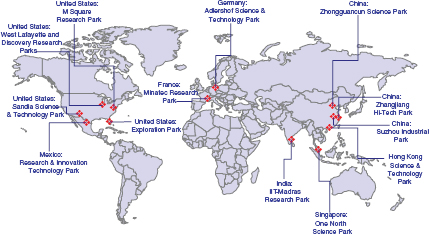
FIGURE 7.2 Global research parks discussed in Chapter 7.
The Biopolis project in One North is the furthest along. This city within a city is central to the government’s plan to make Singapore “the biomedical hub of Asia,” Ms. Lim said, by attracting scientists, researchers and entrepreneurs from around the world. Unlike traditional research parks that are located in suburbs, Biopolis is in the heart of Singapore. The campus is designed to encourage scientists and researchers in disciplines as diverse as proteomics, X-ray crystallography, and DNA sequencing to intermingle and collaborate on new projects. Lab buildings are situated intentionally close together and include amenities such as convenience stores, a gym, child care, restaurants, and a pub.143 Singapore officials expect that, within a few years, Biopolis will have 5,000 researchers, making it bigger than any U.S. biomedical cluster aside from San Diego.144
Fusionopolis, a development that opened in 2008, is nearby. It serves as a one-stop science and R&D haven mixing companies and research labs in new energy technologies, aerospace, nanotechnology, sensors and sensor networks,
______________________
143Two Biopolis phases have opened since ground was broken in 2001. Buildings house seven research institutes, including the Genome Institute of Singapore, the Institute of Bioengineering and Nanotechnology, the Institute of Molecular and Cell Biology, and labs of 20 companies, including Novartis, Eli Lilly, and GlaxoSmithKline. The largest private tenant will be Procter & Gamble, which announced it is building a Singapore $250 million (US$195 million) global innovation hub that will cover 34,000 square feet when it opens in 2013. Linette Lim, “P&G Invests $250 million in Innovation Centre,” The Business Times, January 27, 2011.
144 Singapore Economic Development Board Executive Director Yeoh Keat Chuan quoted in Pete Engardio, “Singapore’s One North,” BusinessWeek, June 1, 2009, (http://www.businessweek.com/innovate/content/jun2009/id2009061_019963.htm).
cognitive science, and devices for wired homes. Fusionopolis is housed in a 24 story building designed by renowned Japanese architect Kisho Kurokawa that includes service apartments, experimental theater space, hotels, and a shopping mall featuring smart-shopping technologies. A*STAR, which manages the complex, also helps integrate the work of research institutes with multinationals, small enterprises, and start-ups, as well as with agencies such as the Economic Development Board.145
China’s Mega Parks
Sprawling research and science parks are the most visible manifestations of China’s big push in innovation and science-based development.146 Susan Wolcott identifies three basic types of Chinese research parks—“multinational development zones” such as those in Shenzhen and Suzhou designed to attract foreign companies as growth engines, “multinational learning zones,” and “local innovation zones” catering mainly to domestically generated technology with some interactions with foreign companies.147
The scale of China’s leading science parks surpasses that of Research Triangle Park, by far America’s largest.148 The Chinese government invested $1.4 billion in Suzhou Industrial Park, for example, home to operations of 113 of the Fortune 500 companies.149 The more established Zhongguancun Science Park in Beijing hosts more than 20,000 enterprises and 950,000 employees, and has produced $110 billion worth of income as of 2009. 150
Strong government policy and financial support at the national, regional, and local level therefore is important in China, said Zhu Shen, CEO of the San Diego pharmaceutical consulting firm BioInsight.151 Some parks offer tax waivers, free rent, and financing to attract multinationals and “sea turtles,” as overseas Chinese who return to the mainland are known. 152 Good ones also
______________________
145 Details on Fusionopolis and Biopolis can be found on the A*STAR Web site at ttp://www.astar.edu.sg/?tabid=860.
146 Kazuyuki Motohashi and Xiao Yun, “China’s innovation system reform and growing industry and science linkages.” Research Policy, 36, pp. 1251-1260, 2007.
147For a review of China’s science and technology industrial parks, see Susan M. Walcott, Chinese Science and Technology Industrial Parks, Aldershot: Ashgate, 2003. Also see Kazuyuki Motohashi and Xiao Yun, “China’s innovation system reform and growing industry and science linkages.” Research Policy, 36, pp. 1251-1260, 2007.
148 Research Triangle Park is about 28 square kilometers in size. Beijing’s Zhongguancun Science Park is about 280 square kilometers, or larger by a factor of ten. “Zhongguancun Going Ahead”, www.sing.com.cn (June 26, 2002).
149 The Suzhou Industrial Park is undergoing a transformation, however, because industries were not developing as planned, with many companies producing low value-added goods and foreign producers relying on markets and supply-chains outside of China. Zhou Furong and Zhang Zhao, “Suzhou Industrial Park Faces Challenges on Path to Change,” China Daily, March 16, 2010.
150 From Zhu Shen presentation, op. cit.
151 Ibid.
152 China Daily, “China Luring ‘Sea Turtles Home.” December 18, 2008. The recent U.S. financial crisis appears to be accelerating the trend of repatriating Chinese professionals and scholars.
offer business resources, such as one-stop services for accounting, intellectual property advice, and counseling.
Some of the most prominent Chinese science parks are not single industry clusters; they are instead characterized by industrial diversity and a high concentration of R&D facilities of universities, corporations, and government research institutes. They are major centers of innovation efforts for industries such as pharmaceuticals, information technology, and high-tech electronics.153
The Zhangjiang High-Tech Park in Shanghai’s Pudong district also illustrates the breadth and scale of modern Chinese science parks. Built on what was farmland in 1992, it has more than 6,000 companies—2,500 of them from overseas—and covers 20 square kilometers.154 The park is expanding at the astounding rate of two kilometers a year and has another 58 square kilometers of undeveloped land.155 Zhangjiang’s workforce has grown from 5,000 in 2000 to 160,000 in 2011.156
The Zhangjiang park has become Shanghai’s premier innovation zone. More than 30 government research institutes and more than 100 multinational R&D centers have located in the district in industries as diverse medical equipment, life sciences, new energy, information technology, semiconductors, and multimedia gaming.
For companies, the advantages of being inside the park include low taxes and land costs that are much lower than in other areas of Shanghai, one of
______________________
153 “The idea is that these are places where a lot of the top talents from different fields are clustered—this then is what attracts private enterprises,” she said. Zhu Shen presentation, op. cit. Beijing’s Zhongguancun Science Park, for example, features companies in information technology, new energy, biomedicine, advanced manufacturing, and new materials. The life science district alone has 100 companies, around 80 percent of them Chinese start-ups. “Sea turtles” founded or run many of these companies For information on some of the most prominent “sea turtles” in the Chinese pharmaceutical research industry, see the slide show, Pete Engardio, “Who’s Who in Chinese Sea Turtles,” Bloomberg BusinessWeek, at http://images.businessweek.com/ss/08/09/0904_chinese/index.htmhttp://images.businessweek.com/ss/08/09/0904_chinese/index.htm. A major attraction of the park is affordable land close to the lifesciences research programs of Tsinghua University, Peking University, and the Chinese Academy of Sciences, according to Jin Guowei, vice general manager of Beijing Zhonguancun Life Science Park Development Co. Interview with Vice General Manager Jin Guowei and Chairman Yuan Shugang of Beijing Zhongguancun Life Science Park Development Co. in Beijing; The park claims that companies on campus have 40 to 50 drugs that are in the first phase of clinical trials. Beijing Zhonguancun Life Science Park Development, a state-run company that manages the park, offers tenants technical support services, such as molecular analysis, and helps them apply for national research funds. The administration also organizes seminars to explain government programs. A second phase is under construction. Interview with Jin and Chairman Yuan Shugang of Beijing Zhongguancun Life Science Park Development Co. in Beijing.
154 Zhangjiang High-Tech Park data.
155 Interview with Yin Hong of Shanghai Zhangjiang Group in Shanghai.
156 Zhangjiang High-Tech Park data.
China’s most expensive real estate markets157. Companies can draw from some 9,000 researchers, scientists, and workers from several nearby universities. The elite Fudan University has moved its research institutes for software, integrated circuits, and pharmaceuticals to Zhangjiang. Just as importantly, Shanghai is one of China’s biggest magnets for international talent, especially Taiwanese. More than 10,000 non-Chinese nationals work in Zhangjiang. The ability to hire engineers, scientists, and managers that have lived and worked abroad is one of the main features that draw multinationals to Zhangjiang, according to Yin Hong, vice general manager of Shanghai Zhangjiang Group In Beijing, by contrast, multinationals mainly recruit from local universities.158 Shanghai Zhangjiang Group, the company that manages the park, serves as a one-stop shop for handling red tape.159
Zhangjiang has become the core of several of Shanghai’s most promising emerging innovation clusters. In life sciences alone, Zhangjiang includes R&D centers by Roche, Eli Lily, Pfizer, Novartis, GE, and AstraZeneca, all of which have announced major expansion plans. There also are 60 small-molecule drug-development companies, 35 medical device and diagnostic firms, and 15 traditional Chinese medicine companies. Small and midsized companies get financial help via grants from the National Technology Innovation Fund and some $2.5 billion in venture funding set aside for the park.160 Zhangjiang also includes two of China’s most important drug-research companies—Wuxi PharmaTech and Hutchison MediPharma—that assist multinationals in early-stage discovery.161
______________________
157 The Zhangjiang High-Tech Park also offers affordable apartments to staff of companies based there. Location is another selling point. Zhangjiang is in the center of Pudong, a district across the Huangpu River from downtown Shanghai that is a major industrial zone and is home of Shanghai’s financial district. Zhangjiang is within 50 minutes of both Shanghai airports. Three ring roads pass through or alongside Zhangjiang, and the park has three subway stops, making it within commuting range of much of Shanghai.
158 Yin Hong, op. cit.
159 If all documents are ready, according to Vice General Manager Yin Hong, the company can approve an application to enter the park within 10 working days. Mr. Yin said the park concentrates on “intelligence-intensive” companies primarily engaged in research in five main clusters: semiconductor manufacturing and design, pharmaceutical research, renewable energy, information technology and gaming, and advanced manufacturing. Of the park’s 160,000 workers, only around 10 percent are engaged in manufacturing. Two-thirds of those employees have at least a bachelor’s degree. Mr. Yin said that the focus on research and development sets Zhangjiang apart from most other “research parks” in China, many of which lease out much of their space for manufacturing. Yin Hong, op. cit.
160 Zhangjiang High-Tech Park data.
161 For more information on China’s role as a drug-research base for multinationals, see Pete Engardio, “Chinese Scientists Build Big Pharma Back Home,” BusinessWeek, Sept. 15, 2008 (http://www.businessweek.com/magazine/content/08_37/b4099052479887.htm). Also see Vivek Wadhwa, Ben Rissing, Gary Gereffi, John Trumpbour, and Pete Engardio, “The Globalization of Innovation: Pharmaceuticals,” Duke Pratt School of Engineering, Kauffman Foundation, Harvard Law School Labor and Worklife Program, June 2008, (http://www.kauffman.org/uploadedFiles/global_pharma_062008.pdf).
Tenants in other industries include Hewlett-Packard, Lenovo, Infineon, Intel, IBM, Citibank, Infosys, SAP, eBay, Dow, and DuPont.162
Like management companies at other research parks in China, Shanghai Zhangjiang has its own direct-investment fund, which it sees not only as a source of capital to seed start-ups but also as a money-making opportunity. The company’s has ¥2 billion ($310 million) in capital.163
One of the park’s top priorities is to deepen the area’s talent pool. As labor gets more expensive, the Shanghai area will have to compete more on the basis of innovation. Shanghai Zhangjiang would like to attract a campus of a major Western university.164 So far, however, the Chinese government has been slow to approve campuses by foreign universities.
Chinese science parks still must overcome many challenges. Some parks are run largely as real-estate projects, rather than as real innovation zones. Phillip H. Phan of Rensselaer Polytechnic Institute noted that China’s weak protection of intellectual property and an academic culture that discourages scientists from thinking like entrepreneurs are other handicaps to developing world-class science parks.165
Rejuvenating Berlin’s Adlershof
The ruins of old wind tunnels, engine-testing facilities, and military barracks that still stand on the six-square-kilometer campus of the Science and Technology Park Berlin Adlershof testify to the site’s storied past as the birthplace of German motorized aviation, a development base of fighter aircraft for two world wars, and a science center of the former East Germany.
Today, Adlershof is one of Europe’s largest and most established science parks. The campus includes 17 research institutes and operations of 866 companies. Employment within the park more than doubled between 1997 and 2010 to around 14,000.166 The campus also includes nearly 8,000 students of Berlin’s Humboldt University, which has moved its computer science, mathematics, chemistry, physics, geography, and psychology institutes to
______________________
162 The R&D centers of most multinationals focus on localizing products and technology for China’s domestic market or for products manufactured in China for export, Mr. Yin explained. He also estimated that around 90 percent of revenue by chip-design companies in the area are from the domestic market Yin interview, op. cit.
163 Its biggest investment is a startup called MicroPort Scientific, a maker of medical devices such as cardiovascular stents and insulin pumps, with $113 million in 2010 sales. Mr. Yin said. Shanghai Zhangjiang also makes low-interest loans to small and midsized Chinese companies. Ibid.
164“We would love to have more and more global education resources in this area,” Mr. Yin said. “It will help foster the talent pool. This also offers a good opportunity for these institutions’ globalization strategies.” Ibid.
165 Phan presentation, op. cit.
166 Data from 2010 Report on Adlershof.
Adlershof. Several more institutes and business accelerators are under construction.167
A study by the German Institute for Economic Research (DIW) concluded that Adlershof directly contributed more than €1 billion in economic value-added in the area in 2010 and another €740 million in other parts of Berlin. The park also was responsible for 28,000 jobs in the city, and generated €340 million in tax revenue—more than half of which stayed in Berlin.168
Adlershof regards itself as a successful model of how public subsidies can stimulate sustainable development of private industry. Between 1991 and 2005, 80 percent of the €1.3 billion invested came from public sources with the remainder from companies. Of the €500 million invested between 2005 and 2011, 70 percent came from private investors.169 Government funding accounts for only 6.4 percent of the park’s budget.170
The park was founded in 1991 after the fall of the Berlin Wall, when the city’s government faced a quandary over what to do with some 5,500 East German scientists and highly skilled staff, many of them at the forefronts of fields such as laser technology, space research, new materials, and chemistry. 171
Adlershof was established in 1991 mainly as a means of providing employment in both research and industry for the remaining 4,100 East German scientists, who did not easily fit into West German scientific research
______________________
167 Briefing by Peter Strunk of Wista-Management GMBH in Berlin.
168 Wista-Management GMBH, “The Economic Significance of Adlershof: Impact on Added Value, Employment, and Tax Revenues in Berlin,” study by the German Institute for Economic Research commissioned by Wista-Management, 2011.
169 Ibid.
170 2010 Report on Adlershof.
171 The science park is located on what originally was the Johannisthal Air Field, which at the turn of the century became one of the world’s first development bases for motorized aircraft. German companies such as Albatros, Fokker, and Rumpler all developed early flying machines on the grounds, as did the Wright brothers, who built 60 aircraft there. The German Research Center for Aviation was established in 1912, and 6,000 fighter planes used in World War I were built at Adlershof. After the war, hundreds of films—including Friedrich Murnau’s Nosferatu—were shot in the unused hangars. When the Nazis came to power, Adlershof once again was used to develop ultrafast warplanes. After Germany’s defeat, Adlershof’s aviation research laboratories were dismantled and shipped to the Soviet Union as war reparations. After Germany’s partition, Adlershof was home to East German national television and a 12,000-strong regiment of the Ministry of State Security, or Stasi. The East German Academy of the Sciences made Adlershof its base for chemistry and physics. Many of the historical details are taken from Hardy Rudolph Schmitz, “100 Years of Innovation from Adlershof: Dawns, Damage, and Determination,” Wista-Management GMBH, Sept. 9, 2009, (http://www.adlershof.de/fileadmin/web/ansprechpartner/netzwerke/internationales/events/Hardy_Schmitz_-_Adlershof_100_years_of_innovation_speech.pdf). Also see a brief history of Adlershof on the Adlershof Web site at http://www.adlershof.de/geschichte/?L=2 and on the Web site of the Gorman Aerospace Center (DLR) http://www.dlr.de/en/desktopdefault.aspx/tabid-2039/2510_read3894/.
organizations.172 Many of these former East German scientists now are entrepreneurs.173
Management of the science park is modeled after North Carolina’s Research Triangle. Governments provided most of the funds for new buildings. But the budget of Wista, the organization that manages the park, comes from renting space to corporate tenants. Companies also pay to use lab space and other services. Tenants must be in industries related to each facility’s specialty. There are five research centers that as of 2010 were 95 percent full. After a center has been in operation for 10 years, Wista-Management is allowed to sell the building and lease it back—using the proceeds to fund new construction. Centers devoted to microsystems and materials and information technology and media opened in 2011. A new center for photovoltaic technologies is under construction. Some German high-tech companies are opening manufacturing plants at Adlershof.174 One key to Adlerhof’s success, Dr. Strunk said, is that government funding agencies have maintained support over the long term but did not interfere with management. “A science park needs 10 to 15 years to reach a tipping point,” Dr. Strunk said. “During that time, it must be free of political constraints.”175
Minatec and France’s Nanotech Push
France has long been known as a great place to do research and is seeking to become a more attractive place to start companies. The French government is investing in research parks to develop regional competitive clusters, or pôles de croissance.
Minatec, a campus of 3,000 students and researchers in Grenoble, is regarded as a model of what the government hopes to achieve.176 The facility
______________________
172 “The main idea was to prevent a social catastrophe,” recalls Peter Stunk, executive manager of public relations for Wista-Management GMBH, which runs the park. “They lost everything.” The Berlin government dismantled many of the aging buildings and built new ones to house reorganized research institutes and incubators for starting new business.
173 Former scientists from the Academy of Sciences founded Röntec, a leading manufacturer of Xray spectrometers that subsequently was acquired by the Nasdaq-listed Bruker Group. Other Adlershof spinoffs founded by East German scientists include FMB Feinwerk und Messtechnik GmbH, a world leader in vacuum systems and beamlines for infrared and soft X-radiation, and LLA Instruments, a maker of devices that can detect 20 different kinds of plastics that are used in recycling facilities. Descriptions of these start-ups are found in Berlin Adlershof, 2010 Report on Adlershof, (http://www.adlershof.de/newsview/?no_cache=1&L=2&tx_ttnews%5Btt_news%5D=8888).
174 Berlin-based Soltecture, a manufacturer of thin-film photovoltaic modules and solar-energy systems that has raised more than €104 million in venture and private-equity investment, is building a major production plant on the campus. One draw is a new “competence” center for cutting-edge research in thin-film and nanotechnology for photovoltaics that will be a joint venture between Helmholtz Center Berlin for Materials and Energy and Berlin Technical University.
175 Strunk, op. cit.
176 See presentation by David Holden of Minatec in Understanding Research, Science, and Technology Parks.
began as an extension of the national nuclear research institute177 and the Laboratory of Electronics and Information Technologies (Leti), which spawned Thompson Semiconductor in 1973.178 It then took on a broader mission of promoting public-private research partnerships and the region’s industrial base. Over the past decade, Minatec has emerged as one of Europe’s premier hubs for nano-technologies and micro-systems. Covering 20 hectares, the campus represents a €3.2 billion investment by the French government and €150 million by local government. As of 2009, the French government also has awarded 113 research projects to Minatec over two years worth about €1.2 billion.
In a nation where researchers tend to be scattered in small groups, Minatec brought together academic programs from four universities with 60,000 students, half of them studying sciences.179
The high concentration of R&D activity at Minatec has led to the creation of start-ups in fields such as optoelectronics, biotechnologies, components, circuit design, and motion sensing. Minatec also has attracted significant corporate investment and has forged major international research alliances.180
Minatec is the focal point of Nano 2012, described as France’s biggest industrial project. The aim of the program, which involves nearly €4 billion in funding from the national, state, and local governments for R&D and equipment, is to make the Grenoble region the world center for development of 32nm and 22nm CMOS technologies.181 Minatec is diversifying into biotechnology and clean-energy technologies to complement its strength in micro-systems.
India’s Research Parks
Science parks are relatively new to India, where until the early 1990s the government discouraged partnerships between academia and business. A number of high-tech industrial estates have since been set up around the country to incubate technology ventures or attract research facilities by foreign and domestic companies. The city of Hyderabad has parks devoted to biotech and
______________________
177 See Junko Yoshida, “Grenoble Lure: Un-French R&D,” EE Times, June 12, 2006.
178 Thompson Semiconductor merged with Italy’s SGS Microelectronics in 1988 and became STS Thompson, one of the world’s largest semiconductor companies.
179 Minatec’s state-of-the-art facilities include a 300mm silicon wafer center that operates around the clock, a 200mm micro-electro-mechanical systems (MEMS) prototyping line for fast development of new products, and one of Europe’s best facilities for characterizing new nano-scale materials. The campus is home to 2,400 researchers and numerous technology-transfer experts. Researchers have filed nearly 300 patents and published more than 1,600 scholarly papers. Data from Minatec Web site and Dr. Holden presentation.
180 Minatec’s 200 industrial partners include Mitsubishi, Philips, Bic, and Total. Two-thirds of its annual €300 million annual budget comes from outside contracts.
181 Among the initiative’s partners are CEA Leti, IBM’s Fishkill, N. Y., semiconductor production complex, ST Microelectronics, the University of New York at Albany, ASML Holdings of the Netherlands, and ST Mentor Graphics of Wilsonville, Oregon. Anne-Francoise Pele, “Mentor Joins 2012 R&D Alliance,” EE Times, March 16, 2010.
information technology, for example, and Uttar Pradesh capital Lucknow has industrial and research parks for software and life sciences. Several of the nation’s famed Indian Institutes of Technology (IIT) and Institutes of Science (IISc) have launched science and technology parks in cities such as Mumbai, Kanpur, Bangalore, and Madras. Most Indian research parks are very small by world standards, however, and focus on incubating start-ups. Other research parks set up by private investors tend to have weak links to universities.182
The new IIT-Madras Research Park is one of India’s first modern research parks, aspiring to “create a knowledge and innovation ecosystem through collaboration between industry and academia.”183 Funded by an independent company and promoted by the university and local government, the park plans to build 1.2 million square feet of office space in three phases in Chennai, the city formerly known as Madras. It will be built at a cost of just 3 billion rupees (around $65 million), mainly with funds from government, bank loans, and alumni donations. The local government provided 11.5 acres of land and infrastructure.184 The first tower opened in March 2010, and so far 27 companies have signed up.
The park intends to boost India’s role as a “design house” for developing higher-quality products and intellectual property, according to IITMadras park director M. S. Ananth. The automotive industry is a major focus. The state of Tamil Nadu is the base of 25 percent of Indian auto assembly and 35 percent of the auto parts industry.185
Some 15 percent of the park’s space will be reserved for start-ups and training facilities. The park also will feature facilities for prototyping and consulting services and help raise venture funding. The rest of the space is reserved for corporate R&D partnerships with the university.
One of the keys to making research parks work in India is to make sure corporations do not simply treat them as cheap industrial real estate, Mr. Ananth said. IIT-Madras has set up a system in which companies may stay in the park as long as they engage in a certain level of joint-research, consult faculty, sponsor students for advanced degrees, teach, or mentor or employ students.186
______________________
182 From presentation by M. S. Ananth of the Indian Institute of Technology-Madras in Understanding Research, Science and Technology Parks.
183 From IIT-Madras Research Park Web site, http://respark.iitm.ac.in/about_us.php.
184Ananth, op. cit.
185 India Department of Scientific and Industrial Research data Nissan, BMW, Ford, Hyundai, Ashok Leyland, and Mitsubishi all have major assembly operations in the region. Caterpillar, Bridgestone, Michelin, BorgWarner, and Delphi are among the many component suppliers. See Eric Bellman, “A New Detroit Rises in India’s South,” The Wall Street Journal, July 8, 2008.
186 Ananth, op. cit.
Leveraging Geography in Hong Kong
Hong Kong is using an impressive new science park to develop a range of new industrial clusters and to position itself as a corporate research hub for China and Southeast Asia.
The government has invested $1.5 billion so far to build the first two phases of the Hong Kong Science and Technology Park in the New Territories, close to the Chinese city of Shenzhen. The park has 250 companies, 80 percent of which are foreign, and employs 7,000 people. When a third phase is completed, the park is expected to have 450 companies and employ 15,000, according to Nicholas Brooke, who chairs the Hong Kong Science and Technology Parks Corp., the park’s manager.187
The park’s strategy is to pick clusters based on existing Hong Kong strengths, and capitalize on its position as a world-class business environment with strong legal protections just across the border from the Chinese city of Shenzhen. It selected electronics, green technology, information and communication technology, precision engineering, and biotechnology. Phase III facilities will focus on new clusters, such as thin-film photovoltaic panels, environmental engineering, and energy management for buildings. The park’s laboratories, design center, and incubators focus on niche technologies within these broad areas, such as chips for wireless telecom devices, smart cards, and RFID applications, areas where Hong Kong already is strong. While Hong Kong is hardly on the cutting-edge of scientific research, as Mr. Brooke conceded, it serves as an important integration platform of technologies from around the world for markets in China and elsewhere in Asia. 188
Mexico’s First Modern Technology Park
The new Research & Innovation Technology Park (PIIT) in Monterrey has become a symbol of Mexico’s ambition to move beyond maquiladora assembly manufacturing and develop a knowledge-based economy. Spread over 172 acres near the airport, PIIT will the first in Mexico to integrate the labs in an array of technologies by leading universities, foreign and domestic corporations, small-business incubators, and national laboratories at a single site.
PIIT’s first $145 million phase includes major labs by companies as diverse as Motorola, PepsiCo, AMD, Bosch, and India’s Infosys. The park also is building public R&D centers for electronics, biotechnology, mechatronics, advanced materials, the food industry, product design, IT, and water research. There are business incubators devoted biotechnology and nanotechnology companies. The University of Texas at Austin will run an IC2 business
______________________
187 From presentation by Nicholas Brooke of the Hong Kong Science and Technology Park Corp. in Understanding Research, Science and Technology Parks.
188 Ibid. Many of the 250 companies in the park conduct sensitive R&D in Hong Kong and manufacture their products in China. DuPont, Philips, Freescale, Xilinx, and Nvidia are among the multinationals using this “Hong Kong-Shenzhen model.”
incubator.189 Texas A&M and Arizona State University also are among the partners.190
The goal is to help Monterrey develop new, hybrid industries and innovative companies that will be pillars of the region’s growth and “promote a new culture of innovation in Nuevo Leon society,” according to PIIT Director Jaime Parada.191
Monterrey has several key ingredients for innovation clusters in industries from auto parts and appliances to information technology and life sciences. The state of Nuevo Leon has the highest education level in Mexico.192 The Monterrey metropolitan area has several of Latin America’s best universities, including Tecnológico de Monterrey and the University of Monterrey, as well as several major research hospitals. The city also has a dynamic industrial base that produces 11 percent of the nation’s manufactured goods. It is home to such large Mexican companies as Cemex and the operations of 2,000 foreign companies, including United Technologies’ Carrier unit, Ford, General Electric, Lenovo, and Whirlpool.
The PIIT campus received $250 million in investment from the federal government. The state of Nuevo Leon also established a $30 million seed fund with private backers. Mexico offers tax incentives covering 30 percent of annual R&D expenses for those who invest in research and development.193
A New Generation of U.S. Research Parks
American universities have long been in the vanguard of using research parks as conduits for disseminating technological know-how from universities to private industry. It is likely that research parks will therefore have to play an important role if America is to extract more economic value from the $100 billion the federal government invests each year in research at universities and national laboratories.
______________________
189 The IC2 Institute at the University of Texas at Austin includes the Austin Technology Incubator.
190 Nuevo Leon Government, “Monterrey: International City of Knowledge,” Power Point. This presentation can be accessed at http://info.worldbank.org/etools/docs/library/244614/IC4Session4_Parada.pdf.
191 See presentation by Jaime Parada of Research and Innovation Technology Park (PIIT) in Understanding Research, Science and Technology Parks. The park stems for an initiative called Monterrey International City of Knowledge, which aims to coordinate the public and private sectors to upgrade industry in the state of Nuevo Leon. The project is part of a larger goal to boost per-capita GDP in Nuevo Leon state from about $16,000 today to $35,000, the current level of industrialized nations, by 2030. The state of also wants to be regarded as among the world’s top 25 locations according to international rankings and to have a “world class education, research and innovation system.” Nuevo Leon Government, “Monterrey: International City of Knowledge,” op. cit. http://info.worldbank.org/etools/docs/library/244614/IC4Session4_Parada.pdf.
192 Ibid.
193 Parada, op. cit.
At a time of intensifying global competition, there is considerable room for improvement in U.S. university research parks. Although American universities and national labs made great strides in commercializing research since passage of the Bayh-Dole Act194 in 1980, not all are proficient at it. There also are signs that overall progress has slowed. While the number of start-ups spun out of elite research universities rose from 200 in 1994 to 600 in 2008, successful patent applications and new technology licenses have remained flat for a decade, according to the Association of University Technology Management.195 Of 19,554 invention disclosures by universities in 2009, only 16 percent resulted in issued U.S. patents and 3 percent of those inventions led to the formation of start-up companies. Fifty-two percent of the 130 technologytransfer programs studied lose money for their universities. Only 16.2 percent reported that their programs are financially self-sustaining, meaning they do not depend on a university’s budget to remain in operation.196
Among the reasons cited for this performance are underfunding of university technology-transfer offices197 and federal rules that make it too difficult for principal investigators to commercialize federally funded innovations. Another explanation is that the system for allocating federal R&D funds and for rewarding faculty focus overwhelming on scientific discovery, rather than applied research or development of prototypes.198
Some U.S. university officials note that the walls between academia and the private sector remain high. Former MIT President Charles M. Vest, now president of the National Academy of Engineering, observes that the role of economic development and technology is necessarily secondary in importance to the university’s prime missions of education and research.199 At universities such as Johns Hopkins, only recently have administrations encouraged scientists to interact with business.200 Even in universities with active technology transfer
______________________
194 The Patent and Trademark Law Amendments Act (35 USC Sec. 200-212), known as the Bayhdole Act, gave universities control over intellectual property that results from publicly funded research.
195 Presentation by Ashley J. Stevens of the Association of University Technology Management in National Research Council, at the National Academies conference on Clustering for 21st Century Prosperity, Washington, DC, February 25, 2010.
196 Ibid. With respect to barriers to innovations, see Box 1.2 in Chapter 1.
197 Ibid.
198 Remarks by Brian Darmody of the Association of University Research Parks at the National Academies conference on Clustering for 21st Century Prosperity, Washington, DC, February 25, 2010i. Also see Association of University Research Parks, “The Power of Place 2.0: The Power of innovation—10 Steps for Creating Jobs, Improving Technology Commercialization and Building Communities of Innovation,” March 5, 2010, (http://www.matr.net/article-38349.html).
199 See remarks by National Academy of Engineering President Charles M. Vest in National Research Council, Building the 21st Century: U.S. - China Cooperation in Science, Technology, and Innovation, Charles. W. Wessner, editor, Washington DC: The National Academies Press, 2011.
200 Presentation by Johns Hopkins University technology-transfer director Aris Melissaratos at the National Academies conference on Clustering for 21st Century Prosperity, Washington, DC, February 25, 2010.
offices, bureaucracy can move too slowly or make obtaining technology too costly for entrepreneurs to seize rapidly evolving market opportunities.201 In other cases, commercialization is stymied by inadequate investment in physical infrastructure and a lack of capital to back promising start-ups and see them through the Valley of Death.
Across America, however, new 21st century research parks affiliated with universities and national labs are being established that have been designed after studies of contemporary best practices and the demands of a knowledge economy. Following are some examples featured in NAS STEP board symposia.
Using Research Parks to Expand Maryland’s Mission
The University of Maryland at College Park not only has been a leader at promoting entrepreneurialism among its faculty and students and engaging with private industry.202 It also has been a pioneer at forging research and economic-development collaborations across Maryland, the nation, and around the world. This high level of engagement with industry has enabled the university to generate $20 billion in economic activity over the past quarter century at a total cost to the state of approximately $88 million, according to former University of Maryland-College Park president C. D. Mote.203
Now the university is using research parks in innovative ways to expand these missions by serving as multi-purpose structures where partners from different sectors can interact and innovate. Such parks help “by adding dimension to (the university’s) partnership opportunities with industry and government on a global scale that cannot be fulfilled in any other manner that we have discovered,” Dr. Mote said.
The new M Square research park, adjacent to the University of Maryland-College Park, is the focal point of research and business clusters in homeland and national security, environmental and earth sciences, and food safety and security. The park benefits from the campus’s proximity to
______________________
201 For example, see Robert E. Litan, Lesa Mitchell, E. J. Reedy, “Commercializing University Innovations: Alternative Approaches,” National Bureau of Economic Research working paper JEL No. O18, M13, 033, 034, 038 (http://papers.ssrn.com/sol3/papers.cfm?abstract_id=976005).
202 For example, the University of Maryland-College Park has a special dormitory for student entrepreneurs, an award competition for student business proposals, a center for entrepreneurship, a technology enterprise institute run by the engineering school, Maryland’s oldest business incubator, a “venture accelerator” to help faculty and student businesses develop commercial products, “boot camps” for technology engineers, and programs to train engineers for industry jobs. See presentation University of Maryland-College Park President C. D. Mote in National Research Council, Building the 21st Century: U.S. - China Cooperation in Science, Technology, and Innovation, Charles. W. Wessner, rapporteur, Washington, DC: The National Academies Press, 2011.
203 See presentation by C. D. Mote in Understanding Research, Science, and Technology Parks, op. cit. Also see Dr. Mote’s presentation in National Research Council, Building the 21st Century: U.S. China Cooperation in Science, Technology, and Innovation, Charles. W. Wessner, editor, Washington, DC: The National Academies Press, 2011.
Washington, DC and important nearby research institutions such as the American Center of Physics.
M Square will cover 138 acres and have more than 2 million square feet of space when fully built out. It has attracted some $500 million in private investment and is expected to employ 6,500 people.204
The research park has helped the University of Maryland, which already had important institutes for physics and telecommunication sciences and the Center for Advanced Study of Languages, land a cluster of research centers tied to federal national security organizations205. The University of Maryland has set up other innovative research parks to extend its global reach. The UM-China Research Park, established in 2002, hosts 10 Chinese companies and offers services provided by the university’s engineering and business schools. Another 11 Chinese companies have set up operations at the university’s special international incubator, Dr. Mote noted, including a developer of software for the construction industry that raised $2 billion in a stock offering valued at $20 billion within six months. Another “international research park” affiliated with the university serves as a “foothold” for foreign companies in Maryland. The park “shows what universities can do on an international scale to build enterprises,” he said.
Purdue’s Regional Approach
A science park initiative need not be limited to one area. The Purdue Research Parks is a network of parks launched a decade ago by the Purdue Research Foundation, a nonprofit set up in the mid-1990s. In addition to the 725-acre park near Purdue’s main West Lafayette, Indiana, campus, there are campuses in Indianapolis, Merrillville, and New Albany, all aimed at helping students and faculty commercialize technology to enhance the Indiana economy. In all, Purdue is a partner in at least 10 Indiana science parks, a half dozen of which are doing quite well, according to Victor L. Lechtenberg, Purdue’s vice provost for engagement.206
______________________
204 A new 38-acre mixed-use University Town Center under development will allow researchers and entrepreneurs to both live and work at the park. Key tenants for climate and weather research include the National Oceanic and Atmospheric Administration, which will occupy 10 acres, employ 800, and partner with the university and the NASA/Goddard Space Flight Center. A climate change institute run jointly by the university and the Pacific Northwest National Laboratory and a $25 million center for earth systems modeling also are at M Square. Data from M Square Web site at http://www.msquare.umd.edu/about/um-research-park.
205 They include the Intelligence Advanced Research Project Activity, a new government program that consolidates high-level, forward-looking intelligence research. Tenants relating to food research include facilities for the U.S. Department of Agriculture, the Food and Drug Administration, and the university’s own Center for Food, Nutrition, and Agriculture policy. M Square also houses a number of start-ups incubated at the university, ranging from developers of medical devices and Internet security software to nutritional products.
206 From presentation by Victor Lechtenberg of Purdue in Understanding Research, Science, and Technology Parks.
The West Lafayette park has nearly 100 high-tech businesses and entities and the nation’s largest incubation program, covering 259,000 square feet and housing 57 start-ups. Some $121 million in venture capital has been invested in businesses. The park’s 2,800 employees earn an average of $58,400 each.207 Combined, the research parks have 214 companies in fields such as life sciences, information technology, advanced manufacturing, digital imaging, agri-science, and engineering.208
A second Purdue initiative is Discovery Park. Founded in 2001, Discovery Park is a network of integrated research centers at the Purdue campus, each dedicated to large-scale, interdisciplinary research in topics such as biosciences, nanotechnology, advanced manufacturing, energy, oncology, and healthcare engineering. Discovery Park also includes a $25 million Hall for Discovery and Learning Research. Discovery Park has 113,000 square feet of laboratory space, has raised nearly $150 million in research funding as of mid2010, and recruited 300 faculty.209 The Lilly Endowment is a major contributor.
Discovery Park’s mission is to help “redefine” the academic culture for research and discovery.”210 The park has a number of project-based centers sponsored by different funders and that are affiliated with the core research centers. One major project is developing systems to predict the reliability of micro-electromechanical systems (MEMS) used in security, defense, and space applications. Scientists at Purdue’s Bindley Bioscience Center work closely with engineers at the Birck Nanotechnology Center to pioneer new cancer treatments using tiny micro-sensors implanted into tumors to allow doctors to monitor radiation. Other R&D projects study processes to convert biomass into energy and develop low-cost diagnostic tools to detect the AIDS virus. The park is also home to the George E. Brown, Jr. Network for Earthquake Engineering Simulation (NEES), which is housed in Purdue University’s Discovery Learning Research Center in Discovery Park. Led by Purdue University, NEES connects research equipment sites and the earthquake engineering community from universities and research centers across the country. NEES is supported by a $105 million grant from the National Science Foundation.211
Seeding and nurturing start-ups by blending different disciplines is a major objective of Discovery Park. It has helped launch 30 companies so far, as well as six start-ups initiated by students. Discovery Park also has helped Purdue
______________________
207 Details on Purdue Research Parks from Lechtenberg presentation, ibid.
208 A current list of companies in the parks are found on the Purdue Research Web site, http://www.purdueresearchpark.com/companies/index.asp.
209 Data from Purdue University Discovery Park Web site, http://www.purdue.edu/discoverypark/.
210 Discovery Park Web site, op. cit.
211 See Peter Folger, Earthquakes, Risk, Detection, Warning and Research, Congressional Research Service, September 2, 2011. Access this CRS report at http://www.fas.org/sgp/crs/misc/RL33861.pdf
raise more research funds, which surged to $342 million in the 2008-2009 fiscal year.
Spurring Entrepreneurialism at Sandia
As at many national laboratories engaged in weapons research, the technologies developed at Sandia National Laboratories in Albuquerque, N.M., did little through most of its history to stimulate civilian industries in the surrounding area. That began to change in a big way in 1999, when Sandia became the first national laboratory to open an industrial park next to its compound. The motive was not only to spur development of science-based companies in New Mexico, but also to enable the laboratories to share costs and expertise with industry so that their scientists can keep pace with the latest technological innovations.212
Today, the Sandia Science and Technology Park has 18 buildings housing 29 companies and more than 2,000 employees, who earn an average annual salary of around $70,000.213 The park also has plenty of room to expand: More than two-thirds of the 240 acres of land reserved for the park have yet to be developed.
Sandia was founded as part of the Manhattan Project in the late 1940s as a spinoff of Los Alamos National Laboratories, also located in New Mexico, in order to manufacture weapons for the U.S. nuclear stockpile. Owned by the DOE and managed by Lockheed Martin, Sandia subsequently broadened its mission to meeting other national needs, such as technology for homeland security and renewable energy. Sandia’s core technological strengths include computer science, micro systems, materials, engineering sciences, and biosciences.214 Sandia also is strong in fields such as solar power, a legacy of its decades of work developing power systems for spacecraft.
The park is located alongside what Sandia Chief Technology Officer Richard Stulen describes as an “innovation corridor.” Major facilities include the Microsystems and Engineering Sciences Applications (MESA) complex, a $$516 million investment by the Department of Energy, the National Nuclear
______________________
212 For an early analysis of the Sandia science park, see National Research Council, IndustryLaboratory Partnerships: A Review of the Sandia Science and Technology Park Initiative, Charles W. Wessner, editor, Washington, DC: National Academy Press, 1999.
213 Sandia Science and Technology Park, “Facts and Figures,” on Web site at http://www.sstp.org/Pages/FactsFiguresPage.html Partners in the park include the DOE, Lockheed Martin, New Mexico’s Economic Development Administration, and local governments. The park claims to have created more than 5,400 indirect jobs in the Albuquerque area and that the $68 million in public investment as of 2009 brought in $243 million in private investment. Data are from 2009 report by the Mid-Region Council of Governments. See Sandia news release, “Report: Sandia Science & Technology Park Fuels Economy With Jobs, Tax Revenue, Spending,” Aug 3., 2010 (https://share.sandia.gov/news/resources/news_releases/report-sandia-science-technology-park-fuelseconomy-with-jobs-tax-revenue-spending/).
214 Presentation by J. Stephen Rottler of Sandia National Laboratories at the National Academies conference on Clustering for 21st Century Prosperity, Washington, DC, February 25, 2010.
Security Agency, and Sandia.215 MESA is used for both classified and nonclassified research and is a state-of-the-art microelectronics fabrication facility that can integrate single chips using different materials in ways not normally available to industry.216 Some of the park’s tenants are sizeable. EMCORE, a developer of fiber-optic transmission equipment and solar cells used in spacecraft and terrestrial systems, employs 500 and has invested $104 million in Albuquerque. The company licensed key laser, solar cell, and transponder technology from Sandia. KTech, a local company that provides technicians for the Sandia Pulsed Power Facility, also employs 500 and has invested $34 million.217 Other tenants include radar-imaging developer Microwave Imaging Systems, the spacecraft electronics operations of Moog Inc., and Applied Technology Associated, a small maker of devices such as sensors and testing instruments.218
Among the biggest challenges for the Sandia science park is “keeping the federal government engaged” and maintaining interest by government agencies in maintaining incentives to lure small businesses, explained Dr. Stulen. “Parks don’t just happen. They require energy, devotion, and passion from leaders – not only of the institution but also of the region.” He said that Sandia and other national laboratories need to improve the ways in which they collaborate with private companies, such as by reducing red tape involved with licensing intellectual property and meeting government regulations. “We need more speed in working with industries, to be able to work at their pace,” he said.
Kennedy Space Center: A New Mission
The final voyage of Space Shuttle Atlantis, which landed for the last time on July 21, 2011, in Cape Canaveral, Fla., not only marked the end an era of American manned space travel. It also marked the beginning of a major economic challenge for the area surrounding the Kennedy Space Center. The end of the program was estimated to have cost up to 25,000 jobs.219
Regional officials hope that a new science park just outside the security gates of Kennedy Space Center will help rebuild the region’s economy and
______________________
215 “DOE/NNSA to Dedicate Half Billion Dollar Microsystems Engineering Sciences Complex at Sandia,” News Release, National Nuclear Security Administration, August 20, 2007.
216 See presentation by Sandia Chief Technology Officer Richard Stulen in Understanding Research, Science and Technology Parks. Sandia also is home to the Red Storm, one of the world’s most powerful supercomputers, and a Joint Computation and Engineering Lab used by corporations such as Goodyear and Procter & Gamble to simulate complex industrial designs. Sandia is a partner in a new Center for Integrated Nanotechnologies, a federally funded public-private research partnership. Sandia has moved some research facilities “outside the fence,” from the highly secured laboratory compound and into the science and technology park itself. They include the Computer Science Research Institute.
217 Ibid.
218 Sandia Science and Technology Park Web, “Tenants.”
219 Donna Leinwand Leger, “End of Shuttle Program Slams Space Coast Economy, USA Today, July 5, 2011.
reposition it for the future. Dubbed Exploration Park, the campus will support the emerging commercial space industry and new companies spun off from the center’s research projects. Construction began in March 2011 on the first 60 acre, nine-building phase of the 139-acre site.220 The project is a public-private partnership involving Space Florida—the state’s aerospace economic development organization—and real estate developer The Pizzuti Companies.
When it opens, 5,000 technicians, engineers, and administrative support staff will transfer to the park, guaranteeing what NASA Kennedy Space Center Director and former astronaut Robert Cabana described as “a really high-quality workforce that will be transitioning from the end of the shuttle program to the future.”221 The science park also is adjacent to the University of Central Florida, which has an excellent engineering program and the third-largest enrollment of any U.S. university. “If we can capitalize on universities, industry, and government partnerships with the state of Florida, it is amazing what I think we can accomplish,” Mr. Cabana said.
The federal government is providing considerable assistance for the transition. The Obama Administration set up a $40 million transition fund and appointed a presidential task force to promote worker retraining and economic development on the Space Coast. The Administration also announced it intends to invest $6 billion over five years in new NASA space initiatives that will stimulate the space industry and that should provide new economic opportunities in the region.222 The federal government also is allocating funds to use the Space Shuttle as a national laboratory for experiments conducted in space and for various technology-demonstration projects. “The question is, ‘How do we tie all of this together, to where we can bring industry in and really make this beneficial to everyone?’” Mr. Cabana said.223
The Kennedy Space Center began focusing more on commercializing technology several years ago. It already opened what is to be the new park’s anchor facility—the Space Life Sciences Lab. Currently the building is located within the gates of Kennedy Space Center, but will move to a new building in the park, where it will be easier for civilians to enter. The facility, built by the state of Florida, has 25 fully equipped scientific laboratories for life-sciences research and administrative offices. NASA will lease the space. The space center has a number of public-private partnerships that focus on applied research and commercialization that can create spin-offs based in the park.224
______________________
220 Space Florida press release, March 10, 2011.
221 From presentation by Robert Cabana of NASA Kennedy Space Center in Understanding Research, Science and Technology Parks.
222 See Presidential Task Force on Space Industry Workforce & Economic Development, “Report to President,” August 15, 2010, (http://www.explorationpark.com/feeds/Space_Industry_Report_to_the_President.pdf).
223 Cabana presentation, op. cit.
224 The NASA Innovative Partnerships Program provides bridge funding to help start-ups and launch projects. Innovation Partnerships provided around $400,000 to help initiate a program called Lunar
In the field of lighting, the Kennedy Space Center is developing lightemitting diode (LED) technology to help plants grow in controlled environments such as space. It also is developing LEDs in different frequencies and colors that have a direct influence on human performance. The technology has applications on earth as well as space, Mr. Cabana said. For example, it could be used to adjust office lighting during certain times of the day to help people work more efficiently.225
Other space center collaborations with industry with terrestrial applications include a “self-healing wire” developed for the Space Shuttle with ASRC Aerospace Corp. The wire can detect breaks and release polymers to repair the damage. A collaboration with PPG Industries is developing “microencapsulated”226 materials that inhibit corrosion in paint, while a joint project with Louisiana Tech University is developing biological instruments that detect radiation damage to DNA during space travel. A partnership with Florida Power & Light is installing a 10-megawatt solar-array system that Mr. Cabana says could help attract solar-array companies to Exploration Park. Yet another collaboration is with Starfighters Inc., a company that operates a fleet of F-104 jets227 that now are used for training. The company is developing a system that can track and monitor rockets fired in test ranges, reducing the chance of human error. 228
Mr. Cabana observed that Kennedy Space Center is a “critical resource for our future” and added that he wants to “make sure that it is maintained so that we have the ability to explore.” With an extensive research commercialization program and construction of Exploration now underway, Mr. Cabana said, “we really are doing all the right things.”
Observations on Factors in the Success of Research Parks
The proliferation of research parks, and the sheer scale of those being built abroad, highlights the need for U.S. policy makers to better understand the role of such parks in a nation’s innovation system. The ways in which successful parks are structured, financed, and operated have important implications for the
______________________
Analog Field Demo of ISRU for lunar prospecting, for example. The program, a collaboration with the Goddard and Johnson space centers, Carnegie Mellon University, and the Pacific International Space Center for Exploration Systems run by the University of Hawai’i, uses a simulation of the lunar surface to find and develop natural resources on the moon. ISRU standards for In-Situ Resource Utilization. The program’s goal is to develop ways to use resources already on the moon to establish lunar habitats and sustain human life. (http://microgravity.grc.nasa.gov/Advanced/Capabilities/ISRU/).
225 Cabana, op. cit.
226 Micro-encapsulation is a process in which tiny particles are surrounded by a coating.
227 The Lockheed F-104 Starfighter is a single-engine supersonic interceptor jet used by the U.S. Air Force from 1958 until 1967. NASA used F-104s for test flights until 1994.
228 Examples in this paragraph cited in Cabana presentation.
competitiveness of the U.S. and other nations in a 21st century global economy. Yet despite the significant investments in such parks, there has been little rigorous study of which practices work best or to precisely quantify their economic impact. As a result, there is no systematic framework to understand the dynamic interactions among the various stakeholders and participants in research parks and the outcomes that result.229
To advance that understanding, the National Academies’ Board on Science, Technology, and Economic Policy (STEP) made research parks a major area of focus in its study of comparative innovation policy. The major policy findings from the examination of research parks around the world are summarized below.
• Successful research parks tend to have a large research university or national laboratory at the core and support a critical mass of highly trained knowledge workers.
• Strong public-private partnerships among government, corporations, universities, and national laboratories are increasingly important to the success of research parks.
• There is ample evidence that public investment in research parks have a high “spillover” effect in terms of attracting corporate investment, creating jobs, and forming new companies, although more work must be done to measure such impact with precision.
• Public financial and policy support must be sustained over the longterm if research parks are to win support from corporate investors. Given the long-time horizons of major corporate research programs, public commitment must be viewed as reliable.
• Research parks must be viewed as much more than real estate projects if they are to be catalysts of regional innovation. Successful parks not only offer corporations access to first-rate public research institutions and talent, but also valuable services such as low-cost shared laboratory and prototyping facilities, small-business incubators, advice on intellectual property, and assistance in raising early-stage capital.
• Successful research parks outside of the U.S. tend to benefit from strong government-supported programs to promote applied research as well as basic research.
• There is substantial room for improvement in the flow of research from universities and national laboratories to the commercial sector. This is especially true in nations such as China, India, Japan, and some nations in Europe, where academic cultures traditionally have not encouraged
______________________
229See Phillip H. Phan, Donald S. Siegel, and Mike Wright, “Science Parks and Incubators: Observations, Synthesis and Future Research,” Journal of Business Venturing, 20(2): 165-182, March 2005.
entrepreneurialism, but also in the United States. Greater incentives and reform of technology-transfer policies may be required.
As we have seen, both advanced and emerging economies are making significant investments and promulgating polices to encourage cluster development as a way to maximize their investments in research and development. This chapter has explored several ways in which U.S. states and regions as diverse as Michigan, New York, West Virginia, and South Carolina are rising to the challenge by developing regional innovation clusters and new types of science and research parks. In many cases, these regional initiatives leverage federal investments to achieve scale. In recent years, federal policies have also sought to develop a more integrated approach to supporting regional efforts. Given that innovation clusters typically coalesce over many years, a key issue is whether these initiatives will benefit from steady commitment over the long term.


