
Caroline Simard, Director of Research and Executive Programs, Anita Borg Institute for Women and Technology
Manwai (“Candy”) Ku, Researcher, Stanford University
Caroline Simard discussed an Anita Borg Institute and Clayman Institute study, Climbing the Technical Ladder,1 which looked at technical women in Silicon Valley high-tech companies. Population samples of 800 male and female employees at seven Silicon Valley companies from all technical levels were surveyed to understand the advancement of women from the entry level to senior leadership roles. Survey results indicated that across all levels, women constituted 20 percent of the technical employees, mostly software and hardware engineers, and were not equally represented at all technical levels. Instead, significantly more women were likely to be entry level, compared to only 4 percent of women reaching leadership roles in the companies surveyed. Furthermore, technical women were more racially and ethnically diverse than technical men, shown in Figure 5-1.
However, Simard commented on a number of areas where gender equity existed. The average age of individual company starters is approximately 41 and these individuals have roughly 15 years of previous work experience. Simard further noted that the educational profile of the male and female employees was similar, suggesting that the poor advancement of women is not due to educational barriers.

1 Simard, C. et al (2008). Climbing the Technical Ladder: Obstacles and Solutions for Mid-Level Women in Technology. Retrived from http://anitaborg.org/files/Climbing_the_Technical_Ladder_Exec_Summary.pdf, March 9, 2012.
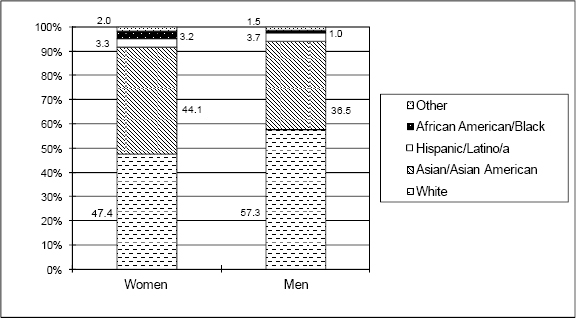
FIGURE 5-1 Race and ethnicity of technical workforce, by gender.
SOURCE: Simard, C. et al (2008). Climbing the Technical Ladder: Obstacles and Solutions for Mid-Level Women in Technology. Copyright granted by Anita Borg Institute for Women and Technology.
To describe the factors that lead to success in high-technology companies, Simard discussed survey results that probed employee perceptions about themselves and their coworkers. Men and women noted that in order to be successful, one must be analytical, innovative, questioning, risk-taking, collaborative, entrepreneurial, and assertive. Simard emphasized that the combination of these attributes suggests that a specific, assertive communication style may be preferred in order to advance in high-tech firms. In terms of personal perception, both men and women perceived themselves similarly as analytical, assertive, and risk-taking. However, significant gender differences were observed when determining self-perceptions of being innovative, entrepreneurial, and collaborative.2
Furthermore, women and men reported considerable differences in their belief that successful mid-level individuals need to work “long hours” in order to be successful, as shown in Figure 5-2. She stated that more women than men believed this attribute to be necessary for individual success, but fewer women perceived themselves to be working the many hours they determined necessary in order to be successful, while more men believed that they work as many hours as required for success.3
2 According to a 2010 report by the Anita Borg Institute, Senior Technical Women: A Profile of Success, only 29.6 percent entry/mid-level women describe themselves as an “innovator,” versus 38.1 percent of senior women and 60.2 percent of senior men. In addition, less than half of high-level technical employees in large companies perceive themselves as entrepreneurial (31.7 percent of women versus 40.5 percent of men).
3 Senior Technical Women: A Profile of Success indicated that senior women were significantly more likely than women at the entry and mid-levels to perceive themselves as working long hours.
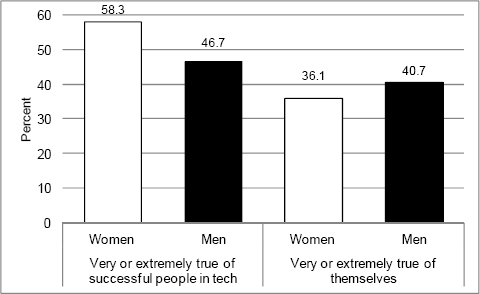
FIGURE 5-2 “Long working hours” Attribute: Attribute of success versus self-perception among mid-level technical men and women.
SOURCE: Simard, C. et al (2008). Climbing the Technical Ladder: Obstacles and Solutions for Mid-Level Women in Technology. Copyright granted by Anita Borg Institute for Women and Technology.
Simard next discussed employee feedback about their managers. In almost all attribute categories, no difference between male and female managers was observed except for their perceived technical skills. Both male and female employees rated their female managers lower in technical skills than their male manager counterparts. Simard explained that both men and women tend to exhibit an implicit bias against the technical skills of women. She further emphasized that this is increasingly important, considering that high-tech companies view technical skills as a critical indicator of success and, therefore, a key point for intervention to advance women.
In looking at family configurations, Simard noted that technical men and women appear to have children at similar rates, but gender differences arise when looking at the overall family structure. As shown in Figure 5-3, 80 percent of technical women, but only 40 percent of technical men, have a partner who also works full-time. This industry profile differs significantly from typical U.S. households, where only 19 percent of all marriages are based on the woman staying home and the man working. Simard stated that these results suggest that the primary household responsibilities tend to fall predominately to women in technical sector families leading to an unequal distribution of family responsibilities. She noted that this gender difference in family configuration may explain why women frequently do not seek upward mobility. Simard suggested that typical advancement rewards are delegated to individuals whom are available at all hours, so with increased household responsibilities, technical mid-level women do not have the same freedom to allocate their time as their male counterparts. She further noted that this trending is similar across all levels. In addition, most women are also partnered in dual-technical households.
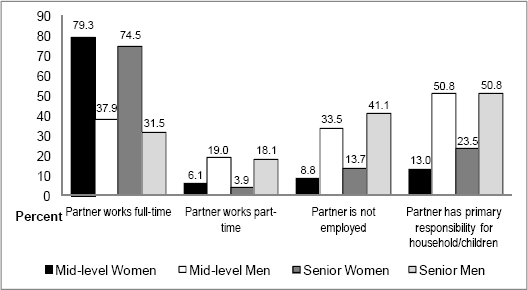
FIGURE 5-3 Household characteristics of partnered mid-level and senior-level technical workers, by gender.
SOURCE: Simard, C. et al (2008). Climbing the Technical Ladder: Obstacles and Solutions for Mid-Level Women in Technology. Copyright granted by Anita Borg Institute for Women and Technology.
After understanding these gender differences, Simard discussed the future plans of these employees. She found that men and women have similar aspirations in the next 12 months, except men were more likely to indicate they planned to start their own company. Although the absolute numbers were small for both men and women, less than 10 percent, a gender divide was observed. She further noted that men and women who ranked themselves higher regarding the attributes of long working long hours, being innovative, and being entrepreneurial were more likely to indicate that they intended to start a company in the coming months. Interestingly, these were the three attributes about which women overall ranked themselves lower than men. She concluded that there are technical women who are willing to take risks, but do not view themselves as innovators or entrepreneurs. As a consequence, interventions with respect to these self-perceptions, as well as providing adequate support mechanisms for dual family careers, are necessary to close the existing gender gaps.
Manwai (“Candy”) Ku, Researcher, Stanford University
Manwai (Candy) Ku discussed the findings of her research focused on entrepreneurship and gender gaps in the high-tech industry.4 Ku tracked venture-backed technology companies in
4 More recent research by Ku is available in Justine Tinkler, Manwai C. Ku, Kjersten Bunker Whittington, and Andrea Davies. (Forthcoming) “Gendered Decision-Making: Assumptions about Technical Knowledge and Social
Silicon Valley and found women to be underrepresented in various ways. In 2006, women CEOs led only 4 percent of information technology related business ventures and, as of 2007, women owned less than 5 percent of information technology firms in Silicon Valley. Ku suggested that both human capital and social capital barriers contributed to these gender differences in securing the venture capital that leads to increased entrepreneurship. Specifically, fewer women enter the technology sector and they participate in smaller venture capital networks. Although increasing the number of women in the technical pipeline and increasing their networking options may be solutions to closing the gender gap, Ku suggested that cultural assumptions and double standards may complicate these efforts. Some venture capitalists may question the technical competence of women, which causes them to experience a double standard. Women believe they need to do more as well as make fewer mistakes in order to seem as competent as male counterparts.
Ku and colleagues probed these biases through a social-psychological experiment, in which a real-world business plan was translated into four versions, changing only the biography of the entrepreneur who would be founding the company in two ways; gender and technical experience were varied (male versus female, and computer science versus history backgrounds). All entrepreneurs were described in the business plans as possessing an MBA and six years of relevant experience and were said to have previously been a vice president of a start-up company. Members of the Stanford Business School Entrepreneur Club acted as venture capitalists, assessed the project proposals, and were told that if their results matched those of actual venture capital firms, they would receive greater monetary rewards. The specific aspects of the proposals that club members were asked to evaluate were: the venture, the entrepreneur, and the influence of the founder’s contacts.
Ku found that the gender and technical background of the applicants significantly affected the final decision of the club members. In the evaluations of the venture, the existence of technical backgrounds was influential: products proposed by entrepreneurs with technical backgrounds were rated higher than the products proposed by entrepreneurs with non-technical backgrounds. The presence of a technical background was shown to aid both men and women in the evaluations of the venture with reviewers more likely to request additional meetings, buy the product, or invest in the venture offered by those with technical backgrounds as opposed to those without. Ku suggested that this supports the classic human capital component; an increase in the number of technical women may lead to an increase in the number of female entrepreneurs.
A clear trend was not evident in the evaluations of the entrepreneur. While having a technical background helps both men and women overall, interestingly, when assessing evaluations of the entrepreneurs themselves the picture is more complex. Having a non-technical background caused women to be rated lower than women with technical backgrounds, however, men without a technical background appeared to be rated higher than women without a technical background perhaps because they were perceived to be more savvy. These findings suggest a possible double-standard in the evaluation of human capital.
A further interesting finding was that when women evaluated the entrepreneur, they rated the non-technical women the highest and best able to penetrate the market. Ku suggests that these results support the hypothesis that venture capital firms with female partners are more likely to invest in women-led ventures than firms without female partners. Similarly, the
Capital in Venture Capital Evaluations.” Gender and Society. Submitted for publication at time of this publication. Working paper available upon request.
influence of the founder’s contacts provided greater benefit to women than men, implying a double standard with regard to social capital as well.
Ku noted that these results show evidence of subtle assumptions about gender as well as support for the classic human and social capital arguments. She suggested that such gender discrepancies may be overcome by focusing on both supply-side and demand-side factors. Ku suggested that increasing the representation of women in technical fields and promoting networking opportunities for women may help supply-side factors. She further suggested that demand-side biases may be overcome by promoting gender awareness among venture capitalists and by encouraging more women to enter the venture capital industry.


