
PANEL I:
FROM BENCH TO BUSINESS: CAREER PATHS FOR PH.D.S
Laurel Smith-Doerr, Associate Professor of Sociology, Boston University Lydia Villa-Komaroff, Chief Scientific Officer, Cytonome/ST, LLC Susan Windham-Bannister, President and CEO, Massachusetts Life Science Center
Laurel Smith-Doerr, Associate Professor of Sociology, Boston University
Laurel Smith-Doerr provided sociological data about women in the life science fields of academia. She further discussed the career contexts for doctoral students in the life sciences, specifically with regard to biotechnology firms that are focused on human therapeutics and diagnostics. She focused on how to prepare entrepreneurship contexts in science and engineering for gender equity in entrepreneurship and innovation. Her sociological analysis of the transition from academic institutions to start-up firms has focused primarily on the life sciences, although over the past few decades there has been significant blurring of the boundaries between academic biology and bio-tech entrepreneurship. In academic institutions, women and men have reached parity at the doctoral student level and similarly, women are also well-represented at post-doc and assistant professor levels at about 45 percent of their total respective populations. However, females still only represent about 30 percent of full-time senior faculty members in the life sciences (see Figure 2-1).
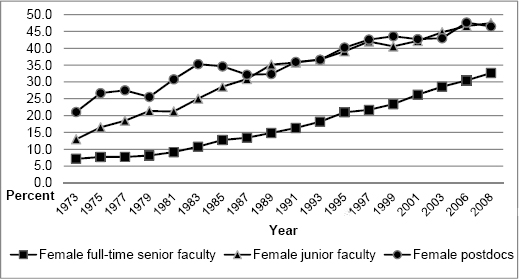
FIGURE 2-1 Percentage of females in academic life science positions, 1973-2008.1
SOURCE: National Science Foundation. Science and Engineering Indicators 2006 and Science and Engineering Indicators 2012.
In discussing women’s entrepreneurship in the academic life sciences, Smith-Doerr cited Fiona Murray’s findings on this topic: “within academic life sciences, women’s entrepreneurship is evident in the form of faculty founding companies, patenting, inclusion on scientific advisory boards, and industry co-authorship.”2 She emphasized that these entrepreneurship-driven faculty members tend to be full professors. Therefore, in light of the tenure gap exhibited in Figure 2.1, Smith-Doerr suggested that biotechnology entrepreneurship tends to be male-dominated, so that of those academics who become entrepreneurs, only 4.7 percent of company founders and 5.6 percent of scientific advisory board members are women.
Looking beyond the company founder and scientific advisory board level, Smith-Doerr researched the participation and equity of females in biotechnology firms relative to established multi-national companies and academic environments. In this context, she briefly highlighted the influence of unconscious and implicit biases. Current research demonstrates the need for women to be more productive than men to achieve the same employment stature, as well as the importance of work-life balance. This, then, led her to explicitly focus on the role of organizational structure and its function in understanding the gender gap. Specifically, Smith-Doerr categorized life science organizations as either “hierarchical” organizations, such as multinational pharmaceutical companies and academic institutions, or “networking” organizations, such as biotechnology, entrepreneur-driven firms. Distinctions between these organizations arise in their communication models and employee interaction procedures. Hierarchical organizations tend to follow strict rules that are strongly influenced by the ranks of the interacting members,

1 Data abstracted from Science and Engineering Indicator 2006 appendix table 5-23, and Science and Engineering Indicators 2012 appendix table 5-13. Data points for 2006 and 2008 were added in Figure 2-1 to data presented at the workshop.
2 Murray, F., Graham, L. (2007). Buying and selling science: gender differences in the market for commercial science, Industrial and Corporate Change, 16, 657-689.
compared to networking organizations that follow cultural norms driven by interpersonal relationships and social capital.
Smith-Doerr noted that there is also a significant difference in the prevalence of women and men in leadership positions with hierarchical versus networking organizations. Women are eight times more likely than men to move into supervisory positions in network-structured firms; however, women are significantly less likely than men to move into supervisory roles in hierarchical organizations. She further noted that men showed no difference in their propensity to advance into supervisory roles between organizational structures.3 Smith-Doerr elaborated on the probabilities of patenting in both organizational structures as shown in Figure 2-2. Only in the networking-type industry settings does gender equity in patenting productivity occur. In all other organizational structures, including industrial hierarchical organizations, significant gender gaps are evident, with increased probabilities for men to patent.
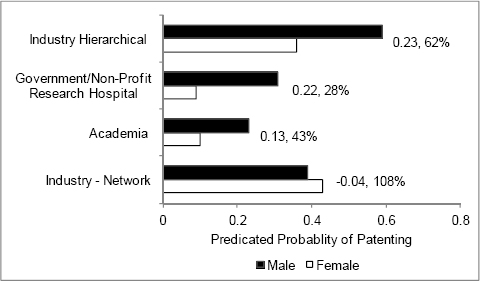
FIGURE 2-2 Predicted probabilities of patenting, by field and gender.
NOTE: Data labels refer to the difference in probabilities between men and women (male-female) and the female/male predicted probability ratio (multiplied by 100). All other variables were held at mean.
SOURCE: Whittington, K.B. and Smith-Doerr, L (2008). Women inventors in context:
Disparities in Patenting across Academia and Industry. Gender and Society. 22 (2): 194-218.
To understand both the leadership and patenting gender gap trending explained above, Smith-Doerr cited interview studies she and her colleagues have performed. She emphasized three recurrent themes from these interviews that help to explain the greater gender equity at biotechnology firms: flexibility in collaboration, increased organizational transparency, and emphasis on collective rewards. Smith-Doerr further explained that these characteristics are examples of network organizations in which there is indefinite and sequential interaction structure, norms govern relations, partners pool resources, expectations foster collaboration but
3 Smith-Doerr, L. (2004), based on logistic regression analysis controlling for years since Ph.D., prestige of Ph.D. program; N=2,062.
are not rule bound, and there is a non-redundant, “freer” flow of information, which interviews suggest lead to greater gender equity.
Moving beyond biotechnology and looking at the transferability of these findings, Smith-Doerr emphasized that the global challenges that may motivate new entrepreneurship appear to require an interdisciplinary approach. According to National Science Foundation (NSF) data, in 2006, 45 percent of the life scientists employed in business and industry were women and 46 percent of those employed in academia were women. Representation of women physical scientists employed in business and industry was 30 percent—the same percentage as in academia.4 Despite these wider gender gaps in non-life science fields, Smith-Doerr suggested that interdisciplinary research appears to draw women. She further noted that entrepreneurship is also becoming more interdisciplinary, suggesting the possibility that entrepreneurship may become more gender equal in the future. She suggested that as more women become attracted to the entrepreneurial pipeline, other sectors may begin to follow the trending observed for biotechnology networking organizations.
Lydia Villa-Komaroff, Chief Scientific Officer, Cytonome/ST, LLC
To follow up with Smith-Doerr’s discussion of gender equity in biotechnology entrepreneurship, Lydia Villa-Komaroff gave a summary of the European Commission – United States Task Force on Biotechnology Research Workshop “A Global Look at Women’s Leadership in Biotechnology Research.” This workshop brought together representatives from United States and the European Union funding agencies to develop a mutual understanding of gender diversity in both areas and to develop a series of recommendations and action items that could lead to change.
In both the United States and the European Union, Villa-Komaroff noted that there is a large decline in the representation of women as their academic careers progress. She highlighted this trend with Figure 2-3, dubbed the “scissors diagram,” which indicates the large disparity between men and women as they progress to higher levels in their European academic careers. She noted the need for institutional change, such as active recruitment of women to combat this gender inequity. She cited recent data demonstrating that at the doctoral degree granting level, the number of science and engineering degrees awarded to women has increased over the past 30 years, but has recently leveled off. Villa-Komaroff suggested that these leveled numbers may be explained by the hypotheses that European doctoral students are only trained in a limited number of areas that do not include business and/or entrepreneurship training, for example, on the realities of the budgeting process. Therefore, she suggested that in order to continue the success of educating the next generation new models for doctoral degree programs need to arise.
4 National Science Foundation (2010). Women, Minorities and Persons with Disabilities in Science & Engineering. Updated from the 2003 data presented at the workshop.
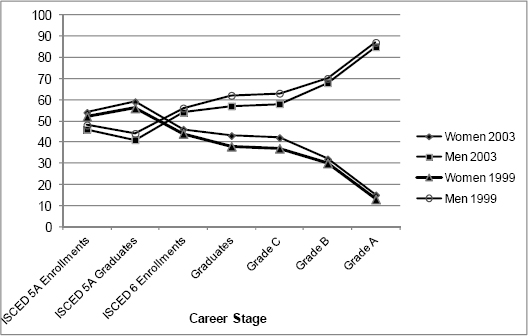
FIGURE 2-3 Proportion of men and women at different stages of a typical academic career, EU 25.
NOTE: The career stages are defined as follows: 5A (bachelors and masters), 6 (advanced higher education programs, doctoral), Grade C (the first grade/post into which a newly qualified doctoral graduate would be recruited), Grade B (researchers working in positions not as senior as top positions [Grade A] but more senior than Grade C), and Grade A (the single highest grade/post at which research is normally conducted).
SOURCE: Eurostat Education Database. Presented by Andrew Collins, University of Olson, Norway at the workshop A Global Look at Women’s Leadership in Biotechnology Research in June 2009. Adapted from European Commission report Mapping the Maze: Getting More Women to the Top in Research.
Furthermore, Villa-Komaroff presented factors that may help women to achieve greater success in science and engineering fields. These factors include:
• Training: Scientific and business training are both necessary. An understanding of business is important, however not inherent in typical doctoral programs.
• Support: In any organizational setting, it is critical to have a supportive environment with mentors at every career stage and a viable network. Female and male networks differ, and some data suggests that female networks are ineffective at advancing women.
• Personal characteristics: Key personal traits for success include persistence, tenacity, flexibility and self-confidence, with additional emphasis on self-confidence and risk-taking.
Villa-Komaroff indicated that policies, intentions, and rules are critical to effectively changing the status-quo. She further noted that institutional changes at the top levels will not induce large-scale transformations; instead efforts to “move down” the educational system are necessary. She also underscored the recommendations from the E.U.-U.S. workshop that included the need for:
• better collection and dissemination of data
• implementation of policies that promote good practices
• achieving buy-in at the highest levels as well as at the grassroots level
• creation of formal and informal mechanisms to provide women with an understanding of what it takes to be successful, i.e. teach them the “rules of the game”
• better accountability of various programs
Susan Windham-Bannister, President and CEO, Massachusetts Life Science Center
Susan Windham-Bannister continued the “business of science” discussion by providing data complementary to that of the previous panelists. She also elaborated on her observations and hypotheses concerning how to bridge the gaps between gender, entrepreneurship, and science.
“What is the story of women in science? It is the story of the few and the fewer,” said Windham-Bannister. She noted that while there are more women than men in the top 10 percent of fundable National Institute of Health (NIH) proposals, fewer grants providing fewer dollars are awarded to women. Similar gender gaps can be seen in other avenues of science as well. For instance, less than 3 percent of Nobel Laureates have been women and over the years; women have held only 27 percent of the jobs in science and engineering. She suggested that discriminatory employee practices are visible from the very start of a career in sciences: women earn 24 percent less than their male counterparts.5 “When you look at women entrepreneurs, it is a somewhat better story but it’s not a great story,” she said.
Windham-Bannister noted that 28-30 percent of primary owners of privately-held businesses are women, but the percentage of women owners increases to 40 percent when also considering women who are part-owners of privately-held businesses. However, she continued that the performance matrix for female-led new ventures lags behind those of male-led new ventures. Women-led companies tend to be less profitable, with a lower four-year survival rate. She indicated that this may be associated with different motivations between men and women for starting their businesses. She suggested that women start businesses to achieve more job flexibility and autonomy, while men start businesses to achieve economic and financial objectives. Not surprisingly, she further noted that women also face more competing domestic demands on their time. As a result, female entrepreneurs tend to have fewer hours on average to invest in growing their ventures. Thus, Windham-Bannister suggested, these gender dependent preferences and behaviors impact the success and profitability of business ventures.
5 Hazen, Robert M. “Why Should You Be Scientifically Literate?” BioScience. 12 (2); Katz, S.J. (2008) “WEBS: Practicing Faculty Mentorship.” Bioscience. 58 (1): 15.; DeWelde, Kristine, Sandra Larsen, and Heather Thiry. Women in Science, Technology, Engineering and Math (STEM).
She further emphasized that capital funds acquisition can be a daunting process for new businesses, but failure is part of the learning curve. In this vein, she suggested serial entrepreneurs appear to be viewed favorably by venture capital firms and company failure may be considered a mark of having been tested. She indicated this serial behavior is more commonly associated with men and their acquisition of venture capital funding. Interestingly, Windham-Bannister noted that fewer than 10 percent of all requests come from women, leading to women-owned businesses receiving only 3-5 percent of overall venture capital funding. However, she emphasized that 13 percent of female-led firms and 15 percent of male-led firms requesting venture capital funding receive it, thus indicating the disappearance of a gender bias. As a consequence, she stressed that women need to ask for money more frequently. Similarly, she discussed a study of institutions affiliated with the Harvard Medical School that found that their female and male investigators had equal success at winning grants from NIH. However, women requested fewer dollars for their grants ($115,000 on average versus $150,000), and also received fewer dollars ($98,000 vs. $120,000). In both science and business, she suggested that women need to ask for more.
Windham-Bannister additionally commented on the perspective of investors. She indicated that the amount of funding an entrepreneur requests from funding sources is often a critical indicator of industry knowledge. Specifically, she noted that the monetary amount may indicate whether or not the start-up firm truly understands what it will take to start and grow a successful business. So, she suggested that it might be easier asking for more money rather than less; entrepreneurs cannot afford to sell themselves short when it comes to asking for money.
“Investors invest in people,” she said. “They would rather invest in a good person who has a lousy idea than invest in a great technology that is being stewarded by someone whom they consider less aggressive, less capable, and less talented.” As a result, she suggested that bridging the gap between science and business requires acknowledging the differences in the mindset of science versus the performance metrics of business. In science, the focus is on methodology, validating findings, and openly sharing published results. The measure of success in science tends to be one of prestige and contributions to the body of scientific knowledge (e.g., publications). In business, the focus is on results and winning in the marketplace, with value equating to a competitive advantage. This places demand on the utility of a new technology or product. Success is measured in financial performance and shareholder value.
Windham-Bannister suggested that for those scientists who aspire to be entrepreneurs, there is a need to blend these paradigms by understanding the demands of both science and business. She emphasized that most who have come up through the science, technology, engineering or mathematics paths have gone through a training process that was anchored in data and analysis, was highly respectful of critical thinking, and favored deductive reasoning and validation. The world of business demands “emotional intelligence,” meaning that an entrepreneur understands not only their own emotions, but also those of their stakeholders. She urged aspiring scientific entrepreneurs to be willing to leap across the chasm and develop an appetite for risk taking in order to be competitive in the field.
By elaborating on emotional intelligence based on her personal experiences, Windham-Bannister noted that entrepreneurs own the vision and the strategy of a business, which requires intervening quickly to address problems that arise and making hard, fast decisions. She suggested that these are not skills that scientists, in general, possess. Women in particular may struggle with making decisions without collaboration and seeking outside opinions. She underscored that women trained in science, technology, engineering and mathematics are
comfortable with details, data, and lots of information, but as an entrepreneurs, the focus needs to shift to the big picture. Therefore, to aid in changing this mindset, she stressed the importance of networks and mentors.
Finally, Windham-Bannister addressed the problem that many women entrepreneurs face of having limited networks. She suggested that they utilize available male mentors and their networks, as well as those associated with women. She went on to discuss gender differences in professional networks and mentoring. Specifically, she discussed a study that showed that Caucasian men receive more information about opportunities of all types—jobs, money, networking opportunities—through their networks than do women or racial minorities. To cover such information gaps, she encouraged women to find a support-system not only to gain a strong network, but also to learn from their mentors’ skills and experience.


