
As described in Chapters 3 and 4, there have been important improvements in dam safety in recent decades, largely because of improved regulatory oversight, increased owner compliance with dam safety requirements and attention to maintenance and inspections, and a better understanding of potential failure modes. Improvements in dam safety practice were accelerated by changes in legislation after a number of catastrophic dam failures in the 1970s. Since then, primarily in the wake of levee failures caused by Hurricane Katrina in 2005, a number of agencies have been making efforts to improve levee safety. Perhaps the most far-reaching has been the decision of the National Flood Insurance Program to deaccredit levees that could not be certified within 2 years as providing at least 100-year level of protection for structural or levee height reasons, and to require the purchase of flood insurance by property owners behind those deaccredited levees. Previously, those property owners had been exempt from mandatory purchase of flood insurance.
As discussed in Chapter 3, most safety improvement efforts focus on reducing the likelihood of failure. In the case of large dams, federal agencies and private dam owners routinely review dam safety, both through their own application of industry best practices and in compliance with state and federal dam safety requirements. But those steps address only one aspect of the risk equation: the likelihood of an adverse event, not its consequences. The potential consequences of dam or levee failure in many locations have increased and will continue to increase in part because of economic growth. Since the 1970s, many areas prone to inundation in the case of dam or levee failure have become developed with residential and commercial properties and associated critical infrastructure. In such circumstances, increased consequences of dam or levee failure can outweigh whatever reductions in risk may have resulted from improved regulatory compliance. Because the likelihood of failure can never be reduced to zero, consequences of failure must be addressed.Chapter 4 describes
the committee vision for dealing with and learning from the consequences of failure through focused and active community collaboration to enhance resilience.1
Throughout the preceding chapters, the committee has described the types of tools, products, and guidance that could be developed at the federal level that would aid development of more comprehensive and effective dam and levee safety programs. The present chapter focuses on tools and methods that could support engagement of community members and stakeholders in collaborative efforts to improve community resilience, and provides information about community circumstances and priorities that can inform technical decision making. The assumption is that the primary proponents for selection and use of these tools will be dam and levee safety professionals. However, the broader community is an equal partner in the application of those tools and in enhancing community resilience. The chapter concludes with discussion of what the committee considers essential to successful incorporation of resilience-enhancing practices into dam and levee safety programs: evaluation of current safety program activities. The committee suggests a model that could be applied by safety programs and the broader community to assess processes that are in place and processes expected to be in place at given increments of program maturity.
Concepts of community resilience cannot be incorporated into dam and levee safety programs in one decision, action, or administrative fiat. Rather, improving resilience requires persistent and coordinated commitment and action—mostly voluntary—by many in the community. In all cases, methods and strategies for outreach and engagement are needed to create long-term and continuously improving relationships between owners, regulators, community members, and stakeholders more broadly. Successful integration of these concepts is supported by the identification and selection of the appropriate tools. But cases are community- and situation-specific, and so generic recommendation of the “best” tools is neither possible nor helpful.
Dam and levee professionals have direct access to much of the expertise and experience needed to develop, apply, or assess tools that can be used at the community level. Some of the expertise and tools can be found in the federal government. In some instances, it may be possible to modify or adapt an existing or developing tool to better meet community needs. In other cases, new tools are needed. The development of tools is best accomplished collaboratively across levels of government to take full advantage of the perspectives and knowledge of local and state entities and key stakeholders.
_____________
1Community is broadly defined in Chapter 2 to include dam and levee safety professionals, all other stakeholders, and the ecological and cultural values of the region.
CHALLENGES TO BUILDING COMMUNITY RESILIENCE
A future in which communities are substantially more resilient to the effects of dam and levee failure is achievable, but only with much effort and change. The importance of recognizing the value of infrastructure services and the risks associated with them has been stated several times in this report. Dam and levee professionals must also recognize the benefits of collaborative engagement to enhance resilience. Community member and stakeholder needs must be met, including those associated with everyday services protected by dams and levees.
In working toward the vision described in this report, dam and levee safety professionals will need to change their professional culture. Some changes involve speeding up the current evolution toward risk-informed management. Others involve accepting an expanded role in safety management and related responsibilities, such as greater collaboration with the broader community. Public and private dam and levee safety programs provide a foundation for meeting those new responsibilities. At the same time, however, these programs face challenges, and even obstacles, that go beyond what can be required by law or regulation of a program. Similarly, challenges within communities as a whole make creating and participating in collaborative processes difficult, if not seemingly insurmountable. Recognizing challenges is an important step toward recognizing the opportunities that resilience-focused collaboration can offer. Tools to help overcome these challenges are discussed in this chapter.
Challenges for Dam and Levee Safety Professionals
Dam and levee professionals will need time to implement the changes suggested in this report. Challenges and obstacles beyond immediate control include the following:
• Public-sector dam and levee safety regulatory agencies have inadequate resources, making it difficult to keep up with current basic dam and levee safety duties. Consequently, additional and changed responsibilities will, at first, mean greater burdens in the face of limitations and cutbacks from state or federal legislative bodies. Legislators and other public officials who set policy will need to recognize themselves as part of the dam and levee safety community and understand—through collaborative engagement—the effects of their legislation on resilience.
• Public and private dam and levee professionals responsible for safety may be similarly overburdened. For example, according to the Association of State Dam Safety Officials (ASDSO), about 10 times as many dam inspectors as are now employed are needed to carry out regulatory mandates for inspections (ASDSO, 2011). Owners and corporate boards may limit the availability of corporate resources, including staff time.
• Dam and levee safety professionals may be accustomed to an insular approach to safety and risk reduction, for example, identifying and remedying structural deficiencies and developing emergency action plans (EAPs). Their constituents often favor strengthening dam and levee infrastructure by using state or federal funds rather than local funding sources (Burby et al., 1991). Convincing their constituents that accustomed funding sources may not be available in the future, and that new approaches involving the broader community are required, is daunting.
• Government agencies and the private sector often are unable or unwilling to make vital public safety information available to communities. In the interest of national security, rules restrict access to some information that is necessary for a community to understand its exposure to risks associated with dam and levee infrastructure failure (see Box 5.1). Some conclude that the disadvantages of withholding data from the public are greater than the benefits of the presumed increase in infrastructure security, and that the practice of withholding information could be eliminated (e.g., Pitt, 2008). The inability to share information is a major barrier to communication, resilience planning, and success of the safety mission. This problem is made more difficult by the fact that dam and levee professionals, including those at the federal level, often lack skills in risk communication and collaborative engagement.Where there may be agreement that more risk communication is necessary, the effective means of conveying what risk is are not well understood. Further, current knowledge about risk communication does not permit conclusions about the best approaches to use under specific circumstances (Kasperson, 2005). Research in appropriate mechanisms and training in their use will be necessary.
Because community engagement is more efficiently developed from the bottom up, dam and levee owners, operators, and regulators will be more productive if they focus engagement efforts at the local level. Safety program professionals associated with locally owned and operated infrastructure may find it easier to interact with the local community because they already may consider themselves community members with multiple personal community linkages. Although they may not have the financial or other resources of larger infrastructure management entities, they may already have reasons beyond the professional for the continued safe functioning of infrastructure, and it may be easier for them to tap community networks and discuss the ties between infrastructure safety and community resilience. Their own professional and technical decisions may likely be more easily influenced by community member and stakeholder resilience needs and priorities. These professionals may be more easily convinced of the need for engagement, but may need assistance identifying and establishing ties with existing networks, or, in some cases, developing new networks. They may not have the skills or manpower for extensive outreach
BOX 5.1
National Security Versus Safety and Resilience
One result of the September 11, 2001 terrorist attacks has been changes in policies and practices that restrict the availability of emergency action plans (EAPs) and dam failure inundation maps to affected communities and, in particular, to the general public (USACE, 2008; DOI, 2011). U.S. Army Corps of Engineers (USACE) interim guidance states that all copies of inundation maps shall be marked for official use only (USACE, 2008), indicating that the informati on can be disseminated only within the Department of Defense, "between officials of Army components and Army contractors, consultants, and grantees, as necessary, in the conduct of official business," and to officials of the "Executive and Judicial Branches in performance of a valid government function" (U.S. Department of the Army, 2000, p. 58). USACE provides the following guidance (USACE, 2008, p. 1):
a. Part of the EAP. The primary use of inundation maps is to support the project Emergency Action Plan (EAP). As part of the EAP, copies of the maps may be given to the emergency management agency of communities or other jurisdictions that would be affected by a dam failure or other dam safety incident. The individual or office providing the map to the local jurisdiction should ask that the map be safeguarded and not distributed to the public [emphasis added]. We recognize that these agencies operate under various state laws concerning the release of information and may have to release copies under their laws and regulations.
b. Public Meetings on Dam Safety. The inundation maps may be used in public meeting concerning dam safety. The maps may be displayed at the meeting and discussed. Copies of the full inundation maps for a dam shall not be distributed at the meeting without written approval from [Headquarters, USACE]. When a public meeting is advertised to cover a specific locality, the portion of the inundation map required for that locality may be extracted and used as handouts at the public meeting.
Such policies, however, can limit access to vital risk information and undermine efforts to meet public safety mandates, build resilient communities, and meet other community needs (e.g., Pitt, 2008). For example, in 2011, USACE wanted the Columbia County, Georgia Emergency Management Agency (GEMA) to remove emergency flood information from public access, according to a local news report (Beasley, 2011). Reportedly, the GEMA director responded, "it is my responsibility to talk to people about what hazards exist [and] what the risks are. . . . It makes sense, it's part of emergency planning to see what is the worst case that could happen and then let those people know so they know what to do" (Beasley, 2011). According to the news report, the 2005 map indicates that 7,000 people could be affected by worst-case scenario projections. Given the rapid growth in the county since 2005, the number is probably higher today. The GEMA director acknowledges that she does not expect a failure of the USACE dam, but is not willing to ignore the risk.
and will need assistance determining how best to use the resources they have to make the necessary incremental changes.
Interactions become more complex, however, when infrastructure ownership and management are not local, or when the infrastructure includes miles of levees that run through multiple communities. In such cases, there may be a greater need to demonstrate the benefits of community engagement, and to plan the incremental steps necessary to engage the local communities, communities further afield (e.g., downstream), and with stakeholders more broadly. This type of encouragement could come from state and federal regulators and agencies.
Overcoming these and other obstacles is possible. Government and professional organizations (such as the Federal Emergency Management Agency, ASDSO, and the U.S. Society on Dams) can help the dam safety profession establish, refine, and expand its role through training, model programs, and the development of new tools. The notion of “levee safety,” however, is relatively new. The lessons of Hurricane Katrina and other flooding and levee failure experiences have raised awareness of risks associated with levees. The levee community will need to continue to develop and define what constitutes a levee safety program and to develop standards of practice, training, model programs, and new tools for use by its professionals. Because dams and levees are generally part of a larger watershed system, many dam and levee operators—and the communities they serve—could benefit from collaboration in managing the overall drainage system and resources and reducing the likelihood and magnitude of individual and cascading failure events.
Community Challenges
Motivation for the community—particularly those vulnerable to flooding—to engage in resilience-focused collaboration is often not translated into substantive action. Elements of the public may not be aware that they live downstream of a dam and in the inundation shadow. Communities behind levees may believe the levees make them “safe” or protect them from flooding. Communities may be uninformed or misinformed because of a lack of information, or because the information they have is inaccurate or incomplete. Equally problematic is that community members may not fully comprehend the information provided.
Challenges to resilience-focused collaboration faced by the broader community may include
• an unwillingness to engage with dam and levee owners and operators,
• a lack of appreciation of the value of infrastructure (services provided, costs, and risks),
• active resistance to adoption of resilience measures by community special interests (e.g., real estate and tourism promotion),
• a lack of reciprocal recognition of dam and levee owners’ needs and responsibilities versus community goals and perceptions,
• an unwillingness of communities to consider hazardous areas in their comprehensive planning efforts (e.g., Burby, 2006),
• the need for state and local governments (and lack of resources) to carry the financial burden of development constructed in harm’s way (Burby, 2006).
CHOOSING TOOLS TO ENHANCE COMMUNITY RESILIENCE
A variety of methods, techniques, measures, and approaches are applicable to efforts to improve community resilience to dam and levee failure. They may be structural or behavioral, mandated or voluntary, and individual or community-wide. They are all intended to improve the ability of a community to avoid and recover from an adverse event, that is, to reduce the magnitude and duration of severe consequences of an event. The committee characterizes all these methods, techniques, measures, and approaches as tools for improving resilience. Their success depends on the availability of adequate relevant information about risks and on agreement on a course of action that meets the needs of dam and levee professionals, community members, other stakeholder groups, and local and state governments.
The Federal Interagency Floodplain Management Task Force (FIFM-TF, 1994) stated that managing flood hazards “encompasses both the process of making decisions and the continuous challenge of seeking out and developing new strategies and tools to encourage the wise use of floodplain lands” (p. 9). It noted that “using one or more . . . strategies (and the tools that implement them) helps bring existing or proposed activities into compatibility with the risks to human resources and the risks to natural resources” (p. 9). These strategies include the following (p. 9):
• “Modify human susceptibility to flood damage and disruption.
• “Modify the impact of flooding on individuals and the community.
• “Modify flooding.
• “Preserve and restore the natural resources and functions of floodplains.”
The committee adapts these strategies, which focus on the concept of safety, and expands them to incorporate concepts that support resilience:
• Develop approaches to identify community members and stakeholders, engage in resilience-focused collaboration, and communicate risk in clear, understandable, and actionable terms.
• Determine characteristics of resilience for the community and decide on objectives to make the community more resilient.
• Adopt an overall set of resilience systems-engineering principles and practices to deal with the uncertainties and complexity inherent in dam and levee safety.
• Reduce the likelihood of harmful events.
• Reduce the consequences of dam or levee failure for the community.
Each of the strategies relies on a set of tools that in combination can enhance dam and levee safety and resilience.
An assessment of existing community resilience programs and their strategies allows the community to set realistic objectives and to identify additional tools that are likely to provide cost-effective reductions in risk and improvements in overall resilience. Some communities may already apply an all-hazards approach to improving community resilience. In such cases, it is desirable for a dam or levee safety program to align itself with existing efforts rather than create a new and possibly conflicting community effort; tools already in use may be sufficient or may need some modification to accommodate dam and levee safety-specific issues.
A means of assessing progress in risk reduction and improving resilience is described later in this chapter.
Reducing the Likelihood of Harmful Events
The likelihood and location of flooding depend on hydrologic and upstream and downstream conditions, dam and levee design and operation, and failure mode. At a minimum, the design and operation of dams and levees would include using tools that quantify and reduce the likelihood of failure. Chapter 3 discusses the progression of safety practices from standards-based methods to more risk-informed approaches. Still better for the broader purpose of reducing risk are methods for designing and operating dams and levees that address the direct and indirect consequences of failure and thus provide some basis for departing from traditional criteria when indicated.
Another way to reduce or modify the likelihood of flooding and its consequences is to promote individual and collective action through financial incentives. For example, changes in reservoir allocation procedures can allow downstream interests to purchase increments of reservoir capacity for flood storage, diverting it from other uses. The reservoir could then be operated in such a way that the purchased increments of capacity are normally empty; this increases the effective flood storage of the reservoir and reduces the likelihood of dam failure during flood events. However, such a strategy could have the unintended consequences of amplifying the vulnerabilities of some communities that lack resources. Collaborative consideration of community and stakeholder needs and priorities is especially important to avoid hidden consequences. Additionally, whether that strategy is cost-effective depends on the cost of compensating displaced storage uses compared with community benefits from
the increase in safety and reduction in risk. Once legal and regulatory authority allows such transactions, a role of dam safety professionals is to assist the community in evaluating all aspects of the issues.
Another commonly used method on large rivers, such as the Mississippi, is the purchase of flood easements, which make it possible to divert flood flows away from the river channel and ease pressure on downstream levees and communities. Financial incentives to landowners may be coupled with appropriate changes in the governance framework to define the circumstances under which diversions could occur.
Reducing the Consequences of Dam and Levee Failure
Identification and selection of tools that assist communities in withstanding the effects of dam and levee failure occur during the preparation and revision of hazard mitigation plans, which can stand alone or be integrated into a comprehensive urban development plan. Citizen involvement in mitigation planning is vital if tool selection is to reflect community interests and values. For example, citizen involvement in flood risk assessment and mitigation planning is required in the member states of the European Union (see Box 5.2).
BOX 5.2
European Union Requires Public Participation in Flood Risk Assessment and Management
The European Union, through its directive on the assessment and management of flood risks (Directive 2007/60/EC), requires member states to carry out preliminary assessments of flood risks to flood-prone river basins and coastal areas. For zones at risk, the directive requires member states to draw flood risk maps and prepare flood risk management plans. It also states that the public will be involved in production, review, and updating of all assessments, maps, and prepared plans. All such products will be publicly accessible so that citizens and other interested parties can have a say in the planning process.
SOURCE: EU (2007).
Various tools have been identified by planners and others to improve a community’s ability to be resilient in the face of dam or levee failure, including
• requirements to provide flood hazard information through delineated flood hazard zones on subdivision plats, through disclosure of hazards by real estate agents, and posting of signs warning of hazards (e.g., high-water marks on historical markers);
• codes that regulate building and housing design;
• zoning ordinances for land use and land development (e.g., for regulating housing developments);
• land acquisition (e.g., purchase of riparian land for open space, vertical parks, or greenways, land easements, or development rights) to move levees back from the river, or for removing previous development from flood hazard areas (see Box 5.3 for an example from the Netherlands); and
• tax adjustments, for example, reducing property taxes for low-intensity land uses in floodplains, or limiting property tax increases on property improvements that reduce the effects of flooding.
A different kind of financial incentive could require each property owner to pay an amount equal to the amortized cost of flood hazard reduction infrastructure (e.g., dams and levees). For example, a community could itself construct levees, financing 100 percent of the project with tax revenue (full-cost pricing). The community as a whole would then be motivated to find a combination of hazard reduction infrastructure and resilience-improving measures to minimize total cost. Such tradeoffs are rarely considered; local communities do not typically pay the full cost of dams or levees. For that reason, resilience improvement seems expensive in comparison, because the alternative (hazard reduction) appears to be inexpensive or free. A rational community, responding to these incentives, might demand higher dams and
BOX 5.3
Room for the River Programme in the Netherlands
The combination of extremely high water levels in the Rhine and Meuse Rivers in 1993 and 1995— barely contained by existing dikes and the cause of evacuation of one-fourth of a million people—and expected increases in water discharge in rivers as a result of climate change prompted the Dutch government in 2007 to implement a different approach to flood risk management and safety. The old approach, dominated by increased heights and sizes of dikes, was replaced by an approach that makes more room for the river, improves safety, protects the land and people living behind the dikes. The Room for the River Programme, expected to be completed by 2015, will provide flood control by allowing the branches of the Rhine to expand naturally during higher levels of water dischage at over 30 locations. A variety of measures are being implemented, such as lowering the floodplains, deepening the summer beds, and moving dikes further inland. The program stipulates that only when alternatives to create room for nature are infeasible will measures to strengthen dikes be implemented. The program is expected to improve safety but also to improve environmental quality of the river region, and provide opportunities for public-private partnerships.
SOURCE: Room for the River Programme. Available at www.ruimtevoorderivier.nl/meta-navigatie/english/ (accessed January 21, 2011).
levees while neglecting any effort to increase resilience. An example of full-cost pricing for flood-hazard reduction is the Miami (Ohio) Conservancy District, which has long provided flood management services while collecting the full cost of doing so in the form of special benefit taxes from the properties that benefit from management activities (see Box 2.1).
Strategies that reduce the likelihood of dam or levee failure and susceptibility to related consequences, no matter how well devised and implemented, can be overwhelmed by large storms or unforeseen events (such as errors in dam and levee design or operation and maintenance). When a dam or levee failure occurs, its effects on members of the community and stakeholders more broadly can be ameliorated or redistributed in time and space with appropriate tools such as those that assist
• emergency preparedness, including for emergency preparedness planning, regional public health planning, flood warning, flood fighting, evacuation, and sheltering;
• identifying and obtaining disaster relief from government and nongovernment sources;
• individuals and businesses to secure flood insurance to protect property and belongings;
• effective predisaster planning for post-disaster recovery and reconstruction, including the identification of staging areas and sites for temporary housing;
• relocation of structures out of the inundation zone.
Some tools assist the community to become more resilient by providing specific information, for example, on the number of people likely to be injured or killed as a result of a given event, and the time required for evacuation. One such model is the Life Safety Model used by the Canadian power-generating company BC Hydro.2 Equipped with such information, a community can design better evacuation plans and other strategies to reduce exposure of threatened populations.
Environmental resilience is a part of community resilience, and floodplains provide important habitat for plants and animals, and migration corridors for many species. Protection of floodplains from development can result in wildlife protection, lowered potential flood heights, protection of downstream development from flood damage, improvements in water quality, and preservation of environmental amenities for educational and recreational purposes.
Strategies commonly employed to preserve and restore natural resources and functions of floodplains include
• Public acquisition of floodplains (see Box 5.4);
• Acquisition of floodplains by land trusts and other nonprofit organizations (see Box 5.5);
_____________
2See www.lifesafetymodel.net (accessed January 21, 2011).
• Regulations that sharply limit the intensity of development in floodplains, including wetlands ordinances, overlay zones, and cluster and transfer of development ordinances;
• Tax incentives that grant lower property taxes to owners who agree to keep their land out of development, especially by dedicating open-space easements to the public.
Engaging the Community
Individuals, organizations, and local governments can improve community resilience through structural modifications (e.g., flood-proofing, structure elevation), land-use decisions (e.g., building outside flood-prone areas, and locating utilities and critical infrastructure where the direct and indirect consequences of dam and levee failure will
BOX 5.4
Dike Relocation in the Elbe River in Germany
To cope with flood disasters, the northwest federal state of Brandenburg, Germany, implemented m ultiple flood prevention measures along the Elbe and Oder Rivers, including strengthening, raising, or setting back existing dikes (Drees and Sunderhauf, 2006). A first project was the relocation of the Elbe dike at Lenzen, which was triggered by the need for structural rehabilitation. About 420 hectares of ecologically important floodplain were restored to the area by moving the dike farther from the river (see figure). The project was initiated in 2002 and completed in 2008 and resulted in a lowering of water levels, reduced stress on the dike, and reduced threat of dike failure (Grajales-Mesa et al., 2010).
Simultaneous with the technical efforts were efforts to consolidate land into public ownership, strengthen agricultural production, and stimulate ecologic preservation, tourism, and village renewal (Drees and Sunderhauf, 2006). Key barriers to such ambitious projects have included inflexibility of existing policies and lack of interpretation of national policy at the local level, funding, institutional and administrative boundaries, lack of scientific demonstration of benefits, the need for community and stakeholder involvement, and especially the need to purchase land or change land use (RESTORE, 2011). Innovative methods were needed to resolve conflicts between agricultural, environmental, tourism, fisheries, transportation, energy supply, municipality, and flood prevention interests. Private owners who refused to sell their land were allocated property behind the new dike after intense negotiations (Drees and Sunderhauf, 2006). Obstacles were overcome by identifying appropriate funding structures and varied sources of funding, designating a network management group to manage the project, and effective stakeholder engagement (RESTORE, 2011).
be less severe). As members of the larger community, dam and levee safety professionals with federal agency support, can demonstrate for each situation the specific benefits of the processes that improve community resilience, and can themselves realize the benefits of the improved resilience. Dam and levee professionals have traditionally disseminated information related to infrastructure operation and emergency action planning, but may need guidance from the federal government and professional associations regarding how to identify and engage community members and stakeholders for enhanced information sharing, collaborative land-use planning, financial planning, EAP preparation, and resource and floodplain management. Accurate and credible information on the nature of dam and levee risks needs to be shared. Tools that provide information on the vulnerability of critical infrastructure—such as utilities, transportation arteries, and public facilities essential to the continuing community function—will allow communities to take effective actions to improve resilience.
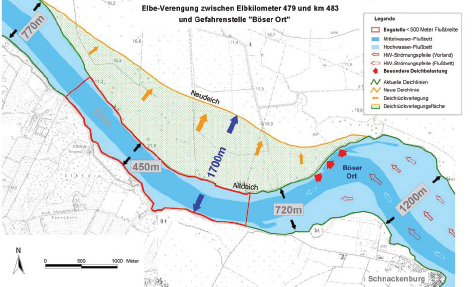
Relocation of the Elbe River dike in Lenzen that restored 420 hectares of ecologically important floodplain, lowered local water levels (without lowering downstream water levels), and reduced stress on the dike and the risk of flooding. SOURCE: Grajales-Mesa et al. (2010).
BOX 5.5
Reconnection of Floodplain and River in Belgium
The European Union (EU) LIFEa Project (LIFE98/NAT/B/005171), which reconnected the Dijle River and floodplain in the valley south of Leuven, Belgium, resolved two competing interests: nature conservation and flood prevention. The Dijle valley is home to wetlands, ponds, and swamp forests, which are valuable for floodwater retention in the region; however, agricultural development had diminished the valley's natural capacity to retain floodwaters and resulted in increased flooding in parts of Leuven. A plan to construct a flood retention reservoir was proposed, but was dismissed after meeting resistance from local conservationists. The final solution—reconnecting the river and floodplain—allowed restoration of the valley's natural flood retention capacity while preserving its alluvial habitats and protecting the interests of the local populace. The LIFE project overcame several potential barriers—conflicts over land ownership, local resistance from farmers, and overall cost—by setting priorities for land purchase through a conservation nongovernmental organization, providing compensation to affected farmers, and avoiding the more expensive solution of a large retention reservoir. The project achieved two main results: it contributed to more natural and less destructive flooding dynamics in the Dijle valley, and it secured large blocks of overgrown land and restored them with natural grassland habitats, partly through a direct marketing scheme with local farmers.
____________
aLIFE is the EU's financial instrument for supporting environmental and nature conservation projects throughout the EU.
SOURCES: RESTORE (2011); see also EU LIFE Project (LIFE98/NAT/B/005171), available at ec.europa.eu/environment/
Expanding risk-communication programs to include two-way risk communication early in decision-making processes will help minimize conflicts based on differences in expectations, and will help build social capital and promote the ability to act on increased knowledge (Kasperson, 2005). Public outreach and risk communication programs can expand current efforts associated with, for example, public hearings, citizen advisory committees and task forces, alternative dispute resolution, citizens panels, surveys, focus groups, technology-based approaches, and development of different deliberative methods (e.g., see NRC, 1996, for explanation of these various activities). Such efforts are important in informing resilience-focused collaboration, as are other community-based activities such as involving those at risk in surveillance demonstrations with professionals, and incorporating community risk and preparedness concepts in primary and secondary school curricula. As already described, discussion and feedback are vital for collaborative engagement, and dam and levee professionals and the communities they serve need assistance identifying mechanisms for engagement, whether for enhancing dam and levee safety related to infrastructure operations or for providing their expertise in land-use, floodplain, or financial management.
ASSESSING THE STATE OF PRACTICE WITH RESPECT TO RESILIENCE
To improve safety programs and community resilience, it is essential that current program practices be evaluated and decisions be made about which tools—implemented to what degree or with what coverage, and at what level—are most appropriate and beneficial given the abilities of a program at a specific time. This requires the ability to assess the present state of practice with respect to resilience and to identify where additional efforts are needed. To assess the state of practice, the committee introduces two concepts:
• Tool maturity. A tool can be applied in different ways, for different reasons, or with different degrees of coverage of a community. A tool is said to be more mature if it improves how well a process is accomplished and if its use increases or leads to an increase in resilience.
• Maturity matrix. A maturity matrix is a table that displays the relative maturity of efforts, for example, efforts to improve resilience. Rows of the matrix correspond to specific program activities and goals. Columns, moving from left to right, reflect continuous improvement in tools or processes and indicate level of maturity. The cells of the matrix contain specific tools and processes; their position depends on the related program goal and relative maturity of a tool or process. In addition to characterizing the current state of practice, the maturity matrix provides a systematic approach for identifying opportunities and priorities to improve processes and increase resilience.
The remainder of this chapter is devoted to the concept of maturity and its assessment. The chapter concludes with an example of a tool that can be used by dam and levee safety programs to promote program and community-level engagement, assess processes that are in place, and establish and set priorities among goals.
Maturing a Tool
The effectiveness of a tool or process in improving community resilience depends in large part on using the tool of the right maturity level for the given circumstances. This principle can be illustrated by considering an important tool in use by dam owners: periodic safety reviews for identifying potential and actual structural deficiencies. The U.S. Army Corps of Engineers has conducted safety reviews of dams since the 1970s, and since enactment of the National Dam Safety Program Act in 1996,3 has inventoried dams and identified those that pose hazards to downstream populations and property. Safety reviews
_____________
3The National Dam Safety Program Act was passed as part of the Water Resources Development Act of 1996. See
originally were intended to provide a sense of where a dam stood relative to a limited set of deterministic engineering standards, such as the ability of a spillway to discharge the inflow design flood, and the stability of structures against overturning and sliding failures under a variety of loading conditions. Although rudimentary, the measures were straightforward to calculate and provided some consistency in screening criteria.
One result of early dam safety reviews was that dam owners were forced to undertake expensive rehabilitation to meet the standards-based criteria. Despite those efforts, dams continued to fail. For example, the Taum Sauk Pumped Storage Project reservoir—built in 1965 in the Missouri Ozarks—met Federal Energy Regulatory Commission (FERC) standards in a number of safety reviews, but the reservoir failed catastrophically on December 14, 2005. Post-incident investigations pointed to a number of causal factors that allowed the reservoir to be overfilled and fail, including the miscalibration of a water level gauge and a lack of redundancy in instrumentation that would have caught the error (FERC IPOC, 2006). The state of practice of dam safety reviews at the time could not account for such factors.
To address inadequacies observed in FERC’s dam safety review process, FERC introduced the Potential Failure Mode Analysis (PFMA) process, which owners are now required to apply. PFMA is intended to capture the “chain of events leading to unsatisfactory performance” (FERC, 2005, p. 14-2) that might not be detected through standard reviews (FERC, 2005). Failure mode analysis had been practiced by a number of progressive dam owners, but was not a standard practice in the industry. PFMA improves an owner’s ability to understand how a dam system performs, to identify events and conditions that could lead to unsatisfactory performance (including dam failure), and to put appropriate controls into place. This process allows dam safety reviews to mature beyond assessing whether a dam meets design standards. PFMA allows operational measures that affect performance and safety to be addressed—a true maturation of the review process.
PFMA represented an early stage of risk assessment, but there remained a need to move beyond the qualitative and into quantitative risk analysis. Quantitative risk analyses were relatively new to dam safety professionals, but applications in other fields, such as nuclear energy, offshore oil and gas production, and other hazardous industries, could be drawn on (Ibrahim et al., 2001; SEI, 2010a; NASA, 2012). Eventually, procedures were developed for risk-informed safety reviews and calibrated against procedures used in other hazardous industries to clarify the divisions between risk criteria (unacceptable risk, tolerable risk, and acceptable risk). This is the state of advanced practice applied by some in the dam safety industry, although it is not universally applied. The maturation of the safety review process continues, led by a number of professional organizations and risk practitioners in the dam safety field.
Some members of the dam and levee safety community do realize the benefits of a safety program that includes elements of community resilience. However, even the relatively
mature practice of safety review falls short of fully integrating concepts of community risk reduction and resilience because communities likely have not been engaged in negotiating the criteria for defining risks or in choosing and implementing appropriate tools to minimize or deal with risks. The next steps in the maturation process include evaluating practices against actual community priorities to define what constitutes acceptable hazard reduction and community resilience.
Figure 5.1 shows the evolution of dam safety analysis as a maturing tool, ranging from its earliest, most simplistic forms to a fully matured risk-based assessment process that incorporates community values. In this case, the current state of dam safety analysis for most dam owners is near the middle of the scale, where failure mode analysis is practiced by many large dam owners and some analyses include quantitative risk assessment. However, even when quantitative risk assessment is applied, the decision criteria are typically those of dam owners rather than of the broader community. Resilience will be improved when dam safety reviews mature and include the community in defining decision-making criteria.
History of Assessing Process Maturity
Dams and levees serve a wide variety of functions and provide an array of services to a broad community of commercial, institutional, and civic stakeholders. Dam and levee professionals manage a complex “package” of procedures and deal with a large and diverse community of stakeholders. The status and maturity of complex processes are systematically assessed in a number of fields, sometimes under the rubric of “resilient systems engineering” (Jackson, 2009). In some cases, such assessments use a maturity matrix to display maturity status and highlight opportunities for improvement and prioritization of processes.
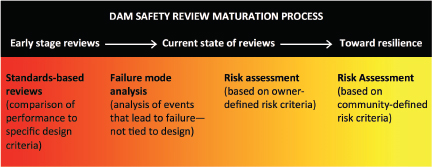
FIGURE 5.1 The dam safety review maturation process. The continuum of the process begins with deterministic processes, such as are mandated by the National Dam Safety Program Act in 1996, and continues through advanced processes of risk-based assessment conducted with full input from the community.
The Capability Maturity Model Integration (CMMI) concept was originally proposed for the software and systems engineering industry to address the daunting complexity of developing software products and processes and the effects of their failure (Paulk et al., 1994). This application later expanded to encompass all systems (SEI, 2010b). Over the last decade, the model has been extended to personnel, supply management, and manufacturing. The model is also used in the electricity generation industry (e.g., Hydro Quebec, 2010). The CMMI concept was further adapted to characterize the preparatory measures needed to improve the capacity of communities to withstand a catastrophe (King, 2010). Ontario Power Generation (OPG), operating 240 dams and 65 hydropower stations in the Province of Ontario, Canada, has developed a model similar to that of the CMMI concept and applied it at a detailed level to assess its ability to manage flood events and their effects on dams (Bennett and Sykes, 2010).
CMMI was developed to gauge improvements in product and service development, but it is not limited to this application. It incorporates best practices with respect to development and maintenance activities for the duration of the product or service life cycle. CMMI is a framework to describe the key elements of an effective process, including operations and maintenance, and stakeholder involvement. CMMI guides the evolutionary improvement that occurs incrementally from ad hoc immature activities to mature, disciplined processes. The processes are improved by the introduction of more advanced (mature) practices specific to the particular product or service being developed.
When applied to processes required for product and service delivery, CMMI generally defines maturity according to five levels: (1) merely performing the activity, (2) planning and executing the process in accordance with policy, (3) tailoring the process using the organization’s set of standard processes and guidelines, (4) management that includes quantifying product and service quality, and (5) changing and adapting successively to meet current projected business objectives (SEI, 2010b).
Engaging stakeholders about specific engineering, management, and support operations has proved successful in delivering value (related to schedule, cost, and quality) to organizations that have adopted CMMI (Goldenson and Gibson, 2003). The CMMI approach defines a stakeholder as a group or individual affected by outcomes of a process, and the CMMI process requires integrating stakeholders into process development. Stakeholders include residents and customers as well as managers, operators, and regulators accountable for outcomes. Relevant stakeholders are identified to participate in specified activities. Without such involvement, process improvements are less likely to occur or will occur more slowly. Stakeholders are brought into the process as it matures from a basic to a managed process (e.g., from the third to the fourth level as described above). This is challenging in part because of the broad interests of stakeholders, and because they have been traditionally outside decision-making processes.
The application of CMMI or related methods to dam and levee systems may result in
opportunities to change the dam and levee safety cultures in ways that will contribute to enhanced safety and resilience. Transition from structure-centric solutions to stakeholder-centric and outcome-driven solutions is necessary for dam and levee safety programs to mature. Using an approach similar to CMMI allows dam and levee professionals to address infrastructure safety as a system rather than as a collection of loosely connected components. A description of how such an approach could be used by dam and levee professionals to build community resilience into safety programs follows.
Assessment of Community and Stakeholder Engagement
The committee presents a tool to facilitate a common understanding among all community members and stakeholders of the shared and individual responsibilities, risks, and processes associated with continued safe operation of dam and levee infrastructure and the continuum of measures to improve community resilience. Tools that ensure transparency and understandability at the community level, both in and outside dam and levee safety programs, are fundamental to success; the Maturity Matrix for Assessing Community Engagement, described below, is such a tool. It is based on the CMMI concept and, like CMMI, it uses a maturity matrix to illustrate and summarize system status. The maturity matrix introduced here considers five levels of maturity for each set of processes or goals, which are gauged with respect to relative success in enhancing community resilience. Table 5.1 defines levels of maturity with respect to regulatory compliance, best industry safety practices, and contributions to resilience. The maturity levels should not be seen as discrete conditions; rather, they exist on a continuum of practices, from those that do not contribute to community resilience (Level I) to those that do the most to enhance resilience (Level V).
On the basis of the descriptions in Table 5.1, the committee derived, for illustrative purposes, a generic and rough outline of a maturity matrix with a few examples of specific tools applicable at different maturity levels. Table 5.2 provides a general idea of how a maturity matrix could be constructed for a community. Because of the unique risks, resources, and priorities of a given community, actual maturity matrices developed for a specific community will have many more rows and detailed descriptions of specific tools. OPG, for example, has generated a highly detailed maturity matrix for its operations intended to move its program toward industry best practices.4 In the consideration of flood management alone, OPG identified 14 areas of activities, each of which was subdivided. If the matrix maturity had been extended to processes involving community collaboration and consideration of community member and stakeholder priorities, the matrix could have been larger. In developing its matrix, OPG defined the scope of the program and identified the purpose, goals, and objectives to develop or improve the program.
_____________
4T. Bennett, OPG, presentation to committee, May 5, 2011.
TABLE 5.1 Description of Maturity Levels
| Level I Poor performance |
Level II Currently accepted practice or regulatory compliance |
Level III Current best practice (due diligence) |
Level IV Best practice plus community/ stakeholder input |
Level V Best practice plus full community/ stakeholder collaboration |
| Ad hoc practices; inconsistent with industry practice or with regulatory compliance | Meeting minimum levels of industry practice or regulatory requirements | Level II plus additional measures based on industry best practice or due- diligence analysis | Level III plus additional measures reflecting dam and levee safety professionals’ objectives and priorities but with consideration of community input | Level III plus additional measures based on robust community and stakeholder input, including collaboration on both tools and goals; decisions reflect community objectives and priorities |
Operationalizing community resilience requires a toolset of various analytical models (e.g., the assessment of interdependencies, of regional economic, environmental, and societal impacts, or regional risk assessments), best practices, and guidelines for community and multijurisdictional community resilience.Because it is not currently possible to measure resilience directly, assessment of actions taken to enhance resilience is necessary. The first steps in applying the Maturity Matrix for Assessing Community Engagement are to define what is to be evaluated (e.g., safety program areas or community practices) and then to define in the maturity matrix the existing conditions and tools already in use. The level of detail of the matrix will need to be decided upon and will depend on expertise and other resources available for the job. Depending on the level of detail desired, there may be many rows outlining specific goals and activities.
Development of the existing-condition maturity matrix is useful for a number of reasons. For example, compiling the matrix facilitates a complete assessment of a safety program and all its safety, communication, and engagement processes. It compels dam and levee owners to scrutinize current technical and resilience goals and processes, and it helps them set and prioritize goals for increased safety, engagement, and resilience. The more detailed the matrix, the more rigorous the scrutiny will be. Additionally, the matrix itself becomes
a tool for communication among dam and levee professionals and the broader community. The committee found even the development of the matrix concept useful in bridging communication gaps among those with different expertise. In collaboratively evaluating and deciding on processes to populate the matrix, dam and levee professionals and the broader community can learn a common vocabulary.
Once the existing-condition matrix has been developed, it becomes a transparent mechanism for planning and evaluating processes intended to enhance technical decision making and community resilience. Opportunities for improvement become immediately apparent. Processes that are less mature can be visibly highlighted, and priorities for improvement can be chosen, for example, on the basis of availability of funding. Regular assessment of safety and resilience programs using the matrix can result in visual updates that reflect changing conditions.
The matrix can assist decision makers in seeing which tools need to be added or augmented to bring the safety program and community up to target levels of safety and resilience. The maturity matrix and the procedures for designing and using it constitute assessment of community and stakeholder engagement. Once introduced to the community, this tool can be a powerful communication aid that allows all to understand why some tools or processes are more desirable than others and how priorities are defined. Safety programs and communities can create extremely detailed maturity matrices that can serve to inform all manner of technical decisions, or decisions related to social aspects of enhancing resilience. The Maturity Matrix for Assessing Community Engagement supports communication and engagement by providing visual pictures of existing conditions and of planned improvements while incorporating the technical detail needed for implementation and assessment.
The Federal Role in Assessing Community and Stakeholder Engagement
Creating a maturity matrix for assessing community engagement is a complex process that will be, to a great extent, unique to each community, just as the maturity matrix itself will be. Dam and levee safety programs and communities will need assistance in understanding the maturity matrix and its application and will need incentives to make the effort. The application needs to be at the community level to be effective. The committee provided a generic outline of such a tool, but the federal government could conduct research and further develop a framework for its application, and training for its use. It may also be beneficial to facilitate a pilot application in a community to research and demonstrate its utility.
With better understanding of the maturity of safety programs and community resilience, the agencies that support dam and levee safety programs could have the information needed to enhance communication with programs and communities to, for example, build knowledge and solicit community and stakeholder concerns. They may be able to assess when to loan staff to assist with the preparation of community hazard mitigation plans and
TABLE 5.2 Sample Entries for a Maturity Matrix for Assessing Community Engagement
| Elements | Level I | Level II | Level III |
| Dam or levee safety reviews | No activity | Standards-based only | Introduction of additional review criteria (e.g., failure mode analysis) |
| Other programs related to conventional dam/levee safety activities | Each tool is defined at different levels to show progression from minimum activity (Level I) through best industry practice to full community member and stakeholder engagement and collaboration (Level V) | ||
| Emergency action plans | No activity | EAPs developed internally by owner | EAPs developed with input from emergency management agency |
| Specific tools related to emergency planning response, including development of community preparedness measures, warning and evacuation procedures, and recovery plans | Each tool is defined at different levels showing progression from minimum activity (Level I) through best industry practice to community member and full stakeholder engagement and collaboration (Level V) | ||
| Application of quantitative risk assessment by using criteria developed by owner or regulator with input from community members and stakeholders | Application of quantitative risk assessment by using criteria that reflect the community's societal values | Community is fully apprised of current level of risk |
| EAPs developed with input from community members and stakeholders and emergency management agency and shared with selected community representatives | Community collaboration with owners or operators to develop integrated EAPs that reflect community values | Community collaboration results in EAPs that minimize consequences of defined emergencies by incorporating community values and the potential for community resilience |
| Floodplain management plans integrated into community comprehensive or general plans | Floodplain management plans fully integrated into dam and levee owners’ planning processes | Full participation by both community and dam and levee owners in floodplain management facilitates adoption of complementary resilienceenhancing measures |
post-disaster recovery plans, or when to acquire or assist in the acquisition of land subject to deep flooding to prevent its development for urban uses. They may also be able to assist in arranging with financial institutions for low-cost loans to fund flood-proofing of residences and businesses, and with training and certifying remodeling companies to increase the supply of flood-proofing services.


