
3
America’s Research Universities
America’s research universities, through education and basic research, have emerged as a major asset—some would say the most potent asset—for the United States as the nation seeks economic growth and national goals. This did not happen by accident; it is the result of prescient and deliberate federal and state policies that have powerfully shaped these institutions.
CREATING THE AMERICAN RESEARCH UNIVERSITY
Before World War II, the federal government and research universities played only a small role in scientific research and its dissemination, with a couple of notable exceptions in agricultural research and extension and early efforts in public health. Scientific research and technological change were carried out by individual researchers and inventors and by industry, which either capitalized on the innovations of others or developed their own industrial laboratories to incorporate science and engineering directly into product development.
The structure and power of the nation’s science and engineering enterprise changed dramatically during World War II. Critical to the war effort, a federal-university partnership created by President Franklin Roosevelt and led by Vannevar Bush led to significant uses of scientific and technological breakthroughs in the war—including radar, the proximity fuse, penicillin, DDT, the computer, jet propulsion, and the atomic
bomb—and in industry.1 As Vannevar Bush wrote in the 1945 report Science: The Endless Frontier:
We all know how much the new drug, penicillin, has meant to our grievously wounded men on the grim battlefronts of this war—the countless lives it has saved—the incalculable suffering which its use has prevented. Science and the great practical genius of this nation made this achievement possible.
Some of us know the vital role which radar has played in bringing the United Nations to victory over Nazi Germany and in driving the Japanese steadily back from their island bastions. Again it was painstaking scientific research over many years that made radar possible.
What we often forget are the millions of pay envelopes on a peacetime Saturday night which are filled because new products and new industries have provided jobs for countless Americans. Science made that possible, too.2
With the value of the partnership clearly demonstrated during wartime, this set up a model for the postwar future.
The model was harnessed to both civilian and military goals in the post–World War II era. Bush proposed, in Science: The Endless Frontier, a new partnership to achieve economic growth, national security, and the public health. Through this partnership, basic research would be increasingly funded by the federal government and largely concentrated in the nation’s research universities.
This partnership gradually emerged over the next 15 years, encompassing a range of federal agencies and an increasing number of public and private research universities. The federal government science establishment expanded through the creation of the National Science Foundation (NSF), the expansion of the National Institutes of Health, the establishment of the National Aeronautics and Space Administration and the “Space Race,” the research and development programs of the Departments of Defense, Energy, and Commerce (National Institute for Standards and Technology and the National Oceanic and Atmospheric Administration). At the same time, university research expanded. For example, from 1958 to 1968, academic research and development (R&D)

1 Hugh Davis Graham and Nancy Diamond, The Rise of American Research Universities: Elites and Challengers in the Postwar Era. Baltimore: The Johns Hopkins University Press, 1997, p. 28.
2 Vannevar Bush, Science: The Endless Frontier. Washington, DC: U.S. Government Printing Office, 1945. Available at: http://www.nsf.gov/about/history/nsf50/vbush1945.jsp (accessed September 16, 2011).
grew by 417 percent; academic research expenditures, by 587 percent; federally funded academic R&D, by 618 percent; and federally funded basic research, by 702 percent. At the same time, the G.I. Bill led to the vast expansion of the university enterprise in a way that reinforced the growth of research. Consequently, as Clark Kerr asserts, “At the end of World War II, perhaps six American universities could be called research universities, in the sense that research was the dominant faculty activity…. By the early 1960s, there were about 20 research universities and they received half of all federal research and development funds going to higher education. In the year 2000, there were at least 100, and many more were aspiring to this status.”3
AN ECOSYSTEM OF DIVERSE INSTITUTIONS
This federal-university partnership has led to the creation of a large, diverse ecosystem of public and private research universities in which each institution plays critical local, regional, and national roles. An expansive view of the ecosystem would identify perhaps as many as 200 or more institutions that either award research doctorates or have more than $35 million in annual R&D expenditures. One observer has argued that about half of these, or 125 institutions, generate most of the new knowledge from research. This more limited set of institutions include about 60 institutions that are large, comprehensive research universities and rank among the top 100 universities globally. There are another 60 or so that educate undergraduate and graduate students and conduct research, but have a more limited set of fields in which they seek to excel in either doctoral education or research.4 The ecosystem also includes our national laboratories that provide a unique capacity for large-scale, sustained research projects that would be inappropriate for universities, such as the deep space missions of the Jet Propulsion Laboratory or the Advanced Light Source at Lawrence Berkeley National Laboratory. Yet it is important to note that most of these large laboratory projects involved both university faculty and graduate students as key players.
For our purposes, research universities are those that share certain values and characteristics and participate in an “ecosystem” of research universities in which institutions interact—through cooperation and competition (see Box 3-1). Many of these values and characteristics distinguish
3 Clark Kerr, The Gold and the Blue: A Personal Memoir of the University of California, 1949-1967, Volume Two: Political Turmoil, Berkeley: University of California Press, 2002, p. 92. Cited in Irwin Feller, Presentation to AAAS Science and Technology Policy Forum, April 2011.
4 Jonathan Cole, The Great American University: Its Rise to Preeminence, Its Indispensable National Role, Why it Must be Protected, New York: Public Affairs, 2009.
BOX 3-1
Values and Characteristics of American Research Universities
The values that these institutions share include:
1. Intellectual freedom: The research university is a place of free inquiry that and a place of original ideas, a value that distinguishes U.S. research universities from many around the world.
2. Initiative and creativity: The U.S. Research University is a place that provides support for student initiative and creativity. This distinguishes us from research universities in Asia (e.g., Singapore and China) where student creativity is not supported.
3. Excellence: There is a competitive drive for talent in students and faculty and quality in research.
4. Openness: The openness of the US academy in the last century to foreign-born students and faculty, both political refugees from Europe and Asia and more purely scientifically curious.
The characteristics they share include:
5. Large and comprehensive: With some notable exceptions, they tend to be large institutions with multiple divisions comprising the “multiversity” described by Clark Kerr.
6. Undergraduate experience: The U.S. Research University includes an undergraduate residential experience that distinguishes these institutions from counterparts in Europe (e.g., France, Germany, and the Netherlands). This experience provides an opportunity to learn outside the classroom as well as within. The undergraduate experience is also enriched by the opportunity to participate in the research activities of faculty.
7. Graduate education: These institutions emphasize high caliber advanced training for graduate students, with a relatively high ratio of graduate students to undergraduates and the integration of graduate education and research.
8. Faculty: These institutions have faculty intensely who are engaged in research and scholarship and compete for external research funding. Research performance plays a critical role in the decision for tenure.
9. Research: Characterized by high levels of research, generally linked to scholarship, economic productivity, and world leadership.
10. Leadership: Enlightened and bold leadership.
Sources: Cole, The Great American University. Graham and Diamond, The Rise of American Research Universities.
American research universities from their counterparts around the world and the ecosystem they participate in may also be distinguished from its counterparts. The traditional European model of higher education emphasizes centralized planning, state control, state funding, little com-
petition, and a focus on research and advanced training. In the American ecosystem, by contrast, there is significant diversity among research universities in size, geography, and missions. The ecosystem is characterized by decentralization, pluralism (public and private institutions), diverse funding sources (endowment, federal, state, tuition), high levels of competition, and a hybrid model that includes undergraduate education, graduate study, and research “in the same place, done by the same people, frequently at the same time.”5 These distinctions have made our ecosystem extremely productive. Indeed, the success of the U.S. system has prompted others to move toward our system, for example, the ongoing debates about the higher education sector in the United Kingdom.
The U.S. ecosystem and its productivity, argues Jonathan Cole, is importantly defined by “unprecedented, vast” federal funding for science and technology research. Hugh Graham and Nancy Diamond note that higher education grew substantially in the post–World War II era because of growing economic prosperity, the baby boom, and revolution in federal science policy. The last of these more specifically drove the expansion of the nation’s research universities. And, as a consequence, “American universities, not widely respected in the international community of scholars and scientists prior to World War II, subsequently won preeminence among the world’s leading institutions.”6
The U.S. ecosystem and its productivity, argue Graham and Diamond, also are importantly defined by a large, competitive, national market for faculty in which state funding has also played a critical role. This market emerged among a small set of prominent institutions between 1900 and 1925. In this system, faculty careers were defined by upward mobility through lateral movement that made the curriculum vitae all important, a primary attachment to profession rather than institution, and research productivity. In this environment, public research universities could only provide salaries competitive with those of private research universities through economies of scale and state appropriations.7
Measuring the direct contribution of universities, through this federal-state-university partnership, on the economy and society is a complex task,8 yet a series of indicators reveal a pattern of quality and impact.
5 Graham and Diamond, Rise of American Research Universities, p. 1.
6 Cole, Great American University; Graham and Diamond, Rise of American Research Universities, pp. 1 and 11.
7 Graham and Diamond, Rise of American Research Universities, pp. 20-22.
8 National Research Council, Measuring the Impact of Federal Investments in Research: Summary of a Workshop. Washington, DC: National Academies Press, 2011.
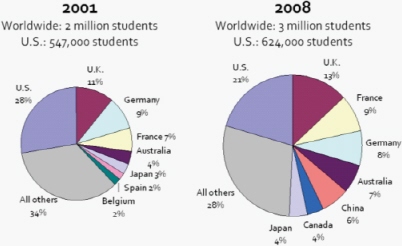
FIGURE 3-1 Foreign students in tertiary education by country of enrollment, 2001 and 2008.
Source: IIE Atlas of Student Mobility.
First, in indicators of relative success and quality as measured against their peers globally, American research universities and the work they do are ranked individually and collectively as the best in the world:9
• Nobel Prizes: Before World War I, Nobel Prizes were largely awarded to Europeans at European institutions such as the University of Berlin, University of Göttingen, L’Ecole Polytechnique, Cambridge University, and Oxford University. Indeed, until Adolph Hitler came to power, German universities were considered the best in the world. Afterwards, there was a great intellectual migration out of Germany, mainly to the United States. Consequently, as Cole relates, “Today, there is not one German university in the world’s top 50.” Meanwhile, since the 1930s, roughly 60 percent of Nobel Prizes have been awarded to scholars at American institutions.10
• International students: American higher education represents one of the few sectors of the U.S. economy with a favorable balance of trade. We attract talented young people from around the world who seek opportunities at American universities as students, scholars, and
9 Graham and Diamond, Rise of American Research Universities p. 10; Cole, Great American University, pp. 4-5.
10 Cole, Great American University, p. 4.
scientists. As shown in Figure 3-1, the United States has the largest market share of foreign students in tertiary education. That share has been shrinking in recent years, but may be on the rise again with increases in Chinese undergraduates at American institutions. As seen in Figure 3-2, a very high percentage of these intellectual migrants stay here and work in science, technology, engineering, and mathematics occupations.
• Global rankings: There are numerous global rankings of research universities and substantial debates about the indicators useful in compiling them. While we do not endorse any particular ranking or methodology, we do note that in almost every case they indicate the general dominance of U.S. institutions. For example, as shown in Box 3-2, the most recent Academic Ranking of World Universities (ARWU) produced
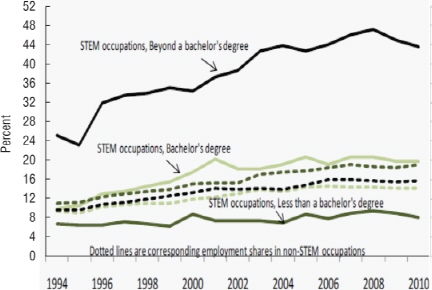
FIGURE 3-2 Foreign-born share of STEM workers, by educational attainment, 1994-2010.
Source: U.S. Department of Commerce, Economic and Statistics Administration, “Education Supports Racial and Ethnic Equality in STEM,” ESA Issue Brief, #05-11, September 2011. http://www.esa.doc.gov/sites/default/files/reports/documents/educationsupportsracialandethnicequalityinstem_0.pdf (accessed September 16, 2011).
BOX 3-2
Top 50 Research Universities, Academic Ranking of World Universities, 2010
1. Harvard University
2. University of California, Berkeley
3. Stanford University
4. Massachusetts Institute of Technology (MIT)
5. University of Cambridge
6. California Institute of Technology
7. Princeton University
8. Columbia University
9. University of Chicago
10. University of Oxford
11. Yale University
12. Cornell University
13. University of California, Los Angeles
14. University of California, San Diego
15. University of Pennsylvania
16. University of Washington
17. University of Wisconsin - Madison
18. The Johns Hopkins University
19. University of California, San Francisco
20. The University of Tokyo
21. University College London
22. University of Michigan - Ann Arbor
23. Swiss Federal Institute of Technology Zurich
24. Kyoto University
25. University of Illinois at Urbana-Champaign
26. The Imperial College of Science, Technology and Medicine
27. University of Toronto
28. University of Minnesota, Twin Cities
29. Northwestern University
30. Washington University in St. Louis
31. New York University
32. University of California, Santa Barbara
33. University of Colorado at Boulder
34. Rockefeller University
35. Duke University
36. University of British Columbia
37. University of Maryland, College Park
38. The University of Texas at Austin
39. Pierre and Marie Curie University - Paris 6
40. University of Copenhagen
41. University of North Carolina at Chapel Hill
42. Karolinska Institute
43. Pennsylvania State University - University Park
44. The University of Manchester
45. University of Paris Sud (Paris 11)
46. University of California, Davis
47. University of California, Irvine
48. University of Southern California
49. The University of Texas Southwestern Medical Center at Dallas
50. Utrecht University
Source: Academic Rankings of World Universities, 2010. Shanghai Jiao Tong University. http://www.arwu.org/ARWU2010.jsp (accessed February 9, 2011).
TABLE 3-1 Indicators and Weights for ARWU
| Criteria | Indicator | Code | Weight |
| Quality of Education | Alumni of an institution winning Nobel Prizes and Fields Medals | Alumni | 10% |
| Staff of an institution winning Nobel Prizes and Fields Medals | Award | 20% | |
| Quality of Faculty | Highly cited researchers in 21 broad subject categories | HiCi | 20% |
| Papers published in Nature and Science* | N&S | 20% | |
| Papers indexed in Science Citation Index-expanded and Social Science | |||
| Research Output | Citation Index | PUB | 20% |
| Per Capita Performance | Per capita academic performance of an institution | PCP | 10% |
| Total | 100% | ||
* For institutions specialized in humanities and social sciences such as London School of Economics, N&S is not considered, and the weight of N&S is relocated to other indicators. Source: http://www.arwu.org/ARWUMethodology2010.jsp (accessed February 9, 2011).
at Shanghai Jiao University (2010), placed 8 U.S. institutions in the top 10, 17 in the top 20, 35 in the top 50, and 54 in the top 100.11
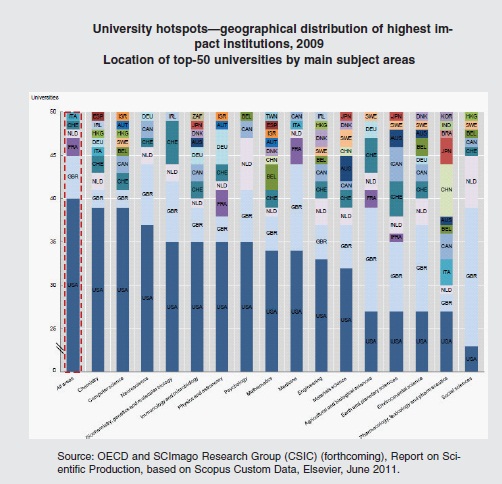
• Productivity: Jonathan Cole argues that “we are the greatest because we are able to produce a very high proportion of the most important fundamental knowledge and practical research discoveries in the world.”12 This can be glimpsed, for example, in the indicators used in the ARWU, as shown in Table 3-1, that emphasize publications and citations and, in particular, the number of highly cited faculty in an institution. It can also be seen in, as shown in Box 3-3, the Organisation for Economic Co-operation and Development’s Science, Technology, and Industry Scoreboard 2011, which demonstrates that, “as measured by normalised citations to academic publications across all disciplines, 40 of the world top 50 universities are located in the United States, with some U.S. universities excelling in a wide range of disciplines.”13
Our preeminence can be seen not just in these indicators, but in the
11 Shanghai Jiao Tong University, Academic Rankings of World Universities–2010. Available at: http://www.arwu.org/ARWU2010.jsp (accessed February 9, 2011).
12 Cole, Great American University, p. 5.
13 Organisation for Economic Co-operation and Development (OECD), Science, Technology, and Industry Scoreboard 2011: Highlights, p. 8. Available at: http://www.oecd.org/dataoecd/63/32/48712591.pdf (accessed April 20, 2012).
“While research efforts are increasing across the globe, top research remains highly concentrated. A new indicator of research impact—measured by normalized citations to academic publications across all disciplines—shows that 40 of the world top 50 universities are located in the United States, with some US universities excelling in a wide range of disciplines. Stanford University features among the top 50 for all 16 subject areas, and 17 other US universities feature in the top 50 in at least 10 scientific fields.
“A more diverse picture emerges on a subject-by-subject basis. The United States accounts for less than 25 of the top 50 universities in social sciences, a field in which the United Kingdom plays a key role. The universities producing the top-rated publications in the areas of earth sciences, environmental science and pharmaceutics are more evenly spread across economies. Universities in Asia are starting to emerge as leading research institutions: China has six in the top 50 in pharmacology, toxicology and pharmaceutics. The Hong Kong University of Science and Technology is among the top universities in computer science, engineering and chemistry.”
Excerpted from: Organisation for Economic Cooperation and Development, OECD Science, Technology, and Industry Scoreboard 2011. Highlights, p.8. Available at: http://www.oecd.org/dataoecd/63/32/48712591.pdf (accessed April 20, 2012).
actions of others. Leaders in nations around the world are reshaping their universities to compete with ours by emulating them and our system. For example, in the Bologna Process, the Council of Europe in conjunction with the European Commission is reforming European higher education, including doctoral education, across 47 countries. The goal of the process is to improve Europe as a knowledge society. The strategies of the process include greater harmonization of degrees across nations; a greater convergence with the U.S. model to promote quality, easier interaction with
the United States, and attractiveness to non-European students; and an increase in the overall competitiveness of European higher education.14
Second, reports of specific institutions have demonstrated their significant economic impact locally, regionally, and nationally, as talented graduates of these institutions have created and populated many new businesses that go on to employ millions of Americans. For example, Jonathan Cole notes:
Stanford University reports, for example, that faculty members, students, and alumni have founded more than 2,400 companies—and a
14 See http://www.ehea.info/ (accessed September 16, 2011).
subset, including Cisco Systems, Google, and Hewlett-Packard, generated $255-billion of total revenue among the “Silicon Valley 150” in 2008.
and
The Massachusetts Institute of Technology (MIT) has reported that 4,000 MIT-related companies employ 1.1 million people and have annual world sales of $232-billion—a little less than the gross domestic product of South Africa and of Thailand, which would make MIT companies among the 40 largest economies in the world.15
Meanwhile, to provide the example of a public institution that has been significantly supported by the federal government and its state, the University of Alabama (UAB) Birmingham reports:
• $4.6 billion in total economic impact is generated by UAB in the state of Alabama.
• $1 invested by the state in UAB generates $16.23 in the total state economy.
• 61,205 jobs are supported in the state of Alabama.
• $302.2 million is generated in state and local tax revenue.
The UAB report asserts further that “the economic and employment impact of UAB’s expansion in 2020 (mid-range scenario) is projected to grow to $6.6 billion, generate 72,449 jobs and create $431.4 million state and local tax revenue.”16 These impacts are generated by just three diverse institutions. Expand this to 120 or more institutions and the impact grows enormously.
Third, examples of specific products and companies demonstrate the economic and social impact and penetration of the results of university education and research. For example, Jonathan Cole summarized many of the examples in his book as follows:
The laser, magnetic-resonance imaging, FM radio, the algorithm for Google searches, global-positioning systems, DNA fingerprinting, fetal monitoring, bar codes, transistors, improved weather forecasting, mainframe computers, scientific cattle breeding, advanced methods of surveying public opinion, even Viagra had their origins in America’s research universities. Those are only a few of the tens of thousands of advances, originating on those campuses that have transformed the world.
15 Jonathan Cole, Can American research universities remain the best in the world? The Chronicle of Higher Education, January 3, 2010.
16 Tripp Umbach, The Economic Impact of UAB: Current and Projected Economic, Employment, and Government Revenue Impacts. Final Executive Report, November 9, 2010.
• Bar code scanners
• Computer-assisted design
• Anti-freeze proteins used in ice cream, cosmetics, fish farming, and tissue transplants
• Genetic plant research that has led to the development of new crops
• Improved biofuels
• The application of modified Buckeyballs in medicine and in building materials
• Low-cost, low-energy use methods for obtaining clean drinking water
• Improved understanding of business cycles and economic policies
• Forensic DNA analysis
• The development of revolutionary weather-sensing networks
• MRI technology
• Reaction injection molding that has led to lighter and more fuel-efficient automobiles
• solid-state physics and ceramics/glass engineering essential to the optical fibers
• The PageRank method that led to Google
• NSFNET, the telecommunications that developed into the Internet
Source: National Science Foundation, NSF Sensational 60. http://www.nsf.gov/about/history/sensational60.pdf. (accessed February 3, 2011).
“Such discoveries, he writes, “have provided industry with the material needed for the growth of new, high-technology businesses—and universities have trained most of the highly skilled work force that populates our major industrial laboratories.”17
To add to Cole’s list, the National Science Foundation and the Science Coalition have also catalogued how federal funding for research, and in particular, for research performed in universities, has led to important products, companies, and jobs. Box 3-4 provides a partial list of NSF’s Sensational 60 products that resulted from or drew on research the foundation funded.18 The Science Coalition report, meanwhile, provides details on the origin, size, and revenue of 100 successful companies, just a small sample of the many that have grown out of federally funded uni-
17 Cole, The Chronicle of Higher Education.
18 National Science Foundation, NSF Sensational 60. Available at: http://www.nsf.gov/about/history/sensational60.pdf (accessed February 3, 2011).
versity research. Some of these companies are well known, like Google and SAS. Google, of course, grew out of research on a better search engine at Stanford University funded by the National Science Foundation. Others, like Sharklet Technologies of Alachua, Florida, or A123 Systems of Watertown, Massachusetts, are not yet household names but contribute importantly to their local economies. A123, which grew out of materials research at MIT funded by the U.S. Department of Energy, now employs 1,740 people and had annual revenue in 2008 of $54 million. What conveys the power of university research, perhaps even more than the data on the 100 companies that can be reviewed in the coalition report, are the quotes in Box 3-5 from company founders that demonstrate, through their own words, how important it can be for jobs, economic growth, and the outcomes for the health, security, or quality of life for Americans that their products bring.
Research in the social, behavioral, and economic (SBE) sciences also contribute to critical national goals. As a recent report from the National Science and Technology Council contends, “The quest for deeper understanding of humans is key to managing society’s most critical challenges.” It continues by noting:
These challenges include:
• Developing more effective education programs
• Developing better health care programs
• Understanding violence, suicide, abuse, neglect, addiction, and mental illness
• Mitigating fanaticism, extremism, and terrorism
• Protecting confidentiality and privacy
• Fostering societal resilience in the face of both natural and human-made disasters
• Fostering a culture of creativity and innovation and maintaining America’s competitiveness in an era of rapid globalization
• Addressing the long-term sustainability of civilization within Earth’s ecosystems.
These challenges all share a human element, which makes them resistant to untested interventions or technological solutions, and makes evidence-based policy making difficult. After a half-century of progress, however, the SBE sciences can offer more rigorous, evidence-based strategies to address this human element.19
19 National Science and Technology Council, Subcommittee on Social, Behavioral, and Economic Sciences, Social, Behavioral, and Economic Research in the Federal Context, January 2009. Available at: http://www.nsf.gov/sbe/prospectus_v10_3_17_09.pdf (accessed March 8, 2009).
The core technology of TomoTherapy was developed by National Cancer Institute funding. Each year, the technology is responsible for the treatment of tens of thousands of difficult to treat patients. In addition, it generates many times its original funding level in salaries and taxes returned to both the U.S. and Wisconsin governments.
—Rock Mackie, Professor, University of Wisconsin-Madison, and Co-Founder and Chairman of the Board, TomoTherapy Incorporated.
Basic research provides the critical ‘seed corn’ for our nation’s technological innovations. Certainly, that was true in the case of A123 which grew out of DOE-funded basic research into new battery concepts at MIT and us today developing batteries and battery systems to enable the electrification of transportation and improved efficiency in the ‘smart’ electric grid.
—Yel-Ming Chiang, Professor, MIT, and Co-Founder A123 Systems.
Our lab at Arizona State University received substantial support from both the Office of Naval Research and the National Science Foundation to develop scanning probe microscopy for biological applications right from the first discovery of the technique (1985-6). This background led directly to the intellectual property that Molecular Imaging licensed from ASU when it was founded in 1993. Today, Agilent AFM in Chandler is a significant employer of scientists and engineers, manufacturing and further developing the instruments pioneered by Molecular Imaging.
—Dr. Stuart Lindsay, Director Arizona State University’s The Biodesign Institute, Single Molecule Biophysics; and Founder Molecular Imaging.
SAS was originally created to analyze crop data through a grant from the Department of Agriculture. Forty years later, SAS is used in every industry around the world. There are plenty of success stories still to be told. Federally supported university research is vitally important to keeping America at the forefront of technology innovation.
—Dr. Jim Goodnight, Chief Executive Officer, SAS.
Source: The Science Coalition, Sparking Economic Growth: How federally funded university research creates innovation, new companies, and jobs, April 2010. See www.sciencecoalition.org (accessed September 16, 2010).
BOX 3-6
Multidisciplinary Social Science Research Program for National Energy Policy
A recent report of the President’s Council of Advisors on Science and Technology (PCAST) addressed ways to accelerate the pace of change in energy technologies through and integrated Federal energy policy. Among its recommendations, PCAST included action that social science researchers could take to improve the adoption of energy technology:
A Multidisciplinary Social Science Research Program
DOE’s energy mission is to support basic and “use-inspired” research, but in fact it devotes little time or investment to understanding how energy technologies ultimately succeed in the marketplace. DOE needs to “close the innovation cycle” through support of a significant new multidisciplinary program into the processes of energy innovation. Understanding how the department’s technologies proceed as they pass from invention to innovation to adoption to diffusion and how the innovation system as a whole is functioning is critical to understanding the overall success of DOE’s mission, as well as the performance of government in energy innovation and technology deployment.
RECOMMENDATION 4-4: DOE, along with NSF, should initiate a multidisciplinary social science research program to examine the U.S. energy technology innovation ecosystem, including its actors, functions, processes, and outcomes. This research should be fully integrated into DOE’s energy research and applied programs.
This research program should fund experts from the physical sciences, engineering, economics, sociology, public policy, political science, international relations, business, and other disciplines. Examples of questions that might be rigorously studied are:
University research in the SBE sciences, therefore, also play a strong role in national efforts to meet our goals both generally and in specific areas. Box 3-6, for example, describes how SBE research contributes to federal energy policy and the acceleration of energy innovation.
• How and why are advanced energy technologies accepted or rejected by consumers?
• What are the barriers to adoption?
• Will the public accept a specific technology and why?
• What market conditions are needed for a technology to compete?
• What is the role of public policy to efficiently and effectively push and pull advanced technologies into the marketplace?
• How are technologies transferred and diffused internationally?
Other types of multidisciplinary research that are needed include strategic energy analyses and full life cycle assessments of new energy technologies. The potential benefits of such a research program are significant. Estimates are as high $1.2 trillion in energy savings through 2020 from wide scale implementation of energy efficiency technologies in the U.S. With or without new technologies, more behavioral research is also needed concerning the patterns, incentives, and decisions that determine individuals’ energy usage. Well-designed social science experiments can yield important insights about how people react to various policies and technologies. Continuity is important. In many cases, large-scale datasets exist or can be easily collected concerning such questions, but are not easy to study because of proprietary or regulatory obstructions. DOE should work with OMB, energy providers, and researchers to facilitate the compilation of energy usage data under both routine and experimental conditions. Other disciplines, such as history and international case studies, can also deliver important lessons.
—Excerpted from President’s Council of Advisors on Science and Technology, Report to the President on Accelerating the Pace of Change in Energy Technologies Through an Integrated Federal Energy Policy, November 2010. Available at: http://www.whitehouse.gov/sites/default/files/microsites/ostp/pcastenergy-tech-report.pdf (accessed March 8, 2012).
This page intentionally left blank.


