
Many participants at the convocation described both the progress that has been made in the past implementing evolution across the curriculum and available resources that can enable greatly accelerated progress. Educators have had particular success reforming Advanced Placement (AP) Biology and some aspects of premedical and medical education, as described in the first part of this chapter. Professional societies also can have a significant impact on education at all levels, as four representatives of those societies observed. In addition, the resources available to make progress in teaching evolution across the curriculum—a few examples of which are described in this chapter—are continually expanding.
The Biological Sciences Curriculum Study
The idea of teaching evolution as a major theme in biology is not new, observed Paul Beardsley, formerly a Science Educator at the Biological Sciences Curriculum Study (BSCS), now at California State Polytechnic University, Pomona, and also a member of the organizing committee for the convocation. Curriculum development at BSCS in the 1950s and 1960s was based on nine major themes, including evolution, “diversity and unity,” and “science as inquiry.” What has changed since the 1960s, said Beardsley, is that educators have learned how difficult it is to teach these
concepts. “To me, evolution is the most difficult set of concepts to teach in all of introductory science.”
Beardsley cited several lessons he has drawn from experience and research that need to be taken into account when designing a curriculum to teach evolution. First, people come to class with pre- and misconceptions about how the world works, and these misconceptions need to be recognized by faculty and addressed in curriculum materials. Second, students need to develop a deep factual understanding based on a conceptual framework grounded in evolutionary science. Third, students need practice thinking about their own learning, which cognitive science researchers call metacognition. Finally, students need a source of motivation, particularly those who are underrepresented in the sciences. “These are not novel ideas,” said Beardsley, “but they need to be a part of our curriculum.”
BSCS has completed a project funded by the National Institutes of Health (NIH) to develop a rigorous contemporary evolution and medicine curriculum based on inquiry, constructivism, and relevance to students’ lives. The resulting evolution and medicine curriculum, which was funded by 11 different offices and centers at NIH, is based on the idea that modern health research requires an understanding of evolution. One lesson, for example, discusses the evolution of lactose tolerance in evolution. Students explore data on lactose tolerance and intolerance and develop explanations of the observed global patterns. They can examine mutations that are common in different parts of the world, argue over alternate explanations, and arrive at conclusions about the persistence of lactase, the enzyme which breaks down the sugar lactose, into adulthood in some human populations. In another lesson, students compare genetic sequences across species for a gene associated with cleft palate, explain the results in terms of common ancestry, and explain how natural selection conserved certain sequences of DNA. In another, they use evolutionary principles and concepts to understand influenza by aligning DNA sequences of the hemagglutinin gene and relate the principles of natural selection to the need for new vaccines.
BSCS also has recently finished a major revision of its comprehensive high school biology textbook, BSCS Biology: A Human Approach. The intent of the revision has been to help students identify preconceptions, foster metacognitive habits, and build interest through relevant, exciting, and engaging examples.
AP Biology
More than 200,000 high school students take AP Biology every year, with approximately 160,000 to 180,000 sitting for the AP Biology exam. In recent years, the course has been redesigned along the lines recommended
in the report Learning and Understanding: Improving Advanced Study of Mathematics and Science in U.S. High Schools (National Research Council, 2002). The new course is organized around 4 big ideas, 7 scientific practices, and 17 enduring understandings (see Box 6-1). “It’s not about covering 1,500 pages of your favorite textbook,” said Spencer Benson, director of the Center for Teaching Excellence and associate professor in the Department of Cell Biology and Molecular Genetics at the University of Maryland, College Park, who was co-chair of the AP biology curriculum redesign committee. “It’s about developing a framework to understand all of biology.”
The big ideas of the redesigned course emphasize concepts, evidence, and data analysis rather than requiring students to memorize endless facts. Benson also called attention to the practice of connecting and relating knowledge across various scales, concepts, and representations in and across domains. That means looking at evolution from many different biological perspectives and reiterating the idea that evolution is a central component of biology throughout the curriculum.
As a high-stakes exam taken by many students every year, restructuring the AP Biology exam is also “critical,” Benson said. The exam is being redesigned to emphasize the concepts, content, and practices that serve as organizing principles for the new curriculum. “People are writing by evidence-based design,” said Benson, “which means that every question is linked directly into the curriculum framework and into scientific practices and enduring understandings.” Results on the exam will be analyzed to determine whether the new exam is working better than the previous one.
Undergraduate Biology Education
In 2007 the American Association for the Advancement of Science, with support from the National Science Foundation, the Howard Hughes Medical Institute, and the National Institutes of Health, launched a major initiative to develop a shared vision for undergraduate biology education and the changes needed to achieve that vision. As Celeste Carter, a program director in the Division of Undergraduate Education at the National Science Foundation, observed at the convocation, the driving force of the initiative was, “how do you make the biology that we teach as exciting as the biology that we do in our laboratories?” Over the course of the two years, the group held a series of regional meetings and then a national conference with faculty, administrators, representatives of professional societies, and students and postdoctoral fellows. This meeting resulted in the report Vision and Change in Undergraduate Biology Education: A Call to Action (Brewer and Smith, 2011), which, as stated in the preface of that
BOX 6-1
Framework for the New AP Biology
The redesigned AP Biology course is organized around four big ideas:
• The process of evolution drives the diversity and unity of life.
• Biological systems utilize free energy and molecular building blocks to grow, to reproduce, and to maintain dynamic homeostasis.
• Living systems store, retrieve, transmit, and respond to information essential to life processes.
• Biological systems interact, and these systems and their interactions possess complex properties.
The course also emphasizes seven scientific practices (enduring understandings), all of which have a connection to evolutionary understanding.
• The student can use representations and models to communicate scientific phenomena and solve scientific problems.
• The student can use mathematics appropriately.
• The student can engage in scientific questioning to extend thinking or to guide investigations within the context of the AP course.
• The student can plan and implement data collection strategies appropriate to a particular scientific question.
• The student can perform data analysis and evaluation of evidence.
• The student can work with scientific explanations and theories.
• The student is able to transfer knowledge across various scales, concepts, and representations in and across domains.
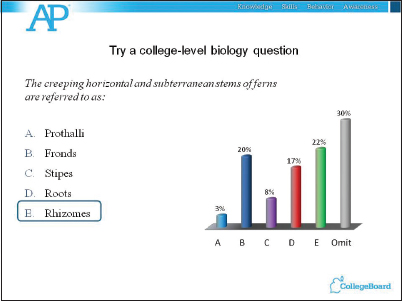
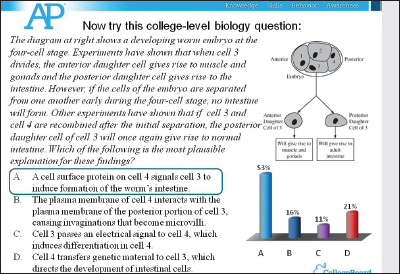
Here is an example of how questions on the AP Biology examination are likely to change.a The first question is typical of factual recall questions that are prevalent in current AP Biology tests. The second represents a higher-level question that requires students to demonstrate a greater level of understanding and synthesis of the concept being tested. Graphs next to each question represent the percentage of students who selected each answer:
_________
a Source: Copyright © 2012 The College Board. Reproduced with permission. http://apcentral.collegeboard.com.
report, “represents the collective wisdom of hundreds of leading life scientists who contributed to the conversations.”1
The report calls for undergraduates to master five basic biological concepts, the first of which is “the diversity of life evolved over time by processes of mutation, selection, and genetic change.” The report explicitly recognizes that evolution “is a thread that should extend all the way through the undergraduate curriculum,” said Carter. As the report says, “Because the theory is the fundamental organizing principle over the entire range of biological phenomena, it is difficult to imagine teaching biology of any kind without introducing Darwin’s profound idea.”
The organizers of the Vision and Change initiative are continuing to work to implement the ideas contained in the report, said Carter. A particular need is for funders to decide on levers that they can use to incentivize change.
Premedical and Medical Education
The same year that the Vision and Change initiative got under way, the Howard Hughes Medical Institute formed a partnership with the Association of American Medical Colleges to examine the education of future physicians. The report emerging from that partnership identified the most important scientific competencies required of students graduating from college prior to matriculating into medical school as well as the scientific competencies required of medical school graduates as they enter postgraduate training. One of the eight competencies identified as essential for premedical students is that they “demonstrate an understanding of how the organizing principle of evolution by natural selection explains the diversity of life on earth.”
The focus on competencies rather than courses has several beneficial consequences, said William Galey, director of graduate and medical education programs at the Howard Hughes Medical Institute, during his prepared remarks as a panelist. It provides room in the curriculum for new areas of science and mathematics that need to be addressed. Also, it “liberates the undergraduate curriculum from the tyranny of premed requirements,” said Galey. The report has been adopted in principle by the committee that reviews the content and structure of the Medical College Admission Test (MCAT), which will further shift the emphasis in premedical and medical education toward competencies and away from specific courses. A new version of the MCAT is being developed for release in 2015.2
_________
1 Additional information is available at http://visionandchange.org.
2 Additional information is available at https://www.aamc.org/initiatives/mr5/preliminary_recommendations.
Mark Schwartz, associate professor of medicine at the New York University School of Medicine, elaborated on the importance of evolution in the preparation of future physicians. Medicine is based on biology, and biology is based on evolution, he said, but very few physicians have had the chance to get beyond the basics of evolutionary principles. Furthermore, medical educators and researchers rarely tap into the elegance and power of evolutionary thinking. Undergraduates now have more opportunities than in the past to learn about the interface of evolution, health, and disease, but most premed students have scant room for electives in their schedules. Medical schools have few prerequisites for admission reflecting evolutionary thinking. No North American medical schools require or develop these competencies. As Schwartz said, quoting evolutionary biologist Randolph Nesse, “We are practicing and teaching medicine with only half of biology.”
Medical students are intrigued by big questions, said Schwartz. Why do we age? Why do so many of us wear glasses? Why is there a menopause? Why must we sleep? Why do we still have an appendix? Why are autoimmune diseases becoming more common?
Most people in the medical community hear these as proximate, mechanistic “what” questions—how does the body work? As a result, they are drawn to pathophysiologic, mechanistic, or epidemiologic explanations. These explanations are of course important and largely shape the practice of medicine, but they tell only part of the story. “To fully understand the biology of health and disease, one must go beyond these ‘what’ questions to the evolutionary questions,” said Schwartz. Evolutionary questions ask “why.” Their answers are framed in terms of selective pressures, phylogenetics, developmental tradeoffs, ecological constraints, and so on.
Evolution provides learners with a conceptual framework, said Schwartz. It integrates basic and clinical sciences, making medical education and practice more coherent. Infusing this integrative science into medical education can foster new questions and insights that provide a sense of discovery about the human condition. “Learners find evolutionary science endlessly intriguing and are quite eager to learn more, but they are very disappointed with the lack of educational opportunities.”
Medical schools are complex systems that are very slow to change. Quoting University of Missouri physician Jack Colwill, Schwartz said that medicine educates tomorrow’s physicians in today’s system while maintaining yesterday’s beliefs. Curricular time is of course precious at all levels of education, and many valuable fields are vying for that time to educate premedical and medical students. But teaching and learning about evolution provides a conceptual scaffold on which facts can be organized, not simply a new set of facts. Evolutionary science “provides the bridges and tunnels that students need to connect and navigate what
otherwise can sometimes seem like an archipelago of various sciences,” said Schwartz.
At the time of the workshop, the National Evolutionary Synthesis Center had just formed a new working group to lay the groundwork for ongoing endeavors to provide testable curriculum models and pathways for infusing evolutionary thinking into premedical and medical education. The working group will refine core competencies across the continuum of premedical to medical training with a focus on teachable moments, since there is not enough room in the medical school curriculum for a whole new course. It will seek to infuse evolutionary thinking into the basic science and clinical education of trainees, and model curricula and learning experiences will be open for all to use. “Of course, these efforts by themselves will not be sufficient, but hopefully this will produce an intellectual platform from which educational interventions, including randomized control studies, can test the efficacy of these interventions.”3
The National Association of Biology Teachers
The National Association of Biology Teachers (NABT) has been changing in recent years, said its executive director, Jaclyn Reeves-Pepin. With a membership of 4,200 people, NABT traditionally has been primarily an organization of high school teachers. However, NABT now consists of about half high school teachers and half two-year and four-year college professors. As a result, the organization is serving a population—higher education faculty—not traditionally associated with the organization. However, it still does not serve most middle school and elementary school teachers, which is where teaching about evolution needs to begin.
Several years ago, NABT did an extensive survey of its members in which it asked the question, “What are the top five topics that NABT members are most interested learning about?” On a list of possible answers, genetics was first, appearing on well more than 50 percent of the lists. Evolution was second, at about 50 percent, followed by environmental science, molecular biology, and human anatomy and physiology.
The second part of that question was, “Which topics do you teach?” with exactly the same options listed as possible answers. Evolution was being taught by fewer than 30 percent of NABT members. “One hundred
_________
3 About two months after this convocation, the journal Evolution: Education and Outreach published a special issue devoted to teaching and learning about evolutionary medicine. That issue can be accessed at http://www.springerlink.com/content/1936-6426/4/4.
percent of NABT members should be saying that they are teaching evolution, but they didn’t,” said Reeves-Pepin.
Since then, NABT has stepped up its work on teaching evolution. It has partnered with multiple organizations, including NASA, BioQUEST, the Smithsonian Institution, and the Howard Hughes Medical Institute on evolution-related initiatives. It has organized talks across the country for parents, school boards, and the public by nationally recognized speakers on how to address controversy and science denialism in the classroom. It also has tried to make its members ambassadors for the profession. “One strong teacher in a district who knows how to address the teaching of evolution and the teaching of biology can become a teacher or leader in that district and can create change at a very local level. We do not want to underestimate the impacts those teachers can have.”
In October 2011, NABT released a position statement on teaching evolution.4 It said:
Just as nothing makes sense except in the light of evolution, nothing in biology education makes sense without reference to and through coverage of the principles and mechanisms provided by the science of evolution. Therefore, teaching biology in an effective, detailed, and scientifically and pedagogically honest manner requires that evolution be a major theme throughout the life science curriculum both in classroom discussions and in laboratory investigations.… Biology educators at all levels must work to encourage the development of and support for standards, curricula, textbooks, and other instructional frameworks that prominently include evolution and its mechanisms and that refrain from confusing non-scientific with scientific explanations in science instruction.
If high school and college teachers do not include evolution as an integral component of their courses, they are doing a disservice not only to their fellow professionals but also to themselves and their students, said Reeves-Pepin. Furthermore, they harm the entire society, she added, because their students will be future voters and future parents.
The American Institute of Biological Sciences
Professional societies can play a major role in encouraging the teaching of evolution across the biology curriculum, said James Collins, Virginia M. Ullman Professor of Natural History at Arizona State University, former assistant director for the Biological Sciences Directorate at National Science Foundation, currently president of the American Insti-
_________
4 The statement, along with a variety of other resources, is available at http://www.nabt.org/websites/institution/index.php?p=110.
tute of Biological Sciences (AIBS), and a member of the convocation’s organizing committee. AIBS, which is an umbrella organization with about 160 member societies and 225,000 affiliated scientists (through both individual memberships in AIBS and through their membership societies), has maintained a strong and persistent presence in advancing evolutionary biology. The journal BioScience is a major organ for disseminating information to the community, and especially to educators. The website ActionBioscience.org, which seeks to “bring biology to informed decision making,” is another way in which AIBS communicates with a larger set of communities. In addition, AIBS has a strong policy presence in Washington, DC, and is involved in alliances on evolution-related issues. “It will be increasingly important for scientific societies to be able to step up and take policy positions, educate people, and participate in the policy arena,” said Collins.
The Federation of American Societies for Experimental Biology
The Federation of American Societies for Experimental Biology (FASEB) is also an umbrella organization that represents 24 societies with about 100,000 members collectively, which are involved largely in medical research, said its president Joseph LaManna, professor of physiology and biophysics, neurology, neurosciences, and pathology at Case Western Reserve University. Many of FASEB’s member societies have a specific and deep interest in evolution, and all of them work in sciences that involve evolutionary thinking. The organization’s website (http://www.faseb.org) contains a variety of resources, including many that are related to evolution. FASEB also offers resources for evolution education that include background information and tips and tools for communicating about evolution. It runs conferences, publishes a journal, and has a society management service. It even produces buttons to hand out at scientific meetings with slogans such as “Teach Evolution” and “Take a Stand for Science.”
FASEB focuses on science policy, so it remains vigilant for policy issues that affect the teaching of evolution. It has a Capitol Hill office and organizes regular visits with Members of Congress and their staff members. It particularly emphasizes the importance of maintaining a good stream of well-trained researchers to support the nation’s research and development base, which requires that students learn evolutionary concepts and content.
In 2005, FASEB’s Board of Directors adopted a statement on evolution that reads:
• FASEB considers evolution a critical topic in science education and strongly supports the teaching of evolution.
• FASEB opposes mandating the introduction of creationism, intelligent design, and other non-scientific concepts into the curricula of science.
• FASEB opposes introducing false controversies regarding evolution or other accepted scientific theories into the curricula of science.
• FASEB calls upon the scientific community and American citizens to defend science education by opposing initiatives to teach intelligent design, creationism, and other non-scientific beliefs in science class.
A useful step forward, said LaManna, would be for the scientific societies to do a “meta-review” of available educational resources. Can these resources be aligned and strengthened, so that people are less confused by the wealth and variable characteristics of the available resources?
In the same vein, consolidating efforts may produce more effective initiatives. For example, organizations could partner on policy objectives by bringing people to advocate on Capitol Hill who are not normally represented in discussions on evolution education.
The American Society for Microbiology
Finally, Amy Chang, education director for the American Society for Microbiology (ASM), spoke about four areas in which professional societies have a role: advocacy, guidelines and models, professional development, and information dissemination. ASM has a diverse membership of about 40,000 people, with about 60 percent from colleges and universities and the other 40 percent from companies, federal and state governments, public health laboratories, diagnostic laboratories, and other organizations.
The ASM has a Statement on the Scientific Basis for Evolution5 that “sets a vision for where we need to be,” said Chang. A particular value of such statements is that developing them requires discussion within an organization, which helps unify its intent and initiatives. The National Center for Science Education has a website that links to all similar statements,6 and Chang urged societies that do not yet have such a statement to generate one.
In the area of guidelines and models, ASM has been developing guidelines for a recommended core curriculum. The introductory course
_________
5 See http://www.asm.org/images/Education/asm%20evolution%20statement_6_06b.pdf.
6 These statements are available at http://ncse.com/media/voices/science.
in microbiology, which is the foundation of the curriculum, has six organizing themes, the first of which is evolution. Introductory microbiology is in part a service course for the nursing and allied health professions, and the need for curriculum guidelines differs significantly between majors. The structure of the courses for science majors and the allied health professions is based on employment and passing licensure examinations that are content dense.
ASM also provides professional development in education for its members. Chang estimated that 80 percent of the society’s members have opportunities to explain science to people in their communities, including parents, youth, children, churchgoers, health professionals, science fair or county fair participants, and many others. “They all have an opportunity to bring science to the citizens,” said Chang. ASM has been developing “training materials and leadership to empower the members to do their jobs in explaining the theories of evolution or evolutionary science and bringing it to everyday life.”
Finally, ASM is involved in information dissemination through a variety of publications and other documents.
RESOURCES FOR TEACHING EVOLUTION
ACROSS THE CURRICULUM
The Understanding Evolution Website7
The Understanding Evolution website, which was launched in January 2004 with support from the National Science Foundation, was designed to give K-12 teachers the content knowledge and resources to teach evolution with confidence. The developers of the website quickly realized that its potential audience was much larger than teachers, said Judy Scotchmoor, assistant director of the University of California Museum of Paleontology. With additional funding from the Howard Hughes Medical Institute, a new version of the site launched a year and a half later. The teacher site was still available, but university instructors, students, and the general public also were included as intended audiences.
In January 2011, a new version of the website launched in partnership with AIBS and NESCent. The site contains teaching materials, a resource library, an in-depth online course on the science of evolution, and stories on how evolution factors into current news stories. The site has a large international audience and has been translated into multiple languages. As the site says, it “is here to help you understand what evolution is, how
_________
7 Available at http://evolution.berkeley.edu/.
it works, how it factors into your life, how research in evolutionary biology is performed, and how ideas in this area have changed over time.”
Several factors have contributed to changes in the website over the past eight years, said Scotchmoor. One was the discovery that about 30 percent of the site’s audience taught at the undergraduate level, even though the target audience for the first version of the site was solely K-12 teachers. Another was input from a high-level advisory group that met in 2008. Scotchmoor recalled a particular comment from group member Rodger Bybee: “Overnight, you’re not going to get everybody to suddenly start integrating evolution into the teaching of biology wherever they are. But if we can encourage them to take baby steps and that first step is comfortable, they’ll take another step.”
Another critical factor was the successful submission of a curriculum development grant to the National Science Foundation in 2009. The goals of the grant were to:
• Encourage college biology instructors to integrate evolutionary concepts—especially the applications and relevance of evolution—throughout their biology teaching.
• Encourage college biology instructors to spend more class time on evolution-related concepts and emphasize the currency of evolution research in their instruction.
• Encourage college biology instructors to use pedagogical techniques supported by education research in their evolution instruction.
• Impact college students.
With funding from that grant, the Understanding Evolution team put together the Understanding Evolution Teacher Advisory Board, which has helped improve the site in many ways. Board members showed how to make the navigation and access better. They worked on how to overcome some of the reasons teachers give for not teaching evolution across the curriculum, which led to development of the “Evolution 101” course that the website provides. The board made sure that additional resources for any given topic in evolutionary science were easily and readily accessible. These resources include examples, case studies, teaching recommendations, and research profiles of evolutionary biologists and their research.
The teaching materials have changed dramatically over the lifetime of the site. The site now has “teachers’ lounges” at the K-2, 3-5, 6-8, 9-12, and undergraduate levels. Each lounge opens with four bullets that link to information appropriate for that grade level:
• Focus on the fundamentals
• Identify your learning goals
• Avoid common teaching pitfalls
• Search for lessons
All of these grade levels are important, said Scotchmoor. A second grade teacher may say, “I don’t teach evolution.” But even in second grade, students can observe that not all kittens look the same and that they inherit certain characteristics from their parents.
By condensing many different syllabi from introductory biology courses, the developers of the Understanding Evolution site also have put together an “interactive syllabus” that links evolution to topics throughout the biology curriculum. For example, when teaching the Krebs cycle, the site provides five-minute slide sets that connect the topic to evolution. The interactive syllabus also provides teaching tips, learning goals, and modifiable teaching scripts for different topics.
The group has been investigating slide sets that promote active learning to incorporate into the syllabus. A journal toolkit enables teachers and students to access the primary literature. Finally, an Evo Gallery provides students with the opportunity to use a medium they choose to talk about evolutionary concept. Students peer review each other’s creations, and their contributions are archived on the website so that the selection continues to grow.
The take-home messages, said Scotchmoor, are to make information easy and accessible, provide appropriate packaging and guidelines for use, create modifiable formats for different teaching styles, provide resources that also target other content and skills that need to be taught, provide assessment and diagnostics whenever possible, engage students actively, provide resources that are relevant to students, and provide professional development for teachers.
Through their experiences with the Understanding Evolution site, the developers realized that a segment of the population is confused about evolution because they are confused about science. The result was a sister site called Understanding Science, which was developed through a multidisciplinary collaboration of scientists and educators.8 The website is based on three major principles. First, the processes of science have to be explicitly and independently emphasized. Second, throughout instruction, students should be encouraged to examine, test, and revise their ideas about what science is (and is not) and how it works. Third, key concepts about the nature and processes of science should be revisited in multiple contexts throughout the school year, allowing students to see how they apply in real-world situations. “Introducing the process of sci-
_________
8 Available at http://understandingscience.org.
ence in pages three through five of any textbook and then forgetting about it is not going to help,” Scotchmoor said.
During the discussion period following this panel discussion, LaManna suggested that the ideas in Understanding Evolution be linked to Wikipedia, particularly in areas where evolution has an impact on daily life, an idea Scotchmoor labeled brilliant. She also responded to a question by saying that members of the website’s Teacher Advisory Board consider their work to be professional development, and many of them do it essentially as volunteers.
The National Evolutionary Synthesis Center
The National Evolutionary Synthesis Center (NESCent) responds to the interests and the goals of the evolutionary biology community, said Kristin Jenkins, who works on education and outreach with the organization and who served as a member of the convocation’s organizing committee. With funding from the National Science Foundation, NESCent has a broad mandate and has developed educational materials for diverse audiences. Most of its products are focused on high school and college levels, because that is where evolution is commonly taught. In addition, proposals from the community lead to the formation of working groups that pursue new initiatives. Some working groups develop particular materials, like assessments. Others focus on specific problem areas such as tree thinking. And some work on big picture ideas, like the Teaching Evolution Across the Curriculum Working Group that served as the impetus and catalyst for the development of this convocation.
NESCent has been thinking about how the evolutionary approaches taught in biology can be applied in other areas. “Many of the students in introductory biology are not necessarily going to be biology majors,” said Jenkins, “but having them pick up that way of thinking and being able to use that in their future careers, as well as being aware of how biology works, is very important to NESCent.”
NESCent also provides professional development so that teachers are knowledgeable and confident in teaching evolution. It works with NABT and AIBS to offer a symposium on evolution every year at the NABT annual meeting.9 And it partners with groups such as Understanding Evolution and BioQUEST to develop specific materials so that if faculty members want to try something novel, they have the support and the resources to do so.
Finally, NESCent works directly with students through such groups as the Society for the Advancement of Chicanos and Native Americans in
_________
9 Links to all of these symposia are available at http://www.aibs.org/events/special-symposia/.
Science (SACNAS)10—for example, by having scientists talk with students to keep them engaged with science. “There are a lot of opportunities to provide scaffolding and support for the people who are in the classroom,” Jenkins said.
Textbooks
One of the objections from William Buckingham, who was the head of the school board’s curriculum committee in Dover, Pennsylvania, about the textbook Biology (Miller and Levine, 2004) is that the book is “laced with Darwinism” from beginning to end. He was objecting to the fact, said Joseph Levine, one of the textbook’s authors, that, similar to the school superintendent in Kentucky who ordered two pages of a textbook glued together (see Chapter 1), a few pages could not be glued together to eliminate mention of evolution. Rather, Levine emphasized, evolution is intentionally integrated throughout the book.
The treatment of evolution has increased in successive editions of the book, said Levine, who has been publishing the book with his coauthor Kenneth Miller for more than two decades with Prentice-Hall (now Pearson Education). The first edition had 63 pages in the evolution unit and 17 references in the index to evolution, partly because the publisher was “afraid of putting too many in,” said Levine. The current edition of the textbook has 123 pages in the unit on evolution and 45 index entries under evolution. Furthermore, many of the chapters in the book have an obvious evolutionary perspective, while others have what Levine referred to as “stealth inclusions” in such areas as genetics and molecular biology. The most recent edition has updated coverage of phylogenetics and a discussion of cladistics. It also observes that the protista are not a kingdom. “Biologists haven’t thought that for about 30, 35 years now. The problem is that most state standards still refer to the kingdom protista, and teachers are obliged to teach about that.”
The book emphasizes concepts rather than facts. Each section of the book starts with key questions that are conceptually based. New vocabulary comes later and is designed to serve the concepts. “We don’t start off the paragraph with a foreign language word that knocks the kids off balance. We start out by discussing what we’re talking about and then put a name to it.”
For any educational program to make a difference in K-12 education on a national scale, it has to succeed in the marketplace, Levine emphasized. The very best materials will have limited value if only the top 10 percent of teachers and the top 10 percent of students get to see them.
_________
10 Additional information is available at http://sacnas.org/.
That top 10 percent may include the students headed to medical school or research. But the other 90 percent, who are not honors or AP students, become the large majority of the general public. Thus, Levine and Miller have had to continually upgrade and improve the presentation of evolutionary thinking while working to ensure that the book is not banned in the marketplace.
Levine described some lessons drawn from his experience as a textbook author. First, implementing materials in K-12 education requires patience as teachers assimilate new material, a willingness to negotiate, and a major investment of time and energy in conceptualizing materials and making sure that they are used and have an effect. The book has many different kinds of ancillary materials, such as English language learner support and differentiated instruction. These materials “require an enormous up-front investment, and this is a commercial operation so they have to recoup that.” Also, national and state standards are much more important than most people realize. “The most powerful selection pressure in the marketplace is state standards and the assessments on which teachers and their students are evaluated.” In fact, evaluation rubrics in some states penalize books not only for not including state standards but also for including material that is not in the standards. The result is “an enormous pressure on publishers and on creators of materials in terms of conforming to the standards.”
The most interesting, up-to-date, relevant, and important evolutionary subjects and cross-connections across the biological disciplines are not in most current curricula and state assessments. The new National Research Council framework (2011) “looks fantastic,” according to Levine. But to benefit from the work that has gone into the framework, standards need to be developed that states will adopt, and groups of teams then will need to work on a state-by-state basis to shepherd those standards into curricula. “Others have done very good standards, [but] by the time they got down to the teachers, they were lists of vocabulary words.”
In addition, many of the people teaching biology today are poorly suited to teach about science through inquiry because they are reluctant to lead their students into areas where they may not know all the answers. “They’re not Mr. or Ms. know-it-all anymore. We have to think creatively about lots of new kinds of communication and professional development.”
Finally, Levine mentioned that the website of a PBS series on evolution for which he served as science editor about a decade ago still exists and is regularly updated.11 “It’s a fantastic resource that is involved in communicating to a more general audience than most of the people in
_________
this room are accustomed to doing.” He also is involved in an effort to create new kinds of inquiry-based professional development for teachers.
Evolution Laboratories
If a course in evolution does not have a laboratory component, students confuse the subject with philosophy and religion, because other biology courses have labs, said John Jungck, Mead Chair of the Sciences at Beloit College and the originator of BioQUEST.12 Jungck has been involved in setting up a variety of evolution laboratories using such tools as phylogenetic trees, bioinformatics, multivariate statistics, exploration of real biological databases, or simply biological variation. All of these options can include field work. “If you want [students] to love biodiversity, get them out in it.” Even students at a very young age can be engaged in biological diversity, and older students can contribute to original research.
As an example, Jungck described the BIRDD approach to evolution labs, where BIRDD stands for Beagle Investigations Return with Darwin Data. Undergraduate students work with original data from the finches Darwin studied in the Galapagos Islands on such characteristics as wing length, upper beak length, bird songs, and georeference maps. They also use modern data such as phylogenetic trees, protein sequences, and nucleic acid sequences. In one student project, three students used multivariate statistics to build a three-dimensional plot based on just three measurements of the physical characteristics of the 13 Galapagos finch species. They then examined character displacement with populations that overlap and are geographically separated. “It was beautiful,” said Jungck. “Students are testing evolutionary theory with data, and they have the pride of ownership of their investigation and their products.”
In another experiment, students investigate HIV data from 600 patient visits in Baltimore to study the evolution of protein structure and function. Jungck also briefly described an investigation involving measurements of sea shells. Over the course of evolution, sea shells have taken some shapes but not others, which is an observation that students can make for themselves. It is then possible to engage them in discussions of questions such as why some shapes are absent and why some forms appear in the geologic past but are no longer observed in extant species.
“We can engage students with real-world data and real-world questions,” said Jungck. “They are investigators. They’re coming to learn science and do science.”
_________
12 Additional information is available at http://bioquest.org.
Brewer, C., and Smith, D., Eds. 2011. Vision and Change in Undergraduate Biology Education: A Call to Action. Washington, DC: American Association for the Advancement of Science.
Miller, K. R., and Levine, J. S. 2004. Biology. Upper Saddle River, NJ: Prentice-Hall.
National Research Council. 2002. Learning and Understanding: Improving Advanced Study of Mathematics and Science in U.S. High Schools. J. P. Gollub, M. Bertenthal, J. Labov, P. C. Curtis, Eds. Washington, DC: National Academy Press.
National Research Council. 2011. A Framework for K-12 Science Education: Practices, Crosscutting Concepts, and Core Ideas. Washington, DC: The National Academies Press.
This page intentionally left blank.


