
3
Challenges to Implementation of Decadal Survey Priorities
The 2005 interim report of the Earth science and applications from space decadal survey discussed the importance of the U.S. civilian Earth observing system of environmental satellites and warned, “Today, this system of environmental satellites is at risk of collapse.”1 It went on to list a number of canceled, descoped, or delayed Earth observation missions. The release of the decadal survey in early 2007 and a positive response to the recommendations by the administration and Congress generated optimism that the threatened collapse might be averted. However, the loss of the Orbiting Carbon Observatory (OCO) and Glory; the combination of increased cost estimates for the survey-recommended missions and the failure of Congress to provide NASA the necessary budget increases to implement the recommended missions; the impact to the National Oceanic and Atmospheric Administration (NOAA) as it absorbs massive cost increases in developing its next-generation polar programs; and a U.S. budget for discretionary spending that appears highly constrained for the foreseeable future have resulted in an austere outlook for Earth observations over at least the next decade. The present trends point to the feared degradation of the U.S. observing system from space that was warned by the 2005 interim report.
EARTH SCIENCE DIVISION BUDGETS
The budget history of NASA’s Earth Science Division (ESD), translated into constant fiscal year (FY) 2006 dollars (the year the survey was completed), illustrates the difficulty in realizing the recommendations of the decadal survey (Figure 3.1). From FY1996 through FY2001 the budget remained approximately constant at about $2 billion. Beginning in FY2002, the budget declined steadily, reaching a minimum of about $1.3 billion in FY2007, a 46 percent decrease. The 2007 survey recommended that the NASA Earth science budget be returned to the FY2002 level of $2 billion in annual funding (in FY2006 dollars) to support the
1National Research Council, Earth Science and Applications from Space: Urgent Needs and Opportunities to Serve the Nation, The National Academies Press, Washington, D.C., 2005, p. 2.
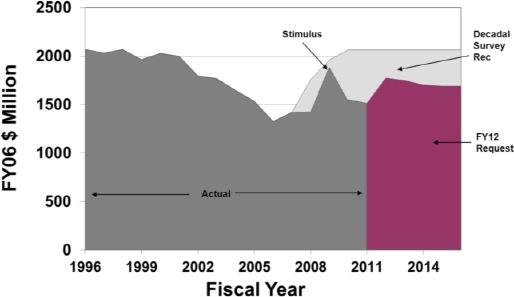
FIGURE 3.1 NASA Earth Science Division budget from fiscal year (FY) 1996 to FY2011 (actual) and projections out to FY2016, based on the President’s FY2012 budget request in constant FY2006 year dollars, as compared to the 2007 decadal survey recommendation. SOURCE: NASA budget data from Michael Freilich, Director, NASA Earth Science Division, “Earth Science Division Decadal Survey Status,” presentation to the Committee on the Assessment of NASA’s Earth Science Program, April 27, 2011.
missions and related programs set forth in the survey.2 The favorable response to the decadal survey by the administration and Congress and passage of the American Recovery and Reinvestment Act of 2009 reversed this decline. However, budget stalemates in FY2010 and FY2011 and an austere forward-looking FY2012 request have resulted in ESD being funded at less than the $1.5 billion level for the foreseeable future, far below what the survey recommended (see Figure 3.1). This failure to restore the Earth science budget to a $2 billion (FY2006) level, as recommended by the survey, is the primary reason for the inability of NASA to realize the mission launch cadence recommended by the survey. Increases in scope directed by Congress and the administration (e.g., the addition of the $150 million Thermal Infrared Sensor on the Landsat Data Continuity Mission and the establishment of the Climate Continuity missions3) without the commensurate required funding, further strained an already-limited ESD budget. This constraint was compounded by the need for an OCO mission and the decision to build its replacement following the 2009 launch vehicle failure.
The resulting delay in implementing the planned and recommended Earth observation missions, coupled with the currently predicted mission end dates for many operating missions, has led to a projected rapid net decrease in total NASA Earth science missions. Figure 3.2 is an updated version of a similar chart of mission and instrument trends that was produced by the 2007 decadal survey. Using agency estimates
2National Research Council, Earth Science and Applications from Space: National Imperatives for the Next Decade and Beyond, The National Academies Press, Washington, D.C., 2007.
3The Climate Continuity missions include SAGE-III (2015), OCO-3 (2015), GRACE-FO (2016), and PACE (2019-2020).
for the anticipated remaining lifetime of in-orbit missions and counting new missions only if they have been formally approved in enacted agency budgets, indicates that the number of missions could decline from 23 in 2012 to only 6 in 2020, and the number of NASA and NOAA Earth-observing instruments in space could decline from a peak of about 110 in 2011 to approximately 20 in 2020. A more optimistic scenario based on the Climate-Centric Architecture put forth to leverage anticipated augmented funding to support administration priorities is also shown in Figure 3.2; however, this plan, which has not been fully funded, also projects a precipitous decline in observing capabilities.
The mission and instrument trends illustrated in Figure 3.2 warn of a coming crisis in Earth observations from space, in which our ability to observe and understand the Earth system will decline just as Earth observations are critically needed to underpin important decisions facing our nation and the world. Advances in weather forecast accuracy may slow or even reverse, and gaps in time series of climate and other critical Earth observations are almost certain to occur.4 When these long-running data streams fall silent, users requiring these observations will go unsupported, and progress toward understanding the Earth system and how it supports life may stagnate. The committee recognizes that the number of missions and instruments in orbit is only one indicator of program health, given that some of the newer instruments measure multiple geophysical parameters. Yet even with the very capable instruments in NASA’s and NOAA’s current pipelines, the overall loss of capability will be felt by the entire Earth science community, and it will have a stark impact on certain specific disciplines.5 While opportunities for international collaboration may help to partially mitigate this loss in capability (see in Chapter 4 the section “International Partnerships”), reliance on such partnerships also carries risks. Moreover, foreign partners are not immune to the challenges currently faced by the U.S. Earth science program, as evidenced by the European Space Agency’s threat to not launch its Sentinel satellites unless it receives the funding to keep them operational beyond 2014.6
The committee is concerned that overruns in other NASA science divisions might begin to further impact the already stressed NASA Earth science budget. Just as the research and analysis program funds are fenced off from other aspects of the NASA Earth science budget to prevent Earth science mission overruns from threatening the overall health of the program, so also the committee hopes that NASA’s Earth science program can be protected from overruns by non-Earth science missions. The committee was encouraged to learn that NASA will not cover overruns in other divisions of the agency with money from the Earth Science Division budget in FY2012.7
Finding: Funding for NASA’s Earth science program has not been restored to the $2 billion per year (in FY2006 dollars) level needed to execute the 2007 decadal survey’s recommended program. Congress’s failure to restore the Earth science budget to a $2 billion level is a principal reason for NASA’s inability to realize the mission launch cadence recommended by the survey.
Finding: The nation’s Earth observing system is beginning a rapid decline in capability as long-running missions end and key new missions are delayed, lost, or canceled.
4See, for example, Office of the Inspector General, Audit of the Joint Polar Satellite System: Challenges Must Be Met to Minimize Gaps in Polar Environmental Satellite Data, Final Report No. OIG-11-034-A, September 30, 2011, available at http://www.oig.doc.gov/Pages/Audit-of-the-Joint-Polar-Satellite-System.aspx.
5There is as yet no plan to replace the capabilities of the Aura satellite, for example, which has served as a primary data source for the atmospheric chemistry community. Issues of data continuity and the lack of a comprehensive plan for stewardship of such sustained observations are discussed in Chapter 4.
6P.B. de Selding, ESA’s Dordain restates Sentinel launch cancellation threat, Space News, January 12, 2012, available at http://www.spacenews.com/earth_observation/120112-dordain-cancel-sentinel.html.
7D. Leone, NASA’s science, cross-agency budgets take a hit to pay for Webb, Space News, September 22, 2011, available at http://www.spacenews.com/civil/110922-science-cross-agency-budgets-take-hit.html.
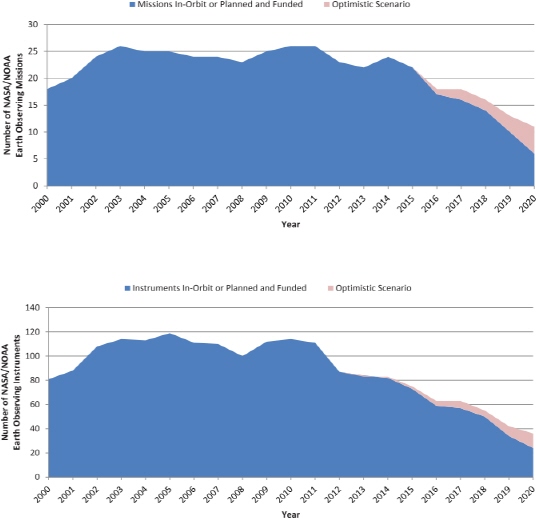
FIGURE 3.2 Number of operating (2000-2011) and planned (2012-2020) NASA and NOAA Earth observing missions (top) and instruments (bottom). Shown in blue are missions that are funded and have a specified launch date in NASA or NOAA budget submissions. Thus, the blue curve does not count missions (and associated instruments) that have been proposed or planned but are not yet funded or selected. Shown in pink is an “optimistic scenario” based on the Climate-Centric Architecture put forth to leverage anticipated augmented funding to support administration priorities that makes the following assumptions: GRACE-FO launches in 2016, PACE launches in 2019, ASCENDS launches in 2020, SWOT launches in 2020, EV-2 launches in 2017, SAGE-3 instrument launches in 2014, OCO-3 instrument launches in 2015, and EV-I instruments are launched every year starting in 2017 (plans are for EV-I instruments to be delivered for integration yearly; this assumes they also launch yearly). NOTE: Mission lifetimes for on-orbit missions are taken from estimates provided by NASA and NOAA; the NASA estimates are based on mission team estimates of remaining mission lifetime as provided (and reviewed by the Technical Panel) during the Senior Review process. Acronyms are defined in Appendix G. SOURCE: NASA and NOAA data.
The decadal survey included rough cost estimates for each of the recommended missions based on a simple parametric model as described in Box 2.3 of the 2007 decadal survey report.8 These estimates were not based on extensive trade studies or detailed designs, although they were used as part of the process to determine the recommended timing of missions. As the first four missions moved toward implementation, however, estimated costs9 grew a great deal for every mission, and this cost growth has contributed to the delay and deferral of missions.
Since the release of the survey, much discussion has focused on how “low” these estimates appear when compared with subsequent estimates for the missions prepared by formulation teams, leading to calls for independent cost estimates in future decadal surveys. This response, to a large extent, misses the point. It should not be surprising that a parametric estimate differs from more detailed cost estimates, nor is it surprising that there is not a statistical spread whereby some estimates are higher and some lower. There were differences in estimate content (e.g., decadal survey costs excluded R&A), changes in book-keeping (e.g., NASA’s change to budgeting to 70 percent confidence10), changes in scope (e.g., changes in mission lifetime and/or technology from that described in the decadal survey11), in-sourcing work (e.g., the SMAP spacecraft) from contractors to NASA center staff,12 use of “directed” missions rather than competed “principal investigator-class” missions,13 and increases in launch vehicle costs which drove the estimates further apart. Indeed, the implementation teams used the rough cost estimates in the survey as a starting point and were not initially directed to operate under a “cost cap” instruction. Starting with a higher (“more conservative”) rough cost estimate might thus only have led to even higher subsequent estimates by changing the starting point from which the teams began studies of trade-offs for design formulation. See in Chapter 4 the discussion “Establishing and Managing Mission Costs” for potential solutions and strategies for dealing with the challenge of cost growth.
8National Research Council, Earth Science and Applications from Space: National Imperatives for the Next Decade and Beyond, 2007, p. 43.
9Cost estimates for missions not yet in implementation are considered unofficial, given that a mission (per NASA) does not have a formal and accepted cost estimate until a cost and scope are formally agreed to at the Mission Concept Review (MCR). Only SMAP and ICESat-2 currently have official cost estimates. Nevertheless, the unofficial cost estimates for CLARREO and DESDynI remain considerably above the decadal survey’s rough estimate.
10This change is discussed in some detail in National Research Council, Controlling Cost Growth of NASA Earth and Space Science Missions, The National Academies Press, Washington, D.C., 2010.
11NASA established mission concept study teams for each of the missions; however, these teams were not given firm constraints in cost or scope from the outset, and many expanded on the concepts as set forth in the final set of recommended missions. The ESD director, during the committee’s first meeting on April 28, 2011, suggested that this might have been exacerbated by teams using panel chapters (Part III of the document) rather than the consensus report (Parts I and II) to support a growth in scope. However, it is clearly noted in the decadal survey preface that the recommended missions represented a compromise across panels and intentionally did not include all of the instrument and spacecraft characteristics advocated by any particular panel in order to “maximize science and application returns across the panels while keeping with in a more affordable budget” (p. xvi). The report also warned against “requirements creep” and consequent damaging cost growth (see Box 2.3 in National Research Council, Earth Science and Applications from Space: National Imperatives for the Next Decade and Beyond, 2007).
12NASA has chosen to implement the preponderance of missions thus far via direct assignment to its centers. Indeed, NASA requires a certain number of in-house missions to maintain overall agency and center health. In-house missions allow for more direct control of mission implementation (aka “directed missions”) compared with fully competed missions, although directed missions are also subject to a greater degree of oversight and programmatic and institutional requirements, which tend to drive cost upward.
13Competed missions arguably can be more efficient; however, they also tend to be driven by a small disciplinary-focused group with tightly focused requirements and capabilities and can be difficult to modulate and balance in the context of a mission portfolio after they have been selected through a proposal process.
Finding: Decadal survey missions have not been managed with sufficient consideration of the scope and cost provided by the decadal survey in an absolute or relative sense.
NASA procures launch services primarily through the NASA Launch Services (NLS) contract. The latest NLS contract, NLS II, was announced on September 16, 2010, and includes launch vehicle offerings from four vendors.14 The Boeing Delta II launch vehicle, long a workhorse for launching NASA science missions, is being phased out and is currently not part of the NLS II contract.15 (See Box 3.1 for more on Delta II.) Of the launch vehicles available through NLS II, only three are in current production (the Pegasus, Taurus, and Atlas V), only one (the Atlas V) meets or exceeds Delta II-class capability, and prices have dramatically increased. While some smaller-class launch vehicles are in development (e.g., Falcon 1 by Space Exploration Technologies and Athena by Lockheed Martin Space Systems), the only currently produced commercial medium-class launch vehicle on the NLS II contract, the Taurus, has failed in three of its last four launch attempts (the 2001 QuikTOMS, 2009 Orbiting Carbon Observatory, and 2011 Glory missions—all NASA Earth science missions). Given the current selection of launch vehicle options on NLS II, NASA Earth science missions are driven to either fit within the Pegasus/Taurus envelope (mindful of the recent history of the Taurus) or accommodate the excess performance and associated cost of the Atlas V.16
Compounding this situation, there is increased commercial sector emphasis on higher-performance launch vehicles, with commensurate higher prices, which at present has resulted in fewer opportunities for NASA Earth science missions to obtain access to space. Decreasing launch rates exacerbate a tendency for missions in development to grow in size and complexity as longer development times, higher overall mission costs, and fewer overall missions increase community expectations for the few missions that do make it to space. This creates a feedback loop with increasing costs driving increasing expectations and decreasing risk tolerance, which can further increase costs. The decadal survey “tilted away” from larger missions precisely because of this threat to programmatic robustness and explicitly recommended smaller, lower-cost, and less complex missions; however, the push toward higher-capability launch vehicles is pulling the program in this undesirable direction.17 Thus, the lack of reliable, affordable, and predictable access to space has become a key impediment to implementing NASA’s Earth science program.
14See http://www.nasa.gov/home/hqnews/2010/sep/C10-053_Launch_Services_Contract.html.
15On September 30, 2011, very late in the development cycle of this report, NASA announced that it had modified the NLS contract to add access to the remaining five Delta II rockets. Although not a permanent “fix” for the long-term lack of a Delta II equivalent launch vehicle, this approach could help considerably in the short term, as long as the price is not prohibitive given that NASA is now a sole user of this service (see NASA Contract Release C11-044, September 30, 2011; see also Box 3.1).
16Excess capacity in both injected mass and volume in the Atlas V fairing suggests the possibility of shared launches if missions with compatible launch requirements can be found; however, an Atlas V dual launch remains in the concept stage, and it is unclear whether costs might be sufficiently reduced through launch vehicle sharing so as to be worth the added complexity and risk.
17From the 2007 decadal survey: “Prior [National Research Council] reports [Issues in the Integration of Research and Operational Satellite Systems for Climate Research; Part I: Science and Design and Part II: Implementation, National Academy Press, Washington D.C., both published in 2000] have concluded that ensuring a balance of facility-class (large), medium, and small missions is important for successful science, enabling a program that balances long-term methodical scientific pursuits with the ability to respond quickly to new discoveries, opportunities, and scientific priorities. A mix of mission sizes also promotes participation at multiple levels of the scientific community, from graduate students to senior scientists. The committee’s recommended missions (Chapter 2) tilt away from facility-class implementations of large multi-instrumented platforms (such as EOS or NPOESS) toward smaller missions to increase programmatic robustness.” (National Research Council, Earth Science and Applications from Space: National Imperatives for the Next Decade and Beyond, 2007, pp. 75-76.)
BOX 3.1 DELTA II LAUNCH VEHICLE CLASS
The Boeing Delta II launch vehicle came into being in 1989 after the space shuttle Challenger accident, due to the realization that the space shuttle could not perform as the nation’s only access to space. Since then, the Delta II has been a medium-class workhorse for launching NASA science missions, including NASA Earth science missions such as Radarsat, Landsat-7, EO-1, Jason-1, EOS Aqua and Aura, ICESat, CALIPSO/CloudSat, Jason-2, Aquarius, and NPP (the last currently planned usage of the Delta II). The Delta II has provided reliable, affordable, and predictable access to space for more than two decades.
The U.S. Air Force and NASA both used the Delta II with great success until a decision was made in the 1990s to move forward with the Air Force Evolved Expendable Launch Vehicle (EELV) program. The EELV program had as its goal making government launches more affordable and reliable, and it eventually resulted in the development of two new launch vehicles, the Boeing Delta IV and the Lockheed Martin Atlas V, both of which began service in 2002. Once the Delta IV/Atlas V launch vehicles were demonstrated to be reliable, the Air Force stopped using Delta IIs, leaving NASA as the sole government user of the Delta II. The price of the Delta II began to rise as NASA assumed the full responsibility for Delta II-related infrastructure costs. Eventually, NASA decided that it could not afford to maintain the capability to launch Delta IIs from both the East and the West coasts and had planned to stop using Delta IIs entirely. More recently, there have been ongoing discussions about NASA providing access to the last five remaining Delta IIs as a gap filler between the situation today, including recognition of the two recent Taurus XL failures carrying the NASA Earth science missions Orbiting Carbon Observatory and Glory, and where NASA expects to be 2 to 3 years from now after SpaceX’s Falcon-9 and Orbital Sciences Corporation’s Taurus II are certified in accordance with NASA requirements.
In the meantime, the assumed launch rate that had been used as the basis for the EELV program never materialized, and maintaining two distinct launch vehicle types became more and more expensive. Accordingly, in 2006, with the blessing of the Air Force, a new company, United Launch Alliance (ULA), was formed to seek appropriate areas of commonality between the two launch vehicle families, mainly in the areas of people and facilities. The objective of ULA was to streamline the approach to building these launch vehicles to achieve cost efficiencies so that two different launch vehicle types could still be available to cover the possibility of one of them being unavailable for technical reasons, to prevent the United States from having (temporarily) no access to space. However, an unintended consequence of this decision was that ULA currently has no viable competition in this size range to help hold its costs in check. Exacerbating this situation, recent decisions, such as canceling NASA’s Constellation program, dropped the demand for RS-68 engines (planned to have been used in the Ares V launch vehicle and used for the Delta IV launch vehicle), thus raising the per unit cost, given the fixed cost of a liquid rocket motor industrial base.
ULA is actively looking for further cost efficiencies in its approach to maintaining a two-launch-vehicle capability under the EELV program, and the Air Force is also investigating ways to stabilize EELV costs.1 Nonetheless, the Delta IV and the Atlas V have demonstrated a remarkable success record to date, providing reliable, though expensive, access to space.
1See http://www.aviationweek.com/aw/generic/story_channel.jsp?channel=space&id=news/awst/2011/05/09/AW_05_09_2011_p26-318881.xml.
Finding: Lack of reliable, affordable, and predictable access to space has become a key impediment to implementing NASA’s Earth science program. Furthermore, the lack of a medium-class launch vehicle threatens programmatic robustness.
Although increased competition is projected for the higher-performance launch vehicle segment (e.g., through development of the Taurus II and Falcon 9), plans to develop alternative small to medium-class launch vehicles appear less firm. Space Exploration Technologies has shifted emphasis away from development of its Falcon 1/1e offerings in favor of its Falcon 9;18 indeed the publicly available launch manifest shows just one Falcon 1e launch in 2014, compared with 27 Falcon 9/F9 Dragon/Falcon Heavy launches through 2017.19 Alternatively, Orbital Sciences is currently developing its Taurus II medium-class launch vehicle, but its first flight is not scheduled until early 2012.20 Non-commercial vehicles (e.g., Minotaur) exist that are capable of launching Delta II-class payloads, but the Commercial Space Act of 199821 precludes their use without special dispensation. To use a Minotaur, the NASA administrator must obtain approval from the Secretary of Defense and certify to Congress that its use of a non-commercial launch vehicle will result in cost savings to the federal government, meet all mission requirements, and be consistent with international obligations of the United States. International launch vehicles (e.g., Ariane, H-II) are also widely available; however, their use would require a partnership arrangement with a foreign agency and no exchange of funds.
The need for reliable and affordable access to space is by no means new or unique to NASA’s Earth science program. The recent loss of two NASA Earth science missions due to launch vehicle failures, however, underscores the urgency of addressing the need.
Recommendation: NASA should seek to ensure the availability of a highly reliable, affordable medium-class launch capability.
LACK OF A NATIONAL STRATEGY FOR ESTABLISHMENT AND MANAGEMENT OF EARTH OBSERVATIONS FROM SPACE
As stated in the 2007 decadal survey, “The committee is concerned that the nation’s civil space institutions (including NASA, NOAA, and the USGS) are not adequately prepared to meet society’s rapidly evolving Earth information needs. These institutions have responsibilities that are in many cases mismatched with their authorities and resources: institutional mandates are inconsistent with agency charters, budgets are not well matched to emerging needs, and shared responsibilities are supported inconsistently by mechanisms for cooperation. These are issues whose solutions will require action at high levels of the federal government.”22 This call for action is not new. For more than 10 years the National Research Council (NRC) has stated the importance of developing a national strategy to sustain long-term climate and environmental data sets.23
18Production of the Falcon 1 was suspended in 2011; see http://www.aviationweek.com/aw/generic/story_channel.jsp?channel=space&id=news/asd/2011/09/28/01.xml&headline=SpaceX%20Puts%20Falcon%201%20On%20Ice.
19See http://www.spacex.com/launch_manifest.php, accessed May 13, 2011.
20In late 2011, as this report was in review, Orbital Sciences Corporation changed the name of the Taurus II to “Antares.”
21The Commercial Space Act of 1998 is available at http://www.nasa.gov/offices/ogc/commercial/CommercialSpaceActof1998.html; see Section 205, “Use of Excess Intercontinental Ballistic Missiles,” regarding the use of the Minotaur.
22National Research Council, Earth Science and Applications from Space: National Imperatives for the Next Decade and Beyond, 2007, p. 66.
23From the 1999 National Research Council letter report “Assessment of NASA’s Plans for Post-2002 Earth Observing Missions”: “No federal entity is currently the ‘agent’ for climate or longer-term observations and analyses, nor has the ‘virtual agency’ envisioned in the [U.S. Global Change Research Program] succeeded in this function. … The task group endorses NASA’s call for a high-level process to develop a national policy to ensure that the long-term continuity and quality of key data sets required for global change research are not compromised in the process of merging research and operational data sets” (National Academy Press, Washington, D.C., April 8, p. 6). And from the 2008 National Research Council report Ensuring the Climate Record from the NPOESS and GOES-R Spacecraft: Elements of a Strategy to Recover Measurement Capabilities Lost in Program Restructuring: “A coherent, integrated, and
The government has not developed such a national strategy for obtaining and managing Earth observations from space. In an era of fiscal constraint, such a strategy is even more important. The fact that a strategy has not been developed in spite of the severity of the need speaks to the difficulty of the problem.24 Recent developments further illustrate the importance of a comprehensive national strategy for Earth observations from space. These include:
• Cancellation of the NOAA-Air Force National Polar-orbiting Operational Environmental Satellite System (NPOESS) program and the initiation of the more modest Joint Polar Satellite System (JPSS) to meet civilian needs for weather and climate-related data;
• Launch vehicle failures resulting in the loss of the OCO and Glory satellites;
• Termination of plans for improved, or even continued, geosynchronous temperature and moisture soundings over the United States for severe weather “nowcasting” and forecasting; and
• Budget shortfalls and the inability of NOAA to transition demonstrably valuable research observations to operational status as in the case of ocean vector winds and Global Positioning System radio occultation, as well as to honor international commitments.
Numerous reports from the NRC25 have documented the repeated attempts by the principal civilian satellite agencies (NASA, NOAA, and now the USGS) to establish a long-term observing system that meets both research needs and operational requirements. However, the fundamental differences between agency missions, budgeting processes, congressional oversight, and structure have resulted in a less-capable, suboptimal system that is prone to stove-piped requirements, critical data gaps, and missed opportunities. Moreover, understanding Earth-system processes requires high-quality measurements of many physical, chemical, and biological variables—sometimes over decadal time periods—as well as the ability to insert new technologies to improve data quality and to address emerging science requirements and the need to combine observations across multiple variables, disciplines, and observing systems. Any long-term observing system must be able to accommodate relatively frequent changes in technology and scientific understanding, compared to systems that are designed for more stable requirements.
The 2010 Government Accountability Office report Environmental Satellites: Strategy Needed to Sustain Critical Climate and Space Weather Measurements26 is only the most recent analysis of these chal-
viable long-term climate observation strategy should explicitly seek to balance the myriad science and applications objectives basic to serving the variety of climate data stakeholders. The program should, for example, consider the appropriate balance between (1) new sensors for technological innovation, (2) new observations for emerging science needs, (3) long-term sustainable science-grade environmental observations, and (4) measurements that improve support for decision making to enable more effective climate mitigation and adaptation regulations [NRC, “A Review of NASA’s 2006 Draft Science Plan: Letter Report,” The National Academies Press, Washington, D.C., 2006]. The various agencies have differing levels of expertise associated with each of these programmatic elements, and a long-term strategy should seek to capitalize on inherent organizational strengths where appropriate” (The National Academies Press, Washington, D.C., p. 73).
24The committee is aware of a preliminary plan set forth by the Office of Science and Technology Policy (http://www.whitehouse.gov/sites/default/files/microsites/ostp/ostp-usgeo-report-earth-obs.pdf). This plan, however, stops far short of identifying a workable architecture for provision of new and sustained Earth observations. The report acknowledges the challenge set forth in the 2007 decadal survey associated with provision of such measurements and outlines existing mechanisms to plan and prioritize measurements nationally and internationally; however, it does not establish, recommend, or fund a comprehensive strategy.
25Issues in the Integration of Research and Operational Satellite Systems for Climate Research: Part I. Science and Design (2000), From Research to Operations in Weather Satellites and Numerical Weather Prediction: Crossing the Valley of Death (2000), Satellite Observations of the Earth’s Environment: Accelerating the Transition of Research to Operations (2003), Extending the Effective Lifetimes of Earth Observing Research Missions (2005), Earth Science and Applications from Space: National Imperatives for the Next Decade and Beyond (2007), and Ensuring the Climate Record from the NPOESS and GOES-R Spacecraft (2008); all National Research Council reports published by The National Academies Press, Washington, D.C.
26Environmental Satellites: Strategy Needed to Sustain Critical Climate and Space Weather Measurements (GAO-10-456, April
lenges. Many mechanisms have been developed to coordinate and implement a comprehensive, long-term observing system, such as the U.S. Global Change Research Program (USGCRP) and the U.S. Group on Earth Observations, but ultimately agencies must respond to short-term pressures and budget realities. Yet the observational component is by far the largest cost driver in the USGCRP. The numerous coordination mechanisms do not have sufficient standing to influence budgets and schedules. The result is thus a “patchwork” of missions and sensors, with little assurance that critical measurements will be continued for the long term or that new capabilities can be infused in a predictable manner.27
The USGCRP (and the program in its form as the Climate Change Science Program during the George W. Bush Administration) is one model for providing this coordination and leadership, but its effectiveness is not sufficient for the long development and implementation time scales associated with satellite missions. Two recent NRC studies in this regard, Restructuring Federal Climate Research to Meet the Challenges of Climate Change (2009)28 and America’s Climate Choices: Advancing the Science of Climate Change (2010),29 have both highlighted this key deficiency. For example, the transition of precision ocean altimetry took 20 years, moving from a joint U.S./France research capability to a joint U.S./Europe operational capability. At each step of this process, there was a risk of failure, potentially creating a gap in a critical observational record. Future U.S. participation is, at present, uncertain and in jeopardy.
The 2007 decadal survey recommended that “the Office of Science and Technology Policy, in collaboration with the relevant agencies and in consultation with the science community, should develop and implement a plan for achieving and sustaining global Earth observations. This plan should recognize the complexity of differing agency roles, responsibilities, and capabilities as well as the lessons from the implementation of the Landsat, EOS, and NPOESS programs.”30 This same recommendation was echoed in a 2008 follow-on report, Ensuring the Climate Record from the NPOESS and GOES-R Spacecraft, which further explored in its Chapter 4 the elements needed for a long-term climate strategy.31 A more complete plan for achieving and sustaining global Earth observations, as called for in the 2007 decadal survey and the 2008 NRC follow-on report, remains to be presented or funded. However, the NASA Climate-Centric
27, 2010, available at http://www.gao.gov/new.items/d10456.pdf) draws heavily from the National Research Council studies cited above, especially the 2007 decadal survey. Other relevant GAO reports include Polar-orbiting Environmental Satellites: Agencies Must Act Quickly to Address Risks That Jeopardize the Continuity of Weather and Climate Data (GAO-10-558, May 27, 2010) and Environmental Satellites: Polar-orbiting Satellite Acquisition Faces Delays; Decisions Needed on Whether and How to Ensure Climate Data Continuity (GAO-08-899T, June 19, 2008), all published by the Government Accountability Office, Washington, D.C.
27As discussed in the National Research Council report Ensuring the Climate Record from the NPOESS and GOES-R Spacecraft, 2008.
Much of climate science depends on long-term, sustained measurement records. Yet, as noted in many previous NRC and agency reports, the nation lacks a clear policy to address these known national and international needs. A coherent, integrated, and viable long-term climate observation strategy should explicitly seek to balance the myriad science and applications objectives basic to serving the variety of climate data stakeholders. The program should, for example, consider the appropriate balance between (1) new sensors for technological innovation, (2) new observations for emerging science needs, (3) long-term sustainable science-grade environmental observations, and (4) measurements that improve support for decision making to enable more effective climate mitigation and adaptation regulations. The various agencies have differing levels of expertise associated with each of these programmatic elements, and a long-term strategy should seek to capitalize on inherent organizational strengths where appropriate.
28National Research Council, Restructuring Federal Climate Research to Meet the Challenges of Climate Change, The National Academies Press, Washington, D.C., 2009.
29National Research Council, America’s Climate Choices: Advancing the Science of Climate Change, The National Academies Press, Washington, D.C., 2010.
30National Research Council, Earth Science and Applications from Space: National Imperatives for the Next Decade and Beyond, 2007, p. 14.
31National Research Council, Ensuring the Climate Record from the NPOESS and GOES-R Spacecraft, 2008.
Architecture plan released in 201032 includes a set of Climate Continuity missions, tacitly recognizing for the first time NASA’s role in sustained observations.
Finding: The 2007 decadal survey’s recommendation that the Office of Science and Technology Policy develop an interagency framework for a sustained global Earth observing system has not been implemented. The committee concluded that the lack of such an implementable and funded strategy has become a key, but not the sole, impediment to sustaining Earth science and applications from space.
The committee does not propose a specific leadership and management framework, but rather notes that such a national strategy should:
• Lead to more effective and resilient interagency collaborations and build a predictable and persistent partnership between the research and operational satellite agencies;
• Establish priorities that allow the strategy to be implemented, consistent with national and agency-specific priorities, given cost and technical constraints;
• Evaluate the present informal relationship between NASA and NOAA as well as the emerging partnership between NASA and the USGS (and NASA/NOAA and the Environmental Protection Agency). This evaluation would be done in the context of the numerous NRC studies on research and operational partnerships to support the development of a climate observing system that would ensure the continuity of climate data records;
• Examine the design, development, and testing of new spacecraft and instruments and the manner by which they are inserted into operational or sustained monitoring;
• Develop and sustain international partners as appropriate and give priority to those partnerships (see the section “International Partnerships” in Chapter 4);
• Set forth a sustainable space-based architecture that takes into account formation flying, constellation approaches, free-flyers and small satellites, sensor overlap, calibration, and low Earth orbit, geostationary, and polar orbits (see the section “Alternative Platforms and Flight Formations” in Chapter 4);
• Engage the broad Earth system science research and applications community at key decision points such as contingency planning.
Although the focus of this report is on NASA, the 2007 decadal survey recognized that the research programs of NASA and the operational programs of NOAA are necessary components of a U.S. Earth observation program from space that serves both science and society.33 In particular, NOAA’s current and planned polar and geostationary programs were an integral part of the baseline capabilities assumed by the survey committee members as they developed their integrated strategy, and 2 of the survey’s recommended 17 missions were directed for implementation by NOAA.34 NOAA and NASA work closely together
32NASA, Responding to the Challenge of Climate and Environmental Change: NASA’s Plan for a Climate-Centric Architecture for Earth Observations and Applications from Space, June 2010; available at http://science.nasa.gov/media/medialibrary/2010/07/01/Climate_Architecture_Final.pdf.
33The statement of task for the decadal survey stated, “The committee will also give particular attention to strategies for NOAA to evolve current capabilities while meeting operational needs to collect, archive, and disseminate high quality data products related to weather, atmosphere, oceans, land, and the near-space environment” (National Research Council, Earth Science and Applications from Space: National Imperatives for the Next Decade and Beyond, 2007, p. 381).
34One mission, CLARREO, included a component to be implemented by NOAA.
on many NOAA missions, and the success and failures of NOAA often impact the NASA programs, and vice versa. Hence the present committee found it appropriate to review progress and issues at NOAA with respect to the decadal survey recommendations. A recommendation-by-recommendation discussion (using the recommendations from the survey) is provided in Appendix D; a summary is provided in Table 3.1. Based on the review provided in Appendix D, the committee found as follows:
Finding: NOAA’s capability to implement the assumed baseline and the recommended program of the 2007 decadal survey has been greatly diminished by budget shortfalls; cost overruns and delays, especially those associated with the NPOESS program prior to its restructuring in 2010 to become the Joint Polar Satellite System (JPSS); and by sensor descopes and sensor eliminations on both NPOESS and the Geostationary Orbit Environmental Satellite-R Series (GOES-R).35
35Even before the latest round of budget-driven delays and descopes, NOAA polar and geostationary programs had experienced severe budget challenges with particular consequences for research and operations deemed outside required “core” capabilities. See National Research Council, Ensuring the Climate Record from the NPOESS and GOES-R Spacecraft: Elements of a Strategy to Recover Measurement Capabilities Lost in Program Restructuring, The National Academies Press, Washington, D.C., 2008. The Government Accountability Office (GAO) has published a number of reports detailing the origins of the cost overruns and assessing program management. See, for example, GAO, Polar-orbiting Environmental Satellites: Agencies Must Act Quickly to Address Risks That Jeopardize the Continuity of Weather and Climate Data, GAO-10-558 (Washington, D.C., May 10, 2010) and Polar-orbiting Environmental Satellites: With Costs Increasing and Data Continuity at Risk, Improvements Needed in Tri-agency Decision Making, GAO-09-564 (Washington, D.C., June 17, 2009).
TABLE 3.1 Summary of Decadal Survey Related NOAA Developments
| Capability | Current Status |
| NPOESS | Canceled in 2010 and split into separate NOAA (JPSS) and Air Force (DWSS) programs. JPSS is experiencing delays as a result of significant shortfalls in the requested funding for FY2011. The joint NASA/NOAA NPP mission was launched successfully on October 28, 2011. |
| Restore descoped sensors | No NPOESS climate sensors flown. |
| Aerosol Polarimetry Sensor (APS) | Failed to reach orbit due to the Glory launch vehicle failure. |
| Total Solar Irradiance Sensor (TSIS) | TIM instrument on Glory failed to reach orbit due to the Glory launch vehicle failure. TSIS (TIM + SIM) is currently NOAA’s highest priority for flight of the canceled NPOESS climate sensors. Several options, including a free-flyer mission for a TIM, are under consideration. |
| Ozone Monitoring and Profiling Suite (OMPS) - Limb | On NPP, but not on JPSS-1. Planned to be included on JPSS-2 launching no earlier than 2019. |
| Earth Radiation Budget Sensor (ERBS) | Clouds and Earth’s Radiant Energy System (CERES) instrument on NPP and JPSS-1 no earlier than 2017; no current plans to fly an ERBS as a follow-on to CERES. |
| Altimeter (ALT) | Canceled on NPOESS/JPSS. Altimetry measurements will be provided by the Jason series of spacecraft; however, in part due to budgetary shortfalls at NOAA, the next in the series, Jason-3, will launch no earlier than April 2014, 6.5 years after the launch of Jason-2. Additional delays are likely due to both budgetary problems and the negative impact of two recent Taurus XL launch failures. |
| Ocean Vector Winds (aka XOVWM) | In an effort to establish an operational ocean surface vector wind satellite capability, NOAA NESDIS had been exploring the possibility of flying a U.S. scatterometer (DFS—dual frequency scatterometer) on board the Japan Aerospace Exploration Agency’s (JAXA’s) Global Change Observation Mission (GCOM) satellite series. NOAA has now announced that it does not have the ability to fund this effort and has requested that NASA assume responsibility for the provision of ocean surface vector winds data. |
| GOES-R/Hyperspectral Environmental Suite (HES) | Advanced atmospheric sounder requirement deleted from GOES-R program. As a result, U.S. geosynchronous sounding capability will end after GOES-N/O/P. |
| COSMIC-2 (aka GPSRO) | A plan is in place with the U.S. Air Force for a 12-satellite constellation; however, the President’s budget for NOAA for FY2011 and FY2012, which included funds for COSMIC-2, was zeroed by Congress. As this report went to press, the Air Force announced that it would fund at least six of the payloads for COSMIC-2 and provide a launch. |
| Deep Space Climate Observatory (DSCOVR) | The Earth-viewing instruments of DSCOVR were not identified as a decadal survey priority; however, the survey noted the important use of the DSCOVR spacecraft bus as a platform for space weather instruments at L1. NOAA did not receive funding for DSCOVR in FY2011; however, the FY2012 enacted budget provided $29.8 million. The U.S. Air Force will pay for the launch of DSCOVR, which is now planned for 2014. |


